BASIC ELECTRONICS
“EVERYTHING IS 0&1 AND IT IS BIENG GENERATED BY
MOVEMENT OF ELECTRON AND HOLES”
Er.Sagar Raj
Poornima institute of engineering and technology
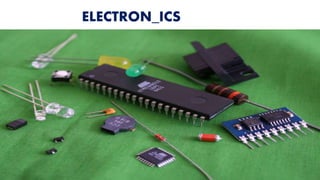
ELECTRON_ICS
It is the branch of physics and technology
concerned with the design of circuit using
transistor and with microchip of and with the
behavior and movement of electrons in a
semiconductor ,conductor, vacuum.
BIRTH OF ELECTRONICS
??....
 Electronics components are made from silicon, a chemical element found
in sand, which does not normally conduct electricity (it doesn't allow
electrons to flow through it easily).
 Silicon is a semiconductor, which means it's neither really a conductor
(something like a metal that lets electricity flow) nor an insulator
(something like plastic that stops electricity flowing).
 If we treat silicon with impurities (a process known as doping), we can
make it behave in a different way. If we dope silicon with the chemical
elements arsenic, phosphorus, or antimony, the silicon gains some extra
"free" electrons—ones that can carry an electric current—so electrons will
flow out of it more naturally. Because electrons have a negative charge,
silicon treated this way is called n-type (negative type).
 We can also dope silicon with other impurities such as boron, gallium,
and aluminum. Silicon treated this way has fewer of those "free" electrons,
so the electrons in nearby materials will tend to flow into it. We call this
sort of silicon p-type (positive type).
 Quickly, in passing, it's important to note that neither n-type or p-
type silicon actually has a charge in itself: both are electrically neutral.
It's true that n-type silicon has extra "free" electrons that increase its
conductivity, while p-type silicon has fewer of those free electrons,
which helps to increase its conductivity in the opposite way.
 In each case, the extra conductivity comes from having
added neutral (uncharged) atoms of impurities to silicon that
was neutral to start with—and we can't create electrical charges out
of thin air! A more detailed explanation would need me to introduce
an idea called band theory, which is a little bit beyond the scope of
this article.
 All we need to remember is that "extra electrons" means
extra free electrons—ones that can freely move about and help to
carry an electric current.
SILICON SANDWICHES
• We now have two different types of silicon. If we put them together
in layers, making sandwiches of p-type and n-type material, we can
make different kinds of electronic components that work in all kinds
of ways.
Suppose we join a piece of n-type silicon to a piece of p-type silicon and put
electrical contacts on either side.
 Exciting and useful things start to happen at the junction between the two
materials.
 If we turn on the current, we can make electrons flow through the junction
from the n-type side to the p-type side and out through the circuit.
This happens because the lack of electrons on the p-type side of the junction
pulls electrons over from the n-type side and vice-versa.
 But if we reverse the current, the electrons won't flow at all. What we've
made here is called a diode (or rectifier). It's an electronic component that
lets current flow through it in only one direction.
 It's useful if you want to turn alternating (two-way) electric current into
direct (one-way) current. Diodes can also be made so they give off light when
electricity flows through them. You might have seen these light-emitting
diodes (LEDs) on pocket calculators and electronic displays on hi-fi stereo
equipment.
ELECTRICAL VS ELECTRONICS
Electrical system always deals with low frequency high
power supply
electronic system always deals with high frequency low
power supply
The study of conductors is Electrical
The study of semiconductors is Electronics
the current flows through the conductor that is known as
the electrical.
The current flow through the vacuum tube or semiconductor that is known
as electronics. now a days we don't not use the vacuum tube.
electrical is transfer a.c current-electronics is control
circuit in d.c voltage
electrical use fundamental all purpose--electronics use based on electrical
electronics deals with voltage (DC) and current
in mili amperes
BASIC COMPONENTS
ELECTRONIC COMPONENTS
The electronic components are mainly classified into two groups or
categories. They are-
passive components
 active components.
ACTIVE COMPONENTS:
The components which deliver energy for a longer duration or which
amplify the signals are called active components. Semiconductor
devices like BJT,FET, MOSFET and vacuum tube and gas tube devices
are listed under Active components.
PASSIVE COMPONENTS:
Components capable of dissipation and storage of energy are called
Passive component.
Eg: Resistors, Capacitors, Inductors.
RESISTOR
• This opposition, due primarily to collisions and friction between the
free electrons and other electrons, ions, and atoms in the path of
motion, converts the supplied electrical energy into heat that raises
the temperature of the electrical component and surrounding
medium.
• The resistance of any material is due primarily to four factors:
• Material
• Length
• Cross-sectional area
• Temperature of the material
RESISTORS FUNCTION
Limit the flow of current Voltage divider
TYPES OF RESISTOR
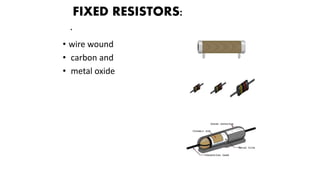
FIXED RESISTORS
Fixed resistors have only one
ohmic value, which cannot be
changed
There are three types of fixed
resistors:
• wire wound
• carbon
• metal oxide.
VARIABLE RESISTORS
Variable resistors can change their
value over a specific range. A
potentiometer is a variable resistor with
three terminals.
FIXED RESISTORS:
.
• wire wound
• carbon and
• metal oxide
EXAMPLE
COLOR CODING
CAPACITOR
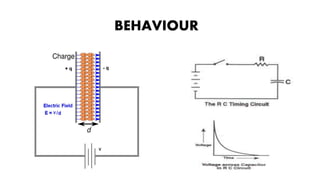
BEHAVIOUR
THEORY OF CAPACITOR:-
• Capacitor is a basic storage device to store electrical charges and release it as it is
required by the circuit
• The unit of capacitance is Farads (F)
• Capacitance values are normally smaller, such as µF, nF or pF
• A basic capacitor has two parallel plates separated by an insulating material
• C =eA/d
• where e = er eo
• er is the relative dielectric constant
• eo is the vacuum permittivity
•
•
CAPACITOR TYPES
FIXED CAPACITORS
• Non-polarized:-
Difficult to make non-polarized capacitors that
store a large amount of charge or operate at
high voltages.
Tolerance on capacitance values is very
large
+50%/-25% is not unusual
• Electrolytic:-
• The negative terminal must always be
at a lower voltage than the positive
terminal
• Plates or Electrodes: Aluminum,
Tantalum
VARIABLE CAPACITORS
Cross-sectional area is changed as one set of
plates are rotated with respect to the other.
APPLICATION:-
• DC blocking capacitor: In this application the capacitor blocks the passage of DC
current (after completely charged) and yet allows the AC to pass at certain
portion of a circuit.
• Capacitor as a filter: Capacitors are the main elements of filters. There are
several types of filters that are used in electronic circuits, such as LPF (Low Pass
Filter), HPF(high Pass Filter), BPF (Band Pass Filter), etc….
• Capacitor as a discharge unit: Capacitors used as a charging unit and the release
of the charge (discharge energy) is used for triggering, ignition, and in high scale
as a power source.
• By Pass capacitor: The reactance of capacitor decreases as the frequency
increases. Therefore in certain application it is used in parallel with other
components to bypass it at a specified frequency.
• Coupling capacitor: The ability of capacitor to pass AC signal, allows it to couple a
section of an electronic circuit to another circuit.
• Decoupling capacitor is typically located very close to the IC output and serves as
a local energy source to provide the needed extra current and therefore
minimizes the noise and disturbances to the logic signal.
DEMONSTRATION
INDUCTOR
ABOUT INDUCTORS
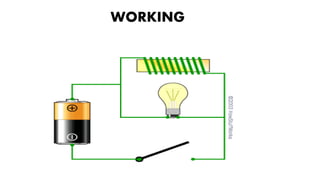
An inductor, also called a coil or reactor, is a passive two-terminal
electrical component which resists changes in electric current passing
through it. It consists of a conductor such as a wire, usually wound into
a coil. When a current flows through it, energy is stored temporarily in
a magnetic field in the coil.
WORKING
APPLICATION
Sensors
Contactless sensors are prized for their reliability and ease of operation
and inductors can be used to sense magnetic fields or the presence of
magnetically permeable material from a distance.
TRANSFORMER
TRANS…………..
• A transformer is a device that changes ac electric power at one
voltage level to ac electric power at another voltage level through the
action of a magnetic field.
• A transformer is a magnetically operated machine.
• All values of a transformer are proportional to its turns ratio.
E-SWITCH
Switches allow us to turn current flow on and
off in the circuits. switches are used in all
electronic appliances ,ex. Lights, computer,
electronic tools etc
TYPES
1. SPST
2. SPDT
3. DPDT
4. DPST
5. PUSH
SPST
• A Single Pole Single Throw toggle switch connects or disconnects one
terminal either to or from another. It is the simplest switch
• Bat UP = ON (terminals connected
• Bat DOWN = OFF (terminals disconnected
SPDT
A Single Pole Double Throw toggle switch connects a common terminal
to one or the other of two terminals. It is always connected to one or
the other. The two outside terminals are never connected by the
switch.
DPDT
• A DPDT switch works just like two separate SPDT switches
• attached to the same switch bat.
• It has two separate common terminals and each of those is
connected to one or the other of the other two terminals on the
same side of the switch. The dotted line in the picture is to illustrate
that the switch is actually two SPDT switches in one package with one
switch bat
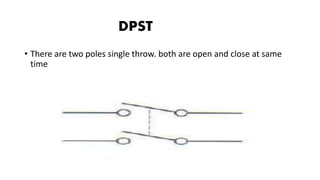
DPST
• There are two poles single throw. both are open and close at same
time
PUSH
Push to break:-current flow normally but no flow when the switch is pushed.
Push to make:-current only flow when switch is pushed.
RELAY
A relay is an electromagnetic switch operated by a relatively
small electric current that can turn on or off a much larger electric
current.
The heart of a relay is an electromagnet (a coil of wire that becomes a
temporary magnet when electricity flows through it).
You can think of a relay as a kind of electric lever: switch it on with a
tiny current and it switches on ("leverages") another appliance using a
much bigger current.
Relays were invented in 1835 by American electromagnetism pioneer
Joseph Henry; in a demonstration at the College of New Jersey, Henry
used a small electromagnet to switch a larger one on and off, and
speculated that relays could be used to control electrical machines over
very long distances.
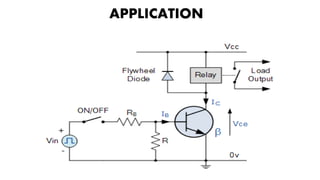
 often we need them to drive bigger pieces of
apparatus that use bigger currents. Relays bridge the
gap, making it possible for small currents to activate
larger ones. That means relays can work either as
switches (turning things on and off) or as amplifiers
(converting small currents into larger ones).
WORKING
APPLICATION
DIODE
In electronics, a diode is a two-terminal electronic component with
asymmetric conductance;
 it has low (ideally zero) resistance to current in one direction, and
high (ideally infinite) resistance in the other.
 A semiconductor diode, the most common type today, is
a crystalline piece of semiconductor material with a p–n
junction connected to two electrical terminals
WORKING
DIODE AS LED
LEDs are simply diodes that are designed to give off light. When a diode is forward-
biased so that electrons and holes are zipping back and forth across the junction,
they're constantly combining and wiping one another out. Sooner or later, after an
electron moves from the n-type into the p-type silicon, it will combine with a hole and
disappear. That makes an atom complete and more stable and it gives off a little burst
of energy (a kind of "sigh of relief") in the form of a tiny "packet" or photon of light.
Above diagram summarizes what happens:
• N-type silicon (red) has extra electrons (black).
• P-type silicon (blue) has extra holes (white).
• Battery connected across the p-n junction makes the diode forward biased, pushing
electrons from the n-type to the p-type and pushing holes in the opposite direction.
• Electrons and holes cross the junction and combine.
• Photons (particles of light) are given off as the electrons and holes recombine.
ABOUT LED
LEDs are specifically designed so they make light of a certain wavelength
and they're built into rounded plastic bulbs to make this light brighter and
more concentrated.
 Red LEDs produce light with a wavelength of about 630–660
nanometres—which happens to look red when we see it,
 while blue LEDs produce light with shorter wavelengths of about 430–500
nanometres, which we see as blue. (You can find out more about the
wavelengths of light produced by different-colored LEDs on this handy page
by solar).
You can also get LEDs that make invisible infrared light, which is useful in
things like "magic eye" beams that trigger photoelectric cells in things like
optical smoke detectors and intruder alarms. Semiconductor lasers work in
a similar way to LEDs but make purer and more precise beams of light.
APPLICATION
POWER SOURCE
BRIDGE RECTIFIER
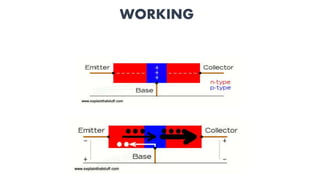
TRANSISTOR
ABOUT TRANSISTOR
it works as an amplifier, it takes in a tiny electric current at one end (an input
current) and produces a much bigger electric current (an output current) at the
other. In other words, it's a kind of current booster.
Transistors can also work as switches. A tiny electric current flowing through one
part of a transistor can make a much bigger current flow through another part of
it. In other words, the small current switches on the larger one. This is essentially
how all computer chips work.
Compact hearing aids were among the first applications for transistors—and this
one dates from about the late 1950s or 1960s. About the size of a pack of playing
cards, it was designed to be worn in or on a jacket pocket. There's a microphone
on the other side of the case that picks up ambient sounds. You can clearly see the
four little back transistors inside, amplifying those sounds and then shooting
them out to the little loudspeaker that sits in your ear.
 An electron is a minute particle inside an atom. It's so small, it weighs just under
0.000000000000000000000000000001 kg! The most advanced transistors work
by controlling the movements of individual electrons, so you can imagine just
how small they are.
WORKING
APPLICATION
GAME OF ZERO & ONE
256 128 64 32 16 8 4 2 1
- - - - - - - - -
RELATION OF POWER,CURRENT,VOLATAGE
WITH RES,INDUCTOR,CAPACITOR
LOGIC GATES
Logic gates are the basic building blocks of any digital system.
 It is an electronic circuit having one or more than one input and only
one output.
The relationship between the input and the output is based on a
certain logic.
Based on this, logic gates are named as AND gate, OR gate,
NOT gate etc.
WE CAN BUILT OR DESIGN A COMPUTER VIA
………..
VIA TRANSISTORS
NOT GATE
OR GATE
AND GATES
NAND GATE
NOR GATE
CONNECT THE INPUT OF NOT GATE TO OUTPUT OF OR GATE
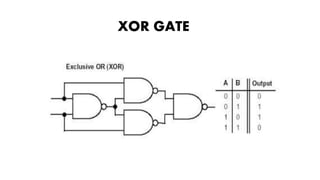
XOR GATE
X-NOR GATE
CONNECT THE INPUT OF NOT GATE TO OUTPUT OF XOR
GORDOON E MOORE
NO. OF TRANSISTOR ON CHIP DOUBLES
EVERY 2 YEAR.
1971—2K TRANSISTORS ON CHIP
2011---2.8 BILLION CHIPS
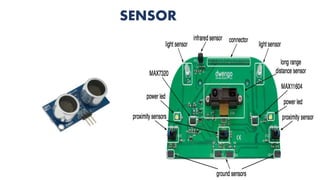
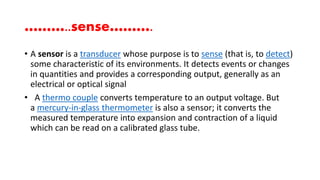
SENSOR
………..sense……….
• A sensor is a transducer whose purpose is to sense (that is, to detect)
some characteristic of its environments. It detects events or changes
in quantities and provides a corresponding output, generally as an
electrical or optical signal
• A thermo couple converts temperature to an output voltage. But
a mercury-in-glass thermometer is also a sensor; it converts the
measured temperature into expansion and contraction of a liquid
which can be read on a calibrated glass tube.
A good sensor obeys the following rules
 Is sensitive to the measured property
 Is insensitive to any other property likely to be encountered in its
application
 Does not influence the measured property
 The sensitivity is then defined as the ratio between output signal and
measured property. For example, if a sensor measures temperature
and has a voltage output, the sensitivity is a constant with the unit
[V/K]; this sensor is linear because the ratio is constant at all points of
measurement.
 For an analog sensor signal to be processed, or used in digital
equipment, it needs to be converted to a digital signal, using
an analog-to-digital converter
TYPES
• Temperature Sensor
• Pressure sensor
• Ultrasonic sensor
• Humidity Sensor
• Gas Sensor
• PIR Motion Sensor
• The acceleration sensor
• Displacement sensor
• Holzer switch sensor
SENSORS IN NATURE
 Light, motion, temperature, magnetic
fields, gravity, humidity, moisture, vibration, pressure, electrical
fields, sound, and other physical aspects of the external environment
 Physical aspects of the internal environment, such as stretch, motion of the
organism, and position of appendages (proprioception)
 Environmental molecules, including toxins, nutrients, and pheromones
 Estimation of biomolecules interaction and some kinetics parameters
 Internal metabolic indicators, such as glucose level, oxygen level,
or osmolality
 Internal signal molecules, such as hormones, neurotransmitters,
and cytokines
 Differences between proteins of the organism itself and of the
environment or alien creatures.
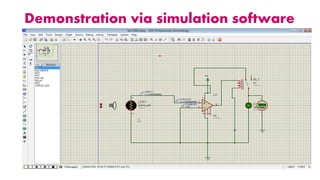
INTERFACING
Demonstration via simulation software
INNOVATION &ENTREPRENEUR
VIA
ELECTRONICS
WHAT TO DO……...
As we know all the concept of electronics
Observe the surrounding as well as social problem
Design a algo.. or block diagram.
Make or design a circuit via using all basic concept & electronics
components as well as interfaces.
Before building or implementing as a hardware directly, simulate on
simulation software's.
PCB fabrication or fix the circuit components on pcb which act as
platform
Study the subjects in proper way from standard books
While studying and reading the chapter, imagine application of that
topics in real time.
Instead of watching movies,
watch or downloads electronics video.
Keep keen interest to learn software's like ckt simulation ,pcb
designing and…….

Basic electronics.rtf

  • 1.
    BASIC ELECTRONICS “EVERYTHING IS0&1 AND IT IS BIENG GENERATED BY MOVEMENT OF ELECTRON AND HOLES” Er.Sagar Raj Poornima institute of engineering and technology
  • 2.
  • 3.
    It is thebranch of physics and technology concerned with the design of circuit using transistor and with microchip of and with the behavior and movement of electrons in a semiconductor ,conductor, vacuum.
  • 4.
  • 5.
     Electronics componentsare made from silicon, a chemical element found in sand, which does not normally conduct electricity (it doesn't allow electrons to flow through it easily).  Silicon is a semiconductor, which means it's neither really a conductor (something like a metal that lets electricity flow) nor an insulator (something like plastic that stops electricity flowing).  If we treat silicon with impurities (a process known as doping), we can make it behave in a different way. If we dope silicon with the chemical elements arsenic, phosphorus, or antimony, the silicon gains some extra "free" electrons—ones that can carry an electric current—so electrons will flow out of it more naturally. Because electrons have a negative charge, silicon treated this way is called n-type (negative type).  We can also dope silicon with other impurities such as boron, gallium, and aluminum. Silicon treated this way has fewer of those "free" electrons, so the electrons in nearby materials will tend to flow into it. We call this sort of silicon p-type (positive type).
  • 6.
     Quickly, inpassing, it's important to note that neither n-type or p- type silicon actually has a charge in itself: both are electrically neutral. It's true that n-type silicon has extra "free" electrons that increase its conductivity, while p-type silicon has fewer of those free electrons, which helps to increase its conductivity in the opposite way.  In each case, the extra conductivity comes from having added neutral (uncharged) atoms of impurities to silicon that was neutral to start with—and we can't create electrical charges out of thin air! A more detailed explanation would need me to introduce an idea called band theory, which is a little bit beyond the scope of this article.  All we need to remember is that "extra electrons" means extra free electrons—ones that can freely move about and help to carry an electric current.
  • 7.
    SILICON SANDWICHES • Wenow have two different types of silicon. If we put them together in layers, making sandwiches of p-type and n-type material, we can make different kinds of electronic components that work in all kinds of ways.
  • 8.
    Suppose we joina piece of n-type silicon to a piece of p-type silicon and put electrical contacts on either side.  Exciting and useful things start to happen at the junction between the two materials.  If we turn on the current, we can make electrons flow through the junction from the n-type side to the p-type side and out through the circuit. This happens because the lack of electrons on the p-type side of the junction pulls electrons over from the n-type side and vice-versa.  But if we reverse the current, the electrons won't flow at all. What we've made here is called a diode (or rectifier). It's an electronic component that lets current flow through it in only one direction.  It's useful if you want to turn alternating (two-way) electric current into direct (one-way) current. Diodes can also be made so they give off light when electricity flows through them. You might have seen these light-emitting diodes (LEDs) on pocket calculators and electronic displays on hi-fi stereo equipment.
  • 9.
  • 10.
    Electrical system alwaysdeals with low frequency high power supply electronic system always deals with high frequency low power supply The study of conductors is Electrical The study of semiconductors is Electronics the current flows through the conductor that is known as the electrical. The current flow through the vacuum tube or semiconductor that is known as electronics. now a days we don't not use the vacuum tube. electrical is transfer a.c current-electronics is control circuit in d.c voltage electrical use fundamental all purpose--electronics use based on electrical electronics deals with voltage (DC) and current in mili amperes
  • 11.
  • 12.
    ELECTRONIC COMPONENTS The electroniccomponents are mainly classified into two groups or categories. They are- passive components  active components.
  • 13.
    ACTIVE COMPONENTS: The componentswhich deliver energy for a longer duration or which amplify the signals are called active components. Semiconductor devices like BJT,FET, MOSFET and vacuum tube and gas tube devices are listed under Active components. PASSIVE COMPONENTS: Components capable of dissipation and storage of energy are called Passive component. Eg: Resistors, Capacitors, Inductors.
  • 14.
  • 15.
    • This opposition,due primarily to collisions and friction between the free electrons and other electrons, ions, and atoms in the path of motion, converts the supplied electrical energy into heat that raises the temperature of the electrical component and surrounding medium. • The resistance of any material is due primarily to four factors: • Material • Length • Cross-sectional area • Temperature of the material
  • 16.
    RESISTORS FUNCTION Limit theflow of current Voltage divider
  • 17.
    TYPES OF RESISTOR FIXEDRESISTORS Fixed resistors have only one ohmic value, which cannot be changed There are three types of fixed resistors: • wire wound • carbon • metal oxide. VARIABLE RESISTORS Variable resistors can change their value over a specific range. A potentiometer is a variable resistor with three terminals.
  • 18.
    FIXED RESISTORS: . • wirewound • carbon and • metal oxide
  • 19.
  • 20.
  • 21.
  • 22.
  • 23.
    THEORY OF CAPACITOR:- •Capacitor is a basic storage device to store electrical charges and release it as it is required by the circuit • The unit of capacitance is Farads (F) • Capacitance values are normally smaller, such as µF, nF or pF • A basic capacitor has two parallel plates separated by an insulating material • C =eA/d • where e = er eo • er is the relative dielectric constant • eo is the vacuum permittivity • •
  • 24.
    CAPACITOR TYPES FIXED CAPACITORS •Non-polarized:- Difficult to make non-polarized capacitors that store a large amount of charge or operate at high voltages. Tolerance on capacitance values is very large +50%/-25% is not unusual • Electrolytic:- • The negative terminal must always be at a lower voltage than the positive terminal • Plates or Electrodes: Aluminum, Tantalum VARIABLE CAPACITORS Cross-sectional area is changed as one set of plates are rotated with respect to the other.
  • 25.
    APPLICATION:- • DC blockingcapacitor: In this application the capacitor blocks the passage of DC current (after completely charged) and yet allows the AC to pass at certain portion of a circuit. • Capacitor as a filter: Capacitors are the main elements of filters. There are several types of filters that are used in electronic circuits, such as LPF (Low Pass Filter), HPF(high Pass Filter), BPF (Band Pass Filter), etc…. • Capacitor as a discharge unit: Capacitors used as a charging unit and the release of the charge (discharge energy) is used for triggering, ignition, and in high scale as a power source. • By Pass capacitor: The reactance of capacitor decreases as the frequency increases. Therefore in certain application it is used in parallel with other components to bypass it at a specified frequency. • Coupling capacitor: The ability of capacitor to pass AC signal, allows it to couple a section of an electronic circuit to another circuit. • Decoupling capacitor is typically located very close to the IC output and serves as a local energy source to provide the needed extra current and therefore minimizes the noise and disturbances to the logic signal.
  • 26.
  • 27.
  • 28.
    ABOUT INDUCTORS An inductor,also called a coil or reactor, is a passive two-terminal electrical component which resists changes in electric current passing through it. It consists of a conductor such as a wire, usually wound into a coil. When a current flows through it, energy is stored temporarily in a magnetic field in the coil.
  • 29.
  • 30.
    APPLICATION Sensors Contactless sensors areprized for their reliability and ease of operation and inductors can be used to sense magnetic fields or the presence of magnetically permeable material from a distance.
  • 31.
  • 32.
    TRANS………….. • A transformeris a device that changes ac electric power at one voltage level to ac electric power at another voltage level through the action of a magnetic field. • A transformer is a magnetically operated machine. • All values of a transformer are proportional to its turns ratio.
  • 34.
  • 35.
    Switches allow usto turn current flow on and off in the circuits. switches are used in all electronic appliances ,ex. Lights, computer, electronic tools etc
  • 36.
    TYPES 1. SPST 2. SPDT 3.DPDT 4. DPST 5. PUSH
  • 37.
    SPST • A SinglePole Single Throw toggle switch connects or disconnects one terminal either to or from another. It is the simplest switch • Bat UP = ON (terminals connected • Bat DOWN = OFF (terminals disconnected
  • 38.
    SPDT A Single PoleDouble Throw toggle switch connects a common terminal to one or the other of two terminals. It is always connected to one or the other. The two outside terminals are never connected by the switch.
  • 39.
    DPDT • A DPDTswitch works just like two separate SPDT switches • attached to the same switch bat. • It has two separate common terminals and each of those is connected to one or the other of the other two terminals on the same side of the switch. The dotted line in the picture is to illustrate that the switch is actually two SPDT switches in one package with one switch bat
  • 40.
    DPST • There aretwo poles single throw. both are open and close at same time
  • 41.
    PUSH Push to break:-currentflow normally but no flow when the switch is pushed. Push to make:-current only flow when switch is pushed.
  • 42.
    RELAY A relay isan electromagnetic switch operated by a relatively small electric current that can turn on or off a much larger electric current. The heart of a relay is an electromagnet (a coil of wire that becomes a temporary magnet when electricity flows through it). You can think of a relay as a kind of electric lever: switch it on with a tiny current and it switches on ("leverages") another appliance using a much bigger current. Relays were invented in 1835 by American electromagnetism pioneer Joseph Henry; in a demonstration at the College of New Jersey, Henry used a small electromagnet to switch a larger one on and off, and speculated that relays could be used to control electrical machines over very long distances.
  • 43.
     often weneed them to drive bigger pieces of apparatus that use bigger currents. Relays bridge the gap, making it possible for small currents to activate larger ones. That means relays can work either as switches (turning things on and off) or as amplifiers (converting small currents into larger ones).
  • 44.
  • 46.
  • 47.
  • 48.
    In electronics, adiode is a two-terminal electronic component with asymmetric conductance;  it has low (ideally zero) resistance to current in one direction, and high (ideally infinite) resistance in the other.  A semiconductor diode, the most common type today, is a crystalline piece of semiconductor material with a p–n junction connected to two electrical terminals
  • 49.
  • 50.
  • 51.
    LEDs are simplydiodes that are designed to give off light. When a diode is forward- biased so that electrons and holes are zipping back and forth across the junction, they're constantly combining and wiping one another out. Sooner or later, after an electron moves from the n-type into the p-type silicon, it will combine with a hole and disappear. That makes an atom complete and more stable and it gives off a little burst of energy (a kind of "sigh of relief") in the form of a tiny "packet" or photon of light. Above diagram summarizes what happens: • N-type silicon (red) has extra electrons (black). • P-type silicon (blue) has extra holes (white). • Battery connected across the p-n junction makes the diode forward biased, pushing electrons from the n-type to the p-type and pushing holes in the opposite direction. • Electrons and holes cross the junction and combine. • Photons (particles of light) are given off as the electrons and holes recombine.
  • 52.
    ABOUT LED LEDs arespecifically designed so they make light of a certain wavelength and they're built into rounded plastic bulbs to make this light brighter and more concentrated.  Red LEDs produce light with a wavelength of about 630–660 nanometres—which happens to look red when we see it,  while blue LEDs produce light with shorter wavelengths of about 430–500 nanometres, which we see as blue. (You can find out more about the wavelengths of light produced by different-colored LEDs on this handy page by solar). You can also get LEDs that make invisible infrared light, which is useful in things like "magic eye" beams that trigger photoelectric cells in things like optical smoke detectors and intruder alarms. Semiconductor lasers work in a similar way to LEDs but make purer and more precise beams of light.
  • 53.
  • 54.
  • 55.
  • 56.
  • 57.
    ABOUT TRANSISTOR it worksas an amplifier, it takes in a tiny electric current at one end (an input current) and produces a much bigger electric current (an output current) at the other. In other words, it's a kind of current booster. Transistors can also work as switches. A tiny electric current flowing through one part of a transistor can make a much bigger current flow through another part of it. In other words, the small current switches on the larger one. This is essentially how all computer chips work. Compact hearing aids were among the first applications for transistors—and this one dates from about the late 1950s or 1960s. About the size of a pack of playing cards, it was designed to be worn in or on a jacket pocket. There's a microphone on the other side of the case that picks up ambient sounds. You can clearly see the four little back transistors inside, amplifying those sounds and then shooting them out to the little loudspeaker that sits in your ear.  An electron is a minute particle inside an atom. It's so small, it weighs just under 0.000000000000000000000000000001 kg! The most advanced transistors work by controlling the movements of individual electrons, so you can imagine just how small they are.
  • 58.
  • 59.
  • 60.
  • 61.
    256 128 6432 16 8 4 2 1 - - - - - - - - -
  • 62.
  • 63.
    LOGIC GATES Logic gatesare the basic building blocks of any digital system.  It is an electronic circuit having one or more than one input and only one output. The relationship between the input and the output is based on a certain logic. Based on this, logic gates are named as AND gate, OR gate, NOT gate etc.
  • 64.
    WE CAN BUILTOR DESIGN A COMPUTER VIA ………..
  • 67.
  • 68.
  • 69.
  • 70.
  • 71.
  • 72.
    NOR GATE CONNECT THEINPUT OF NOT GATE TO OUTPUT OF OR GATE
  • 73.
  • 74.
    X-NOR GATE CONNECT THEINPUT OF NOT GATE TO OUTPUT OF XOR
  • 75.
    GORDOON E MOORE NO.OF TRANSISTOR ON CHIP DOUBLES EVERY 2 YEAR. 1971—2K TRANSISTORS ON CHIP 2011---2.8 BILLION CHIPS
  • 76.
  • 77.
    ………..sense………. • A sensoris a transducer whose purpose is to sense (that is, to detect) some characteristic of its environments. It detects events or changes in quantities and provides a corresponding output, generally as an electrical or optical signal • A thermo couple converts temperature to an output voltage. But a mercury-in-glass thermometer is also a sensor; it converts the measured temperature into expansion and contraction of a liquid which can be read on a calibrated glass tube.
  • 78.
    A good sensorobeys the following rules  Is sensitive to the measured property  Is insensitive to any other property likely to be encountered in its application  Does not influence the measured property  The sensitivity is then defined as the ratio between output signal and measured property. For example, if a sensor measures temperature and has a voltage output, the sensitivity is a constant with the unit [V/K]; this sensor is linear because the ratio is constant at all points of measurement.  For an analog sensor signal to be processed, or used in digital equipment, it needs to be converted to a digital signal, using an analog-to-digital converter
  • 79.
    TYPES • Temperature Sensor •Pressure sensor • Ultrasonic sensor • Humidity Sensor • Gas Sensor • PIR Motion Sensor • The acceleration sensor • Displacement sensor • Holzer switch sensor
  • 80.
    SENSORS IN NATURE Light, motion, temperature, magnetic fields, gravity, humidity, moisture, vibration, pressure, electrical fields, sound, and other physical aspects of the external environment  Physical aspects of the internal environment, such as stretch, motion of the organism, and position of appendages (proprioception)  Environmental molecules, including toxins, nutrients, and pheromones  Estimation of biomolecules interaction and some kinetics parameters  Internal metabolic indicators, such as glucose level, oxygen level, or osmolality  Internal signal molecules, such as hormones, neurotransmitters, and cytokines  Differences between proteins of the organism itself and of the environment or alien creatures.
  • 82.
  • 83.
  • 84.
  • 85.
    WHAT TO DO……... Aswe know all the concept of electronics Observe the surrounding as well as social problem Design a algo.. or block diagram. Make or design a circuit via using all basic concept & electronics components as well as interfaces. Before building or implementing as a hardware directly, simulate on simulation software's. PCB fabrication or fix the circuit components on pcb which act as platform
  • 86.
    Study the subjectsin proper way from standard books While studying and reading the chapter, imagine application of that topics in real time. Instead of watching movies, watch or downloads electronics video. Keep keen interest to learn software's like ckt simulation ,pcb designing and…….