1
EST 130, Part B,
Basic Electronics Engineering
MEC
2
Coverage
• Definition and Evolution of Electronics.
• Passive and Active Devices.
• Basic Electronic Circuits.
• Public Address System.
• Instrumentation System.
• Analog Communication Systems.
• Cellular Communication Systems.
3
Evolution of Electronics
MEC
4
Contents
• Meaning of Electronics.
• Milestones/History of Development.
• Impact.
• Applications.
• Classifying Electronic Components.
5
Electronics
• Electronics - Electron Mechanics.
• Branch of science dealing with flow of
electrons and their effects in materials
such as vaccum, gas and semiconductors.
• Concerned with design, fabrication and
operation of electronic circuits, devices
and systems.
• Deals with low ranges of voltage, current
and power (millivolts/milliwatts etc.)
6
Electronics
• Offshoot of electrical engineering.
• Capable of controlling of higher range of
voltage, current and power.
• Wide applications in communication,
instrumentation, defence, education,
industry, entertainment etc.
• Making life simpler and easier – consumer
electronics.
7
Evolution of Electronics
• Edison Effect : Thomas Alva Edison
(1883), Electron flow from one metal
conductor to another through vacuum.
• Vacuum Diode : John Fleming (1904),
Edison Effect through two element
electron tube.
• Vacuum Triode : Lee Dee Forest (1906),
triggered development of electronics.
8
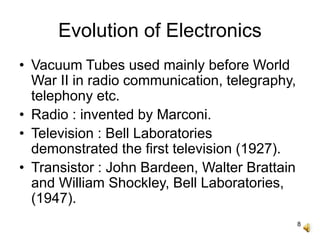
Evolution of Electronics
• Vacuum Tubes used mainly before World
War II in radio communication, telegraphy,
telephony etc.
• Radio : invented by Marconi.
• Television : Bell Laboratories
demonstrated the first television (1927).
• Transistor : John Bardeen, Walter Brattain
and William Shockley, Bell Laboratories,
(1947).
9
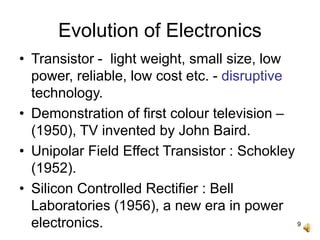
Evolution of Electronics
• Transistor - light weight, small size, low
power, reliable, low cost etc. - disruptive
technology.
• Demonstration of first colour television –
(1950), TV invented by John Baird.
• Unipolar Field Effect Transistor : Schokley
(1952).
• Silicon Controlled Rectifier : Bell
Laboratories (1956), a new era in power
electronics.
10
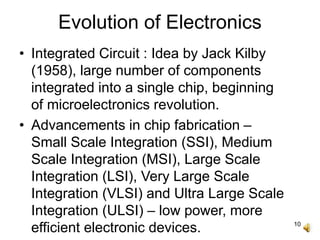
Evolution of Electronics
• Integrated Circuit : Idea by Jack Kilby
(1958), large number of components
integrated into a single chip, beginning
of microelectronics revolution.
• Advancements in chip fabrication –
Small Scale Integration (SSI), Medium
Scale Integration (MSI), Large Scale
Integration (LSI), Very Large Scale
Integration (VLSI) and Ultra Large Scale
Integration (ULSI) – low power, more
efficient electronic devices.
11
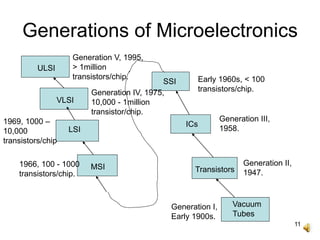
Generations of Microelectronics
Vacuum
Tubes
Transistors
ICs
SSI
MSI
LSI
VLSI
ULSI
Generation I,
Early 1900s.
Generation II,
1947.
Generation III,
1958.
Early 1960s, < 100
transistors/chip.
1966, 100 - 1000
transistors/chip.
1969, 1000 –
10,000
transistors/chip
Generation IV, 1975,
10,000 - 1million
transistor/chip.
Generation V, 1995,
> 1million
transistors/chip.
12
Evolution of Electronics
• Four bit Microprocessor (1971), Intel 4004.
• Eight Bit Microprocessor (1972).
• Gigabit Memory chip (1995).
• Nanoelectronics in action.
13
Applications
• In Industry : Automatic Control Systems, Quality
Control of Materials, Automation, Robotics,
Measurements/measuring instruments, in
chemical and explosives industries, automobile,
textile manufacturing and rubber industries etc.
• Communication & Entertainment : Telegraphy,
Telephony, Radio, Television, Music Players,
Mobile Communication, Internetworking, Video
Conferencing and Wireless Communications.
14
Applications
• Medical Electronics : ECG, EEG, EMG,
MRI, Laser Applications in Medicine,
Computer Tomography, X-Ray, Ultrasound
and Nuclear Imaging, Pace Maker,
Positron Emission Technology,
Telemedicine, Other Medical Diagnostic
Instruments, Assistive Devices.
• Military : RADAR, SONAR, LIDAR etc.
15
Applications
• Instrumentation : Multimeter, CRO, Power
Supplies, Signal Generators, Signal
Conditioners and Other Measuring
Instruments, Law Enforcement and
Security Systems, Identification / Identity
Verification Instruments, Air Traffic Control
etc.
• Household and Cooking : Induction
Cooking, Microwave Oven, Pump Control,
Washing Machines etc.
16
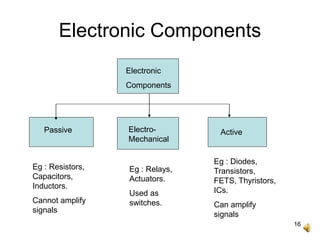
Electronic Components
Passive Electro-
Mechanical
Active
Electronic
Components
Eg : Resistors,
Capacitors,
Inductors.
Cannot amplify
signals
Eg : Relays,
Actuators.
Used as
switches.
Eg : Diodes,
Transistors,
FETS, Thyristors,
ICs.
Can amplify
signals
17
Thank You

EST 130, Part B, Basic Electronics Engineering

  • 1.
    1 EST 130, PartB, Basic Electronics Engineering MEC
  • 2.
    2 Coverage • Definition andEvolution of Electronics. • Passive and Active Devices. • Basic Electronic Circuits. • Public Address System. • Instrumentation System. • Analog Communication Systems. • Cellular Communication Systems.
  • 3.
  • 4.
    4 Contents • Meaning ofElectronics. • Milestones/History of Development. • Impact. • Applications. • Classifying Electronic Components.
  • 5.
    5 Electronics • Electronics -Electron Mechanics. • Branch of science dealing with flow of electrons and their effects in materials such as vaccum, gas and semiconductors. • Concerned with design, fabrication and operation of electronic circuits, devices and systems. • Deals with low ranges of voltage, current and power (millivolts/milliwatts etc.)
  • 6.
    6 Electronics • Offshoot ofelectrical engineering. • Capable of controlling of higher range of voltage, current and power. • Wide applications in communication, instrumentation, defence, education, industry, entertainment etc. • Making life simpler and easier – consumer electronics.
  • 7.
    7 Evolution of Electronics •Edison Effect : Thomas Alva Edison (1883), Electron flow from one metal conductor to another through vacuum. • Vacuum Diode : John Fleming (1904), Edison Effect through two element electron tube. • Vacuum Triode : Lee Dee Forest (1906), triggered development of electronics.
  • 8.
    8 Evolution of Electronics •Vacuum Tubes used mainly before World War II in radio communication, telegraphy, telephony etc. • Radio : invented by Marconi. • Television : Bell Laboratories demonstrated the first television (1927). • Transistor : John Bardeen, Walter Brattain and William Shockley, Bell Laboratories, (1947).
  • 9.
    9 Evolution of Electronics •Transistor - light weight, small size, low power, reliable, low cost etc. - disruptive technology. • Demonstration of first colour television – (1950), TV invented by John Baird. • Unipolar Field Effect Transistor : Schokley (1952). • Silicon Controlled Rectifier : Bell Laboratories (1956), a new era in power electronics.
  • 10.
    10 Evolution of Electronics •Integrated Circuit : Idea by Jack Kilby (1958), large number of components integrated into a single chip, beginning of microelectronics revolution. • Advancements in chip fabrication – Small Scale Integration (SSI), Medium Scale Integration (MSI), Large Scale Integration (LSI), Very Large Scale Integration (VLSI) and Ultra Large Scale Integration (ULSI) – low power, more efficient electronic devices.
  • 11.
    11 Generations of Microelectronics Vacuum Tubes Transistors ICs SSI MSI LSI VLSI ULSI GenerationI, Early 1900s. Generation II, 1947. Generation III, 1958. Early 1960s, < 100 transistors/chip. 1966, 100 - 1000 transistors/chip. 1969, 1000 – 10,000 transistors/chip Generation IV, 1975, 10,000 - 1million transistor/chip. Generation V, 1995, > 1million transistors/chip.
  • 12.
    12 Evolution of Electronics •Four bit Microprocessor (1971), Intel 4004. • Eight Bit Microprocessor (1972). • Gigabit Memory chip (1995). • Nanoelectronics in action.
  • 13.
    13 Applications • In Industry: Automatic Control Systems, Quality Control of Materials, Automation, Robotics, Measurements/measuring instruments, in chemical and explosives industries, automobile, textile manufacturing and rubber industries etc. • Communication & Entertainment : Telegraphy, Telephony, Radio, Television, Music Players, Mobile Communication, Internetworking, Video Conferencing and Wireless Communications.
  • 14.
    14 Applications • Medical Electronics: ECG, EEG, EMG, MRI, Laser Applications in Medicine, Computer Tomography, X-Ray, Ultrasound and Nuclear Imaging, Pace Maker, Positron Emission Technology, Telemedicine, Other Medical Diagnostic Instruments, Assistive Devices. • Military : RADAR, SONAR, LIDAR etc.
  • 15.
    15 Applications • Instrumentation :Multimeter, CRO, Power Supplies, Signal Generators, Signal Conditioners and Other Measuring Instruments, Law Enforcement and Security Systems, Identification / Identity Verification Instruments, Air Traffic Control etc. • Household and Cooking : Induction Cooking, Microwave Oven, Pump Control, Washing Machines etc.
  • 16.
    16 Electronic Components Passive Electro- Mechanical Active Electronic Components Eg: Resistors, Capacitors, Inductors. Cannot amplify signals Eg : Relays, Actuators. Used as switches. Eg : Diodes, Transistors, FETS, Thyristors, ICs. Can amplify signals
  • 17.