1
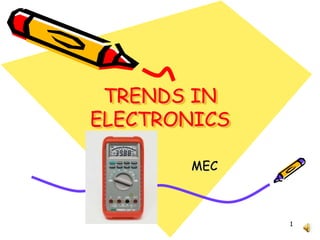
TRENDS IN
ELECTRONICS
MEC
2
ELECTRONICS
• ELECTRON mechanICS = Electronics
• Study of behaviour of electrons under
external applied fields.
• Deals with electron devices and their
utilization.
• ELECTRON DEVICE :- a device in which
conduction takes place by movement of
electrons.
• From Vacuum Tubes to Transistors to
Ultra Large Scale Integration.
3
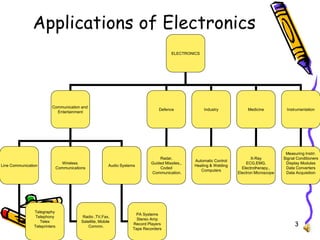
Applications of Electronics
ELECTRONICS
Communication and
Entertainment
Industry Medicine
Line Communication
Defence
Audio Systems
Wireless
Communications
X-Ray
ECG,EMG,
Electrotherapy,,
Electron Microscope
Instrumentation
Radar,
Guided Missiles,,
Coded
Communication.
Automatic Control
Heating & Welding
Computers
Measuring Instrr.
Signal Conditioners
Display Modules
Data Converters
Data Acquisition
Telegraphy
Telephony
Telex
Teleprinters
Radio ,TV,Fax,
Satellite, Mobile
Commn.
PA Systems
Stereo Amp
Record Players
Tape Recorders
4
A Few Applications
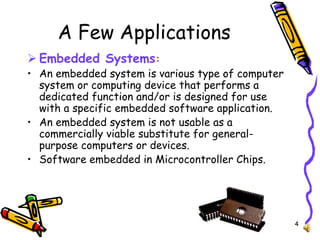
 Embedded Systems:
• An embedded system is various type of computer
system or computing device that performs a
dedicated function and/or is designed for use
with a specific embedded software application.
• An embedded system is not usable as a
commercially viable substitute for general-
purpose computers or devices.
• Software embedded in Microcontroller Chips.
5
A Few Applications
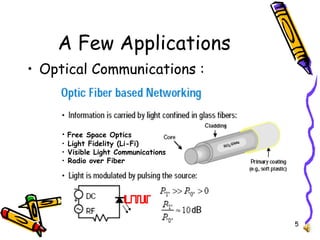
• Optical Communications :
• Free Space Optics
• Light Fidelity (Li-Fi)
• Visible Light Communications
• Radio over Fiber
6
•
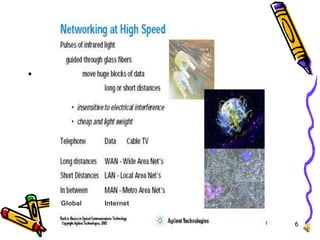
Internet
Global
7
A Few Applications
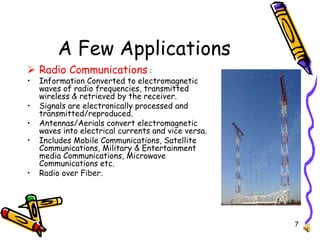
 Radio Communications :
• Information Converted to electromagnetic
waves of radio frequencies, transmitted
wireless & retrieved by the receiver.
• Signals are electronically processed and
transmitted/reproduced.
• Antennas/Aerials convert electromagnetic
waves into electrical currents and vice versa.
• Includes Mobile Communications, Satellite
Communications, Military & Entertainment
media Communications, Microwave
Communications etc.
• Radio over Fiber.
8
Mobile Communications
• Wireless telecommunications can be
divided into two broad categories: mobile
communications and fixed wireless
communications.
• GSM and CDMA Technologies.
• Smart Phones.
• Long Distance Communications.
• Towards 5G……
9
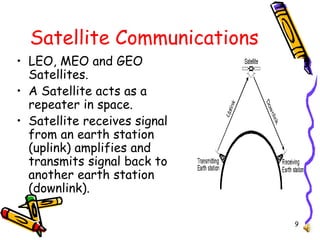
Satellite Communications
• LEO, MEO and GEO
Satellites.
• A Satellite acts as a
repeater in space.
• Satellite receives signal
from an earth station
(uplink) amplifies and
transmits signal back to
another earth station
(downlink).
10
Radio Frequency
Identification
• RFID stands for radio frequency
identification. It is an automatic
identification technology whereby digital data
encoded in an RFID tag or “smart label” is
captured by a reader using radio waves.
• RFID is similar to bar/QR code technology
but uses radio waves to capture data from
tags, rather than optically scanning the bar
codes on a label. RFID does not require the
tag or label to be seen to read its stored
data—that's one of the key characteristics of
an RFID system.
11
Radio Frequency
Identification
• Makes life faster, tracks goods and pets.
• Alternative to Bar/QR Codes.
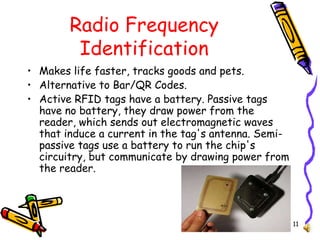
• Active RFID tags have a battery. Passive tags
have no battery, they draw power from the
reader, which sends out electromagnetic waves
that induce a current in the tag's antenna. Semi-
passive tags use a battery to run the chip's
circuitry, but communicate by drawing power from
the reader.
12
Automation
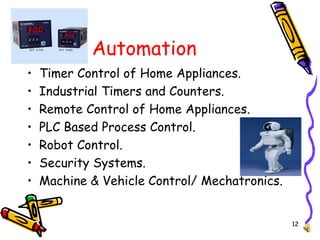
• Timer Control of Home Appliances.
• Industrial Timers and Counters.
• Remote Control of Home Appliances.
• PLC Based Process Control.
• Robot Control.
• Security Systems.
• Machine & Vehicle Control/ Mechatronics.
13
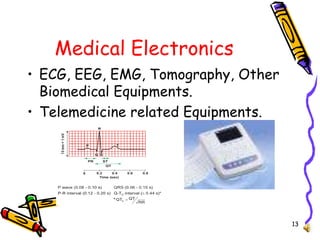
Medical Electronics
• ECG, EEG, EMG, Tomography, Other
Biomedical Equipments.
• Telemedicine related Equipments.
14
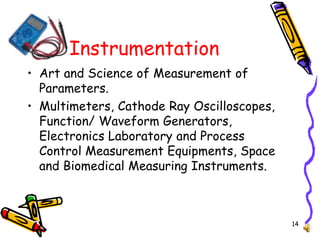
Instrumentation
• Art and Science of Measurement of
Parameters.
• Multimeters, Cathode Ray Oscilloscopes,
Function/ Waveform Generators,
Electronics Laboratory and Process
Control Measurement Equipments, Space
and Biomedical Measuring Instruments.
15
Telemetry
• Telemetry is a technology that allows the
remote measurement and reporting of
information of interest to the system
designer or operator. The word is derived
from Greek roots tele = remote, and
metron = measure.
• Wired and Wireless.
16
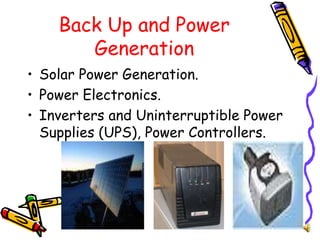
Back Up and Power
Generation
• Solar Power Generation.
• Power Electronics.
• Inverters and Uninterruptible Power
Supplies (UPS), Power Controllers.
17
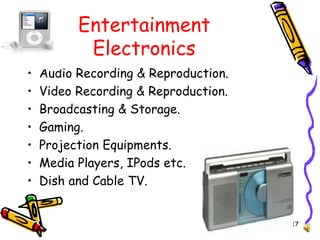
Entertainment
Electronics
• Audio Recording & Reproduction.
• Video Recording & Reproduction.
• Broadcasting & Storage.
• Gaming.
• Projection Equipments.
• Media Players, IPods etc.
• Dish and Cable TV.
18
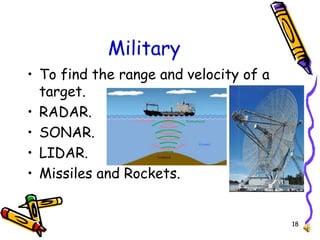
Military
• To find the range and velocity of a
target.
• RADAR.
• SONAR.
• LIDAR.
• Missiles and Rockets.
19
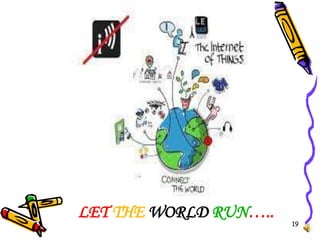
LET THE WORLD RUN…..
20
Have a Nice Day ……………

EST 130, Emerging Trends in Electronics

  • 1.
  • 2.
    2 ELECTRONICS • ELECTRON mechanICS= Electronics • Study of behaviour of electrons under external applied fields. • Deals with electron devices and their utilization. • ELECTRON DEVICE :- a device in which conduction takes place by movement of electrons. • From Vacuum Tubes to Transistors to Ultra Large Scale Integration.
  • 3.
    3 Applications of Electronics ELECTRONICS Communicationand Entertainment Industry Medicine Line Communication Defence Audio Systems Wireless Communications X-Ray ECG,EMG, Electrotherapy,, Electron Microscope Instrumentation Radar, Guided Missiles,, Coded Communication. Automatic Control Heating & Welding Computers Measuring Instrr. Signal Conditioners Display Modules Data Converters Data Acquisition Telegraphy Telephony Telex Teleprinters Radio ,TV,Fax, Satellite, Mobile Commn. PA Systems Stereo Amp Record Players Tape Recorders
  • 4.
    4 A Few Applications Embedded Systems: • An embedded system is various type of computer system or computing device that performs a dedicated function and/or is designed for use with a specific embedded software application. • An embedded system is not usable as a commercially viable substitute for general- purpose computers or devices. • Software embedded in Microcontroller Chips.
  • 5.
    5 A Few Applications •Optical Communications : • Free Space Optics • Light Fidelity (Li-Fi) • Visible Light Communications • Radio over Fiber
  • 6.
  • 7.
    7 A Few Applications Radio Communications : • Information Converted to electromagnetic waves of radio frequencies, transmitted wireless & retrieved by the receiver. • Signals are electronically processed and transmitted/reproduced. • Antennas/Aerials convert electromagnetic waves into electrical currents and vice versa. • Includes Mobile Communications, Satellite Communications, Military & Entertainment media Communications, Microwave Communications etc. • Radio over Fiber.
  • 8.
    8 Mobile Communications • Wirelesstelecommunications can be divided into two broad categories: mobile communications and fixed wireless communications. • GSM and CDMA Technologies. • Smart Phones. • Long Distance Communications. • Towards 5G……
  • 9.
    9 Satellite Communications • LEO,MEO and GEO Satellites. • A Satellite acts as a repeater in space. • Satellite receives signal from an earth station (uplink) amplifies and transmits signal back to another earth station (downlink).
  • 10.
    10 Radio Frequency Identification • RFIDstands for radio frequency identification. It is an automatic identification technology whereby digital data encoded in an RFID tag or “smart label” is captured by a reader using radio waves. • RFID is similar to bar/QR code technology but uses radio waves to capture data from tags, rather than optically scanning the bar codes on a label. RFID does not require the tag or label to be seen to read its stored data—that's one of the key characteristics of an RFID system.
  • 11.
    11 Radio Frequency Identification • Makeslife faster, tracks goods and pets. • Alternative to Bar/QR Codes. • Active RFID tags have a battery. Passive tags have no battery, they draw power from the reader, which sends out electromagnetic waves that induce a current in the tag's antenna. Semi- passive tags use a battery to run the chip's circuitry, but communicate by drawing power from the reader.
  • 12.
    12 Automation • Timer Controlof Home Appliances. • Industrial Timers and Counters. • Remote Control of Home Appliances. • PLC Based Process Control. • Robot Control. • Security Systems. • Machine & Vehicle Control/ Mechatronics.
  • 13.
    13 Medical Electronics • ECG,EEG, EMG, Tomography, Other Biomedical Equipments. • Telemedicine related Equipments.
  • 14.
    14 Instrumentation • Art andScience of Measurement of Parameters. • Multimeters, Cathode Ray Oscilloscopes, Function/ Waveform Generators, Electronics Laboratory and Process Control Measurement Equipments, Space and Biomedical Measuring Instruments.
  • 15.
    15 Telemetry • Telemetry isa technology that allows the remote measurement and reporting of information of interest to the system designer or operator. The word is derived from Greek roots tele = remote, and metron = measure. • Wired and Wireless.
  • 16.
    16 Back Up andPower Generation • Solar Power Generation. • Power Electronics. • Inverters and Uninterruptible Power Supplies (UPS), Power Controllers.
  • 17.
    17 Entertainment Electronics • Audio Recording& Reproduction. • Video Recording & Reproduction. • Broadcasting & Storage. • Gaming. • Projection Equipments. • Media Players, IPods etc. • Dish and Cable TV.
  • 18.
    18 Military • To findthe range and velocity of a target. • RADAR. • SONAR. • LIDAR. • Missiles and Rockets.
  • 19.
  • 20.
    20 Have a NiceDay ……………