A Short History of Probability
Dr. Alan M. Polansky
Division of Statistics
Northern Illinois University
History of Probability 2
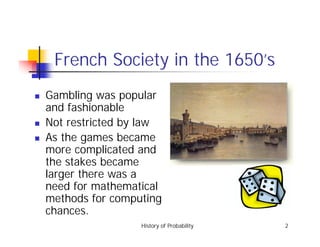
French Society in the 1650’s
! Gambling was popular
and fashionable
! Not restricted by law
! As the games became
more complicated and
the stakes became
larger there was a
need for mathematical
methods for computing
chances.
History of Probability 3
Enter the Mathematicians
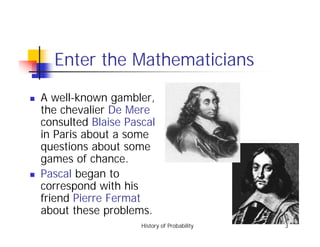
! A well-known gambler,
the chevalier De Mere
consulted Blaise Pascal
in Paris about a some
questions about some
games of chance.
! Pascal began to
correspond with his
friend Pierre Fermat
about these problems.
History of Probability 4
Classical Probability
! The correspondence between Pascal and Fermat
is the origin of the mathematical study of
probability.
! The method they developed is now called the
classical approach to computing probabilities.
! The method: Suppose a game has n equally
likely outcomes, of which m outcomes
correspond to winning. Then the probability of
winning is m/n.
History of Probability 5
Problems with the Classical Method
! The classical method requires a game
to be broken down into equally likely
outcomes.
! It is not always possible to do this.
! It is not always clear when possibilities are
equally likely.
History of Probability 6
Experience
! Another method, known as the frequency
method had also been used for some time.
! This method consists of repeating a game a
large number of times under the same
conditions. The probability of winning is then
approximately equal to the proportion of wins
in the repeats.
! This method was used by Pascal and Fermat
to verify results obtained by the classical
method.
History of Probability 7
Early Generalizations
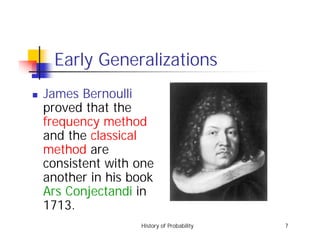
! James Bernoulli
proved that the
frequency method
and the classical
method are
consistent with one
another in his book
Ars Conjectandi in
1713.
History of Probability 8
Early Generalizations
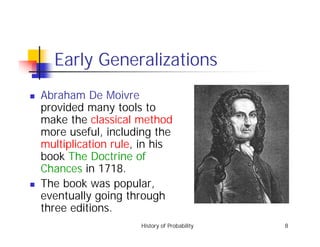
! Abraham De Moivre
provided many tools to
make the classical method
more useful, including the
multiplication rule, in his
book The Doctrine of
Chances in 1718.
! The book was popular,
eventually going through
three editions.
History of Probability 9
From Games to Science
! Throughout the 18th century, the
application of probability moved from
games of chance to scientific problems:
! Mathematical theory of life insurance - life
tables.
! Biological problems - what is the
probability of being born female or male?
History of Probability 10
Applied Probability
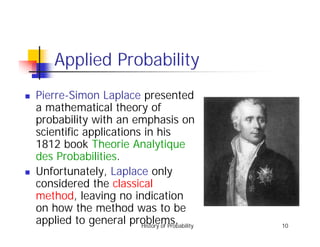
! Pierre-Simon Laplace presented
a mathematical theory of
probability with an emphasis on
scientific applications in his
1812 book Theorie Analytique
des Probabilities.
! Unfortunately, Laplace only
considered the classical
method, leaving no indication
on how the method was to be
applied to general problems.
History of Probability 11
Stagnation the Frustration
! After the publication of Laplace’s book, the
mathematical development of probability
stagnated for many years.
! By 1850, many mathematicians found the
classical method to be unrealistic for general
use and were attempting to redefine
probability in terms of the frequency method.
! These attempts were never fully accepted
and the stagnation continued.
History of Probability 12
Axiomatic Development
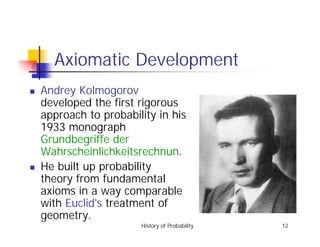
! Andrey Kolmogorov
developed the first rigorous
approach to probability in his
1933 monograph
Grundbegriffe der
Wahrscheinlichkeitsrechnun.
! He built up probability
theory from fundamental
axioms in a way comparable
with Euclid's treatment of
geometry.
History of Probability 13
Probability Today
! Modern research in probability theory is
closely related to the mathematical field of
measure theory.
! Modern innovators in the field include Patrick
Billingsley (University of Chicago), Yuan Shih
Chow (Columbia), Kai Lai Chung (Stanford),
Samuel Karlin (Stanford), Rolf-Dieter Reiss,
Sheldon Ross (Berkeley), Henry Teicher
(Rutgers) and many many more…

history of probability

  • 1.
    A Short Historyof Probability Dr. Alan M. Polansky Division of Statistics Northern Illinois University
  • 2.
    History of Probability2 French Society in the 1650’s ! Gambling was popular and fashionable ! Not restricted by law ! As the games became more complicated and the stakes became larger there was a need for mathematical methods for computing chances.
  • 3.
    History of Probability3 Enter the Mathematicians ! A well-known gambler, the chevalier De Mere consulted Blaise Pascal in Paris about a some questions about some games of chance. ! Pascal began to correspond with his friend Pierre Fermat about these problems.
  • 4.
    History of Probability4 Classical Probability ! The correspondence between Pascal and Fermat is the origin of the mathematical study of probability. ! The method they developed is now called the classical approach to computing probabilities. ! The method: Suppose a game has n equally likely outcomes, of which m outcomes correspond to winning. Then the probability of winning is m/n.
  • 5.
    History of Probability5 Problems with the Classical Method ! The classical method requires a game to be broken down into equally likely outcomes. ! It is not always possible to do this. ! It is not always clear when possibilities are equally likely.
  • 6.
    History of Probability6 Experience ! Another method, known as the frequency method had also been used for some time. ! This method consists of repeating a game a large number of times under the same conditions. The probability of winning is then approximately equal to the proportion of wins in the repeats. ! This method was used by Pascal and Fermat to verify results obtained by the classical method.
  • 7.
    History of Probability7 Early Generalizations ! James Bernoulli proved that the frequency method and the classical method are consistent with one another in his book Ars Conjectandi in 1713.
  • 8.
    History of Probability8 Early Generalizations ! Abraham De Moivre provided many tools to make the classical method more useful, including the multiplication rule, in his book The Doctrine of Chances in 1718. ! The book was popular, eventually going through three editions.
  • 9.
    History of Probability9 From Games to Science ! Throughout the 18th century, the application of probability moved from games of chance to scientific problems: ! Mathematical theory of life insurance - life tables. ! Biological problems - what is the probability of being born female or male?
  • 10.
    History of Probability10 Applied Probability ! Pierre-Simon Laplace presented a mathematical theory of probability with an emphasis on scientific applications in his 1812 book Theorie Analytique des Probabilities. ! Unfortunately, Laplace only considered the classical method, leaving no indication on how the method was to be applied to general problems.
  • 11.
    History of Probability11 Stagnation the Frustration ! After the publication of Laplace’s book, the mathematical development of probability stagnated for many years. ! By 1850, many mathematicians found the classical method to be unrealistic for general use and were attempting to redefine probability in terms of the frequency method. ! These attempts were never fully accepted and the stagnation continued.
  • 12.
    History of Probability12 Axiomatic Development ! Andrey Kolmogorov developed the first rigorous approach to probability in his 1933 monograph Grundbegriffe der Wahrscheinlichkeitsrechnun. ! He built up probability theory from fundamental axioms in a way comparable with Euclid's treatment of geometry.
  • 13.
    History of Probability13 Probability Today ! Modern research in probability theory is closely related to the mathematical field of measure theory. ! Modern innovators in the field include Patrick Billingsley (University of Chicago), Yuan Shih Chow (Columbia), Kai Lai Chung (Stanford), Samuel Karlin (Stanford), Rolf-Dieter Reiss, Sheldon Ross (Berkeley), Henry Teicher (Rutgers) and many many more…