Assignment
On
Uses of computer in Research
Submitted by : Arti Arora
(Ph.D. Research Scholar)
Under the guidness of: Dr.Reenu Rani
Assistant Professor
Department of Economics
S.B.S.P.G.College ,Rudrapur
Udham Singh Nagar, Uttrakhand
Introduction
Computer is an electronic device or combination of electronic devices which is capable of solving
our problems. It is the most versatile electronic machine man has ever created. Computers have
made a great impact on our everyday life. Their presence is felt in almost every walk of life be it
homes, schools, colleges,offices,industries,hospitals,banks,retail stores,railways,research and design
organizations etc. The word computer stand for
C-Commonly
O-Operated
M-Machine
P-Particularly
U-Used for
T-Trade
E-Education
R-Research.
A computer can, not only store and process data but also retrieve data i.e. take out data from its
memory or storage as and when desired. Thus, computer is general term that refers to an electronic
data processing machine used for a wide range of activities.
Characteristics of a computer system-
Speed – Computers are fast. Electric pulses travel at incredible speeds and because the computer is
electronic.
Versatility – Computers can handle a variety of jobs and applications and can be used in various
fields.
Diligence – Computer never get tired or bored.
Storage – Computer can store massive amount of data. They are capable of handling voluminous
data and information.
Programmability – A computer is programmable; that is , what the computer does depends on
the program the computer is using.
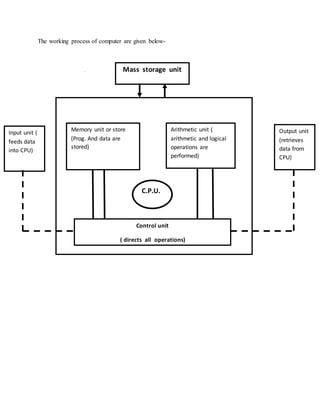
The working process of computer are given below-
Mass storage unit
Input unit (
feeds data
into CPU)
Output unit
(retrieves
data from
CPU)
Memory unit or store
(Prog. And data are
stored)
Arithmetic unit (
arithmetic and logical
operations are
performed)
Control unit
( directs all operations)
C.P.U.
COMPUTERS IN RESEARCH
In research process the role of computer becomes more important. The main use of computer in
research are given below-
1. Researchers can get information from previously written books and journal articles present
in online libraries on the research topic through computers.
2. Researchers can get information from all sorts of websites.
3. Researches can conduct surveys online.
4. Researchers connect to the focus group from all over the world through messenger in the
same chat group.
5. Researchers can analyze results using softwares like spss.
6. Researchers can share your research and ideas in all over the world and can take suggestions
form them.
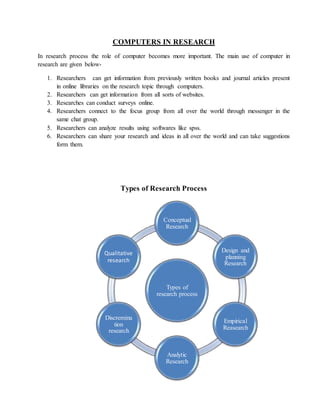
Types of Research Process
Types of
research process
Conceptual
Research
Design and
planning
Research
Empirical
Reasearch
Analytic
Research
Discremina
tion
research
Qualitative
research
Importance of computers in different types of Research–
Role of computers in qualitative research – Most Qualitative researchers now work with
computers,but relatively few use software designed for analysis qualitative research. This is not
because they see no need for help in handling rich,complex , or messy data. Rather , computers
offer no instant solutions to the problems faced by qualitative researchers, because the data they
handle are particularly resistant to tidy processing methods and the methods they use are very unlike
the technique computers easily support. The past decade has produced a plethora of software
packages that seem as though they should help, but these are packages designed for executives,
librarians,and banks. There is now a much smaller group of programs designed for particular
approaches to qualitative research, but they are less accessible and less professionally presented.
Thus the researcher is offered a bewildering range of ways of handling textual data on computers,
and many of these are quite different from the methods found in qualitative texts. The computer
method can have dramatic implications for the research process and outcomes, from unacceptable
restrictions on analysis to unexpected opening out of possibilities.
Role of Computers in Research Dissemination -This phase is the publication of the
research study.
Research publishing: The research article is typed in word format and converted to portable
data format (PDF) and stored and/or published in the World Wide Web .FURTHER USES OF
COMPUTERS Medical record linkage in longitudinal studies: In a more comprehensive way
medical record linkage provides continuous record of individual patients from birth to death,
including illnesses hospitalization, operation, allergies and so on. Prior to the use of computers, the
linking together of different events in an individuals medical case history was extremely difficult.
Individual events (treatment by family doctor, stay in hospital, etc.) were, and indeed usually still
are, recorded separately at different locations with no systematic procedures to bring together these
elements of a case history into a single record. With computer based recording systems, such
linking becomes more feasible, medical records can be put to better use and information stored
efficiently; moreover, this information can be retrieved more rapidly than before. Cumulative files
for individuals can be compiled and assembled into family groups, socio-economic categories, and
so on, for purposes of analysis. Longitudinal studies, which involve following up a given group of
cohort over a period of time, area well established application of the concept of medical record
linkage, and the large and comprehensive computerized databases established through record
linkage open up a wide range of potential research studies. For performing Meta-analysis and
systematic reviews: The results from systematic reviews are graded as the level I evidence.
meta-analysis of the data from various studies. This is made easy by the use of specialized
softwares for the purpose. This will be a mammoth task without a computer. For performing Re
search analysis: Many sophisticated softwares are available to analyse the psychometric properties
of various outcome measures and performing a research analysis with the help of computers. A
Note of Caution The above description indicates clearly the usefulness of computer throughout the
research process. Researchers using computers make their work faster with more accuracy and
greater reliability. The developments taking place in the technology will further enhance and
facilitate the use of computers for researchers. In spite of all these sophistications it is wise to
remember that a computer is just a tool and a resource. It can only calculate or obey commands and
cannot think. If the methods of handling the data are to be applied efficiently, adequate planning
and suitable organisation is necessary. No facility can replace this aspect of planning. Further, it
would be a disaster to replace the statistician by a computer, no matter how powerful, since
statistical analyses are built on sound principles of design, implementation and handling of
exigencies in data collection, all of which require the expertise of a qualified statistician. The human
brain remains supreme and will continue to be so for ever. Conclusion To conclude, computers are
useful tools that make the research process easier and faster with accuracy and greater reliability
and fewer errors. The programmer or the computer operator should have a thorough knowledge
about the abilities and limitations of the softwares used for better use of computers.
Role of Computers in Empirical phase -Empirical phase consist of collecting and
preparing the data for analysis.
Data Storage: The data obtained from the subjects are stored in computers as word files or
excel spread sheets. This has the advantage of making necessary correctionsor editing the whole
layout of the tables if needed, which is impossible or time consuming incase of writing in papers.
Thus, computers help in data entry, data editing, data management including follow up actions etc.
Computers also allow for greater flexibility in recording the data while they are collected as well as
grater ease during the analysis of these data. In research studies, the preparation and inputting data
is the most labor-intensive and time consuming aspect of the work. Typically the data will be
initially recorded on a questionnaire or record form suitable for its acceptance by the computer. To
do this the researcher in conjunction with the statistician and the programmer, will convert the data
into Microsoft word file or excel spreadsheet. These spreadsheets can be directly opened with
statistical softwares for analysis.
Role of Computers in Design and planning phase- Design and planning phase consist of
research design, population, research variables, sampling plan, reviewing research plan and pilot
study . Several softwares are available to calculate the sample size required for a proposed study.
NCSS-PASS-GESS is such software. The standard deviation of the data from the pilot study is
required for the sample size calculation.
Role of Computer to collect Secondary data - Internet is the best source to collect
secondary data. All types of journals, articles,magazine and many more data are available here.
Such websites , which is helpful to researchers are given below-
www.shodhganga.com
www.shodhgangotri.com
www.slideshare.com
www.indianjournals.com
Role of Computers in Data Analysis - This phase consist of statistical analysis of the data
and interpretation of results. Data Analysis: Many softwares are now available to perform the
‘mathematical part ’of the research process i.e. the calculations using various statistical methods.
Softwares like SPSS, NCSS-PASS, STATA and Sysat are some of the widely used. They can be
like calculating the sample size for a proposed study, hypothesis testing and calculating the power
of the study. Familiarity with any one package will suffice to carry out the most intricate statistical
analyses. Computers are useful not only for statistical analyses, but also to monitor the accuracy and
completeness of the data as they are collected.

Computer is an electronic device or combination of electronic devices

  • 1.
    Assignment On Uses of computerin Research Submitted by : Arti Arora (Ph.D. Research Scholar) Under the guidness of: Dr.Reenu Rani Assistant Professor Department of Economics S.B.S.P.G.College ,Rudrapur Udham Singh Nagar, Uttrakhand
  • 2.
    Introduction Computer is anelectronic device or combination of electronic devices which is capable of solving our problems. It is the most versatile electronic machine man has ever created. Computers have made a great impact on our everyday life. Their presence is felt in almost every walk of life be it homes, schools, colleges,offices,industries,hospitals,banks,retail stores,railways,research and design organizations etc. The word computer stand for C-Commonly O-Operated M-Machine P-Particularly U-Used for T-Trade E-Education R-Research. A computer can, not only store and process data but also retrieve data i.e. take out data from its memory or storage as and when desired. Thus, computer is general term that refers to an electronic data processing machine used for a wide range of activities. Characteristics of a computer system- Speed – Computers are fast. Electric pulses travel at incredible speeds and because the computer is electronic. Versatility – Computers can handle a variety of jobs and applications and can be used in various fields. Diligence – Computer never get tired or bored. Storage – Computer can store massive amount of data. They are capable of handling voluminous data and information. Programmability – A computer is programmable; that is , what the computer does depends on the program the computer is using.
  • 3.
    The working processof computer are given below- Mass storage unit Input unit ( feeds data into CPU) Output unit (retrieves data from CPU) Memory unit or store (Prog. And data are stored) Arithmetic unit ( arithmetic and logical operations are performed) Control unit ( directs all operations) C.P.U.
  • 4.
    COMPUTERS IN RESEARCH Inresearch process the role of computer becomes more important. The main use of computer in research are given below- 1. Researchers can get information from previously written books and journal articles present in online libraries on the research topic through computers. 2. Researchers can get information from all sorts of websites. 3. Researches can conduct surveys online. 4. Researchers connect to the focus group from all over the world through messenger in the same chat group. 5. Researchers can analyze results using softwares like spss. 6. Researchers can share your research and ideas in all over the world and can take suggestions form them. Types of Research Process Types of research process Conceptual Research Design and planning Research Empirical Reasearch Analytic Research Discremina tion research Qualitative research
  • 5.
    Importance of computersin different types of Research– Role of computers in qualitative research – Most Qualitative researchers now work with computers,but relatively few use software designed for analysis qualitative research. This is not because they see no need for help in handling rich,complex , or messy data. Rather , computers offer no instant solutions to the problems faced by qualitative researchers, because the data they handle are particularly resistant to tidy processing methods and the methods they use are very unlike the technique computers easily support. The past decade has produced a plethora of software packages that seem as though they should help, but these are packages designed for executives, librarians,and banks. There is now a much smaller group of programs designed for particular approaches to qualitative research, but they are less accessible and less professionally presented. Thus the researcher is offered a bewildering range of ways of handling textual data on computers, and many of these are quite different from the methods found in qualitative texts. The computer method can have dramatic implications for the research process and outcomes, from unacceptable restrictions on analysis to unexpected opening out of possibilities. Role of Computers in Research Dissemination -This phase is the publication of the research study. Research publishing: The research article is typed in word format and converted to portable data format (PDF) and stored and/or published in the World Wide Web .FURTHER USES OF COMPUTERS Medical record linkage in longitudinal studies: In a more comprehensive way medical record linkage provides continuous record of individual patients from birth to death, including illnesses hospitalization, operation, allergies and so on. Prior to the use of computers, the linking together of different events in an individuals medical case history was extremely difficult. Individual events (treatment by family doctor, stay in hospital, etc.) were, and indeed usually still are, recorded separately at different locations with no systematic procedures to bring together these elements of a case history into a single record. With computer based recording systems, such linking becomes more feasible, medical records can be put to better use and information stored efficiently; moreover, this information can be retrieved more rapidly than before. Cumulative files for individuals can be compiled and assembled into family groups, socio-economic categories, and so on, for purposes of analysis. Longitudinal studies, which involve following up a given group of cohort over a period of time, area well established application of the concept of medical record linkage, and the large and comprehensive computerized databases established through record linkage open up a wide range of potential research studies. For performing Meta-analysis and systematic reviews: The results from systematic reviews are graded as the level I evidence. meta-analysis of the data from various studies. This is made easy by the use of specialized softwares for the purpose. This will be a mammoth task without a computer. For performing Re search analysis: Many sophisticated softwares are available to analyse the psychometric properties of various outcome measures and performing a research analysis with the help of computers. A
  • 6.
    Note of CautionThe above description indicates clearly the usefulness of computer throughout the research process. Researchers using computers make their work faster with more accuracy and greater reliability. The developments taking place in the technology will further enhance and facilitate the use of computers for researchers. In spite of all these sophistications it is wise to remember that a computer is just a tool and a resource. It can only calculate or obey commands and cannot think. If the methods of handling the data are to be applied efficiently, adequate planning and suitable organisation is necessary. No facility can replace this aspect of planning. Further, it would be a disaster to replace the statistician by a computer, no matter how powerful, since statistical analyses are built on sound principles of design, implementation and handling of exigencies in data collection, all of which require the expertise of a qualified statistician. The human brain remains supreme and will continue to be so for ever. Conclusion To conclude, computers are useful tools that make the research process easier and faster with accuracy and greater reliability and fewer errors. The programmer or the computer operator should have a thorough knowledge about the abilities and limitations of the softwares used for better use of computers. Role of Computers in Empirical phase -Empirical phase consist of collecting and preparing the data for analysis. Data Storage: The data obtained from the subjects are stored in computers as word files or excel spread sheets. This has the advantage of making necessary correctionsor editing the whole layout of the tables if needed, which is impossible or time consuming incase of writing in papers. Thus, computers help in data entry, data editing, data management including follow up actions etc. Computers also allow for greater flexibility in recording the data while they are collected as well as grater ease during the analysis of these data. In research studies, the preparation and inputting data is the most labor-intensive and time consuming aspect of the work. Typically the data will be initially recorded on a questionnaire or record form suitable for its acceptance by the computer. To do this the researcher in conjunction with the statistician and the programmer, will convert the data into Microsoft word file or excel spreadsheet. These spreadsheets can be directly opened with statistical softwares for analysis. Role of Computers in Design and planning phase- Design and planning phase consist of research design, population, research variables, sampling plan, reviewing research plan and pilot study . Several softwares are available to calculate the sample size required for a proposed study. NCSS-PASS-GESS is such software. The standard deviation of the data from the pilot study is required for the sample size calculation. Role of Computer to collect Secondary data - Internet is the best source to collect secondary data. All types of journals, articles,magazine and many more data are available here. Such websites , which is helpful to researchers are given below- www.shodhganga.com www.shodhgangotri.com www.slideshare.com www.indianjournals.com
  • 7.
    Role of Computersin Data Analysis - This phase consist of statistical analysis of the data and interpretation of results. Data Analysis: Many softwares are now available to perform the ‘mathematical part ’of the research process i.e. the calculations using various statistical methods. Softwares like SPSS, NCSS-PASS, STATA and Sysat are some of the widely used. They can be like calculating the sample size for a proposed study, hypothesis testing and calculating the power of the study. Familiarity with any one package will suffice to carry out the most intricate statistical analyses. Computers are useful not only for statistical analyses, but also to monitor the accuracy and completeness of the data as they are collected.