EVOLUTION AND IMPACT OF
ELECTRONICS
WHAT IS ELECTRONICS……?
Electronics means study of flow of electrons in electrical
circuits.
Electronics is the branch of science that deals with the study of
flow and control of electrons (electricity) and the study of their
behavior and effects in vacuums, gases, and semiconductors
ELECTRICAL V/S ELECTRONICS ENGG
Deals with the current flow in semiconductors. Most
electronic components are very small, and require small
direct current (DC) voltages (3 – 12V DC).
Deals with the current flow in conductors. Electrical
components tend to be larger, and use alternating current
(AC) voltages (230V AC).
EVOLUTION OF ELCTRONICS
Evolution of electronics is mainly through 3 key components
1.The vacuum tube
2.The transistor
3. The integrated circuits
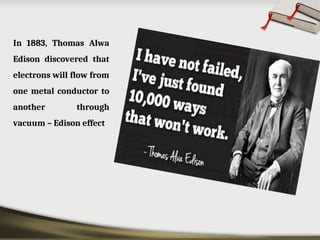
In 1883, Thomas Alwa
Edison discovered that
electrons will flow from
one metal conductor to
another through
vacuum – Edison effect
In 1904 John Fleming applied Edison
effect in inventing two element
electron tube called vacuum diode.
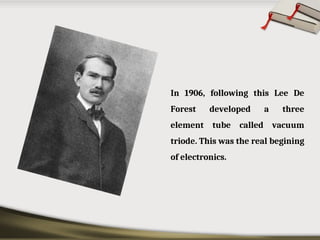
In 1906, following this Lee De
Forest developed a three
element tube called vacuum
triode. This was the real begining
of electronics.
In 1927, Marconi invented
radio which was the primary
form of education and
entertainment.
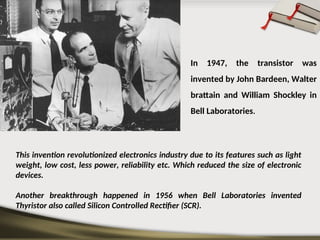
In 1947, the transistor was
invented by John Bardeen, Walter
brattain and William Shockley in
Bell Laboratories.
This invention revolutionized electronics industry due to its features such as light
weight, low cost, less power, reliability etc. Which reduced the size of electronic
devices.
Another breakthrough happened in 1956 when Bell Laboratories invented
Thyristor also called Silicon Controlled Rectifier (SCR).
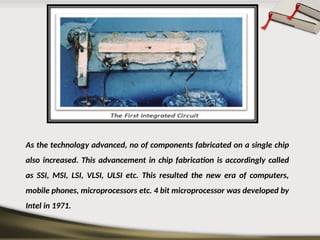
In 1958 Jack Kilby an engineer of Texas
instruments demonstrated the first IC.
Large no of electronic components could be
fabricated together on a single chip.
Beginning of microelectronics revolution.
In the year 2000 Jack Kilby won the Nobel
Prize in Physics for miniaturized electronic
circuits.
As the technology advanced, no of components fabricated on a single chip
also increased. This advancement in chip fabrication is accordingly called
as SSI, MSI, LSI, VLSI, ULSI etc. This resulted the new era of computers,
mobile phones, microprocessors etc. 4 bit microprocessor was developed by
Intel in 1971.
IMPACT OF ELECTRONICS IN MODERN WORLD
21st
century rely on electronics. Electronic technology is employed in
the field of Industry, Communication, Military, Entertainments,
Education, Automobiles, etc. In fact it is difficult to find an area where
electronic technology is not applied.
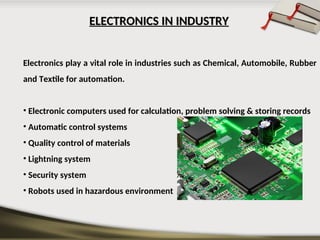
ELECTRONICS IN INDUSTRY
Electronics play a vital role in industries such as Chemical, Automobile, Rubber
and Textile for automation.
• Electronic computers used for calculation, problem solving & storing records
• Automatic control systems
• Quality control of materials
• Lightning system
• Security system
• Robots used in hazardous environment
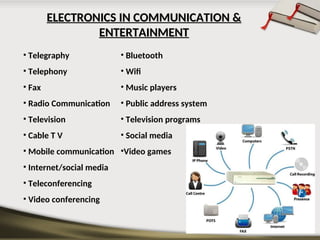
ELECTRONICS IN COMMUNICATION &
ENTERTAINMENT
ENTERTAINMENT
• Telegraphy
• Telephony
• Fax
• Radio Communication
• Television
• Cable T V
• Mobile communication
• Internet/social media
• Teleconferencing
• Video conferencing
• Bluetooth
• Wifi
• Music players
• Public address system
• Television programs
• Social media
•Video games
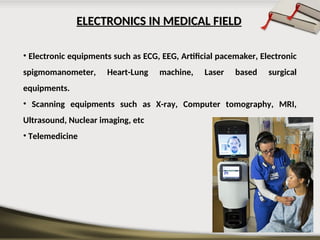
ELECTRONICS IN MEDICAL FIELD
• Electronic equipments such as ECG, EEG, Artificial pacemaker, Electronic
spigmomanometer, Heart-Lung machine, Laser based surgical
equipments.
• Scanning equipments such as X-ray, Computer tomography, MRI,
Ultrasound, Nuclear imaging, etc
• Telemedicine
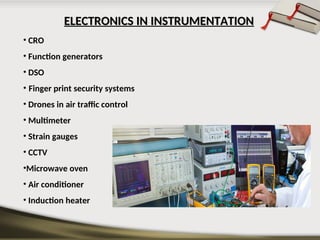
ELECTRONICS IN INSTRUMENTATION
• CRO
• Function generators
• DSO
• Finger print security systems
• Drones in air traffic control
• Multimeter
• Strain gauges
• CCTV
•Microwave oven
• Air conditioner
• Induction heater
ELECTRONICS IN DEFENCE
• RADAR
• Missiles
• Rocket launching
• SONAR
EMERGING ELECTRONICS
• Memristor
• Organic electronics
• Bio electronics
• LiFi
• Electronic textiles
• Organic LED
Evolution of Electronics Evolution of Electronics

Evolution of Electronics Evolution of Electronics

  • 1.
    EVOLUTION AND IMPACTOF ELECTRONICS
  • 2.
    WHAT IS ELECTRONICS……? Electronicsmeans study of flow of electrons in electrical circuits. Electronics is the branch of science that deals with the study of flow and control of electrons (electricity) and the study of their behavior and effects in vacuums, gases, and semiconductors
  • 3.
    ELECTRICAL V/S ELECTRONICSENGG Deals with the current flow in semiconductors. Most electronic components are very small, and require small direct current (DC) voltages (3 – 12V DC). Deals with the current flow in conductors. Electrical components tend to be larger, and use alternating current (AC) voltages (230V AC).
  • 4.
    EVOLUTION OF ELCTRONICS Evolutionof electronics is mainly through 3 key components 1.The vacuum tube 2.The transistor 3. The integrated circuits
  • 5.
    In 1883, ThomasAlwa Edison discovered that electrons will flow from one metal conductor to another through vacuum – Edison effect
  • 6.
    In 1904 JohnFleming applied Edison effect in inventing two element electron tube called vacuum diode.
  • 7.
    In 1906, followingthis Lee De Forest developed a three element tube called vacuum triode. This was the real begining of electronics.
  • 8.
    In 1927, Marconiinvented radio which was the primary form of education and entertainment.
  • 9.
    In 1947, thetransistor was invented by John Bardeen, Walter brattain and William Shockley in Bell Laboratories. This invention revolutionized electronics industry due to its features such as light weight, low cost, less power, reliability etc. Which reduced the size of electronic devices. Another breakthrough happened in 1956 when Bell Laboratories invented Thyristor also called Silicon Controlled Rectifier (SCR).
  • 10.
    In 1958 JackKilby an engineer of Texas instruments demonstrated the first IC. Large no of electronic components could be fabricated together on a single chip. Beginning of microelectronics revolution. In the year 2000 Jack Kilby won the Nobel Prize in Physics for miniaturized electronic circuits.
  • 11.
    As the technologyadvanced, no of components fabricated on a single chip also increased. This advancement in chip fabrication is accordingly called as SSI, MSI, LSI, VLSI, ULSI etc. This resulted the new era of computers, mobile phones, microprocessors etc. 4 bit microprocessor was developed by Intel in 1971.
  • 13.
    IMPACT OF ELECTRONICSIN MODERN WORLD IMPACT OF ELECTRONICS IN MODERN WORLD 21st century rely on electronics. Electronic technology is employed in the field of Industry, Communication, Military, Entertainments, Education, Automobiles, etc. In fact it is difficult to find an area where electronic technology is not applied.
  • 14.
    ELECTRONICS IN INDUSTRY ELECTRONICSIN INDUSTRY Electronics play a vital role in industries such as Chemical, Automobile, Rubber and Textile for automation. • Electronic computers used for calculation, problem solving & storing records • Automatic control systems • Quality control of materials • Lightning system • Security system • Robots used in hazardous environment
  • 15.
    ELECTRONICS IN COMMUNICATION& ELECTRONICS IN COMMUNICATION & ENTERTAINMENT ENTERTAINMENT • Telegraphy • Telephony • Fax • Radio Communication • Television • Cable T V • Mobile communication • Internet/social media • Teleconferencing • Video conferencing • Bluetooth • Wifi • Music players • Public address system • Television programs • Social media •Video games
  • 16.
    ELECTRONICS IN MEDICALFIELD ELECTRONICS IN MEDICAL FIELD • Electronic equipments such as ECG, EEG, Artificial pacemaker, Electronic spigmomanometer, Heart-Lung machine, Laser based surgical equipments. • Scanning equipments such as X-ray, Computer tomography, MRI, Ultrasound, Nuclear imaging, etc • Telemedicine
  • 17.
    ELECTRONICS IN INSTRUMENTATION ELECTRONICSIN INSTRUMENTATION • CRO • Function generators • DSO • Finger print security systems • Drones in air traffic control • Multimeter • Strain gauges • CCTV •Microwave oven • Air conditioner • Induction heater
  • 18.
    ELECTRONICS IN DEFENCE ELECTRONICSIN DEFENCE • RADAR • Missiles • Rocket launching • SONAR
  • 19.
    EMERGING ELECTRONICS EMERGING ELECTRONICS •Memristor • Organic electronics • Bio electronics • LiFi • Electronic textiles • Organic LED