Electron Microscopy
Presented to: Dr. Muhammad Waseem
Presented by: Rimsha Khan
2020-PHD-1187
Contents:
 What is Electron Microscope
 History of Electron Microscope
 Why do we need Electron Microscope?
 Types of Electron Microscope
 Scanning Electron Microscope
 Transmission Electron Microscope
 Advantages of Electron Microscopy
 Limitations of Electron Microscopy
 References
What is Electron Microscope?
A special type of Microscope having a high resolution of images, able to
magnify objects in nano meters, which are formed by controlled use of
electrons in vacuum captured on the screen.
Electron Microscopy:
Type of microscopy that uses beam of electrons to create an image of
sample, similar to optical microscopy except with electrons and photons.
Electron Microscope:
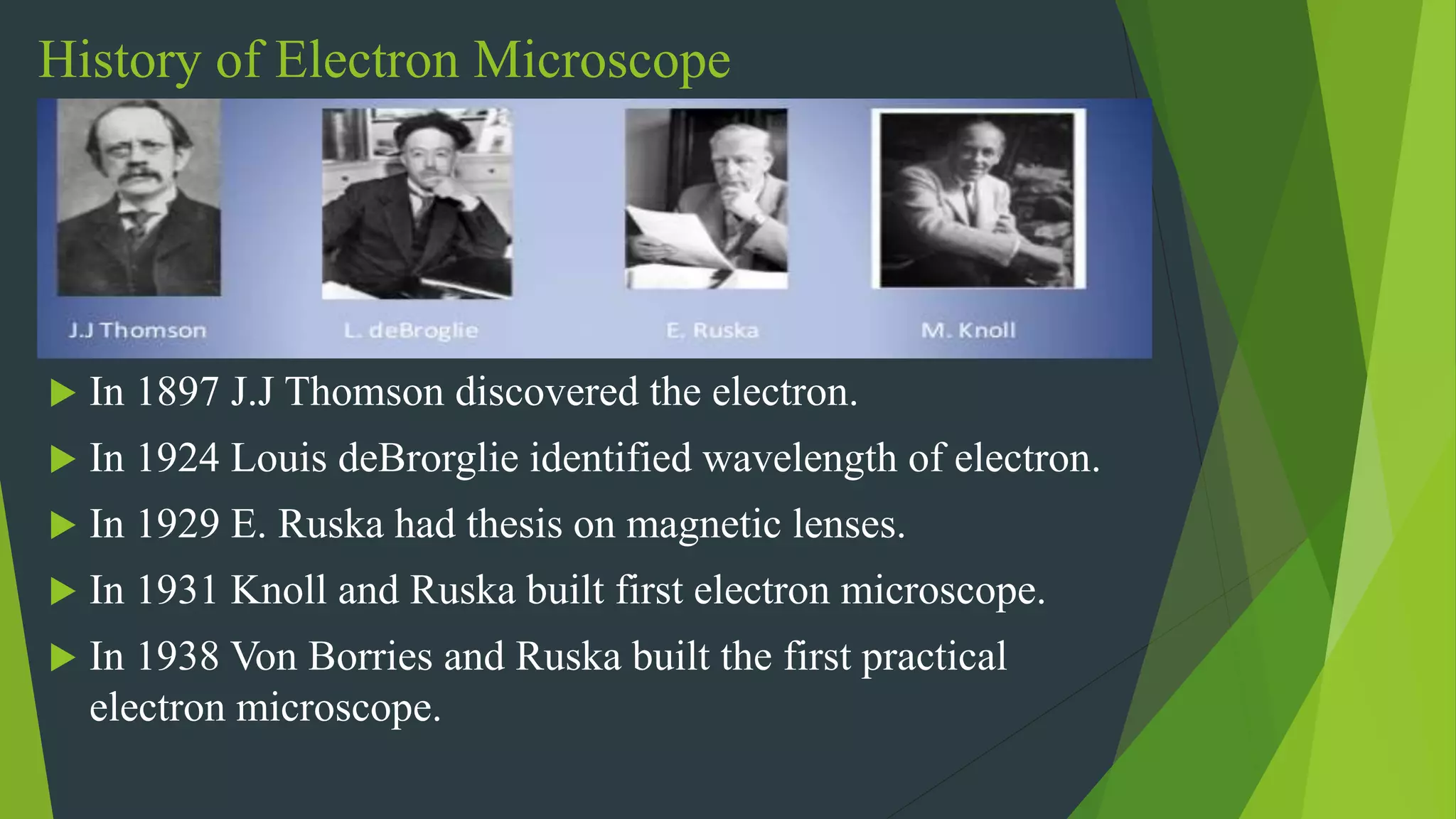
History of Electron Microscope
 In 1897 J.J Thomson discovered the electron.
 In 1924 Louis deBrorglie identified wavelength of electron.
 In 1929 E. Ruska had thesis on magnetic lenses.
 In 1931 Knoll and Ruska built first electron microscope.
 In 1938 Von Borries and Ruska built the first practical
electron microscope.
Why do we need Electron Microscope?
 Light microscope are limited by the physics of light to 500x or
1000x magnification and resolution of 0.2 micro meters.
 In 1930 It was an early scientific desire in biomedical research
to investigate the detailed structure of tissues, cells, organelles
and macromolecular complexes.
 This required 10,000x plus magnification which was not just
possible using electron microscope.
Light Microscope Comparison with Electron Microscope
Types of Electron Microscope
 Transmission Electron Microscopy (TEM)
(to study inner surfaces)
 Scanning Electron Microscopy (SEM)
(to study surface of objects)
Transmission Electron
Microscopy (TEM)
 Transmission electron
microscopy (TEM) is
a microscopy technique in which a beam
of electrons is transmitted through a
specimen to form an image.
 The specimen is most often an ultrathin
section less than 100 nm thick or a
suspension on a grid.
Scanning Electron Microscope
 A scanning electron microscope (SEM) is a
type of electron microscope that produces
images of a sample by scanning the surface
with a focused beam of electrons.
 The electrons interact with atoms in the
sample.
 It produce various signals that contain
information about the surface topography
and composition of the sample.
The Electron Beams in SEM:
These types of electron beams produce in SEM
 Secondary electrons (SE)
 Back Scattered electrons (BSE)
 X-Rays
 Light Rays (cathodoluminescence)
Advantages of Electron Microscopy
 As diagnostic tool in medicine : e.g. renal biopsy
 Cellular tomography: 3D images of sub cellular macromolecular
objects.
 Cancer research: to study tumor cells ultra structures
 Toxicology : scientific study of adverse effects that occur in living
organisms due to chemicals
 Virology: viral structures investigation.
 Cryo electron microscopy: Cryogenic electron microscopy is an
electron microscopy technique applied on samples cooled to cryogenic
temperatures. Surfaces images of frozen materials.
 Forensics: it detects undetectable presence of materials on evidences
 3D images of microorganisums
Limitations of Electron Microscopy
 The main disadvantages are cost, size, maintenance, researcher training and
image artifacts resulting from specimen preparation.
 This type of microscope is a large, cumbersome, expensive piece of equipment.
 Extremely sensitive to vibration and external magnetic fields.
 Extensive sample preparation.
 Time consuming process.
 Structure of sample may change during thin film of sample preparation .
References:
 https://www.slideshare.net/ISHRAKMAHADI/electron-microscope-
67879230
 https://www.google.com/search?bih=646&biw=1366&hl=en&sxsrf=A
LeKk03KNEqny55iSORaQk86NhkwOUaHMA%3A1603230298482&
ei=WlqPX_buHKyblwSG5rqgBA&q=limitations+of+electron+microsc
ope&oq=limitations+of+&gs_lcp=CgZwc3ktYWIQARgAMgcIABDJ
AxBDMgQIABBDMgQIABBDMgIIADICCAAyAggAMgIIADICCA
AyAggAMgIIADoHCCMQ6gIQJzoHCAAQsQMQQzoICAAQsQMQ
gwE6BQguELEDOgUIABCxAzoFCAAQkQI6DggAELEDEIMBEMk
DEJECOgcILhCxAxBDUI3HI1jR6yNg0PsjaAFwAXgAgAGaBIgB8i
CSAQoyLTEzLjAuMS4xmAEAoAEBqgEHZ3dzLXdperABCsABAQ
&sclient=psy-ab
 https://www.slideshare.net/search/slideshow?searchfrom=header&q=ele
ctron+microscopy

Electron Microscopy By Rimsha Khan.pptx

  • 1.
    Electron Microscopy Presented to:Dr. Muhammad Waseem Presented by: Rimsha Khan 2020-PHD-1187
  • 2.
    Contents:  What isElectron Microscope  History of Electron Microscope  Why do we need Electron Microscope?  Types of Electron Microscope  Scanning Electron Microscope  Transmission Electron Microscope  Advantages of Electron Microscopy  Limitations of Electron Microscopy  References
  • 3.
    What is ElectronMicroscope? A special type of Microscope having a high resolution of images, able to magnify objects in nano meters, which are formed by controlled use of electrons in vacuum captured on the screen. Electron Microscopy: Type of microscopy that uses beam of electrons to create an image of sample, similar to optical microscopy except with electrons and photons.
  • 4.
  • 5.
    History of ElectronMicroscope  In 1897 J.J Thomson discovered the electron.  In 1924 Louis deBrorglie identified wavelength of electron.  In 1929 E. Ruska had thesis on magnetic lenses.  In 1931 Knoll and Ruska built first electron microscope.  In 1938 Von Borries and Ruska built the first practical electron microscope.
  • 6.
    Why do weneed Electron Microscope?  Light microscope are limited by the physics of light to 500x or 1000x magnification and resolution of 0.2 micro meters.  In 1930 It was an early scientific desire in biomedical research to investigate the detailed structure of tissues, cells, organelles and macromolecular complexes.  This required 10,000x plus magnification which was not just possible using electron microscope.
  • 7.
    Light Microscope Comparisonwith Electron Microscope
  • 8.
    Types of ElectronMicroscope  Transmission Electron Microscopy (TEM) (to study inner surfaces)  Scanning Electron Microscopy (SEM) (to study surface of objects)
  • 9.
    Transmission Electron Microscopy (TEM) Transmission electron microscopy (TEM) is a microscopy technique in which a beam of electrons is transmitted through a specimen to form an image.  The specimen is most often an ultrathin section less than 100 nm thick or a suspension on a grid.
  • 10.
    Scanning Electron Microscope A scanning electron microscope (SEM) is a type of electron microscope that produces images of a sample by scanning the surface with a focused beam of electrons.  The electrons interact with atoms in the sample.  It produce various signals that contain information about the surface topography and composition of the sample.
  • 11.
    The Electron Beamsin SEM: These types of electron beams produce in SEM  Secondary electrons (SE)  Back Scattered electrons (BSE)  X-Rays  Light Rays (cathodoluminescence)
  • 13.
    Advantages of ElectronMicroscopy  As diagnostic tool in medicine : e.g. renal biopsy  Cellular tomography: 3D images of sub cellular macromolecular objects.  Cancer research: to study tumor cells ultra structures  Toxicology : scientific study of adverse effects that occur in living organisms due to chemicals  Virology: viral structures investigation.  Cryo electron microscopy: Cryogenic electron microscopy is an electron microscopy technique applied on samples cooled to cryogenic temperatures. Surfaces images of frozen materials.  Forensics: it detects undetectable presence of materials on evidences  3D images of microorganisums
  • 14.
    Limitations of ElectronMicroscopy  The main disadvantages are cost, size, maintenance, researcher training and image artifacts resulting from specimen preparation.  This type of microscope is a large, cumbersome, expensive piece of equipment.  Extremely sensitive to vibration and external magnetic fields.  Extensive sample preparation.  Time consuming process.  Structure of sample may change during thin film of sample preparation .
  • 15.