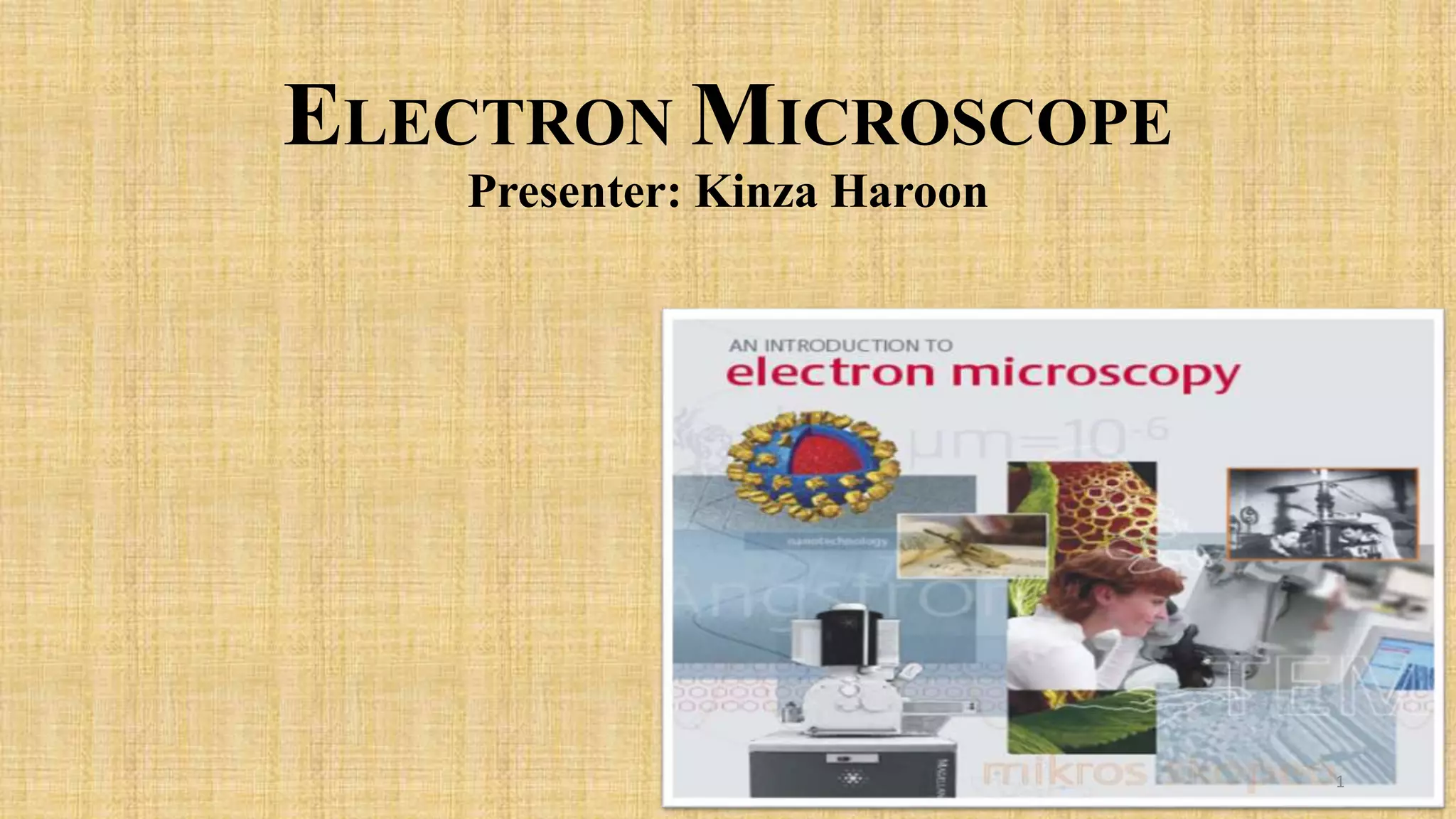
ELECTRON MICROSCOPE
Presenter: Kinza Haroon
1
History of Electron Microscope:
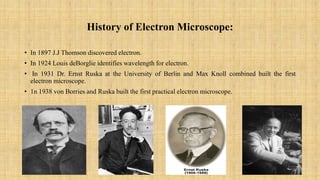
• In 1897 J.J Thomson discovered electron.
• In 1924 Louis deBorglie identifies wavelength for electron.
• In 1931 Dr. Ernst Ruska at the University of Berlin and Max Knoll combined built the first
electron microscope.
• 1n 1938 von Borries and Ruska built the first practical electron microscope.
2
Principle of Electron Microscope:
• In electron microscope, tungsten is heated by applying a high voltage current,
electron from a continues stream, which is used like a light beam. The lenses used
in EM are magnetic coils capable of focusing the electron beam on the specimen
and illuminating it. The strength of the magnetic lens depends upon the current
that flows through it. Greater the flow of the current, greater will be strength of the
magnetic field. The electron beam cannot pass through the glass lens.
3
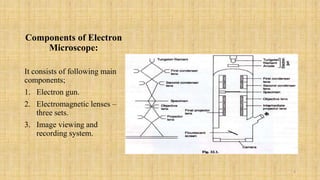
Components of Electron
Microscope:
It consists of following main
components;
1. Electron gun.
2. Electromagnetic lenses –
three sets.
3. Image viewing and
recording system.
4
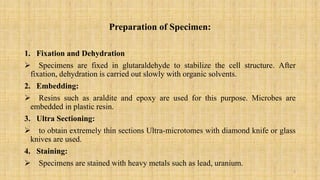
Preparation of Specimen:
1. Fixation and Dehydration
 Specimens are fixed in glutaraldehyde to stabilize the cell structure. After
fixation, dehydration is carried out slowly with organic solvents.
2. Embedding:
 Resins such as araldite and epoxy are used for this purpose. Microbes are
embedded in plastic resin.
3. Ultra Sectioning:
 to obtain extremely thin sections Ultra-microtomes with diamond knife or glass
knives are used.
4. Staining:
 Specimens are stained with heavy metals such as lead, uranium.
5
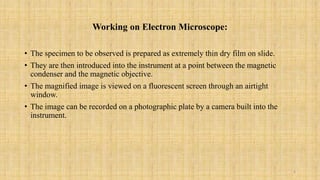
Working on Electron Microscope:
• The specimen to be observed is prepared as extremely thin dry film on slide.
• They are then introduced into the instrument at a point between the magnetic
condenser and the magnetic objective.
• The magnified image is viewed on a fluorescent screen through an airtight
window.
• The image can be recorded on a photographic plate by a camera built into the
instrument.
6
Types of Electron Microscope:
• There are two basic types of electron microscope:
1. Transmission Electron Microscope (TEM);
 Allows one to study of the inner structures.
2. Scanning Electron Microscope (SEM);
 Used to visualize the surface of object.
7
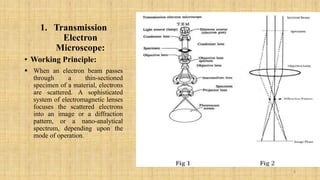
1. Transmission
Electron
Microscope:
• Working Principle:
 When an electron beam passes
through a thin-sectioned
specimen of a material, electrons
are scattered. A sophisticated
system of electromagnetic lenses
focuses the scattered electrons
into an image or a diffraction
pattern, or a nano-analytical
spectrum, depending upon the
mode of operation.
8
Biological Applications of TEM:
• Its applications in biological sciences are enormous in which some of them are
mentioned below;
Cancer research
Cellular tomography,
Toxicology,
Chemical identity,
Pollution nanotechnology.
9
Limitations of TEM:
• TEMs are large and very expensive.
• It is difficult to produce thin sample.
• Relatively time consuming process with a low throughput of samples.
• The structure of the sample may be changed during the preparation process.
• Require special housing and maintenance.
• Operation and analysis requires special training.
• Images are black and white.
10
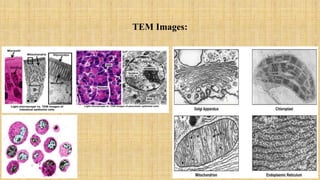
TEM Images:
11
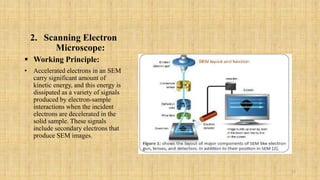
2. Scanning Electron
Microscope:
 Working Principle:
• Accelerated electrons in an SEM
carry significant amount of
kinetic energy, and this energy is
dissipated as a variety of signals
produced by electron-sample
interactions when the incident
electrons are decelerated in the
solid sample. These signals
include secondary electrons that
produce SEM images.
12
Biological Applications of SEM:
• For investigation of viral structure,
• Cryo-electron microscopy,
• 3D tissue imaging,
• Forensic sciences,
• For anatomical study of certain biological molecules,
• For visualization of intracellular changes,
• Used in ultra high vacuum, air, water and various liquid environment.
13
Limitations of SEM:
• SEMs are expensive and large.
• Special training is required to operate the SEM.
• SEMs are limited to solid sample.
• Couldn’t detect elements with atomic number less than 11.
14
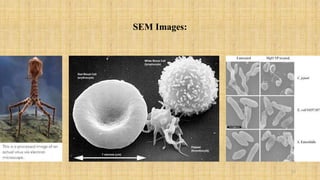
SEM Images:
15
Difference Between TEM and SEM;
TEM
• Electron beam passes through thin
sample.
• Higher resolution of 1nm or less.
• Expensive.
• Relatively detrimental to human
health.
• Image shown on fluorescent screen.
SEM
• Electron beam scans over surface of
sample.
• Shows only morphology of specimens.
• cheap.
• Relatively safe to use.
• Image shown on TV monitor.
16
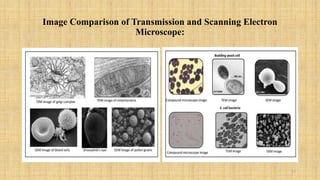
Image Comparison of Transmission and Scanning Electron
Microscope:
17
Conclusion;
• By the time electron microscope been invented it becomes a valuable tool in
development of scientific theories.
• It has contributed greatly in biological sciences, medicines, physical and chemical
sciences, its wide spread use is because, it has the ability to observe the material
up to nanometer and micrometer scale.
• Its fact that they are highly expensive but they are still widely used in research
field because they produce a detailed image of working specimen.
• In a nut shell, we can say that electron microscope invention made a revolution in
every field and brought a whole new universe.
18
19

Electron microscope 1

  • 1.
  • 2.
    History of ElectronMicroscope: • In 1897 J.J Thomson discovered electron. • In 1924 Louis deBorglie identifies wavelength for electron. • In 1931 Dr. Ernst Ruska at the University of Berlin and Max Knoll combined built the first electron microscope. • 1n 1938 von Borries and Ruska built the first practical electron microscope. 2
  • 3.
    Principle of ElectronMicroscope: • In electron microscope, tungsten is heated by applying a high voltage current, electron from a continues stream, which is used like a light beam. The lenses used in EM are magnetic coils capable of focusing the electron beam on the specimen and illuminating it. The strength of the magnetic lens depends upon the current that flows through it. Greater the flow of the current, greater will be strength of the magnetic field. The electron beam cannot pass through the glass lens. 3
  • 4.
    Components of Electron Microscope: Itconsists of following main components; 1. Electron gun. 2. Electromagnetic lenses – three sets. 3. Image viewing and recording system. 4
  • 5.
    Preparation of Specimen: 1.Fixation and Dehydration  Specimens are fixed in glutaraldehyde to stabilize the cell structure. After fixation, dehydration is carried out slowly with organic solvents. 2. Embedding:  Resins such as araldite and epoxy are used for this purpose. Microbes are embedded in plastic resin. 3. Ultra Sectioning:  to obtain extremely thin sections Ultra-microtomes with diamond knife or glass knives are used. 4. Staining:  Specimens are stained with heavy metals such as lead, uranium. 5
  • 6.
    Working on ElectronMicroscope: • The specimen to be observed is prepared as extremely thin dry film on slide. • They are then introduced into the instrument at a point between the magnetic condenser and the magnetic objective. • The magnified image is viewed on a fluorescent screen through an airtight window. • The image can be recorded on a photographic plate by a camera built into the instrument. 6
  • 7.
    Types of ElectronMicroscope: • There are two basic types of electron microscope: 1. Transmission Electron Microscope (TEM);  Allows one to study of the inner structures. 2. Scanning Electron Microscope (SEM);  Used to visualize the surface of object. 7
  • 8.
    1. Transmission Electron Microscope: • WorkingPrinciple:  When an electron beam passes through a thin-sectioned specimen of a material, electrons are scattered. A sophisticated system of electromagnetic lenses focuses the scattered electrons into an image or a diffraction pattern, or a nano-analytical spectrum, depending upon the mode of operation. 8
  • 9.
    Biological Applications ofTEM: • Its applications in biological sciences are enormous in which some of them are mentioned below; Cancer research Cellular tomography, Toxicology, Chemical identity, Pollution nanotechnology. 9
  • 10.
    Limitations of TEM: •TEMs are large and very expensive. • It is difficult to produce thin sample. • Relatively time consuming process with a low throughput of samples. • The structure of the sample may be changed during the preparation process. • Require special housing and maintenance. • Operation and analysis requires special training. • Images are black and white. 10
  • 11.
  • 12.
    2. Scanning Electron Microscope: Working Principle: • Accelerated electrons in an SEM carry significant amount of kinetic energy, and this energy is dissipated as a variety of signals produced by electron-sample interactions when the incident electrons are decelerated in the solid sample. These signals include secondary electrons that produce SEM images. 12
  • 13.
    Biological Applications ofSEM: • For investigation of viral structure, • Cryo-electron microscopy, • 3D tissue imaging, • Forensic sciences, • For anatomical study of certain biological molecules, • For visualization of intracellular changes, • Used in ultra high vacuum, air, water and various liquid environment. 13
  • 14.
    Limitations of SEM: •SEMs are expensive and large. • Special training is required to operate the SEM. • SEMs are limited to solid sample. • Couldn’t detect elements with atomic number less than 11. 14
  • 15.
  • 16.
    Difference Between TEMand SEM; TEM • Electron beam passes through thin sample. • Higher resolution of 1nm or less. • Expensive. • Relatively detrimental to human health. • Image shown on fluorescent screen. SEM • Electron beam scans over surface of sample. • Shows only morphology of specimens. • cheap. • Relatively safe to use. • Image shown on TV monitor. 16
  • 17.
    Image Comparison ofTransmission and Scanning Electron Microscope: 17
  • 18.
    Conclusion; • By thetime electron microscope been invented it becomes a valuable tool in development of scientific theories. • It has contributed greatly in biological sciences, medicines, physical and chemical sciences, its wide spread use is because, it has the ability to observe the material up to nanometer and micrometer scale. • Its fact that they are highly expensive but they are still widely used in research field because they produce a detailed image of working specimen. • In a nut shell, we can say that electron microscope invention made a revolution in every field and brought a whole new universe. 18
  • 19.