ELECTRON
MICROSCOPE
Dr. P. Suganya
Assistant Professor
Sri Kaliswari College (Autonomous)
Sivakasi
Definition
• An electron microscope is a microscope that uses a beam of
accelerated electrons as a source of illumination.
• It is a special type of microscope having a high resolution of
images, able to magnify objects in nanometers, which are
formed by controlled use of electrons in vacuum captured
on a phosphorescent screen.
• Ernst Ruska (1906-1988), a German engineer and
academic professor, built the first Electron Microscope in
1931, and the same principles behind his prototype still
govern modern EMs.
History
• The first prototype electron microscope, capable of
four-hundred-power magnification, was developed in
1931 by the physicist Ernst Ruska and the electrical
engineer Max Knoll. The apparatus was the first
practical demonstration of the principles of electron
microscopy.
Working Principle
• Electron microscopes use signals arising from the interaction of
an electron beam with the sample to obtain information about
structure, morphology, and composition.
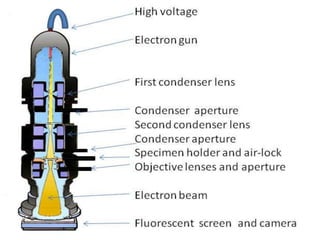
• The electron gun generates electrons.
• Two sets of condenser lenses focus the electron beam on the
specimen and then into a thin tight beam.
• .
• To move electrons down the column, an accelerating voltage
(mostly between 100 kV-1000 kV) is applied between
tungsten filament and anode.
• The specimen to be examined is made extremely thin, at least
200 times thinner than those used in the optical microscope.
Ultra-thin sections of 20-100 nm are cut which is already
placed on the specimen holder
• The electronic beam passes through the specimen and electrons are
scattered depending upon the thickness or refractive index of different
parts of the specimen.
• The denser regions in the specimen scatter more electrons and therefore
appear darker in the image since fewer electrons strike that area of the
screen. In contrast, transparent regions are brighter.
• The electron beam coming out of the specimen passes to the objective
lens, which has high power and forms the intermediate magnified image.
• The ocular lenses then produce the final further magnified image.
Types of Electron microscope
• There are two types of electron microscopes, with
different operating styles:
TEM (Transmission Electron Microscope)
SEM (Scanning Electron Microscope)
The transmission electron
microscope (TEM)
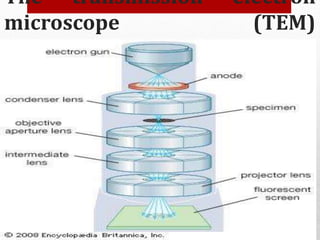
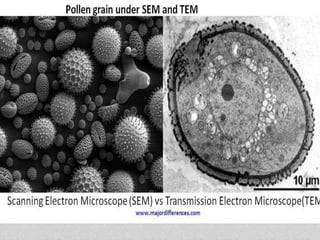
• The transmission electron microscope is used to view thin
specimens through which electrons can pass generating a
projection image.
• The TEM is analogous in many ways to the conventional
(compound) light microscope.
• TEM is used, among other things, to image the interior of cells
(in thin sections), the structure of protein molecules
(contrasted by metal shadowing), the organization of molecules
in viruses and cytoskeletal filaments (prepared by the negative
staining technique), and the arrangement of protein molecules
in cell membranes (by freeze-fracture).
The scanning electron
microscope (SEM)
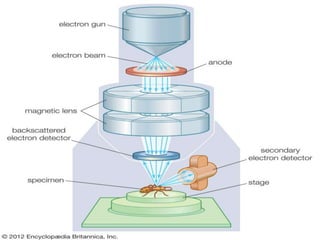
• Conventional scanning electron microscopy depends
on the emission of secondary electrons from the
surface of a specimen.
• Because of its great depth of focus, a scanning
electron microscope is the EM analog of a stereo light
microscope.
• It provides detailed images of the surfaces of cells
and whole organisms that are not possible by TEM. It
can also be used for particle counting and size
determination, and for process control.
• It is termed a scanning electron microscope because
the image is formed by scanning a focused electron
beam onto the surface of the specimen in a raster
pattern.
Parts of Electron microscope
• EM is in the form of a tall vacuum column which is vertically mounted. It has
the following components:
• Electron gun
• The electron gun is a heated tungsten filament, which generates electrons.
• Electromagnetic lenses
• Condenser lens focuses the electron beam on the specimen. A second
condenser lens forms the electrons into a thin tight beam.
• The electron beam coming out of the specimen passes down the second of
magnetic coils called the objective lens, which has high power and forms the
intermediate magnified image.
• The third set of magnetic lenses called projector (ocular) lenses produce the
final further magnified image.
• Each of these lenses acts as an image magnifier all the while maintaining an
incredible level of detail and resolution.
• Specimen Holder
• The specimen holder is an extremely thin film of carbon or collodion held by a
metal grid.
• Image viewing and Recording System.
• The final image is projected on a fluorescent screen.
• Below the fluorescent screen is a camera for recording the image
Applications
• Electron microscopes are used to investigate the ultrastructure of
a wide range of biological and inorganic specimens including
microorganisms, cells, large molecules, biopsy samples, metals,
and crystals.
• Industrially, electron microscopes are often used for quality
control and failure analysis.
• Modern electron microscopes produce electron micrographs using
specialized digital cameras and frame grabbers to capture the
images.
• Science of microbiology owes its development to the electron
microscope. Study of microorganisms like bacteria, virus and other
pathogens have made the treatment of diseases very effective.
Advantages
• Very high magnification
• Incredibly high resolution
• Material rarely distorted by preparation
• It is possible to investigate a greater depth of field
• Diverse applications
Limitation
• The live specimen cannot be observed.
• As the penetration power of the electron beam is very low, the
object should be ultra-thin. For this, the specimen is dried and cut
into ultra-thin sections before observation.
• As the EM works in a vacuum, the specimen should be completely
dry.
• Expensive to build and maintain
• Requiring researcher training
• Image artifacts resulting from specimen preparation.
• This type of microscope is a large, cumbersome extremely
sensitive to vibration and external magnetic fields.
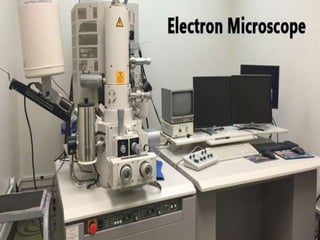
Electron microscope
Electron microscope
Electron microscope
Electron microscope
Electron microscope

Electron microscope

  • 1.
    ELECTRON MICROSCOPE Dr. P. Suganya AssistantProfessor Sri Kaliswari College (Autonomous) Sivakasi
  • 2.
    Definition • An electronmicroscope is a microscope that uses a beam of accelerated electrons as a source of illumination. • It is a special type of microscope having a high resolution of images, able to magnify objects in nanometers, which are formed by controlled use of electrons in vacuum captured on a phosphorescent screen. • Ernst Ruska (1906-1988), a German engineer and academic professor, built the first Electron Microscope in 1931, and the same principles behind his prototype still govern modern EMs.
  • 3.
    History • The firstprototype electron microscope, capable of four-hundred-power magnification, was developed in 1931 by the physicist Ernst Ruska and the electrical engineer Max Knoll. The apparatus was the first practical demonstration of the principles of electron microscopy.
  • 6.
    Working Principle • Electronmicroscopes use signals arising from the interaction of an electron beam with the sample to obtain information about structure, morphology, and composition. • The electron gun generates electrons. • Two sets of condenser lenses focus the electron beam on the specimen and then into a thin tight beam. • .
  • 7.
    • To moveelectrons down the column, an accelerating voltage (mostly between 100 kV-1000 kV) is applied between tungsten filament and anode. • The specimen to be examined is made extremely thin, at least 200 times thinner than those used in the optical microscope. Ultra-thin sections of 20-100 nm are cut which is already placed on the specimen holder
  • 8.
    • The electronicbeam passes through the specimen and electrons are scattered depending upon the thickness or refractive index of different parts of the specimen. • The denser regions in the specimen scatter more electrons and therefore appear darker in the image since fewer electrons strike that area of the screen. In contrast, transparent regions are brighter. • The electron beam coming out of the specimen passes to the objective lens, which has high power and forms the intermediate magnified image. • The ocular lenses then produce the final further magnified image.
  • 9.
    Types of Electronmicroscope • There are two types of electron microscopes, with different operating styles: TEM (Transmission Electron Microscope) SEM (Scanning Electron Microscope)
  • 10.
  • 11.
    • The transmissionelectron microscope is used to view thin specimens through which electrons can pass generating a projection image. • The TEM is analogous in many ways to the conventional (compound) light microscope. • TEM is used, among other things, to image the interior of cells (in thin sections), the structure of protein molecules (contrasted by metal shadowing), the organization of molecules in viruses and cytoskeletal filaments (prepared by the negative staining technique), and the arrangement of protein molecules in cell membranes (by freeze-fracture).
  • 12.
  • 13.
    • Conventional scanningelectron microscopy depends on the emission of secondary electrons from the surface of a specimen. • Because of its great depth of focus, a scanning electron microscope is the EM analog of a stereo light microscope. • It provides detailed images of the surfaces of cells and whole organisms that are not possible by TEM. It can also be used for particle counting and size determination, and for process control. • It is termed a scanning electron microscope because the image is formed by scanning a focused electron beam onto the surface of the specimen in a raster pattern.
  • 14.
    Parts of Electronmicroscope • EM is in the form of a tall vacuum column which is vertically mounted. It has the following components: • Electron gun • The electron gun is a heated tungsten filament, which generates electrons. • Electromagnetic lenses • Condenser lens focuses the electron beam on the specimen. A second condenser lens forms the electrons into a thin tight beam. • The electron beam coming out of the specimen passes down the second of magnetic coils called the objective lens, which has high power and forms the intermediate magnified image. • The third set of magnetic lenses called projector (ocular) lenses produce the final further magnified image. • Each of these lenses acts as an image magnifier all the while maintaining an incredible level of detail and resolution. • Specimen Holder • The specimen holder is an extremely thin film of carbon or collodion held by a metal grid. • Image viewing and Recording System. • The final image is projected on a fluorescent screen. • Below the fluorescent screen is a camera for recording the image
  • 15.
    Applications • Electron microscopesare used to investigate the ultrastructure of a wide range of biological and inorganic specimens including microorganisms, cells, large molecules, biopsy samples, metals, and crystals. • Industrially, electron microscopes are often used for quality control and failure analysis. • Modern electron microscopes produce electron micrographs using specialized digital cameras and frame grabbers to capture the images. • Science of microbiology owes its development to the electron microscope. Study of microorganisms like bacteria, virus and other pathogens have made the treatment of diseases very effective.
  • 16.
    Advantages • Very highmagnification • Incredibly high resolution • Material rarely distorted by preparation • It is possible to investigate a greater depth of field • Diverse applications
  • 17.
    Limitation • The livespecimen cannot be observed. • As the penetration power of the electron beam is very low, the object should be ultra-thin. For this, the specimen is dried and cut into ultra-thin sections before observation. • As the EM works in a vacuum, the specimen should be completely dry. • Expensive to build and maintain • Requiring researcher training • Image artifacts resulting from specimen preparation. • This type of microscope is a large, cumbersome extremely sensitive to vibration and external magnetic fields.