ELECTROMAGNETIC
RADIATION
ELECTROMAGNETIC RADIATION
•Definition – a form of energy generated
through free pace or through a medium in the
form of electromagnetic waves. It includes
radio waves, microwaves, infrared, visible light,
ultraviolet, X-rays and gamma rays.
•Electromagnetic radiation is dual in nature – it
exhibits wave properties and particulate
WAVE PROPERTIES
WAVE PROPERTIES
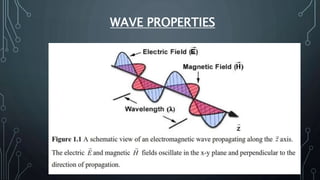
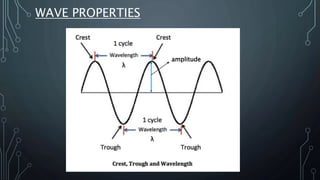
•Waves are characterised by frequency,
wavelength and amplitude
• Frequency (ν) – is the number of waves (cycles) per
second
• Wavelength (λ) – is the distance between two
consecutive peaks or troughs in a wave
• Wavenumber (ν͠ ) – the number of waves crests (or troughs) in
a given length
WAVE PROPERTIES
amplitude
WAVE PROPERTIES
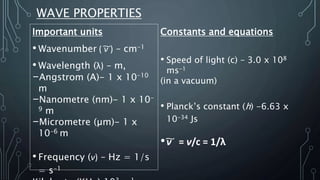
Important units
• Wavenumber ( ν͠ ) – cm-1
• Wavelength (λ) – m,
-Angstrom (A)- 1 x 10⁻¹⁰
m
-Nanometre (nm)- 1 x 10-
9 m
-Micrometre (µm)- 1 x
10-6 m
• Frequency (ν) – Hz = 1/s
= s-1
Constants and equations
• Speed of light (c) – 3.0 x 10⁸
ms-1
(in a vacuum)
• Planck’s constant (h) -6.63 x
10-34 Js
•ν͠ = ν/c = 1/λ
PARTICULATE (PHOTON)
PROPERTIES
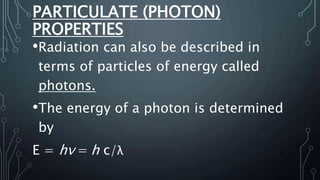
•Radiation can also be described in
terms of particles of energy called
photons.
•The energy of a photon is determined
by
E = hν = h c/λ
WORKED EXAMPLE
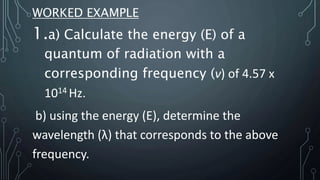
1.a) Calculate the energy (E) of a
quantum of radiation with a
corresponding frequency (ν) of 4.57 x
1014 Hz.
b) using the energy (E), determine the
wavelength (λ) that corresponds to the above
frequency.
WORKED EXAMPLE
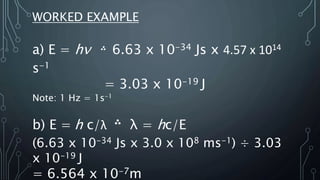
a) E = hν
֒ 6.63 x 10-34 Js x 4.57 x 1014
s-1
= 3.03 x 10⁻¹⁹ J
Note: 1 Hz = 1s-1
b) E = h c/λ
֒ λ = hc/E
(6.63 x 10-34 Js x 3.0 x 108 ms-1) ÷ 3.03
x 10-19 J
= 6.564 x 10⁻⁷m
CALCULATION HOMEWORK
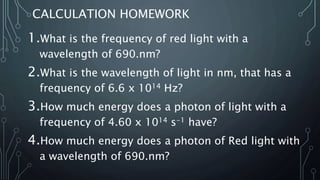
1.What is the frequency of red light with a
wavelength of 690.nm?
2.What is the wavelength of light in nm, that has a
frequency of 6.6 x 10¹⁴ Hz?
3.How much energy does a photon of light with a
frequency of 4.60 x 10¹⁴ s-1 have?
4.How much energy does a photon of Red light with
a wavelength of 690.nm?
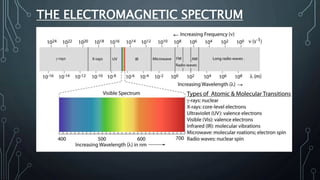
THE ELECTROMAGNETIC SPECTRUM
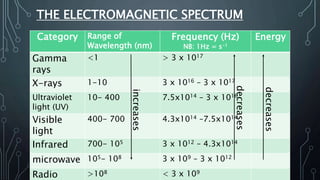
Category Range of
Wavelength (nm)
Frequency (Hz)
NB: 1Hz = s-1
Energy
Gamma
rays
<1 > 3 x 10¹⁷
X-rays 1-10 3 x 10¹⁶ – 3 x 10¹⁷
Ultraviolet
light (UV)
10- 400 7.5x10¹⁴ – 3 x 10¹⁶
Visible
light
400- 700 4.3x10¹⁴ –7.5x10¹⁴
Infrared 700- 105 3 x 10¹² – 4.3x10¹⁴
microwave 105- 108 3 x 10⁹ – 3 x 10¹²
Radio >108 < 3 x 10⁹
increases
decreases
decreases
DANGERS OF HIGH ENERGY WAVELENGTHS PENETRATING ABILITY
OF EM RADIATION
• Different frequencies of EM radiation have different degrees of
penetration. For example, if we take the human body as the object,
visible light is reflected off the surface of the human body, ultra-violet
light (from sunlight) damages the skin, but X-rays are able to penetrate
the skin and bone and allow for pictures of the inside of the human
body to be taken.
• If we compare the energy of visible light to the energy of X-rays, we
find that X-rays have a much higher energy. Usually, electromagnetic
radiation with higher (energy) have a higher degree of penetration than
those with low frequency.
• Certain kinds of electromagnetic radiation such as ultra-violet
radiation, X-rays and gamma rays are very dangerous. Radiation such
as these are called ionising radiation. Ionising radiation transfers
energy as it passes through matter, breaking molecular bonds and
creating ions.
• Excessive exposure to radiation, including sunlight, X-rays and all
ENERGY LEVELS IN ATOMS AND MOLECULES
• E = hν also useful in calculating the energy of a quantum of radiation in an
atom or molecule.
• Recall the assumption that electrons in an atom only exist at
certain energy levels and energy levels are fixed (quantised)
• When sufficient energy is supplied an electron can be promoted
(excited) from a lower energy level to a higher one.
• The electron is unstable at a higher energy level and emits
(releases) the excess energy (as radiation) to return to the lower
energy level.
• If the frequencies that correspond to the radiation emitted falls
within the visible region, the radiation will have colour.

Electromagnetic radiation

  • 1.
  • 2.
    ELECTROMAGNETIC RADIATION •Definition –a form of energy generated through free pace or through a medium in the form of electromagnetic waves. It includes radio waves, microwaves, infrared, visible light, ultraviolet, X-rays and gamma rays. •Electromagnetic radiation is dual in nature – it exhibits wave properties and particulate
  • 3.
  • 4.
    WAVE PROPERTIES •Waves arecharacterised by frequency, wavelength and amplitude • Frequency (ν) – is the number of waves (cycles) per second • Wavelength (λ) – is the distance between two consecutive peaks or troughs in a wave • Wavenumber (ν͠ ) – the number of waves crests (or troughs) in a given length
  • 5.
  • 6.
    WAVE PROPERTIES Important units •Wavenumber ( ν͠ ) – cm-1 • Wavelength (λ) – m, -Angstrom (A)- 1 x 10⁻¹⁰ m -Nanometre (nm)- 1 x 10- 9 m -Micrometre (µm)- 1 x 10⁻⁶ m • Frequency (ν) – Hz = 1/s = s-1 Constants and equations • Speed of light (c) – 3.0 x 10⁸ ms-1 (in a vacuum) • Planck’s constant (h) -6.63 x 10⁻³⁴ Js •ν͠ = ν/c = 1/λ
  • 7.
    PARTICULATE (PHOTON) PROPERTIES •Radiation canalso be described in terms of particles of energy called photons. •The energy of a photon is determined by E = hν = h c/λ
  • 8.
    WORKED EXAMPLE 1.a) Calculatethe energy (E) of a quantum of radiation with a corresponding frequency (ν) of 4.57 x 10¹⁴ Hz. b) using the energy (E), determine the wavelength (λ) that corresponds to the above frequency.
  • 9.
    WORKED EXAMPLE a) E= hν ֒ 6.63 x 10-34 Js x 4.57 x 1014 s-1 = 3.03 x 10⁻¹⁹ J Note: 1 Hz = 1s-1 b) E = h c/λ ֒ λ = hc/E (6.63 x 10-34 Js x 3.0 x 108 ms-1) ÷ 3.03 x 10⁻¹⁹ J = 6.564 x 10⁻⁷m
  • 10.
    CALCULATION HOMEWORK 1.What isthe frequency of red light with a wavelength of 690.nm? 2.What is the wavelength of light in nm, that has a frequency of 6.6 x 10¹⁴ Hz? 3.How much energy does a photon of light with a frequency of 4.60 x 10¹⁴ s-1 have? 4.How much energy does a photon of Red light with a wavelength of 690.nm?
  • 11.
  • 12.
    THE ELECTROMAGNETIC SPECTRUM CategoryRange of Wavelength (nm) Frequency (Hz) NB: 1Hz = s-1 Energy Gamma rays <1 > 3 x 10¹⁷ X-rays 1-10 3 x 10¹⁶ – 3 x 10¹⁷ Ultraviolet light (UV) 10- 400 7.5x10¹⁴ – 3 x 10¹⁶ Visible light 400- 700 4.3x10¹⁴ –7.5x10¹⁴ Infrared 700- 105 3 x 10¹² – 4.3x10¹⁴ microwave 105- 108 3 x 10⁹ – 3 x 10¹² Radio >108 < 3 x 10⁹ increases decreases decreases
  • 13.
    DANGERS OF HIGHENERGY WAVELENGTHS PENETRATING ABILITY OF EM RADIATION • Different frequencies of EM radiation have different degrees of penetration. For example, if we take the human body as the object, visible light is reflected off the surface of the human body, ultra-violet light (from sunlight) damages the skin, but X-rays are able to penetrate the skin and bone and allow for pictures of the inside of the human body to be taken. • If we compare the energy of visible light to the energy of X-rays, we find that X-rays have a much higher energy. Usually, electromagnetic radiation with higher (energy) have a higher degree of penetration than those with low frequency. • Certain kinds of electromagnetic radiation such as ultra-violet radiation, X-rays and gamma rays are very dangerous. Radiation such as these are called ionising radiation. Ionising radiation transfers energy as it passes through matter, breaking molecular bonds and creating ions. • Excessive exposure to radiation, including sunlight, X-rays and all
  • 14.
    ENERGY LEVELS INATOMS AND MOLECULES • E = hν also useful in calculating the energy of a quantum of radiation in an atom or molecule. • Recall the assumption that electrons in an atom only exist at certain energy levels and energy levels are fixed (quantised) • When sufficient energy is supplied an electron can be promoted (excited) from a lower energy level to a higher one. • The electron is unstable at a higher energy level and emits (releases) the excess energy (as radiation) to return to the lower energy level. • If the frequencies that correspond to the radiation emitted falls within the visible region, the radiation will have colour.