Electromagnetic Radiation
(EMR)
Prepared by : Museera Sardar
Spectroscopy
The study of interaction of electromagnetic radiation (EMR) with material (atom
or molecule )
Radiation
Energy travelling from one place to another.
Electromagnetic Radiation :(EMR)
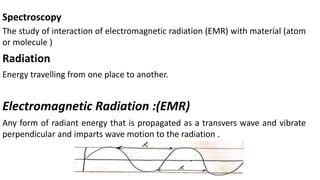
Any form of radiant energy that is propagated as a transvers wave and vibrate
perpendicular and imparts wave motion to the radiation .
Terms Related with EMR
1. Wave Length
The distance between two consecutive crust or trough. OR The distance of one
complete cycle.
Unit:m, cm, nm, pm, A`
Represented by: λ
2. Frequency
The number of vibration or cycle completed per second is called frequency.
Represented by: v (n`u )
Unit: s−1 or HZ
3. Wave number
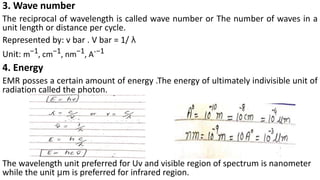
The reciprocal of wavelength is called wave number or The number of waves in a
unit length or distance per cycle.
Represented by: v bar . V bar = 1/ λ
Unit: m−1, cm−1, nm−1, A`−1
4. Energy
EMR posses a certain amount of energy .The energy of ultimately indivisible unit of
radiation called the photon.
The wavelength unit preferred for Uv and visible region of spectrum is nanometer
while the unit μm is preferred for infrared region.
EMR Spectrum
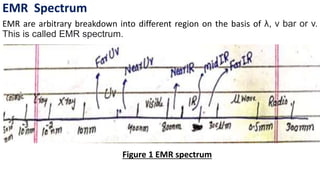
EMR are arbitrary breakdown into different region on the basis of λ, v bar or v.
This is called EMR spectrum.
Figure 1 EMR spectrum
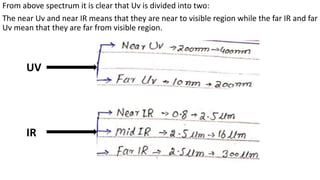
From above spectrum it is clear that Uv is divided into two:
The near Uv and near IR means that they are near to visible region while the far IR and far
Uv mean that they are far from visible region.
UV
IR
Visible Region
• Visible region range from 400-800nm
• It is consist of 7colors: VIBGYOR
How dose we see colors?
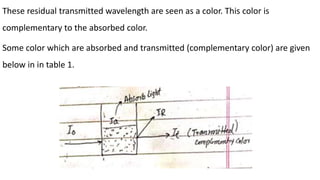
We see objects color because they transmit only a portion of the spectrum of
white light when illuminated by white light .
When polychromatic light (white light ) which contain the whole spectrum of
wavelengths in the object, The visible region passes through an object, The object
absorbs certain of the wavelength, leaving the unabsorbed wavelength to be
transmitted.
These residual transmitted wavelength are seen as a color. This color is
complementary to the absorbed color.
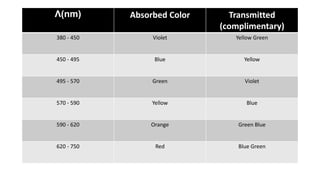
Some color which are absorbed and transmitted (complementary color) are given
below in in table 1.
Λ(nm) Absorbed Color Transmitted
(complimentary)
380 - 450 Violet Yellow Green
450 - 495 Blue Yellow
495 - 570 Green Violet
570 - 590 Yellow Blue
590 - 620 Orange Green Blue
620 - 750 Red Blue Green

Electromagnetic Radiation (EMR).pptx

  • 1.
  • 2.
    Spectroscopy The study ofinteraction of electromagnetic radiation (EMR) with material (atom or molecule ) Radiation Energy travelling from one place to another. Electromagnetic Radiation :(EMR) Any form of radiant energy that is propagated as a transvers wave and vibrate perpendicular and imparts wave motion to the radiation .
  • 3.
    Terms Related withEMR 1. Wave Length The distance between two consecutive crust or trough. OR The distance of one complete cycle. Unit:m, cm, nm, pm, A` Represented by: λ 2. Frequency The number of vibration or cycle completed per second is called frequency. Represented by: v (n`u ) Unit: s−1 or HZ
  • 4.
    3. Wave number Thereciprocal of wavelength is called wave number or The number of waves in a unit length or distance per cycle. Represented by: v bar . V bar = 1/ λ Unit: m−1, cm−1, nm−1, A`−1 4. Energy EMR posses a certain amount of energy .The energy of ultimately indivisible unit of radiation called the photon. The wavelength unit preferred for Uv and visible region of spectrum is nanometer while the unit μm is preferred for infrared region.
  • 5.
    EMR Spectrum EMR arearbitrary breakdown into different region on the basis of λ, v bar or v. This is called EMR spectrum. Figure 1 EMR spectrum
  • 6.
    From above spectrumit is clear that Uv is divided into two: The near Uv and near IR means that they are near to visible region while the far IR and far Uv mean that they are far from visible region. UV IR
  • 7.
    Visible Region • Visibleregion range from 400-800nm • It is consist of 7colors: VIBGYOR How dose we see colors? We see objects color because they transmit only a portion of the spectrum of white light when illuminated by white light . When polychromatic light (white light ) which contain the whole spectrum of wavelengths in the object, The visible region passes through an object, The object absorbs certain of the wavelength, leaving the unabsorbed wavelength to be transmitted.
  • 8.
    These residual transmittedwavelength are seen as a color. This color is complementary to the absorbed color. Some color which are absorbed and transmitted (complementary color) are given below in in table 1.
  • 9.
    Λ(nm) Absorbed ColorTransmitted (complimentary) 380 - 450 Violet Yellow Green 450 - 495 Blue Yellow 495 - 570 Green Violet 570 - 590 Yellow Blue 590 - 620 Orange Green Blue 620 - 750 Red Blue Green