Introduction to the
electromagnetic spectrum
Introduction to Spectroscopy
• Electromagnetic radiation is one of many ways in which energy
travels through space.
• As chemists we study how electromagnetic radiation interact with
atoms and molecules (Spectroscopy).
• Electromagnetic radiation (light) exhibit wave like properties.
• These waves are usually described in terms of its wavelength (l)
and frequency (n).
Copyright © 2017 John Wiley & Sons, Inc. All rights reserved. 14-2 Klein, Organic Chemistry 3e
Introduction to Spectroscopy
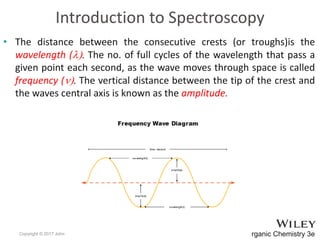
• The distance between the consecutive crests (or troughs)is the
wavelength (l). The no. of full cycles of the wavelength that pass a
given point each second, as the wave moves through space is called
frequency (n). The vertical distance between the tip of the crest and
the waves central axis is known as the amplitude.
Copyright © 2017 John Wiley & Sons, Inc. All rights reserved. 14-3 Klein, Organic Chemistry 3e
Properties of Waves
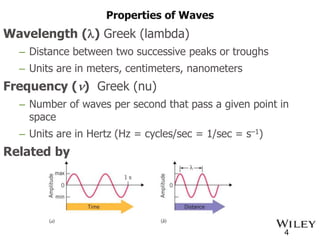
Wavelength (l) Greek (lambda)
– Distance between two successive peaks or troughs
– Units are in meters, centimeters, nanometers
Frequency (n) Greek (nu)
– Number of waves per second that pass a given point in
space
– Units are in Hertz (Hz = cycles/sec = 1/sec = s–1)
Related by
4
Introduction to Spectroscopy
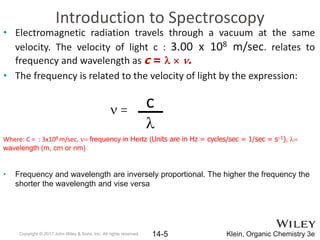
• Electromagnetic radiation travels through a vacuum at the same
velocity. The velocity of light c : 3.00 x 10⁸ m/sec. relates to
frequency and wavelength as c = l  n.
• The frequency is related to the velocity of light by the expression:
n =
Where: C = : 3x10⁸ m/sec, n= frequency in Hertz (Units are in Hz = cycles/sec = 1/sec = s–1), l=
wavelength (m, cm or nm)
• Frequency and wavelength are inversely proportional. The higher the frequency the
shorter the wavelength and vise versa
Copyright © 2017 John Wiley & Sons, Inc. All rights reserved. 14-5 Klein, Organic Chemistry 3e
c
l
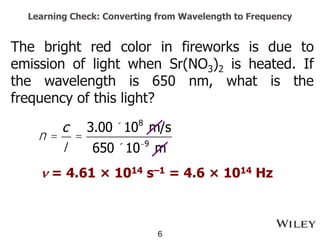
Learning Check: Converting from Wavelength to Frequency
The bright red color in fireworks is due to
emission of light when Sr(NO3)2 is heated. If
the wavelength is 650 nm, what is the
frequency of this light?
6
n =
c
l
=
3.00 ´108
m/s
650 ´10-9
m
n = 4.61 × 10¹⁴ s–1 = 4.6 × 10¹⁴ Hz
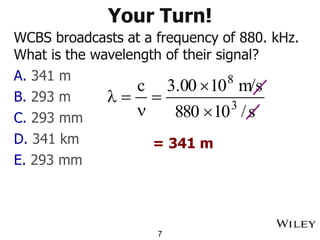
Your Turn!
WCBS broadcasts at a frequency of 880. kHz.
What is the wavelength of their signal?
A. 341 m
B. 293 m
C. 293 mm
D. 341 km
E. 293 mm
7
s
/
10
880
m/s
10
00
.
3
c
3
8


=
n
=
l
= 341 m
Introduction to Spectroscopy
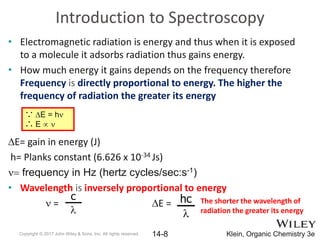
• Electromagnetic radiation is energy and thus when it is exposed
to a molecule it adsorbs radiation thus gains energy.
• How much energy it gains depends on the frequency therefore
Frequency is directly proportional to energy. The higher the
frequency of radiation the greater its energy
DE= gain in energy (J)
h= Planks constant (6.626 x 10⁻³⁴ Js)
n= frequency in Hz (hertz cycles/sec:s-1)
• Wavelength is inversely proportional to energy
n = DE =
Copyright © 2017 John Wiley & Sons, Inc. All rights reserved. 14-8 Klein, Organic Chemistry 3e
∵ DE = hn
∴ E  n
hc
l
c
l
The shorter the wavelength of
radiation the greater its energy
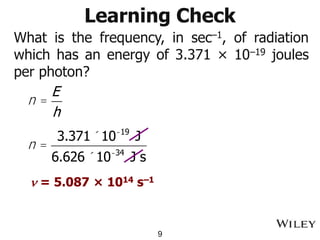
Learning Check
What is the frequency, in sec–1, of radiation
which has an energy of 3.371 × 10⁻¹⁹ joules
per photon?
9
n =
E
h
n =
3.371´10-19
J
6.626 ´10-34
J s
n = 5.087 × 10¹⁴ s–1
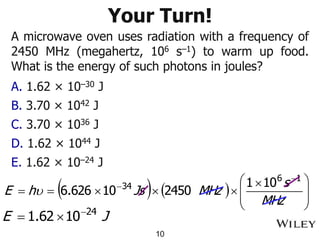
Your Turn!
A microwave oven uses radiation with a frequency of
2450 MHz (megahertz, 106 s–1) to warm up food.
What is the energy of such photons in joules?
A. 1.62 × 10⁻³⁰ J
B. 3.70 × 1042 J
C. 3.70 × 1036 J
D. 1.62 × 1044 J
E. 1.62 × 10⁻²⁴ J
10
 )  ) 






 



=
=


MHz
s
MHz
Js
h
E
1
6
34 10
1
2450
10
626
.
6

J
E 24
10
62
.
1 

=
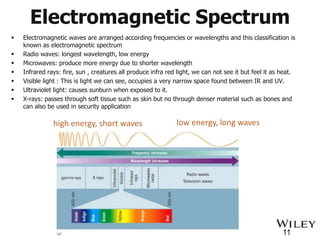
Electromagnetic Spectrum
11
high energy, short waves low energy, long waves
 Electromagnetic waves are arranged according frequencies or wavelengths and this classification is
known as electromagnetic spectrum
 Radio waves: longest wavelength, low energy
 Microwaves: produce more energy due to shorter wavelength
 Infrared rays: fire, sun , creatures all produce infra red light, we can not see it but feel it as heat.
 Visible light : This is light we can see, occupies a very narrow space found between IR and UV.
 Ultraviolet light: causes sunburn when exposed to it.
 X-rays: passes through soft tissue such as skin but no through denser material such as bones and
can also be used in security application
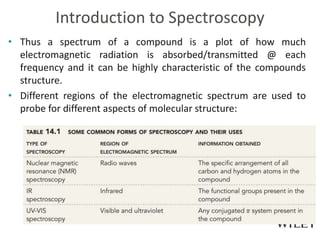
• Thus a spectrum of a compound is a plot of how much
electromagnetic radiation is absorbed/transmitted @ each
frequency and it can be highly characteristic of the compounds
structure.
• Different regions of the electromagnetic spectrum are used to
probe for different aspects of molecular structure:
Introduction to Spectroscopy
Relating this session to real life situation
• Do 5G towers result in COVID-19?
13
Homework
• A particular wave of electromagnetic radiation has a frequency of 1.5×10¹⁴ Hz.
What is the wavelength of this wave? What would you expect to happen to the
frequency of a light wave if its wavelength were increased by a factor of 10?
• A photon has a frequency of 2.0×1024 Hz, What is the energy of this photon?
• The wavelength of orange light is about 590−635 nm, and the wavelength of
green light is about 520−560 nm. Which color of light is more energetic, orange
or green?
14

Electromagnetic spectrum_lecture 1.pptx

  • 1.
  • 2.
    Introduction to Spectroscopy •Electromagnetic radiation is one of many ways in which energy travels through space. • As chemists we study how electromagnetic radiation interact with atoms and molecules (Spectroscopy). • Electromagnetic radiation (light) exhibit wave like properties. • These waves are usually described in terms of its wavelength (l) and frequency (n). Copyright © 2017 John Wiley & Sons, Inc. All rights reserved. 14-2 Klein, Organic Chemistry 3e
  • 3.
    Introduction to Spectroscopy •The distance between the consecutive crests (or troughs)is the wavelength (l). The no. of full cycles of the wavelength that pass a given point each second, as the wave moves through space is called frequency (n). The vertical distance between the tip of the crest and the waves central axis is known as the amplitude. Copyright © 2017 John Wiley & Sons, Inc. All rights reserved. 14-3 Klein, Organic Chemistry 3e
  • 4.
    Properties of Waves Wavelength(l) Greek (lambda) – Distance between two successive peaks or troughs – Units are in meters, centimeters, nanometers Frequency (n) Greek (nu) – Number of waves per second that pass a given point in space – Units are in Hertz (Hz = cycles/sec = 1/sec = s–1) Related by 4
  • 5.
    Introduction to Spectroscopy •Electromagnetic radiation travels through a vacuum at the same velocity. The velocity of light c : 3.00 x 10⁸ m/sec. relates to frequency and wavelength as c = l  n. • The frequency is related to the velocity of light by the expression: n = Where: C = : 3x10⁸ m/sec, n= frequency in Hertz (Units are in Hz = cycles/sec = 1/sec = s–1), l= wavelength (m, cm or nm) • Frequency and wavelength are inversely proportional. The higher the frequency the shorter the wavelength and vise versa Copyright © 2017 John Wiley & Sons, Inc. All rights reserved. 14-5 Klein, Organic Chemistry 3e c l
  • 6.
    Learning Check: Convertingfrom Wavelength to Frequency The bright red color in fireworks is due to emission of light when Sr(NO3)2 is heated. If the wavelength is 650 nm, what is the frequency of this light? 6 n = c l = 3.00 ´108 m/s 650 ´10-9 m n = 4.61 × 10¹⁴ s–1 = 4.6 × 10¹⁴ Hz
  • 7.
    Your Turn! WCBS broadcastsat a frequency of 880. kHz. What is the wavelength of their signal? A. 341 m B. 293 m C. 293 mm D. 341 km E. 293 mm 7 s / 10 880 m/s 10 00 . 3 c 3 8   = n = l = 341 m
  • 8.
    Introduction to Spectroscopy •Electromagnetic radiation is energy and thus when it is exposed to a molecule it adsorbs radiation thus gains energy. • How much energy it gains depends on the frequency therefore Frequency is directly proportional to energy. The higher the frequency of radiation the greater its energy DE= gain in energy (J) h= Planks constant (6.626 x 10⁻³⁴ Js) n= frequency in Hz (hertz cycles/sec:s-1) • Wavelength is inversely proportional to energy n = DE = Copyright © 2017 John Wiley & Sons, Inc. All rights reserved. 14-8 Klein, Organic Chemistry 3e ∵ DE = hn ∴ E  n hc l c l The shorter the wavelength of radiation the greater its energy
  • 9.
    Learning Check What isthe frequency, in sec–1, of radiation which has an energy of 3.371 × 10⁻¹⁹ joules per photon? 9 n = E h n = 3.371´10-19 J 6.626 ´10-34 J s n = 5.087 × 10¹⁴ s–1
  • 10.
    Your Turn! A microwaveoven uses radiation with a frequency of 2450 MHz (megahertz, 106 s–1) to warm up food. What is the energy of such photons in joules? A. 1.62 × 10⁻³⁰ J B. 3.70 × 1042 J C. 3.70 × 1036 J D. 1.62 × 1044 J E. 1.62 × 10⁻²⁴ J 10  )  )             = =   MHz s MHz Js h E 1 6 34 10 1 2450 10 626 . 6  J E 24 10 62 . 1   =
  • 11.
    Electromagnetic Spectrum 11 high energy,short waves low energy, long waves  Electromagnetic waves are arranged according frequencies or wavelengths and this classification is known as electromagnetic spectrum  Radio waves: longest wavelength, low energy  Microwaves: produce more energy due to shorter wavelength  Infrared rays: fire, sun , creatures all produce infra red light, we can not see it but feel it as heat.  Visible light : This is light we can see, occupies a very narrow space found between IR and UV.  Ultraviolet light: causes sunburn when exposed to it.  X-rays: passes through soft tissue such as skin but no through denser material such as bones and can also be used in security application
  • 12.
    • Thus aspectrum of a compound is a plot of how much electromagnetic radiation is absorbed/transmitted @ each frequency and it can be highly characteristic of the compounds structure. • Different regions of the electromagnetic spectrum are used to probe for different aspects of molecular structure: Introduction to Spectroscopy
  • 13.
    Relating this sessionto real life situation • Do 5G towers result in COVID-19? 13
  • 14.
    Homework • A particularwave of electromagnetic radiation has a frequency of 1.5×10¹⁴ Hz. What is the wavelength of this wave? What would you expect to happen to the frequency of a light wave if its wavelength were increased by a factor of 10? • A photon has a frequency of 2.0×1024 Hz, What is the energy of this photon? • The wavelength of orange light is about 590−635 nm, and the wavelength of green light is about 520−560 nm. Which color of light is more energetic, orange or green? 14