Evaluation seminar on

          Basics of UV/Visble
            spectroscopy
By
Mallappa. Shalavadi,
Lecturer,
Department of Pharmacology,
HSK College of Pharmacy,
Bagalkot.
Contents:
1. Radiation.
2. Characteristics of electromagnetic radiation.
3. Electromagnetic Spectrum.
4. Visible light.
5. Interaction of radiation with matter.
6. Basic principle of UV/visible spectroscopy.
Radiation:
• Radiation is the energy travelling trough space as a
  series of waves or a stream of particles.
• Visible light can be explained by two theories
  Corpuscular theory and Wave theory.
• Corpuscular theory- light travels in the form of
  particles called photons.
• Wave theory- light travels in the form of wave.
• Radiant energy has wave nature and being
  associated with electric as well as magnetic fields,
  these radiations are called electromag- netic
  radiations.
• Ex – Visible light, UV light, Infra-red, X-rays, Radio-waves ect.
Characterization of
  electromagnetic radiation:
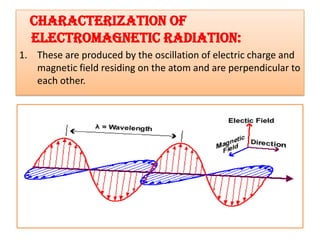
1. These are produced by the oscillation of electric charge and
   magnetic field residing on the atom and are perpendicular to
   each other.
2. These are characterized by their wavelengths or frequencies
    or wavenumbers.
3. The energy carried by an electromagetic radiation is directly
    proportional to its frequency.
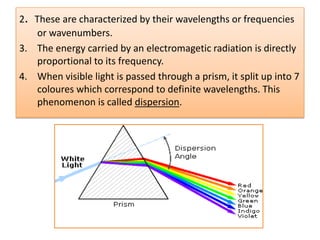
4. When visible light is passed through a prism, it split up into 7
    coloures which correspond to definite wavelengths. This
    phenomenon is called dispersion.
WHAT IS Wavelength ?
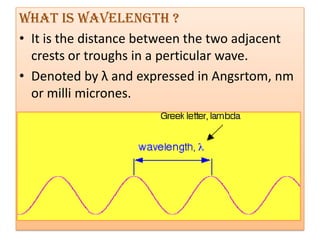
• It is the distance between the two adjacent
  crests or troughs in a perticular wave.
• Denoted by λ and expressed in Angsrtom, nm
  or milli micrones.
Frequency-
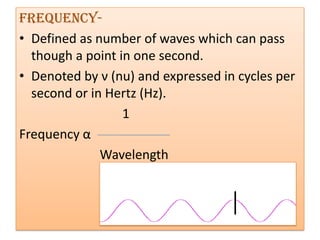
• Defined as number of waves which can pass
  though a point in one second.
• Denoted by ν (nu) and expressed in cycles per
  second or in Hertz (Hz).
                  1
Frequency α
              Wavelength
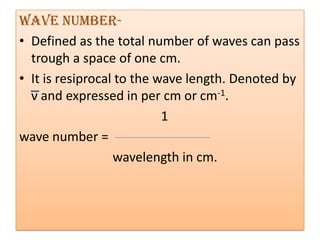
Wave number-
• Defined as the total number of waves can pass
  trough a space of one cm.
• It is resiprocal to the wave length. Denoted by
  ν and expressed in per cm or cm-1.
                           1
wave number =
                  wavelength in cm.
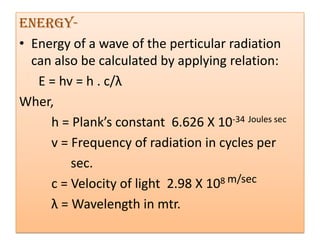
Energy-
• Energy of a wave of the perticular radiation
  can also be calculated by applying relation:
   E = hv = h . c/λ
Wher,
     h = Plank’s constant 6.626 X 10⁻³⁴ Joules sec
     v = Frequency of radiation in cycles per
         sec.
     c = Velocity of light 2.98 X 10⁸ m/sec
     λ = Wavelength in mtr.
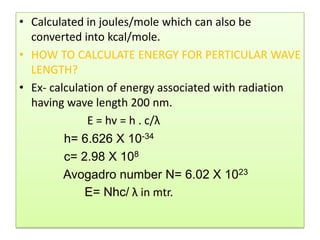
• Calculated in joules/mole which can also be
  converted into kcal/mole.
• HOW TO CALCULATE ENERGY FOR PERTICULAR WAVE
  LENGTH?
• Ex- calculation of energy associated with radiation
  having wave length 200 nm.
              E = hv = h . c/λ
         h= 6.626 X 10⁻³⁴
         c= 2.98 X 10⁸
         Avogadro number N= 6.02 X 10²³
             E= Nhc/ λ in mtr.
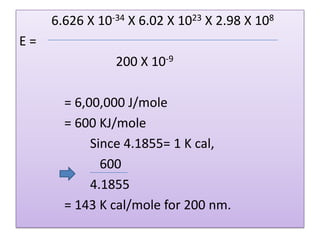
6.626 X 10-34 X 6.02 X 1023 X 2.98 X 108
E=
                200 X 10-9

       = 6,00,000 J/mole
       = 600 KJ/mole
            Since 4.1855= 1 K cal,
              600
            4.1855
       = 143 K cal/mole for 200 nm.
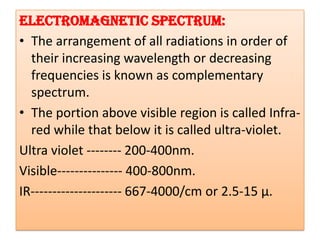
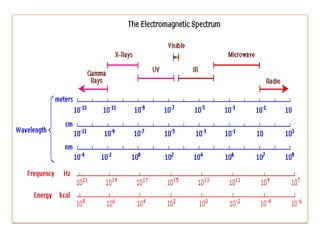
Electromagnetic spectrum:
• The arrangement of all radiations in order of
  their increasing wavelength or decreasing
  frequencies is known as complementary
  spectrum.
• The portion above visible region is called Infra-
  red while that below it is called ultra-violet.
Ultra violet -------- 200-400nm.
Visible--------------- 400-800nm.
IR--------------------- 667-4000/cm or 2.5-15 µ.
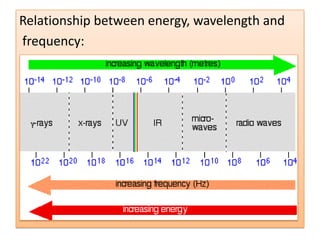
Relationship between energy, wavelength and
frequency:
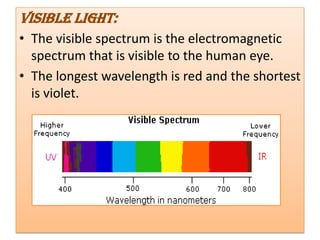
Visible light:
• The visible spectrum is the electromagnetic
  spectrum that is visible to the human eye.
• The longest wavelength is red and the shortest
  is violet.
•   Violet:   400 - 420 nm
•   Indigo:   420 - 440 nm
•   Blue:     440 - 490 nm
•   Green:    490 - 570 nm
•   Yellow:   570 - 585 nm
•   Orange:   585 - 620 nm
•   Red:      620 - 780 nm
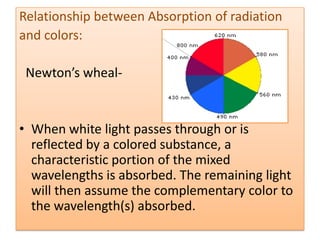
Relationship between Absorption of radiation
and colors:

 Newton’s wheal-


• When white light passes through or is
  reflected by a colored substance, a
  characteristic portion of the mixed
  wavelengths is absorbed. The remaining light
  will then assume the complementary color to
  the wavelength(s) absorbed.
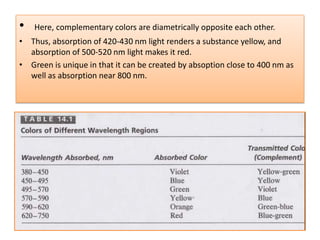
•   Here, complementary colors are diametrically opposite each other.
• Thus, absorption of 420-430 nm light renders a substance yellow, and
  absorption of 500-520 nm light makes it red.
• Green is unique in that it can be created by absoption close to 400 nm as
  well as absorption near 800 nm.
Matter:
• All organic compounds are capable of
  absorbing ECM radiation because all contain
  valency electrons that can be excited to higher
  energy levels.
• The electrons that leads to absorption are
a. Sigma electrons (σ): These associated with
   the saturated bonds. located in sigma bond
   ex- C-C, C-H, O-H, C-N,N-N ect.
b. Pi electrons (π): These electrons are involved
   in unsaturated compounds
Ex- Alkenes, Alkynes and Aromatic compounds
    C=C, C=N, C=O, C=S, ect.
c. Non bonding electrons (n): n electrons are
   less firmly held or non bonding electrons and
   found on nitrogen, oxygen, sulphur and
   halogens.
   ex- :O: N: :S: ect.
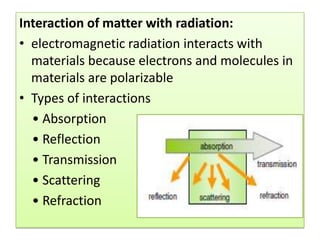
Interaction of matter with radiation:
• electromagnetic radiation interacts with
  materials because electrons and molecules in
  materials are polarizable
• Types of interactions
  • Absorption
  • Reflection
  • Transmission
  • Scattering
  • Refraction
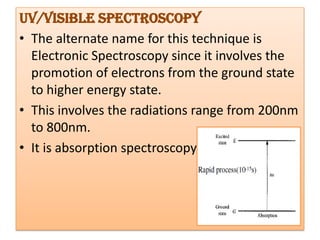
UV/Visible spectroscopy
• The alternate name for this technique is
  Electronic Spectroscopy since it involves the
  promotion of electrons from the ground state
  to higher energy state.
• This involves the radiations range from 200nm
  to 800nm.
• It is absorption spectroscopy.
Principle-
• Any molecule has either n, π and σ or a
  combination of these electrons .
• These bonding (π and σ ) and non bonding
  electrons absorb the characteristic radiation
  and undergoes transition from ground state to
  excited state.
• By the characteristic absorption peaks, the
  nature of the electrons present.
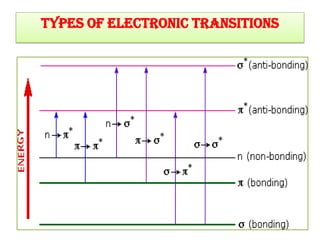
TYPES OF ELECTRONIC TRANSITIONS
σ → σ* Transitions
• The energy required is large because σ- electrones.
• The transition occurs in mainly in saturated
  compounds.
   Examples:
            Methane -122nm
            Ethane -135nm
            Propane -135nm
            Cyclopropane- 190nm
• Below 200nm O2 and N2 from air absorb thus whol
  path is evacuated thus called Vacum UV region.
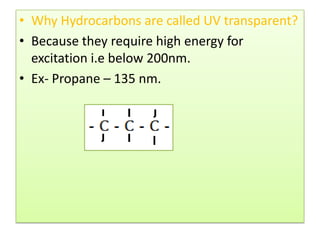
• Why Hydrocarbons are called UV transparent?
• Because they require high energy for
  excitation i.e below 200nm.
• Ex- Propane – 135 nm.
n → σ* Transitions
• Saturated compounds containing atoms with lone
  pairs (non-bonding electrons) are capable of show
  n → σ* transitions.
• These transitions usually need less energy than
  σ → σ* transitions.
• Examples:
             methanol-203
             ethanol -204
             ccl4     -257
             methyl iodide -258
             methyl chloride -172-175
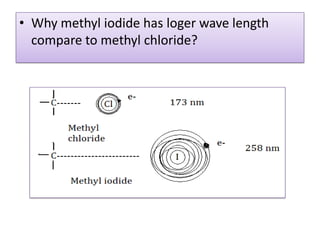
• Why methyl iodide has loger wave length
  compare to methyl chloride?
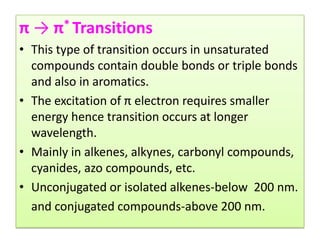
π → π* Transitions
• This type of transition occurs in unsaturated
  compounds contain double bonds or triple bonds
  and also in aromatics.
• The excitation of π electron requires smaller
  energy hence transition occurs at longer
  wavelength.
• Mainly in alkenes, alkynes, carbonyl compounds,
  cyanides, azo compounds, etc.
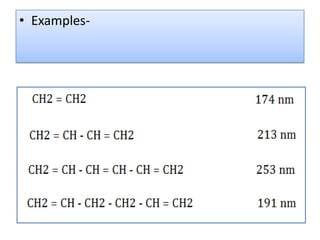
• Unconjugated or isolated alkenes-below 200 nm.
  and conjugated compounds-above 200 nm.
• Examples-
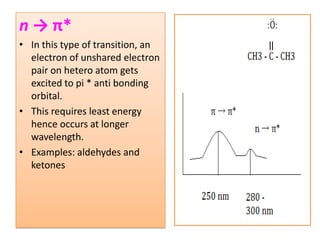
n → π*
• In this type of transition, an
  electron of unshared electron
  pair on hetero atom gets
  excited to pi * anti bonding
  orbital.
• This requires least energy
  hence occurs at longer
  wavelength.
• Examples: aldehydes and
  ketones
References:
Instrumental analysis by B. K. Sharma
Elementary organic spectroscopy by Y. R.
 Sharma
www.Google.com

Basic uv,visible

  • 1.
    Evaluation seminar on Basics of UV/Visble spectroscopy By Mallappa. Shalavadi, Lecturer, Department of Pharmacology, HSK College of Pharmacy, Bagalkot.
  • 2.
    Contents: 1. Radiation. 2. Characteristicsof electromagnetic radiation. 3. Electromagnetic Spectrum. 4. Visible light. 5. Interaction of radiation with matter. 6. Basic principle of UV/visible spectroscopy.
  • 3.
    Radiation: • Radiation isthe energy travelling trough space as a series of waves or a stream of particles. • Visible light can be explained by two theories Corpuscular theory and Wave theory. • Corpuscular theory- light travels in the form of particles called photons. • Wave theory- light travels in the form of wave. • Radiant energy has wave nature and being associated with electric as well as magnetic fields, these radiations are called electromag- netic radiations. • Ex – Visible light, UV light, Infra-red, X-rays, Radio-waves ect.
  • 4.
    Characterization of electromagnetic radiation: 1. These are produced by the oscillation of electric charge and magnetic field residing on the atom and are perpendicular to each other.
  • 5.
    2. These arecharacterized by their wavelengths or frequencies or wavenumbers. 3. The energy carried by an electromagetic radiation is directly proportional to its frequency. 4. When visible light is passed through a prism, it split up into 7 coloures which correspond to definite wavelengths. This phenomenon is called dispersion.
  • 6.
    WHAT IS Wavelength? • It is the distance between the two adjacent crests or troughs in a perticular wave. • Denoted by λ and expressed in Angsrtom, nm or milli micrones.
  • 7.
    Frequency- • Defined asnumber of waves which can pass though a point in one second. • Denoted by ν (nu) and expressed in cycles per second or in Hertz (Hz). 1 Frequency α Wavelength
  • 8.
    Wave number- • Definedas the total number of waves can pass trough a space of one cm. • It is resiprocal to the wave length. Denoted by ν and expressed in per cm or cm-1. 1 wave number = wavelength in cm.
  • 9.
    Energy- • Energy ofa wave of the perticular radiation can also be calculated by applying relation: E = hv = h . c/λ Wher, h = Plank’s constant 6.626 X 10⁻³⁴ Joules sec v = Frequency of radiation in cycles per sec. c = Velocity of light 2.98 X 10⁸ m/sec λ = Wavelength in mtr.
  • 10.
    • Calculated injoules/mole which can also be converted into kcal/mole. • HOW TO CALCULATE ENERGY FOR PERTICULAR WAVE LENGTH? • Ex- calculation of energy associated with radiation having wave length 200 nm. E = hv = h . c/λ h= 6.626 X 10⁻³⁴ c= 2.98 X 10⁸ Avogadro number N= 6.02 X 10²³ E= Nhc/ λ in mtr.
  • 11.
    6.626 X 10-34X 6.02 X 1023 X 2.98 X 108 E= 200 X 10-9 = 6,00,000 J/mole = 600 KJ/mole Since 4.1855= 1 K cal, 600 4.1855 = 143 K cal/mole for 200 nm.
  • 12.
    Electromagnetic spectrum: • Thearrangement of all radiations in order of their increasing wavelength or decreasing frequencies is known as complementary spectrum. • The portion above visible region is called Infra- red while that below it is called ultra-violet. Ultra violet -------- 200-400nm. Visible--------------- 400-800nm. IR--------------------- 667-4000/cm or 2.5-15 µ.
  • 14.
    Relationship between energy,wavelength and frequency:
  • 15.
    Visible light: • Thevisible spectrum is the electromagnetic spectrum that is visible to the human eye. • The longest wavelength is red and the shortest is violet.
  • 16.
    Violet: 400 - 420 nm • Indigo: 420 - 440 nm • Blue: 440 - 490 nm • Green: 490 - 570 nm • Yellow: 570 - 585 nm • Orange: 585 - 620 nm • Red: 620 - 780 nm
  • 17.
    Relationship between Absorptionof radiation and colors: Newton’s wheal- • When white light passes through or is reflected by a colored substance, a characteristic portion of the mixed wavelengths is absorbed. The remaining light will then assume the complementary color to the wavelength(s) absorbed.
  • 18.
    Here, complementary colors are diametrically opposite each other. • Thus, absorption of 420-430 nm light renders a substance yellow, and absorption of 500-520 nm light makes it red. • Green is unique in that it can be created by absoption close to 400 nm as well as absorption near 800 nm.
  • 19.
    Matter: • All organiccompounds are capable of absorbing ECM radiation because all contain valency electrons that can be excited to higher energy levels. • The electrons that leads to absorption are a. Sigma electrons (σ): These associated with the saturated bonds. located in sigma bond ex- C-C, C-H, O-H, C-N,N-N ect. b. Pi electrons (π): These electrons are involved in unsaturated compounds
  • 20.
    Ex- Alkenes, Alkynesand Aromatic compounds C=C, C=N, C=O, C=S, ect. c. Non bonding electrons (n): n electrons are less firmly held or non bonding electrons and found on nitrogen, oxygen, sulphur and halogens. ex- :O: N: :S: ect.
  • 21.
    Interaction of matterwith radiation: • electromagnetic radiation interacts with materials because electrons and molecules in materials are polarizable • Types of interactions • Absorption • Reflection • Transmission • Scattering • Refraction
  • 22.
    UV/Visible spectroscopy • Thealternate name for this technique is Electronic Spectroscopy since it involves the promotion of electrons from the ground state to higher energy state. • This involves the radiations range from 200nm to 800nm. • It is absorption spectroscopy.
  • 23.
    Principle- • Any moleculehas either n, π and σ or a combination of these electrons . • These bonding (π and σ ) and non bonding electrons absorb the characteristic radiation and undergoes transition from ground state to excited state. • By the characteristic absorption peaks, the nature of the electrons present.
  • 24.
  • 25.
    σ → σ*Transitions • The energy required is large because σ- electrones. • The transition occurs in mainly in saturated compounds. Examples: Methane -122nm Ethane -135nm Propane -135nm Cyclopropane- 190nm • Below 200nm O2 and N2 from air absorb thus whol path is evacuated thus called Vacum UV region.
  • 26.
    • Why Hydrocarbonsare called UV transparent? • Because they require high energy for excitation i.e below 200nm. • Ex- Propane – 135 nm.
  • 27.
    n → σ*Transitions • Saturated compounds containing atoms with lone pairs (non-bonding electrons) are capable of show n → σ* transitions. • These transitions usually need less energy than σ → σ* transitions. • Examples: methanol-203 ethanol -204 ccl4 -257 methyl iodide -258 methyl chloride -172-175
  • 28.
    • Why methyliodide has loger wave length compare to methyl chloride?
  • 29.
    π → π*Transitions • This type of transition occurs in unsaturated compounds contain double bonds or triple bonds and also in aromatics. • The excitation of π electron requires smaller energy hence transition occurs at longer wavelength. • Mainly in alkenes, alkynes, carbonyl compounds, cyanides, azo compounds, etc. • Unconjugated or isolated alkenes-below 200 nm. and conjugated compounds-above 200 nm.
  • 30.
  • 31.
    n → π* •In this type of transition, an electron of unshared electron pair on hetero atom gets excited to pi * anti bonding orbital. • This requires least energy hence occurs at longer wavelength. • Examples: aldehydes and ketones
  • 32.
    References: Instrumental analysis byB. K. Sharma Elementary organic spectroscopy by Y. R. Sharma www.Google.com