SPECTROSCOPY
Introduction of Spectrometric Analyses

The study how the chemical compound
interacts with different wavelenghts in a given
region of electromagnetic radiation is called
spectroscopy or spectrochemical analysis.

The collection of measurements signals
(absorbance) of the compound as a function of
electromagnetic radiation is called a spectrum.
Energy Absorption

The mechanism of absorption energy is different in
the Ultraviolet, Infrared, and Nuclear magnetic
resonance regions. However, the fundamental
process is the absorption of certain amount of energy.

The energy required for the transition from a state of lower
energy to a state of higher energy is directly
related to the frequency of electromagnetic radiation
that causes the transition.
Spectral Distribution of Radiant Energy


                      Wave Number (cycles/cm)

 X-Ray           UV             Visible           IR   Microwave

         200nm          400nm             800nm

                       Wavelength (nm)
Electromagnetic Radiation

       V = Wave Number (cm )    -1


       λ = Wave Length
       C = Velocity of Radiation (constant) = 3 x 1010 cm/sec.
 υ = Frequency of Radiation (cycles/sec)
                                                υ 1
                                          V =     =
                                                C  λ
The energy of photon:
h (Planck's constant) = 6.62 x 10- (Erg×sec)
                                     27


                            C                    C
               E = h υh
                     =                      υ=         C = υλ
                            λ                    λ
Spectral Properties, Application and Interactions of
                             Electromagnetic Radiation

                           Wave        Wavelength   Frequency
        Energy            Number V         λ            υ
                                                                  Type          Type              Type
                                                                Radiation   spectroscopy    Quantum Transition
Kcal/mol         eV         cm-1          cm         Hz

9.4 x 10⁷    4.9 x 10⁶    3.3 x 10¹⁰    3 x 10-11    1021        Gamma      Gamma ray
                                                                   ray                      Nuclear
                                                                            emission
                                                                            X-ray                       Electronic
9.4 x 10³    4.9 x 10²    3.3 x 10⁶     3 x 10⁻⁷     1017         X-ray
                                                                            absorption,                 (inner shell)
                                                                            emission
                                                                  Ultra
9.4 x 101    4.9 x 100    3.3 x 10⁴     3 x 10⁻⁵     1015         violet    UV absorption               Electronic
                                                                 Visible                                (outer shell)


9.4 x 10⁻¹   4.9 x 10⁻²   3.3 x 10²     3 x 10⁻³     1013        Infrared   IR absorption   Molecular
                                                                                            vibration   Molecular
                                                                                                        rotation

9.4 x 10⁻³   4.9 x 10⁻⁴   3.3 x 100     3 x 10⁻¹     1011         Micro-    Microwave
                                                                  wave      absorption
                                                                                                        Magnetically
                                                                            Nuclear                     induced spin
                                                                  Radio     magnetic
9.4 x 10⁻⁷   4.9 x 10⁻⁸   3.3 x 10⁻⁴    3 x 10³       107                                               states
                                                                            resonance
Spectrum of Radiation
Dispersion of Polymagnetic Light with a Prism

Prism - Spray out the spectrum and choose the certain wavelength
(λ) that you want by slit.

                                           Infrared
                                                        monochromatic
                                                          Ray

                                            Red
                                            Orange
                                           Yellow          SLIT
     Polychromatic       PRISM
                                            Green
       Ray                                   Blue
                                            Violet


                                         Ultraviolet


             Polychromatic Ray      Monochromatic Ray
Ultra Violet Spectrometry


The absorption of ultraviolet radiation by molecules is
dependent upon the electronic structure of the molecule.
So the ultraviolet spectrum is called electronic spectrum.
Electronic Excitation


The absorption of light energy by organic compounds
in the visible and ultraviolet region involves the
promotion of electrons in σ, π, and n-orbitals from the
ground state to higher energy states. This is also called
energy transition. These higher energy states are
molecular orbitals called antibonding.
Antibonding
     σ*

     π
     *                              Antibonding
             σ σ


                               π
                              n→
                         σ
              →


                   ππ
               *


                   →


                                *
                        n→*
                    *
Energy


         n                          Nonbonding
                                    Bonding
         π

                                    Bonding
         σ
Electronic Molecular Energy Levels


The higher energy transitions (σ →σ*) occur a
shorter wavelength and the low energy transitions
(π→π*, n →π*) occur at longer wavelength.
Chromophore is a functional group which absorbs a
characteristic ultraviolet or visible region.
            UV
             210 nm          Double Bonds
             233 nm          Conjugated Diene
             268 nm          Conjugated Triene
             315 nm          Conjugated Tetraene


                                       •      •
          •      •


        σ σ
        and * orbitals              π π
                                    and * orbitals
Spectrophotometer

An instrument which can measure the absorbance of a
sample at any wavelength.


Light      Lens     Slit       Monochromator                Slits

        Sample      Detector        Quantitative Analysis
Fluorometer
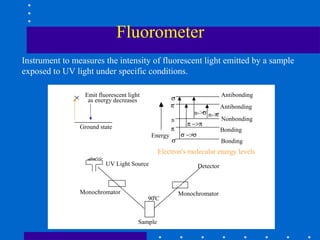
Instrument to measures the intensity of fluorescent light emitted by a sample
exposed to UV light under specific conditions.

                 Emit fluorescent light                                  Antibonding
                  as energy decreases              σ'
                                                   π'                Antibonding
                                                          n->σ n-> '
                                                              '  π
                                                  n                  Nonbonding
                Ground state                          π −>π '
                                                  π                  Bonding
                                           Energy   σ −>σ
                                                        '
                                                  σ                  Bonding
                                               Electron's molecular energy levels
                         UV Light Source                      Detector


                Monochromator                           Monochromator
                                          90°C


                                      Sample
Food Compound


  H 3C   S   CH2 CH2 CH3
Chromophore is a functional group which absorbs a
characteristic ultraviolet or visible region.
            UV
             210 nm          Double Bonds
             233 nm          Conjugated Diene
             268 nm          Conjugated Triene
             315 nm          Conjugated Tetraene


                                       •      •
          •      •


        σ σ
        and * orbitals              π π
                                    and * orbitals
Beer – Lambert Law


           Light
                    I0                   I

                    Glass cell filled with
                   concentration of solution (C)


As the cell thickness increases, the transmitted intensity
of light of I decreases.
R- Transmittance
              I
      R=                        I0 - Original light intensity
              I0
                                I- Transmitted light intensity
 
                              I
% Transmittance = 100 x
                              I0

                            1
Absorbance (A) = Log
                            T
                                   I0
                      = Log           = 2 - Log%T
                                   I
       I
Log       is proportional to C (concentration of solution) and is
       I0
              also proportional to L (length of light path
              through the solution).
A ∝ CL = ECL by definition and it is called the Beer
- Lambert Law.
A = ECL


A = ECL
E = Molar Extinction Coefficient ---- Extinction
Coefficient of a solution containing 1g molecule of
solute per 1 liter of solution
Absorbance x Liter
          E =
                    Moles x cm


UNITS
    A = ECL
    A = No unit (numerical number only)

                 Liter
           E =
               Cm x M ole
L = Cm
C = Moles/Liter


                  Liter            Mole
A = ECL = (                   )x           x Cm
                  Cm x Mole        Liter
Steps in Developing a Spectrometric Analytical Method


1. Run the sample for spectrum
2. Obtain a monochromatic
                                                 2.0
   wavelength for the maximum


                                    Absorbance
   absorption wavelength.
3. Calculate the concentration of                0.0

   your sample using Beer Lambert                  200   250   300   350     400   450

                                                                Wavelength (nm)
   Equation: A = ECL
Spectrometer Reading
∆
                                                        A
             Slope of Standard Curve =
                                                        ∆
                                                        C


                                                   x

        A at 280 nm
                      1.0
                                       x

                      0.5
                                x


                            1       2       3      4    5
                                Concentration (mg/ml)


There is some A vs. C where graph is linear.
NEVER extrapolate beyond point known where
becomes non-linear.
Spectrometric Analysis Using Standard Curve


                         1.2

           A at 540 nm
                         0.8


                         0.4


                                    1           2          3   4
                               Concentration (g/l) glucose


Avoid very high or low absorbencies when drawing a standard
curve. The best results are obtained with 0.1 < A < 1. Plot the
Absorbance vs. Concentration to get a straight line
Sample Cells


UV Spectrophotometer
           Quartz (crystalline silica)

Visible Spectrophotometer
           Glass
Light Sources

UV Spectrophotometer
     1.    Hydrogen Gas Lamp
     2.    Mercury Lamp
Visible Spectrophotometer
     1.    Tungsten Lamp
Chemical Structure & UV Absorption


Chromophoric Group ---- The groupings of the
molecules which contain the electronic system which
is giving rise to absorption in the ultra-violet region.
Chromophoric Structure
Group                 Structure           nm
Carbonyl              >C=O                280
Azo                   -N = N-             262
Nitro                 -N=O                270
Thioketone            -C =S               330
Nitrite               -NO2                230
Conjugated Diene      -C=C-C=C-           233
Conjugated Triene     -C=C-C=C-C=C-       268
Conjugated Tetraene   -C=C-C=C-C=C-C=C-   315
Benzene                                   261
UV Spectrometer Application

   Protein
   Amino Acids (aromatic)
   Pantothenic Acid
   Glucose Determination
   Enzyme Activity (Hexokinase)
Flurometric Application

Thiamin (365 nm, 435 nm)
Riboflavin
Vitamin A
Vitamin C
Visible Spectrometer Application

    Niacin
    Pyridoxine
    Vitamin B12
    Metal Determination (Fe)
    Fat-quality Determination (TBA)
    Enzyme Activity (glucose oxidase)
Practice Examples
     1. Calculate the Molar Extinction Coefficient E at 351 nm for
aquocobalamin in 0.1 M phosphate buffer. pH = 7.0 from the
following data which were obtained in 1 Cm cell.
       Solution       C x 10 M
                             5
                                            Io             I
       A              2.23                   100           27
       B              1.90                   100           32

    2. The molar extinction coefficient (E) of compound
riboflavin is 3 x 10³ Liter/Cm x Mole. If the absorbance   reading
(A) at 350 nm is 0.9 using a cell of 1 Cm, what is the
concentration of compound riboflavin in sample?
3. The concentration of compound Y was 2 x 10 moles/liter and
                                                     -4


       the absorption of the solution at 300 nm using 1 Cm quartz cell
       was 0.4. What is the molar extinction coefficient of compound
       Y?


     4. Calculate the molar extinction coefficient E at 351 nm for
aquocobalamin in 0.1 M phosphate buffer. pH =7.0 from the
following data which were obtained in 1 Cm cell.
       Solution               C x 10 M 5
                                                     I0              I
          A                      2.0                 100             30
Spectroscopy Homework
1. A substance absorbs at 600 nm and 4000 nm. What type of energy
   transition most likely accounts for each of these absorption
   processes?


2. Complete the following table.
 [X](M) Absorbance Transmittance(%) E(L/mole-cm)              L(cm)
                         30            2000                   1.00
             0.5                       2500                   1.00
2.5 x 10⁻³   0.2                                              1.00
4.0 x 10⁻⁵               50            5000
2.0 x 10⁻⁴                             150
                                   [X](M) = Concentration in Mole/L
3. The molar absorptivity of a pigment (molecular weight 300)
is 30,000 at 550 nm. What is the absorptivity in L/g-cm.


 4. The iron complex of o-phenanthroline (Molecular weight
236) has molar absorptivity of 10,000 at 525 nm. If the
absorbance of 0.01 is the lowest detectable signal, what
concentration in part per million can be detected in a 1-cm
cell?
Spectrometry

Spectrometry

  • 1.
  • 2.
    Introduction of SpectrometricAnalyses The study how the chemical compound interacts with different wavelenghts in a given region of electromagnetic radiation is called spectroscopy or spectrochemical analysis. The collection of measurements signals (absorbance) of the compound as a function of electromagnetic radiation is called a spectrum.
  • 3.
    Energy Absorption The mechanismof absorption energy is different in the Ultraviolet, Infrared, and Nuclear magnetic resonance regions. However, the fundamental process is the absorption of certain amount of energy. The energy required for the transition from a state of lower energy to a state of higher energy is directly related to the frequency of electromagnetic radiation that causes the transition.
  • 4.
    Spectral Distribution ofRadiant Energy Wave Number (cycles/cm) X-Ray UV Visible IR Microwave 200nm 400nm 800nm Wavelength (nm)
  • 5.
    Electromagnetic Radiation V = Wave Number (cm ) -1 λ = Wave Length C = Velocity of Radiation (constant) = 3 x 1010 cm/sec. υ = Frequency of Radiation (cycles/sec) υ 1 V = = C λ The energy of photon: h (Planck's constant) = 6.62 x 10- (Erg×sec) 27 C C E = h υh = υ= C = υλ λ λ
  • 7.
    Spectral Properties, Applicationand Interactions of Electromagnetic Radiation Wave Wavelength Frequency Energy Number V λ υ Type Type Type Radiation spectroscopy Quantum Transition Kcal/mol eV cm-1 cm Hz 9.4 x 10⁷ 4.9 x 10⁶ 3.3 x 10¹⁰ 3 x 10-11 1021 Gamma Gamma ray ray Nuclear emission X-ray Electronic 9.4 x 10³ 4.9 x 10² 3.3 x 10⁶ 3 x 10⁻⁷ 1017 X-ray absorption, (inner shell) emission Ultra 9.4 x 101 4.9 x 100 3.3 x 10⁴ 3 x 10⁻⁵ 1015 violet UV absorption Electronic Visible (outer shell) 9.4 x 10⁻¹ 4.9 x 10⁻² 3.3 x 10² 3 x 10⁻³ 1013 Infrared IR absorption Molecular vibration Molecular rotation 9.4 x 10⁻³ 4.9 x 10⁻⁴ 3.3 x 100 3 x 10⁻¹ 1011 Micro- Microwave wave absorption Magnetically Nuclear induced spin Radio magnetic 9.4 x 10⁻⁷ 4.9 x 10⁻⁸ 3.3 x 10⁻⁴ 3 x 10³ 107 states resonance
  • 9.
  • 10.
    Dispersion of PolymagneticLight with a Prism Prism - Spray out the spectrum and choose the certain wavelength (λ) that you want by slit. Infrared monochromatic Ray Red Orange Yellow SLIT Polychromatic PRISM Green Ray Blue Violet Ultraviolet Polychromatic Ray Monochromatic Ray
  • 11.
    Ultra Violet Spectrometry Theabsorption of ultraviolet radiation by molecules is dependent upon the electronic structure of the molecule. So the ultraviolet spectrum is called electronic spectrum.
  • 12.
    Electronic Excitation The absorptionof light energy by organic compounds in the visible and ultraviolet region involves the promotion of electrons in σ, π, and n-orbitals from the ground state to higher energy states. This is also called energy transition. These higher energy states are molecular orbitals called antibonding.
  • 13.
    Antibonding σ* π * Antibonding σ σ π n→ σ → ππ * → * n→* * Energy n Nonbonding Bonding π Bonding σ
  • 14.
    Electronic Molecular EnergyLevels The higher energy transitions (σ →σ*) occur a shorter wavelength and the low energy transitions (π→π*, n →π*) occur at longer wavelength.
  • 15.
    Chromophore is afunctional group which absorbs a characteristic ultraviolet or visible region. UV 210 nm Double Bonds 233 nm Conjugated Diene 268 nm Conjugated Triene 315 nm Conjugated Tetraene • • • • σ σ and * orbitals π π and * orbitals
  • 16.
    Spectrophotometer An instrument whichcan measure the absorbance of a sample at any wavelength. Light Lens Slit Monochromator Slits Sample Detector Quantitative Analysis
  • 17.
    Fluorometer Instrument to measuresthe intensity of fluorescent light emitted by a sample exposed to UV light under specific conditions. Emit fluorescent light Antibonding as energy decreases σ' π' Antibonding n->σ n-> ' ' π n Nonbonding Ground state π −>π ' π Bonding Energy σ −>σ ' σ Bonding Electron's molecular energy levels UV Light Source Detector Monochromator Monochromator 90°C Sample
  • 18.
    Food Compound H 3C S CH2 CH2 CH3
  • 19.
    Chromophore is afunctional group which absorbs a characteristic ultraviolet or visible region. UV 210 nm Double Bonds 233 nm Conjugated Diene 268 nm Conjugated Triene 315 nm Conjugated Tetraene • • • • σ σ and * orbitals π π and * orbitals
  • 20.
    Beer – LambertLaw Light I0 I Glass cell filled with concentration of solution (C) As the cell thickness increases, the transmitted intensity of light of I decreases.
  • 21.
    R- Transmittance I R= I0 - Original light intensity I0 I- Transmitted light intensity   I % Transmittance = 100 x I0 1 Absorbance (A) = Log T I0 = Log = 2 - Log%T I I Log is proportional to C (concentration of solution) and is I0 also proportional to L (length of light path through the solution).
  • 22.
    A ∝ CL= ECL by definition and it is called the Beer - Lambert Law. A = ECL A = ECL E = Molar Extinction Coefficient ---- Extinction Coefficient of a solution containing 1g molecule of solute per 1 liter of solution
  • 23.
    Absorbance x Liter E = Moles x cm UNITS A = ECL A = No unit (numerical number only) Liter E = Cm x M ole
  • 24.
    L = Cm C= Moles/Liter Liter Mole A = ECL = ( )x x Cm Cm x Mole Liter
  • 25.
    Steps in Developinga Spectrometric Analytical Method 1. Run the sample for spectrum 2. Obtain a monochromatic 2.0 wavelength for the maximum Absorbance absorption wavelength. 3. Calculate the concentration of 0.0 your sample using Beer Lambert 200 250 300 350 400 450 Wavelength (nm) Equation: A = ECL
  • 26.
  • 27.
    A Slope of Standard Curve = ∆ C x A at 280 nm 1.0 x 0.5 x 1 2 3 4 5 Concentration (mg/ml) There is some A vs. C where graph is linear. NEVER extrapolate beyond point known where becomes non-linear.
  • 28.
    Spectrometric Analysis UsingStandard Curve 1.2 A at 540 nm 0.8 0.4 1 2 3 4 Concentration (g/l) glucose Avoid very high or low absorbencies when drawing a standard curve. The best results are obtained with 0.1 < A < 1. Plot the Absorbance vs. Concentration to get a straight line
  • 29.
    Sample Cells UV Spectrophotometer Quartz (crystalline silica) Visible Spectrophotometer Glass
  • 30.
    Light Sources UV Spectrophotometer 1. Hydrogen Gas Lamp 2. Mercury Lamp Visible Spectrophotometer 1. Tungsten Lamp
  • 31.
    Chemical Structure &UV Absorption Chromophoric Group ---- The groupings of the molecules which contain the electronic system which is giving rise to absorption in the ultra-violet region.
  • 32.
    Chromophoric Structure Group Structure nm Carbonyl >C=O 280 Azo -N = N- 262 Nitro -N=O 270 Thioketone -C =S 330 Nitrite -NO2 230 Conjugated Diene -C=C-C=C- 233 Conjugated Triene -C=C-C=C-C=C- 268 Conjugated Tetraene -C=C-C=C-C=C-C=C- 315 Benzene 261
  • 33.
    UV Spectrometer Application Protein Amino Acids (aromatic) Pantothenic Acid Glucose Determination Enzyme Activity (Hexokinase)
  • 34.
    Flurometric Application Thiamin (365nm, 435 nm) Riboflavin Vitamin A Vitamin C
  • 35.
    Visible Spectrometer Application Niacin Pyridoxine Vitamin B12 Metal Determination (Fe) Fat-quality Determination (TBA) Enzyme Activity (glucose oxidase)
  • 36.
    Practice Examples 1. Calculate the Molar Extinction Coefficient E at 351 nm for aquocobalamin in 0.1 M phosphate buffer. pH = 7.0 from the following data which were obtained in 1 Cm cell. Solution C x 10 M 5 Io I A 2.23 100 27 B 1.90 100 32 2. The molar extinction coefficient (E) of compound riboflavin is 3 x 10³ Liter/Cm x Mole. If the absorbance reading (A) at 350 nm is 0.9 using a cell of 1 Cm, what is the concentration of compound riboflavin in sample?
  • 37.
    3. The concentrationof compound Y was 2 x 10 moles/liter and -4 the absorption of the solution at 300 nm using 1 Cm quartz cell was 0.4. What is the molar extinction coefficient of compound Y? 4. Calculate the molar extinction coefficient E at 351 nm for aquocobalamin in 0.1 M phosphate buffer. pH =7.0 from the following data which were obtained in 1 Cm cell. Solution C x 10 M 5 I0 I A 2.0 100 30
  • 38.
    Spectroscopy Homework 1. Asubstance absorbs at 600 nm and 4000 nm. What type of energy transition most likely accounts for each of these absorption processes? 2. Complete the following table. [X](M) Absorbance Transmittance(%) E(L/mole-cm) L(cm) 30 2000 1.00 0.5 2500 1.00 2.5 x 10⁻³ 0.2 1.00 4.0 x 10⁻⁵ 50 5000 2.0 x 10⁻⁴ 150 [X](M) = Concentration in Mole/L
  • 39.
    3. The molarabsorptivity of a pigment (molecular weight 300) is 30,000 at 550 nm. What is the absorptivity in L/g-cm. 4. The iron complex of o-phenanthroline (Molecular weight 236) has molar absorptivity of 10,000 at 525 nm. If the absorbance of 0.01 is the lowest detectable signal, what concentration in part per million can be detected in a 1-cm cell?