ELECTRICITY
Electricity
Circuits
Effects
What do you use
electricity for?
ELECTRICITY
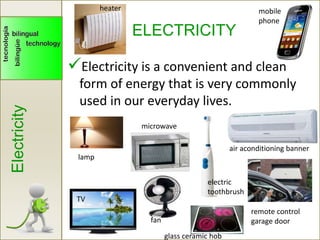
Electricity is a convenient and clean
form of energy that is very commonly
used in our everyday lives.
Electricity
heater mobile
phone
lamp
TV
fan
microwave
electric
toothbrush
remote control
garage door
air aconditioning banner
glass ceramic hob
ELECTRICITY
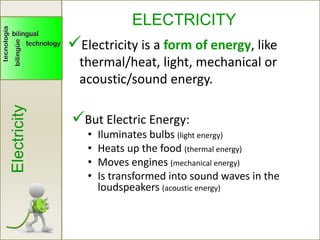
Electricity is a form of energy, like
thermal/heat, light, mechanical or
acoustic/sound energy.
But Electric Energy:
• Iluminates bulbs (light energy)
• Heats up the food (thermal energy)
• Moves engines (mechanical energy)
• Is transformed into sound waves in the
loudspeakers (acoustic energy)
Electricity
Static electricity
Atomicparticles
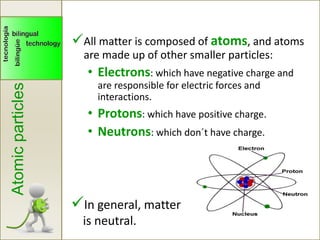
All matter is composed of atoms, and atoms
are made up of other smaller particles:
• Electrons: which have negative charge and
are responsible for electric forces and
interactions.
• Protons: which have positive charge.
• Neutrons: which don´t have charge.
In general, matter
is neutral.
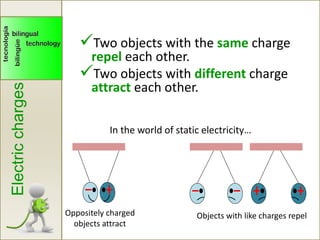
Two objects with the same charge
repel each other.
Two objects with different charge
attract each other.
In the world of static electricity…
Oppositely charged
objects attract
Objects with like charges repel
Electriccharges
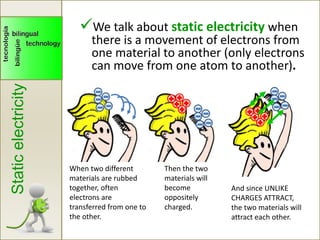
We talk about static electricity when
there is a movement of electrons from
one material to another (only electrons
can move from one atom to another).
Staticelectricity
And since UNLIKE
CHARGES ATTRACT,
the two materials will
attract each other.
When two different
materials are rubbed
together, often
electrons are
transferred from one to
the other.
Then the two
materials will
become
oppositely
charged.
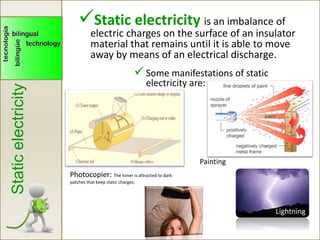
Static electricity is an imbalance of
electric charges on the surface of an insulator
material that remains until it is able to move
away by means of an electrical discharge.
 Some manifestations of static
electricity are:
Lightning
Photocopier: The toner is attracted to dark
patches that keep static charges.
Painting
Staticelectricity
Electrical current
Electrical current is the continual
movement of electrical charges
(electrons) through an appropriate path.
 This path must be done with a good
conductor material, not with an insulator
Electrical
current
Metals are good
conductor materials.
Wires are made of copper and are covered with
a plastic cover (plastic is a electrical insulator and
protects us).
Electrical circuit
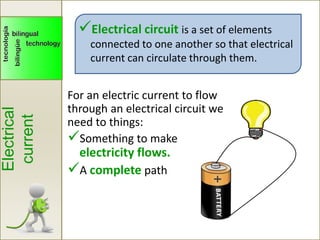
Electrical circuit is a set of elements
connected to one another so that electrical
current can circulate through them.
For an electric current to flow
through an electrical circuit we
need to things:
Something to make
electricity flows.
A complete path
Electrical
current
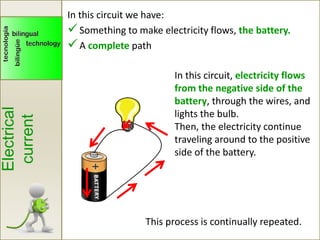
In this circuit, electricity flows
from the negative side of the
battery, through the wires, and
lights the bulb.
Then, the electricity continue
traveling around to the positive
side of the battery.
Electrical
current
This process is continually repeated.
In this circuit we have:
Something to make electricity flows, the battery.
A complete path
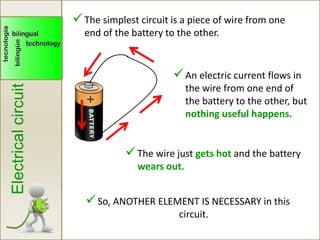
The simplest circuit is a piece of wire from one
end of the battery to the other.
Electricalcircuit
An electric current flows in
the wire from one end of
the battery to the other, but
nothing useful happens.
The wire just gets hot and the battery
wears out.
So, ANOTHER ELEMENT IS NECESSARY in this
circuit.
Electricalcircuit
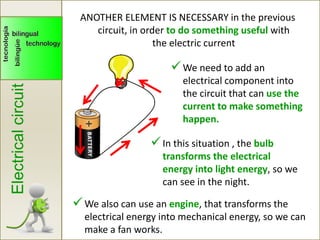
We need to add an
electrical component into
the circuit that can use the
current to make something
happen.
ANOTHER ELEMENT IS NECESSARY in the previous
circuit, in order to do something useful with
the electric current
In this situation , the bulb
transforms the electrical
energy into light energy, so we
can see in the night.
We also can use an engine, that transforms the
electrical energy into mechanical energy, so we can
make a fan works.
Electricalcircuit
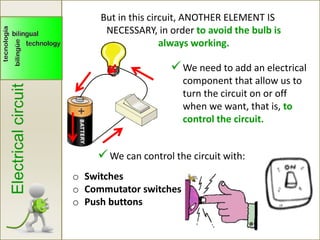
We need to add an electrical
component that allow us to
turn the circuit on or off
when we want, that is, to
control the circuit.
But in this circuit, ANOTHER ELEMENT IS
NECESSARY, in order to avoid the bulb is
always working.
o Switches
o Commutator switches
o Push buttons
We can control the circuit with:
Electricalcircuit
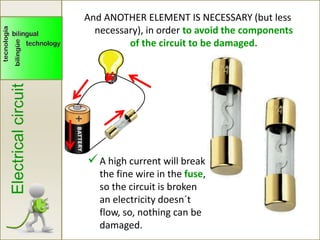
A high current will break
the fine wire in the fuse,
so the circuit is broken
an electricity doesn´t
flow, so, nothing can be
damaged.
And ANOTHER ELEMENT IS NECESSARY (but less
necessary), in order to avoid the components
of the circuit to be damaged.
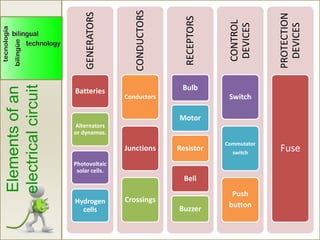
Elementsofan
electricalcircuit
GENERATORSBatteries
Alternators
or dynamos.
Photovoltaic
solar cells.
Hydrogen
cells
CONDUCTORS
Conductors
Junctions
Crossings
RECEPTORS
Bulb
Motor
Resistor
Bell
Buzzer
CONTROL
DEVICES
Switch
Commutator
switch
Push
button
PROTECTION
DEVICES
Fuse
Circuit
diagrams
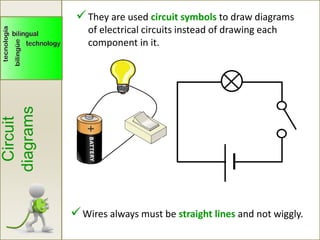
They are used circuit symbols to draw diagrams
of electrical circuits instead of drawing each
component in it.
Wires always must be straight lines and not wiggly.
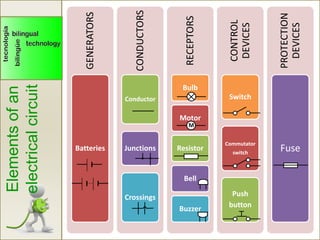
Elementsofan
electricalcircuit
GENERATORS
Batteries
CONDUCTORS
Conductor
Junctions
Crossings
RECEPTORS
Bulb
Motor
Resistor
Bell
Buzzer
CONTROL
DEVICES
Switch
Commutator
switch
Push
button
PROTECTION
DEVICES
Fuse
M
Serialand
parallelcircuits
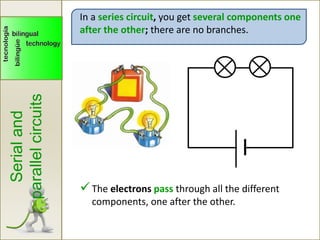
In a series circuit, you get several components one
after the other; there are no branches.
The electrons pass through all the different
components, one after the other.
Serialand
parallelcircuits
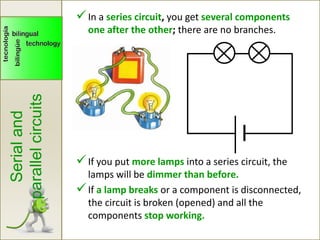
In a series circuit, you get several components
one after the other; there are no branches.
If you put more lamps into a series circuit, the
lamps will be dimmer than before.
If a lamp breaks or a component is disconnected,
the circuit is broken (opened) and all the
components stop working.
Serialand
parallelcircuits
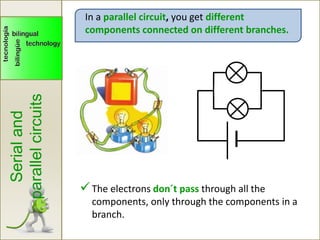
In a parallel circuit, you get different
components connected on different branches.
The electrons don´t pass through all the
components, only through the components in a
branch.
Serialand
parallelcircuits
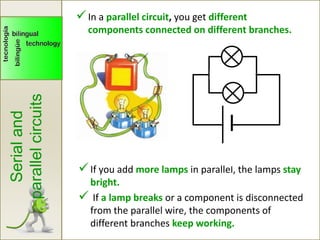
In a parallel circuit, you get different
components connected on different branches.
If you add more lamps in parallel, the lamps stay
bright.
 If a lamp breaks or a component is disconnected
from the parallel wire, the components of
different branches keep working.
Serialand
parallelcircuits
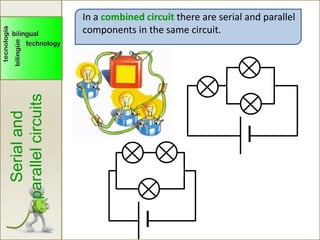
In a combined circuit there are serial and parallel
components in the same circuit.
Electrical
quantities
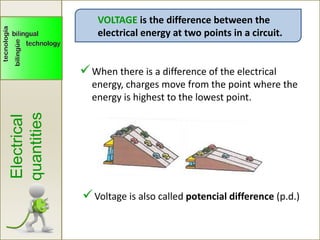
VOLTAGE is the difference between the
electrical energy at two points in a circuit.
When there is a difference of the electrical
energy, charges move from the point where the
energy is highest to the lowest point.
Voltage is also called potencial difference (p.d.)
Electrical
quantities
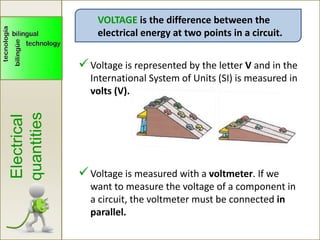
VOLTAGE is the difference between the
electrical energy at two points in a circuit.
Voltage is measured with a voltmeter. If we
want to measure the voltage of a component in
a circuit, the voltmeter must be connected in
parallel.
Voltage is represented by the letter V and in the
International System of Units (SI) is measured in
volts (V).
Electrical
quantities
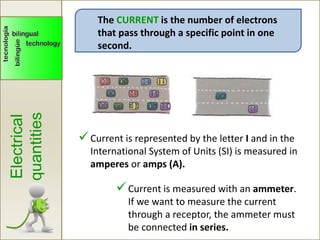
The CURRENT is the number of electrons
that pass through a specific point in one
second.
Current is represented by the letter I and in the
International System of Units (SI) is measured in
amperes or amps (A).
Current is measured with an ammeter.
If we want to measure the current
through a receptor, the ammeter must
be connected in series.
Electrical
quantities
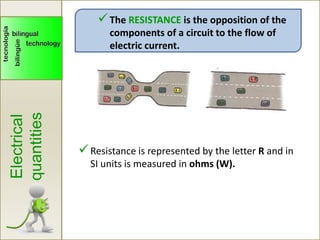
The RESISTANCE is the opposition of the
components of a circuit to the flow of
electric current.
Resistance is represented by the letter R and in
SI units is measured in ohms (W).
Ohm´slaw
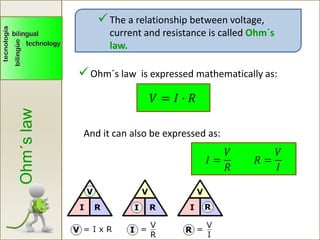
The a relationship between voltage,
current and resistance is called Ohm´s
law.
Ohm´s law is expressed mathematically as:
𝑉 = 𝐼 ∙ 𝑅
𝐼 =
𝑉
𝑅
𝑅 =
𝑉
𝐼
And it can also be expressed as:
Effectsofthe
electricalcurrent
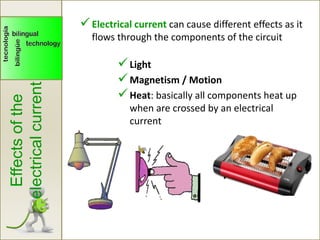
Light
Magnetism / Motion
Heat: basically all components heat up
when are crossed by an electrical
current
Electrical current can cause different effects as it
flows through the components of the circuit
Equivalent
resistances
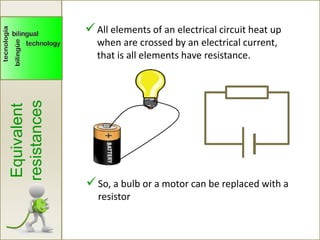
All elements of an electrical circuit heat up
when are crossed by an electrical current,
that is all elements have resistance.
So, a bulb or a motor can be replaced with a
resistor
Equivalent
resistances
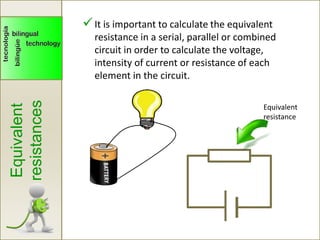
It is important to calculate the equivalent
resistance in a serial, parallel or combined
circuit in order to calculate the voltage,
intensity of current or resistance of each
element in the circuit.
Equivalent
resistance
Equivalent
resistances
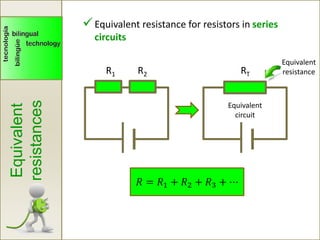
Equivalent resistance for resistors in series
circuits
R1 R2 RT
𝑅 = 𝑅1 + 𝑅2 + 𝑅3 + ⋯
Equivalent
circuit
Equivalent
resistance
Equivalent
resistances
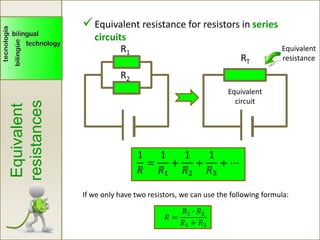
Equivalent resistance for resistors in series
circuits
1
𝑅
=
1
𝑅1
+
1
𝑅2
+
1
𝑅3
+ ⋯
RT
R1
R2
If we only have two resistors, we can use the following formula:
𝑅 =
𝑅1 ∙ 𝑅2
𝑅1 + 𝑅2
Equivalent
circuit
Equivalent
resistance

Electricity

  • 1.
  • 2.
    What do youuse electricity for?
  • 3.
    ELECTRICITY Electricity is aconvenient and clean form of energy that is very commonly used in our everyday lives. Electricity heater mobile phone lamp TV fan microwave electric toothbrush remote control garage door air aconditioning banner glass ceramic hob
  • 4.
    ELECTRICITY Electricity is aform of energy, like thermal/heat, light, mechanical or acoustic/sound energy. But Electric Energy: • Iluminates bulbs (light energy) • Heats up the food (thermal energy) • Moves engines (mechanical energy) • Is transformed into sound waves in the loudspeakers (acoustic energy) Electricity
  • 5.
  • 6.
    Atomicparticles All matter iscomposed of atoms, and atoms are made up of other smaller particles: • Electrons: which have negative charge and are responsible for electric forces and interactions. • Protons: which have positive charge. • Neutrons: which don´t have charge. In general, matter is neutral.
  • 7.
    Two objects withthe same charge repel each other. Two objects with different charge attract each other. In the world of static electricity… Oppositely charged objects attract Objects with like charges repel Electriccharges
  • 8.
    We talk aboutstatic electricity when there is a movement of electrons from one material to another (only electrons can move from one atom to another). Staticelectricity And since UNLIKE CHARGES ATTRACT, the two materials will attract each other. When two different materials are rubbed together, often electrons are transferred from one to the other. Then the two materials will become oppositely charged.
  • 9.
    Static electricity isan imbalance of electric charges on the surface of an insulator material that remains until it is able to move away by means of an electrical discharge.  Some manifestations of static electricity are: Lightning Photocopier: The toner is attracted to dark patches that keep static charges. Painting Staticelectricity
  • 10.
  • 11.
    Electrical current isthe continual movement of electrical charges (electrons) through an appropriate path.  This path must be done with a good conductor material, not with an insulator Electrical current Metals are good conductor materials. Wires are made of copper and are covered with a plastic cover (plastic is a electrical insulator and protects us).
  • 12.
  • 13.
    Electrical circuit isa set of elements connected to one another so that electrical current can circulate through them. For an electric current to flow through an electrical circuit we need to things: Something to make electricity flows. A complete path Electrical current
  • 14.
    In this circuit,electricity flows from the negative side of the battery, through the wires, and lights the bulb. Then, the electricity continue traveling around to the positive side of the battery. Electrical current This process is continually repeated. In this circuit we have: Something to make electricity flows, the battery. A complete path
  • 15.
    The simplest circuitis a piece of wire from one end of the battery to the other. Electricalcircuit An electric current flows in the wire from one end of the battery to the other, but nothing useful happens. The wire just gets hot and the battery wears out. So, ANOTHER ELEMENT IS NECESSARY in this circuit.
  • 16.
    Electricalcircuit We need toadd an electrical component into the circuit that can use the current to make something happen. ANOTHER ELEMENT IS NECESSARY in the previous circuit, in order to do something useful with the electric current In this situation , the bulb transforms the electrical energy into light energy, so we can see in the night. We also can use an engine, that transforms the electrical energy into mechanical energy, so we can make a fan works.
  • 17.
    Electricalcircuit We need toadd an electrical component that allow us to turn the circuit on or off when we want, that is, to control the circuit. But in this circuit, ANOTHER ELEMENT IS NECESSARY, in order to avoid the bulb is always working. o Switches o Commutator switches o Push buttons We can control the circuit with:
  • 18.
    Electricalcircuit A high currentwill break the fine wire in the fuse, so the circuit is broken an electricity doesn´t flow, so, nothing can be damaged. And ANOTHER ELEMENT IS NECESSARY (but less necessary), in order to avoid the components of the circuit to be damaged.
  • 19.
  • 20.
    Circuit diagrams They are usedcircuit symbols to draw diagrams of electrical circuits instead of drawing each component in it. Wires always must be straight lines and not wiggly.
  • 21.
  • 22.
    Serialand parallelcircuits In a seriescircuit, you get several components one after the other; there are no branches. The electrons pass through all the different components, one after the other.
  • 23.
    Serialand parallelcircuits In a seriescircuit, you get several components one after the other; there are no branches. If you put more lamps into a series circuit, the lamps will be dimmer than before. If a lamp breaks or a component is disconnected, the circuit is broken (opened) and all the components stop working.
  • 24.
    Serialand parallelcircuits In a parallelcircuit, you get different components connected on different branches. The electrons don´t pass through all the components, only through the components in a branch.
  • 25.
    Serialand parallelcircuits In a parallelcircuit, you get different components connected on different branches. If you add more lamps in parallel, the lamps stay bright.  If a lamp breaks or a component is disconnected from the parallel wire, the components of different branches keep working.
  • 26.
    Serialand parallelcircuits In a combinedcircuit there are serial and parallel components in the same circuit.
  • 27.
    Electrical quantities VOLTAGE is thedifference between the electrical energy at two points in a circuit. When there is a difference of the electrical energy, charges move from the point where the energy is highest to the lowest point. Voltage is also called potencial difference (p.d.)
  • 28.
    Electrical quantities VOLTAGE is thedifference between the electrical energy at two points in a circuit. Voltage is measured with a voltmeter. If we want to measure the voltage of a component in a circuit, the voltmeter must be connected in parallel. Voltage is represented by the letter V and in the International System of Units (SI) is measured in volts (V).
  • 29.
    Electrical quantities The CURRENT isthe number of electrons that pass through a specific point in one second. Current is represented by the letter I and in the International System of Units (SI) is measured in amperes or amps (A). Current is measured with an ammeter. If we want to measure the current through a receptor, the ammeter must be connected in series.
  • 30.
    Electrical quantities The RESISTANCE isthe opposition of the components of a circuit to the flow of electric current. Resistance is represented by the letter R and in SI units is measured in ohms (W).
  • 31.
    Ohm´slaw The a relationshipbetween voltage, current and resistance is called Ohm´s law. Ohm´s law is expressed mathematically as: 𝑉 = 𝐼 ∙ 𝑅 𝐼 = 𝑉 𝑅 𝑅 = 𝑉 𝐼 And it can also be expressed as:
  • 32.
    Effectsofthe electricalcurrent Light Magnetism / Motion Heat:basically all components heat up when are crossed by an electrical current Electrical current can cause different effects as it flows through the components of the circuit
  • 33.
    Equivalent resistances All elements ofan electrical circuit heat up when are crossed by an electrical current, that is all elements have resistance. So, a bulb or a motor can be replaced with a resistor
  • 34.
    Equivalent resistances It is importantto calculate the equivalent resistance in a serial, parallel or combined circuit in order to calculate the voltage, intensity of current or resistance of each element in the circuit. Equivalent resistance
  • 35.
    Equivalent resistances Equivalent resistance forresistors in series circuits R1 R2 RT 𝑅 = 𝑅1 + 𝑅2 + 𝑅3 + ⋯ Equivalent circuit Equivalent resistance
  • 36.
    Equivalent resistances Equivalent resistance forresistors in series circuits 1 𝑅 = 1 𝑅1 + 1 𝑅2 + 1 𝑅3 + ⋯ RT R1 R2 If we only have two resistors, we can use the following formula: 𝑅 = 𝑅1 ∙ 𝑅2 𝑅1 + 𝑅2 Equivalent circuit Equivalent resistance