structures
FORCES
A force is anything that
can deform a body or
change its state of rest
or movement.
But if a classmate
hold it, another
force counteracts
your force and
prevents the book
from moving.
If you drop your rubber
and your pencil so that
they hit each other, the
direction of their
movements change
When you
press down
your rubber, the
force you apply
causes its
shape to
change
When you push
your book, the force
you apply causes
the book to move
STRUCTURES
A structure is a set
of elements in a body
that are intented to resist
the effects of the forces
that act on it.
A structure prevents a body
from breaking or becoming
too deformed
TYPES OF STRUCTURES
A structure is a set
of elements in a body
that are intented to resist
the effects of the forces
that act on it.
Natural structures
are the ones
created by nature
A structure prevents a body
from breaking or becoming
too deformed
Artificial
structures are the
human-made ones.
LOADS
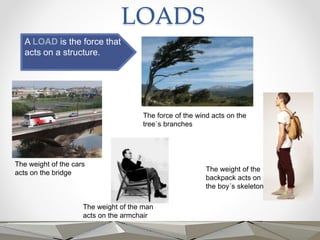
A LOAD is the force that
acts on a structure.
The force of the wind acts on the
tree´s branches
The weight of the cars
acts on the bridge
The weight of the man
acts on the armchair
The weight of the
backpack acts on
the boy´s skeleton
STRESSES
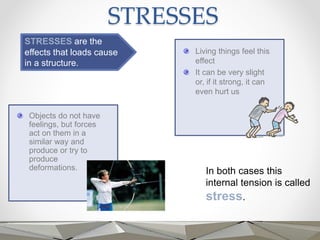
STRESSES are the
effects that loads cause
in a structure.
Living things feel this
effect
It can be very slight
or, if it strong, it can
even hurt us
Objects do not have
feelings, but forces
act on them in a
similar way and
produce or try to
produce
deformations. In both cases this
internal tension is called
stress.
TYPES OF STRESSES
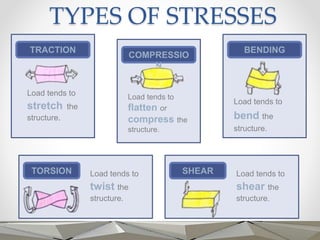
TRACTION
Load tends to
stretch the
structure.
COMPRESSIO
N
Load tends to
flatten or
compress the
structure.
BENDING
Load tends to
bend the
structure.
TORSION Load tends to
twist the
structure.
SHEAR Load tends to
shear the
structure.
TYPES OF STRESSES
TRACTIO
N COMPRESSIO
N
BENDING
TORSIO
N
SHEAR
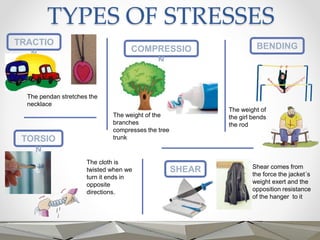
The pendan stretches the
necklace
The weight of the
branches
compresses the tree
trunk
The weight of
the girl bends
the rod
The cloth is
twisted when we
turn it ends in
opposite
directions.
Shear comes from
the force the jacket´s
weight exert and the
opposition resistance
of the hanger to it
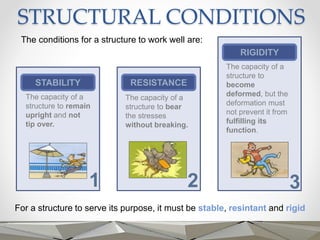
STRUCTURAL CONDITIONS
STABILITY
The capacity of a
structure to remain
upright and not
tip over.
RESISTANCE
The capacity of a
structure to bear
the stresses
without breaking.
RIGIDITY
The capacity of a
structure to
become
deformed, but the
deformation must
not prevent it from
fulfilling its
function.
1 2 3
The conditions for a structure to work well are:
For a structure to serve its purpose, it must be stable, resintant and rigid
STRUCTURAL CONDITIONS
STABILITY
Stability is the
capacity of a
structure to remain
upright and not
tip over.
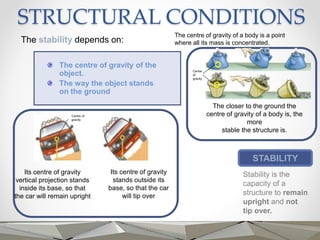
The stability depends on:
The centre of gravity of the
object.
The way the object stands
on the ground
The centre of gravity of a body is a point
where all its mass is concentrated.
Its centre of gravity
vertical projection stands
inside its base, so that
the car will remain upright
Its centre of gravity
stands outside its
base, so that the car
will tip over
Centre of
gravity
The closer to the ground the
centre of gravity of a body is, the
more
stable the structure is.
Centre
of
gravity
STRUCTURAL CONDITIONS
STABILITY
Stability is the
capacity of a
structure to remain
upright and not
tip over.
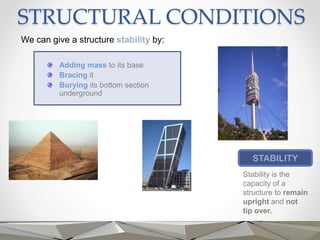
We can give a structure stability by:
Adding mass to its base
Bracing it
Burying its bottom section
underground
STRUCTURAL CONDITIONS
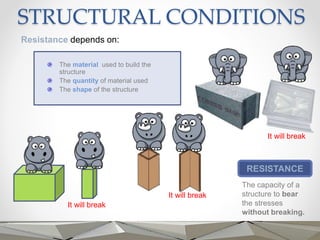
Resistance depends on:
The material used to build the
structure
The quantity of material used
The shape of the structure
RESISTANCE
The capacity of a
structure to bear
the stresses
without breaking.
It will break
It will break
It will break
STRUCTURAL CONDITIONS
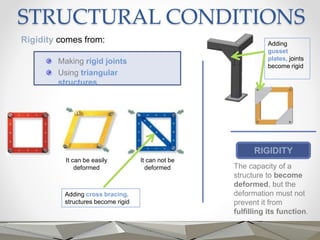
Rigidity comes from:
Making rigid joints
Using triangular
structures
It can be easily
deformed
RIGIDITY
The capacity of a
structure to become
deformed, but the
deformation must not
prevent it from
fulfilling its function.
It can not be
deformed
Adding
gusset
plates, joints
become rigid
Adding cross bracing,
structures become rigid

Structures

  • 1.
  • 2.
    FORCES A force isanything that can deform a body or change its state of rest or movement. But if a classmate hold it, another force counteracts your force and prevents the book from moving. If you drop your rubber and your pencil so that they hit each other, the direction of their movements change When you press down your rubber, the force you apply causes its shape to change When you push your book, the force you apply causes the book to move
  • 3.
    STRUCTURES A structure isa set of elements in a body that are intented to resist the effects of the forces that act on it. A structure prevents a body from breaking or becoming too deformed
  • 4.
    TYPES OF STRUCTURES Astructure is a set of elements in a body that are intented to resist the effects of the forces that act on it. Natural structures are the ones created by nature A structure prevents a body from breaking or becoming too deformed Artificial structures are the human-made ones.
  • 5.
    LOADS A LOAD isthe force that acts on a structure. The force of the wind acts on the tree´s branches The weight of the cars acts on the bridge The weight of the man acts on the armchair The weight of the backpack acts on the boy´s skeleton
  • 6.
    STRESSES STRESSES are the effectsthat loads cause in a structure. Living things feel this effect It can be very slight or, if it strong, it can even hurt us Objects do not have feelings, but forces act on them in a similar way and produce or try to produce deformations. In both cases this internal tension is called stress.
  • 7.
    TYPES OF STRESSES TRACTION Loadtends to stretch the structure. COMPRESSIO N Load tends to flatten or compress the structure. BENDING Load tends to bend the structure. TORSION Load tends to twist the structure. SHEAR Load tends to shear the structure.
  • 8.
    TYPES OF STRESSES TRACTIO NCOMPRESSIO N BENDING TORSIO N SHEAR The pendan stretches the necklace The weight of the branches compresses the tree trunk The weight of the girl bends the rod The cloth is twisted when we turn it ends in opposite directions. Shear comes from the force the jacket´s weight exert and the opposition resistance of the hanger to it
  • 9.
    STRUCTURAL CONDITIONS STABILITY The capacityof a structure to remain upright and not tip over. RESISTANCE The capacity of a structure to bear the stresses without breaking. RIGIDITY The capacity of a structure to become deformed, but the deformation must not prevent it from fulfilling its function. 1 2 3 The conditions for a structure to work well are: For a structure to serve its purpose, it must be stable, resintant and rigid
  • 10.
    STRUCTURAL CONDITIONS STABILITY Stability isthe capacity of a structure to remain upright and not tip over. The stability depends on: The centre of gravity of the object. The way the object stands on the ground The centre of gravity of a body is a point where all its mass is concentrated. Its centre of gravity vertical projection stands inside its base, so that the car will remain upright Its centre of gravity stands outside its base, so that the car will tip over Centre of gravity The closer to the ground the centre of gravity of a body is, the more stable the structure is. Centre of gravity
  • 11.
    STRUCTURAL CONDITIONS STABILITY Stability isthe capacity of a structure to remain upright and not tip over. We can give a structure stability by: Adding mass to its base Bracing it Burying its bottom section underground
  • 12.
    STRUCTURAL CONDITIONS Resistance dependson: The material used to build the structure The quantity of material used The shape of the structure RESISTANCE The capacity of a structure to bear the stresses without breaking. It will break It will break It will break
  • 13.
    STRUCTURAL CONDITIONS Rigidity comesfrom: Making rigid joints Using triangular structures It can be easily deformed RIGIDITY The capacity of a structure to become deformed, but the deformation must not prevent it from fulfilling its function. It can not be deformed Adding gusset plates, joints become rigid Adding cross bracing, structures become rigid