THE
REPRESENTATI
ON OF
OBJECTS:
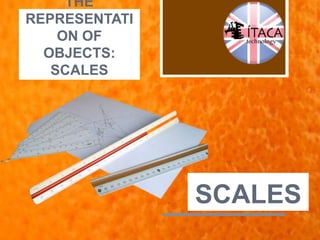
SCALES
SCALES
Representing objects
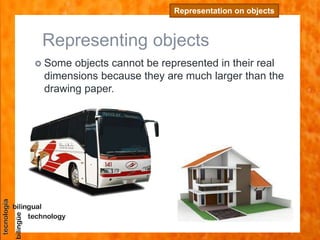
 Some objects cannot be represented in their real
dimensions because they are much larger than the
drawing paper.
Representation on objects
Representing objects
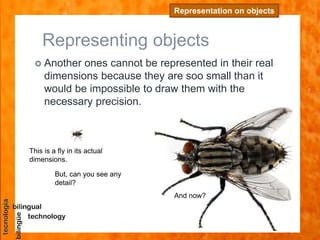
 Another ones cannot be represented in their real
dimensions because they are soo small than it
would be impossible to draw them with the
necessary precision.
Representation on objects
This is a fly in its actual
dimensions.
But, can you see any
detail?
And now?
Representing objects
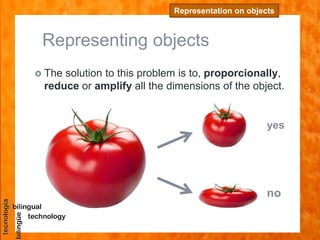
 The solution to this problem is to, proporcionally,
reduce or amplify all the dimensions of the object.
Representation on objects
yes
no
Scales
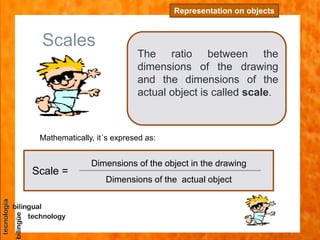
The ratio between the
dimensions of the drawing
and the dimensions of the
actual object is called scale.
Representation on objects
Scale =
Dimensions of the object in the drawing
Dimensions of the actual object
Mathematically, it´s expresed as:
Scales
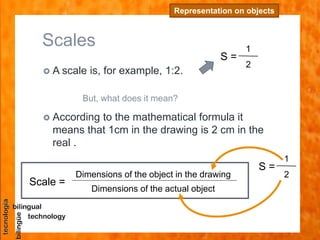
 A scale is, for example, 1:2.
Representation on objects
Scale =
Dimensions of the object in the drawing
Dimensions of the actual object
 According to the mathematical formula it
means that 1cm in the drawing is 2 cm in the
real .
But, what does it mean?
S =
1
2
S =
1
2
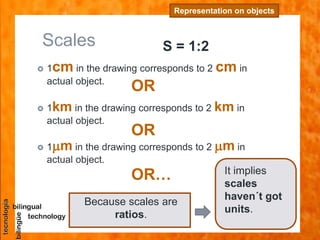
Scales S = 1:2
Representation on objects
 1cm in the drawing corresponds to 2 cm in
actual object.
OR
 1km in the drawing corresponds to 2 km in
actual object.
OR
 1mm in the drawing corresponds to 2 mm in
actual object.
OR…
Because scales are
ratios.
It implies
scales
haven´t got
units.
Scales
Representation on objects
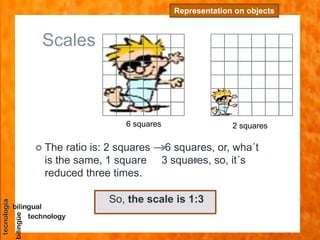
 The ratio is: 2 squares 6 squares, or, wha´t
is the same, 1 square 3 squares, so, it´s
reduced three times.
So, the scale is 1:3
6 squares 2 squares
Scales
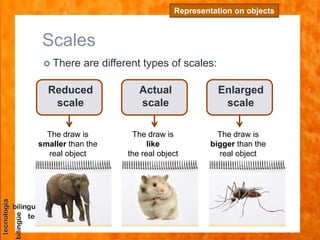
 There are different types of scales:
Representation on objects
Reduced
scale
The draw is
smaller than the
real object
Actual
scale
The draw is
like
the real object
Enlarged
scale
The draw is
bigger than the
real object
Scales: reduced scale
Representation on objects
Reduced
scale
The draw is
smaller than the
real object
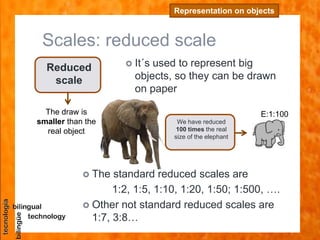
 It´s used to represent big
objects, so they can be drawn
on paper
 The standard reduced scales are
1:2, 1:5, 1:10, 1:20, 1:50; 1:500, ….
 Other not standard reduced scales are
1:7, 3:8…
E:1:100
We have reduced
100 times the real
size of the elephant
Scales: actual scale
Representation on objects
Actual
scale
The draw is the
same than the
real object
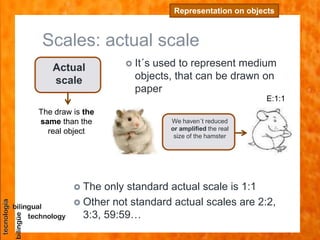
 It´s used to represent medium
objects, that can be drawn on
paper
 The only standard actual scale is 1:1
 Other not standard actual scales are 2:2,
3:3, 59:59…
E:1:1
We haven´t reduced
or amplified the real
size of the hamster
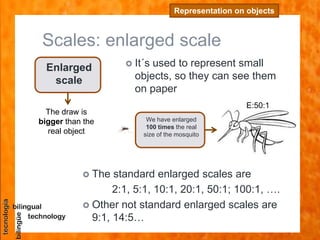
Scales: enlarged scale
Representation on objects
Enlarged
scale
The draw is
bigger than the
real object
 It´s used to represent small
objects, so they can see them
on paper
 The standard enlarged scales are
2:1, 5:1, 10:1, 20:1, 50:1; 100:1, ….
 Other not standard enlarged scales are
9:1, 14:5…
We have enlarged
100 times the real
size of the mosquito
E:50:1
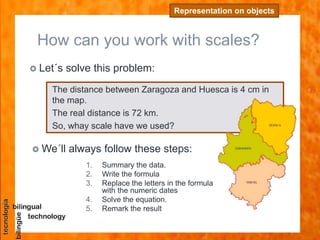
How can you work with scales?
 Let´s solve this problem:
Representation on objects
The distance between Zaragoza and Huesca is 4 cm in
the map.
The real distance is 72 km.
So, whay scale have we used?
 We´ll always follow these steps:
1. Summary the data.
2. Write the formula
3. Replace the letters in the formula
with the numeric dates
4. Solve the equation.
5. Remark the result
How can you work with scales?
Representation on objects
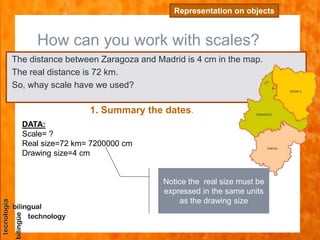
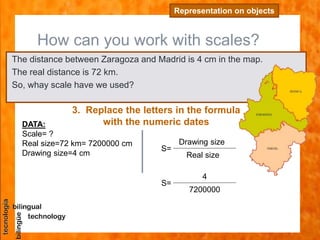
The distance between Zaragoza and Madrid is 4 cm in the map.
The real distance is 72 km.
So, whay scale have we used?
1. Summary the dates.
DATA:
Scale= ?
Real size=72 km= 7200000 cm
Drawing size=4 cm
Notice the real size must be
expressed in the same units
as the drawing size
How can you work with scales?
Representation on objects
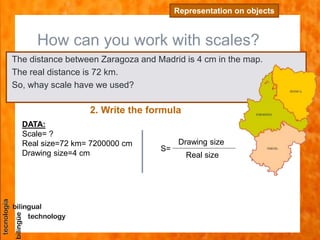
The distance between Zaragoza and Madrid is 4 cm in the map.
The real distance is 72 km.
So, whay scale have we used?
2. Write the formula
DATA:
Scale= ?
Real size=72 km= 7200000 cm
Drawing size=4 cm
S=
Drawing size
Real size
How can you work with scales?
Representation on objects
The distance between Zaragoza and Madrid is 4 cm in the map.
The real distance is 72 km.
So, whay scale have we used?
3. Replace the letters in the formula
with the numeric datesDATA:
Scale= ?
Real size=72 km= 7200000 cm
Drawing size=4 cm
S=
Drawing size
Real size
S=
4
7200000
How can you work with scales?
Representation on objects
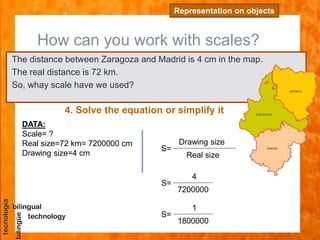
The distance between Zaragoza and Madrid is 4 cm in the map.
The real distance is 72 km.
So, whay scale have we used?
4. Solve the equation or simplify it
DATA:
Scale= ?
Real size=72 km= 7200000 cm
Drawing size=4 cm
S=
Drawing size
Real size
S=
4
7200000
S=
1
1800000
How can you work with scales?
Representation on objects
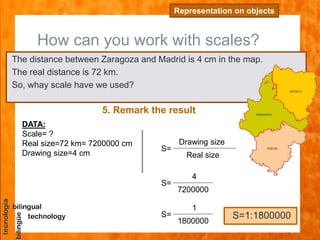
The distance between Zaragoza and Madrid is 4 cm in the map.
The real distance is 72 km.
So, whay scale have we used?
5. Remark the result
DATA:
Scale= ?
Real size=72 km= 7200000 cm
Drawing size=4 cm
S=
Drawing size
Real size
S=
4
7200000
S=
1
1800000
S=1:1800000
How can you work with scales?
Representation on objects
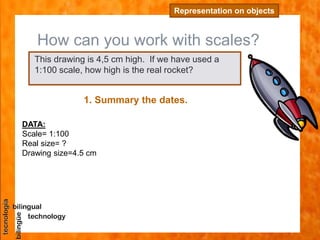
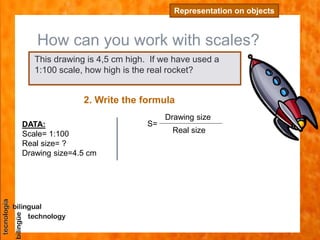
1. Summary the dates.
DATA:
Scale= 1:100
Real size= ?
Drawing size=4.5 cm
This drawing is 4,5 cm high. If we have used a
1:100 scale, how high is the real rocket?
How can you work with scales?
Representation on objects
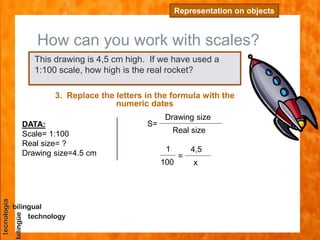
2. Write the formula
DATA:
Scale= 1:100
Real size= ?
Drawing size=4.5 cm
This drawing is 4,5 cm high. If we have used a
1:100 scale, how high is the real rocket?
S=
Drawing size
Real size
How can you work with scales?
Representation on objects
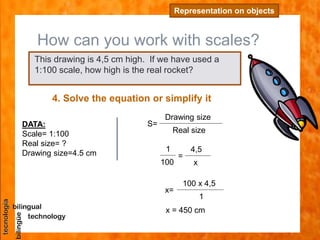
3. Replace the letters in the formula with the
numeric dates
DATA:
Scale= 1:100
Real size= ?
Drawing size=4.5 cm
This drawing is 4,5 cm high. If we have used a
1:100 scale, how high is the real rocket?
S=
Drawing size
Real size
=
4,5
x
1
100
How can you work with scales?
Representation on objects
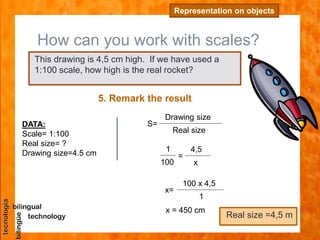
4. Solve the equation or simplify it
DATA:
Scale= 1:100
Real size= ?
Drawing size=4.5 cm
This drawing is 4,5 cm high. If we have used a
1:100 scale, how high is the real rocket?
S=
Drawing size
Real size
=
4,5
x
1
100
x=
100 x 4,5
1
x = 450 cm
How can you work with scales?
Representation on objects
5. Remark the result
DATA:
Scale= 1:100
Real size= ?
Drawing size=4.5 cm
This drawing is 4,5 cm high. If we have used a
1:100 scale, how high is the real rocket?
S=
Drawing size
Real size
=
4,5
x
1
100
x=
100 x 4,5
1
x = 450 cm
Real size =4,5 m
How do you know what scale to
draw an object at?
Representation on objects
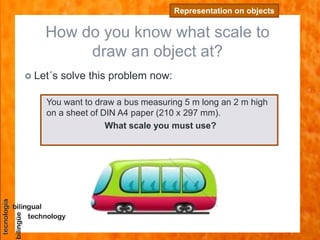
 Let´s solve this problem now:
You want to draw a bus measuring 5 m long an 2 m high
on a sheet of DIN A4 paper (210 x 297 mm).
What scale you must use?
How do you know what scale to
draw an object at?
Representation on objects
You want to draw a bus measuring 5 m long an 2 m high
on a sheet of DIN A4 paper (210 x 297 mm).
What scale you must use?
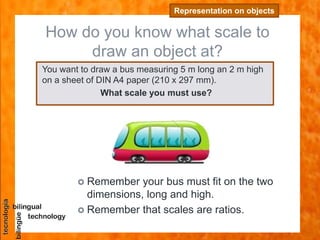
 Remember your bus must fit on the two
dimensions, long and high.
 Remember that scales are ratios.
How do you know what scale to
draw an object at?
Representation on objects
You want to draw a bus measuring 5 m long an 2 m high
on a sheet of DIN A4 paper (210 x 297 mm).
What scale you must use?
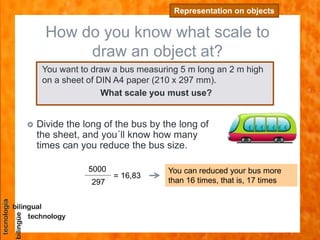
 Divide the long of the bus by the long of
the sheet, and you´ll know how many
times can you reduce the bus size.
= 16,83
5000
297
You can reduced your bus more
than 16 times, that is, 17 times
How do you know what scale to
draw an object at?
Representation on objects
You want to draw a bus measuring 5 m long an 2 m high
on a sheet of DIN A4 paper (210 x 297 mm).
What scale you must use?
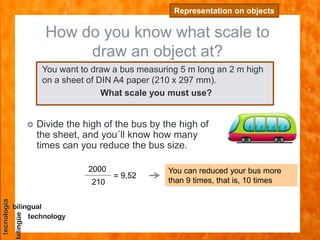
 Divide the high of the bus by the high of
the sheet, and you´ll know how many
times can you reduce the bus size.
= 9,52
2000
210
You can reduced your bus more
than 9 times, that is, 10 times
How do you know what scale to
draw an object at?
Representation on objects
You want to draw a bus measuring 5 m long an 2 m high
on a sheet of DIN A4 paper (210 x 297 mm).
What scale you must use?
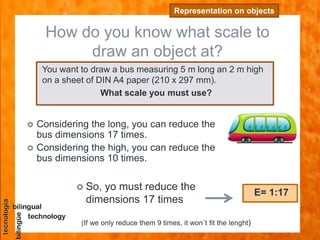
 Considering the long, you can reduce the
bus dimensions 17 times.
 Considering the high, you can reduce the
bus dimensions 10 times.
 So, yo must reduce the
dimensions 17 times
E= 1:17
(If we only reduce them 9 times, it won´t fit the lenght)

Scales

  • 1.
  • 2.
    Representing objects  Someobjects cannot be represented in their real dimensions because they are much larger than the drawing paper. Representation on objects
  • 3.
    Representing objects  Anotherones cannot be represented in their real dimensions because they are soo small than it would be impossible to draw them with the necessary precision. Representation on objects This is a fly in its actual dimensions. But, can you see any detail? And now?
  • 4.
    Representing objects  Thesolution to this problem is to, proporcionally, reduce or amplify all the dimensions of the object. Representation on objects yes no
  • 5.
    Scales The ratio betweenthe dimensions of the drawing and the dimensions of the actual object is called scale. Representation on objects Scale = Dimensions of the object in the drawing Dimensions of the actual object Mathematically, it´s expresed as:
  • 6.
    Scales  A scaleis, for example, 1:2. Representation on objects Scale = Dimensions of the object in the drawing Dimensions of the actual object  According to the mathematical formula it means that 1cm in the drawing is 2 cm in the real . But, what does it mean? S = 1 2 S = 1 2
  • 7.
    Scales S =1:2 Representation on objects  1cm in the drawing corresponds to 2 cm in actual object. OR  1km in the drawing corresponds to 2 km in actual object. OR  1mm in the drawing corresponds to 2 mm in actual object. OR… Because scales are ratios. It implies scales haven´t got units.
  • 8.
    Scales Representation on objects The ratio is: 2 squares 6 squares, or, wha´t is the same, 1 square 3 squares, so, it´s reduced three times. So, the scale is 1:3 6 squares 2 squares
  • 9.
    Scales  There aredifferent types of scales: Representation on objects Reduced scale The draw is smaller than the real object Actual scale The draw is like the real object Enlarged scale The draw is bigger than the real object
  • 10.
    Scales: reduced scale Representationon objects Reduced scale The draw is smaller than the real object  It´s used to represent big objects, so they can be drawn on paper  The standard reduced scales are 1:2, 1:5, 1:10, 1:20, 1:50; 1:500, ….  Other not standard reduced scales are 1:7, 3:8… E:1:100 We have reduced 100 times the real size of the elephant
  • 11.
    Scales: actual scale Representationon objects Actual scale The draw is the same than the real object  It´s used to represent medium objects, that can be drawn on paper  The only standard actual scale is 1:1  Other not standard actual scales are 2:2, 3:3, 59:59… E:1:1 We haven´t reduced or amplified the real size of the hamster
  • 12.
    Scales: enlarged scale Representationon objects Enlarged scale The draw is bigger than the real object  It´s used to represent small objects, so they can see them on paper  The standard enlarged scales are 2:1, 5:1, 10:1, 20:1, 50:1; 100:1, ….  Other not standard enlarged scales are 9:1, 14:5… We have enlarged 100 times the real size of the mosquito E:50:1
  • 13.
    How can youwork with scales?  Let´s solve this problem: Representation on objects The distance between Zaragoza and Huesca is 4 cm in the map. The real distance is 72 km. So, whay scale have we used?  We´ll always follow these steps: 1. Summary the data. 2. Write the formula 3. Replace the letters in the formula with the numeric dates 4. Solve the equation. 5. Remark the result
  • 14.
    How can youwork with scales? Representation on objects The distance between Zaragoza and Madrid is 4 cm in the map. The real distance is 72 km. So, whay scale have we used? 1. Summary the dates. DATA: Scale= ? Real size=72 km= 7200000 cm Drawing size=4 cm Notice the real size must be expressed in the same units as the drawing size
  • 15.
    How can youwork with scales? Representation on objects The distance between Zaragoza and Madrid is 4 cm in the map. The real distance is 72 km. So, whay scale have we used? 2. Write the formula DATA: Scale= ? Real size=72 km= 7200000 cm Drawing size=4 cm S= Drawing size Real size
  • 16.
    How can youwork with scales? Representation on objects The distance between Zaragoza and Madrid is 4 cm in the map. The real distance is 72 km. So, whay scale have we used? 3. Replace the letters in the formula with the numeric datesDATA: Scale= ? Real size=72 km= 7200000 cm Drawing size=4 cm S= Drawing size Real size S= 4 7200000
  • 17.
    How can youwork with scales? Representation on objects The distance between Zaragoza and Madrid is 4 cm in the map. The real distance is 72 km. So, whay scale have we used? 4. Solve the equation or simplify it DATA: Scale= ? Real size=72 km= 7200000 cm Drawing size=4 cm S= Drawing size Real size S= 4 7200000 S= 1 1800000
  • 18.
    How can youwork with scales? Representation on objects The distance between Zaragoza and Madrid is 4 cm in the map. The real distance is 72 km. So, whay scale have we used? 5. Remark the result DATA: Scale= ? Real size=72 km= 7200000 cm Drawing size=4 cm S= Drawing size Real size S= 4 7200000 S= 1 1800000 S=1:1800000
  • 19.
    How can youwork with scales? Representation on objects 1. Summary the dates. DATA: Scale= 1:100 Real size= ? Drawing size=4.5 cm This drawing is 4,5 cm high. If we have used a 1:100 scale, how high is the real rocket?
  • 20.
    How can youwork with scales? Representation on objects 2. Write the formula DATA: Scale= 1:100 Real size= ? Drawing size=4.5 cm This drawing is 4,5 cm high. If we have used a 1:100 scale, how high is the real rocket? S= Drawing size Real size
  • 21.
    How can youwork with scales? Representation on objects 3. Replace the letters in the formula with the numeric dates DATA: Scale= 1:100 Real size= ? Drawing size=4.5 cm This drawing is 4,5 cm high. If we have used a 1:100 scale, how high is the real rocket? S= Drawing size Real size = 4,5 x 1 100
  • 22.
    How can youwork with scales? Representation on objects 4. Solve the equation or simplify it DATA: Scale= 1:100 Real size= ? Drawing size=4.5 cm This drawing is 4,5 cm high. If we have used a 1:100 scale, how high is the real rocket? S= Drawing size Real size = 4,5 x 1 100 x= 100 x 4,5 1 x = 450 cm
  • 23.
    How can youwork with scales? Representation on objects 5. Remark the result DATA: Scale= 1:100 Real size= ? Drawing size=4.5 cm This drawing is 4,5 cm high. If we have used a 1:100 scale, how high is the real rocket? S= Drawing size Real size = 4,5 x 1 100 x= 100 x 4,5 1 x = 450 cm Real size =4,5 m
  • 24.
    How do youknow what scale to draw an object at? Representation on objects  Let´s solve this problem now: You want to draw a bus measuring 5 m long an 2 m high on a sheet of DIN A4 paper (210 x 297 mm). What scale you must use?
  • 25.
    How do youknow what scale to draw an object at? Representation on objects You want to draw a bus measuring 5 m long an 2 m high on a sheet of DIN A4 paper (210 x 297 mm). What scale you must use?  Remember your bus must fit on the two dimensions, long and high.  Remember that scales are ratios.
  • 26.
    How do youknow what scale to draw an object at? Representation on objects You want to draw a bus measuring 5 m long an 2 m high on a sheet of DIN A4 paper (210 x 297 mm). What scale you must use?  Divide the long of the bus by the long of the sheet, and you´ll know how many times can you reduce the bus size. = 16,83 5000 297 You can reduced your bus more than 16 times, that is, 17 times
  • 27.
    How do youknow what scale to draw an object at? Representation on objects You want to draw a bus measuring 5 m long an 2 m high on a sheet of DIN A4 paper (210 x 297 mm). What scale you must use?  Divide the high of the bus by the high of the sheet, and you´ll know how many times can you reduce the bus size. = 9,52 2000 210 You can reduced your bus more than 9 times, that is, 10 times
  • 28.
    How do youknow what scale to draw an object at? Representation on objects You want to draw a bus measuring 5 m long an 2 m high on a sheet of DIN A4 paper (210 x 297 mm). What scale you must use?  Considering the long, you can reduce the bus dimensions 17 times.  Considering the high, you can reduce the bus dimensions 10 times.  So, yo must reduce the dimensions 17 times E= 1:17 (If we only reduce them 9 times, it won´t fit the lenght)