1
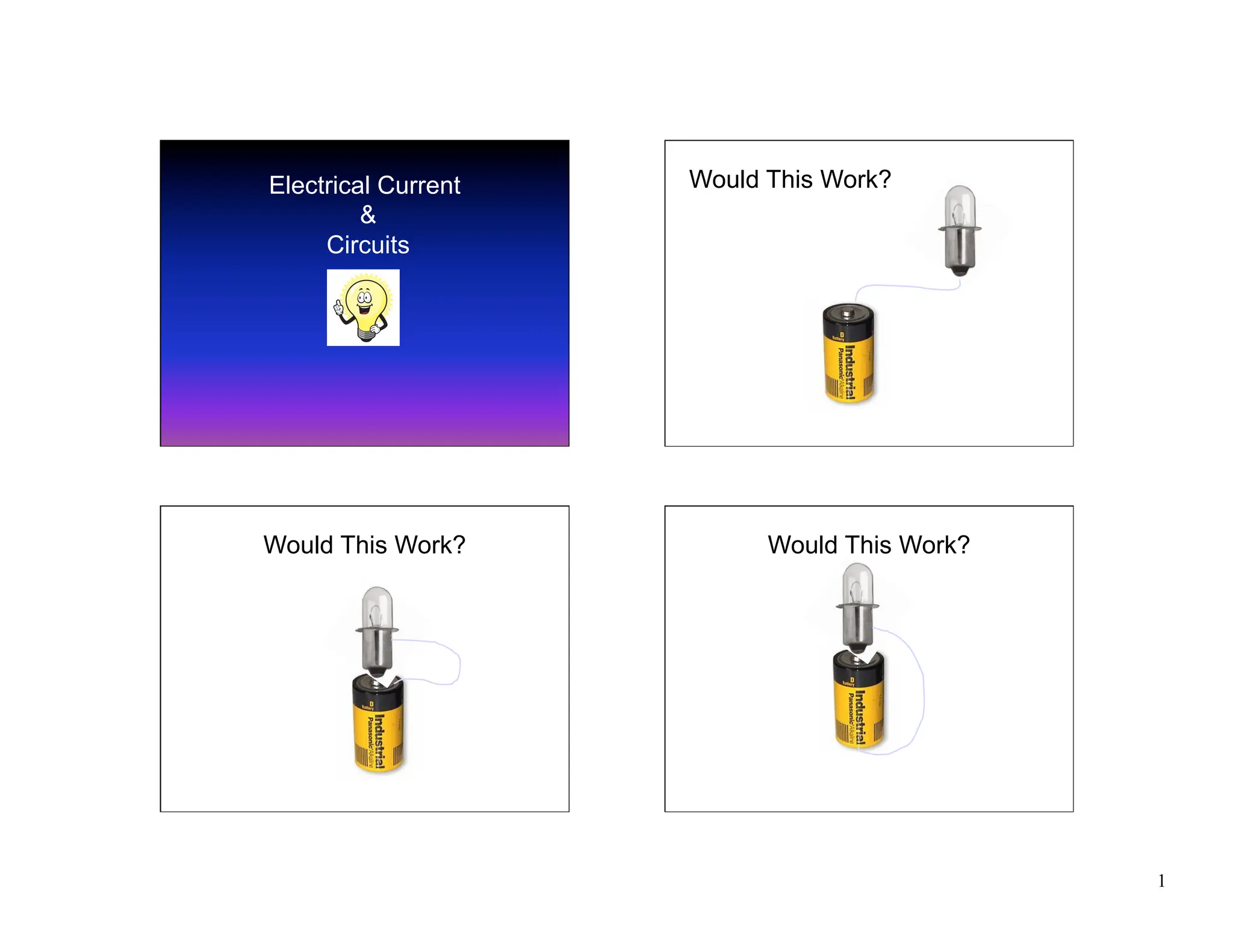
Electrical Current
&
Circuits
Would This Work?
Would This Work? Would This Work?
2
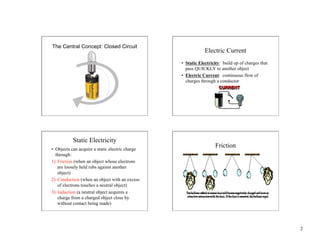
The Central Concept: Closed Circuit
Electric Current
• Static Electricity: build up of charges that
pass QUICKLY to another object
• Electric Current: continuous flow of
charges through a conductor
Static Electricity
• Objects can acquire a static electric charge
through:
1) Friction (when an object whose electrons
are loosely held rubs against another
object)
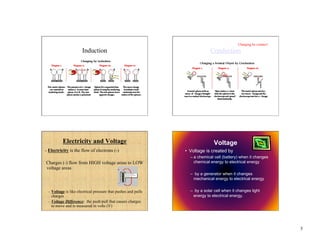
2) Conduction (when an object with an excess
of electrons touches a neutral object)
3) Induction (a neutral object acquires a
charge from a charged object close by
without contact being made)
Friction
3
Induction Conduction
Charging by contact!
Electricity and Voltage
- Electricity is the flow of electrons (-)
Charges (-) flow from HIGH voltage areas to LOW
voltage areas
– Voltage is like electrical pressure that pushes and pulls
charges
– Voltage Difference: the push/pull that causes charges
to move and is measured in volts (V)
Voltage
• Voltage is created by
– a chemical cell (battery) when it changes
chemical energy to electrical energy
– by a generator when it changes
mechanical energy to electrical energy
– by a solar cell when it changes light
energy to electrical energy.
4
Voltage and Current
• When a wire connects the terminals of a battery or generators, then
the voltage will push and pull electrons through a conductor.
– One terminal has extra electrons thus a negative charge. The other terminal has a
deficit of electrons and thus a positive charge.
– Electrons in the wire are pushed by the negative terminal and pulled by the
positive terminal through the wire
Circuit: a closed, conducting path
• For changes to flow, the wire must always be connected in a circuit
• Electric Current: the flow of charges through a wire or any
conductor. Measured in Amperes (A=Amps)
• Current is almost always the flow of electrons
• What happens if we break the circuit?
Resistance
• Resistance: the tendency for a material to
oppose the flow of electrons
• Changes electrical energy into thermal energy
and light
• Ex: light bulb filament
• Measured in Ohms (Ω)
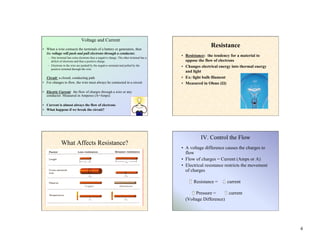
What Affects Resistance?
IV. Control the Flow
• A voltage difference causes the charges to
flow
• Flow of charges = Current (Amps or A)
• Electrical resistance restricts the movement
of charges
Resistance = current
Pressure = current
(Voltage Difference)
5
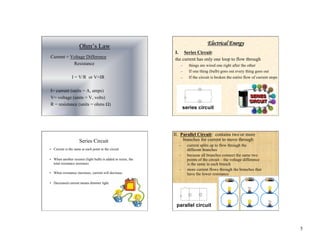
Ohm’s Law
Current = Voltage Difference
Resistance
I = V/R or V=IR
I= current (units = A, amps)
V= voltage (units = V, volts)
R = resistance (units = ohms Ω)
Tutorial
Electrical Energy
I. Series Circuit:
the current has only one loop to flow through
– things are wired one right after the other
– If one thing (bulb) goes out every thing goes out
– If the circuit is broken the entire flow of current stops
Series Circuit
• Current is the same at each point in the circuit
• When another resistor (light bulb) is added in series, the
total resistance increases.
• When resistance increases, current will decrease.
• Decreased current means dimmer light.
II. Parallel Circuit: contains two or more
branches for current to move through
– current splits up to flow through the
different branches
– because all branches connect the same two
points of the circuit – the voltage difference
is the same in each branch
– more current flows through the branches that
have the lower resistance
6
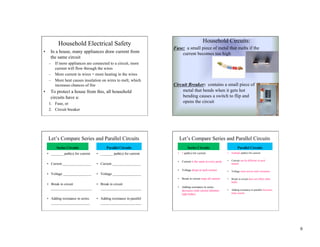
Household Electrical Safety
• In a house, many appliances draw current from
the same circuit
– If more appliances are connected to a circuit, more
current will flow through the wires
– More current in wires = more heating in the wires
– More heat causes insulation on wires to melt, which
increases chances of fire
• To protect a house from this, all household
circuits have a:
1. Fuse, or
2. Circuit breaker
Household Circuits:
Fuse: a small piece of metal that melts if the
current becomes too high
Circuit Breaker: contains a small piece of
metal that bends when it gets hot
bending causes a switch to flip and
opens the circuit
Let’s Compare Series and Parallel Circuits
Series Circuits
• _______ path(s) for current
• Current ________________
• Voltage ________________
• Break in circuit
_______________________
• Adding resistance in series
______________________
Parallel Circuits
• _______ path(s) for current
• Current ________________
• Voltage ________________
• Break in circuit
_______________________
• Adding resistance in parallel
_______________________
Let’s Compare Series and Parallel Circuits
Series Circuits
• 1 path(s) for current
• Current is the same at every point
• Voltage drops at each resistor
• Break in circuit stops all current
• Adding resistance in series
decreases total current (dimmer
light bulbs)
Parallel Circuits
• multiple path(s) for current
• Current can be different in each
branch
• Voltage same across each resistance
• Break in circuit does not affect other
bulbs
• Adding resistance in parallel increases
total current

electric_current_and_circuits.pdf

  • 1.
    1 Electrical Current & Circuits Would ThisWork? Would This Work? Would This Work?
  • 2.
    2 The Central Concept:Closed Circuit Electric Current • Static Electricity: build up of charges that pass QUICKLY to another object • Electric Current: continuous flow of charges through a conductor Static Electricity • Objects can acquire a static electric charge through: 1) Friction (when an object whose electrons are loosely held rubs against another object) 2) Conduction (when an object with an excess of electrons touches a neutral object) 3) Induction (a neutral object acquires a charge from a charged object close by without contact being made) Friction
  • 3.
    3 Induction Conduction Charging bycontact! Electricity and Voltage - Electricity is the flow of electrons (-) Charges (-) flow from HIGH voltage areas to LOW voltage areas – Voltage is like electrical pressure that pushes and pulls charges – Voltage Difference: the push/pull that causes charges to move and is measured in volts (V) Voltage • Voltage is created by – a chemical cell (battery) when it changes chemical energy to electrical energy – by a generator when it changes mechanical energy to electrical energy – by a solar cell when it changes light energy to electrical energy.
  • 4.
    4 Voltage and Current •When a wire connects the terminals of a battery or generators, then the voltage will push and pull electrons through a conductor. – One terminal has extra electrons thus a negative charge. The other terminal has a deficit of electrons and thus a positive charge. – Electrons in the wire are pushed by the negative terminal and pulled by the positive terminal through the wire Circuit: a closed, conducting path • For changes to flow, the wire must always be connected in a circuit • Electric Current: the flow of charges through a wire or any conductor. Measured in Amperes (A=Amps) • Current is almost always the flow of electrons • What happens if we break the circuit? Resistance • Resistance: the tendency for a material to oppose the flow of electrons • Changes electrical energy into thermal energy and light • Ex: light bulb filament • Measured in Ohms (Ω) What Affects Resistance? IV. Control the Flow • A voltage difference causes the charges to flow • Flow of charges = Current (Amps or A) • Electrical resistance restricts the movement of charges Resistance = current Pressure = current (Voltage Difference)
  • 5.
    5 Ohm’s Law Current =Voltage Difference Resistance I = V/R or V=IR I= current (units = A, amps) V= voltage (units = V, volts) R = resistance (units = ohms Ω) Tutorial Electrical Energy I. Series Circuit: the current has only one loop to flow through – things are wired one right after the other – If one thing (bulb) goes out every thing goes out – If the circuit is broken the entire flow of current stops Series Circuit • Current is the same at each point in the circuit • When another resistor (light bulb) is added in series, the total resistance increases. • When resistance increases, current will decrease. • Decreased current means dimmer light. II. Parallel Circuit: contains two or more branches for current to move through – current splits up to flow through the different branches – because all branches connect the same two points of the circuit – the voltage difference is the same in each branch – more current flows through the branches that have the lower resistance
  • 6.
    6 Household Electrical Safety •In a house, many appliances draw current from the same circuit – If more appliances are connected to a circuit, more current will flow through the wires – More current in wires = more heating in the wires – More heat causes insulation on wires to melt, which increases chances of fire • To protect a house from this, all household circuits have a: 1. Fuse, or 2. Circuit breaker Household Circuits: Fuse: a small piece of metal that melts if the current becomes too high Circuit Breaker: contains a small piece of metal that bends when it gets hot bending causes a switch to flip and opens the circuit Let’s Compare Series and Parallel Circuits Series Circuits • _______ path(s) for current • Current ________________ • Voltage ________________ • Break in circuit _______________________ • Adding resistance in series ______________________ Parallel Circuits • _______ path(s) for current • Current ________________ • Voltage ________________ • Break in circuit _______________________ • Adding resistance in parallel _______________________ Let’s Compare Series and Parallel Circuits Series Circuits • 1 path(s) for current • Current is the same at every point • Voltage drops at each resistor • Break in circuit stops all current • Adding resistance in series decreases total current (dimmer light bulbs) Parallel Circuits • multiple path(s) for current • Current can be different in each branch • Voltage same across each resistance • Break in circuit does not affect other bulbs • Adding resistance in parallel increases total current