THE
REPRESENTATION
OF OBJECTS
DIMENSIONING
What is dimensioning?
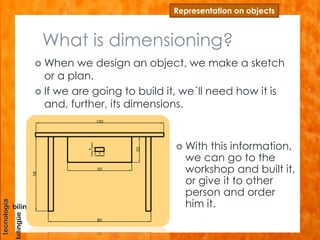
 When we design an object, we make a sketch
or a plan.
 If we are going to build it, we´ll need how it is
and, further, its dimensions.
Representation on objects
 With this information,
we can go to the
workshop and built it,
or give it to other
person and order
him it.
Representation on objects
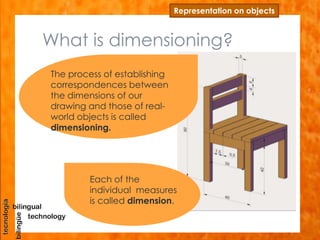
Each of the
individual measures
is called dimension.
The process of establishing
correspondences between
the dimensions of our
drawing and those of real-
world objects is called
dimensioning.
What is dimensioning?
Dimensioning
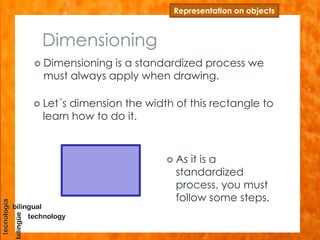
 Let´s dimension the width of this rectangle to
learn how to do it.
Representation on objects
 As it is a
standardized
process, you must
follow some steps.
 Dimensioning is a standardized process we
must always apply when drawing.
Dimensioning
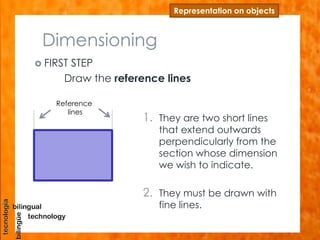
 FIRST STEP
Draw the reference lines
Representation on objects
1. They are two short lines
that extend outwards
perpendicularly from the
section whose dimension
we wish to indicate.
2. They must be drawn with
fine lines.
Reference
lines
Dimensioning
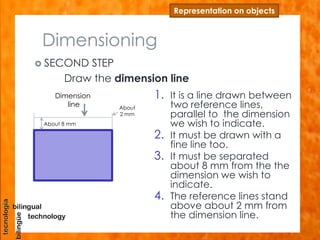
 SECOND STEP
Draw the dimension line
Representation on objects
1. It is a line drawn between
two reference lines,
parallel to the dimension
we wish to indicate.
2. It must be drawn with a
fine line too.
3. It must be separated
about 8 mm from the the
dimension we wish to
indicate.
4. The reference lines stand
above about 2 mm from
the dimension line.
Dimension
line
About 8 mm
About
2 mm
Dimensioning
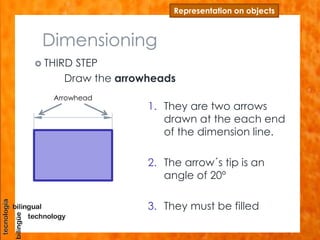
 THIRD STEP
Draw the arrowheads
Representation on objects
1. They are two arrows
drawn at the each end
of the dimension line.
2. The arrow´s tip is an
angle of 20º
3. They must be filled
Arrowhead
Dimensioning
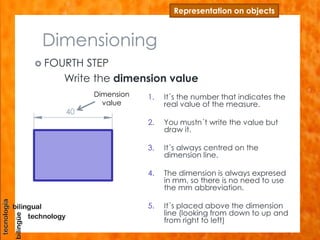
 FOURTH STEP
Write the dimension value
Representation on objects
1. It´s the number that indicates the
real value of the measure.
2. You mustn´t write the value but
draw it.
3. It´s always centred on the
dimension line.
4. The dimension is always expresed
in mm, so there is no need to use
the mm abbreviation.
5. It´s placed above the dimension
line (looking from down to up and
from right to left)
40
Dimension
value
Dimensioning
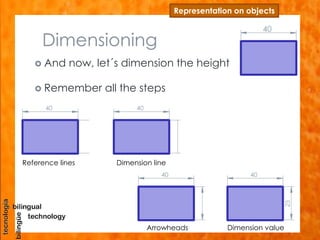
 And now, let´s dimension the height
Representation on objects
40
 Remember all the steps
40 40
40 40
25
Reference lines Dimension line
Arrowheads Dimension value
Some rules
 In order to properly indicate the dimensions of an
object, we should take into account some
recommendations:
Representation on objects
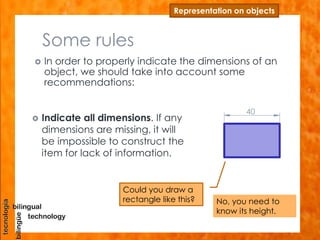
 Indicate all dimensions. If any
dimensions are missing, it will
be impossible to construct the
item for lack of information.
40
Could you draw a
rectangle like this? No, you need to
know its height.
Some rules
 In order to properly indicate the dimensions of an
object, we should take into account some
recommendations:
Representation on objects
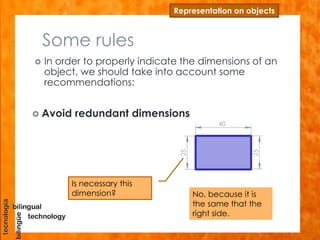
 Avoid redundant dimensions
Is necessary this
dimension? No, because it is
the same that the
right side.
40
25
25
Some rules
 In order to properly indicate the dimensions of an
object, we should take into account some
recommendations:
Representation on objects
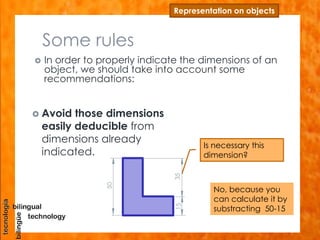
 Avoid those dimensions
easily deducible from
dimensions already
indicated.
Is necessary this
dimension?
No, because you
can calculate it by
substracting 50-15
50
1535
Some rules
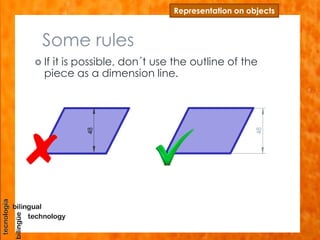
 If it is possible, don´t use the outline of the
piece as a dimension line.
Representation on objects
48
48
Some rules
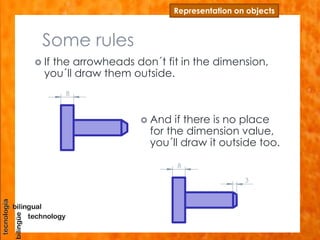
 If the arrowheads don´t fit in the dimension,
you´ll draw them outside.
Representation on objects
 And if there is no place
for the dimension value,
you´ll draw it outside too.
8
8
3
Some rules
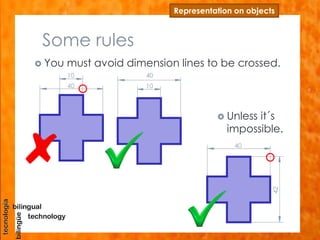
 You must avoid dimension lines to be crossed.
Representation on objects
 Unless it´s
impossible.
10
4010
40
42
40
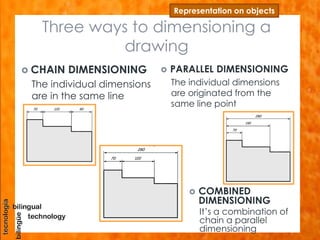
Three ways to dimensioning a
drawing
 CHAIN DIMENSIONING
The individual dimensions
are in the same line
Representation on objects
 PARALLEL DIMENSIONING
The individual dimensions
are originated from the
same line point
 COMBINED
DIMENSIONING
It’s a combination of
chain a parallel
dimensioning
Some rules
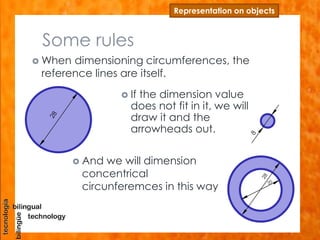
 When dimensioning circumferences, the
reference lines are itself.
Representation on objects
 If the dimension value
does not fit in it, we will
draw it and the
arrowheads out.
 And we will dimension
concentrical
circunferemces in this way
Some rules
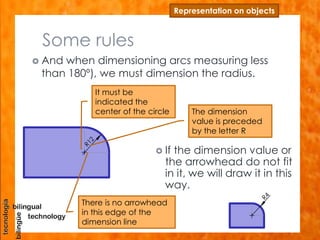
 And when dimensioning arcs measuring less
than 180º), we must dimension the radius.
Representation on objects
 If the dimension value or
the arrowhead do not fit
in it, we will draw it in this
way.
The dimension
value is preceded
by the letter R
It must be
indicated the
center of the circle
There is no arrowhead
in this edge of the
dimension line
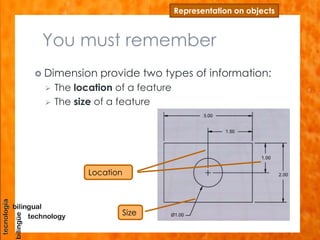
You must remember
 Dimension provide two types of information:
 The location of a feature
 The size of a feature
Representation on objects
Location
Size
Reviewing
Representation on objects
40
25
40
2540
25
40
25
40
There are two redundant
dimensions
There is a
dimension left
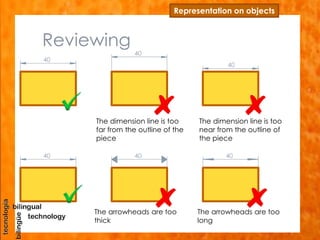
Reviewing
Representation on objects
40
The dimension line is too
near from the outline of
the piece
40
40
The dimension line is too
far from the outline of the
piece
40 40 40
The arrowheads are too
long
The arrowheads are too
thick
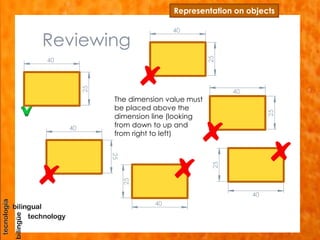
Reviewing
Representation on objects
40
25
40
25
40
25
40
25
40
25
40
25
The dimension value must
be placed above the
dimension line (looking
from down to up and
from right to left)
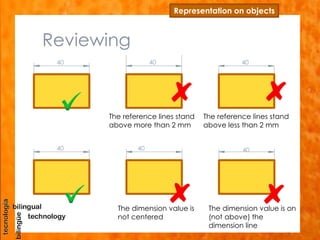
Reviewing
Representation on objects
40
The reference lines stand
above less than 2 mm
The reference lines stand
above more than 2 mm
The dimension value is on
(not above) the
dimension line
The dimension value is
not centered
4040
40 40 40
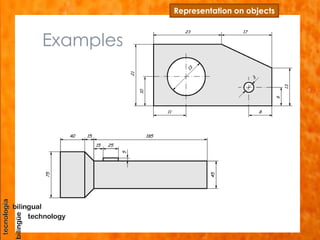
Examples
Representation on objects
Examples
Representation on objects
Examples
Representation on objects
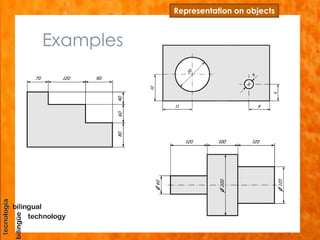
 The purpose of dimensioning is to provide a
clear and complete description of an object.
 A complete set of dimensions will permit only
one interpretation needed to construct the
object, although the set of dimensions is not an
only one.
 So, dimensioning should follow these guidelines:
 Accuracy: correct values must be given.
 Clearness: dimensions must be placed in
appropriate positions.
 Completeness: nothing must be left out,
and nothing duplicated.
 Readability: the appropriate line quality
must be used for legibility.

Dimensioning

  • 1.
  • 2.
    What is dimensioning? When we design an object, we make a sketch or a plan.  If we are going to build it, we´ll need how it is and, further, its dimensions. Representation on objects  With this information, we can go to the workshop and built it, or give it to other person and order him it.
  • 3.
    Representation on objects Eachof the individual measures is called dimension. The process of establishing correspondences between the dimensions of our drawing and those of real- world objects is called dimensioning. What is dimensioning?
  • 4.
    Dimensioning  Let´s dimensionthe width of this rectangle to learn how to do it. Representation on objects  As it is a standardized process, you must follow some steps.  Dimensioning is a standardized process we must always apply when drawing.
  • 5.
    Dimensioning  FIRST STEP Drawthe reference lines Representation on objects 1. They are two short lines that extend outwards perpendicularly from the section whose dimension we wish to indicate. 2. They must be drawn with fine lines. Reference lines
  • 6.
    Dimensioning  SECOND STEP Drawthe dimension line Representation on objects 1. It is a line drawn between two reference lines, parallel to the dimension we wish to indicate. 2. It must be drawn with a fine line too. 3. It must be separated about 8 mm from the the dimension we wish to indicate. 4. The reference lines stand above about 2 mm from the dimension line. Dimension line About 8 mm About 2 mm
  • 7.
    Dimensioning  THIRD STEP Drawthe arrowheads Representation on objects 1. They are two arrows drawn at the each end of the dimension line. 2. The arrow´s tip is an angle of 20º 3. They must be filled Arrowhead
  • 8.
    Dimensioning  FOURTH STEP Writethe dimension value Representation on objects 1. It´s the number that indicates the real value of the measure. 2. You mustn´t write the value but draw it. 3. It´s always centred on the dimension line. 4. The dimension is always expresed in mm, so there is no need to use the mm abbreviation. 5. It´s placed above the dimension line (looking from down to up and from right to left) 40 Dimension value
  • 9.
    Dimensioning  And now,let´s dimension the height Representation on objects 40  Remember all the steps 40 40 40 40 25 Reference lines Dimension line Arrowheads Dimension value
  • 10.
    Some rules  Inorder to properly indicate the dimensions of an object, we should take into account some recommendations: Representation on objects  Indicate all dimensions. If any dimensions are missing, it will be impossible to construct the item for lack of information. 40 Could you draw a rectangle like this? No, you need to know its height.
  • 11.
    Some rules  Inorder to properly indicate the dimensions of an object, we should take into account some recommendations: Representation on objects  Avoid redundant dimensions Is necessary this dimension? No, because it is the same that the right side. 40 25 25
  • 12.
    Some rules  Inorder to properly indicate the dimensions of an object, we should take into account some recommendations: Representation on objects  Avoid those dimensions easily deducible from dimensions already indicated. Is necessary this dimension? No, because you can calculate it by substracting 50-15 50 1535
  • 13.
    Some rules  Ifit is possible, don´t use the outline of the piece as a dimension line. Representation on objects 48 48
  • 14.
    Some rules  Ifthe arrowheads don´t fit in the dimension, you´ll draw them outside. Representation on objects  And if there is no place for the dimension value, you´ll draw it outside too. 8 8 3
  • 15.
    Some rules  Youmust avoid dimension lines to be crossed. Representation on objects  Unless it´s impossible. 10 4010 40 42 40
  • 16.
    Three ways todimensioning a drawing  CHAIN DIMENSIONING The individual dimensions are in the same line Representation on objects  PARALLEL DIMENSIONING The individual dimensions are originated from the same line point  COMBINED DIMENSIONING It’s a combination of chain a parallel dimensioning
  • 17.
    Some rules  Whendimensioning circumferences, the reference lines are itself. Representation on objects  If the dimension value does not fit in it, we will draw it and the arrowheads out.  And we will dimension concentrical circunferemces in this way
  • 18.
    Some rules  Andwhen dimensioning arcs measuring less than 180º), we must dimension the radius. Representation on objects  If the dimension value or the arrowhead do not fit in it, we will draw it in this way. The dimension value is preceded by the letter R It must be indicated the center of the circle There is no arrowhead in this edge of the dimension line
  • 19.
    You must remember Dimension provide two types of information:  The location of a feature  The size of a feature Representation on objects Location Size
  • 20.
    Reviewing Representation on objects 40 25 40 2540 25 40 25 40 Thereare two redundant dimensions There is a dimension left
  • 21.
    Reviewing Representation on objects 40 Thedimension line is too near from the outline of the piece 40 40 The dimension line is too far from the outline of the piece 40 40 40 The arrowheads are too long The arrowheads are too thick
  • 22.
    Reviewing Representation on objects 40 25 40 25 40 25 40 25 40 25 40 25 Thedimension value must be placed above the dimension line (looking from down to up and from right to left)
  • 23.
    Reviewing Representation on objects 40 Thereference lines stand above less than 2 mm The reference lines stand above more than 2 mm The dimension value is on (not above) the dimension line The dimension value is not centered 4040 40 40 40
  • 24.
  • 25.
  • 26.
    Examples Representation on objects The purpose of dimensioning is to provide a clear and complete description of an object.  A complete set of dimensions will permit only one interpretation needed to construct the object, although the set of dimensions is not an only one.  So, dimensioning should follow these guidelines:  Accuracy: correct values must be given.  Clearness: dimensions must be placed in appropriate positions.  Completeness: nothing must be left out, and nothing duplicated.  Readability: the appropriate line quality must be used for legibility.