save the earth
It´s a little and wonderful place
Why is it important to recycle
and save natural resources?
Satellites show
Amazon forest
burning in Brazil,
Indonesia, Australia,
Spain ...
A new species inhabits our
seas, "plastic" 13.000
pieces per square kilometer!
Pyrenees
glaciers are
melting. And of
Patagonia,
Argentina, and
Norway ...
Sunbathing has
become
dangerous: the
deterioration of
the ozone layer
causes more
ultraviolet
radiation
reaches us.
How to live without destroying
the planet?
Recycling is one of the best
things that you can do for
the environment.
While reducing piles of garbage, you're
also protecting natural resources,
cutting global warming pollution and
saving water and energy.
How to live without destroying
the planet?
Make recycling a family affair.
The goal is to help make recycling so easy
and automatic that it blends into the flow
of everyday life.
It’s easier to get people
involved if they know
what they’re supposed to
do.
What and How to recycle
One of the keys to reducing the
amount of waste generated is
to apply the rule of the 3 R´s
The strategy of the 3 R's
It corresponds to the initials of Reduce,
Reuse and Recycle which should
established in this order at the time of
managing waste.
What and How to recycle
The rate of waste generation
amounts at the city of Madrid to
1.5 kg per capita per day,
representing a quantity of
waste difficult to imagine.
The strategy of the 3 R's
Children must to learn why it is
important to treat natural resources
and waste with care.
reduce
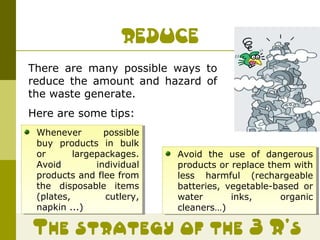
There are many possible ways to
reduce the amount and hazard of
the waste generate.
Here are some tips:
The strategy of the 3 R's
Whenever possible
buy products in bulk
or largepackages.
Avoid individual
products and flee from
the disposable items
(plates, cutlery,
napkin ...)
Whenever possible
buy products in bulk
or largepackages.
Avoid individual
products and flee from
the disposable items
(plates, cutlery,
napkin ...)
Avoid the use of dangerous
products or replace them with
less harmful (rechargeable
batteries, vegetable-based or
water inks, organic
cleaners…)
Avoid the use of dangerous
products or replace them with
less harmful (rechargeable
batteries, vegetable-based or
water inks, organic
cleaners…)
reuse
The strategy of the 3 R's
Do not use disposable products,
choose other more durable
(handkerchiefs, cutlery, glass
dishes, shopping carts ...).
If you have to buy them give
several applications: fill the
bottle, wash the cutlery and
plates, reuse shopping bags,
etc.
Do not use disposable products,
choose other more durable
(handkerchiefs, cutlery, glass
dishes, shopping carts ...).
If you have to buy them give
several applications: fill the
bottle, wash the cutlery and
plates, reuse shopping bags,
etc.
Donate or delivering
anything that can still
be helpful to someone
else.
There are associations
that collect clothing,
computers, furniture,
toys, books ... and are
responsible for making
them available to
people who need
them.
Donate or delivering
anything that can still
be helpful to someone
else.
There are associations
that collect clothing,
computers, furniture,
toys, books ... and are
responsible for making
them available to
people who need
them.
reuse
The strategy of the 3 R's
You can give new functions to objects that would
normally strip them away.
For example:
Use clothes that you can not donate as rags.
Take glass jars to package other products.
Use the shopping bags for trash instead of buying
other bags for it, etc.
You can give new functions to objects that would
normally strip them away.
For example:
Use clothes that you can not donate as rags.
Take glass jars to package other products.
Use the shopping bags for trash instead of buying
other bags for it, etc.
recycle
The strategy of the 3 R's
Although the recycling of most materials needed for
processes that can not be done at home, some products
can be recycled at home:
Soap from vegetable oil.
Recycled paper.
Composting: technology for recycling organic waste.
Crafts and other creative ideas.
Although the recycling of most materials needed for
processes that can not be done at home, some products
can be recycled at home:
Soap from vegetable oil.
Recycled paper.
Composting: technology for recycling organic waste.
Crafts and other creative ideas.
recycle
The strategy of the 3 R's
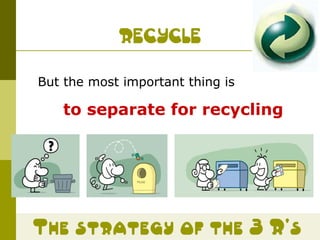
But the most important thing is
to separate for recycling
What waste is in the yellow
container?
Plastic Packaging Metal containers
(Steel and aluminium)
Carton
Milk bottles, juice, yogurt, soft
drinks, water
Home cleaning products
Personal cleanliness products
Cups of yogurt, pudding or
other desserts.
Shopping bags
Packaged goods (bread, chips,
nuts…)
Polystyrene trays (Styrofoam)
Plastic film
Plastic wraps
Cans, tins.
Aluminum plates
and trays (such as
catering)
Foil,bags of chips,
etc.
Lids and caps of
bottle or jars.
Aerosols
Of milk,
tomatoes,
wine, oil,
soups ...
What waste is in the yellow
container?
It is important to note that in the yellow
bin deposited only plastics that are part
of a package (along with cans and
cartons)
If you want to recycle other plastic
products, such as a toy or a plastic chair,
you should take them to the clean
point
What waste is in the green
container?
Remove lids, caps, corks, paper labels.
Rinse bottles before placing in the container.
Glass bottles must not be mixed with other
types of glass such as windows, light bulbs,
mirrors, glass tableware or auto glass.
Ceramics contaminate glass and are difficult
to sort out.
Bottles, cans and glass jars
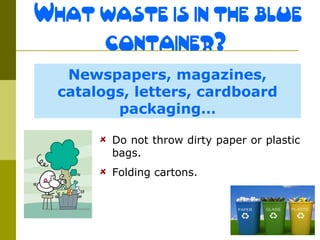
What waste is in the blue
container?
Do not throw dirty paper or plastic
bags.
Folding cartons.
Newspapers, magazines,
catalogs, letters, cardboard
packaging…
What can citizens do to protect
the environment?
We all know what
to do, but sometimes we forget it

Recycling

  • 1.
    save the earth It´sa little and wonderful place
  • 2.
    Why is itimportant to recycle and save natural resources? Satellites show Amazon forest burning in Brazil, Indonesia, Australia, Spain ... A new species inhabits our seas, "plastic" 13.000 pieces per square kilometer! Pyrenees glaciers are melting. And of Patagonia, Argentina, and Norway ... Sunbathing has become dangerous: the deterioration of the ozone layer causes more ultraviolet radiation reaches us.
  • 3.
    How to livewithout destroying the planet? Recycling is one of the best things that you can do for the environment. While reducing piles of garbage, you're also protecting natural resources, cutting global warming pollution and saving water and energy.
  • 4.
    How to livewithout destroying the planet? Make recycling a family affair. The goal is to help make recycling so easy and automatic that it blends into the flow of everyday life. It’s easier to get people involved if they know what they’re supposed to do.
  • 5.
    What and Howto recycle One of the keys to reducing the amount of waste generated is to apply the rule of the 3 R´s The strategy of the 3 R's It corresponds to the initials of Reduce, Reuse and Recycle which should established in this order at the time of managing waste.
  • 6.
    What and Howto recycle The rate of waste generation amounts at the city of Madrid to 1.5 kg per capita per day, representing a quantity of waste difficult to imagine. The strategy of the 3 R's Children must to learn why it is important to treat natural resources and waste with care.
  • 7.
    reduce There are manypossible ways to reduce the amount and hazard of the waste generate. Here are some tips: The strategy of the 3 R's Whenever possible buy products in bulk or largepackages. Avoid individual products and flee from the disposable items (plates, cutlery, napkin ...) Whenever possible buy products in bulk or largepackages. Avoid individual products and flee from the disposable items (plates, cutlery, napkin ...) Avoid the use of dangerous products or replace them with less harmful (rechargeable batteries, vegetable-based or water inks, organic cleaners…) Avoid the use of dangerous products or replace them with less harmful (rechargeable batteries, vegetable-based or water inks, organic cleaners…)
  • 8.
    reuse The strategy ofthe 3 R's Do not use disposable products, choose other more durable (handkerchiefs, cutlery, glass dishes, shopping carts ...). If you have to buy them give several applications: fill the bottle, wash the cutlery and plates, reuse shopping bags, etc. Do not use disposable products, choose other more durable (handkerchiefs, cutlery, glass dishes, shopping carts ...). If you have to buy them give several applications: fill the bottle, wash the cutlery and plates, reuse shopping bags, etc. Donate or delivering anything that can still be helpful to someone else. There are associations that collect clothing, computers, furniture, toys, books ... and are responsible for making them available to people who need them. Donate or delivering anything that can still be helpful to someone else. There are associations that collect clothing, computers, furniture, toys, books ... and are responsible for making them available to people who need them.
  • 9.
    reuse The strategy ofthe 3 R's You can give new functions to objects that would normally strip them away. For example: Use clothes that you can not donate as rags. Take glass jars to package other products. Use the shopping bags for trash instead of buying other bags for it, etc. You can give new functions to objects that would normally strip them away. For example: Use clothes that you can not donate as rags. Take glass jars to package other products. Use the shopping bags for trash instead of buying other bags for it, etc.
  • 10.
    recycle The strategy ofthe 3 R's Although the recycling of most materials needed for processes that can not be done at home, some products can be recycled at home: Soap from vegetable oil. Recycled paper. Composting: technology for recycling organic waste. Crafts and other creative ideas. Although the recycling of most materials needed for processes that can not be done at home, some products can be recycled at home: Soap from vegetable oil. Recycled paper. Composting: technology for recycling organic waste. Crafts and other creative ideas.
  • 11.
    recycle The strategy ofthe 3 R's But the most important thing is to separate for recycling
  • 12.
    What waste isin the yellow container? Plastic Packaging Metal containers (Steel and aluminium) Carton Milk bottles, juice, yogurt, soft drinks, water Home cleaning products Personal cleanliness products Cups of yogurt, pudding or other desserts. Shopping bags Packaged goods (bread, chips, nuts…) Polystyrene trays (Styrofoam) Plastic film Plastic wraps Cans, tins. Aluminum plates and trays (such as catering) Foil,bags of chips, etc. Lids and caps of bottle or jars. Aerosols Of milk, tomatoes, wine, oil, soups ...
  • 13.
    What waste isin the yellow container? It is important to note that in the yellow bin deposited only plastics that are part of a package (along with cans and cartons) If you want to recycle other plastic products, such as a toy or a plastic chair, you should take them to the clean point
  • 14.
    What waste isin the green container? Remove lids, caps, corks, paper labels. Rinse bottles before placing in the container. Glass bottles must not be mixed with other types of glass such as windows, light bulbs, mirrors, glass tableware or auto glass. Ceramics contaminate glass and are difficult to sort out. Bottles, cans and glass jars
  • 15.
    What waste isin the blue container? Do not throw dirty paper or plastic bags. Folding cartons. Newspapers, magazines, catalogs, letters, cardboard packaging…
  • 16.
    What can citizensdo to protect the environment? We all know what to do, but sometimes we forget it