THE 'IMPACT ANALYSIS' OR DETAILED STUDY PHASE OF
EIA INVOLVES
 identifying the impacts more specifically
 predicting the characteristics of the main impacts
 evaluating the significance of the residual impact
2
IMPACT IDENTIFICATION METHODS
• Adhoc method
• Checklists
• Matrices
• Networks
• Overlays and geographical information systems
(GIS)
• Expert systems
• Professional judgement
3
CHOICE OF EIA METHOD DEPENDS ON
 The type and size of the proposal
 The type of alternatives being considered
 The nature of the likely impacts;
 The availability of impact identification methods
 The experience of the EIA team with their use
 The resources available - cost, information, time,
personnel
4
5
Functions of EIA Methods
• Impact identification
• Impact prediction
• Impact interpretation
• Communication of information
• Devising monitoring schemes
6
1. Ad Hoc Method of EIA
• No structure
• Brainstorming
• Basis for other methods?
• More effective the wider the consultation
7
2. Checklist Methods of EIA s
• Simple checklists
• Descriptive checklists : Suggests prediction
techniques
• Scaling checklist : Forces interpretation by including
thresholds of concern”
• Questionnaire checklist :Gives rough idea of impacts
8
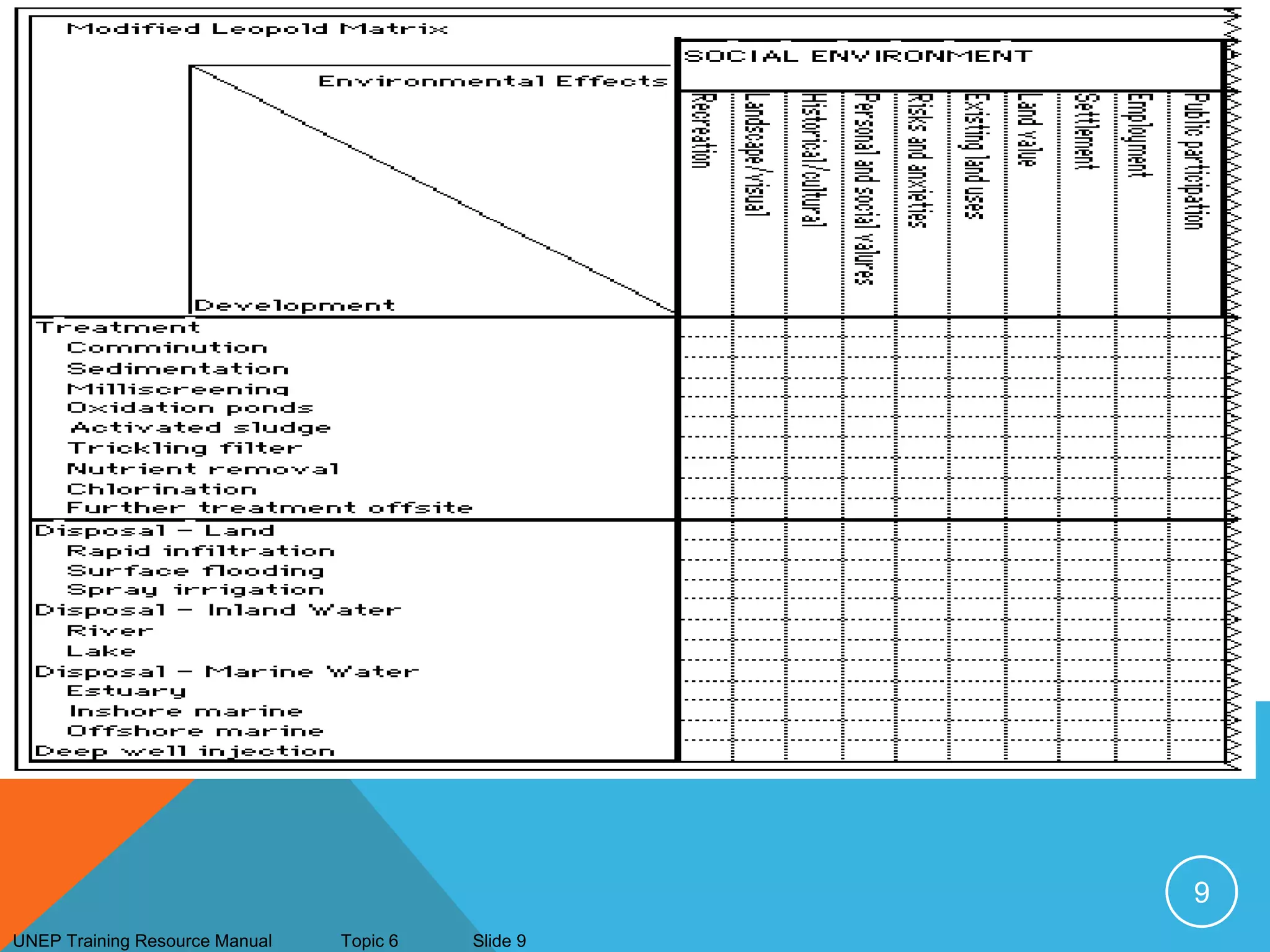
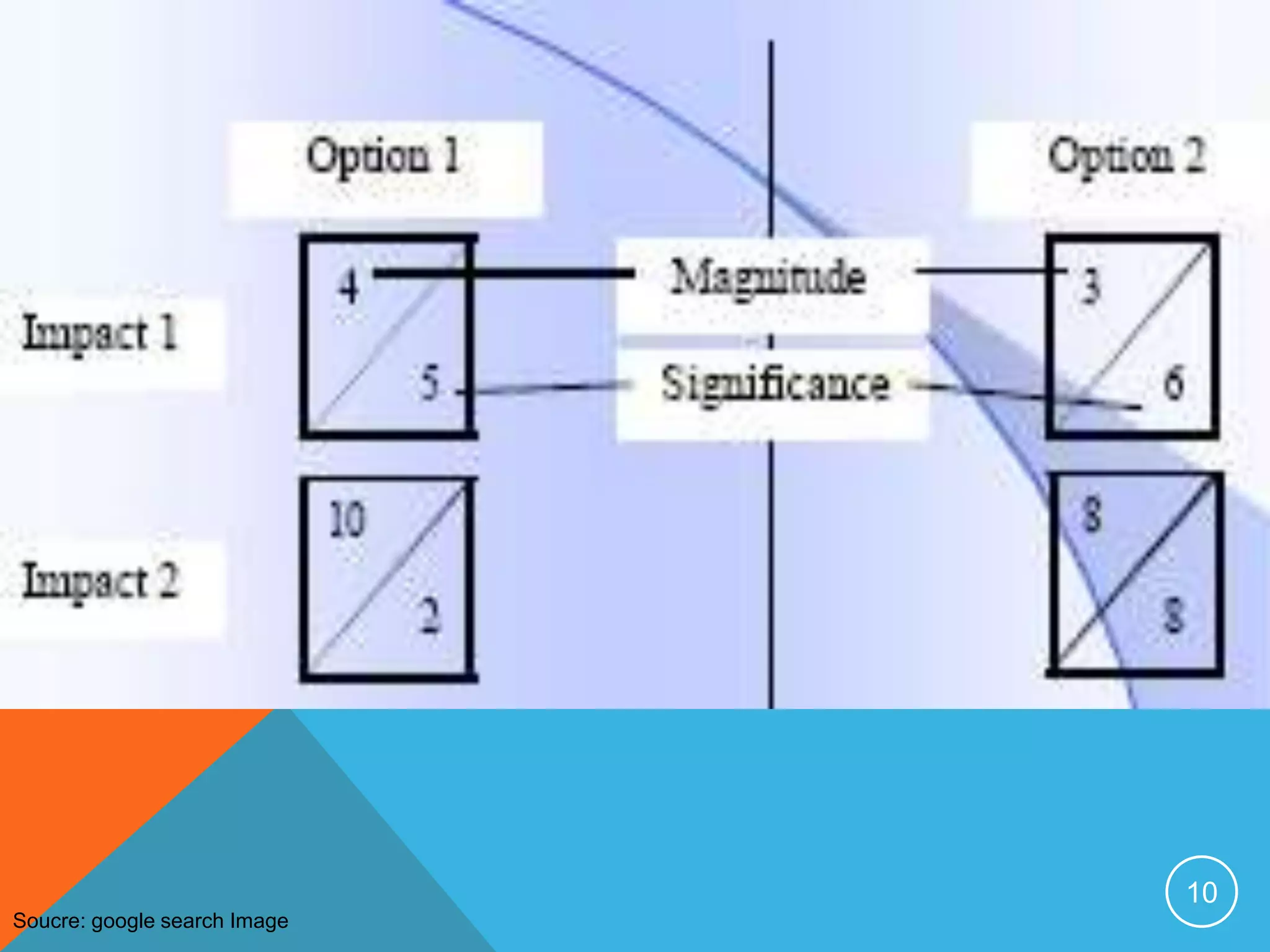
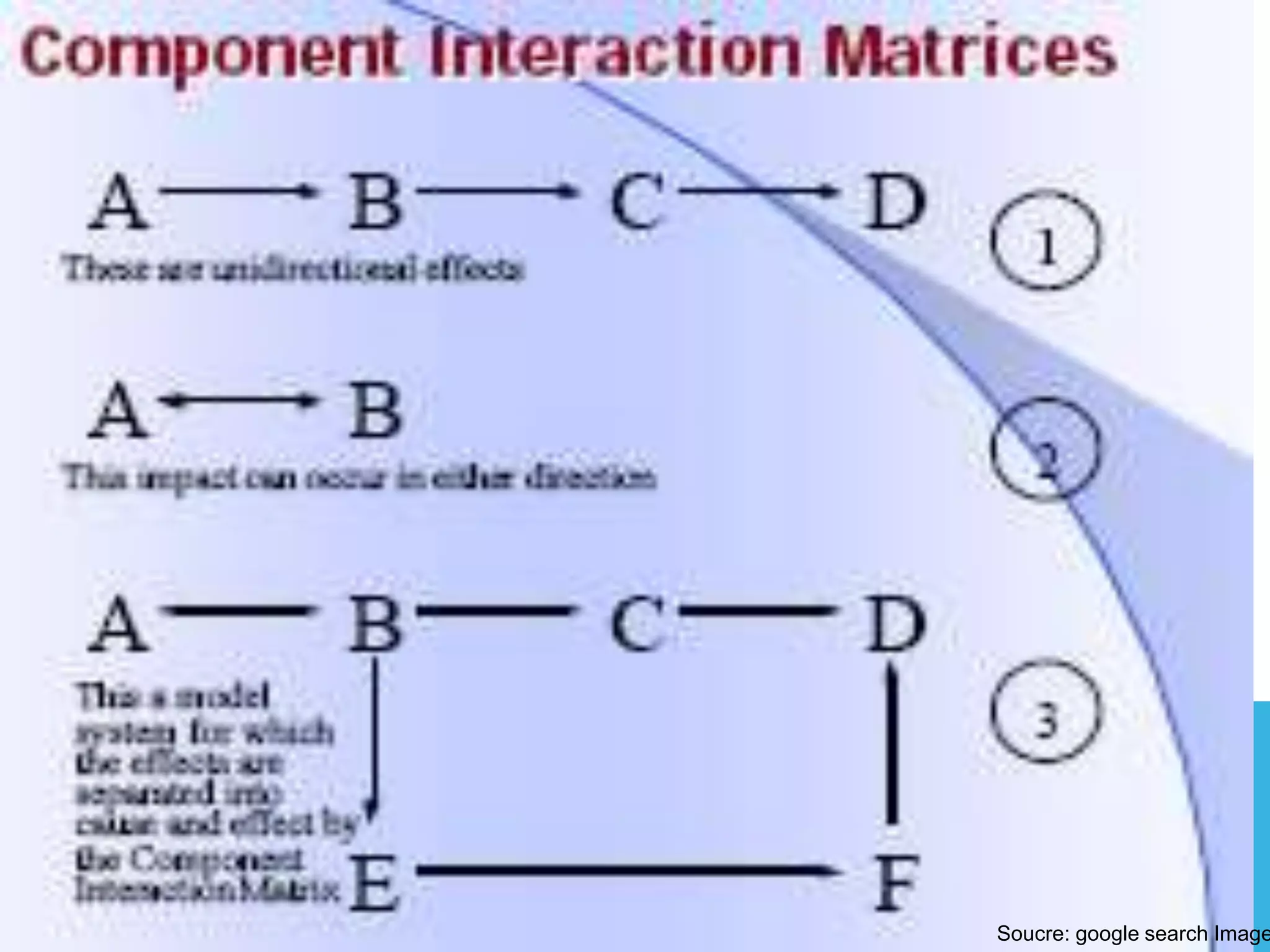
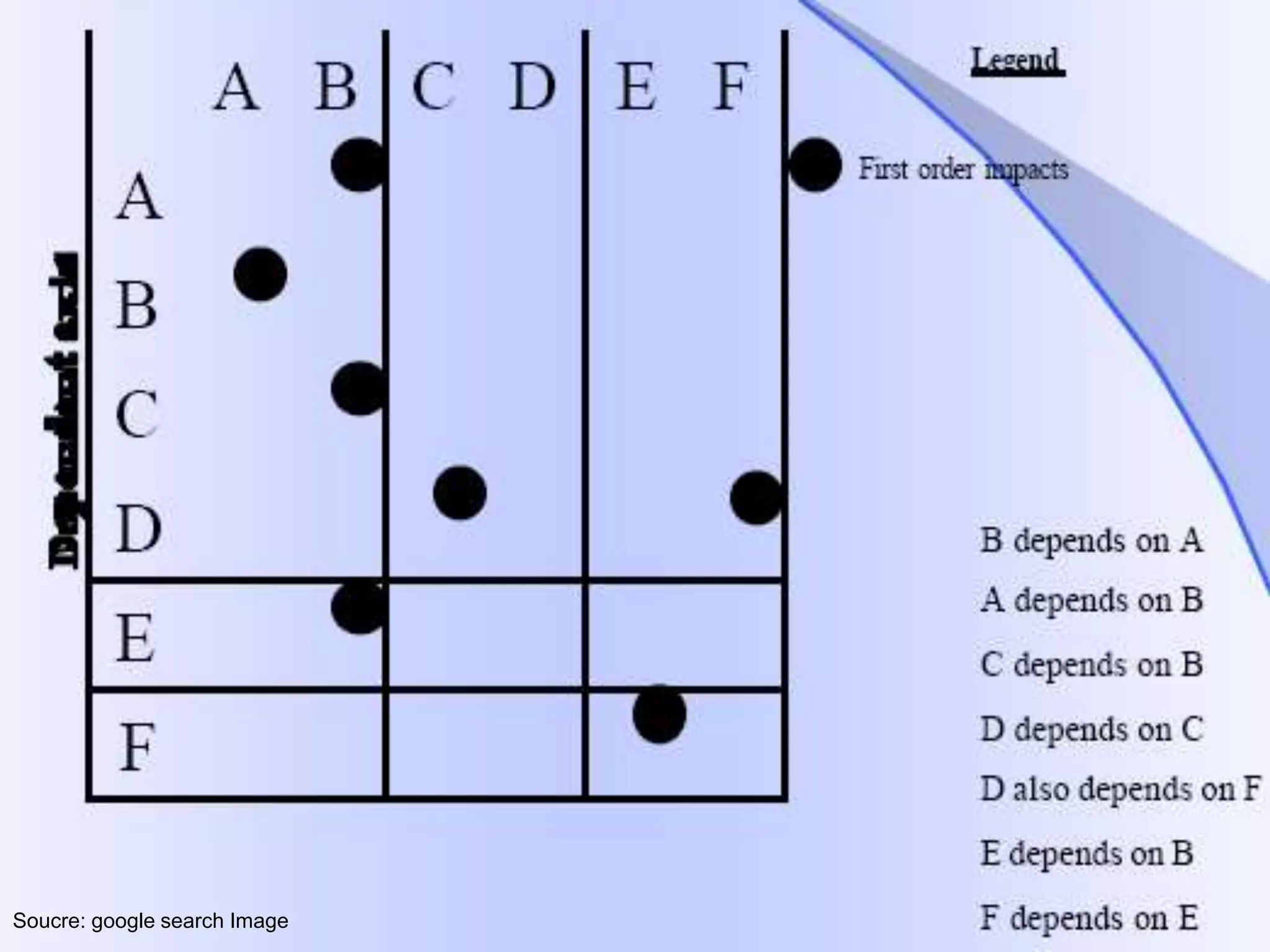
3. Matrices
• Leopold matrix
• Simple matrix
• Component interaction matrix
9
UNEP Training Resource Manual Topic 6 Slide 9
10
Soucre: google search Image
11
Soucre: google search Image
12
Soucre: google search Image
13
4. Networks
• Need big sheet of paper
• Excellent for indirect impacts
• Excellent for interlinkage
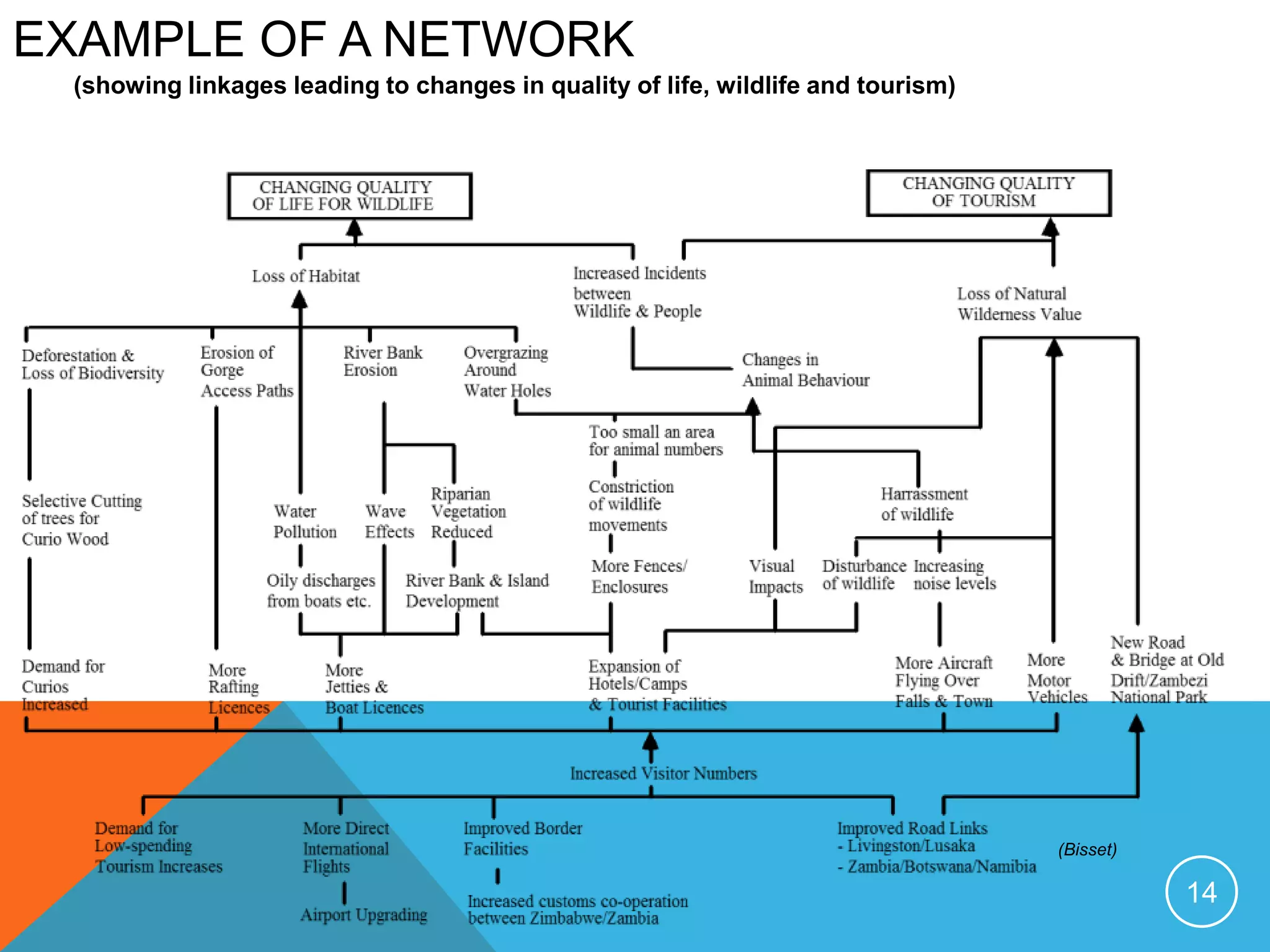
EXAMPLE OF A NETWORK
14
(showing linkages leading to changes in quality of life, wildlife and tourism)
(Bisset)
15
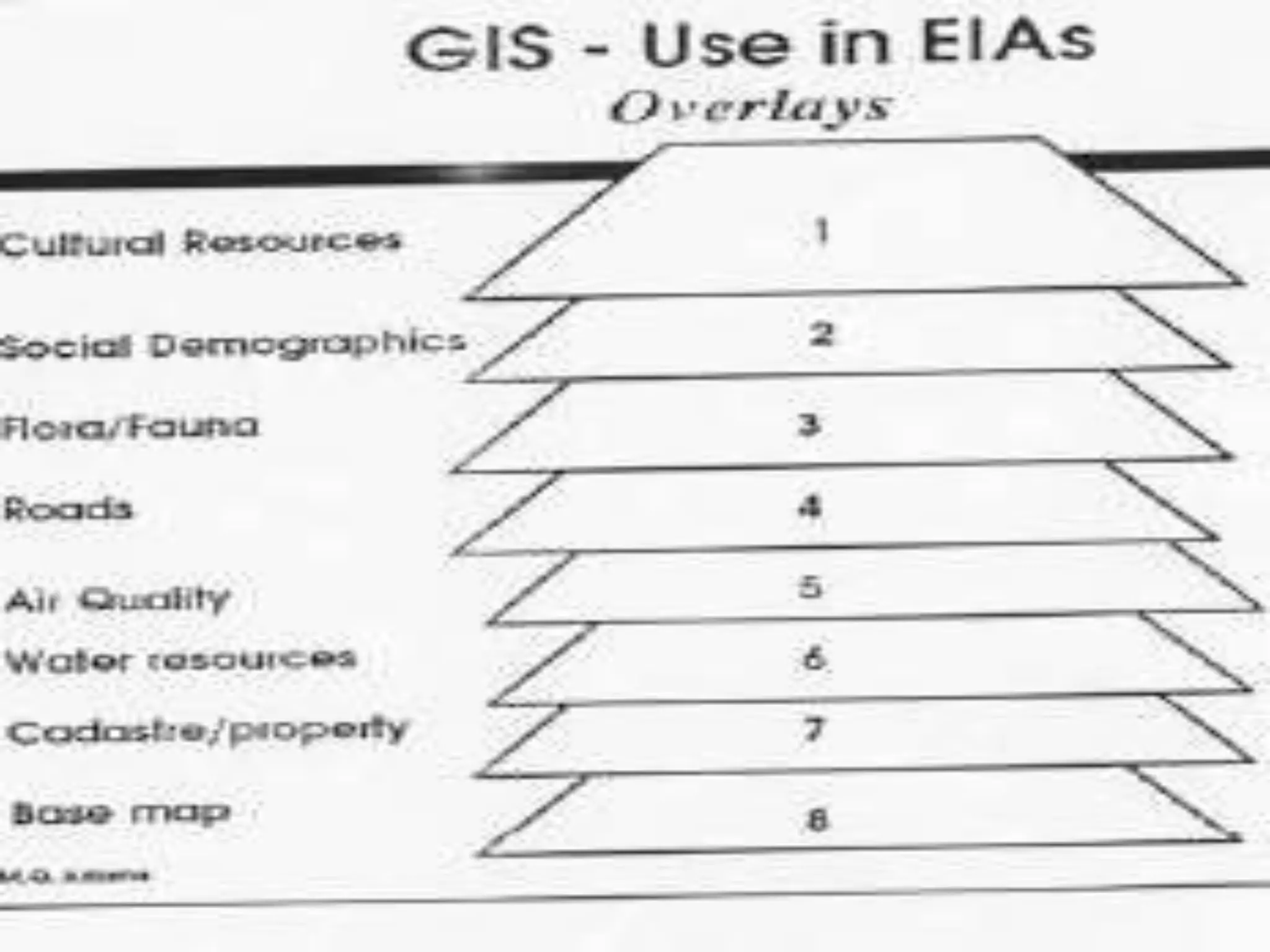
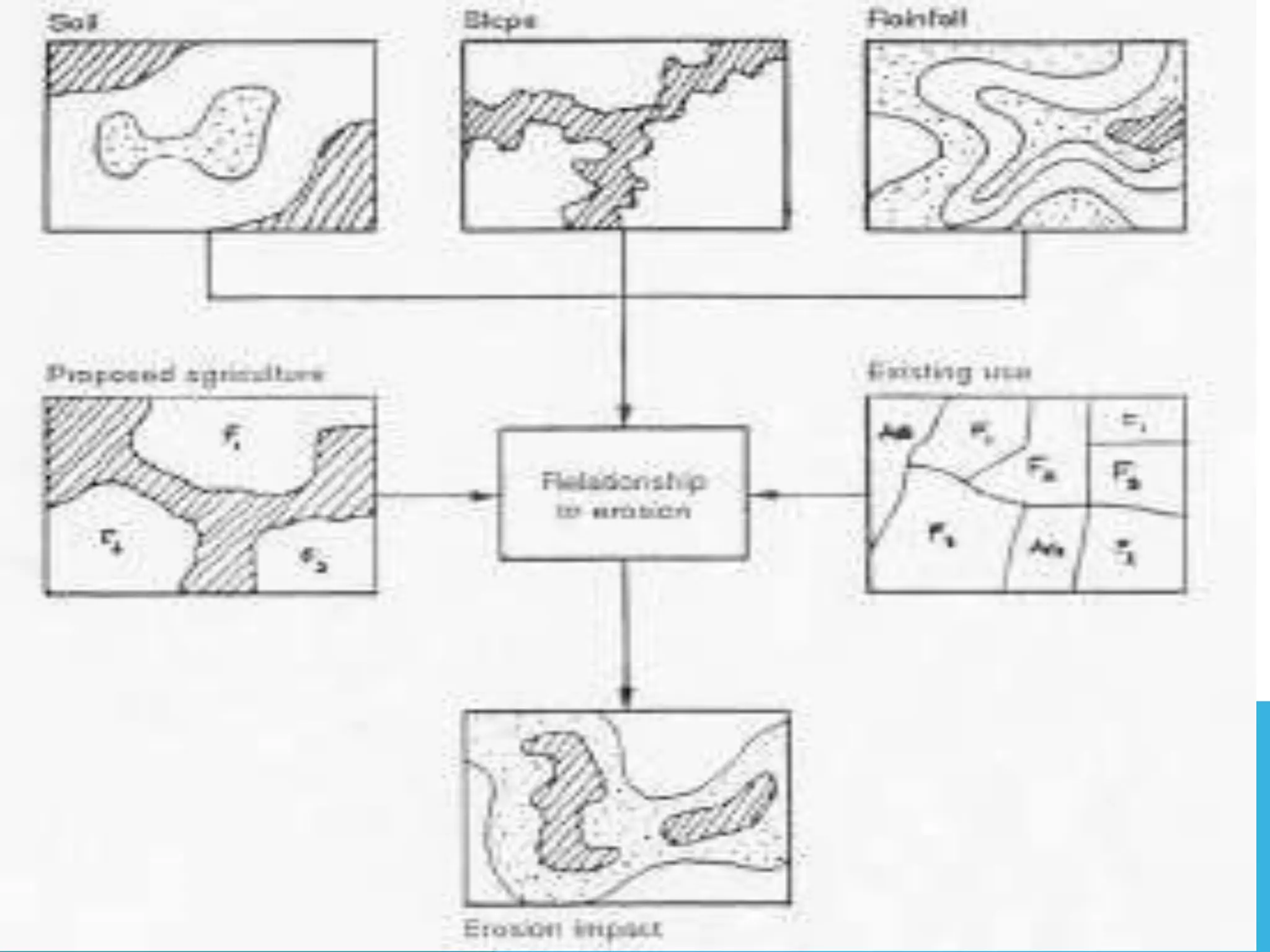
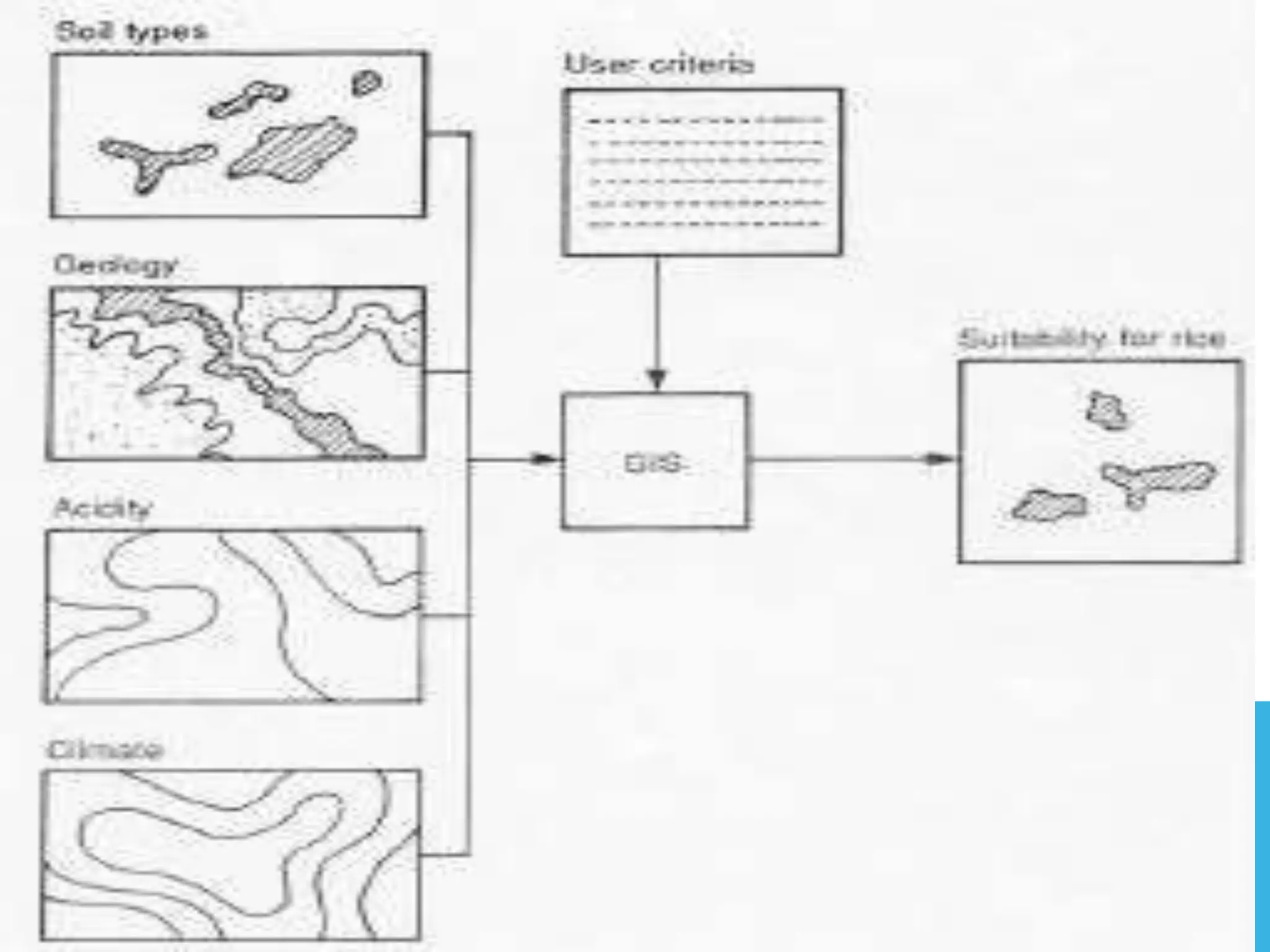
5 Overlays Method
• McHarg overlays
• Geographical Information Systems (GIS)
• The various EIA methods draw on a broad range of tools, including many
general purpose data processing and analytical methods.
• The most important ones among them are:
• geographical information systems (GIS), for the capture, management,
display, and analysis of geo-referenced data; basic methods include overlay
and buffer analysis.
• statistical analysis, with basic tools such as time series analysis, histograms,
regression, analysis of variance, cluster analysis, etc.
16
17
18
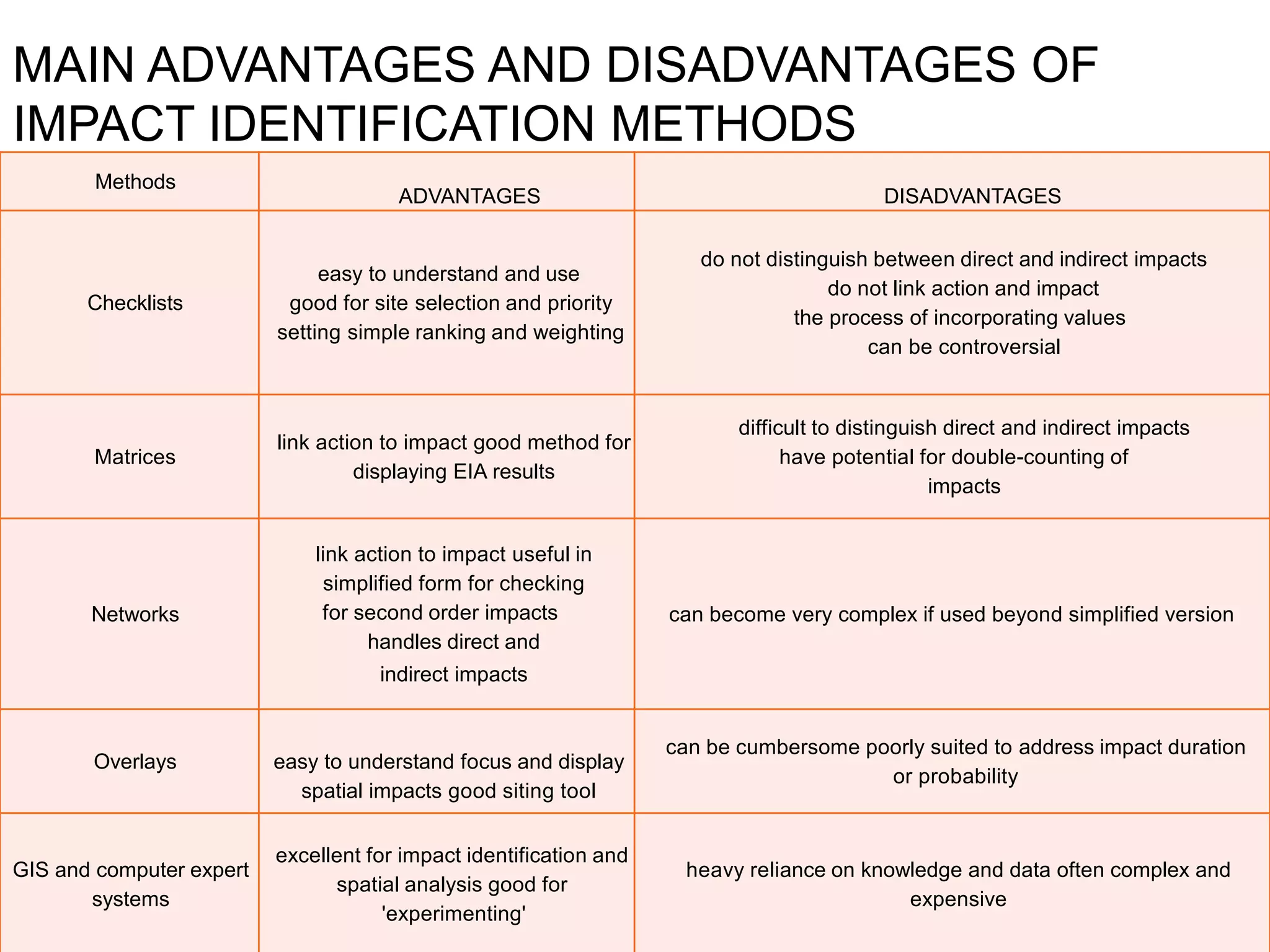
MAIN ADVANTAGES AND DISADVANTAGES OF
IMPACT IDENTIFICATION METHODS
19
Methods
ADVANTAGES DISADVANTAGES
Checklists
easy to understand and use
good for site selection and priority
setting simple ranking and weighting
do not distinguish between direct and indirect impacts
do not link action and impact
the process of incorporating values
can be controversial
Matrices
link action to impact good method for
displaying EIA results
difficult to distinguish direct and indirect impacts
have potential for double-counting of
impacts
Networks
link action to impact useful in
simplified form for checking
for second order impacts
handles direct and
indirect impacts
can become very complex if used beyond simplified version
Overlays easy to understand focus and display
spatial impacts good siting tool
can be cumbersome poorly suited to address impact duration
or probability
GIS and computer expert
systems
excellent for impact identification and
spatial analysis good for
'experimenting'
heavy reliance on knowledge and data often complex and
expensive
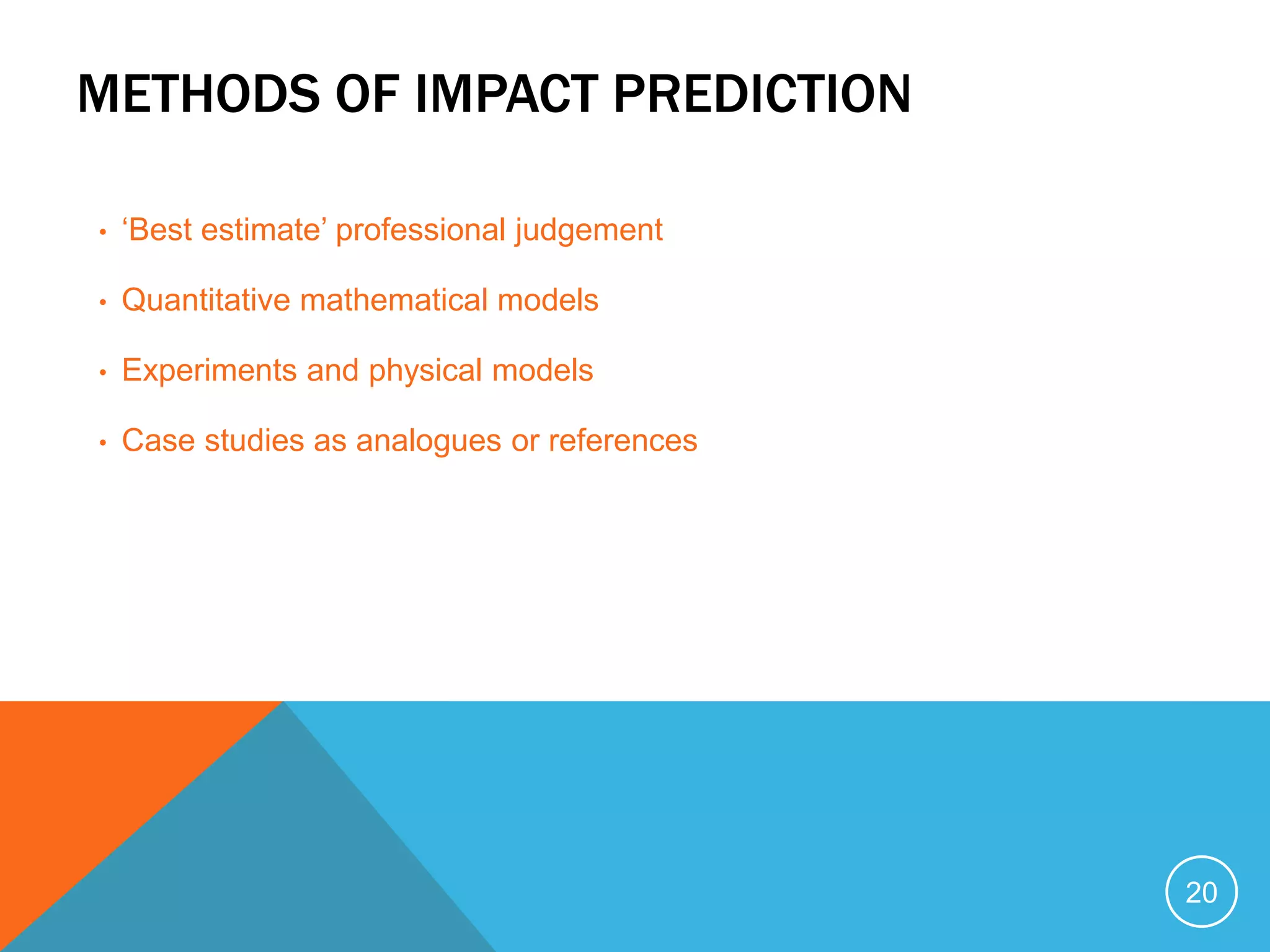
METHODS OF IMPACT PREDICTION
• ‘Best estimate’ professional judgement
• Quantitative mathematical models
• Experiments and physical models
• Case studies as analogues or references
20
TYPES OF UNCERTAINTY IN IMPACT PREDICTION
 scientific uncertainty – limited understanding of the ecosystem or community
affected
 data uncertainty – incomplete information or insufficient methodology
 policy uncertainty – unclear or disputed objectives or standards
21
TYPES OF SOCIAL IMPACT
 demographic – changes to population numbers, distribution
 cultural – changes to customs, traditions and values
 community – changes to cohesion, relationships etc.
 socio-psychological – changes to quality of life and well being
22
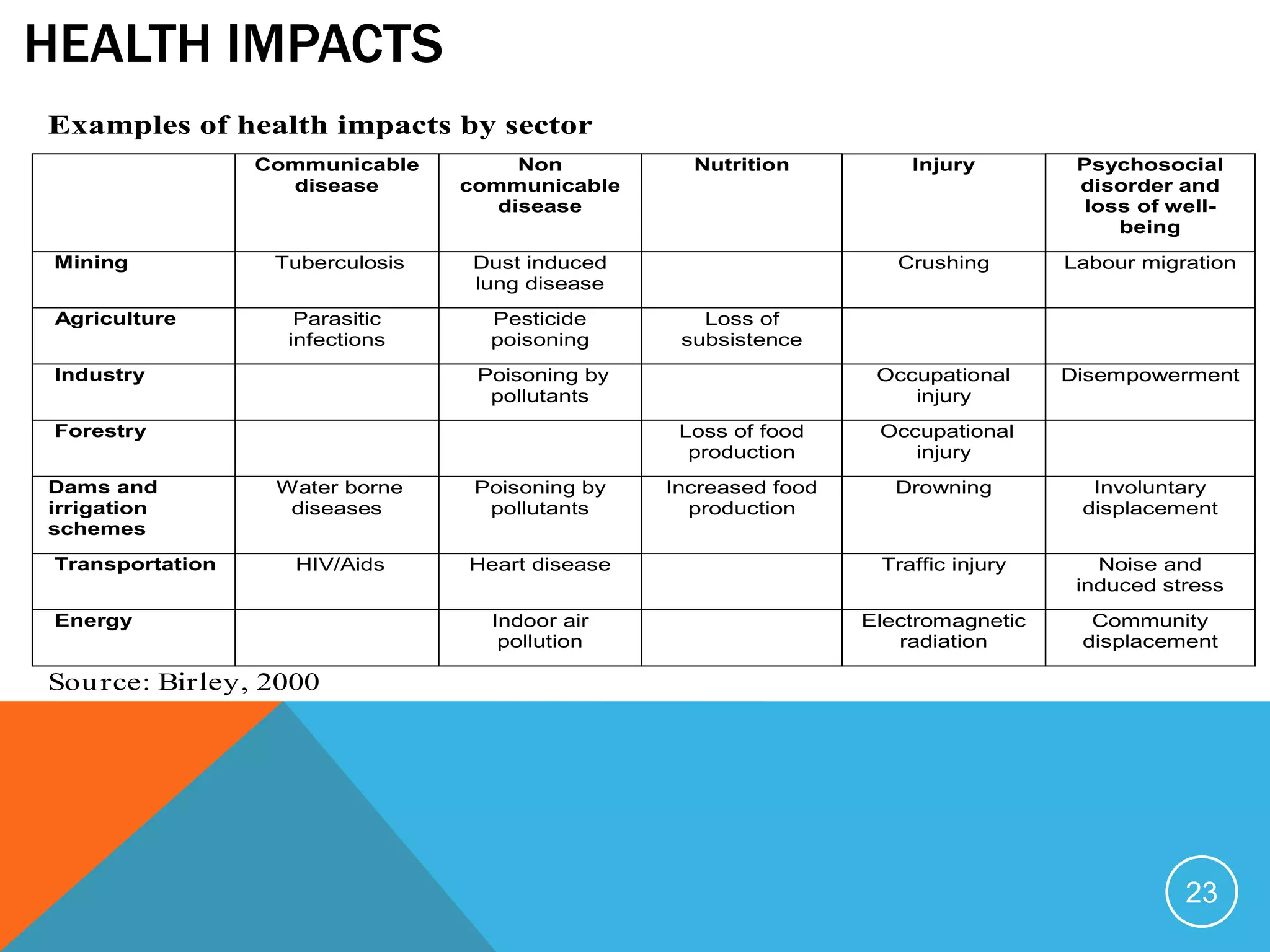
HEALTH IMPACTS
23
Examples of health impacts by sector
Communicable
disease
Non
communicable
disease
Nutrition Injury Psychosocial
disorder and
loss of well-
being
Mining Tuberculosis Dust induced
lung disease
Crushing Labour migration
Agriculture Parasitic
infections
Pesticide
poisoning
Loss of
subsistence
Industry Poisoning by
pollutants
Occupational
injury
Disempowerment
Forestry Loss of food
production
Occupational
injury
Dams and
irrigation
schemes
Water borne
diseases
Poisoning by
pollutants
Increased food
production
Drowning Involuntary
displacement
Transportation HIV/Aids Heart disease Traffic injury Noise and
induced stress
Energy Indoor air
pollution
Electromagnetic
radiation
Community
displacement
Source: Birley, 2000
FACTORS AFFECTING ECONOMIC IMPACTS
• Duration of construction and operation
• Workforce requirements for each period
• Skill requirements (local availability)
• Earning
• Raw material and other input purchases
• Capital investment
• Outputs
• The characteristics of the local economy
24
FACTORS AFFECTING FISCAL IMPACTS
• Size of investment and workforce requirements
• Capacity of existing service delivery and infrastructure systems
• Local/regional tax or other revenue raising processes
• Demographic changes arising from project requirements
25
26
Impact Prediction
• Impact prediction is a way of ‘mapping’ the environmental consequences of the
significant aspects of the project and its alternatives. Environmental impact can never
be predicted with absolute certainty and this is all the more reason to consider all
possible factors and take all possible precautions for reducing the degree of
uncertainty.
27
Here’s a example that we can consider for what we need to predict in
regards to different criteria during a planning phase of transportation
project
• Air
• changes in ambient levels and ground level concentrations due to total
emissions from point, line and area sources
• effects on soils, materials, vegetation, and human health
• Noise
• changes in ambient levels due to noise generated from equipment and
movement of vehicles
• effect on fauna and human health
• Water
• availability to competing users
• changes in quality
• sediment transport
• ingress of saline water
·
28
• Land
• Changes in land use and drainage pattern
• Changes in land quality including effects of waste disposal
• Changes in shoreline/riverbank and their stability
• Biological
• Deforestation/tree-cutting and shrinkage of animal habitat.
• Impact on fauna and flora (including aquatic species if any) due to
contaminants/pollutants
• Impact on rare and endangered species, endemic species, and migratory
path/route of animals.
• Impact on breeding and nesting grounds
• Socio-economic
• Impact on the local community including demographic changes.
• Impact on economic status
• Impact on human health.
• Impact of increased traffic
MAIN ENVIRONMENTAL PROBLEMS COMMONLY ASSOCIATED WITH RURAL
ROADS PROJECTS.
• Encroachment into precious ecological resources, including forests and swamps.
• Encroachment into historical areas and cultural monuments.
• Impairment of fisheries, aquatic ecology and other beneficial water uses, due t
changes in surface hydrology.
• Erosion and silt runoff from exposed areas, which may also cause impairment of
• Downstream water quality and damage to land values.
• Dust nuisances caused by both the road usage and during construction.
CONCLUSION
Environmental Impact Assessment (EIA) OF TRANSPORTATION
PROJECTS study is a time-consuming process because it has a large
number of dependent and independent variables which have to be taken
into account (e.g. land use, land price, population density, socio-
economic level, road accessibility, railway accessibility, air quality,
ground water quality, noise level, biological content, historical value,
archeological and visual importance), which also have different
consequences. Traditionally, environmental data was collected to test
hypotheses and simulate environmental systems using in situ (field)
methodology

Eia methods for transportation project

  • 2.
    THE 'IMPACT ANALYSIS'OR DETAILED STUDY PHASE OF EIA INVOLVES  identifying the impacts more specifically  predicting the characteristics of the main impacts  evaluating the significance of the residual impact 2
  • 3.
    IMPACT IDENTIFICATION METHODS •Adhoc method • Checklists • Matrices • Networks • Overlays and geographical information systems (GIS) • Expert systems • Professional judgement 3
  • 4.
    CHOICE OF EIAMETHOD DEPENDS ON  The type and size of the proposal  The type of alternatives being considered  The nature of the likely impacts;  The availability of impact identification methods  The experience of the EIA team with their use  The resources available - cost, information, time, personnel 4
  • 5.
    5 Functions of EIAMethods • Impact identification • Impact prediction • Impact interpretation • Communication of information • Devising monitoring schemes
  • 6.
    6 1. Ad HocMethod of EIA • No structure • Brainstorming • Basis for other methods? • More effective the wider the consultation
  • 7.
    7 2. Checklist Methodsof EIA s • Simple checklists • Descriptive checklists : Suggests prediction techniques • Scaling checklist : Forces interpretation by including thresholds of concern” • Questionnaire checklist :Gives rough idea of impacts
  • 8.
    8 3. Matrices • Leopoldmatrix • Simple matrix • Component interaction matrix
  • 9.
    9 UNEP Training ResourceManual Topic 6 Slide 9
  • 10.
  • 11.
  • 12.
  • 13.
    13 4. Networks • Needbig sheet of paper • Excellent for indirect impacts • Excellent for interlinkage
  • 14.
    EXAMPLE OF ANETWORK 14 (showing linkages leading to changes in quality of life, wildlife and tourism) (Bisset)
  • 15.
    15 5 Overlays Method •McHarg overlays • Geographical Information Systems (GIS) • The various EIA methods draw on a broad range of tools, including many general purpose data processing and analytical methods. • The most important ones among them are: • geographical information systems (GIS), for the capture, management, display, and analysis of geo-referenced data; basic methods include overlay and buffer analysis. • statistical analysis, with basic tools such as time series analysis, histograms, regression, analysis of variance, cluster analysis, etc.
  • 16.
  • 17.
  • 18.
  • 19.
    MAIN ADVANTAGES ANDDISADVANTAGES OF IMPACT IDENTIFICATION METHODS 19 Methods ADVANTAGES DISADVANTAGES Checklists easy to understand and use good for site selection and priority setting simple ranking and weighting do not distinguish between direct and indirect impacts do not link action and impact the process of incorporating values can be controversial Matrices link action to impact good method for displaying EIA results difficult to distinguish direct and indirect impacts have potential for double-counting of impacts Networks link action to impact useful in simplified form for checking for second order impacts handles direct and indirect impacts can become very complex if used beyond simplified version Overlays easy to understand focus and display spatial impacts good siting tool can be cumbersome poorly suited to address impact duration or probability GIS and computer expert systems excellent for impact identification and spatial analysis good for 'experimenting' heavy reliance on knowledge and data often complex and expensive
  • 20.
    METHODS OF IMPACTPREDICTION • ‘Best estimate’ professional judgement • Quantitative mathematical models • Experiments and physical models • Case studies as analogues or references 20
  • 21.
    TYPES OF UNCERTAINTYIN IMPACT PREDICTION  scientific uncertainty – limited understanding of the ecosystem or community affected  data uncertainty – incomplete information or insufficient methodology  policy uncertainty – unclear or disputed objectives or standards 21
  • 22.
    TYPES OF SOCIALIMPACT  demographic – changes to population numbers, distribution  cultural – changes to customs, traditions and values  community – changes to cohesion, relationships etc.  socio-psychological – changes to quality of life and well being 22
  • 23.
    HEALTH IMPACTS 23 Examples ofhealth impacts by sector Communicable disease Non communicable disease Nutrition Injury Psychosocial disorder and loss of well- being Mining Tuberculosis Dust induced lung disease Crushing Labour migration Agriculture Parasitic infections Pesticide poisoning Loss of subsistence Industry Poisoning by pollutants Occupational injury Disempowerment Forestry Loss of food production Occupational injury Dams and irrigation schemes Water borne diseases Poisoning by pollutants Increased food production Drowning Involuntary displacement Transportation HIV/Aids Heart disease Traffic injury Noise and induced stress Energy Indoor air pollution Electromagnetic radiation Community displacement Source: Birley, 2000
  • 24.
    FACTORS AFFECTING ECONOMICIMPACTS • Duration of construction and operation • Workforce requirements for each period • Skill requirements (local availability) • Earning • Raw material and other input purchases • Capital investment • Outputs • The characteristics of the local economy 24
  • 25.
    FACTORS AFFECTING FISCALIMPACTS • Size of investment and workforce requirements • Capacity of existing service delivery and infrastructure systems • Local/regional tax or other revenue raising processes • Demographic changes arising from project requirements 25
  • 26.
    26 Impact Prediction • Impactprediction is a way of ‘mapping’ the environmental consequences of the significant aspects of the project and its alternatives. Environmental impact can never be predicted with absolute certainty and this is all the more reason to consider all possible factors and take all possible precautions for reducing the degree of uncertainty.
  • 27.
    27 Here’s a examplethat we can consider for what we need to predict in regards to different criteria during a planning phase of transportation project • Air • changes in ambient levels and ground level concentrations due to total emissions from point, line and area sources • effects on soils, materials, vegetation, and human health • Noise • changes in ambient levels due to noise generated from equipment and movement of vehicles • effect on fauna and human health • Water • availability to competing users • changes in quality • sediment transport • ingress of saline water ·
  • 28.
    28 • Land • Changesin land use and drainage pattern • Changes in land quality including effects of waste disposal • Changes in shoreline/riverbank and their stability • Biological • Deforestation/tree-cutting and shrinkage of animal habitat. • Impact on fauna and flora (including aquatic species if any) due to contaminants/pollutants • Impact on rare and endangered species, endemic species, and migratory path/route of animals. • Impact on breeding and nesting grounds • Socio-economic • Impact on the local community including demographic changes. • Impact on economic status • Impact on human health. • Impact of increased traffic
  • 29.
    MAIN ENVIRONMENTAL PROBLEMSCOMMONLY ASSOCIATED WITH RURAL ROADS PROJECTS. • Encroachment into precious ecological resources, including forests and swamps. • Encroachment into historical areas and cultural monuments. • Impairment of fisheries, aquatic ecology and other beneficial water uses, due t changes in surface hydrology. • Erosion and silt runoff from exposed areas, which may also cause impairment of • Downstream water quality and damage to land values. • Dust nuisances caused by both the road usage and during construction.
  • 30.
    CONCLUSION Environmental Impact Assessment(EIA) OF TRANSPORTATION PROJECTS study is a time-consuming process because it has a large number of dependent and independent variables which have to be taken into account (e.g. land use, land price, population density, socio- economic level, road accessibility, railway accessibility, air quality, ground water quality, noise level, biological content, historical value, archeological and visual importance), which also have different consequences. Traditionally, environmental data was collected to test hypotheses and simulate environmental systems using in situ (field) methodology