MODULE III
IMPACT ASSESSMENT
METHODOLOGIES
EIA METHODOLOGY:-
❖Methodology means the structural approaches for doing
one or more activities of EIA.
❖There are some specific characteristic which an EIA
methodology should depict.
❖These are:-(1)It should be appropriate to the necessary
task of EIA process such as impact
identification/comparison of alternatives.
❖(2)It should be significantly free from assessors bias
❖(3)It should be economical in terms of costs, and its
requirement of data ,investigating time , personnel,
equipment and facilities.
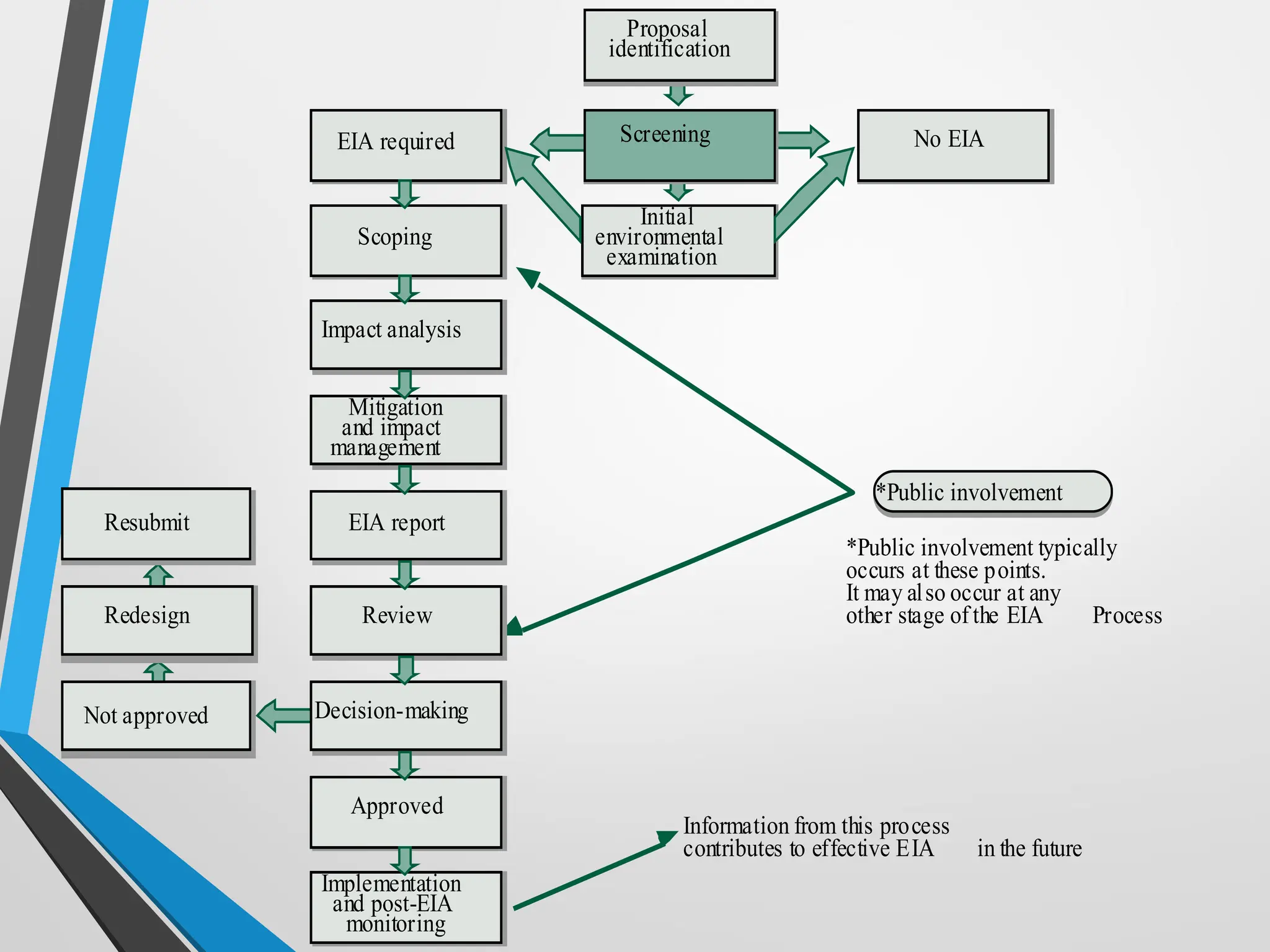
*Public involvement typically
occurs at these points.
It may also occur at any
other stage ofthe EIA Process
Information from this process
contributes to effective EIA in the future
No EIA
Initial
environmental
examination
EIA required
Approved
Not approved
Redesign
Resubmit
Proposal
identification
*Public involvement
Screening
Scoping
Impact analysis
Mitigation
and impact
management
EIA report
Review
Decision-making
Implementation
and post-EIA
monitoring
IMPACT ANALYSIS:-
❖ This stage of EIA identifies and predicts
the likely Environmental and social impact
of the proposed project and evaluates the
significance
METHODS FOR IMPACT
ANALYSIS:-
1. IMPACT IDENTIFICATION
2. IMPACT PREDICTION
3. IMPACT EVALUATION
1. IMPACT IDENTIFICATION:-
❖Impact Identification attempts to answer the question, “what
will happen when a project enters its operational stage?”
❖A List of important impacts such as changes in ambient air
quality, changes in water and soil qualities, noise levels, wildlife
habitats, species diversity, social and cultural systems,
employment levels etc may be prepared.
❖The important sources of impact like smoke emission,
consumption of water, discharge of effluents etc are
identified.
METHODS OF ENVRONMENT IMPACT
IDENTIFICATION:-
❖Ad hoc method
❖Checklists
❖Matrices
❖Overlays
❖Networks
Ad hoc Method:-
❖Simple method based on subjective environment impacts on broad aspects.
❖Ad hoc method is useful when time constraints and lack of information require
that the EIA must rely exclusively on expert opinion.
❖ It provides minimal guidance for total impact assessment while suggesting the
broad areas of possible impacts and the general nature of these possible impacts.
❖When more scientific methods are available, it is not recommended.
❖GENERALLY USED FOR SCREENING
Types of Ad hoc method:-
❖Opinion polls.
❖Experts opinion.
❖Delphi methods etc.
Ad hoc method:-
ADVANTAGE
❖Specialists on a particular
area will provide guidance.
DISADVANTAGE
❖QUALITATIVE
❖No assurance that all
impacts are covered.
❖Lacks consistency
❖Identification , prediction
and interpretation of
impacts are quite poor.
Checklists Method:-
❖Environmental factors are listed in a structured format.
❖Checklist means a listing of potential Environmental
Impacts.
❖This method is done to assess the nature of the impacts
i.e. its type such as adverse /beneficial , short term or long
term , no effect or significant impact , reversible or
irreversible etc.
Types of Checklists Method:-
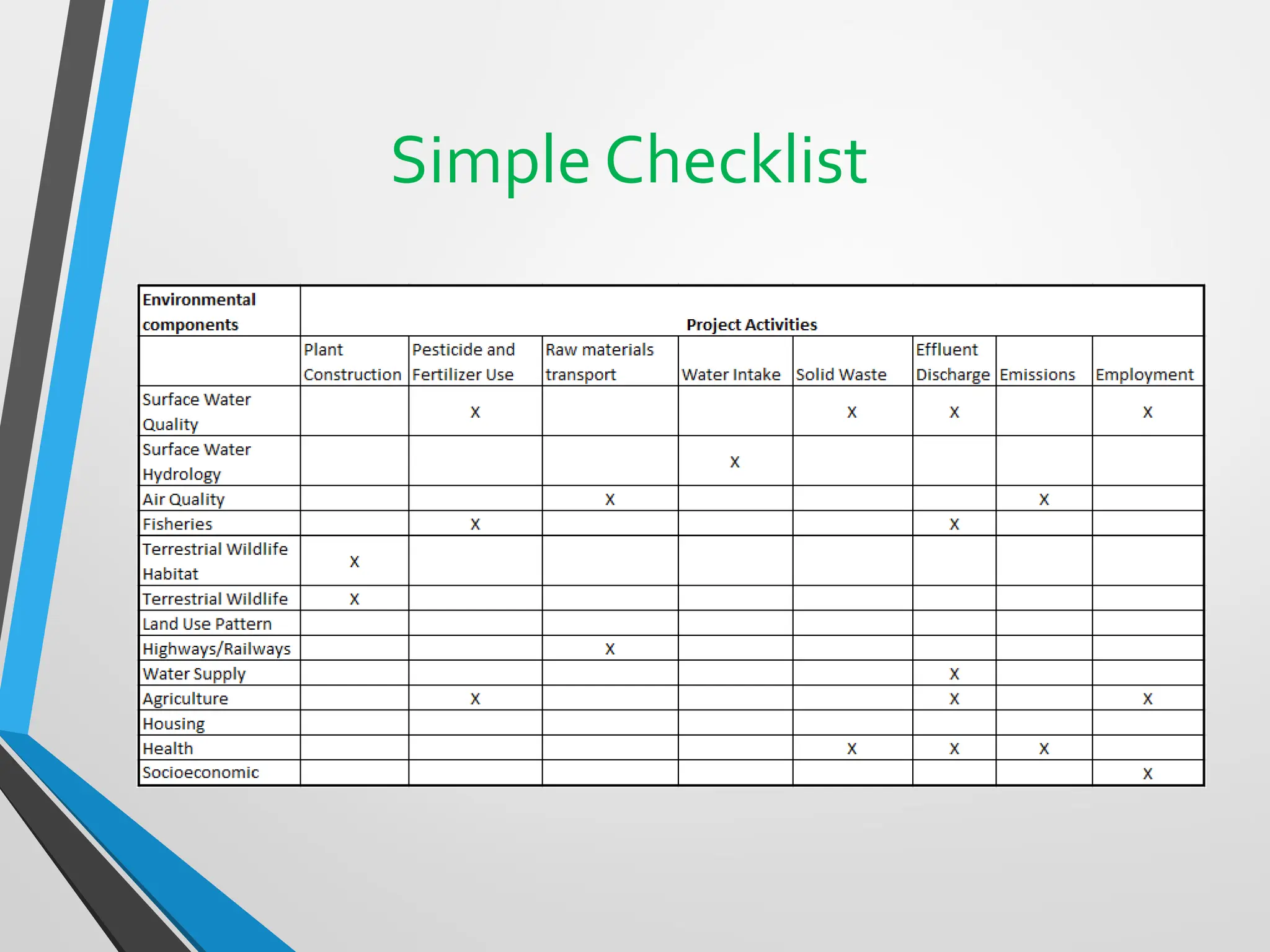
❖Simple Lists.
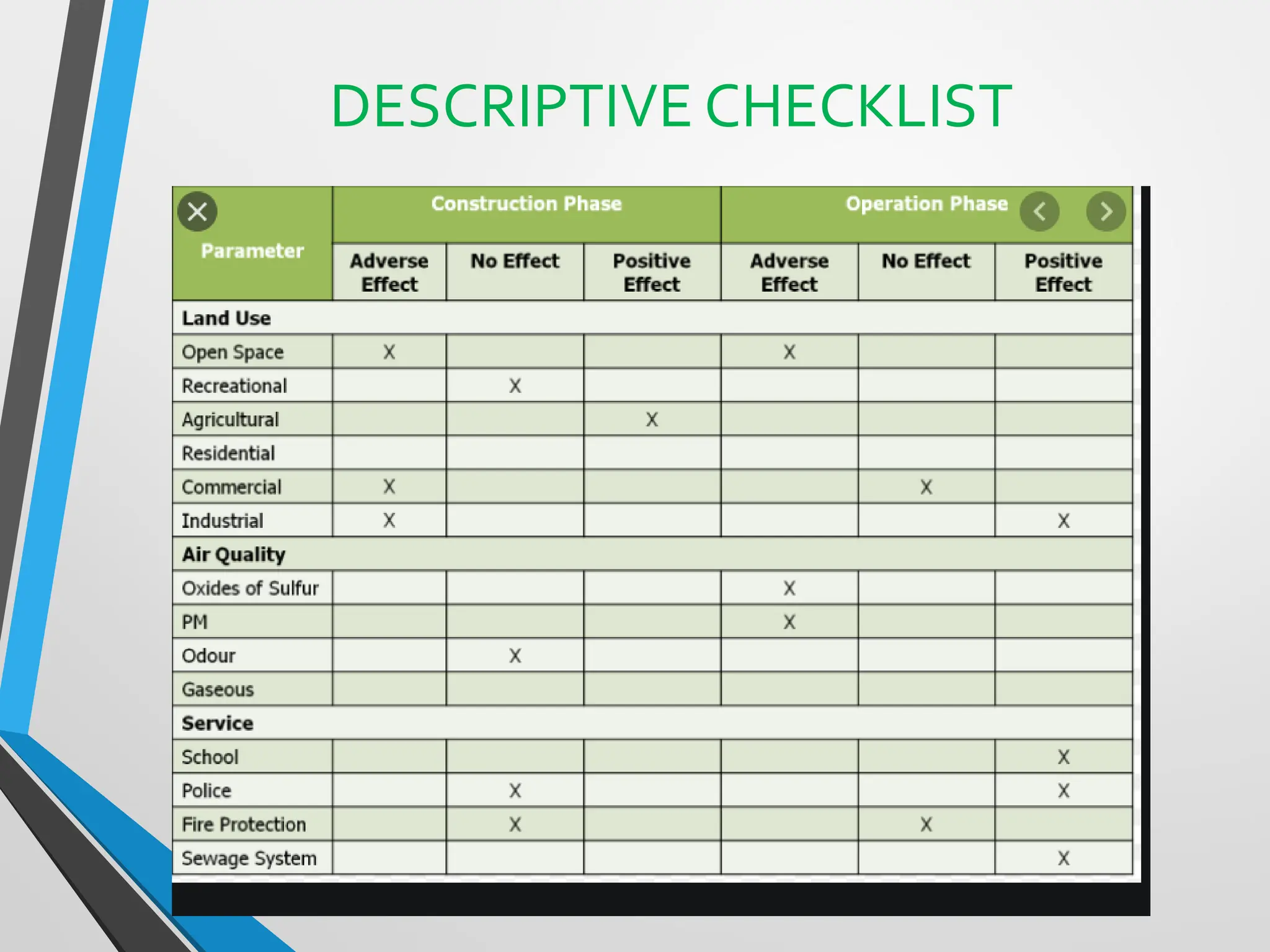
❖Descriptive Checklists.
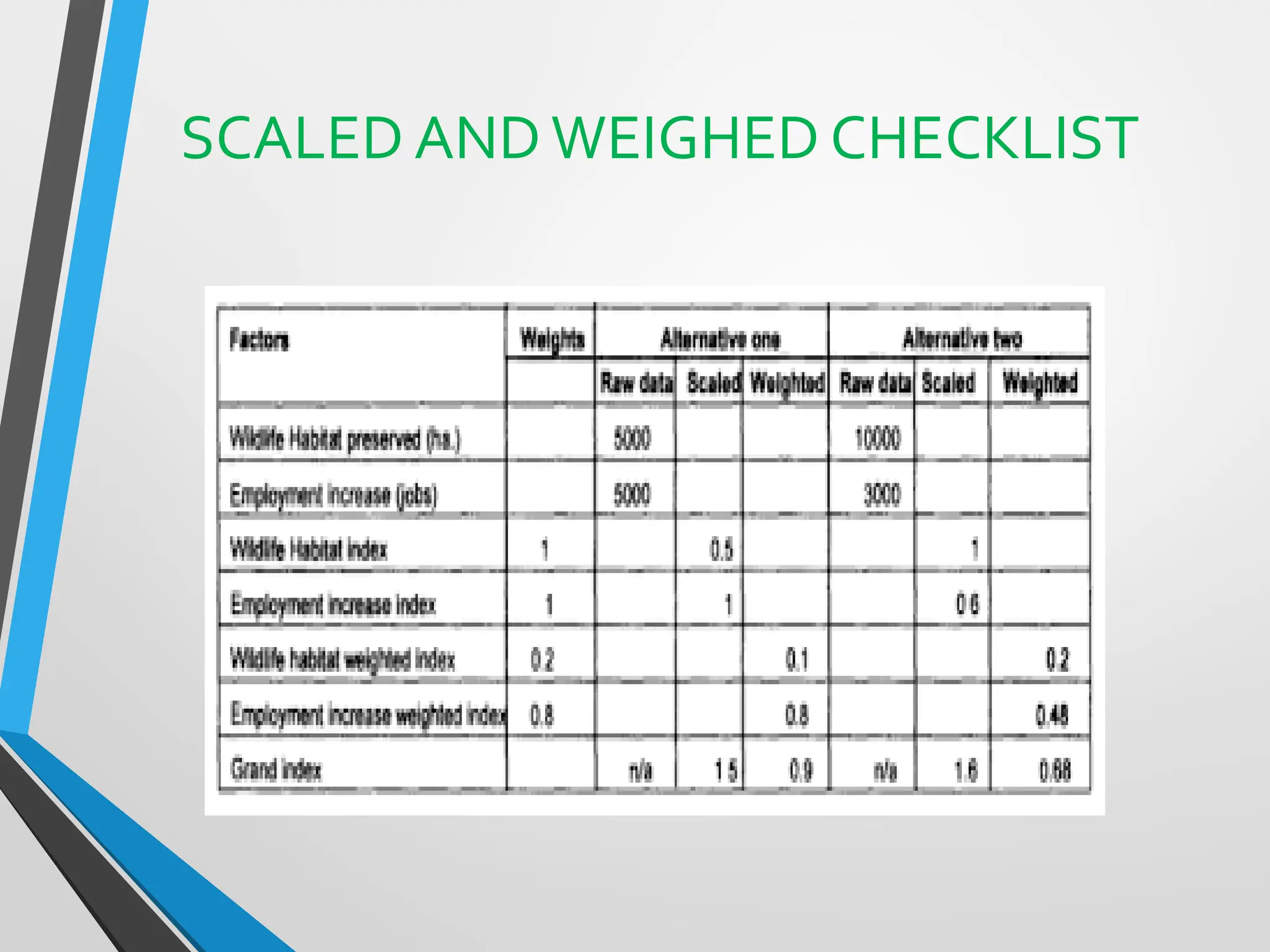
❖Scaling Checklists.
❖Questionnaire Checklists.
Simple Checklist
DESCRIPTIVE CHECKLIST
SCALED ANDWEIGHED CHECKLIST
Checklists :-
ADVANTAGES
❖Simple to
understand and use.
❖Good for site
selection and priority
setting.
DISADVANTAGES
❖Do not distinguish
between direct and
indirect impacts.
❖Do not link action
and impact.
❖Sometime it is a
cumbersome task.
Matrices:-
❖Matrix and its variants provide us a framework of interaction
of different actions /activities of a project with potential EI
caused by them.
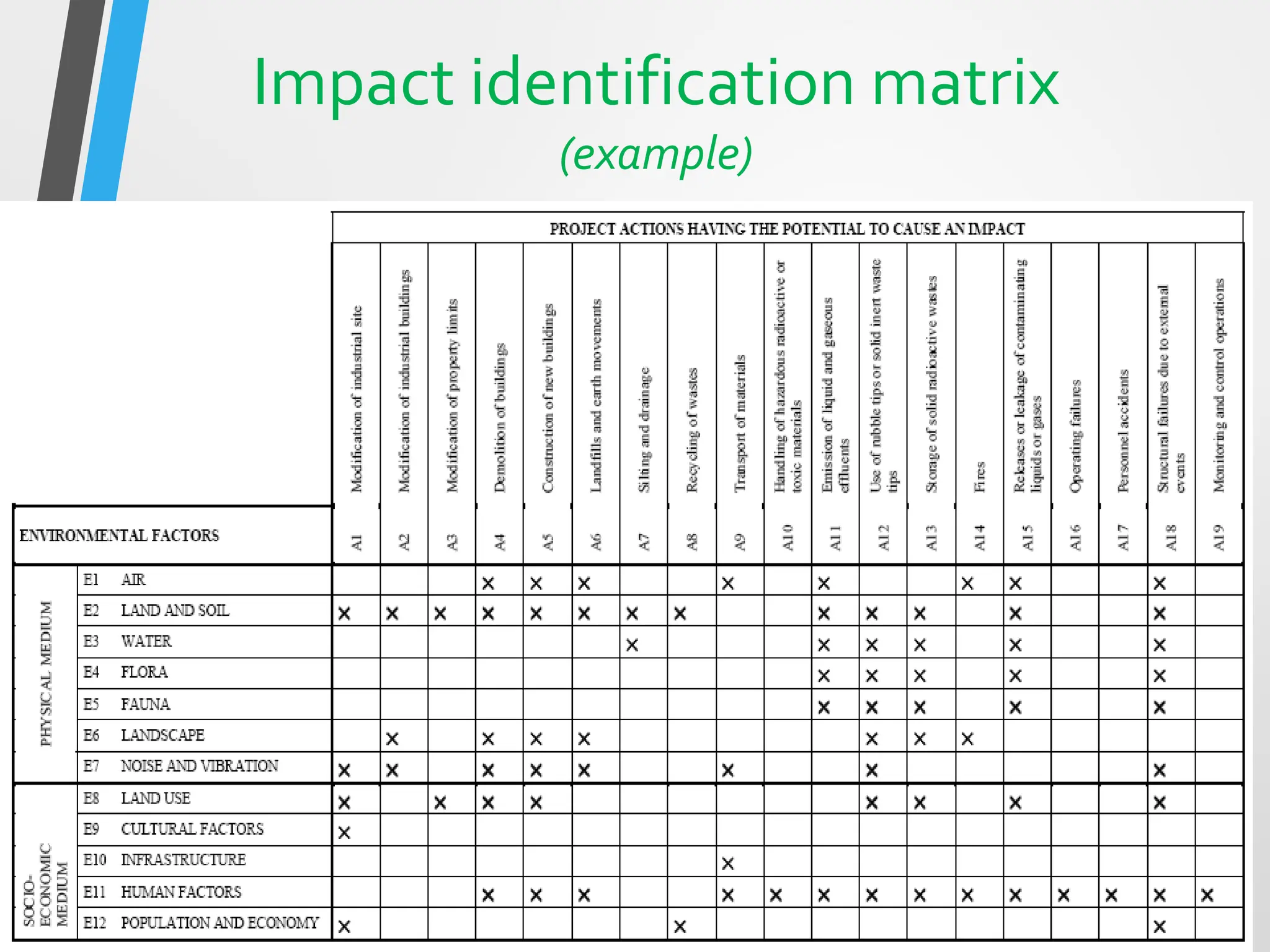
❖A simple interaction matrix is formed where project actions
are listed along one axis i.e. vertically and EI are listed along
the other side i.e. horizontally.
❖It was pioneer by Leopold et al(1971).
❖It lists about 100 project actions and about 88 environmental
characteristic and condition.
Impact identification matrix
(example)
Matrices Method :-
ADVANTAGES
❖Link action to
impact
❖Good method for
displaying EIA
results
DISADVANTAGES
❖Difficult to
distinguish direct
and indirect
impacts
❖Significant
potential for
double-counting of
impacts
❖Qualitative
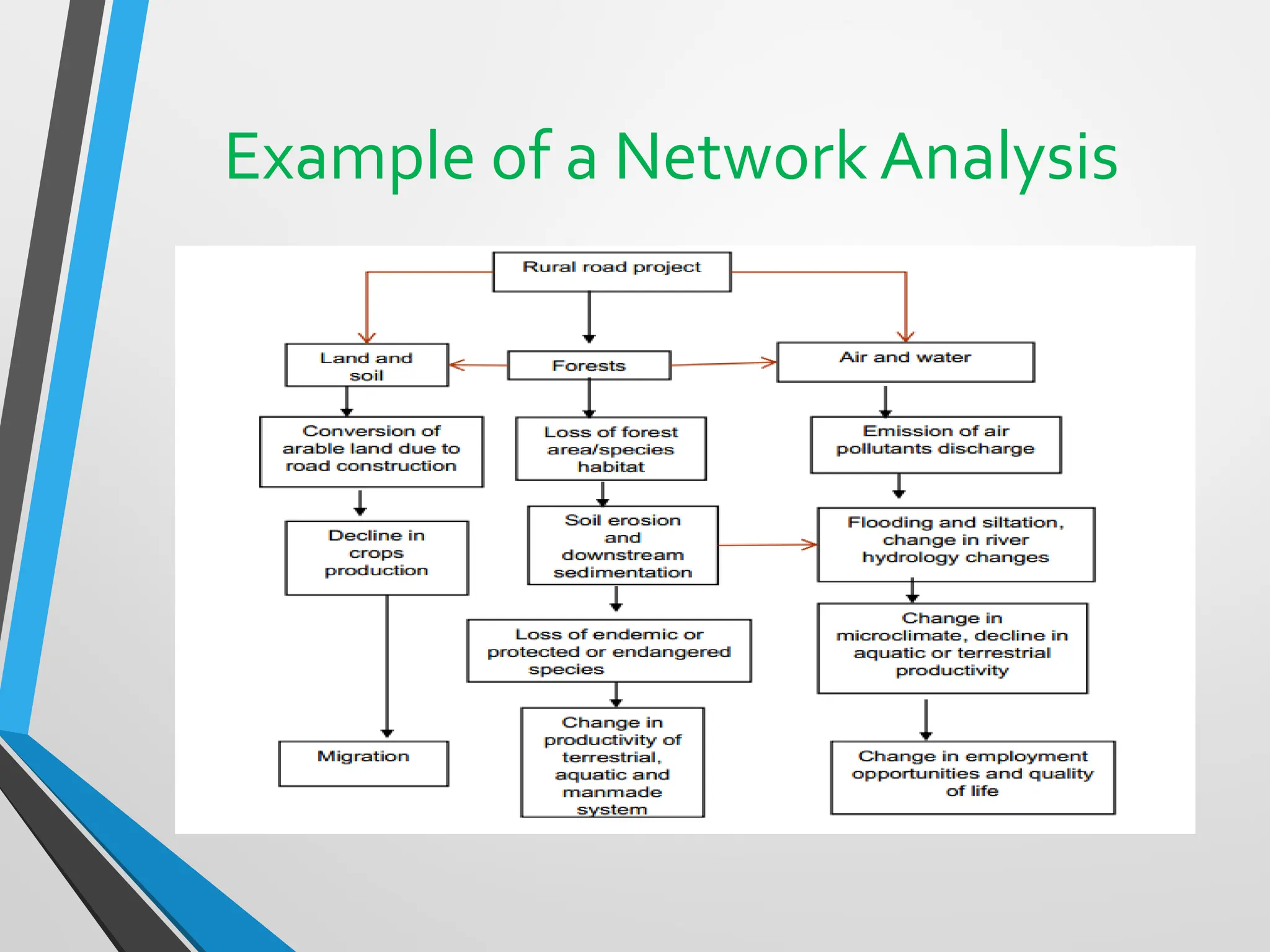
Network method:-
❖It uses the matrix approach by extending it take into account
primary as well the secondary impacts.
❖Shown in the form of tree called as Relevance/Impact
tree/Sequence diagram.
❖Identification of direct ,indirect /short and long term
environment impact is a crucial and intact basic step of
making Impact tree.
❖Used to identify cause-effect linkages
❖Visual description of linkages
Example of a Network Analysis
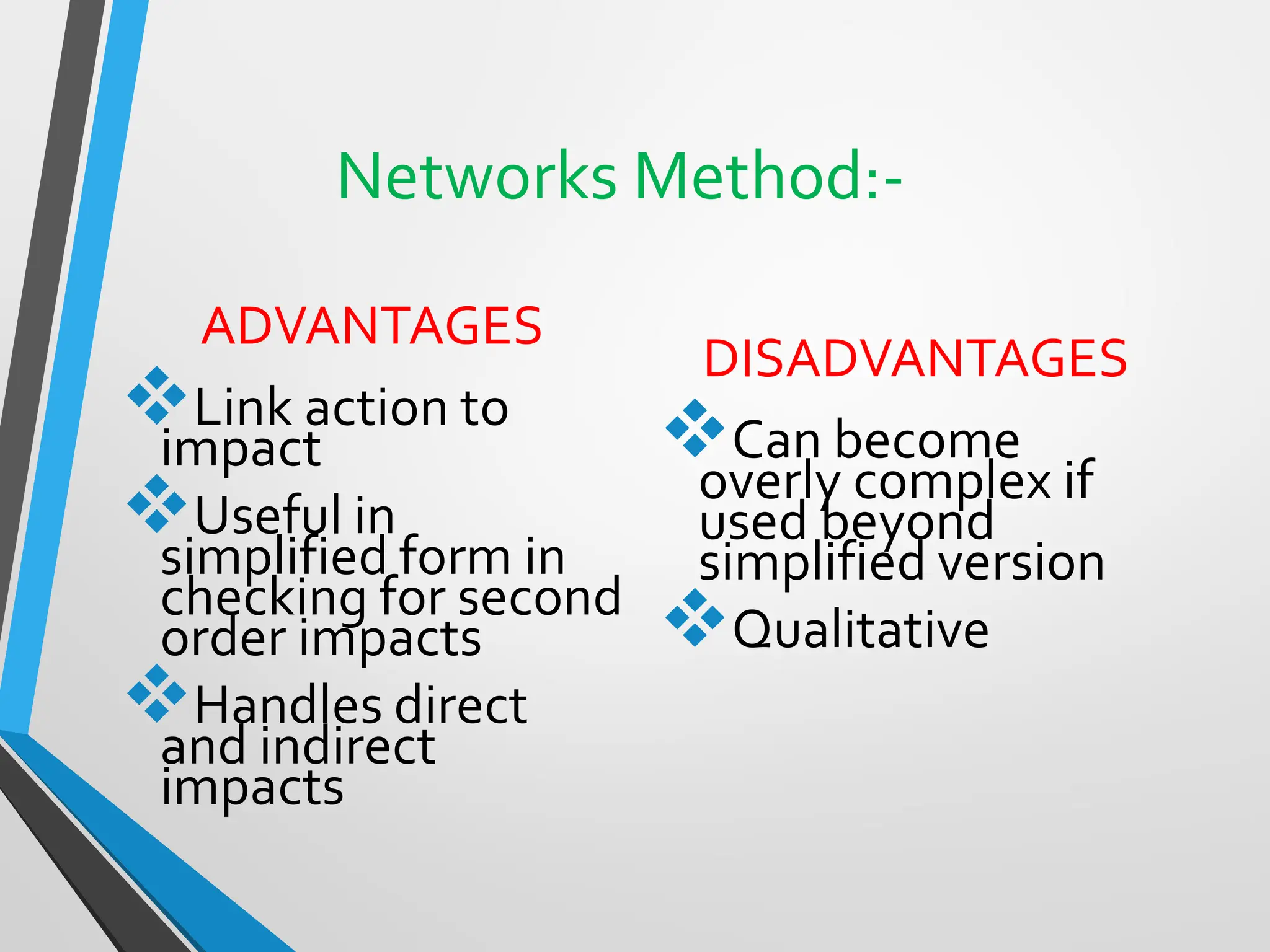
Networks Method:-
ADVANTAGES
❖Link action to
impact
❖Useful in
simplified form in
checking for second
order impacts
❖Handles direct
and indirect
impacts
DISADVANTAGES
❖Can become
overly complex if
used beyond
simplified version
❖Qualitative
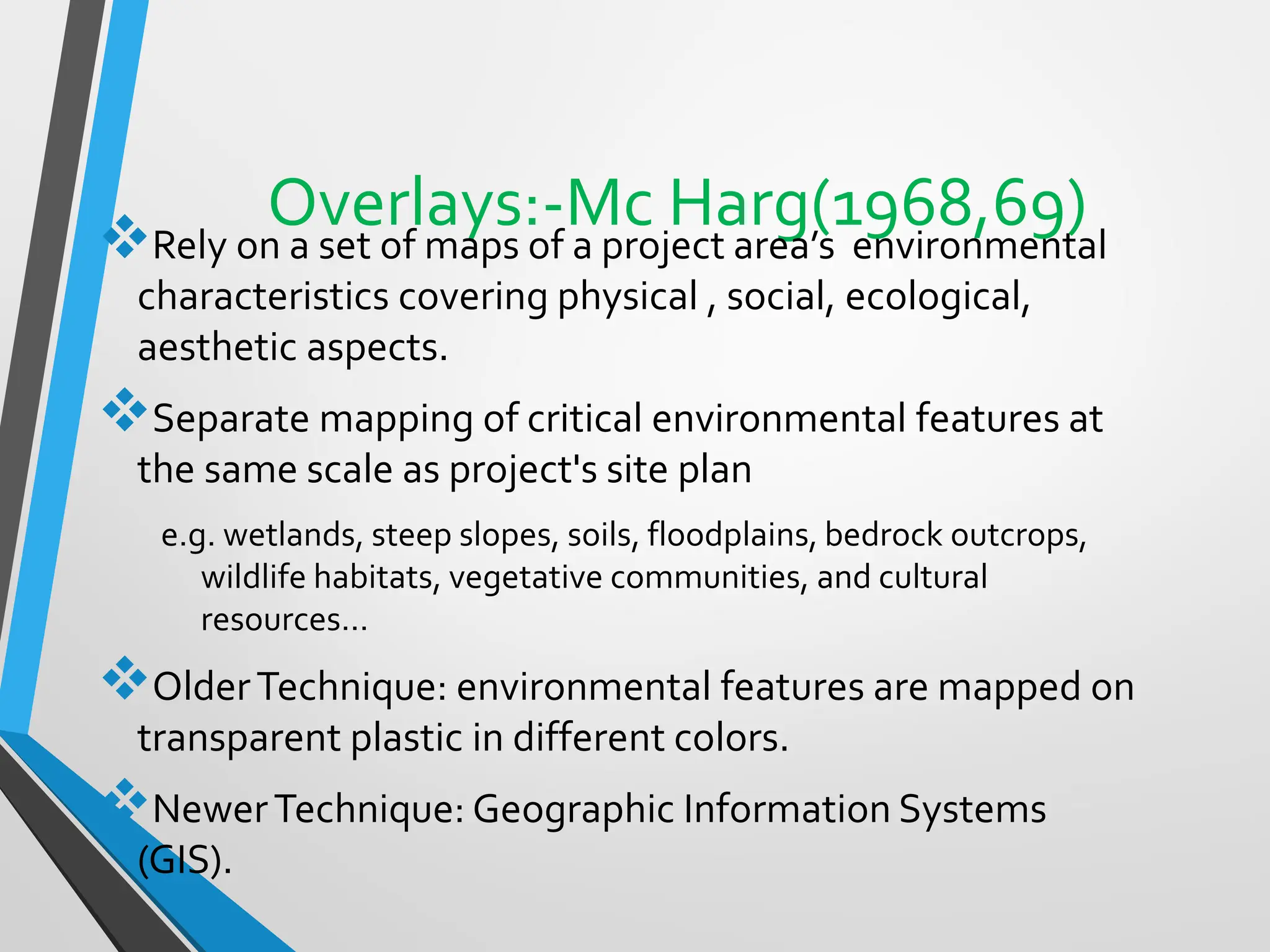
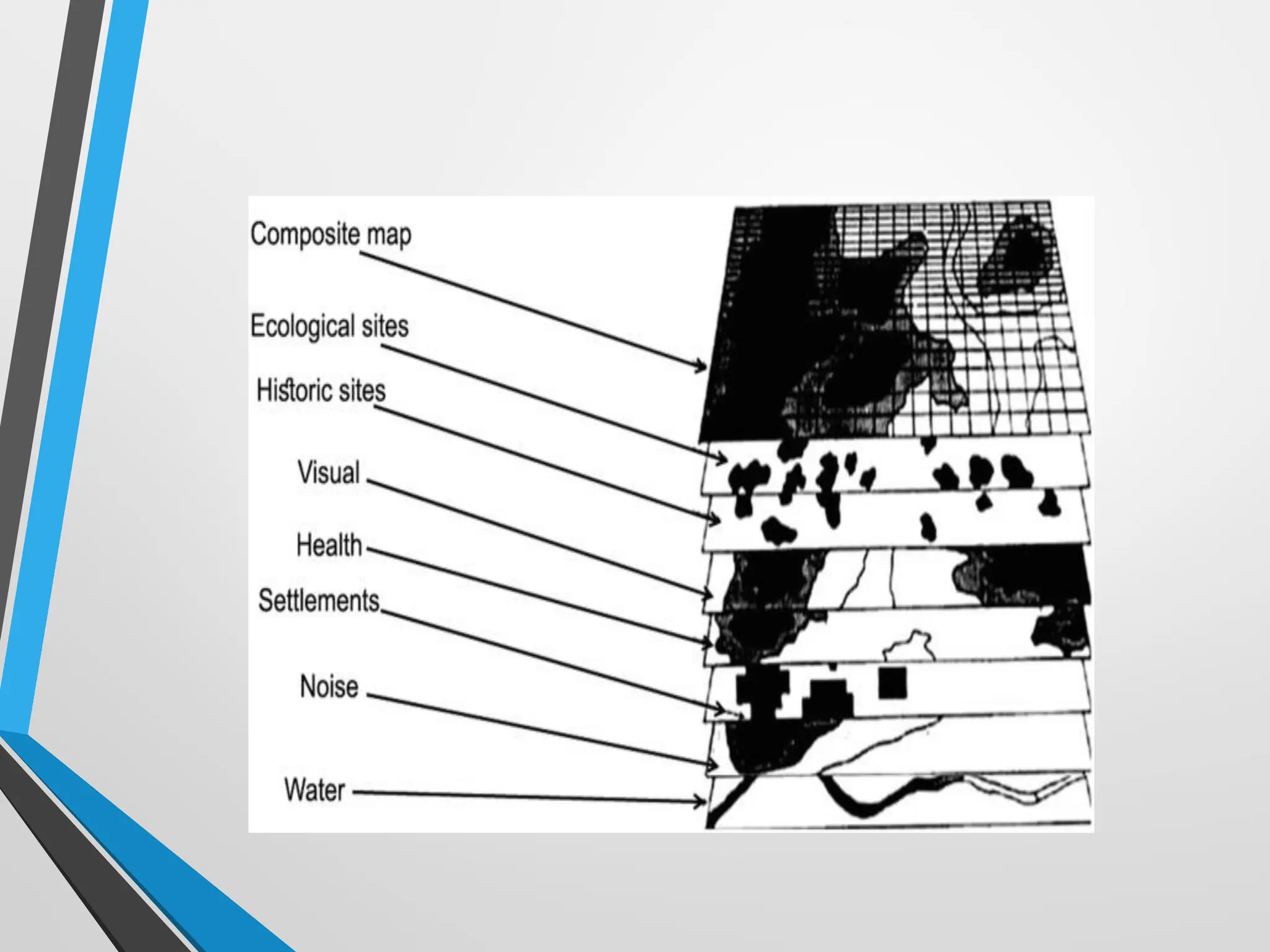
Overlays:-Mc Harg(1968,69)
❖Rely on a set of maps of a project area’s environmental
characteristics covering physical , social, ecological,
aesthetic aspects.
❖Separate mapping of critical environmental features at
the same scale as project's site plan
e.g. wetlands, steep slopes, soils, floodplains, bedrock outcrops,
wildlife habitats, vegetative communities, and cultural
resources...
❖OlderTechnique: environmental features are mapped on
transparent plastic in different colors.
❖NewerTechnique: Geographic Information Systems
(GIS).
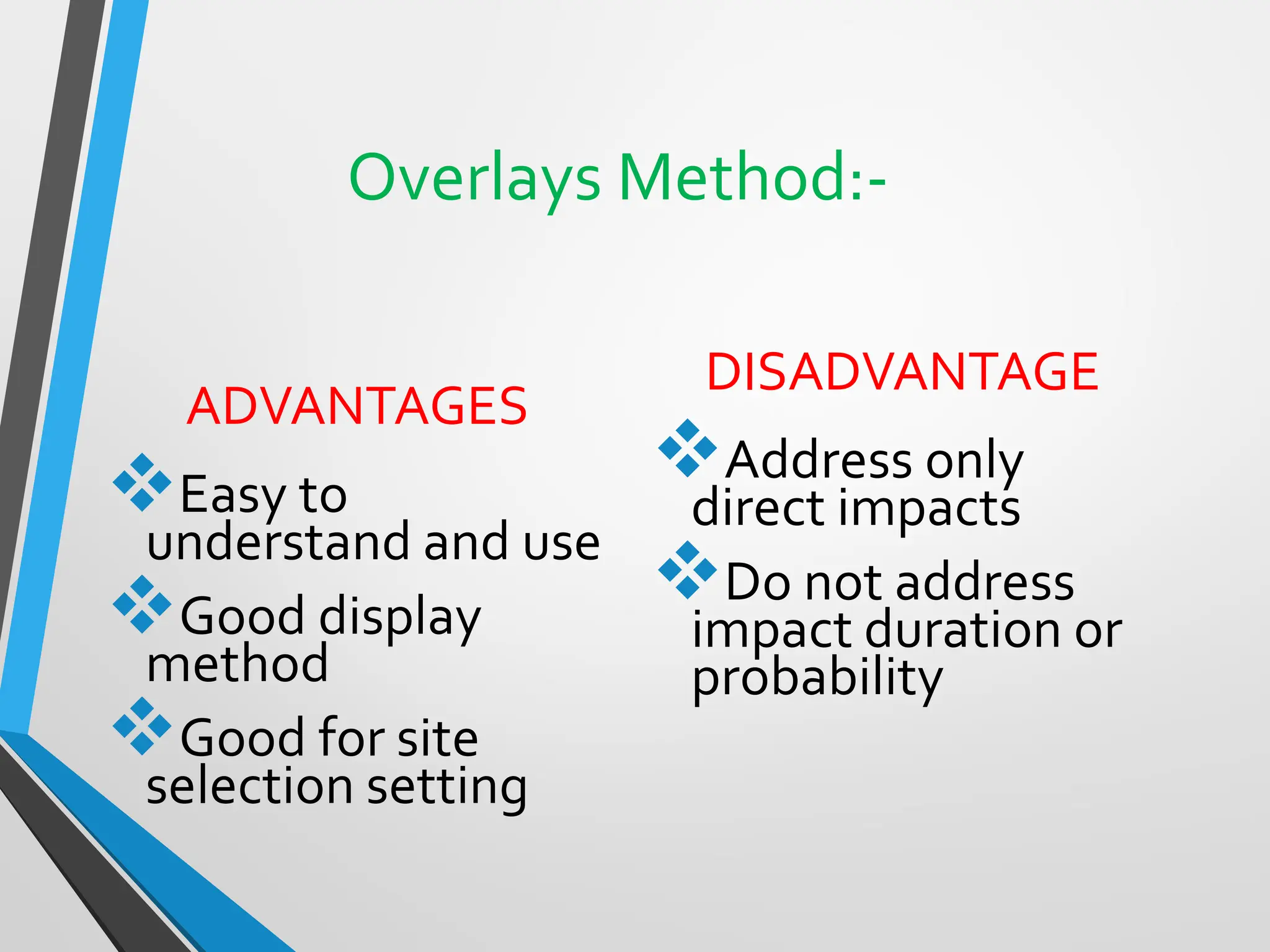
Overlays Method:-
ADVANTAGES
❖Easy to
understand and use
❖Good display
method
❖Good for site
selection setting
DISADVANTAGE
❖Address only
direct impacts
❖Do not address
impact duration or
probability
TYPES OF IMPACTS:-
A. Biological and Physio -chemical impacts.
B. Social impacts.
C. Health impacts.
D. Economic impacts.
A. Biological and Physio-Chemical
Impacts:-
❖It relate to effects on biological resources such as
vegetation ,wildlife , crops and aquatic life.
❖Interaction with Physical elements like air ,water , soil,
rocks and solar radiation.
❖Chemical impacts like chemical change in air , water , soil
quality etc.
B. SOCIAL IMPACTS:-
❖ Demographic – Displacement and
relocation effects and changes in
population characteristics.
❖ Cultural – Traditional patterns , family
structure ,religious, archaeological
features , social networks.
❖ Gender – implication of projects on
roles of women in society ,
employment opportunity and equity
❖ Institutional – Housing , schools,
Criminal justice , Health, welfare
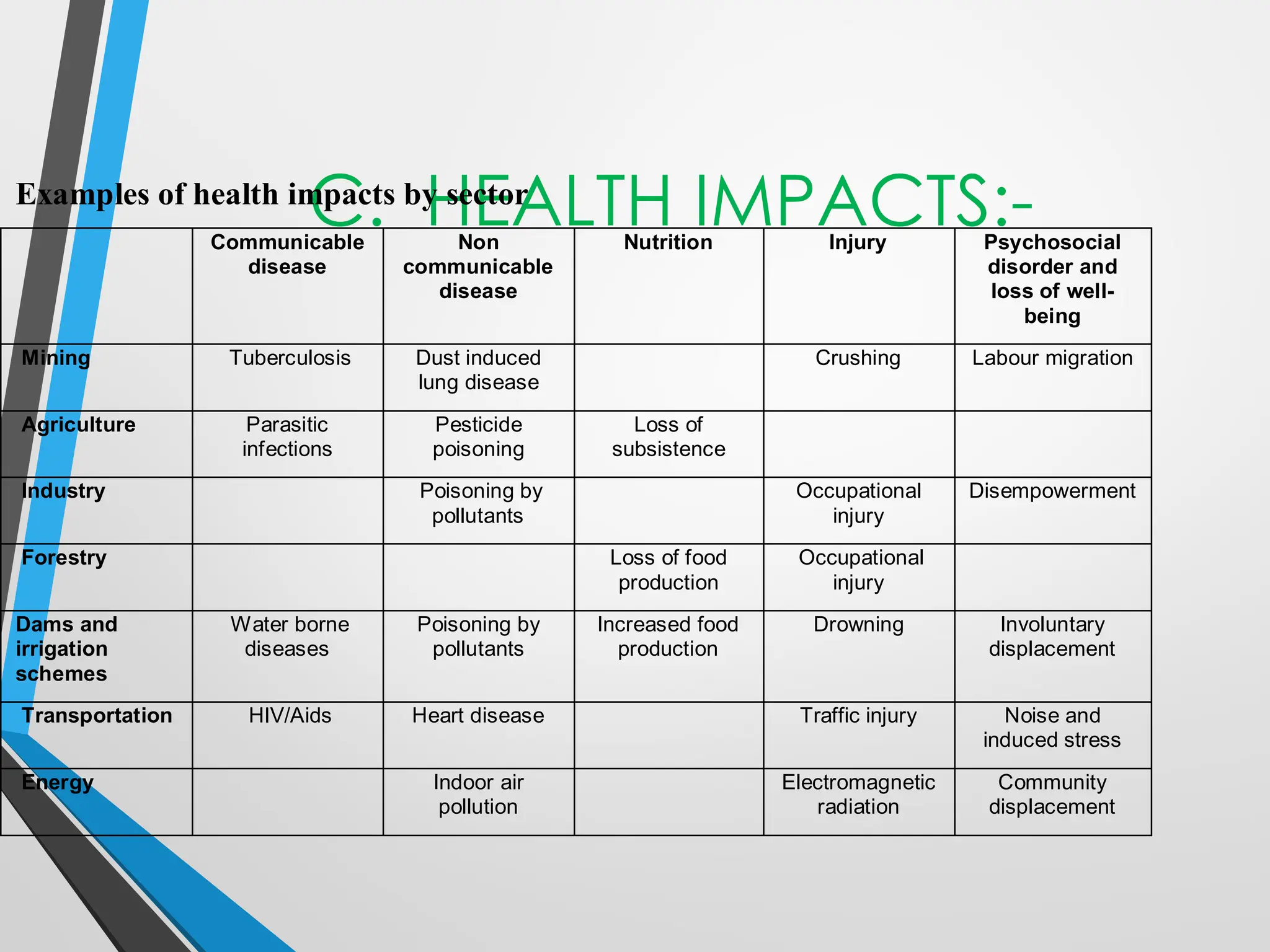
C. HEALTH IMPACTS:-
Examples of health impacts by sector
Communicable
disease
Non
communicable
disease
Nutrition Injury Psychosocial
disorder and
loss of well-
being
Mining Tuberculosis Dust induced
lung disease
Crushing Labour migration
Agriculture Parasitic
infections
Pesticide
poisoning
Loss of
subsistence
Industry Poisoning by
pollutants
Occupational
injury
Disempowerment
Forestry Loss of food
production
Occupational
injury
Dams and
irrigation
schemes
Water borne
diseases
Poisoning by
pollutants
Increased food
production
Drowning Involuntary
displacement
Transportation HIV/Aids Heart disease Traffic injury Noise and
induced stress
Energy Indoor air
pollution
Electromagnetic
radiation
Community
displacement
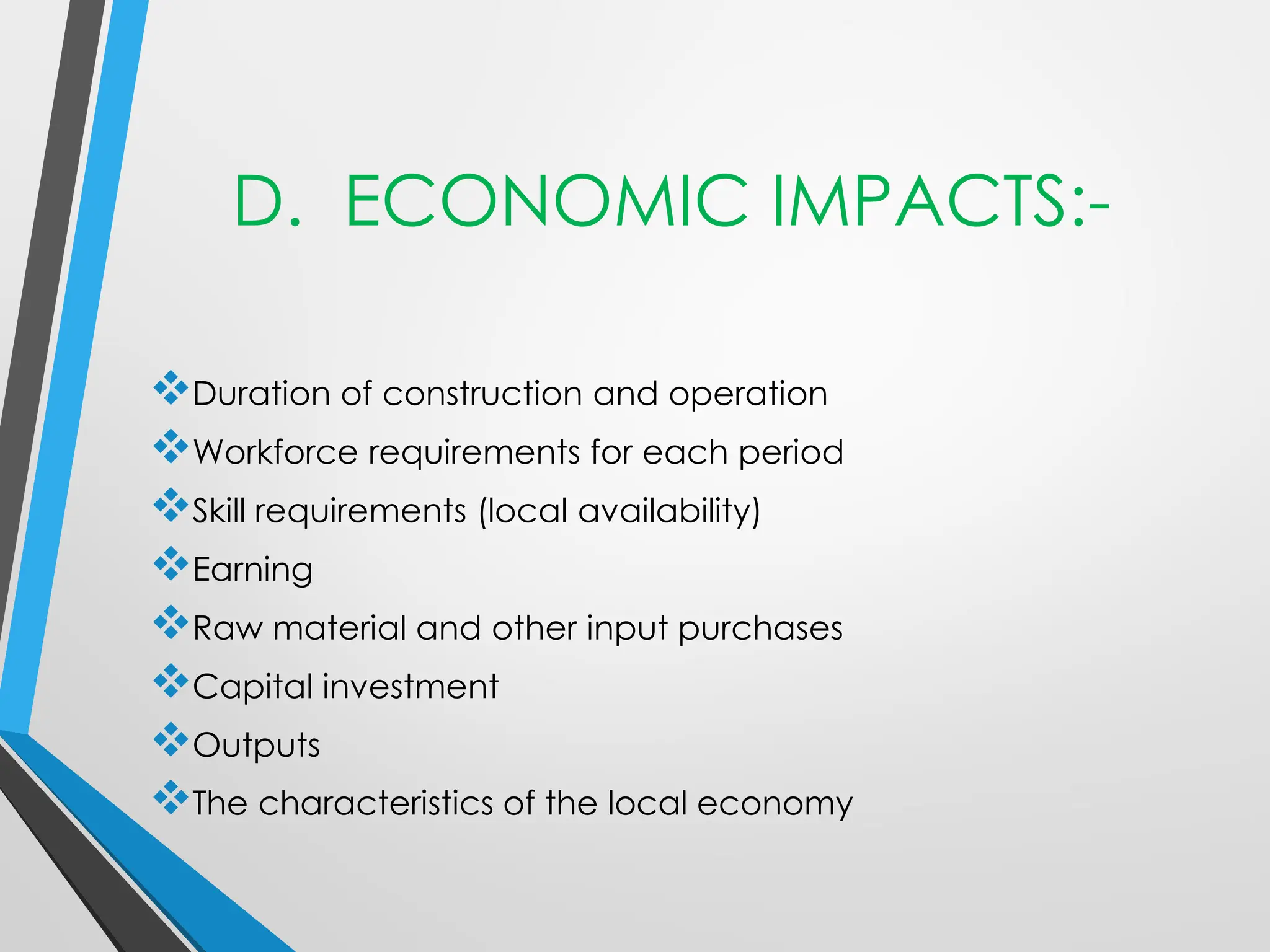
D. ECONOMIC IMPACTS:-
❖Duration of construction and operation
❖Workforce requirements for each period
❖Skill requirements (local availability)
❖Earning
❖Raw material and other input purchases
❖Capital investment
❖Outputs
❖The characteristics of the local economy
2. IMPACT PREDICTION:-
❖The accumulated knowledge of the findings of the
environmental investigations form the basis for the
prediction of impacts.
❖Once a potential impact has been determined during
scoping process ,it is necessary to identify which project
activity will cause impact , and its magnitude and extent.
Methods of impact
prediction:-
❖ Best estimate professional judgement .
❖ Quantitative mathematical models .
❖ Experiments and physical models .
❖ Case studies as analogues or
references .
POINTSTO CONSIDER FOR
IMPACT PREDICTIONS:-
1. Baseline condition
2. Un certainty
3. Spatial limits
4. Temporary boundaries
5. Incremental condition
6. Quantitative and Qualitative methods
3. IMPACTS EVALUATION:-
❖Its purpose is to assign relative significance to predicted
impacts associated with the projects and to determine
the order in which impacts are to be avoided , mitigated
or compensated
Criteria for Evaluating
Potential Effects:-
❖ Importance of affected resource
❖ Magnitude and extent of disturbance
❖ Duration and frequency
❖ Risk/likelihood of occurrence
❖ Reversibility
❖ Contribution to cumulative impacts
Evaluation of EIA system Effectiveness:-
❖Be considered effective if
• Information generated in the EIA contributed to decision making.
• Predictions were accurate
• Proposed mitigatory and compensatory measure achieved
approved management objectives
❖Efficiency criteria are satisfied if
• EIA decisions are timely relative to economic and other factors
determine project decisions
• Costs of conducting EIA can be determined and are reasonable.
36
Five Step Process for Evaluation of
Cumulative Effects :-
❖ The area in which the effects of the proposed
action will occur
❖ The impacts that are expected in that area
from the proposed action
❖ Other past, present, and reasonably
foreseeable actions that have or are expected
to have impacts in the area
❖ The impacts or expected impacts from those
other actions
❖ The overall impact that can be expected if the
individual impacts are allowed to accumulate
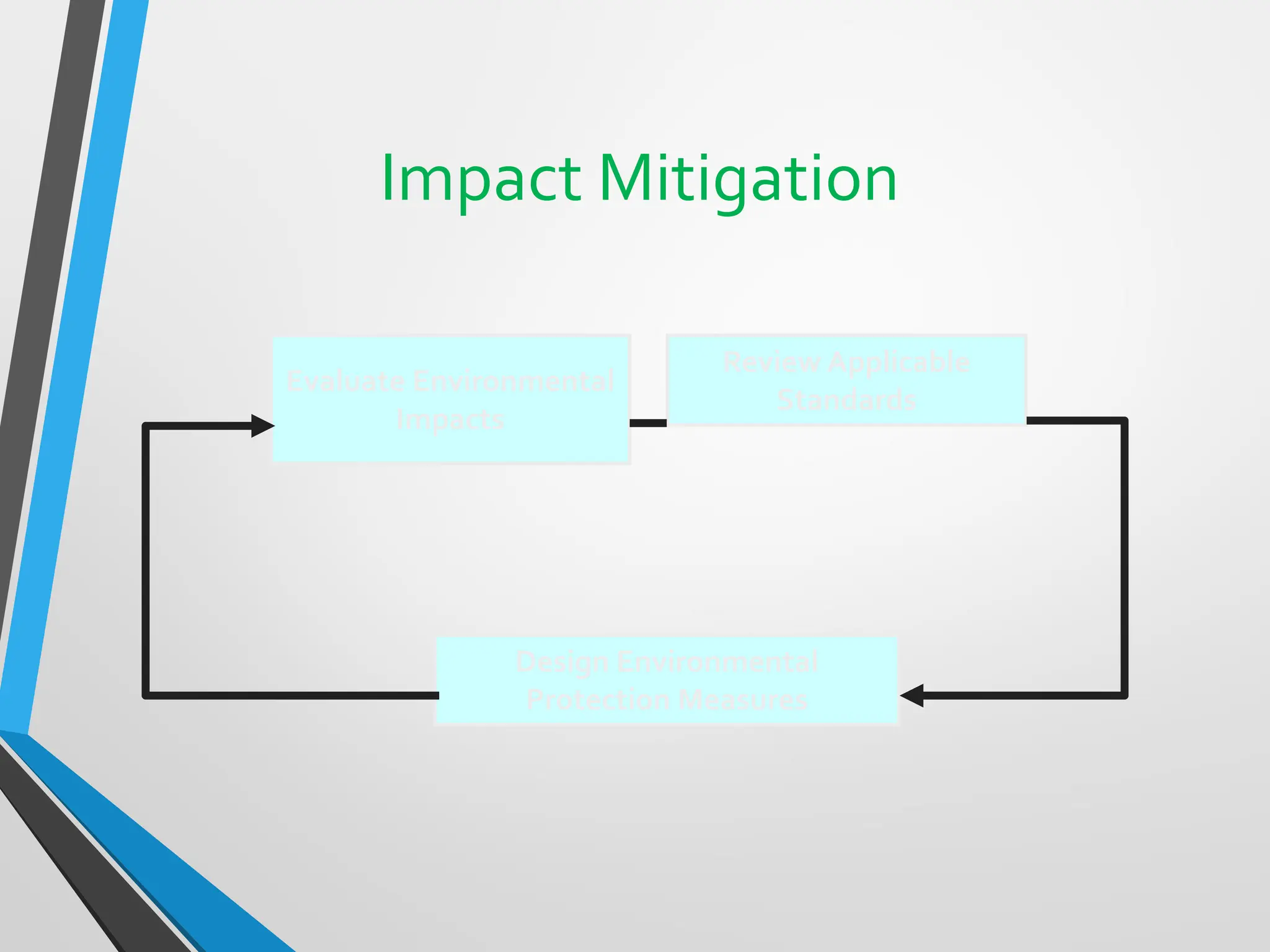
Impact Mitigation
Evaluate Environmental
Impacts
Design Environmental
Protection Measures
Review Applicable
Standards
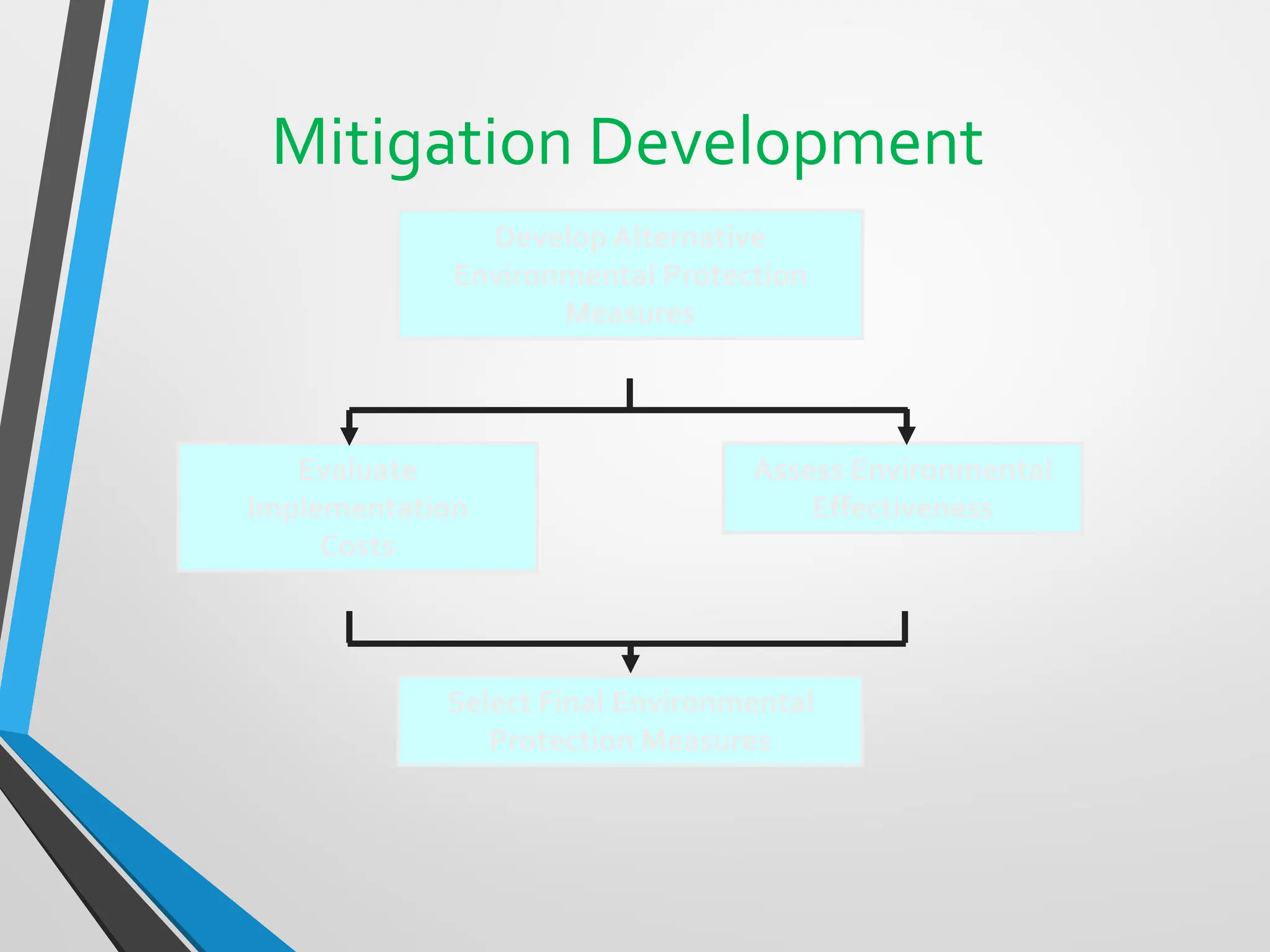
Mitigation Development
Develop Alternative
Environmental Protection
Measures
Evaluate
Implementation
Costs
Assess Environmental
Effectiveness
Select Final Environmental
Protection Measures
CONCLUSION:-
❖The above simple techniques of EIA such as impact
identification ,prediction ,evaluation are used for
measuring environment variables and construction of a
number of indices to describe the changes in
environmental inventory.
REFERENCE:-
❖http://www.unescap.org/drpad/vc/orientation/M8_4.htm
❖http://www.scopenvironment.org/downloadpubs/scope5
/chapter04.html
THANK
YOU

impact assessment methodologies - Copy.pdf

  • 1.
  • 2.
    EIA METHODOLOGY:- ❖Methodology meansthe structural approaches for doing one or more activities of EIA. ❖There are some specific characteristic which an EIA methodology should depict. ❖These are:-(1)It should be appropriate to the necessary task of EIA process such as impact identification/comparison of alternatives. ❖(2)It should be significantly free from assessors bias ❖(3)It should be economical in terms of costs, and its requirement of data ,investigating time , personnel, equipment and facilities.
  • 3.
    *Public involvement typically occursat these points. It may also occur at any other stage ofthe EIA Process Information from this process contributes to effective EIA in the future No EIA Initial environmental examination EIA required Approved Not approved Redesign Resubmit Proposal identification *Public involvement Screening Scoping Impact analysis Mitigation and impact management EIA report Review Decision-making Implementation and post-EIA monitoring
  • 4.
    IMPACT ANALYSIS:- ❖ Thisstage of EIA identifies and predicts the likely Environmental and social impact of the proposed project and evaluates the significance
  • 5.
    METHODS FOR IMPACT ANALYSIS:- 1.IMPACT IDENTIFICATION 2. IMPACT PREDICTION 3. IMPACT EVALUATION
  • 6.
    1. IMPACT IDENTIFICATION:- ❖ImpactIdentification attempts to answer the question, “what will happen when a project enters its operational stage?” ❖A List of important impacts such as changes in ambient air quality, changes in water and soil qualities, noise levels, wildlife habitats, species diversity, social and cultural systems, employment levels etc may be prepared. ❖The important sources of impact like smoke emission, consumption of water, discharge of effluents etc are identified.
  • 7.
    METHODS OF ENVRONMENTIMPACT IDENTIFICATION:- ❖Ad hoc method ❖Checklists ❖Matrices ❖Overlays ❖Networks
  • 8.
    Ad hoc Method:- ❖Simplemethod based on subjective environment impacts on broad aspects. ❖Ad hoc method is useful when time constraints and lack of information require that the EIA must rely exclusively on expert opinion. ❖ It provides minimal guidance for total impact assessment while suggesting the broad areas of possible impacts and the general nature of these possible impacts. ❖When more scientific methods are available, it is not recommended. ❖GENERALLY USED FOR SCREENING
  • 9.
    Types of Adhoc method:- ❖Opinion polls. ❖Experts opinion. ❖Delphi methods etc.
  • 10.
    Ad hoc method:- ADVANTAGE ❖Specialistson a particular area will provide guidance. DISADVANTAGE ❖QUALITATIVE ❖No assurance that all impacts are covered. ❖Lacks consistency ❖Identification , prediction and interpretation of impacts are quite poor.
  • 11.
    Checklists Method:- ❖Environmental factorsare listed in a structured format. ❖Checklist means a listing of potential Environmental Impacts. ❖This method is done to assess the nature of the impacts i.e. its type such as adverse /beneficial , short term or long term , no effect or significant impact , reversible or irreversible etc.
  • 12.
    Types of ChecklistsMethod:- ❖Simple Lists. ❖Descriptive Checklists. ❖Scaling Checklists. ❖Questionnaire Checklists.
  • 13.
  • 14.
  • 15.
  • 16.
    Checklists :- ADVANTAGES ❖Simple to understandand use. ❖Good for site selection and priority setting. DISADVANTAGES ❖Do not distinguish between direct and indirect impacts. ❖Do not link action and impact. ❖Sometime it is a cumbersome task.
  • 17.
    Matrices:- ❖Matrix and itsvariants provide us a framework of interaction of different actions /activities of a project with potential EI caused by them. ❖A simple interaction matrix is formed where project actions are listed along one axis i.e. vertically and EI are listed along the other side i.e. horizontally. ❖It was pioneer by Leopold et al(1971). ❖It lists about 100 project actions and about 88 environmental characteristic and condition.
  • 18.
  • 19.
    Matrices Method :- ADVANTAGES ❖Linkaction to impact ❖Good method for displaying EIA results DISADVANTAGES ❖Difficult to distinguish direct and indirect impacts ❖Significant potential for double-counting of impacts ❖Qualitative
  • 20.
    Network method:- ❖It usesthe matrix approach by extending it take into account primary as well the secondary impacts. ❖Shown in the form of tree called as Relevance/Impact tree/Sequence diagram. ❖Identification of direct ,indirect /short and long term environment impact is a crucial and intact basic step of making Impact tree. ❖Used to identify cause-effect linkages ❖Visual description of linkages
  • 21.
    Example of aNetwork Analysis
  • 22.
    Networks Method:- ADVANTAGES ❖Link actionto impact ❖Useful in simplified form in checking for second order impacts ❖Handles direct and indirect impacts DISADVANTAGES ❖Can become overly complex if used beyond simplified version ❖Qualitative
  • 23.
    Overlays:-Mc Harg(1968,69) ❖Rely ona set of maps of a project area’s environmental characteristics covering physical , social, ecological, aesthetic aspects. ❖Separate mapping of critical environmental features at the same scale as project's site plan e.g. wetlands, steep slopes, soils, floodplains, bedrock outcrops, wildlife habitats, vegetative communities, and cultural resources... ❖OlderTechnique: environmental features are mapped on transparent plastic in different colors. ❖NewerTechnique: Geographic Information Systems (GIS).
  • 25.
    Overlays Method:- ADVANTAGES ❖Easy to understandand use ❖Good display method ❖Good for site selection setting DISADVANTAGE ❖Address only direct impacts ❖Do not address impact duration or probability
  • 26.
    TYPES OF IMPACTS:- A.Biological and Physio -chemical impacts. B. Social impacts. C. Health impacts. D. Economic impacts.
  • 27.
    A. Biological andPhysio-Chemical Impacts:- ❖It relate to effects on biological resources such as vegetation ,wildlife , crops and aquatic life. ❖Interaction with Physical elements like air ,water , soil, rocks and solar radiation. ❖Chemical impacts like chemical change in air , water , soil quality etc.
  • 28.
    B. SOCIAL IMPACTS:- ❖Demographic – Displacement and relocation effects and changes in population characteristics. ❖ Cultural – Traditional patterns , family structure ,religious, archaeological features , social networks. ❖ Gender – implication of projects on roles of women in society , employment opportunity and equity ❖ Institutional – Housing , schools, Criminal justice , Health, welfare
  • 29.
    C. HEALTH IMPACTS:- Examplesof health impacts by sector Communicable disease Non communicable disease Nutrition Injury Psychosocial disorder and loss of well- being Mining Tuberculosis Dust induced lung disease Crushing Labour migration Agriculture Parasitic infections Pesticide poisoning Loss of subsistence Industry Poisoning by pollutants Occupational injury Disempowerment Forestry Loss of food production Occupational injury Dams and irrigation schemes Water borne diseases Poisoning by pollutants Increased food production Drowning Involuntary displacement Transportation HIV/Aids Heart disease Traffic injury Noise and induced stress Energy Indoor air pollution Electromagnetic radiation Community displacement
  • 30.
    D. ECONOMIC IMPACTS:- ❖Durationof construction and operation ❖Workforce requirements for each period ❖Skill requirements (local availability) ❖Earning ❖Raw material and other input purchases ❖Capital investment ❖Outputs ❖The characteristics of the local economy
  • 31.
    2. IMPACT PREDICTION:- ❖Theaccumulated knowledge of the findings of the environmental investigations form the basis for the prediction of impacts. ❖Once a potential impact has been determined during scoping process ,it is necessary to identify which project activity will cause impact , and its magnitude and extent.
  • 32.
    Methods of impact prediction:- ❖Best estimate professional judgement . ❖ Quantitative mathematical models . ❖ Experiments and physical models . ❖ Case studies as analogues or references .
  • 33.
    POINTSTO CONSIDER FOR IMPACTPREDICTIONS:- 1. Baseline condition 2. Un certainty 3. Spatial limits 4. Temporary boundaries 5. Incremental condition 6. Quantitative and Qualitative methods
  • 34.
    3. IMPACTS EVALUATION:- ❖Itspurpose is to assign relative significance to predicted impacts associated with the projects and to determine the order in which impacts are to be avoided , mitigated or compensated
  • 35.
    Criteria for Evaluating PotentialEffects:- ❖ Importance of affected resource ❖ Magnitude and extent of disturbance ❖ Duration and frequency ❖ Risk/likelihood of occurrence ❖ Reversibility ❖ Contribution to cumulative impacts
  • 36.
    Evaluation of EIAsystem Effectiveness:- ❖Be considered effective if • Information generated in the EIA contributed to decision making. • Predictions were accurate • Proposed mitigatory and compensatory measure achieved approved management objectives ❖Efficiency criteria are satisfied if • EIA decisions are timely relative to economic and other factors determine project decisions • Costs of conducting EIA can be determined and are reasonable. 36
  • 37.
    Five Step Processfor Evaluation of Cumulative Effects :- ❖ The area in which the effects of the proposed action will occur ❖ The impacts that are expected in that area from the proposed action ❖ Other past, present, and reasonably foreseeable actions that have or are expected to have impacts in the area ❖ The impacts or expected impacts from those other actions ❖ The overall impact that can be expected if the individual impacts are allowed to accumulate
  • 38.
    Impact Mitigation Evaluate Environmental Impacts DesignEnvironmental Protection Measures Review Applicable Standards
  • 39.
    Mitigation Development Develop Alternative EnvironmentalProtection Measures Evaluate Implementation Costs Assess Environmental Effectiveness Select Final Environmental Protection Measures
  • 40.
    CONCLUSION:- ❖The above simpletechniques of EIA such as impact identification ,prediction ,evaluation are used for measuring environment variables and construction of a number of indices to describe the changes in environmental inventory.
  • 41.
  • 42.