EIA TECHNIQUES
Prepared By: Yetnayet Almaw
Debre tabor University
Selection of the Methodologies:
 Numerous techniques and methods have been developed for evaluating and presenting
the effects of proposed and on going developmental activities on the environment.
 An appropriate methodology or technique for evaluation of a project should have the
following qualities and characteristics:
⁃ it should be systematic in approach
⁃ it should be able to organize a large mass of heterogeneous data
⁃ it should be capable of summarizing such data
⁃ it should have good predictive capability
⁃ it should be able to finally display the raw data and the derived information in a meaningful
fashion.
4/5/2022 2
Cont…
 Objective criteria for selection of the methodologies for the assessment of EI;
◦ General:
 Simplicity
 Manpower, time and budget constraint
 Flexibility
◦ Impact identification:
 comprehensiveness
 specificity
 timing and duration
4/5/2022 3
Cont…
◦ Impact measurement:
 explicit indicators
 magnitude
 objective criteria
◦ Impact interpretation and evaluation:
 significance
 aggregation
 risk and uncertainty
 alternative comparison and public involvement
o Impact communication:
 summary format, key issues and compliance
4/5/2022 4
Cont…
 Methods Available:
⁃ Baseline studies
⁃ Check-list
⁃ Battelle Env’al Evaluation System
⁃ Matrices
⁃ Network diagrams
⁃ Overlays
4/5/2022 5
⁃ Cost/Benefit Analysis
⁃ Mathematical modeling
⁃ Expert advice
⁃ Economic techniques
Cont…
1) Baseline studies:
◦ When do we require baseline studies?
 At the Scoping stage
◦ Why do we require baseline studies?
 To identify Key-Issues of the EI
 Once key issues have been identified, the need for further in-depth studies
can be clearly identified and any additional data collection initiated.
 Available data and local knowledge are sources of info. for base line studies.
4/5/2022 6
Cont…
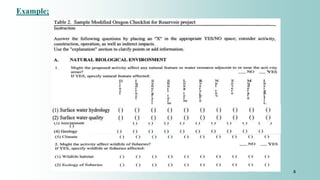
2) Checklist:
 Checklists are comprehensive lists of environmental effects and impact indicators
designed to stimulate the analyst to think broadly about possible consequences of
contemplated actions.
 They are used as a means of checking whether all of the important items have
been included, and do not represent a methodology for EIA by itself.
 Disadvantages of checklists are that they merely identify the possible potential
effects without any rating as to their relative magnitude.
 As a result they are most applicable at the stage of initial environmental
examination (IEE).
4/5/2022 7
Example;
8
Cont…
3) Battelle Environmental Evaluation System
⁃ is used to evaluate the expected future condition of the environmental quality, both
‘with’ and ‘without’ the project.
⁃ EES assessment of the environmental impacts of a projects is based on
commensurate "environmental impact units" (EIU).
⁃ Two EIU scores are produced, one 'with' and another 'without' the proposed
project.
⁃ The difference between the two scores is a measure of the environmental impact.
⁃ The scores are based on the magnitude and importance of specific impacts.
4/5/2022 9
Cont…
⁃ This method takes the item-by-item evaluation approach and then
determines a numerical value function of each parameter.
⁃ Its shortcoming is the difficulty in replication because different experts
have trouble agreeing on values of parameters.
4/5/2022 10
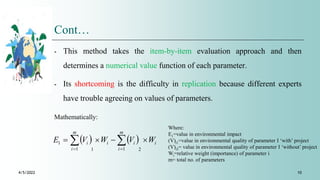
Mathematically:
Where:
E1=value in environmental impact
(V)i1=value in environmental quality of parameter I ‘with’ project
(V)i2= value in environmental quality of parameter I ‘without’ project
Wi=relative weight (importance) of parameter i
m= total no. of parameters
    i
m
i
i
i
m
i
i W
V
W
V
E 


 
 
 2
1
1
1
1
4/5/2022 11
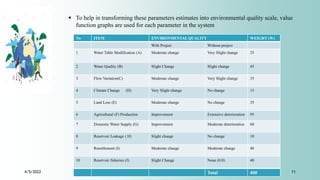
No ITEM ENVIRONMENTAL QUALITY WEIGHT (W)
With Project Without project
1 Water Table Modification (A) Moderate change Very Slight change 25
2 Water Quality (B) Slight Change Slight change 45
3 Flow Variation(C) Moderate change Very Slight change 35
4 Climate Change (D) Very Slight change No change 15
5 Land Loss (E) Moderate change No change 35
6 Agricultural (F) Production Improvement Extensive deterioration 95
7 Domestic Water Supply (G) Improvement Moderate deterioration 60
8 Reservoir Leakage ( H) Slight change No change 10
9 Resettlement (I) Moderate change Moderate change 40
10 Reservoir fisheries (J) Slight Change None (0.0) 40
Total 400
 To help in transforming these parameters estimates into environmental quality scale, value
function graphs are used for each parameter in the system
Cont…
4/5/2022 12
 Steps in determination of value function for an environmental parameter
are as follows:
i. Information is collected on the relationship between the parameter
and the quality of the environment.
ii. The parameter scale, which is normally the abscissa, is ordered, so
that the lowest value is zero.
iii. The environmental quality scale is divided into equal intervals
between 0 to 1, and appropriate value of the parameters for each
interval is determined.
Cont…
Remarks:
⁎ These steps should be performed repeatedly for all the environmental
parameters of interest by various groups of experts until a group curve is
obtained.
⁎ The next step is the computation of the EIUs.
⁎ The problem areas in a project are identified using minor and major flags.
⁎ The positive impact is also marked by + and the negative impacts with–
EIU.
⁎ A conclusion may be finally formulated.
4/5/2022 13
Cont…
4) Matrices
 Are used to quantify effects by applying numerical values to the
magnitudes and importance of various actions.
 The main advantages of the matrix method are:
⁎ Provide a graphic tool for displaying impacts to their audience in a
simple manner
⁎ Identify first order effects
⁎ Depict ecological interaction
4/5/2022 14
Cont…
⁎ Offers the possibility of rating and weighting, through this, offers
criteria to decision making analysis
⁎ Matrices are strong in identifying impacts and unlike checklists can
also represent higher order effects and interactions
⁎ Can identify the dynamic nature of the impact
⁎ Can communicate the result in an easily understood format
4/5/2022 15
Cont…
 The main disadvantages of matrix method are:
⁎ Simple matrices can not show higher interactive effects between
impacts.
⁎ Matrix method can not compare different alternatives in a single
format and different alternatives need to be assessed and presented
separately.
⁎ A great deal of information that is valuable for decision making is lost
in the conversion to numbers.
4/5/2022 16
Cont…
5) Network Method:
 Is based on a list of project activities to establish cause-condition
relationships.
 It attempts to define a set of possible networks and allow the user to
identify impacts by selecting and tracing out the appropriate project
actions.
 The procedure begins with a list of environmental attributes/features.
4/5/2022 17
Cont…
 Environmental attributes examined in three respects;
 Initial condition (or first order, direct impact)
 Consequence condition (or second and third order impact)
 Environmental effects
 They can incorporate several alternatives into their format and are capable of;
 identifying direct and indirect impacts,
 higher order effects and interactions between impacts and
 incorporate mitigation and management measures into the planning stage of a
project.
4/5/2022 18
Cont…
 Network methods usually only consider adverse environmental
effects.
 It do not distinguish clearly short and long term damages and do not
consider social values attached to different impacts.
 They are of little practical value when several alternatives are
considered.
4/5/2022 19
Cont…
6) Overlay Method:
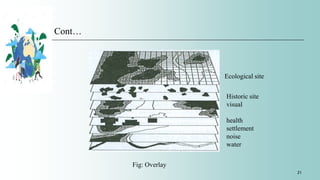
 This method uses a set of transparent maps of a project area.
 Within each unit (geographical units, topographic features, different land
uses), information is collected about the environmental parameters and
represented.
 It can provide a suitable and effective mode of presentation and display to
their audience and are useful when addressing questions such as site and
route selection.
 There is no provision for quantification and measurement of impacts.
4/5/2022 20
Cont…
21
Ecological site
Historic site
visual
health
settlement
noise
water
Fig: Overlay
Cont…
7) Cost/Benefit Analysis
 Provides the nature of expenses and benefits for a project in monetary
terms.
 Among the hardest tasks for the economist or project analyst is to
decide which of the environmental and resource impacts are important
and how to measure them and include them in monetary terms.
4/5/2022 22
Cont…
 Among the various environmental effects of dam projects some general
guidelines that should be of help in setting up the analysis are:
⁃ Start with the most obvious, most easily valued environmental
impacts.
⁃ There is a useful symmetry in benefits and costs. The distinction
between benefits and costs is the reference point from which changes
are measured.
 All assumptions should be stated explicitly (clearly).
4/5/2022 23
Cont…
8) Simulation Models:
 Recent Development in the EIA Methods.
 The models used in EIA are simplified representations of reality.
 We can never produce a perfect copy, but we can mimic the most
important features of reality, then the model will be recognized and
useful.
4/5/2022 24

EIA TECHNIQUES.pptx

  • 1.
    EIA TECHNIQUES Prepared By:Yetnayet Almaw Debre tabor University
  • 2.
    Selection of theMethodologies:  Numerous techniques and methods have been developed for evaluating and presenting the effects of proposed and on going developmental activities on the environment.  An appropriate methodology or technique for evaluation of a project should have the following qualities and characteristics: ⁃ it should be systematic in approach ⁃ it should be able to organize a large mass of heterogeneous data ⁃ it should be capable of summarizing such data ⁃ it should have good predictive capability ⁃ it should be able to finally display the raw data and the derived information in a meaningful fashion. 4/5/2022 2
  • 3.
    Cont…  Objective criteriafor selection of the methodologies for the assessment of EI; ◦ General:  Simplicity  Manpower, time and budget constraint  Flexibility ◦ Impact identification:  comprehensiveness  specificity  timing and duration 4/5/2022 3
  • 4.
    Cont… ◦ Impact measurement: explicit indicators  magnitude  objective criteria ◦ Impact interpretation and evaluation:  significance  aggregation  risk and uncertainty  alternative comparison and public involvement o Impact communication:  summary format, key issues and compliance 4/5/2022 4
  • 5.
    Cont…  Methods Available: ⁃Baseline studies ⁃ Check-list ⁃ Battelle Env’al Evaluation System ⁃ Matrices ⁃ Network diagrams ⁃ Overlays 4/5/2022 5 ⁃ Cost/Benefit Analysis ⁃ Mathematical modeling ⁃ Expert advice ⁃ Economic techniques
  • 6.
    Cont… 1) Baseline studies: ◦When do we require baseline studies?  At the Scoping stage ◦ Why do we require baseline studies?  To identify Key-Issues of the EI  Once key issues have been identified, the need for further in-depth studies can be clearly identified and any additional data collection initiated.  Available data and local knowledge are sources of info. for base line studies. 4/5/2022 6
  • 7.
    Cont… 2) Checklist:  Checklistsare comprehensive lists of environmental effects and impact indicators designed to stimulate the analyst to think broadly about possible consequences of contemplated actions.  They are used as a means of checking whether all of the important items have been included, and do not represent a methodology for EIA by itself.  Disadvantages of checklists are that they merely identify the possible potential effects without any rating as to their relative magnitude.  As a result they are most applicable at the stage of initial environmental examination (IEE). 4/5/2022 7
  • 8.
  • 9.
    Cont… 3) Battelle EnvironmentalEvaluation System ⁃ is used to evaluate the expected future condition of the environmental quality, both ‘with’ and ‘without’ the project. ⁃ EES assessment of the environmental impacts of a projects is based on commensurate "environmental impact units" (EIU). ⁃ Two EIU scores are produced, one 'with' and another 'without' the proposed project. ⁃ The difference between the two scores is a measure of the environmental impact. ⁃ The scores are based on the magnitude and importance of specific impacts. 4/5/2022 9
  • 10.
    Cont… ⁃ This methodtakes the item-by-item evaluation approach and then determines a numerical value function of each parameter. ⁃ Its shortcoming is the difficulty in replication because different experts have trouble agreeing on values of parameters. 4/5/2022 10 Mathematically: Where: E1=value in environmental impact (V)i1=value in environmental quality of parameter I ‘with’ project (V)i2= value in environmental quality of parameter I ‘without’ project Wi=relative weight (importance) of parameter i m= total no. of parameters     i m i i i m i i W V W V E         2 1 1 1 1
  • 11.
    4/5/2022 11 No ITEMENVIRONMENTAL QUALITY WEIGHT (W) With Project Without project 1 Water Table Modification (A) Moderate change Very Slight change 25 2 Water Quality (B) Slight Change Slight change 45 3 Flow Variation(C) Moderate change Very Slight change 35 4 Climate Change (D) Very Slight change No change 15 5 Land Loss (E) Moderate change No change 35 6 Agricultural (F) Production Improvement Extensive deterioration 95 7 Domestic Water Supply (G) Improvement Moderate deterioration 60 8 Reservoir Leakage ( H) Slight change No change 10 9 Resettlement (I) Moderate change Moderate change 40 10 Reservoir fisheries (J) Slight Change None (0.0) 40 Total 400  To help in transforming these parameters estimates into environmental quality scale, value function graphs are used for each parameter in the system
  • 12.
    Cont… 4/5/2022 12  Stepsin determination of value function for an environmental parameter are as follows: i. Information is collected on the relationship between the parameter and the quality of the environment. ii. The parameter scale, which is normally the abscissa, is ordered, so that the lowest value is zero. iii. The environmental quality scale is divided into equal intervals between 0 to 1, and appropriate value of the parameters for each interval is determined.
  • 13.
    Cont… Remarks: ⁎ These stepsshould be performed repeatedly for all the environmental parameters of interest by various groups of experts until a group curve is obtained. ⁎ The next step is the computation of the EIUs. ⁎ The problem areas in a project are identified using minor and major flags. ⁎ The positive impact is also marked by + and the negative impacts with– EIU. ⁎ A conclusion may be finally formulated. 4/5/2022 13
  • 14.
    Cont… 4) Matrices  Areused to quantify effects by applying numerical values to the magnitudes and importance of various actions.  The main advantages of the matrix method are: ⁎ Provide a graphic tool for displaying impacts to their audience in a simple manner ⁎ Identify first order effects ⁎ Depict ecological interaction 4/5/2022 14
  • 15.
    Cont… ⁎ Offers thepossibility of rating and weighting, through this, offers criteria to decision making analysis ⁎ Matrices are strong in identifying impacts and unlike checklists can also represent higher order effects and interactions ⁎ Can identify the dynamic nature of the impact ⁎ Can communicate the result in an easily understood format 4/5/2022 15
  • 16.
    Cont…  The maindisadvantages of matrix method are: ⁎ Simple matrices can not show higher interactive effects between impacts. ⁎ Matrix method can not compare different alternatives in a single format and different alternatives need to be assessed and presented separately. ⁎ A great deal of information that is valuable for decision making is lost in the conversion to numbers. 4/5/2022 16
  • 17.
    Cont… 5) Network Method: Is based on a list of project activities to establish cause-condition relationships.  It attempts to define a set of possible networks and allow the user to identify impacts by selecting and tracing out the appropriate project actions.  The procedure begins with a list of environmental attributes/features. 4/5/2022 17
  • 18.
    Cont…  Environmental attributesexamined in three respects;  Initial condition (or first order, direct impact)  Consequence condition (or second and third order impact)  Environmental effects  They can incorporate several alternatives into their format and are capable of;  identifying direct and indirect impacts,  higher order effects and interactions between impacts and  incorporate mitigation and management measures into the planning stage of a project. 4/5/2022 18
  • 19.
    Cont…  Network methodsusually only consider adverse environmental effects.  It do not distinguish clearly short and long term damages and do not consider social values attached to different impacts.  They are of little practical value when several alternatives are considered. 4/5/2022 19
  • 20.
    Cont… 6) Overlay Method: This method uses a set of transparent maps of a project area.  Within each unit (geographical units, topographic features, different land uses), information is collected about the environmental parameters and represented.  It can provide a suitable and effective mode of presentation and display to their audience and are useful when addressing questions such as site and route selection.  There is no provision for quantification and measurement of impacts. 4/5/2022 20
  • 21.
  • 22.
    Cont… 7) Cost/Benefit Analysis Provides the nature of expenses and benefits for a project in monetary terms.  Among the hardest tasks for the economist or project analyst is to decide which of the environmental and resource impacts are important and how to measure them and include them in monetary terms. 4/5/2022 22
  • 23.
    Cont…  Among thevarious environmental effects of dam projects some general guidelines that should be of help in setting up the analysis are: ⁃ Start with the most obvious, most easily valued environmental impacts. ⁃ There is a useful symmetry in benefits and costs. The distinction between benefits and costs is the reference point from which changes are measured.  All assumptions should be stated explicitly (clearly). 4/5/2022 23
  • 24.
    Cont… 8) Simulation Models: Recent Development in the EIA Methods.  The models used in EIA are simplified representations of reality.  We can never produce a perfect copy, but we can mimic the most important features of reality, then the model will be recognized and useful. 4/5/2022 24

Editor's Notes

  • #3 Being systematic is searching, selecting and managing the best available evidence for the proposed project
  • #4 comprehensiveness:- inclusiveness or completness
  • #7 Scoping Is the process of identifying the key environmental issues and impacts to be considered A full year of baseline data is desirable to capture seasonal effects of many environmental phenomena. However, to avoid delay in decision making, short-term data monitoring should be undertaken in parallel with long-term collection to provide conservative estimates of environmental impacts.
  • #8 In preparing a checklist, first, a list of activities is drawn up. Then, the team looks at the possible areas within the project area that will be affected by the activity. This is followed by characterizing the environmental aspects within that area that will be impacted (primary impact) Checklists for different types of undertakings have been prepared by a variety of financial, regulatory and professional organization (such as ADB, WORLD BANK, ICOLD, ICID etc.).
  • #9 The following points are also included: Environmental hazards, resource conservation and use, water quality and quantity, air quality/ atmospheric environment, Noise/Sonic Environment, Community facility/service, Community structure, Open space and recreation, Historic resources, Visual resources, Economic and environment, Planning co-ordination and growth
  • #10 developed by Battelle Northwest Laboratories for the US Bureau of Reclamation
  • #21 For each attribute, a transparent map is constructed using gradation of colors to indicate areal extent and value rating within the unit. Topographical Features include mountains, hills, valleys, lakes, oceans, rivers, cities, dams, and roads.