1 
 
Carboxylic Acid  
Their Derivatives 
Jully Tan 
School of Engineering 
EP101 / EG101  
Learning Outcome 
 At the end of this chapter, students are able to: 
 Provide nomenclature of the carboxylic acid  its derivatives 
 Physical properties of carboxylic acid 
 Synthesis and reaction of carboxylic acid  its derivatives
2 
Carboxylic Acids and Their Derivatives: 
Nucleophilic Addition-Elimination at the Acyl Carbon 
Carboxylic acids are a family of organic compounds with the 
functional group 
EP101 / EG101  
O= 
-C-OH 
which is also written as -CO2H or COOH. 
The carbon-oxygen double bond is made up of a s-bond and a p-bond. 
The carbon atom is sp2 hybridized, which explains the trigonal planar 
geometry at this center. 
p 
R C O 
HO s 
R may be alkyl, aryl or simply H 
EP101 / EG101  
Naming Rules 
 Uses the name of alkane that corresponds to the longest continuous chain of the 
carbon atom. 
 The final –e in the alkane name is replaced by suffix –oic acid 
 The chain is numbered, starting with carboxyl carbon (COO-) atom as C1. 
 Position of the substituent is indicated by a number. 
 Acid which has C=O attached to ring are named by adding the name carboxylic 
acid to the name of the cyclic compound. 
 When the acid has C=C in their structure, stereochemical term of cis and trans or E 
and Z are used as they are with other alkenes.
3 
EP101 / EG101  
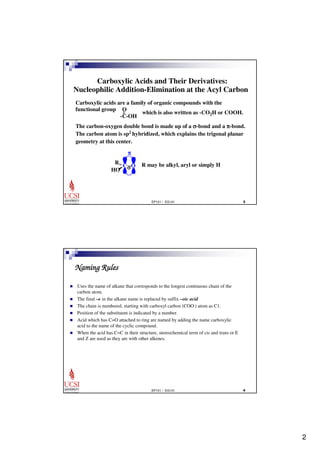
IUPAC Names 
 Remove -e from alkane (or alkene) name, add -oic acid. 
 The carbon of the carboxyl group is #1. 
Cl 
CH3CH2CHC 
OH 
O 
2-chlorobutanoic acid 
Ph 
C 
H 
C 
H 
COOH 
trans-3-phenyl-2-propenoic acid 
EP101 / EG101  
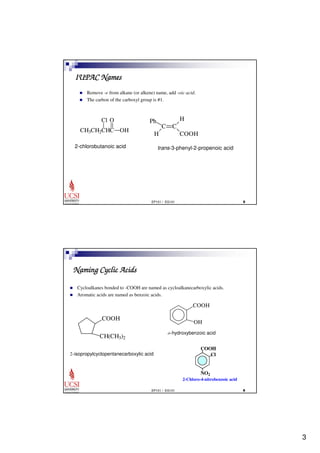
Naming Cyclic Acids 
 Cycloalkanes bonded to -COOH are named as cycloalkanecarboxylic acids. 
 Aromatic acids are named as benzoic acids. 
COOH 
CH(CH3)2 
2-isopropylcyclopentanecarboxylic acid 
COOH 
OH 
o-hydroxybenzoic acid 
COOH 
NO2 
Cl 
2-Chloro-4-nitrobenzoic acid
4 
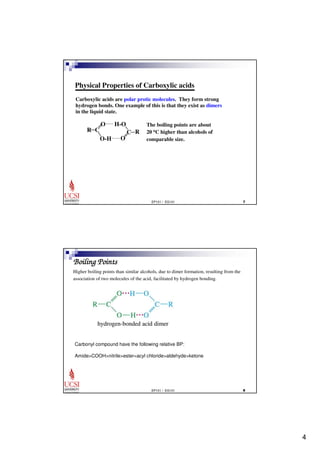
Physical Properties of Carboxylic acids 
Carboxylic acids are polar protic molecules. They form strong 
hydrogen bonds. One example of this is that they exist as dimers 
in the liquid state. 
EP101 / EG101  
C 
O 
O-H 
R 
O 
C 
H-O 
R 
The boiling points are about 
20 oC higher than alcohols of 
comparable size. 
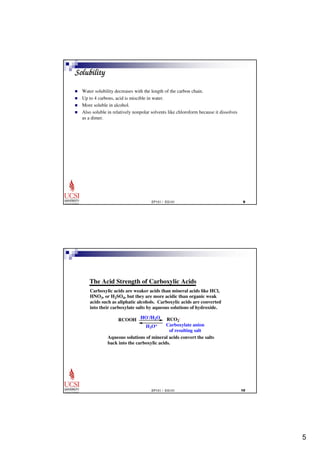
Boiling Points 
Higher boiling points than similar alcohols, due to dimer formation, resulting from the 
association of two molecules of the acid, facilitated by hydrogen bonding. 
Carbonyl compound have the following relative BP: 
AmideCOOHnitrileester=acyl chloridealdehydeketone 
EP101 / EG101
5 
EP101 / EG101 	 
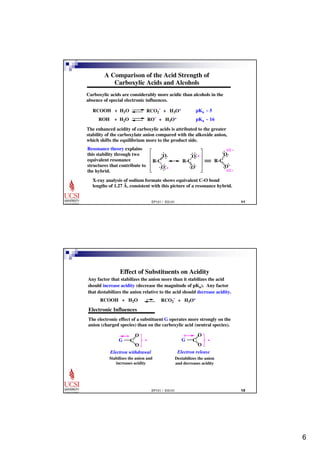
Solubility 
 Water solubility decreases with the length of the carbon chain. 
 Up to 4 carbons, acid is miscible in water. 
 More soluble in alcohol. 
 Also soluble in relatively nonpolar solvents like chloroform because it dissolves 
as a dimer. 
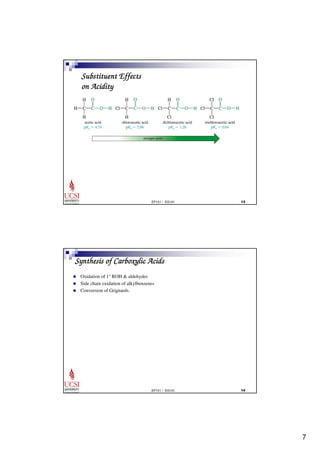
The Acid Strength of Carboxylic Acids 
Carboxylic acids are weaker acids than mineral acids like HCl, 
HNO3, or H2SO4, but they are more acidic than organic weak 
acids such as aliphatic alcohols. Carboxylic acids are converted 
into their carboxylate salts by aqueous solutions of hydroxide. 
RCOOH HO-/H2O 
H3O+ 
- 
RCO2 
Carboxylate anion 
of resulting salt 
Aqueous solutions of mineral acids convert the salts 
back into the carboxylic acids. 
EP101 / EG101
6 
A Comparison of the Acid Strength of 
Carboxylic Acids and Alcohols 
Carboxylic acids are considerably more acidic than alcohols in the 
absence of special electronic influences. 
RCOOH + H2O RCO2 
- + H3O+ pKa ~ 5 
ROH + H2O RO- + H3O+ pKa ~ 16 
The enhanced acidity of carboxylic acids is attributed to the greater 
stability of the carboxylate anion compared with the alkoxide anion, 
which shifts the equilibrium more to the product side. 
Resonance theory explains 
this stability through two 
equivalent resonance 
R-C 
structures that contribute to 
the hybrid. 
O . 
. .. 
.. 
.. 
O. .. ... O.. 
..- O.. 
.. O 
.. 
R-C 
- 
R-C 
1/2 - 
.. O 
.. 
1/2 - 
X-ray analysis of sodium formate shows equivalent C-O bond 
lengths of 1.27 A, consistent with this picture of a resonance hybrid. o 
EP101 / EG101  
Effect of Substituents on Acidity 
Any factor that stabilizes the anion more than it stabilizes the acid 
should increase acidity (decrease the magnitude of pKa). Any factor 
that destabilizes the anion relative to the acid should decrease acidity. 
- + H3O+ 
RCOOH + H2O RCO2 
Electronic Influences 
The electronic effect of a substituent G operates more strongly on the 
anion (charged species) than on the carboxylic acid (neutral species). 
EP101 / EG101  
G C 
O 
O 
- 
Electron withdrawal 
Stabilizes the anion and 
increases acidity 
G C 
O 
O 
- 
Electron release 
Destabilizes the anion 
and decreases acidity
7 
EP101 / EG101  
Substituent Effects 
on Acidity 
Synthesis of Carboxylic Acids 
EP101 / EG101  
 Oxidation of 1° ROH  aldehydes 
 Side chain oxidation of alkylbenzenes 
 Conversion of Grignards.
8 
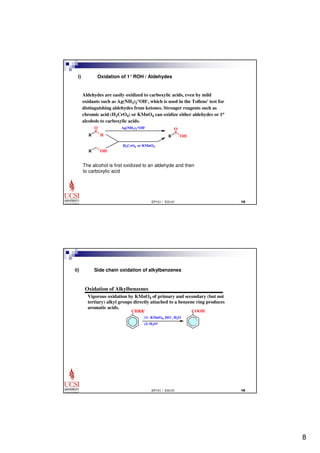
i) Oxidation of 1°ROH / Aldehydes 
Aldehydes are easily oxidized to carboxylic acids, even by mild 
oxidants such as Ag(NH3)2 
+OH-, which is used in the Tollens' test for 
distinguishing aldehydes from ketones. Stronger reagents such as 
chromic acid (H2CrO4) or KMnO4 can oxidize either aldehydes or 1o 
alcohols to carboxylic acids. 
O 
EP101 / EG101  
O 
R H 
R OH 
R OH 
+OH-H2CrO4 
Ag(NH3)2 
or KMnO4 
The alcohol is first oxidized to an aldehyde and then 
to carboxylic acid 
Oxidation of Alkylbenzenes 
Vigorous oxidation by KMnO4 of primary and secondary (but not 
tertiary) alkyl groups directly attached to a benzene ring produces 
aromatic acids. 
EP101 / EG101  
CHRR' 
(1) KMnO4, HO-, H2O 
(2) H3O+ 
COOH 
ii) Side chain oxidation of alkylbenzenes
9 
iii) Conversion of Grignards Reagent 
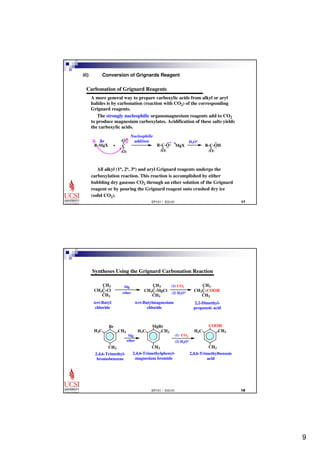
Carbonation of Grignard Reagents 
A more general way to prepare carboxylic acids from alkyl or aryl 
halides is by carbonation (reaction with CO2) of the corresponding 
Grignard reagents. 
The strongly nucleophilic organomagnesium reagents add to CO2 
to produce magnesium carboxylates. Acidification of these salts yields 
the carboxylic acids. 
- +MgX 
:: 
H3O+ 
: : 
R-C-OH 
:O: 
= 
EP101 / EG101  
d- d+ 
R-MgX 
:O: 
= 
+ C 
= 
:O: 
R-C-O 
:O: 
= 
: 
Nucleophilic 
addition 
All alkyl (1o, 2o, 3o) and aryl Grignard reagents undergo the 
carboxylation reaction. This reaction is accomplished by either 
bubbling dry gaseous CO2 through an ether solution of the Grignard 
reagent or by pouring the Grignard reagent onto crushed dry ice 
(solid CO2). 
Syntheses Using the Grignard Carbonation Reaction 
CH3 
CH3 
Mg 
ether CH3C-MgCl 
tert-Butylmagnesium 
chloride 
CH3 
CH3 
MgBr 
COOH 
H3C H3C 
EP101 / EG101  
CH3 
CH3 
CH3C-Cl 
tert-Butyl 
chloride 
CH3C-COOH 
2,2-Dimethyl-propanoic 
acid 
(1) CO2 
(2) H3O+ 
Br 
H3C CH3 
CH3 
Mg 
ether 
CH3 
CH3 
2,4,6-Trimethylphenyl-magnesium 
bromide 
CH3 
CH3 
2,4,6-Trimethylbenzoic 
acid 
(1) CO2 
(2) H3O+ 
2,4,6-Trimethyl-bromobenzene
10 
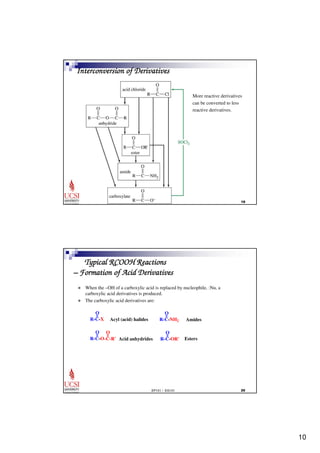
Interconversion of Derivatives 
More reactive derivatives 
can be converted to less 
reactive derivatives. 
EP101 / EG101 	 
Typical RCOOH Reactions 
– Formation of Acid Derivatives 
 When the –OH of a carboxylic acid is replaced by nucleophile, :Nu, a 
carboxylic acid derivatives is produced. 
 The carboxylic acid derivatives are: 
O 
R-C-X Amides 
R-C-NH2 
O 
EP101 / EG101 
 
O 
O 
R-C-O 
O 
Acyl (acid) halides 
O 
-C-R' 
Acid anhydrides R-C-OR' 
Esters 
Another class of carboxylic acid
11 
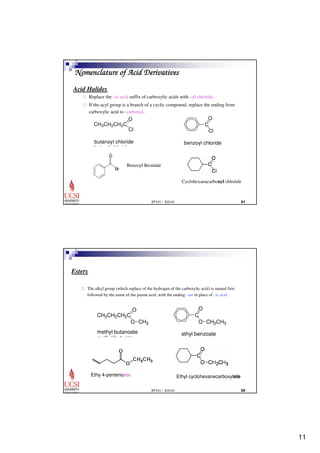
Nomenclature of Acid Derivatives 
Acid Halides 
 Replace the –ic acid suffix of carboxylic acids with –yl chloride. 
 If the acyl group is a branch of a cyclic compound, replace the ending from 
O 
EP101 / EG101  
carboxylic acid to -carbonyl. 
C 
Cl 
CH3CH2CH2C 
O 
Cl 
butanoyl chloride 
butyryl chloride 
benzoyl chloride 
Br 
O 
Benzoyl Bromide 
Cyclohexanacarbonyl chloride 
O 
EP101 / EG101  
Esters 
 The alkyl group (which replace of the hydrogen of the carboxylic acid) is named first 
followed by the name of the parent acid, with the ending –ate in place of –ic acid 
C 
O CH2CH3 
ethyl benzoate 
O 
O CH3 
CH3CH2CH2C 
methyl butanoate 
methyl butyrate 
Ethy 4-pentenoate Ethyl cyclohexanecarboxylate
12 
O O 
EP101 / EG101  
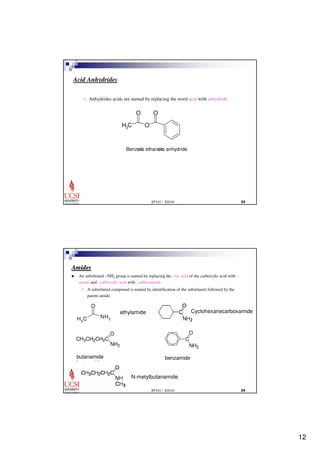
Acid Anhydrides 
 Anhydrides acids are named by replacing the word acid with anhydride. 
H C O 3 
Benzoic ethanoic anhydride 
O 
EP101 / EG101  
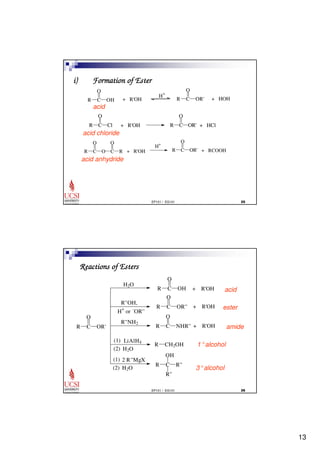
Amides 
 An substituted –NH2 group is named by replacing the –oic acid of the carboxylic acid with – 
amide and –carboxylic acid with –carboxamide. 
 A substituted compound is named by identification of the substituent followed by the 
parent amide. 
H C 3 
O 
NH2 
ethylamide 
C 
NH2 
CH3CH2CH2C 
O 
NH2 
butanamide 
butyramide 
benzamide 
N-metylbutanamide 
Cyclohexanecarboxamide
13 
O 
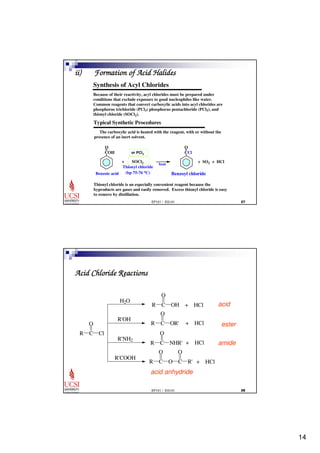
i) Formation of Ester 
R C R C 
OR' 
O 
R C OR' 
O 
O 
R C OR' 
EP101 / EG101  
O 
OH + R'OH 
H+ 
+ HOH 
acid 
R C 
O 
Cl + R'OH + HCl 
acid chloride 
R C 
O 
O C 
R + R'OH 
H+ 
+ RCOOH 
acid anhydride 
O 
O 
O 
+ R'OH 
OH 
EP101 / EG101  
Reactions of Esters 
O 
R C 
OR' 
R C 
OH + R'OH 
R C 
OR'' 
R C 
NHR'' + R'OH 
R CH2OH 
R C 
R'' 
R'' 
H2O 
R''OH, 
H+ or -OR'' 
R''NH2 
(1) 
(2) H2O 
LiAlH4 
(1) 2 R''MgX 
(2) H2O 
acid 
ester 
amide 
1°alcohol 
3°alcohol
14 
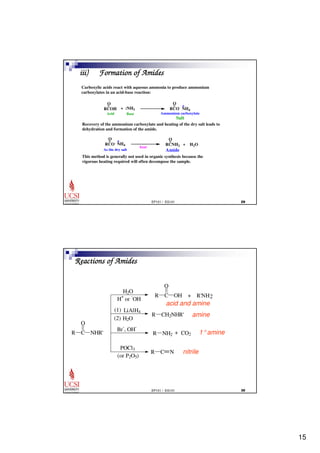
ii) Formation of Acid Halides 
Synthesis of Acyl Chlorides 
Because of their reactivity, acyl chlorides must be prepared under 
conditions that exclude exposure to good nucleophiles like water. 
Common reagents that convert carboxylic acids into acyl chlorides are 
phosphorus trichloride (PCl3) phosphorus pentachloride (PCl5), and 
thionyl chloride (SOCl2). 
Typical Synthetic Procedures 
The carboxylic acid is heated with the reagent, with or without the 
presence of an inert solvent. 
O= 
+ SO2 + HCl 
EP101 / EG101  
O= 
COH 
Benzoic acid 
or PCl3 
+ SOCl2 
Thionyl chloride 
(bp 75-76 oC) 
heat 
CCl 
Benzoyl chloride 
Thionyl chloride is an especially convenient reagent because the 
byproducts are gases and easily removed. Excess thionyl chloride is easy 
to remove by distillation. 
O 
O 
O 
O 
O 
+ HCl 
+ HCl 
EP101 / EG101  
Acid Chloride Reactions 
H2O 
R'OH 
R'NH2 
R'COOH 
O 
R C 
Cl 
R C 
OH + HCl 
R C 
OR' 
R C 
NHR' 
R C 
O C 
R' + HCl 
acid 
ester 
amide 
acid anhydride
15 
iii) Formation of Amides 
Carboxylic acids react with aqueous ammonia to produce ammonium 
carboxylates in an acid-base reaction: 
O= 
+ 
O= 
EP101 / EG101 	 
O= 
RCOH 
+ :NH3 
Acid Base 
RCO- 
NH4 
Ammonium carboxylate 
Salt 
Recovery of the ammonium carboxylate and heating of the dry salt leads to 
dehydration and formation of the amide. 
O= 
RCO- 
+ 
NH4 
As the dry salt 
RCNH2 + H2O 
heat Amide 
This method is generally not used in organic synthesis because the 
vigorous heating required will often decompose the sample. 
O 
acid and amine 
EP101 / EG101 
 
Reactions of Amides 
R C 
OH + R'NH2 
O 
R C 
NHR' 
R CH2NHR' 
H2O 
H+ or -OH 
(1) 
(2) H2O 
LiAlH4 
Br-, OH-R 
NH2 + CO2 
POCl3 
(or P2O5) 
R C N 
amine 
1°amine 
nitrile
16 
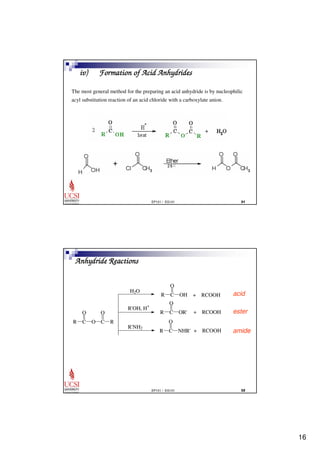
iv) Formation of Acid Anhydrides 
The most general method for the preparing an acid anhydride is by nucleophilic 
acyl substitution reaction of an acid chloride with a carboxylate anion. 
EP101 / EG101  
O 
O 
O 
+ RCOOH 
EP101 / EG101  
Anhydride Reactions 
O 
R C 
O 
O C 
R 
R C 
OH + RCOOH 
R C 
OR' 
R C 
NHR' + RCOOH 
H2O 
R'OH, H+ 
R'NH2 
acid 
ester 
amide
17 
EP101 / EG101  
Conclusion 
At the end of the chapter…. You suppose able to: 
 Understand the nomenclature of carboxylic acid and its derivatives 
 The physical properties of carboxylic acid 
 The 3 main methods of synthesis carboxylic acid 
 The reaction of carboxylic acid to form its derivatives.

Carboxylic Acid & Their Derivatives

  • 1.
    1 CarboxylicAcid Their Derivatives Jully Tan School of Engineering EP101 / EG101 Learning Outcome At the end of this chapter, students are able to: Provide nomenclature of the carboxylic acid its derivatives Physical properties of carboxylic acid Synthesis and reaction of carboxylic acid its derivatives
  • 2.
    2 Carboxylic Acidsand Their Derivatives: Nucleophilic Addition-Elimination at the Acyl Carbon Carboxylic acids are a family of organic compounds with the functional group EP101 / EG101 O= -C-OH which is also written as -CO2H or COOH. The carbon-oxygen double bond is made up of a s-bond and a p-bond. The carbon atom is sp2 hybridized, which explains the trigonal planar geometry at this center. p R C O HO s R may be alkyl, aryl or simply H EP101 / EG101 Naming Rules Uses the name of alkane that corresponds to the longest continuous chain of the carbon atom. The final –e in the alkane name is replaced by suffix –oic acid The chain is numbered, starting with carboxyl carbon (COO-) atom as C1. Position of the substituent is indicated by a number. Acid which has C=O attached to ring are named by adding the name carboxylic acid to the name of the cyclic compound. When the acid has C=C in their structure, stereochemical term of cis and trans or E and Z are used as they are with other alkenes.
  • 3.
    3 EP101 /EG101 IUPAC Names Remove -e from alkane (or alkene) name, add -oic acid. The carbon of the carboxyl group is #1. Cl CH3CH2CHC OH O 2-chlorobutanoic acid Ph C H C H COOH trans-3-phenyl-2-propenoic acid EP101 / EG101 Naming Cyclic Acids Cycloalkanes bonded to -COOH are named as cycloalkanecarboxylic acids. Aromatic acids are named as benzoic acids. COOH CH(CH3)2 2-isopropylcyclopentanecarboxylic acid COOH OH o-hydroxybenzoic acid COOH NO2 Cl 2-Chloro-4-nitrobenzoic acid
  • 4.
    4 Physical Propertiesof Carboxylic acids Carboxylic acids are polar protic molecules. They form strong hydrogen bonds. One example of this is that they exist as dimers in the liquid state. EP101 / EG101 C O O-H R O C H-O R The boiling points are about 20 oC higher than alcohols of comparable size. Boiling Points Higher boiling points than similar alcohols, due to dimer formation, resulting from the association of two molecules of the acid, facilitated by hydrogen bonding. Carbonyl compound have the following relative BP: AmideCOOHnitrileester=acyl chloridealdehydeketone EP101 / EG101
  • 5.
    5 EP101 /EG101 Solubility Water solubility decreases with the length of the carbon chain. Up to 4 carbons, acid is miscible in water. More soluble in alcohol. Also soluble in relatively nonpolar solvents like chloroform because it dissolves as a dimer. The Acid Strength of Carboxylic Acids Carboxylic acids are weaker acids than mineral acids like HCl, HNO3, or H2SO4, but they are more acidic than organic weak acids such as aliphatic alcohols. Carboxylic acids are converted into their carboxylate salts by aqueous solutions of hydroxide. RCOOH HO-/H2O H3O+ - RCO2 Carboxylate anion of resulting salt Aqueous solutions of mineral acids convert the salts back into the carboxylic acids. EP101 / EG101
  • 6.
    6 A Comparisonof the Acid Strength of Carboxylic Acids and Alcohols Carboxylic acids are considerably more acidic than alcohols in the absence of special electronic influences. RCOOH + H2O RCO2 - + H3O+ pKa ~ 5 ROH + H2O RO- + H3O+ pKa ~ 16 The enhanced acidity of carboxylic acids is attributed to the greater stability of the carboxylate anion compared with the alkoxide anion, which shifts the equilibrium more to the product side. Resonance theory explains this stability through two equivalent resonance R-C structures that contribute to the hybrid. O . . .. .. .. O. .. ... O.. ..- O.. .. O .. R-C - R-C 1/2 - .. O .. 1/2 - X-ray analysis of sodium formate shows equivalent C-O bond lengths of 1.27 A, consistent with this picture of a resonance hybrid. o EP101 / EG101 Effect of Substituents on Acidity Any factor that stabilizes the anion more than it stabilizes the acid should increase acidity (decrease the magnitude of pKa). Any factor that destabilizes the anion relative to the acid should decrease acidity. - + H3O+ RCOOH + H2O RCO2 Electronic Influences The electronic effect of a substituent G operates more strongly on the anion (charged species) than on the carboxylic acid (neutral species). EP101 / EG101 G C O O - Electron withdrawal Stabilizes the anion and increases acidity G C O O - Electron release Destabilizes the anion and decreases acidity
  • 7.
    7 EP101 /EG101 Substituent Effects on Acidity Synthesis of Carboxylic Acids EP101 / EG101 Oxidation of 1° ROH aldehydes Side chain oxidation of alkylbenzenes Conversion of Grignards.
  • 8.
    8 i) Oxidationof 1°ROH / Aldehydes Aldehydes are easily oxidized to carboxylic acids, even by mild oxidants such as Ag(NH3)2 +OH-, which is used in the Tollens' test for distinguishing aldehydes from ketones. Stronger reagents such as chromic acid (H2CrO4) or KMnO4 can oxidize either aldehydes or 1o alcohols to carboxylic acids. O EP101 / EG101 O R H R OH R OH +OH-H2CrO4 Ag(NH3)2 or KMnO4 The alcohol is first oxidized to an aldehyde and then to carboxylic acid Oxidation of Alkylbenzenes Vigorous oxidation by KMnO4 of primary and secondary (but not tertiary) alkyl groups directly attached to a benzene ring produces aromatic acids. EP101 / EG101 CHRR' (1) KMnO4, HO-, H2O (2) H3O+ COOH ii) Side chain oxidation of alkylbenzenes
  • 9.
    9 iii) Conversionof Grignards Reagent Carbonation of Grignard Reagents A more general way to prepare carboxylic acids from alkyl or aryl halides is by carbonation (reaction with CO2) of the corresponding Grignard reagents. The strongly nucleophilic organomagnesium reagents add to CO2 to produce magnesium carboxylates. Acidification of these salts yields the carboxylic acids. - +MgX :: H3O+ : : R-C-OH :O: = EP101 / EG101 d- d+ R-MgX :O: = + C = :O: R-C-O :O: = : Nucleophilic addition All alkyl (1o, 2o, 3o) and aryl Grignard reagents undergo the carboxylation reaction. This reaction is accomplished by either bubbling dry gaseous CO2 through an ether solution of the Grignard reagent or by pouring the Grignard reagent onto crushed dry ice (solid CO2). Syntheses Using the Grignard Carbonation Reaction CH3 CH3 Mg ether CH3C-MgCl tert-Butylmagnesium chloride CH3 CH3 MgBr COOH H3C H3C EP101 / EG101 CH3 CH3 CH3C-Cl tert-Butyl chloride CH3C-COOH 2,2-Dimethyl-propanoic acid (1) CO2 (2) H3O+ Br H3C CH3 CH3 Mg ether CH3 CH3 2,4,6-Trimethylphenyl-magnesium bromide CH3 CH3 2,4,6-Trimethylbenzoic acid (1) CO2 (2) H3O+ 2,4,6-Trimethyl-bromobenzene
  • 10.
    10 Interconversion ofDerivatives More reactive derivatives can be converted to less reactive derivatives. EP101 / EG101 Typical RCOOH Reactions – Formation of Acid Derivatives When the –OH of a carboxylic acid is replaced by nucleophile, :Nu, a carboxylic acid derivatives is produced. The carboxylic acid derivatives are: O R-C-X Amides R-C-NH2 O EP101 / EG101 O O R-C-O O Acyl (acid) halides O -C-R' Acid anhydrides R-C-OR' Esters Another class of carboxylic acid
  • 11.
    11 Nomenclature ofAcid Derivatives Acid Halides Replace the –ic acid suffix of carboxylic acids with –yl chloride. If the acyl group is a branch of a cyclic compound, replace the ending from O EP101 / EG101 carboxylic acid to -carbonyl. C Cl CH3CH2CH2C O Cl butanoyl chloride butyryl chloride benzoyl chloride Br O Benzoyl Bromide Cyclohexanacarbonyl chloride O EP101 / EG101 Esters The alkyl group (which replace of the hydrogen of the carboxylic acid) is named first followed by the name of the parent acid, with the ending –ate in place of –ic acid C O CH2CH3 ethyl benzoate O O CH3 CH3CH2CH2C methyl butanoate methyl butyrate Ethy 4-pentenoate Ethyl cyclohexanecarboxylate
  • 12.
    12 O O EP101 / EG101 Acid Anhydrides Anhydrides acids are named by replacing the word acid with anhydride. H C O 3 Benzoic ethanoic anhydride O EP101 / EG101 Amides An substituted –NH2 group is named by replacing the –oic acid of the carboxylic acid with – amide and –carboxylic acid with –carboxamide. A substituted compound is named by identification of the substituent followed by the parent amide. H C 3 O NH2 ethylamide C NH2 CH3CH2CH2C O NH2 butanamide butyramide benzamide N-metylbutanamide Cyclohexanecarboxamide
  • 13.
    13 O i)Formation of Ester R C R C OR' O R C OR' O O R C OR' EP101 / EG101 O OH + R'OH H+ + HOH acid R C O Cl + R'OH + HCl acid chloride R C O O C R + R'OH H+ + RCOOH acid anhydride O O O + R'OH OH EP101 / EG101 Reactions of Esters O R C OR' R C OH + R'OH R C OR'' R C NHR'' + R'OH R CH2OH R C R'' R'' H2O R''OH, H+ or -OR'' R''NH2 (1) (2) H2O LiAlH4 (1) 2 R''MgX (2) H2O acid ester amide 1°alcohol 3°alcohol
  • 14.
    14 ii) Formationof Acid Halides Synthesis of Acyl Chlorides Because of their reactivity, acyl chlorides must be prepared under conditions that exclude exposure to good nucleophiles like water. Common reagents that convert carboxylic acids into acyl chlorides are phosphorus trichloride (PCl3) phosphorus pentachloride (PCl5), and thionyl chloride (SOCl2). Typical Synthetic Procedures The carboxylic acid is heated with the reagent, with or without the presence of an inert solvent. O= + SO2 + HCl EP101 / EG101 O= COH Benzoic acid or PCl3 + SOCl2 Thionyl chloride (bp 75-76 oC) heat CCl Benzoyl chloride Thionyl chloride is an especially convenient reagent because the byproducts are gases and easily removed. Excess thionyl chloride is easy to remove by distillation. O O O O O + HCl + HCl EP101 / EG101 Acid Chloride Reactions H2O R'OH R'NH2 R'COOH O R C Cl R C OH + HCl R C OR' R C NHR' R C O C R' + HCl acid ester amide acid anhydride
  • 15.
    15 iii) Formationof Amides Carboxylic acids react with aqueous ammonia to produce ammonium carboxylates in an acid-base reaction: O= + O= EP101 / EG101 O= RCOH + :NH3 Acid Base RCO- NH4 Ammonium carboxylate Salt Recovery of the ammonium carboxylate and heating of the dry salt leads to dehydration and formation of the amide. O= RCO- + NH4 As the dry salt RCNH2 + H2O heat Amide This method is generally not used in organic synthesis because the vigorous heating required will often decompose the sample. O acid and amine EP101 / EG101 Reactions of Amides R C OH + R'NH2 O R C NHR' R CH2NHR' H2O H+ or -OH (1) (2) H2O LiAlH4 Br-, OH-R NH2 + CO2 POCl3 (or P2O5) R C N amine 1°amine nitrile
  • 16.
    16 iv) Formationof Acid Anhydrides The most general method for the preparing an acid anhydride is by nucleophilic acyl substitution reaction of an acid chloride with a carboxylate anion. EP101 / EG101 O O O + RCOOH EP101 / EG101 Anhydride Reactions O R C O O C R R C OH + RCOOH R C OR' R C NHR' + RCOOH H2O R'OH, H+ R'NH2 acid ester amide
  • 17.
    17 EP101 /EG101 Conclusion At the end of the chapter…. You suppose able to: Understand the nomenclature of carboxylic acid and its derivatives The physical properties of carboxylic acid The 3 main methods of synthesis carboxylic acid The reaction of carboxylic acid to form its derivatives.