Aldehyde and ketone
Mr. Mote G.D.
ADCBP, Ashta Dist: Sangli
Maharashtra
Method of preparation of aldehyde and ketone
1. Oxidation of alcohol
2. Catalytic dehydrogenation of alcohol
3. Oxidation of alkene
4. Hydration of alkynes
5. Hydrolysis of gem- dihalides
6. Reduction of acid chlorides
7. From nitriles using Grignard reagents
8. Oxo process
9. Pyrolysis of calcium salt of acid
10. Catalytic decomposition of acids.
2Mr. Mote G.D
1. Oxidation of alcohol
• Alkyl halide undergo reduction with nascent hydrogen in
presence of reducing agent like Zn/HCl to form alkanes.
3Mr. Mote G.D
CH3
H
C
H
OH
O
K2Cr2O7
CH3 C
H
O H2O
ethanol
acetaldehyde
2. Catalytic dehydrogenation of alcohol
• Alkyl halide undergo reduction with nascent hydrogen in
presence of reducing agent like Zn/HCl to form alkanes.
4Mr. Mote G.D
CH3
H
C
H
OH
Cu
300°C
CH3 C
H
O H2
ethanol
acetaldehyde
3. Oxidation of alkene
• Alkyl halide undergo reduction with nascent hydrogen in
presence of reducing agent like Zn/HCl to form alkanes.
5Mr. Mote G.D
C
H
C
H
CH3
O3
Zn/ H2O
CH3 C
H
O
2 - pentene
acetaldehyde
H2
CH3C
ZnO
H3C
H2
C C O
H
Propionaldehyde
4. Hydration of alkynes.
• Alkyl halide undergo reduction with nascent hydrogen in
presence of reducing agent like Zn/HCl to form alkanes.
6Mr. Mote G.D
CH CH H OH
HC C
H
H
OH
2HC C
H
H
O
ethyne
ethanal
5. Hydrolysis of gem dihalides
• Alkyl halide undergo reduction with nascent hydrogen in
presence of reducing agent like Zn/HCl to form alkanes.
7Mr. Mote G.D
H3C CH H OH
H2C C
H
H
OH
H2C C
H
H
O
ethanal
Cl
Cl
OH
-H2O
1,1-dichloroethane
2
6. Reduction of acid chlorides
• Aldehydes can be prepared by the hydrogenation of acid
chlorides in the presence of palladium supported over barium
sulphate.
8Mr. Mote G.D
R C
O
Cl
H2
R C
O
H
HCl
H3C C
O
Cl
H2
H3C C
O
H
HCl
acetyl chloride
acetaldehyde
Pd/BaSO4
Pd/BaSO4
7. From nitriles using Grignard reagents.
• A Grignard reagent attacks to nitrile to give the magnesium salt of
an imines.
• Acid hydrolysis of the imines leads to ketone
9Mr. Mote G.D
CH3 CH2 C N CH3MgCl CH3 CH2 C N
CH3
MgCl
H+
CH3 CH2 C N
CH3
H
H2O
CH3 CH2 C O
CH3
NH3
butan-2-one
propiononitrile methylmagnesium chloride
butan-2-imine
8. Oxo process.
• Alkene react with hydrogen and carbon dioxide to form
aldehyde
10Mr. Mote G.D
CH3 C
H
CH2
CH3
H
C CH2
C
CO2 H2+
O
H
Hprop-1-ene
butyraldehyde
9. Pyrolysis of calcium salt of acid.
• Pyrolysis of calcium salt of dicarboxylic acid to give ketone
11Mr. Mote G.D
R C
O
O
R C
O
O
Ca
R C
O
R
CaCO3

H3C C
O
O
H3C C
O
O
Ca
H3C C
O
CH3
CaCO3

Calcium salt of dicarboxylic acid
acetone
10. Catalytic decomposition.
• When carboxylic acid treated with manganese oxide at 300°C
to form ketone.
12Mr. Mote G.D
R C
O
OH
R C
O
OH
R C
O
R
CO2
MnO
H3C C
O
OH
H3C C
O
OH
H3C C
O
CH3
CO2
MnO
acetone
H2O
300°C
H2O
acetic acid
300°C
Electromeric effect
• The complete transfer of shared pairs of π electrons of a double bond or multiple bond to one of the
bonded atoms under the influence of the attacking reagent is known as electromeric effect.
• Since the effect involves complete transference of electrons, it lead to the development of full positive
charge (+) and negative charges (-) within the molecule. Electromeric effect is a temporary effect and
operates in presence of attacking reagent.
• If a proton (H+) adds to C=C bond, the π bond will break and the electron pair will be transferred
completely to one of the C atoms.
• When the displacement of an electron pair is away from the atom or group, it is called + E effect.
• When the displacement of an electron pair is towards the atom or group, it is called + E effect
13Mr. Mote G.D
C
O-
HH
+
+ C
O-
HH
CN
H++ HC
OH
H
CN-
C
O-
HH
+
+ E Effect
- E Effect
Reactions of aldehyde and ketones
A) Nucleophilic addition reaction
1. Addition of water
2. Addition of alcohol
3. Addition of hydrogen cyanide
B) Addition- elimination reaction
1. Reaction with ammonia
2. Reaction with hydroxyl amine
3. Reaction with hydrazine
4. Reaction with phenyl hydrazine
5. Reaction with 2,4 dinitrophenyl hydrazine
C) Reduction of aldehyde and ketone
D) Oxidation of aldehyde and ketone
E) Reaction involving alpha hydrogen
1. Aldol condensation
2. Perkin condensation
3. Benzoin condensation
4. Canizzaro reaction
14Mr. Mote G.D
A. Nucleophilic addition reaction
• Positively charged carbon is readily attacked by electron rich
nucleophile and negatively charged oxygen is attacked by
electrophile.
15Mr. Mote G.D
C
O-
+
+ Nu C
O-
Nu
H+
C
OH
Nu
Addition product
Base catalysed reaction
Nu-H + B-
Nu- + BH
Acid catlysed addition
HC
O
H H++ HC
OH
H HC
OH
H
Nu
Nu-
strongweak
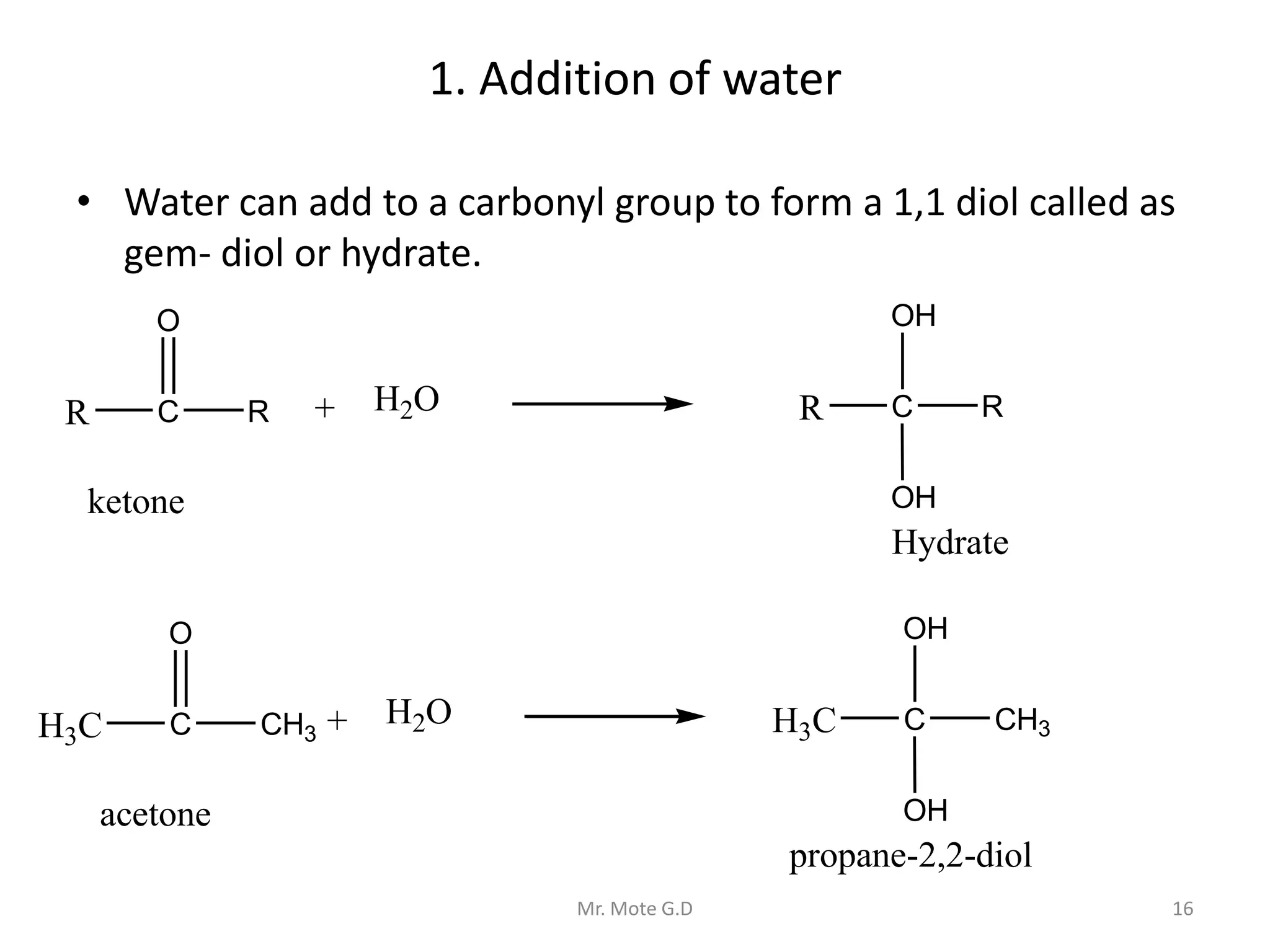
1. Addition of water
• Water can add to a carbonyl group to form a 1,1 diol called as
gem- diol or hydrate.
16Mr. Mote G.D
R C
O
R H2O+ R C
OH
R
OH
Hydrate
ketone
H3C C
O
CH3
H2O+ H3C C
OH
CH3
OHacetone
propane-2,2-diol
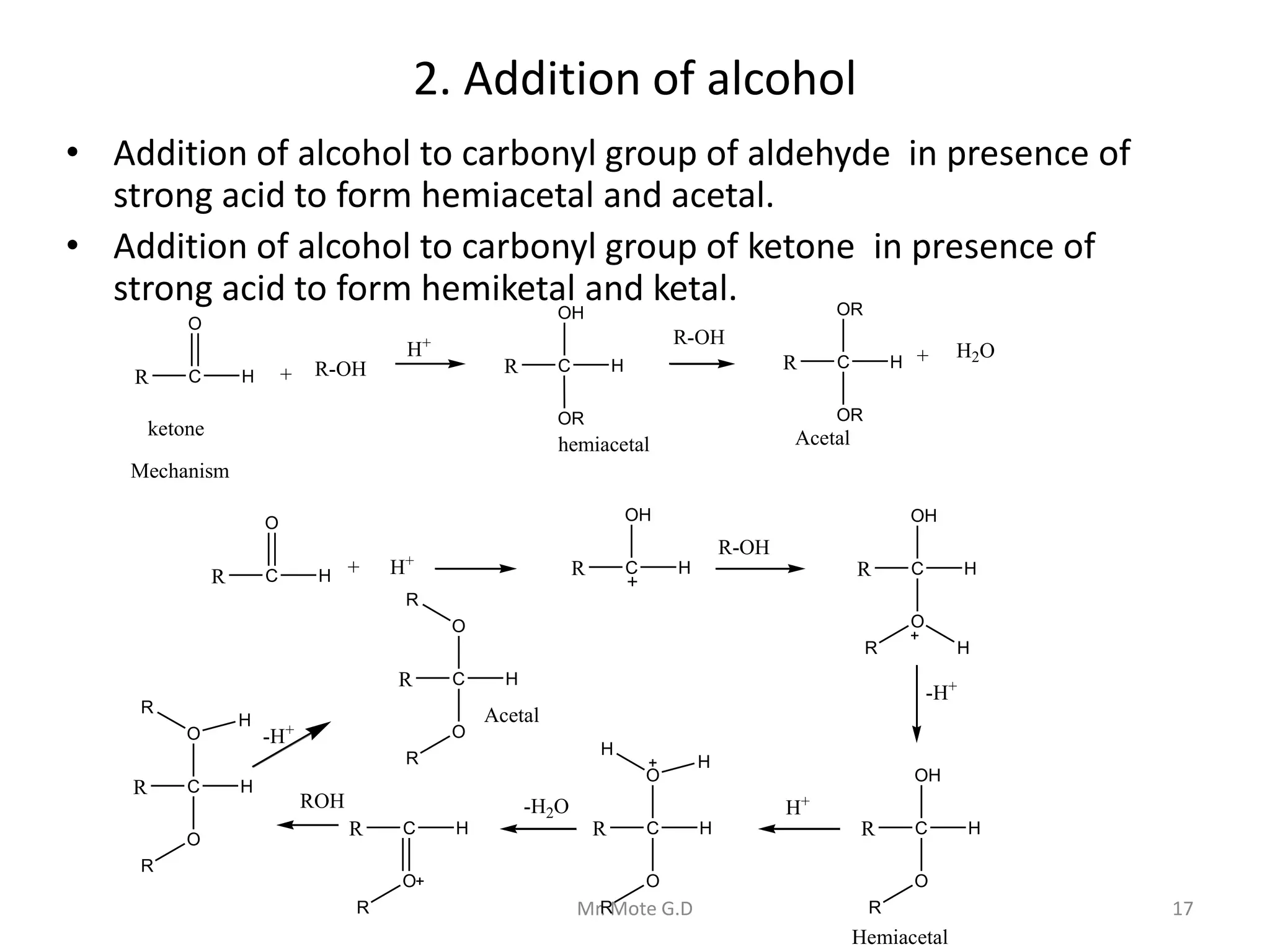
2. Addition of alcohol
• Addition of alcohol to carbonyl group of aldehyde in presence of
strong acid to form hemiacetal and acetal.
• Addition of alcohol to carbonyl group of ketone in presence of
strong acid to form hemiketal and ketal.
17Mr. Mote G.D
R C
O
H R-OH+ R C
OH
H
OR
hemiacetal
ketone
H+ R-OH
R C
OR
H
OR
+ H2O
Acetal
Mechanism
R C
O
H H+
+ R C
OH
H
R-OH
R C
OH
H
O
R H
-H+
R C
OH
H
O
R
H+
R C
O
H
O
R
H
H
-H2O
R C H
O
R
ROH
R C H
O
R
O
R
H
-H+
R C H
O
R
O
R
Acetal
Hemiacetal
3. Addition hydrogen cyanide
• Hydrogen cyanide can add to the carbonyl group of an
aldehyde or ketone to form cyanohydrins.
18Mr. Mote G.D
R C
O
H HCN+ R C
OH
H
CN
CN-
HCN + OH- CN- + H+
CN- + R C
O
H
CN
HCN
R C
OH
H
CN
+ CN-
4. Addition of Grignard reagents
• Aldehydes and ketones react with Grignard reagents to give
an addition product which can be hydrolyzed to give alcohol.
19Mr. Mote G.D
CH3 C
O
H + CH3MgI
acetaldehyde
CH3 C
O
H
MgI
CH3
H2O
CH3 C
O
H
H
CH3
propan-2-oliodo(isopropoxy)magnesium
B. Addition- elimination reactions
• Nucleophilic addition to carbonyl group followed by elination
of water to form product containing a double bond.
20Mr. Mote G.D
R C
O
R + R C
OH
R
NuH
addition
H-NuH
-H2O
R C R
Nu
5. Reaction with ammonia
• Ammonia is a nucleophile that can attack a carbonyl group of
an aldehyde or ketone and product is imine.
21Mr. Mote G.D
R C
O
R + R C
OH
R
NH2
addition
H-NH2
-H2O
R C R
NH
R C
O
R + R C
OH
R
NHR
addition
R-NH2
-H2O
R C R
NR
H3C C
O
CH3 + H3C C
OH
CH3
NHCH3
addition
CH3-NH2
-H2O
H3C C CH3
NCH3
acetone
imine
6. Reaction with hydroxy amine
• Aldehydes and ketones react with hydroxylamine to form
oximes.
22Mr. Mote G.D
+ H2N-OHC
H
OH3C
C
H
NOHH3C
acetaldehyde oxime
+ H2O
7. Reaction with hydrazine
• Aldehydes and ketones react with hydrazine (NH2-NH2) to
form hydrazones.
23Mr. Mote G.D
+ H2N-NH2C
H
OH3C
C
H
N-NH2H3C
acetaldehyde hydrazone
+ H2O
8. Reaction with phenyl hydrazine
• Aldehydes and ketones react with phenylhydrazine to form
phenyl hydrazones.
24Mr. Mote G.D
+ H2N-NHC
H
OH3C
C
H
N-NHH3C
acetaldehyde Phenylhydrazone
+ H2O
C6H5
C6H5
9. Reaction 2,4 dinitro phenyl hydrazine
• Aldehydes and ketones react with 2,4 dinitrophenyl hydrazine
to form 2,4 dinitrophenyl hydrozones.
25Mr. Mote G.D
+ H2N-NHC
H
OH3C
C
H
N-NHH3C
acetaldehyde 2,4 dinitrophenylhydrazone
+ H2O
NO2
NO2
NO2
NO2
10 . Reduction of aldehyde and ketone
• Reduction of aldehyde and ketone to form alcohol and alkane.
26Mr. Mote G.D
Catalytic hydrogentation
CH3 C
O
H + H2
Pt
CH3CH2OH
ethanol
acetaldehyde
Reduction with lithium aluminium hydride or sodium borohydride
CH3 CH2 C
O
CH3
LiAlH4
NaBH4
H3C CH2 C
H
OH
CH3
H3C CH2 C
H
OH
CH3
butan-2
-olbutan-2
-ol
Clemmensen reduction-
Carbonyl group(C=O) converted into CH2
CH3 CH2
H2
C C
O
CH3 CH3 CH2
H2
C
H2
C CH3
Zn/Hg
HCl
pentan-2
-one
pentane
11. Oxidation of aldehyde and ketone
• Aldehydes undergoes oxidation in presence of sodium
dichromate to form carboxylic acid
• Aldehydes and ketone oxidized by Fehling's or benedicts or
tollens reagent to form acid and gives red ppt
27Mr. Mote G.D
oxidation of aldehydes
CH3 C
O
H + H2
Na2Cr2O7
acetaldehyde
oxidation of ketone
CH3 CH2 C
O
CH3
HNO3
H3C CH2 C
O
OH
H2SO4
CH3 C
O
OH
acetic acid
+ CH3 C OH
acetic acid
propanoic acid2- butanone
O
12. Aldol condensation
• The reaction of an aldehyde or ketone with dilute base or acid
to form a beta-hydroxycarbonyl product.
28Mr. Mote G.D
RCH 2 C
O
H2
OH -
or H +
RCH 2 C
H
OH
CH
R
C
O
H
RCH 2 C
O
H +R' C
O
H
OH
-
or H
+
R' C
OH
H
CH
R
C
O
H
CH3CH=O
dil. NaOH
CH3CHCH2CH O
OH
acetaldehyde 3-hydroxybutanal
OH
CH2CH=O CH3CH+ O CH3CHCH2CH O
O
+ H2O
+ H2O
nucleophilic addition by enolate ion.
H3C
C
CH3
O
OH
H3C
C
CH2
O
H3C
C
CH3
O
H3C
C
O
C
H2
C
O
CH3
CH3
+ H2O
+ H2O
H3C
C
O
C
H2
C
OH
CH3
CH3
dil. NaOH
12. Crossed aldol condensation
• If you react two aldehydes or ketones together in an aldol
condensation, you will get four products. However, if one of
the reactants doesn’t have any alpha hydrogens it can be
condensed with another compound that does have alpha
hydrogens to give only one organic product in a “crossed”
aldol..
31Mr. Mote G.D
CH3CH2CH + H2C OO CH3CHCH2 OH
CH O
A crossed aldol can also be done between an aldehyde and a
ketone to yield one product. The enolate carbanion from the
ketone adds to the more reactive aldehyde.
C CH3
O
acetophenone
+ CH3CH=O
acetaldehyde
dil OH-
CCH2
O
C
H
OH
CH3
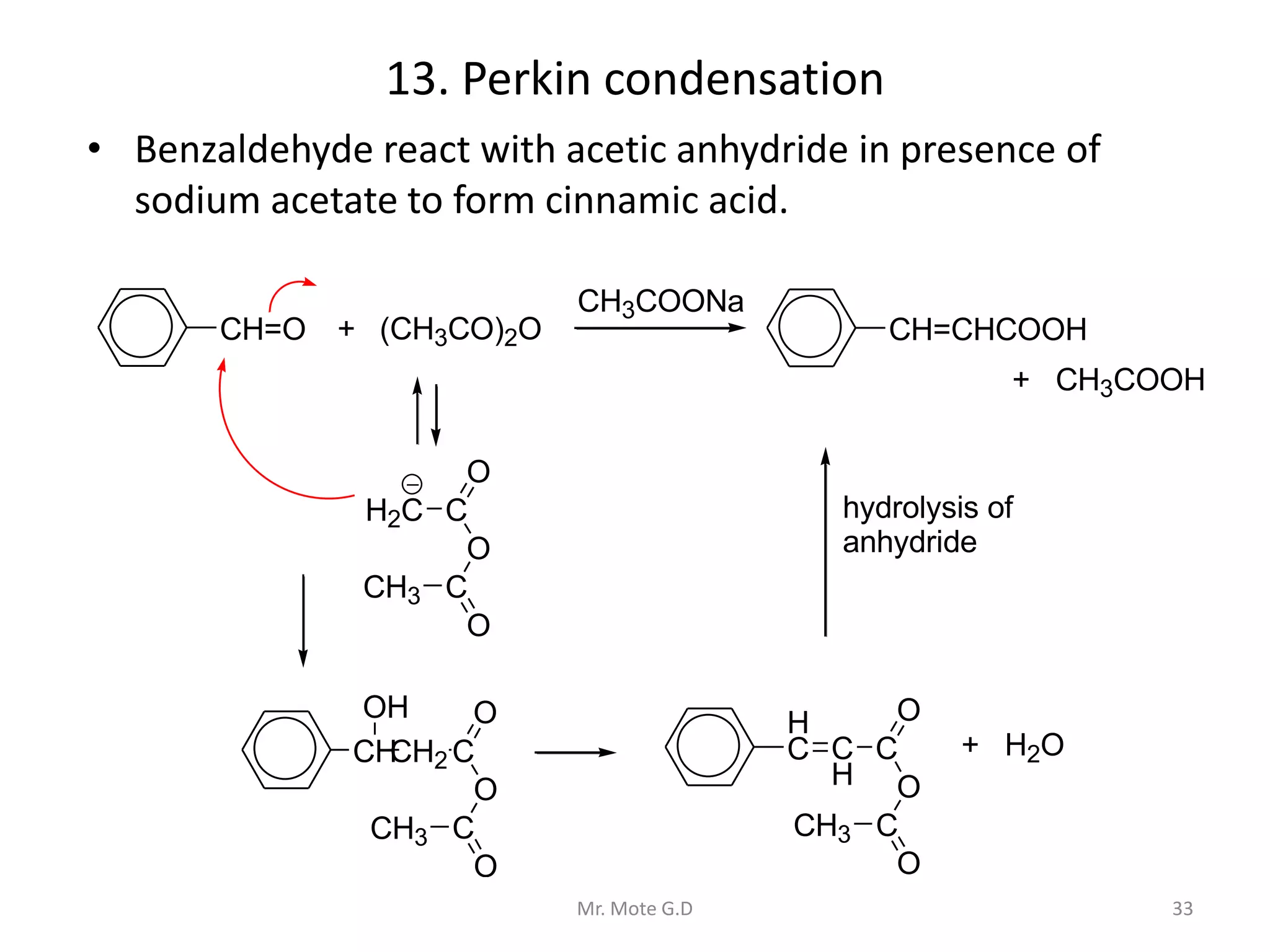
13. Perkin condensation
• Benzaldehyde react with acetic anhydride in presence of
sodium acetate to form cinnamic acid.
33Mr. Mote G.D
CH=O + (CH3CO)2O
CH3COONa
CH=CHCOOH
H2C C
O
O
CCH3
O
CH
OH
CH2 C
O
O
CCH3
O
+ H2O
H
C C
H
C
O
O
CCH3
O
hydrolysis of
anhydride
+ CH3COOH
14. Benzoin condensation
• The Benzoin Condensation is a coupling reaction between two
aldehydes that allows the preparation of α-hydroxyketones.
34Mr. Mote G.D
C
O
H
2
KCN/ C2H5OH
C
O
OH
Benzaldehyde
Benzoin
14. Benzoin condensation
35Mr. Mote G.D
15. Canizzaro reaction
• Aldehyde are treated with sodium hydroxide to form alcohol
and sodium salt of acid.
36Mr. Mote G.D
15. Mechanism of Canizzaro reaction
37Mr. Mote G.D
H C
O
H
OH-
H C
O
H
OH
H C
O
H
OH
H C
O
H H C
O
OH
H C
O
OH
CH3OH H C
O
O
H C
O
O
Na+
H C
O
ONa
CH3O-
CH3O-
15. Crossed canizzaro reaction
• When the mixture of formaldehyde and non enolizable
aldehydes are treated with NaOH to form alcohol and formic
acid is converted into formic acid called as crossed cannizaro
reaction.
• E.g. Benzaldehyde and formaldehyde is treated with strong
base to form benzyl alcohol and formic acid.
38Mr. Mote G.D
C O
H
Benzaldehyde
H C
H
O
C OH
H
Benzyl alcohol
H HCOOH
NaOH
16. Reformatsky reaction
• Alkyl halide undergo reduction with nascent hydrogen in
presence of reducing agent like Zn/HCl to form alkanes.
39Mr. Mote G.D
R C
O
R + Br CH 2 C
O
OR'
Zn benzene/1.
2.
R C
O
H + Br CH 2 C
O
OR'
Zn benzene/1.
2.
OH
C OR'
O
CCH 2
H
R
OH
C OR'
O
CCH 2R
R
H3O
+
H3O
+
Identification test for aldehyde and ketone
Sr.
No
Name of test Aldehyde Ketone
1 DNP test
DNP solution: phenyl hydrazine in 5M
hydrochloric acid .
Red or orange
ppt
Red or orange
ppt
2 Tollen’s test :dissolve *1 gm of silver nitrate in
10 ml of water] ( solution A ) and [1 gm of
NaOH in 10 ml of water] (solution B ) when
the reagent is required mix equal volumes 1 ml
from A & B in a clean test tube and
add dilute ammonia solution drop by drop until
the silver oxide is just dissolve
Red ppt on
heating of
sample
solution with
Tollen’s
reagent
Red ppt
heating of
sample
solution with
Tollen’s
reagent
3 Fehling’s reagent
Fehling Reagent A: Copper sulphate and
sulphuric acid in water.
Fehling reagent B: Sodium hydroxide and
Sodium potassium tartarate in water
Red ppt with
Fehling
reagent A and
B by heating
Red ppt with
Fehling
reagent A and
B by heating
4 Sodium nitroprusside no red color
with sodium
nitropruside
Red color
with sodium
nitropruside
Sr.
No
Name of compound Uses structure
1. Formaldehyde Strong smelling gas, Building construction materials, in automobile
for light material and durable compounds
2. Paraldehyde Anticonvulsant, alcoholism, hypnotics, sedatives
3. Acetone Solvent, cleaning tool, polyester resins, volatile components for
paints, varnishes
4. Benzaldehyde Flavoring agents, Preparation cinnamic acid, Benzoin for throat
infection, cinnamaldehyde, mandelic acid
5. Chloral hydrate Sedative, hypnotics,
6. Hexamine In preparations of phenolic resin, used as binders, e.g. in brake and
clutch linings, abrasive products, non-woven textiles, formed parts
produced by moulding processes, and fireproof materials
7. cinnamaldehyde It is also used in some perfumes of natural, sweet, flavouring
in chewing gum, ice cream, candy and beveragesinducer of
apoptosis, protect mice against obesity and hyperglycemia
8. Vanilin food flavouring, It is also used in cleaning products, tobacco, and
toothpaste, Vanillin is also used in perfumes, to mask unpleasant
odors, or tastes in medicine
H C
O
H
formaldehyde
O O
O
CH3
CH3H3C
H3C C
O
CH3
C
O
H
CCl
Cl
C
H
Cl
OH
OH

Aldehyde and ketone

  • 1.
    Aldehyde and ketone Mr.Mote G.D. ADCBP, Ashta Dist: Sangli Maharashtra
  • 2.
    Method of preparationof aldehyde and ketone 1. Oxidation of alcohol 2. Catalytic dehydrogenation of alcohol 3. Oxidation of alkene 4. Hydration of alkynes 5. Hydrolysis of gem- dihalides 6. Reduction of acid chlorides 7. From nitriles using Grignard reagents 8. Oxo process 9. Pyrolysis of calcium salt of acid 10. Catalytic decomposition of acids. 2Mr. Mote G.D
  • 3.
    1. Oxidation ofalcohol • Alkyl halide undergo reduction with nascent hydrogen in presence of reducing agent like Zn/HCl to form alkanes. 3Mr. Mote G.D CH3 H C H OH O K2Cr2O7 CH3 C H O H2O ethanol acetaldehyde
  • 4.
    2. Catalytic dehydrogenationof alcohol • Alkyl halide undergo reduction with nascent hydrogen in presence of reducing agent like Zn/HCl to form alkanes. 4Mr. Mote G.D CH3 H C H OH Cu 300°C CH3 C H O H2 ethanol acetaldehyde
  • 5.
    3. Oxidation ofalkene • Alkyl halide undergo reduction with nascent hydrogen in presence of reducing agent like Zn/HCl to form alkanes. 5Mr. Mote G.D C H C H CH3 O3 Zn/ H2O CH3 C H O 2 - pentene acetaldehyde H2 CH3C ZnO H3C H2 C C O H Propionaldehyde
  • 6.
    4. Hydration ofalkynes. • Alkyl halide undergo reduction with nascent hydrogen in presence of reducing agent like Zn/HCl to form alkanes. 6Mr. Mote G.D CH CH H OH HC C H H OH 2HC C H H O ethyne ethanal
  • 7.
    5. Hydrolysis ofgem dihalides • Alkyl halide undergo reduction with nascent hydrogen in presence of reducing agent like Zn/HCl to form alkanes. 7Mr. Mote G.D H3C CH H OH H2C C H H OH H2C C H H O ethanal Cl Cl OH -H2O 1,1-dichloroethane 2
  • 8.
    6. Reduction ofacid chlorides • Aldehydes can be prepared by the hydrogenation of acid chlorides in the presence of palladium supported over barium sulphate. 8Mr. Mote G.D R C O Cl H2 R C O H HCl H3C C O Cl H2 H3C C O H HCl acetyl chloride acetaldehyde Pd/BaSO4 Pd/BaSO4
  • 9.
    7. From nitrilesusing Grignard reagents. • A Grignard reagent attacks to nitrile to give the magnesium salt of an imines. • Acid hydrolysis of the imines leads to ketone 9Mr. Mote G.D CH3 CH2 C N CH3MgCl CH3 CH2 C N CH3 MgCl H+ CH3 CH2 C N CH3 H H2O CH3 CH2 C O CH3 NH3 butan-2-one propiononitrile methylmagnesium chloride butan-2-imine
  • 10.
    8. Oxo process. •Alkene react with hydrogen and carbon dioxide to form aldehyde 10Mr. Mote G.D CH3 C H CH2 CH3 H C CH2 C CO2 H2+ O H Hprop-1-ene butyraldehyde
  • 11.
    9. Pyrolysis ofcalcium salt of acid. • Pyrolysis of calcium salt of dicarboxylic acid to give ketone 11Mr. Mote G.D R C O O R C O O Ca R C O R CaCO3  H3C C O O H3C C O O Ca H3C C O CH3 CaCO3  Calcium salt of dicarboxylic acid acetone
  • 12.
    10. Catalytic decomposition. •When carboxylic acid treated with manganese oxide at 300°C to form ketone. 12Mr. Mote G.D R C O OH R C O OH R C O R CO2 MnO H3C C O OH H3C C O OH H3C C O CH3 CO2 MnO acetone H2O 300°C H2O acetic acid 300°C
  • 13.
    Electromeric effect • Thecomplete transfer of shared pairs of π electrons of a double bond or multiple bond to one of the bonded atoms under the influence of the attacking reagent is known as electromeric effect. • Since the effect involves complete transference of electrons, it lead to the development of full positive charge (+) and negative charges (-) within the molecule. Electromeric effect is a temporary effect and operates in presence of attacking reagent. • If a proton (H+) adds to C=C bond, the π bond will break and the electron pair will be transferred completely to one of the C atoms. • When the displacement of an electron pair is away from the atom or group, it is called + E effect. • When the displacement of an electron pair is towards the atom or group, it is called + E effect 13Mr. Mote G.D C O- HH + + C O- HH CN H++ HC OH H CN- C O- HH + + E Effect - E Effect
  • 14.
    Reactions of aldehydeand ketones A) Nucleophilic addition reaction 1. Addition of water 2. Addition of alcohol 3. Addition of hydrogen cyanide B) Addition- elimination reaction 1. Reaction with ammonia 2. Reaction with hydroxyl amine 3. Reaction with hydrazine 4. Reaction with phenyl hydrazine 5. Reaction with 2,4 dinitrophenyl hydrazine C) Reduction of aldehyde and ketone D) Oxidation of aldehyde and ketone E) Reaction involving alpha hydrogen 1. Aldol condensation 2. Perkin condensation 3. Benzoin condensation 4. Canizzaro reaction 14Mr. Mote G.D
  • 15.
    A. Nucleophilic additionreaction • Positively charged carbon is readily attacked by electron rich nucleophile and negatively charged oxygen is attacked by electrophile. 15Mr. Mote G.D C O- + + Nu C O- Nu H+ C OH Nu Addition product Base catalysed reaction Nu-H + B- Nu- + BH Acid catlysed addition HC O H H++ HC OH H HC OH H Nu Nu- strongweak
  • 16.
    1. Addition ofwater • Water can add to a carbonyl group to form a 1,1 diol called as gem- diol or hydrate. 16Mr. Mote G.D R C O R H2O+ R C OH R OH Hydrate ketone H3C C O CH3 H2O+ H3C C OH CH3 OHacetone propane-2,2-diol
  • 17.
    2. Addition ofalcohol • Addition of alcohol to carbonyl group of aldehyde in presence of strong acid to form hemiacetal and acetal. • Addition of alcohol to carbonyl group of ketone in presence of strong acid to form hemiketal and ketal. 17Mr. Mote G.D R C O H R-OH+ R C OH H OR hemiacetal ketone H+ R-OH R C OR H OR + H2O Acetal Mechanism R C O H H+ + R C OH H R-OH R C OH H O R H -H+ R C OH H O R H+ R C O H O R H H -H2O R C H O R ROH R C H O R O R H -H+ R C H O R O R Acetal Hemiacetal
  • 18.
    3. Addition hydrogencyanide • Hydrogen cyanide can add to the carbonyl group of an aldehyde or ketone to form cyanohydrins. 18Mr. Mote G.D R C O H HCN+ R C OH H CN CN- HCN + OH- CN- + H+ CN- + R C O H CN HCN R C OH H CN + CN-
  • 19.
    4. Addition ofGrignard reagents • Aldehydes and ketones react with Grignard reagents to give an addition product which can be hydrolyzed to give alcohol. 19Mr. Mote G.D CH3 C O H + CH3MgI acetaldehyde CH3 C O H MgI CH3 H2O CH3 C O H H CH3 propan-2-oliodo(isopropoxy)magnesium
  • 20.
    B. Addition- eliminationreactions • Nucleophilic addition to carbonyl group followed by elination of water to form product containing a double bond. 20Mr. Mote G.D R C O R + R C OH R NuH addition H-NuH -H2O R C R Nu
  • 21.
    5. Reaction withammonia • Ammonia is a nucleophile that can attack a carbonyl group of an aldehyde or ketone and product is imine. 21Mr. Mote G.D R C O R + R C OH R NH2 addition H-NH2 -H2O R C R NH R C O R + R C OH R NHR addition R-NH2 -H2O R C R NR H3C C O CH3 + H3C C OH CH3 NHCH3 addition CH3-NH2 -H2O H3C C CH3 NCH3 acetone imine
  • 22.
    6. Reaction withhydroxy amine • Aldehydes and ketones react with hydroxylamine to form oximes. 22Mr. Mote G.D + H2N-OHC H OH3C C H NOHH3C acetaldehyde oxime + H2O
  • 23.
    7. Reaction withhydrazine • Aldehydes and ketones react with hydrazine (NH2-NH2) to form hydrazones. 23Mr. Mote G.D + H2N-NH2C H OH3C C H N-NH2H3C acetaldehyde hydrazone + H2O
  • 24.
    8. Reaction withphenyl hydrazine • Aldehydes and ketones react with phenylhydrazine to form phenyl hydrazones. 24Mr. Mote G.D + H2N-NHC H OH3C C H N-NHH3C acetaldehyde Phenylhydrazone + H2O C6H5 C6H5
  • 25.
    9. Reaction 2,4dinitro phenyl hydrazine • Aldehydes and ketones react with 2,4 dinitrophenyl hydrazine to form 2,4 dinitrophenyl hydrozones. 25Mr. Mote G.D + H2N-NHC H OH3C C H N-NHH3C acetaldehyde 2,4 dinitrophenylhydrazone + H2O NO2 NO2 NO2 NO2
  • 26.
    10 . Reductionof aldehyde and ketone • Reduction of aldehyde and ketone to form alcohol and alkane. 26Mr. Mote G.D Catalytic hydrogentation CH3 C O H + H2 Pt CH3CH2OH ethanol acetaldehyde Reduction with lithium aluminium hydride or sodium borohydride CH3 CH2 C O CH3 LiAlH4 NaBH4 H3C CH2 C H OH CH3 H3C CH2 C H OH CH3 butan-2 -olbutan-2 -ol Clemmensen reduction- Carbonyl group(C=O) converted into CH2 CH3 CH2 H2 C C O CH3 CH3 CH2 H2 C H2 C CH3 Zn/Hg HCl pentan-2 -one pentane
  • 27.
    11. Oxidation ofaldehyde and ketone • Aldehydes undergoes oxidation in presence of sodium dichromate to form carboxylic acid • Aldehydes and ketone oxidized by Fehling's or benedicts or tollens reagent to form acid and gives red ppt 27Mr. Mote G.D oxidation of aldehydes CH3 C O H + H2 Na2Cr2O7 acetaldehyde oxidation of ketone CH3 CH2 C O CH3 HNO3 H3C CH2 C O OH H2SO4 CH3 C O OH acetic acid + CH3 C OH acetic acid propanoic acid2- butanone O
  • 28.
    12. Aldol condensation •The reaction of an aldehyde or ketone with dilute base or acid to form a beta-hydroxycarbonyl product. 28Mr. Mote G.D RCH 2 C O H2 OH - or H + RCH 2 C H OH CH R C O H RCH 2 C O H +R' C O H OH - or H + R' C OH H CH R C O H
  • 29.
    CH3CH=O dil. NaOH CH3CHCH2CH O OH acetaldehyde3-hydroxybutanal OH CH2CH=O CH3CH+ O CH3CHCH2CH O O + H2O + H2O nucleophilic addition by enolate ion.
  • 30.
  • 31.
    12. Crossed aldolcondensation • If you react two aldehydes or ketones together in an aldol condensation, you will get four products. However, if one of the reactants doesn’t have any alpha hydrogens it can be condensed with another compound that does have alpha hydrogens to give only one organic product in a “crossed” aldol.. 31Mr. Mote G.D CH3CH2CH + H2C OO CH3CHCH2 OH CH O
  • 32.
    A crossed aldolcan also be done between an aldehyde and a ketone to yield one product. The enolate carbanion from the ketone adds to the more reactive aldehyde. C CH3 O acetophenone + CH3CH=O acetaldehyde dil OH- CCH2 O C H OH CH3
  • 33.
    13. Perkin condensation •Benzaldehyde react with acetic anhydride in presence of sodium acetate to form cinnamic acid. 33Mr. Mote G.D CH=O + (CH3CO)2O CH3COONa CH=CHCOOH H2C C O O CCH3 O CH OH CH2 C O O CCH3 O + H2O H C C H C O O CCH3 O hydrolysis of anhydride + CH3COOH
  • 34.
    14. Benzoin condensation •The Benzoin Condensation is a coupling reaction between two aldehydes that allows the preparation of α-hydroxyketones. 34Mr. Mote G.D C O H 2 KCN/ C2H5OH C O OH Benzaldehyde Benzoin
  • 35.
  • 36.
    15. Canizzaro reaction •Aldehyde are treated with sodium hydroxide to form alcohol and sodium salt of acid. 36Mr. Mote G.D
  • 37.
    15. Mechanism ofCanizzaro reaction 37Mr. Mote G.D H C O H OH- H C O H OH H C O H OH H C O H H C O OH H C O OH CH3OH H C O O H C O O Na+ H C O ONa CH3O- CH3O-
  • 38.
    15. Crossed canizzaroreaction • When the mixture of formaldehyde and non enolizable aldehydes are treated with NaOH to form alcohol and formic acid is converted into formic acid called as crossed cannizaro reaction. • E.g. Benzaldehyde and formaldehyde is treated with strong base to form benzyl alcohol and formic acid. 38Mr. Mote G.D C O H Benzaldehyde H C H O C OH H Benzyl alcohol H HCOOH NaOH
  • 39.
    16. Reformatsky reaction •Alkyl halide undergo reduction with nascent hydrogen in presence of reducing agent like Zn/HCl to form alkanes. 39Mr. Mote G.D R C O R + Br CH 2 C O OR' Zn benzene/1. 2. R C O H + Br CH 2 C O OR' Zn benzene/1. 2. OH C OR' O CCH 2 H R OH C OR' O CCH 2R R H3O + H3O +
  • 40.
    Identification test foraldehyde and ketone Sr. No Name of test Aldehyde Ketone 1 DNP test DNP solution: phenyl hydrazine in 5M hydrochloric acid . Red or orange ppt Red or orange ppt 2 Tollen’s test :dissolve *1 gm of silver nitrate in 10 ml of water] ( solution A ) and [1 gm of NaOH in 10 ml of water] (solution B ) when the reagent is required mix equal volumes 1 ml from A & B in a clean test tube and add dilute ammonia solution drop by drop until the silver oxide is just dissolve Red ppt on heating of sample solution with Tollen’s reagent Red ppt heating of sample solution with Tollen’s reagent 3 Fehling’s reagent Fehling Reagent A: Copper sulphate and sulphuric acid in water. Fehling reagent B: Sodium hydroxide and Sodium potassium tartarate in water Red ppt with Fehling reagent A and B by heating Red ppt with Fehling reagent A and B by heating 4 Sodium nitroprusside no red color with sodium nitropruside Red color with sodium nitropruside
  • 41.
    Sr. No Name of compoundUses structure 1. Formaldehyde Strong smelling gas, Building construction materials, in automobile for light material and durable compounds 2. Paraldehyde Anticonvulsant, alcoholism, hypnotics, sedatives 3. Acetone Solvent, cleaning tool, polyester resins, volatile components for paints, varnishes 4. Benzaldehyde Flavoring agents, Preparation cinnamic acid, Benzoin for throat infection, cinnamaldehyde, mandelic acid 5. Chloral hydrate Sedative, hypnotics, 6. Hexamine In preparations of phenolic resin, used as binders, e.g. in brake and clutch linings, abrasive products, non-woven textiles, formed parts produced by moulding processes, and fireproof materials 7. cinnamaldehyde It is also used in some perfumes of natural, sweet, flavouring in chewing gum, ice cream, candy and beveragesinducer of apoptosis, protect mice against obesity and hyperglycemia 8. Vanilin food flavouring, It is also used in cleaning products, tobacco, and toothpaste, Vanillin is also used in perfumes, to mask unpleasant odors, or tastes in medicine H C O H formaldehyde O O O CH3 CH3H3C H3C C O CH3 C O H CCl Cl C H Cl OH OH