Critical Frequency
Definition:-
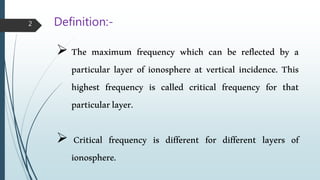
 The maximum frequency which can be reflected by a
particular layer of ionosphere at vertical incidence. This
highest frequency is called critical frequency for that
particularlayer.
 Critical frequency is different for different layers of
ionosphere.
2
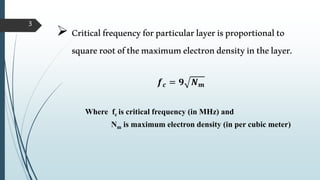
 Criticalfrequencyforparticularlayerisproportionalto
squarerootofthemaximumelectrondensityinthelayer.
Where fc is critical frequency (in MHz) and
Nm is maximum electron density (in per cubic meter)
𝒇 𝒄 = 𝟗 𝑵 𝒎
3
4
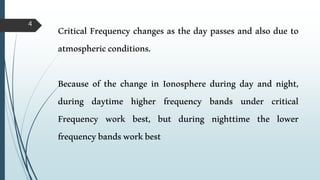
Critical Frequency changes as the day passes and also due to
atmosphericconditions.
Because of the change in Ionosphere during day and night,
during daytime higher frequency bands under critical
Frequency work best, but during nighttime the lower
frequencybandsworkbest
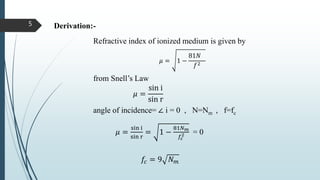
Derivation:-
from Snell’s Law
𝜇 =
sin i
sin r
angle of incidence= ∠ i = 0 , N=Nm , f=fc
𝜇 =
sin i
sin r
= 1 −
81𝑁 𝑚
𝑓𝑐
2 = 0
𝑓𝑐 = 9 𝑁 𝑚
Refractive index of ionized medium is given by
𝜇 = 1 −
81𝑁
𝑓2
5
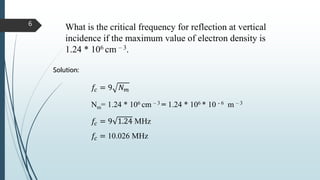
What is the critical frequency for reflection at vertical
incidence if the maximum value of electron density is
1.24 * 106 cm – 3.
Solution:
𝑓𝑐 = 9 𝑁 𝑚
Nm= 1.24 * 106 cm – 3 = 1.24 * 106 * 10 - 6 m – 3
𝑓𝑐 = 9 1.24 MHz
𝑓𝑐 = 10.026 MHz
6
7
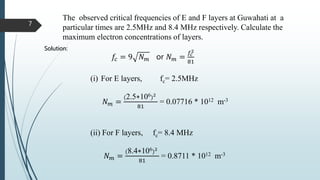
The observed critical frequencies of E and F layers at Guwahati at a
particular times are 2.5MHz and 8.4 MHz respectively. Calculate the
maximum electron concentrations of layers.
Solution:
𝑓𝑐 = 9 𝑁 𝑚 or 𝑁 𝑚 =
𝑓𝑐
2
81
(i) For E layers, fc= 2.5MHz
𝑁 𝑚 =
(2.5∗106)2
81
= 0.07716 * 1012 m-3
(ii) For F layers, fc= 8.4 MHz
𝑁 𝑚 =
(8.4∗106)2
81
= 0.8711 * 1012 m-3
Reference:
1. K.D. Prasad, Antenna & wave propagation,
Satya Prakashan, 3/e (2010-11)
8
Thank YOU
9

Critical frequency

  • 1.
  • 2.
    Definition:-  The maximumfrequency which can be reflected by a particular layer of ionosphere at vertical incidence. This highest frequency is called critical frequency for that particularlayer.  Critical frequency is different for different layers of ionosphere. 2
  • 3.
     Criticalfrequencyforparticularlayerisproportionalto squarerootofthemaximumelectrondensityinthelayer. Where fcis critical frequency (in MHz) and Nm is maximum electron density (in per cubic meter) 𝒇 𝒄 = 𝟗 𝑵 𝒎 3
  • 4.
    4 Critical Frequency changesas the day passes and also due to atmosphericconditions. Because of the change in Ionosphere during day and night, during daytime higher frequency bands under critical Frequency work best, but during nighttime the lower frequencybandsworkbest
  • 5.
    Derivation:- from Snell’s Law 𝜇= sin i sin r angle of incidence= ∠ i = 0 , N=Nm , f=fc 𝜇 = sin i sin r = 1 − 81𝑁 𝑚 𝑓𝑐 2 = 0 𝑓𝑐 = 9 𝑁 𝑚 Refractive index of ionized medium is given by 𝜇 = 1 − 81𝑁 𝑓2 5
  • 6.
    What is thecritical frequency for reflection at vertical incidence if the maximum value of electron density is 1.24 * 106 cm – 3. Solution: 𝑓𝑐 = 9 𝑁 𝑚 Nm= 1.24 * 106 cm – 3 = 1.24 * 106 * 10 - 6 m – 3 𝑓𝑐 = 9 1.24 MHz 𝑓𝑐 = 10.026 MHz 6
  • 7.
    7 The observed criticalfrequencies of E and F layers at Guwahati at a particular times are 2.5MHz and 8.4 MHz respectively. Calculate the maximum electron concentrations of layers. Solution: 𝑓𝑐 = 9 𝑁 𝑚 or 𝑁 𝑚 = 𝑓𝑐 2 81 (i) For E layers, fc= 2.5MHz 𝑁 𝑚 = (2.5∗106)2 81 = 0.07716 * 1012 m-3 (ii) For F layers, fc= 8.4 MHz 𝑁 𝑚 = (8.4∗106)2 81 = 0.8711 * 1012 m-3
  • 8.
    Reference: 1. K.D. Prasad,Antenna & wave propagation, Satya Prakashan, 3/e (2010-11) 8
  • 9.