Microwave Filter Design
By
Professor Syed Idris Syed Hassan
Sch of Elect. & Electron Eng
Engineering Campus USM
Nibong Tebal 14300
SPS Penang
Contents
2
1. Composite filter
2. LC ladder filter
3. Microwave filter
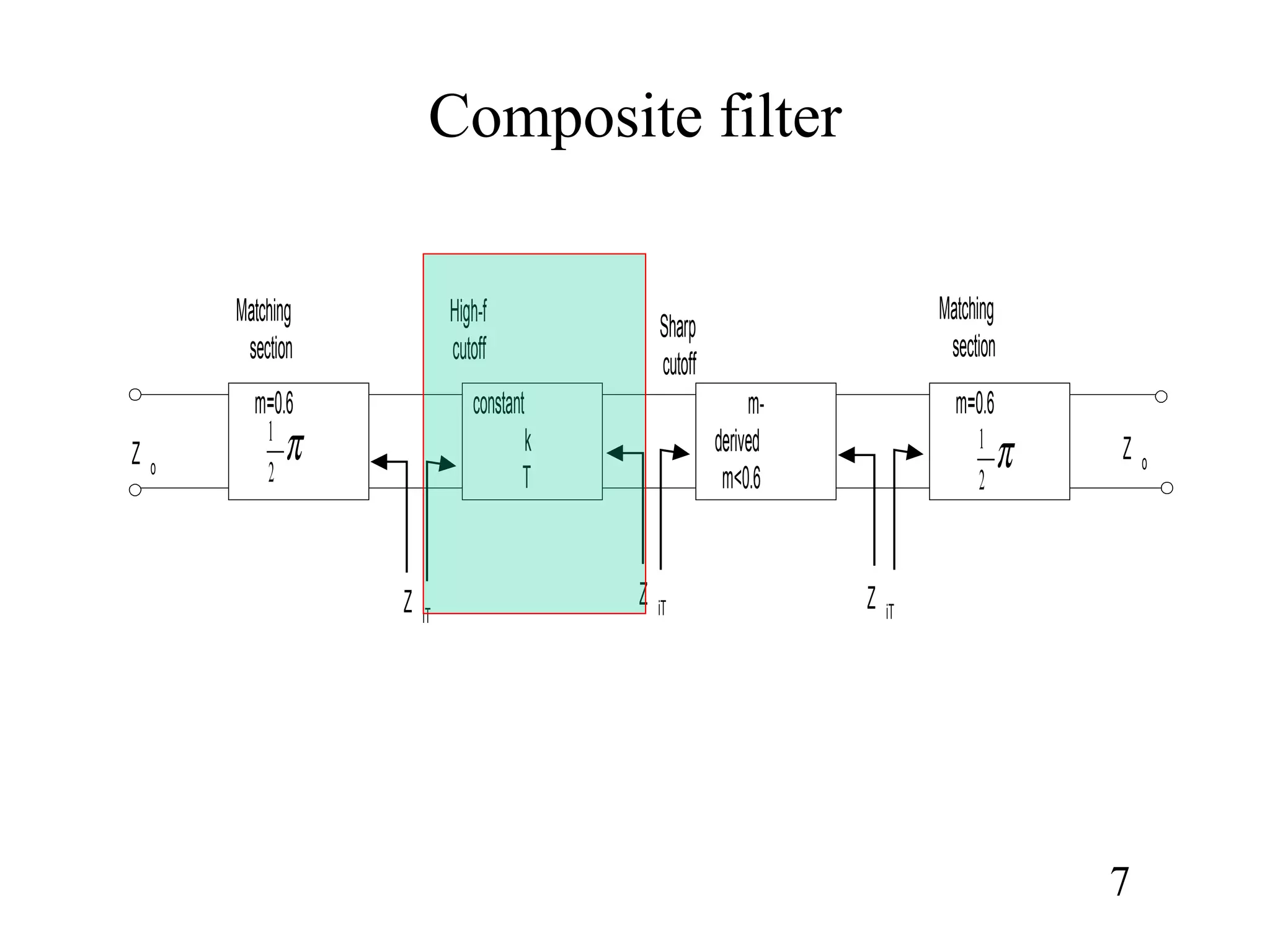
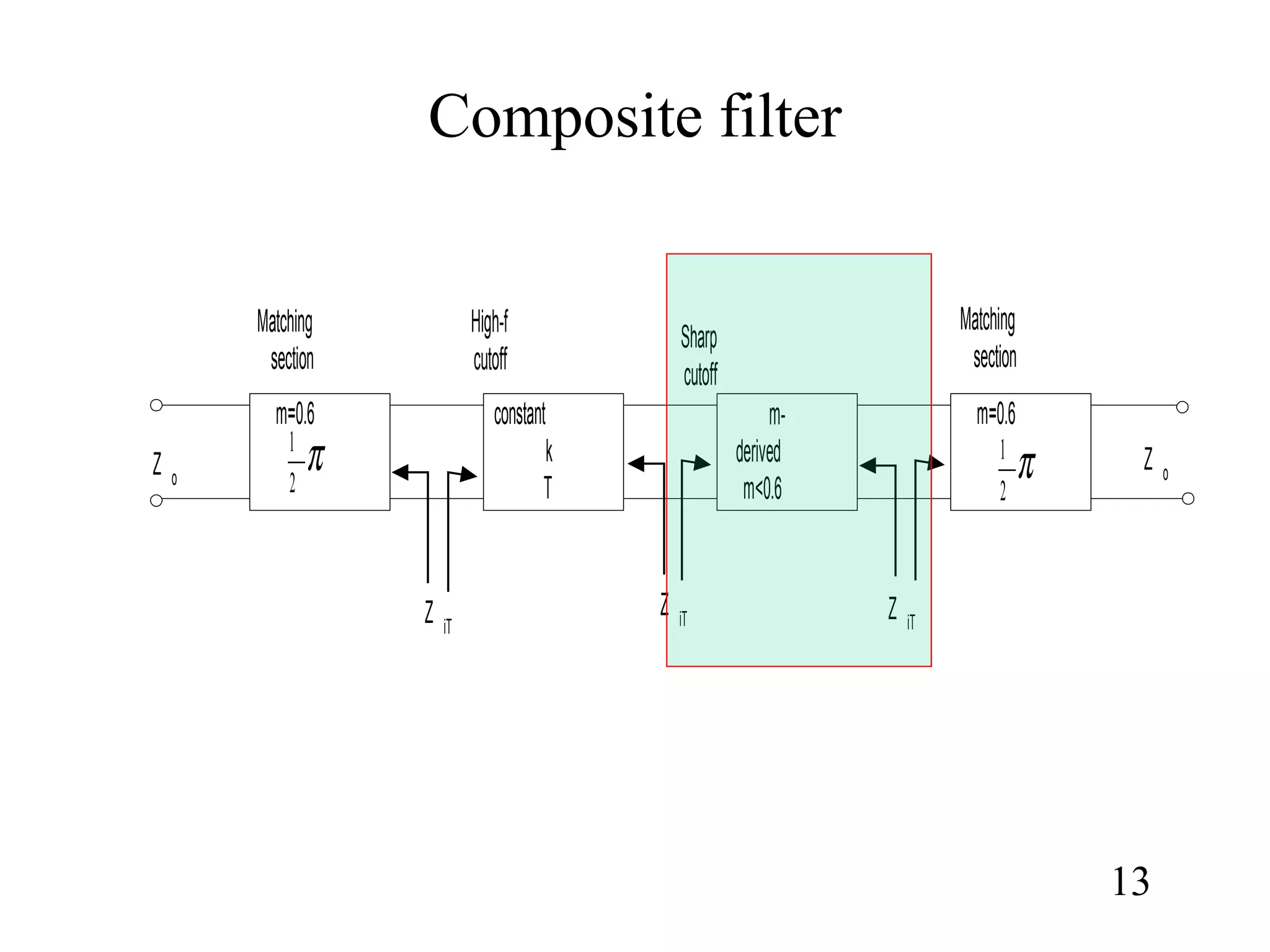
Composite filter
3
m=0.6 m=0.6m-
derived
m<0.6
constant
k
T
π2
1
π2
1
Matching
section
Matching
section
High-f
cutoff
Sharp
cutoff
Z iT
Z iT Z iT
Z o
Z o
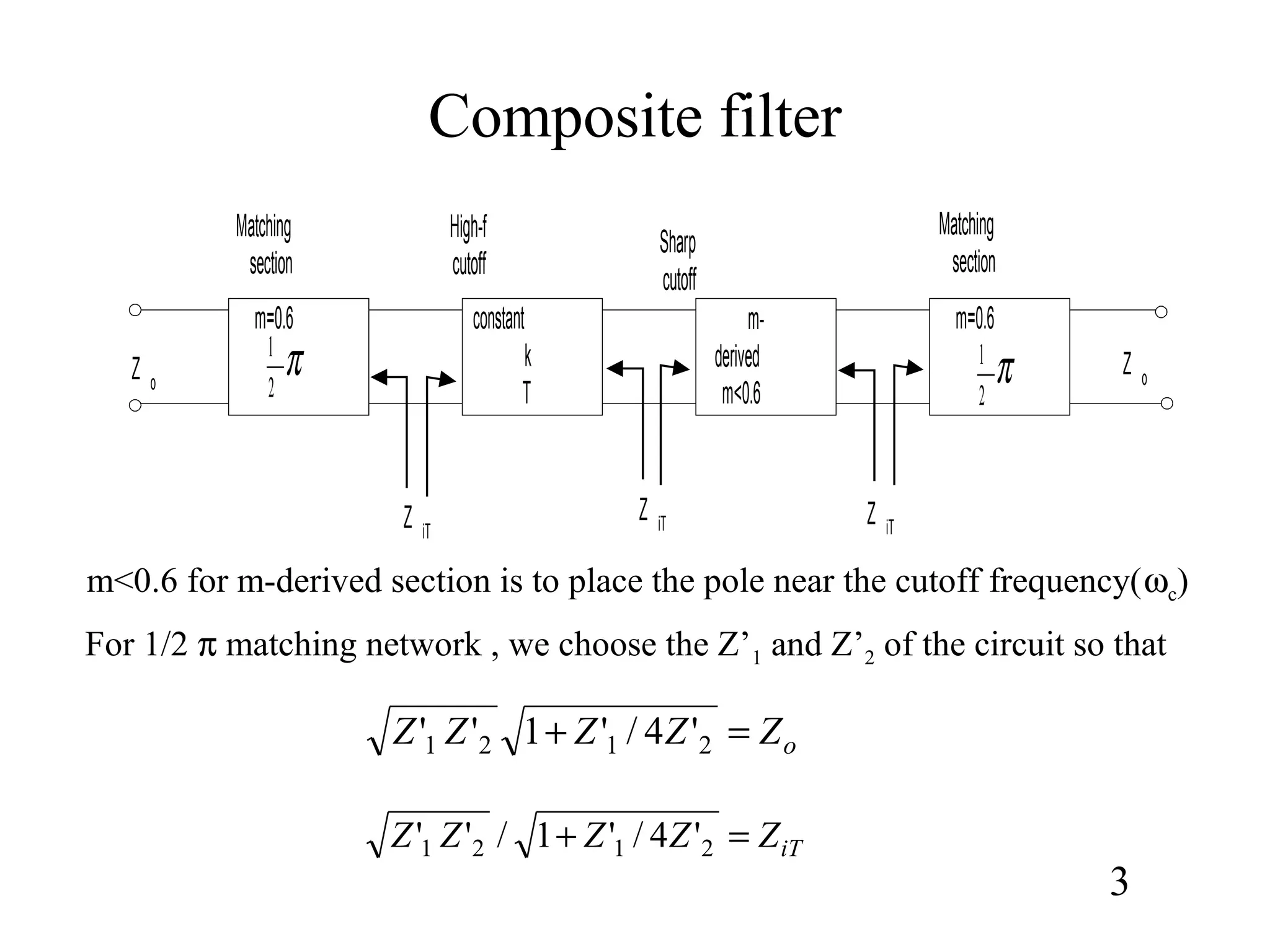
m<0.6 for m-derived section is to place the pole near the cutoff frequency(ωc)
oZZZZZ =+ 2121 '4/'1''
iTZZZZZ =+ 2121 '4/'1/''
For 1/2 π matching network , we choose the Z’1 and Z’2 of the circuit so that
Image method






DC
BA
Z i1 Z i2
I 1 I 2
+
V 1
-
+
V 2
-
Z in1 Z in2
221
221
DICVI
BIAVV
+=
+=
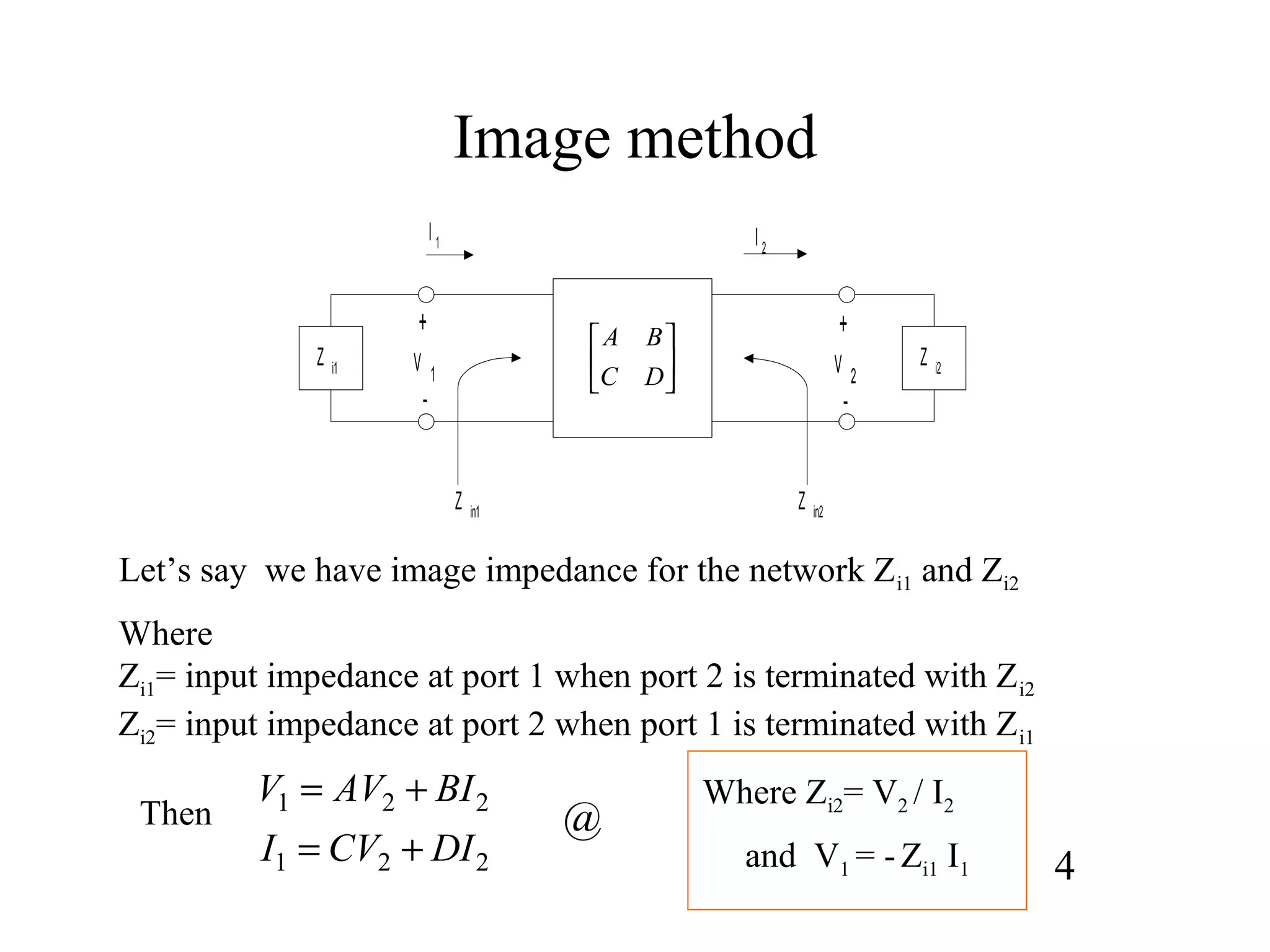
Let’s say we have image impedance for the network Zi1 and Zi2
Where
Zi1= input impedance at port 1 when port 2 is terminated with Zi2
Zi2= input impedance at port 2 when port 1 is terminated with Zi1
Then
4
@
Where Zi2= V2 / I2
and V1 = -Zi1 I1
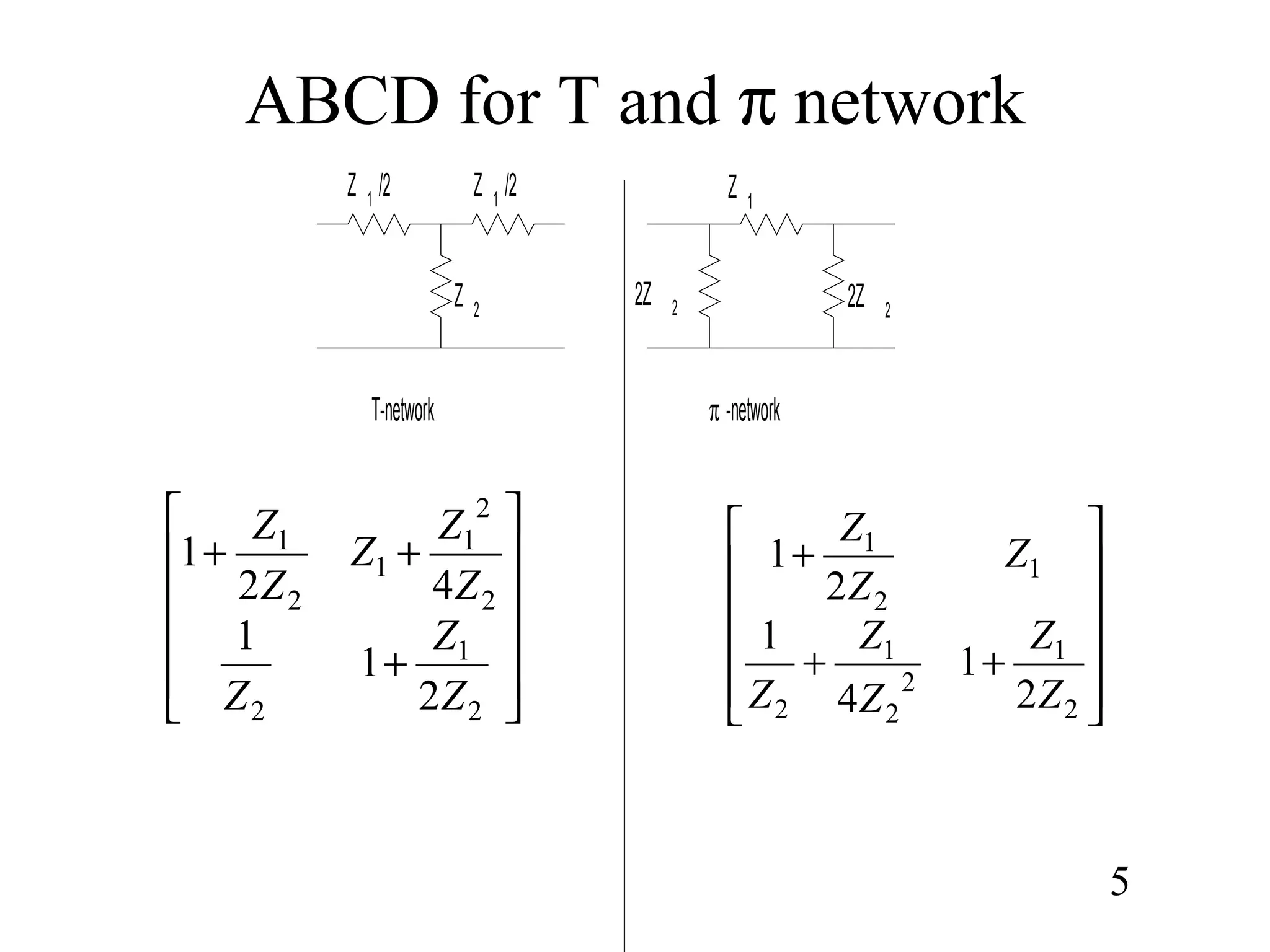
ABCD for T and π network
5
Z 1 /2 Z 1 /2
Z 2
Z 1
2Z 2 2Z 2
T-network π -network












++
+
2
1
2
2
1
2
1
2
1
2
1
4
1
2
1
Z
Z
Z
Z
Z
Z
Z
Z












+
++
2
1
2
2
2
1
1
2
1
2
1
1
42
1
Z
Z
Z
Z
Z
Z
Z
Z
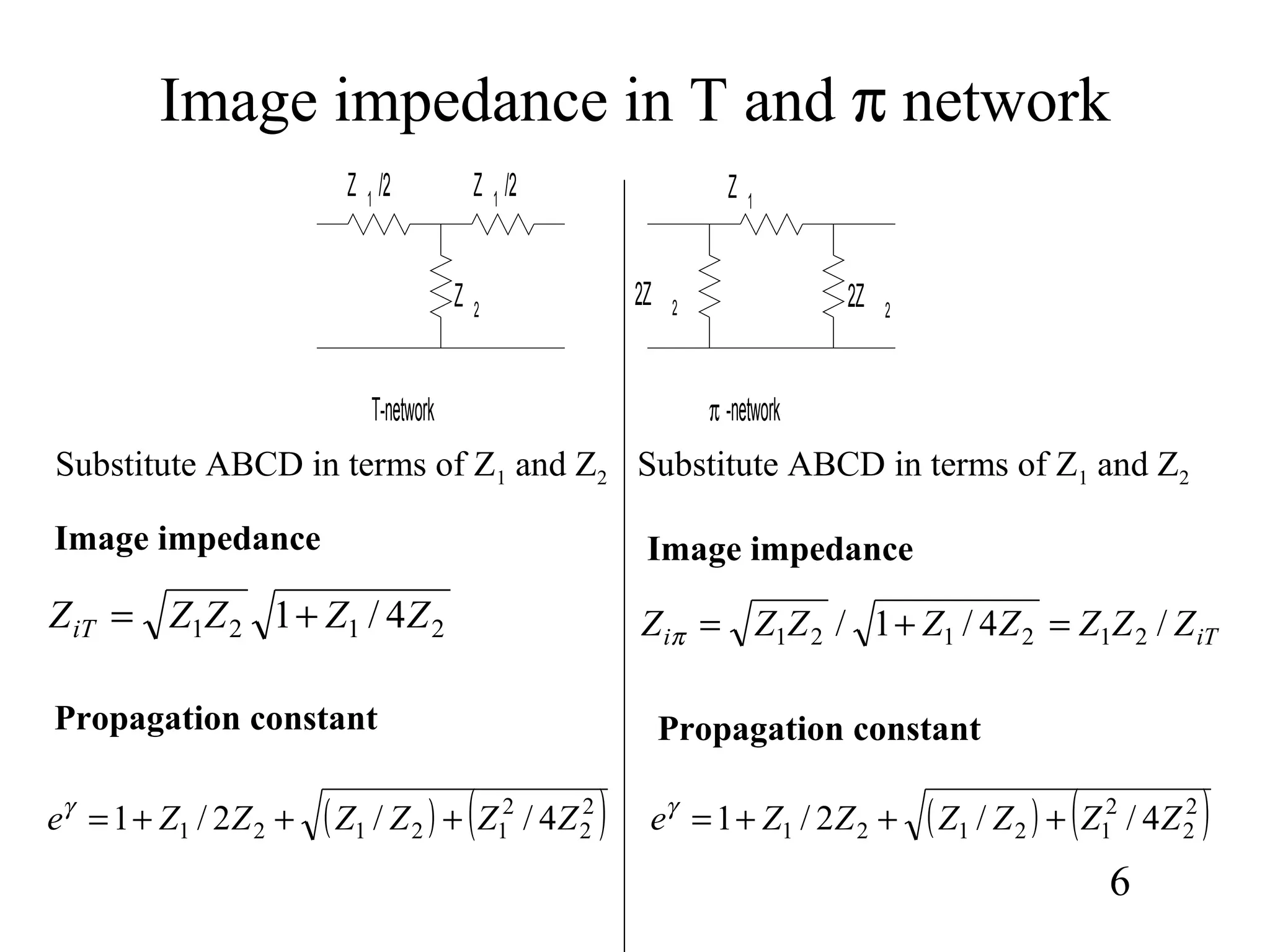
Image impedance in T and π network
6
Z 1 /2 Z 1 /2
Z 2
Z 1
2Z 2 2Z 2
T-network π -network
2121 4/1 ZZZZZiT +=
( ) ( )2
2
2
12121 4//2/1 ZZZZZZe +++=γ
iTi ZZZZZZZZ /4/1/ 212121 =+=π
( ) ( )2
2
2
12121 4//2/1 ZZZZZZe +++=γ
Image impedance Image impedance
Propagation constant Propagation constant
Substitute ABCD in terms of Z1 and Z2 Substitute ABCD in terms of Z1 and Z2
Composite filter
7
m=0.6 m=0.6m-
derived
m<0.6
constant
k
T
π2
1
π2
1
Matching
section
Matching
section
High-f
cutoff
Sharp
cutoff
Z iT
Z iT Z iT
Z o
Z o
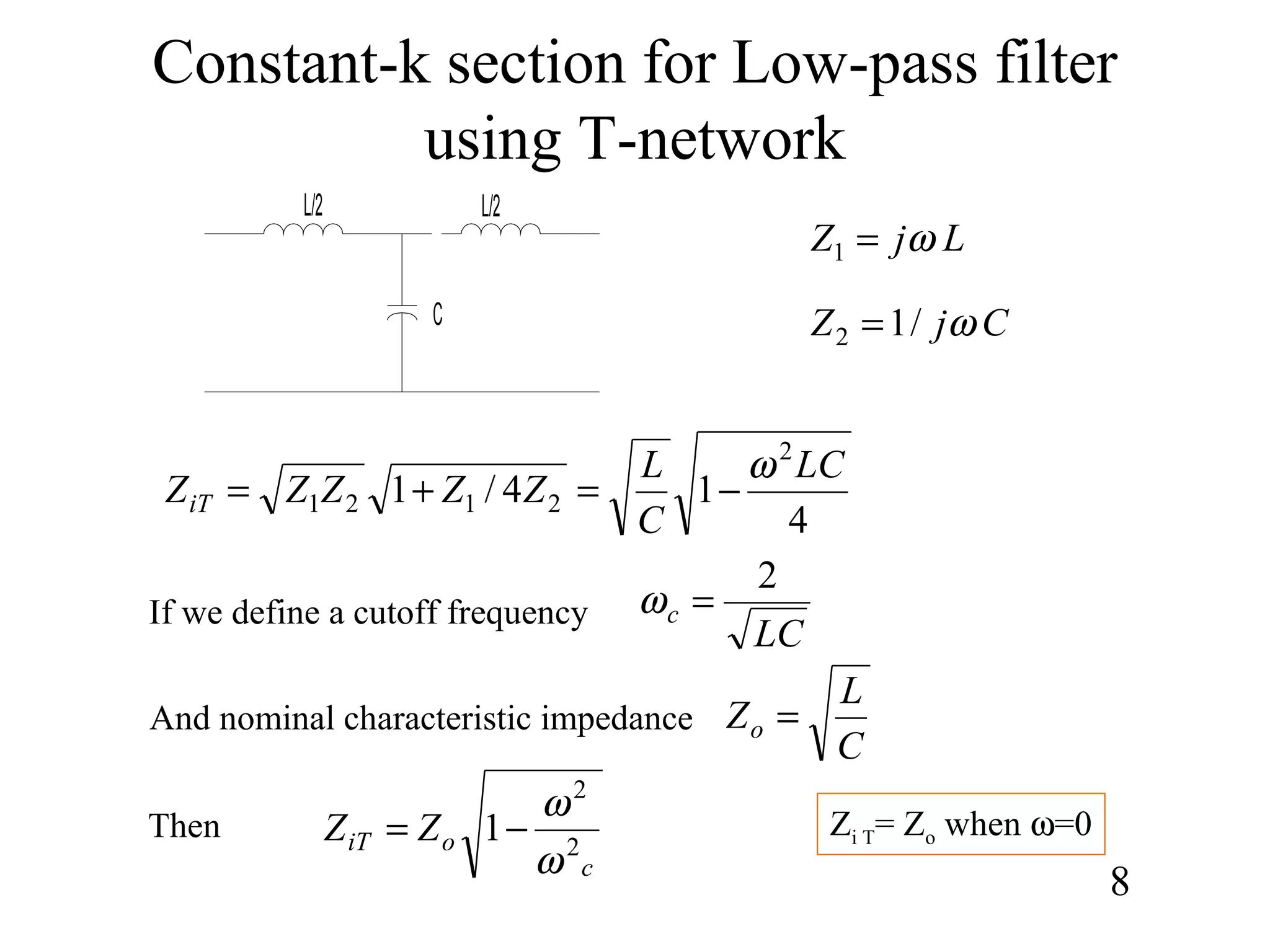
Constant-k section for Low-pass filter
using T-network
8
L/2
C
L/2
4
14/1
2
2121
LC
C
L
ZZZZZiT
ω
−=+=
LjZ ω=1
CjZ ω/12 =
If we define a cutoff frequency
LC
c
2
=ω
And nominal characteristic impedance
C
L
Zo =
Then
c
oiT ZZ 2
2
1
ω
ω
−= Zi T= Zo when ω=0
continue
9
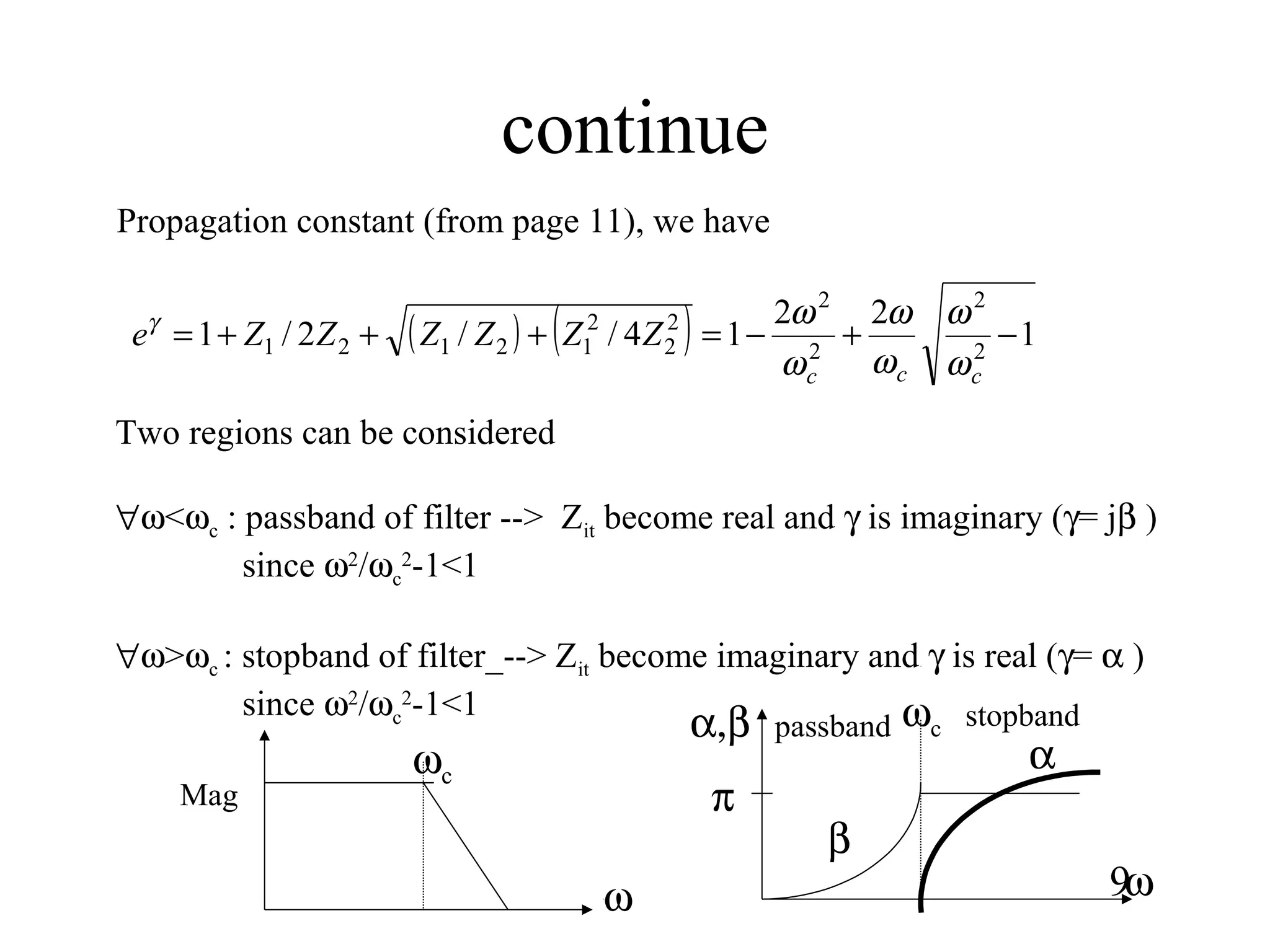
Propagation constant (from page 11), we have
( ) ( ) 1
22
14//2/1 2
2
2
2
2
2
2
12121 −+−=+++=
ccc
ZZZZZZe
ω
ω
ω
ω
ω
ωγ
Two regions can be considered
∀ω<ωc : passband of filter --> Zit become real and γ is imaginary (γ= jβ )
since ω2
/ωc
2
-1<1
∀ω>ωc : stopband of filter_--> Zit become imaginary and γ is real (γ= α )
since ω2
/ωc
2
-1<1
ωc
ω
Mag
ωcα,β
ω
π
β
α
passband stopband
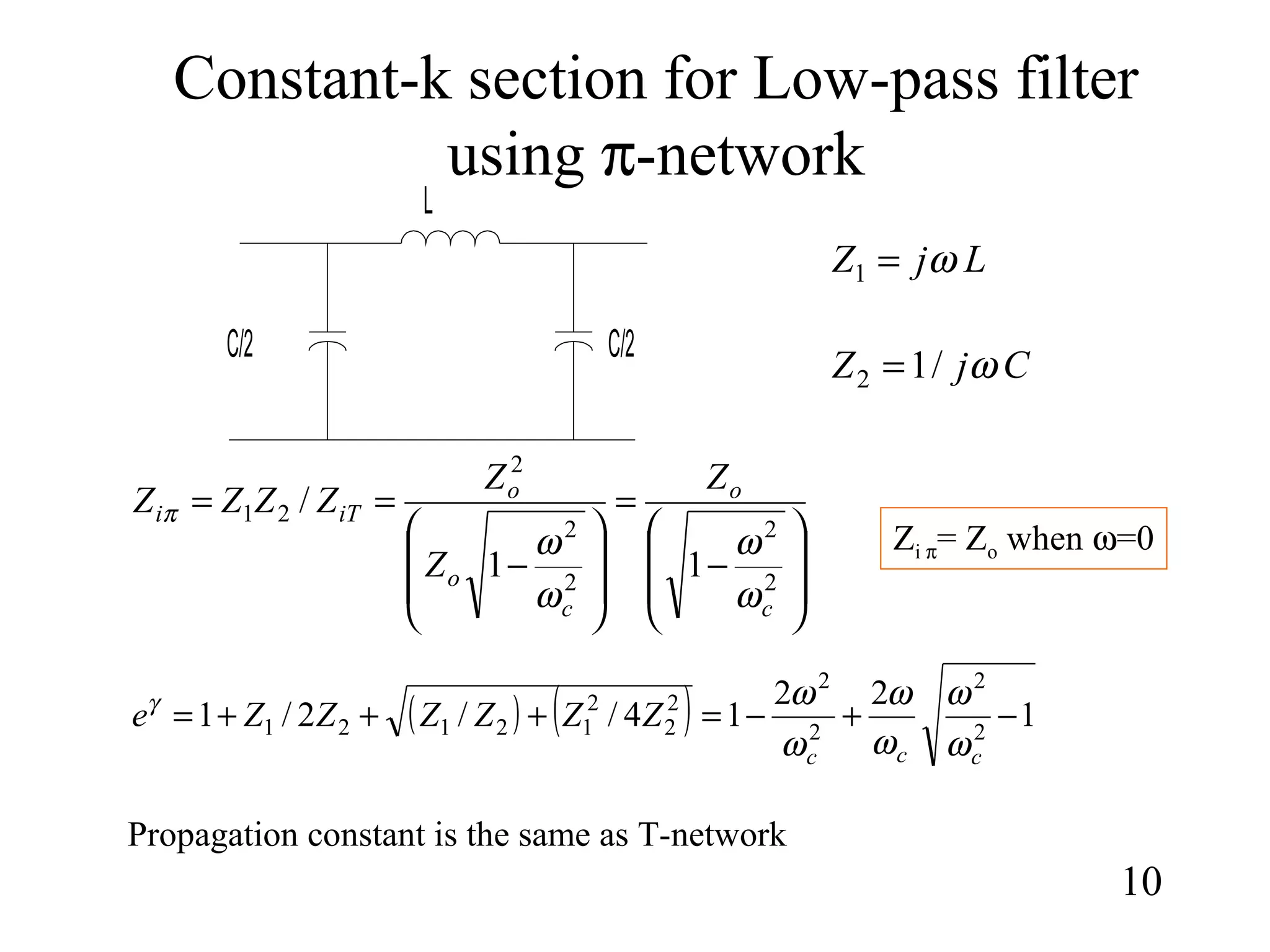
Constant-k section for Low-pass filter
using π-network
10
LjZ ω=1
CjZ ω/12 =








−
=








−
==
2
2
2
2
2
21
11
/
c
o
c
o
o
iTi
Z
Z
Z
ZZZZ
ω
ω
ω
ω
π
( ) ( ) 1
22
14//2/1 2
2
2
2
2
2
2
12121 −+−=+++=
ccc
ZZZZZZe
ω
ω
ω
ω
ω
ωγ
Zi π= Zo when ω=0
Propagation constant is the same as T-network
C/2
L
C/2
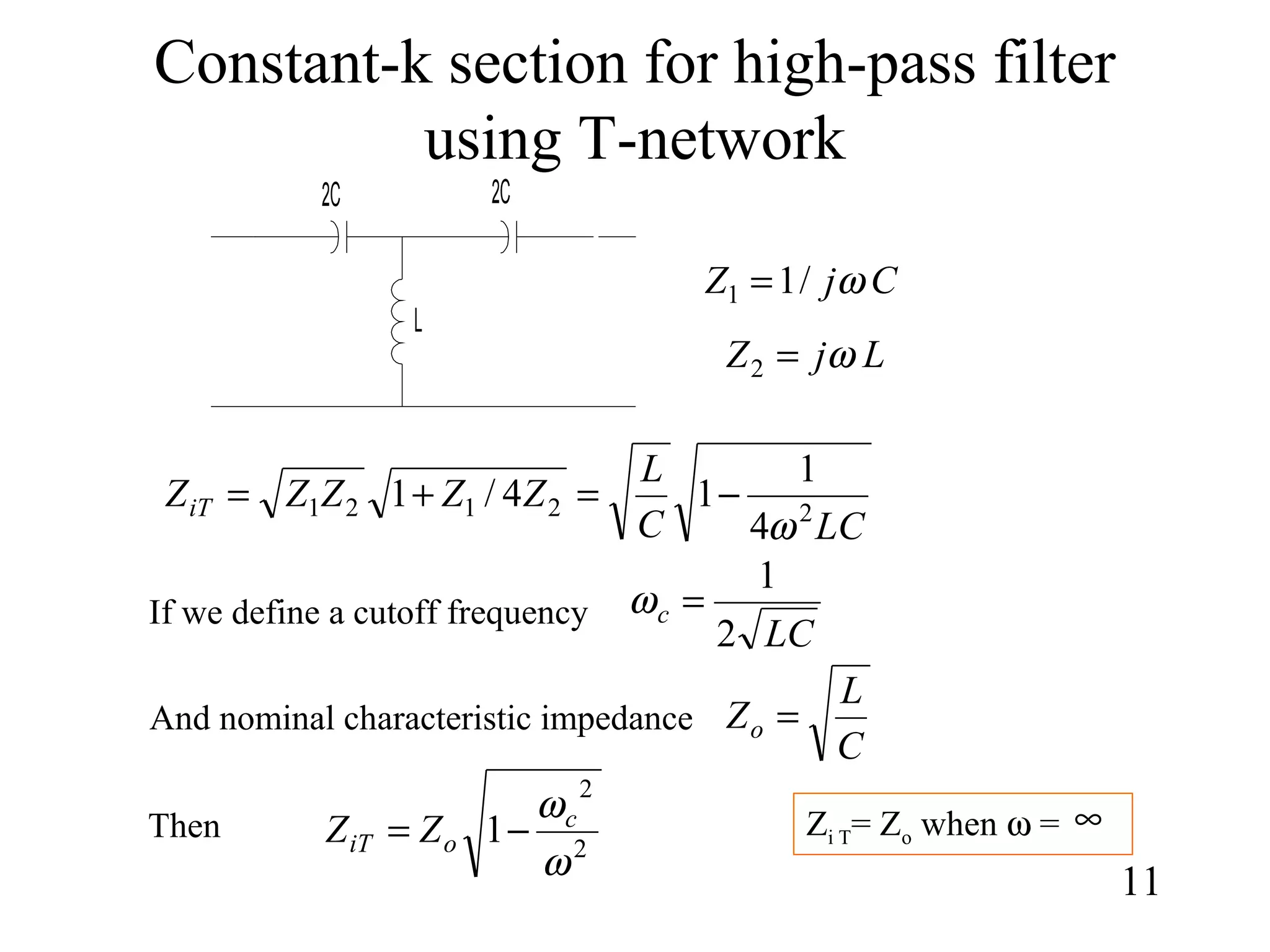
Constant-k section for high-pass filter
using T-network
11
LCC
L
ZZZZZiT 22121
4
1
14/1
ω
−=+=
CjZ ω/11 =
LjZ ω=2
If we define a cutoff frequency
LC
c
2
1
=ω
And nominal characteristic impedance
C
L
Zo =
Then
2
2
1
ω
ωc
oiT ZZ −= Zi T= Zo when ω = ∞
2C
L
2C
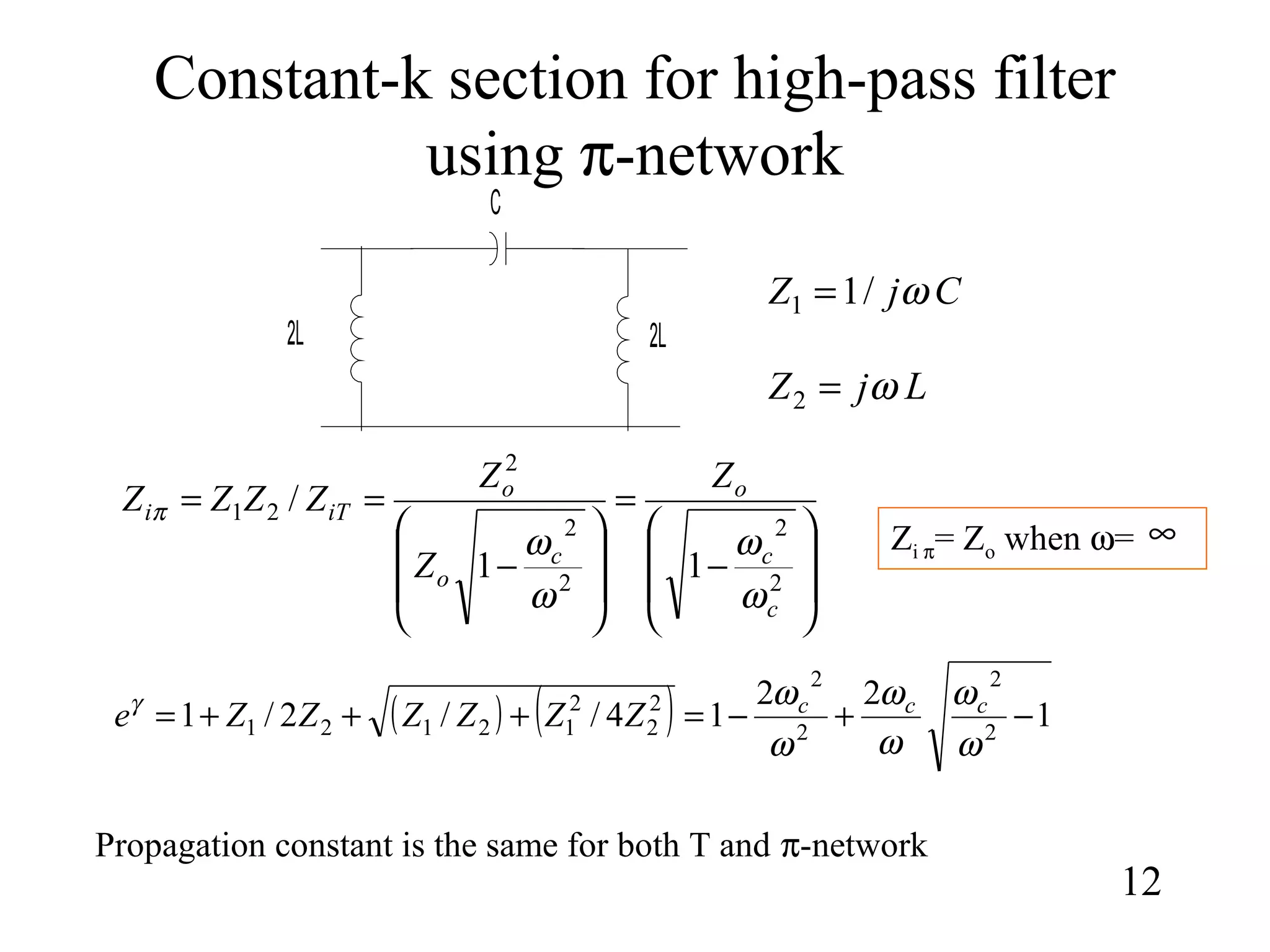
Constant-k section for high-pass filter
using π-network
12
CjZ ω/11 =
LjZ ω=2








−
=








−
==
2
2
2
2
2
21
11
/
c
c
o
c
o
o
iTi
Z
Z
Z
ZZZZ
ω
ω
ω
ω
π
( ) ( ) 1
22
14//2/1 2
2
2
2
2
2
2
12121 −+−=+++=
ω
ω
ω
ω
ω
ωγ ccc
ZZZZZZe
Zi π= Zo when ω=
Propagation constant is the same for both T and π-network
∞
2L
C
2L
Composite filter
13
m=0.6 m=0.6m-
derived
m<0.6
constant
k
T
π2
1
π2
1
Matching
section
Matching
section
High-f
cutoff
Sharp
cutoff
Z iT
Z iT Z iT
Z o
Z o
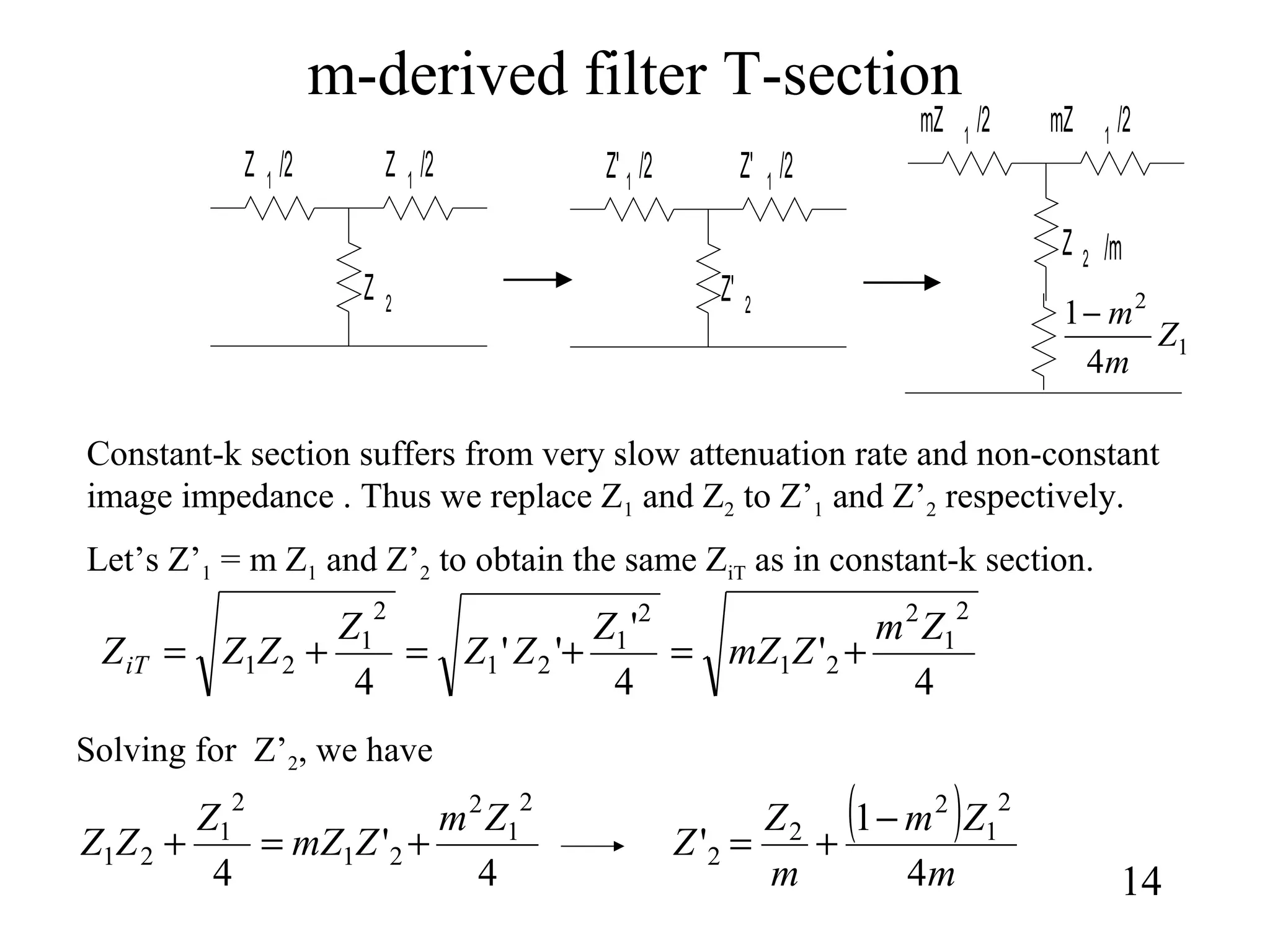
m-derived filter T-section
14
Z 1 /2 Z 1 /2
Z 2
Z' 1
/2 Z' 1
/2
Z' 2
mZ 1
/2 mZ 1
/2
Z 2 /m
1
2
4
1
Z
m
m−
Constant-k section suffers from very slow attenuation rate and non-constant
image impedance . Thus we replace Z1 and Z2 to Z’1 and Z’2 respectively.
Let’s Z’1 = m Z1 and Z’2 to obtain the same ZiT as in constant-k section.
4
'
4
'
''
4
2
1
2
21
2
1
21
2
1
21
Zm
ZmZ
Z
ZZ
Z
ZZZiT +=+=+=
4
'
4
2
1
2
21
2
1
21
Zm
ZmZ
Z
ZZ +=+
Solving for Z’2, we have
( )
m
Zm
m
Z
Z
4
1
'
2
1
2
2
2
−
+=
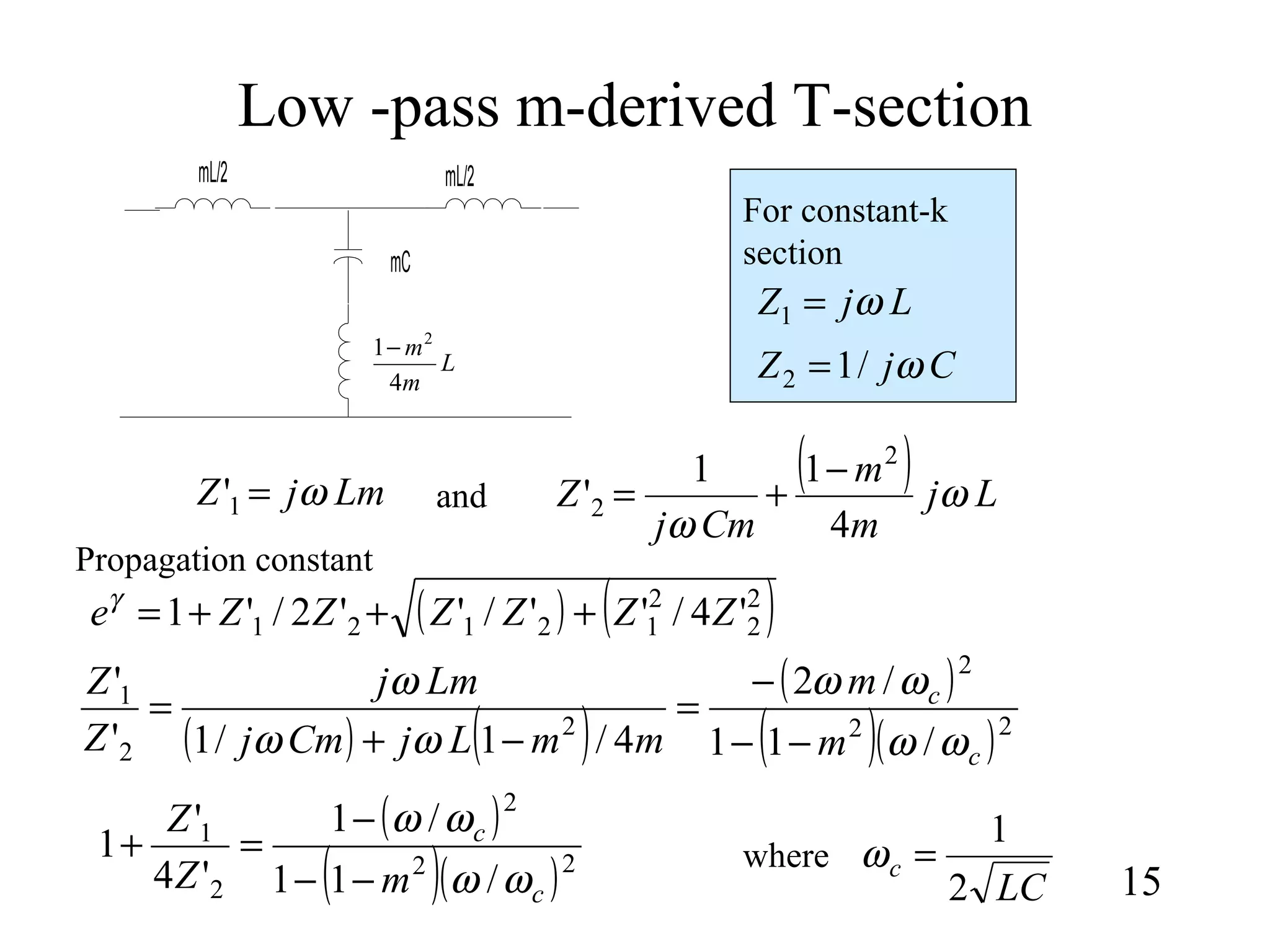
Low -pass m-derived T-section
15
L
m
m
4
1 2
−
mC
mL/2mL/2
LjZ ω=1
CjZ ω/12 =
For constant-k
section
LmjZ ω=1'
( ) Lj
m
m
Cmj
Z ω
ω 4
11
'
2
2
−
+=and
( ) ( )2
2
2
12121 '4/''/''2/'1 ZZZZZZe +++=γ
( ) ( )
( )
( )( )22
2
2
2
1
/11
/2
4/1/1'
'
c
c
m
m
mmLjCmj
Lmj
Z
Z
ωω
ωω
ωω
ω
−−
−
=
−+
=
( )
( )( )22
2
2
1
/11
/1
'4
'
1
c
c
mZ
Z
ωω
ωω
−−
−
=+
Propagation constant
LC
c
2
1
=ωwhere
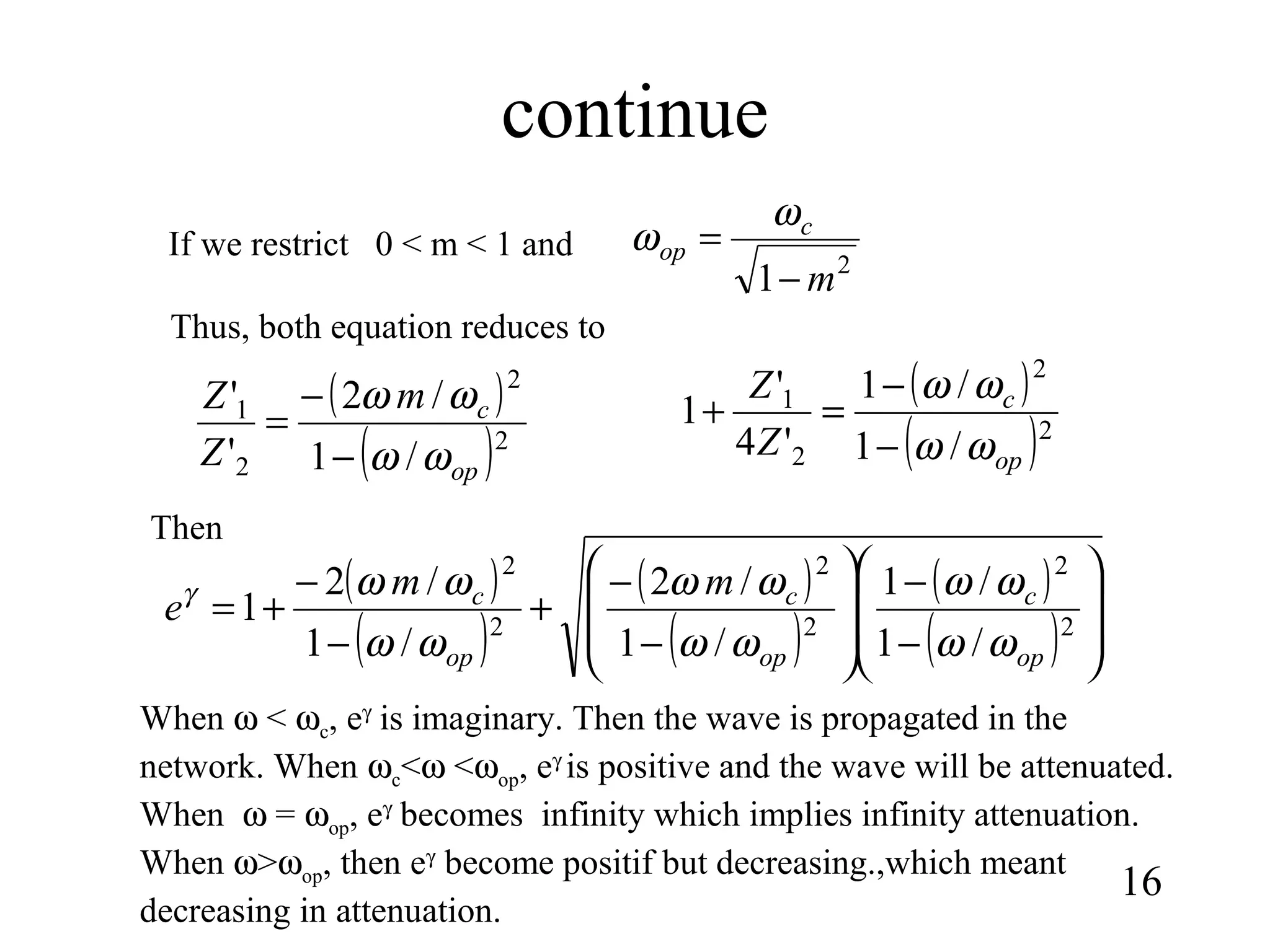
continue
16
( )
( )2
2
2
1
/1
/1
'4
'
1
op
c
Z
Z
ωω
ωω
−
−
=+( )
( )2
2
2
1
/1
/2
'
'
op
cm
Z
Z
ωω
ωω
−
−
=
If we restrict 0 < m < 1 and
2
1 m
c
op
−
=
ω
ω
Thus, both equation reduces to
( )
( )
( )
( )
( )
( ) 







−
−








−
−
+
−
−
+= 2
2
2
2
2
2
/1
/1
/1
/2
/1
/2
1
op
c
op
c
op
c mm
e
ωω
ωω
ωω
ωω
ωω
ωωγ
Then
When ω < ωc, eγ
is imaginary. Then the wave is propagated in the
network. When ωc<ω <ωop, eγ
is positive and the wave will be attenuated.
When ω = ωop, eγ
becomes infinity which implies infinity attenuation.
When ω>ωop, then eγ
become positif but decreasing.,which meant
decreasing in attenuation.
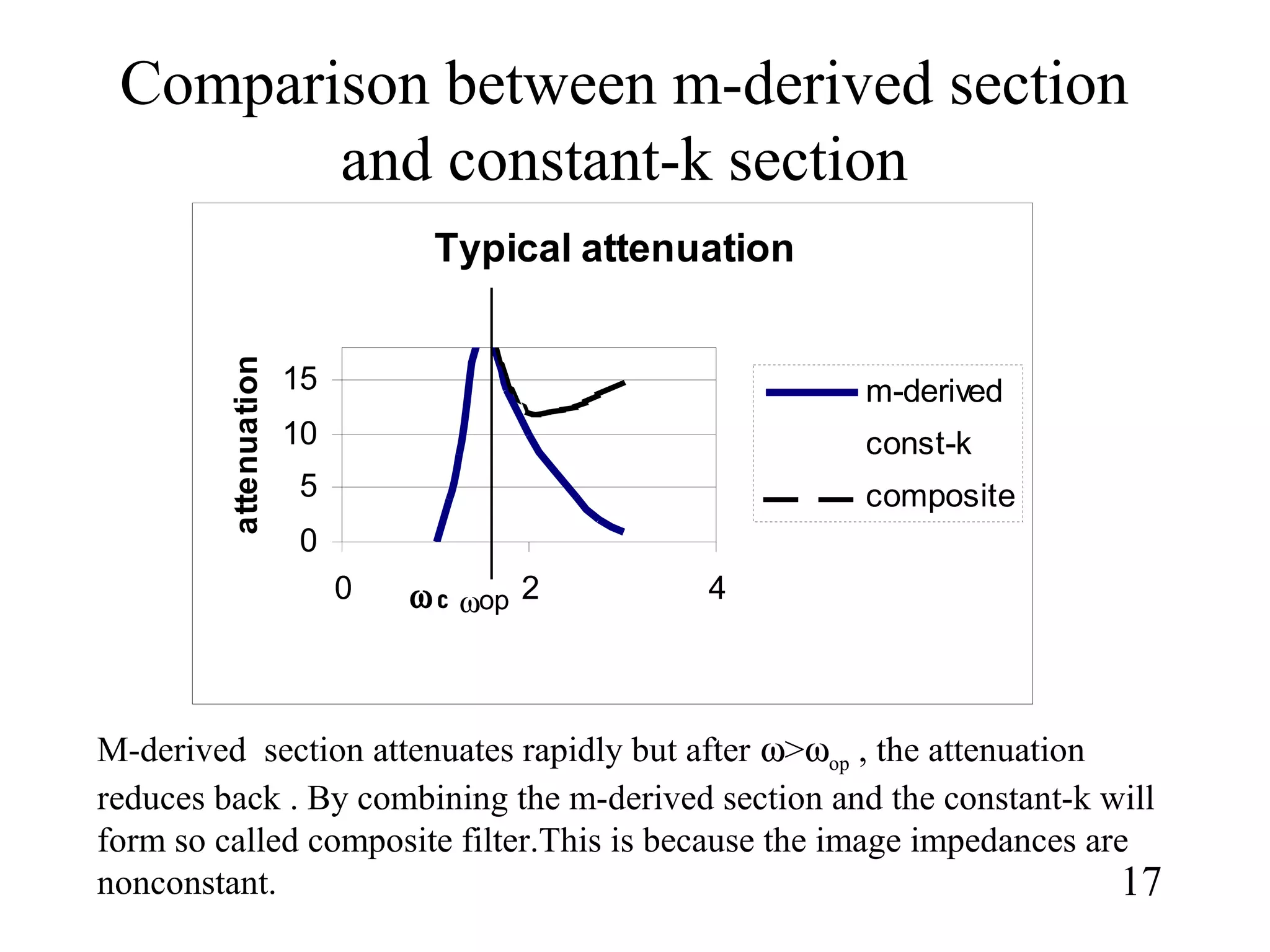
Comparison between m-derived section
and constant-k section
17
Typical attenuation
0
5
10
15
0 2 4ω c
attenuation
m-derived
const-k
composite
ωop
M-derived section attenuates rapidly but after ω>ωop , the attenuation
reduces back . By combining the m-derived section and the constant-k will
form so called composite filter.This is because the image impedances are
nonconstant.
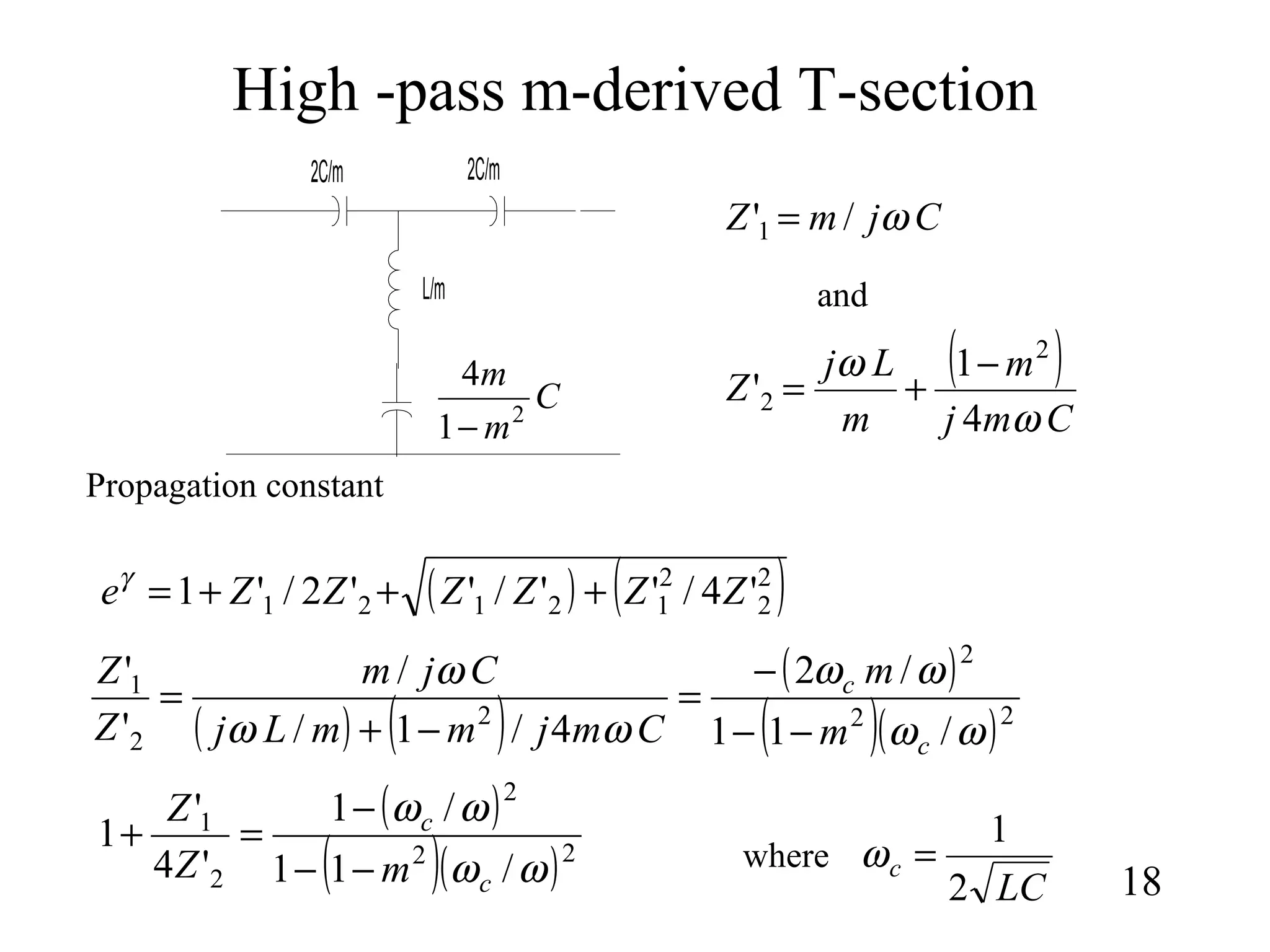
High -pass m-derived T-section
18
2C/m
L/m
2C/m
C
m
m
2
1
4
−
CjmZ ω/'1 =
( )
Cmj
m
m
Lj
Z
ω
ω
4
1
'
2
2
−
+=
and
( ) ( )2
2
2
12121 '4/''/''2/'1 ZZZZZZe +++=γ
( ) ( )
( )
( )( )22
2
2
2
1
/11
/2
4/1/
/
'
'
ωω
ωω
ωω
ω
c
c
m
m
CmjmmLj
Cjm
Z
Z
−−
−
=
−+
=
( )
( )( )22
2
2
1
/11
/1
'4
'
1
ωω
ωω
c
c
mZ
Z
−−
−
=+
Propagation constant
LC
c
2
1
=ωwhere
continue
19
( )
( )2
2
2
1
/1
/1
'4
'
1
ωω
ωω
op
c
Z
Z
−
−
=+( )
( )2
2
2
1
/1
/2
'
'
ωω
ωω
op
c m
Z
Z
−
−
=
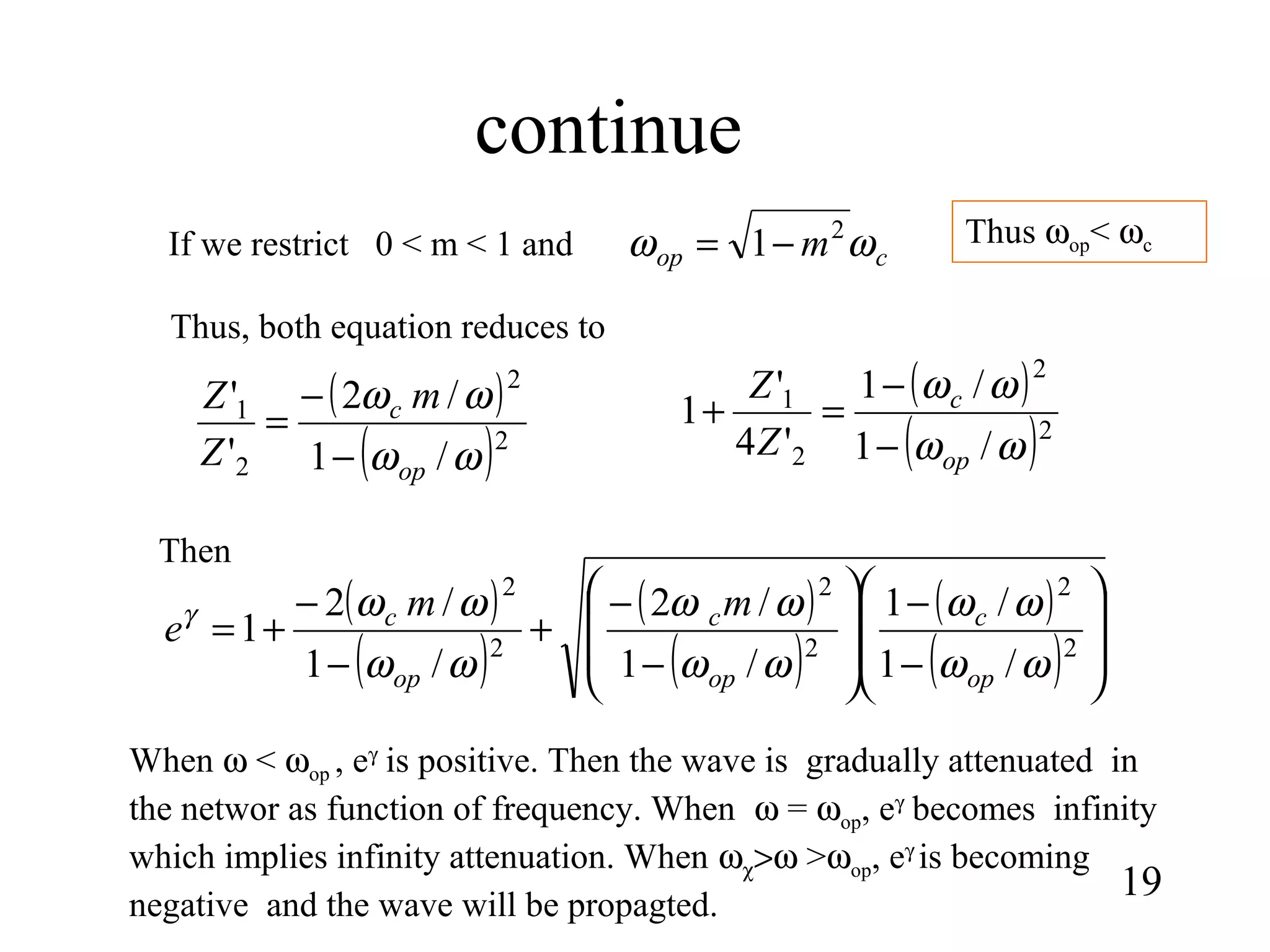
If we restrict 0 < m < 1 and cop m ωω 2
1−=
Thus, both equation reduces to
( )
( )
( )
( )
( )
( ) 







−
−








−
−
+
−
−
+= 2
2
2
2
2
2
/1
/1
/1
/2
/1
/2
1
ωω
ωω
ωω
ωω
ωω
ωωγ
op
c
op
c
op
c mm
e
Then
When ω < ωop , eγ
is positive. Then the wave is gradually attenuated in
the networ as function of frequency. When ω = ωop, eγ
becomes infinity
which implies infinity attenuation. When ωχ>ω >ωop, eγ
is becoming
negative and the wave will be propagted.
Thus ωop< ωc
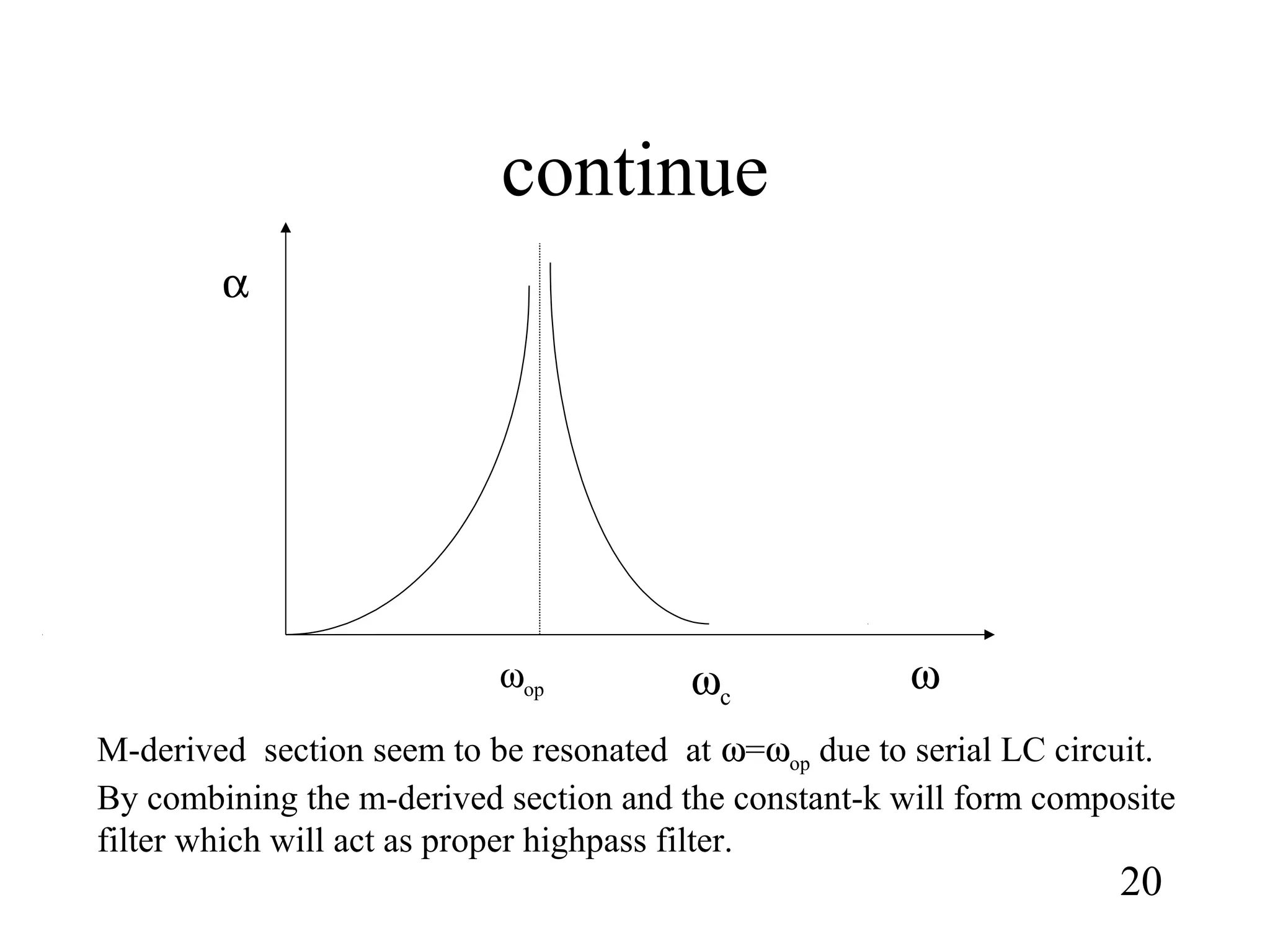
continue
20
α
ωωop ωc
M-derived section seem to be resonated at ω=ωop due to serial LC circuit.
By combining the m-derived section and the constant-k will form composite
filter which will act as proper highpass filter.
m-derived filter π-section
21
mZ 1
m
Z22
m
Z22
( )
m
Zm
4
12 1
2
−( )
m
Zm
4
12 1
2
−
( )
( )2
22
121
21
/1
4/1
/''
co
iTi
Z
mZZZ
ZZZZ
ωω
π
−
−+
==
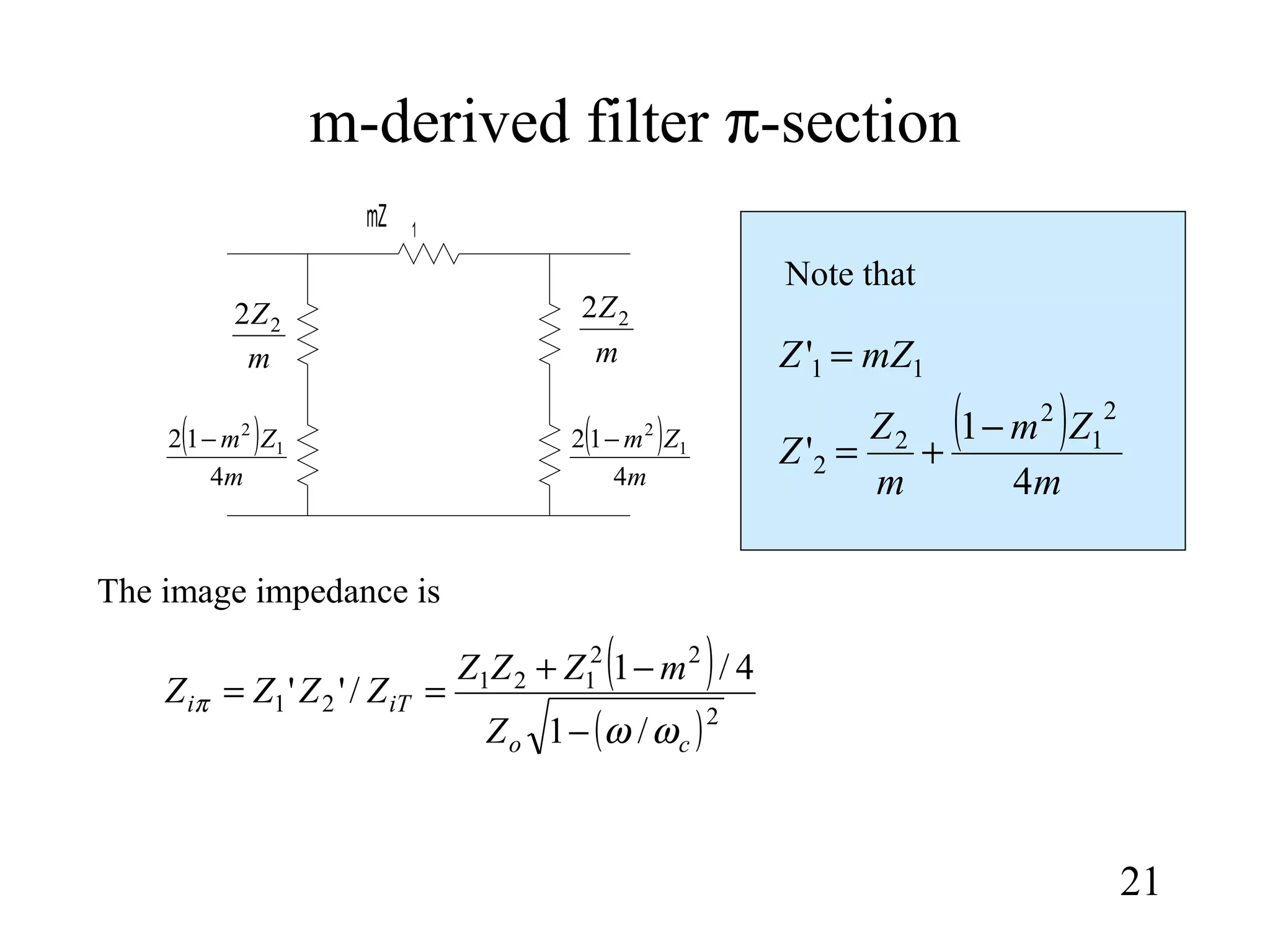
11' mZZ =
( )
m
Zm
m
Z
Z
4
1
'
2
1
2
2
2
−
+=
Note that
The image impedance is
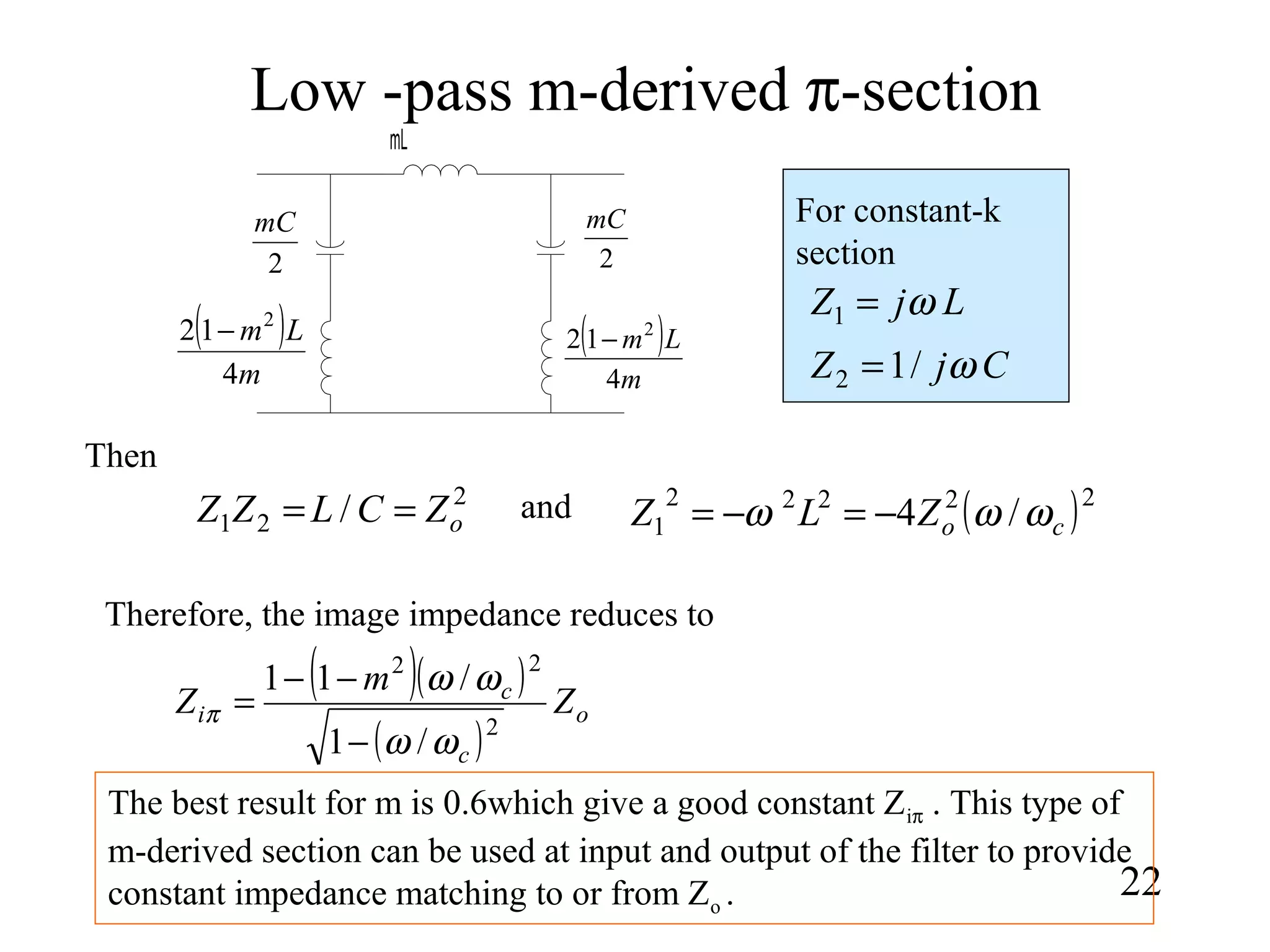
Low -pass m-derived π-section
22
mL
2
mC
2
mC
( )
m
Lm
4
12 2
−( )
m
Lm
4
12 2
−
LjZ ω=1
CjZ ω/12 =
For constant-k
section
2
21 / oZCLZZ == ( )22222
1 /4 coZLZ ωωω −=−=
Then
and
Therefore, the image impedance reduces to
( )( )
( )
o
c
c
i Z
m
Z
2
22
/1
/11
ωω
ωω
π
−
−−
=
The best result for m is 0.6which give a good constant Ziπ . This type of
m-derived section can be used at input and output of the filter to provide
constant impedance matching to or from Zo .
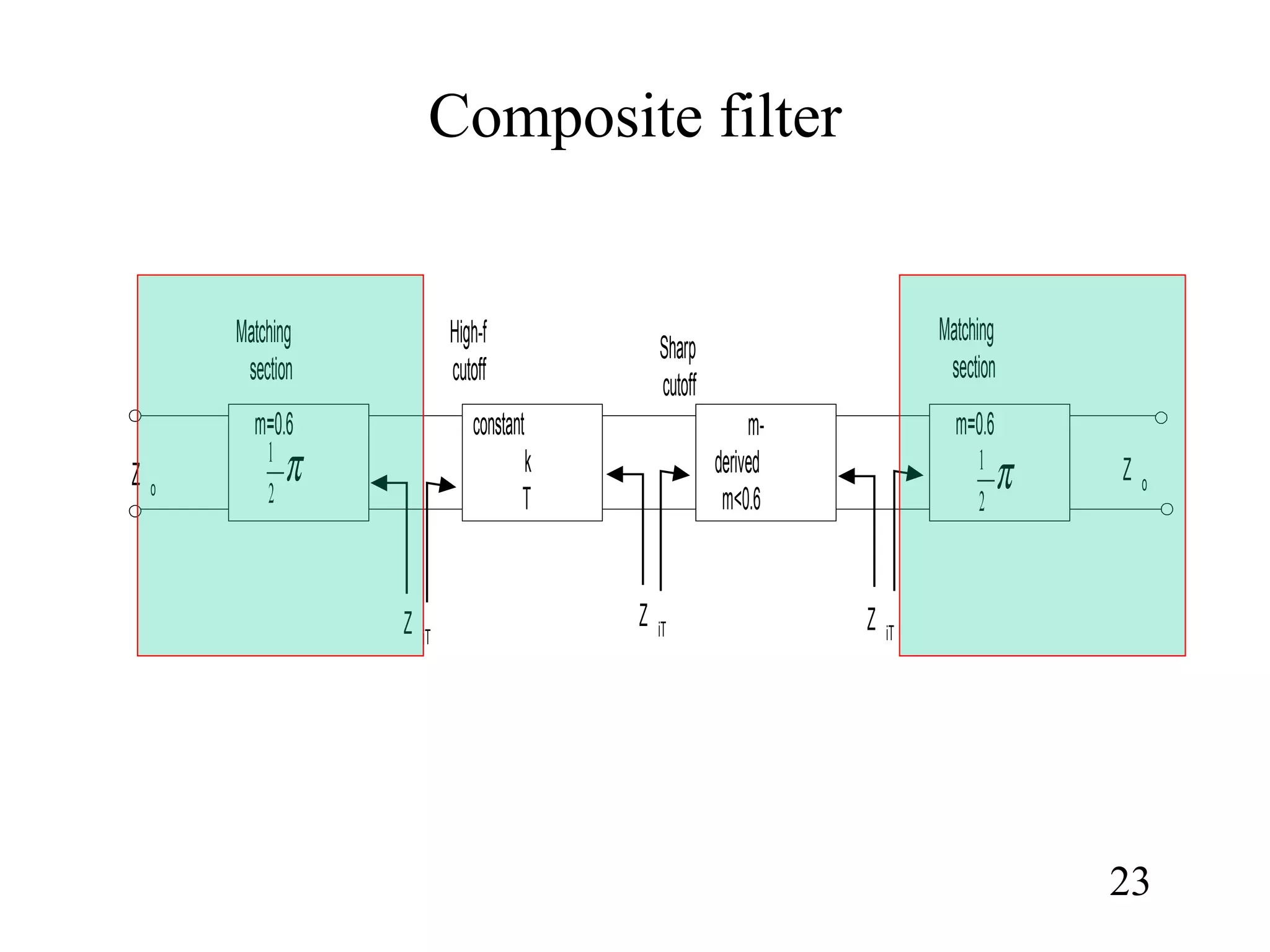
Composite filter
23
m=0.6 m=0.6m-
derived
m<0.6
constant
k
T
π2
1
π2
1
Matching
section
Matching
section
High-f
cutoff
Sharp
cutoff
Z iT
Z iT Z iT
Z o
Z o
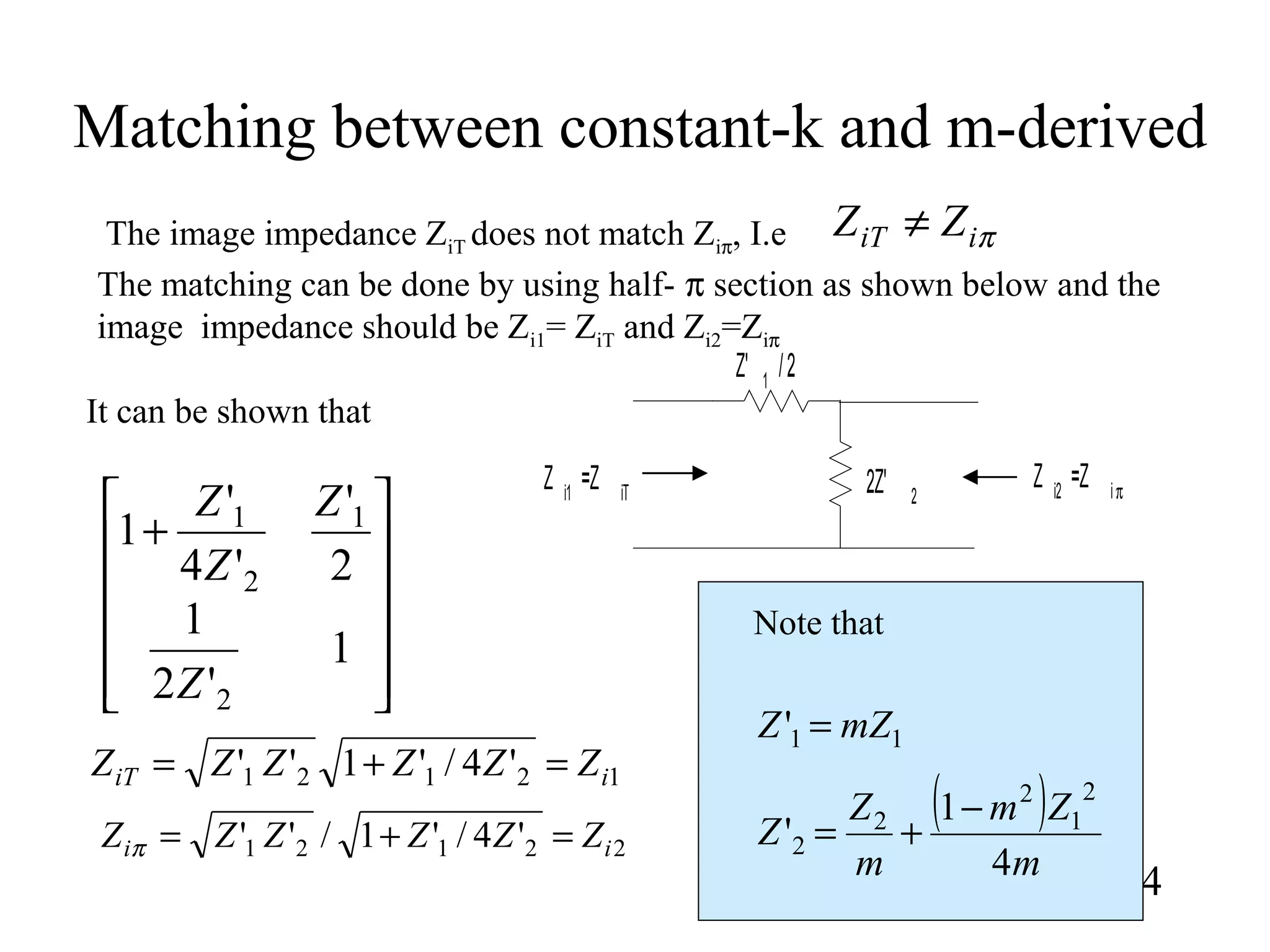
Matching between constant-k and m-derived
24
πiiT ZZ ≠The image impedance ZiT does not match Ziπ, I.e
The matching can be done by using half- π section as shown below and the
image impedance should be Zi1= ZiT and Zi2=Ziπ
Z' 1
/2
2Z' 2
Z i2
=Z iπZ i1
=Z iT












+
1
'2
1
2
'
'4
'
1
2
1
2
1
Z
Z
Z
Z
12121 '4/'1'' iiT ZZZZZZ =+=
22121 '4/'1/'' ii ZZZZZZ =+=π
It can be shown that
11' mZZ =
( )
m
Zm
m
Z
Z
4
1
'
2
1
2
2
2
−
+=
Note that
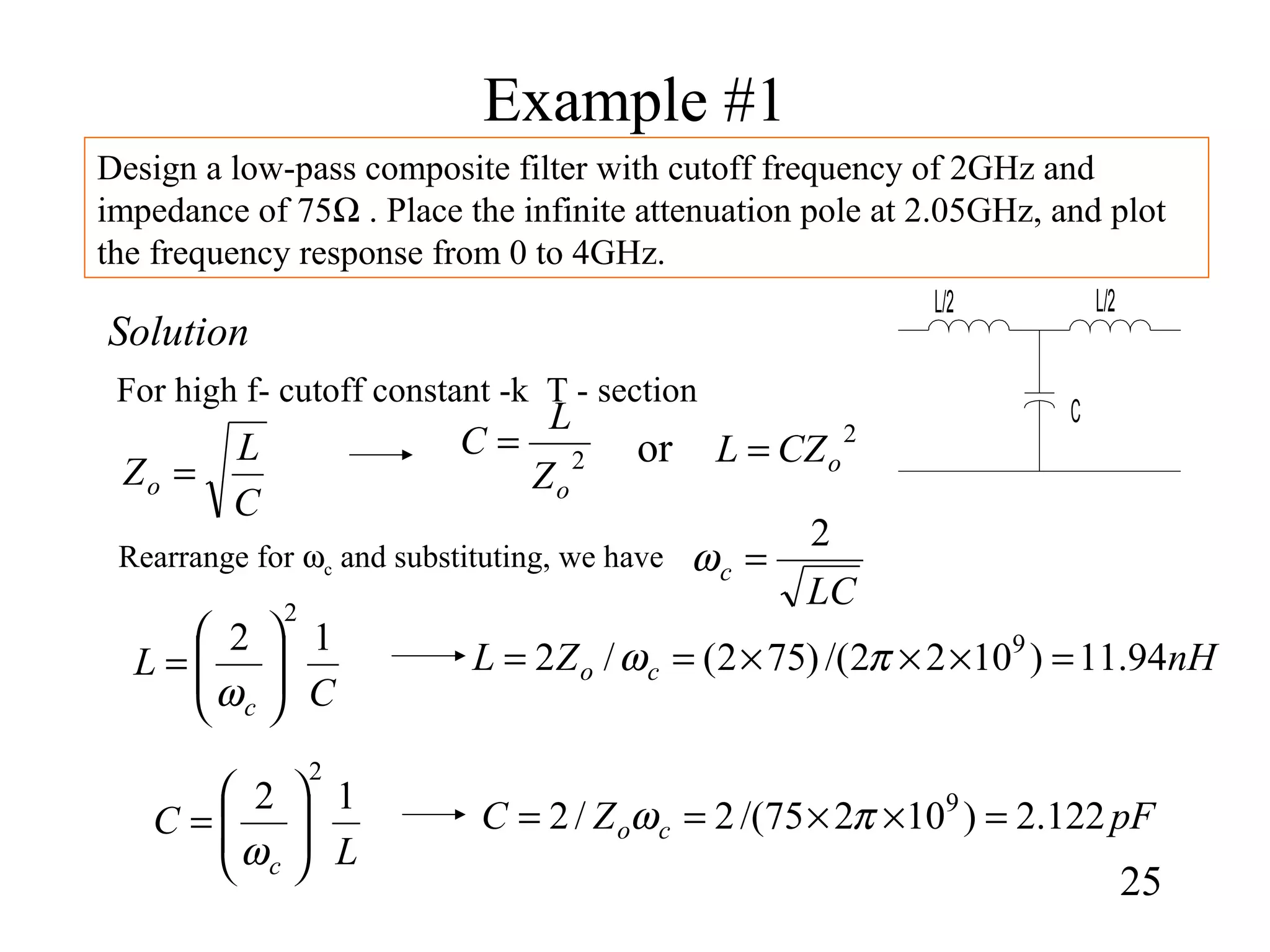
Example #1
25
Design a low-pass composite filter with cutoff frequency of 2GHz and
impedance of 75Ω . Place the infinite attenuation pole at 2.05GHz, and plot
the frequency response from 0 to 4GHz.
Solution
For high f- cutoff constant -k T - section
C
L/2 L/2
LC
c
2
=ω
C
L
Zo =
L
C
c
12
2






=
ω
2
oZ
L
C = 2
oCZL =or
C
L
c
12
2






=
ω
Rearrange for ωc and substituting, we have
nHZL co 94.11)1022/()752(/2 9
=×××== πω
pFZC co 122.2)10275/(2/2 9
=××== πω
continue
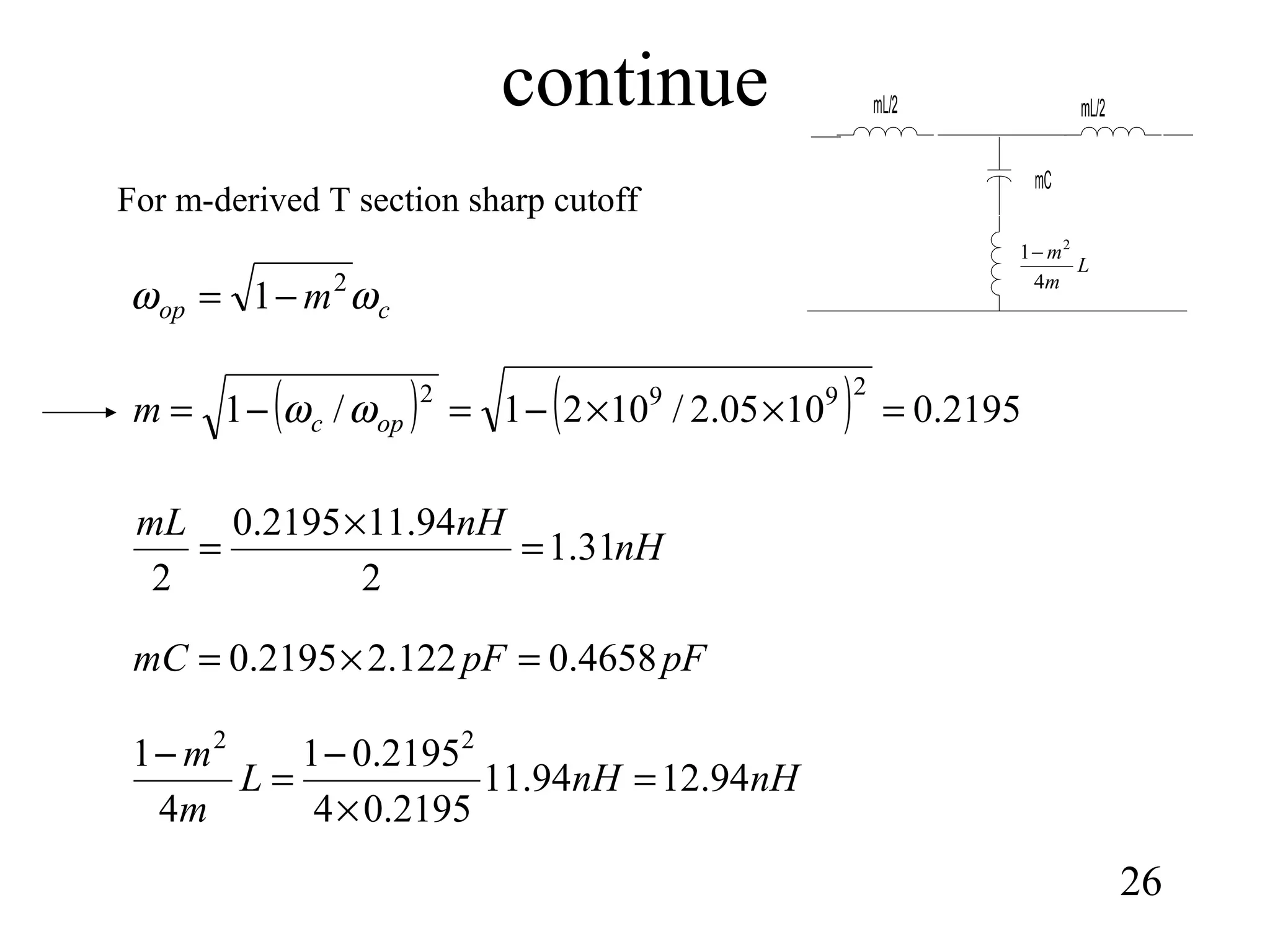
26
cop m ωω 2
1−=
( ) ( ) 2195.01005.2/1021/1
2992
=××−=−= opcm ωω
For m-derived T section sharp cutoff
nH
nHmL
31.1
2
94.112195.0
2
=
×
=
pFpFmC 4658.0122.22195.0 =×=
nHnHL
m
m
94.1294.11
2195.04
2195.01
4
1 22
=
×
−
=
−
L
m
m
4
1 2
−
mC
mL/2mL/2
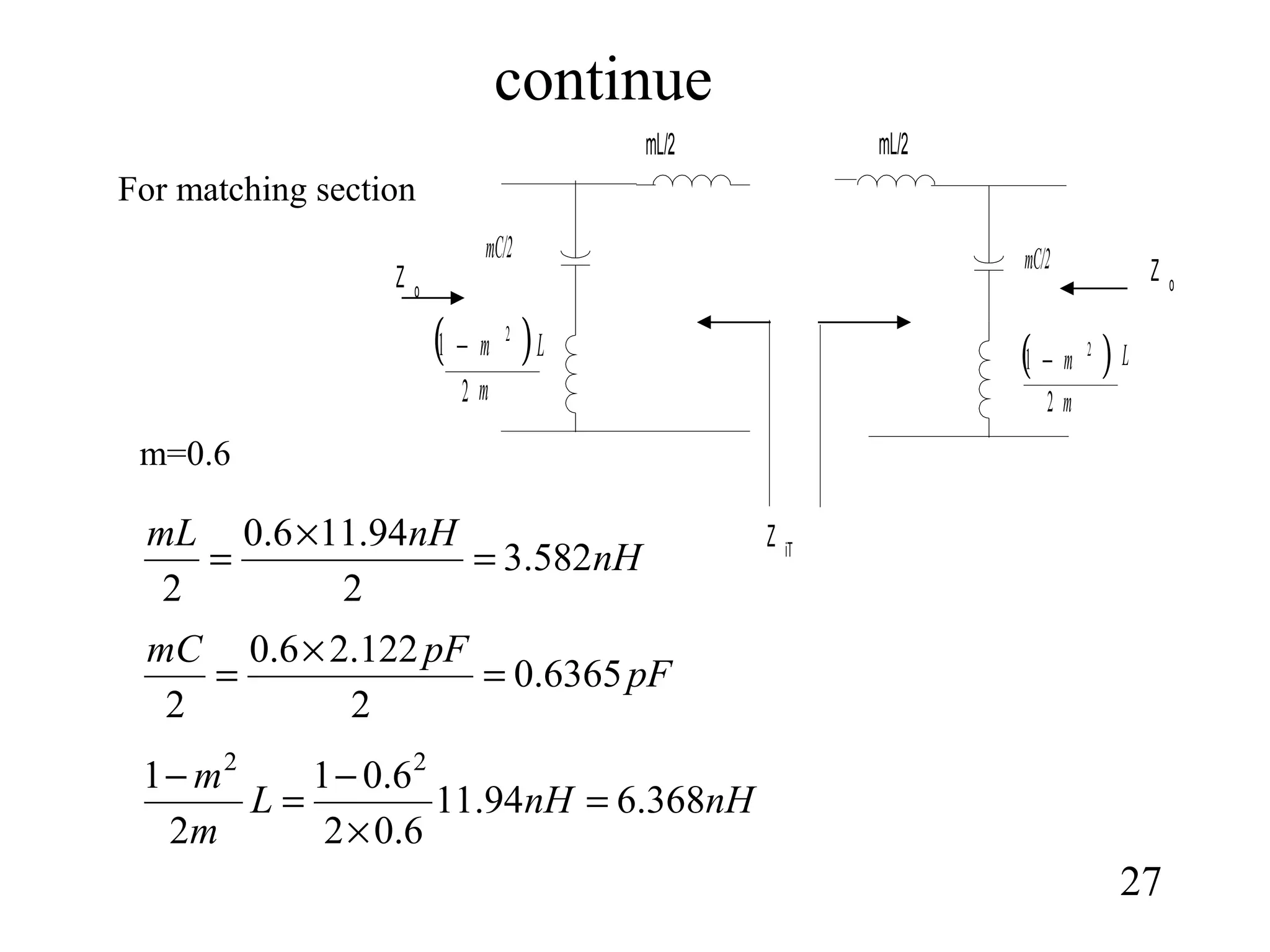
continue
27
For matching section
mL/2
mC/2mC/2
( )
m
Lm
2
1 2
−( )
m
Lm
2
1 2
−
mL/2
Z iT
Z o
Z o
m=0.6
nH
nHmL
582.3
2
94.116.0
2
=
×
=
pF
pFmC
6365.0
2
122.26.0
2
=
×
=
nHnHL
m
m
368.694.11
6.02
6.01
2
1 22
=
×
−
=
−
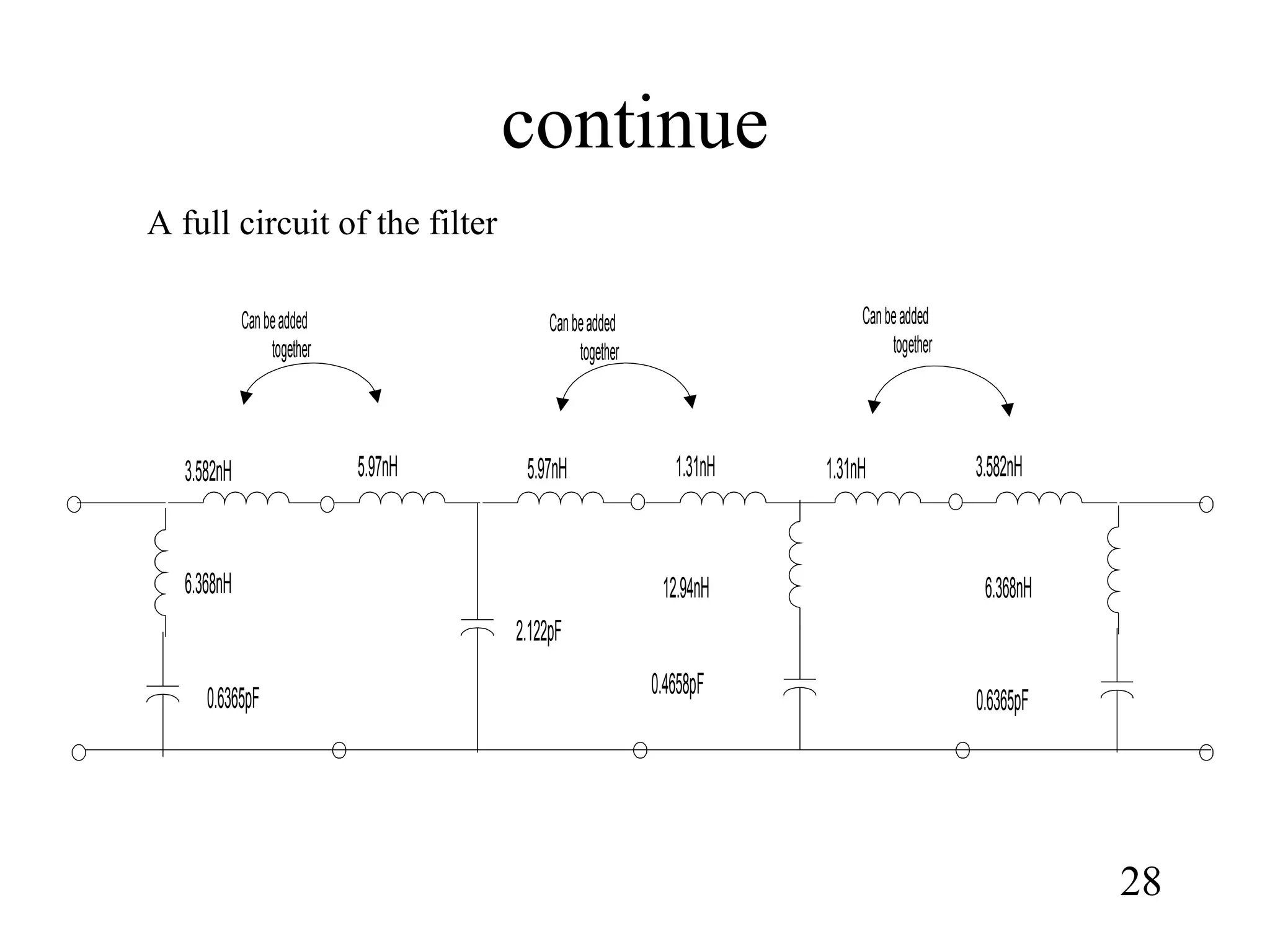
continue
28
3.582nH 5.97nH 1.31nH
6.368nH
0.6365pF
2.122pF
12.94nH
0.4658pF
3.582nH
6.368nH
0.6365pF
1.31nH5.97nH
Canbeadded
together
Canbeadded
together
Canbeadded
together
A full circuit of the filter
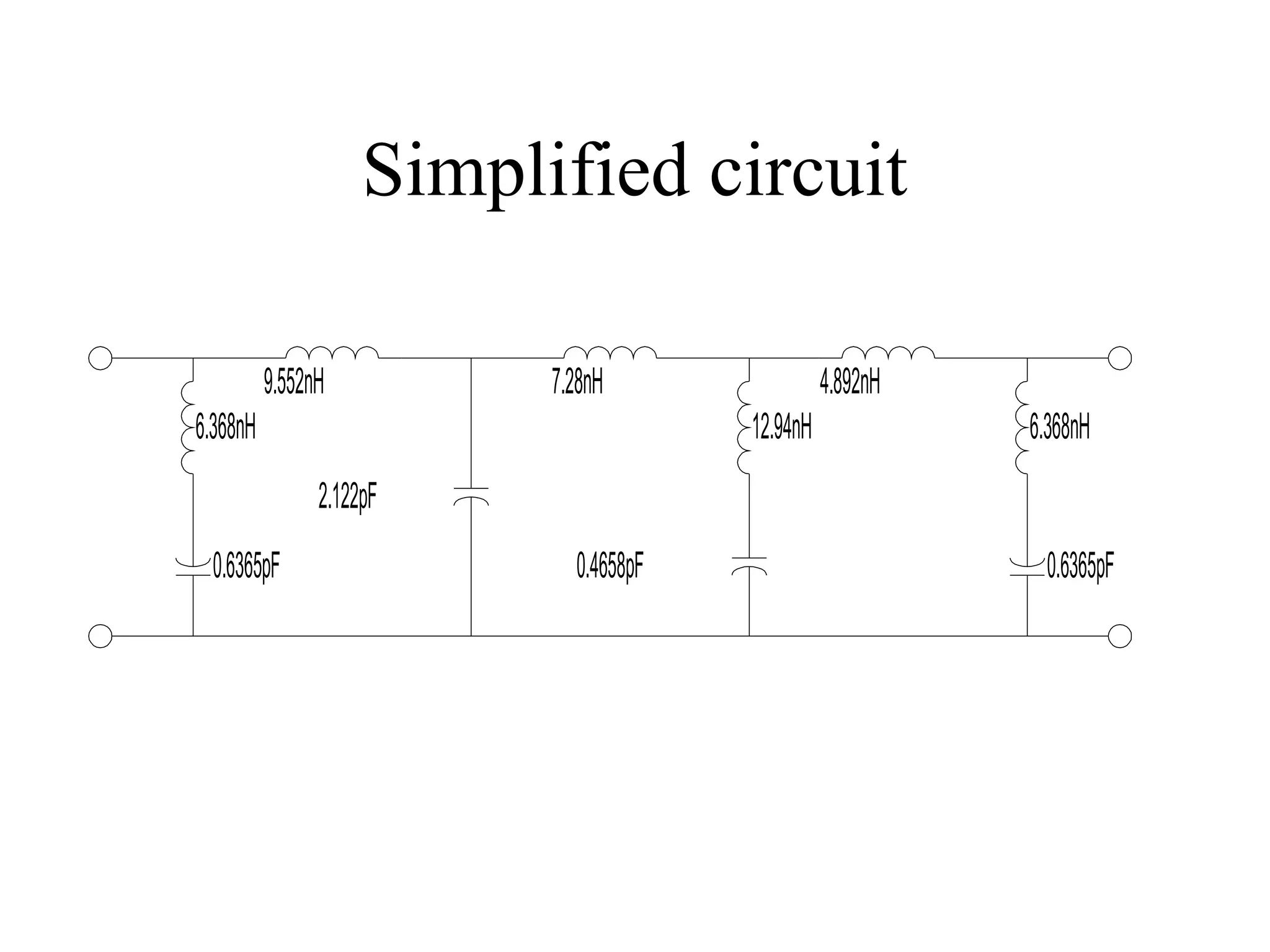
Simplified circuit
12.94nH
9.552nH
6.368nH
7.28nH 4.892nH
0.6365pF 0.6365pF0.4658pF
2.122pF
6.368nH
continue
30
Freq response of low-pass filter
-60
-40
-20
0
0 1 2 3 4
Frequency (GHz)
S11
Pole due to
m=0.2195
section
Pole due to
m=0.6
section
N-section LC ladder circuit
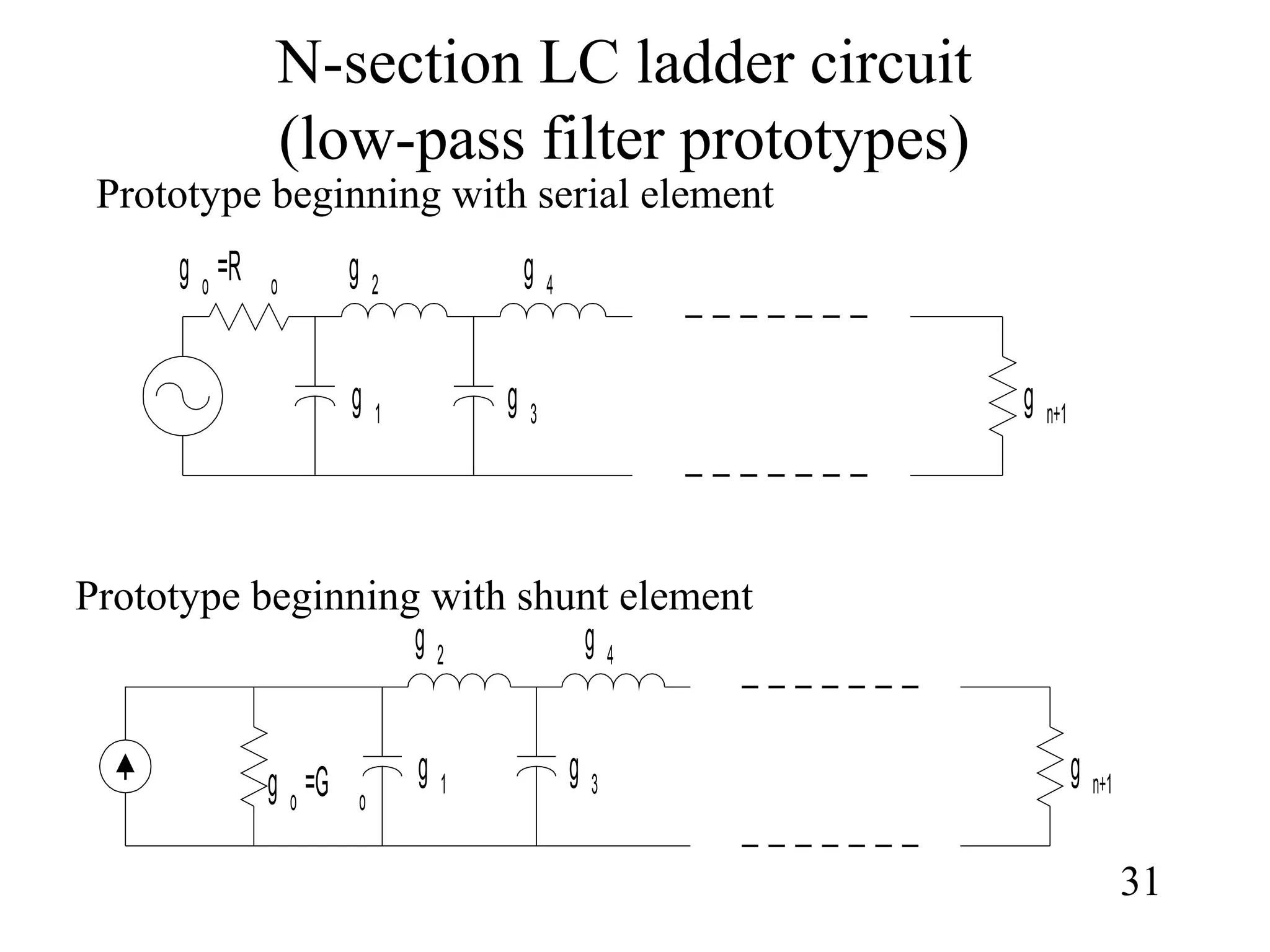
(low-pass filter prototypes)
31
g o
=G o
g 1
g 2
g 3
g 4
g n+1
g o
=R o
g 1
g 2
g 3
g 4
g n+1
Prototype beginning with serial element
Prototype beginning with shunt element
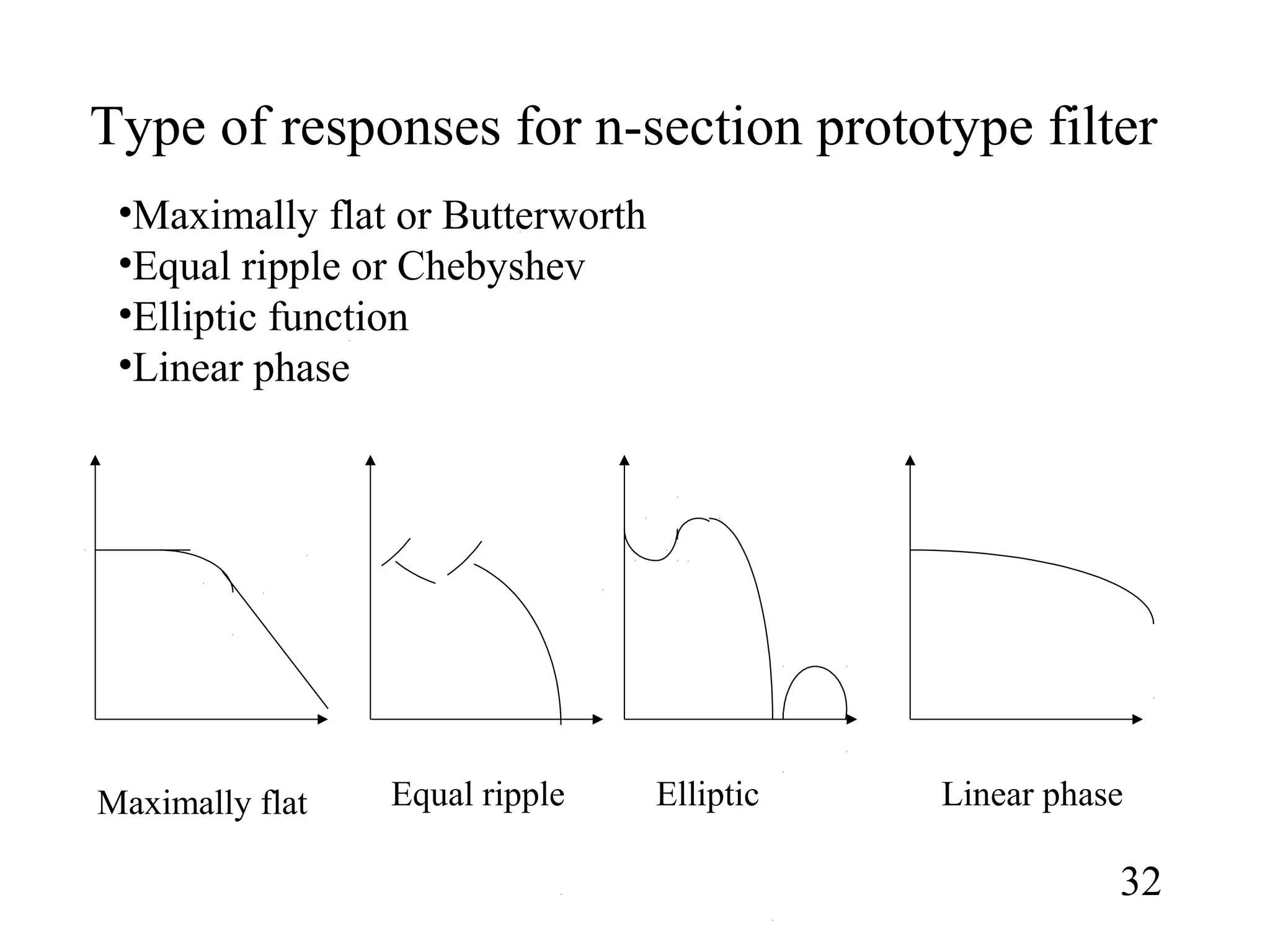
Type of responses for n-section prototype filter
32
•Maximally flat or Butterworth
•Equal ripple or Chebyshev
•Elliptic function
•Linear phase
Maximally flat Equal ripple Elliptic Linear phase
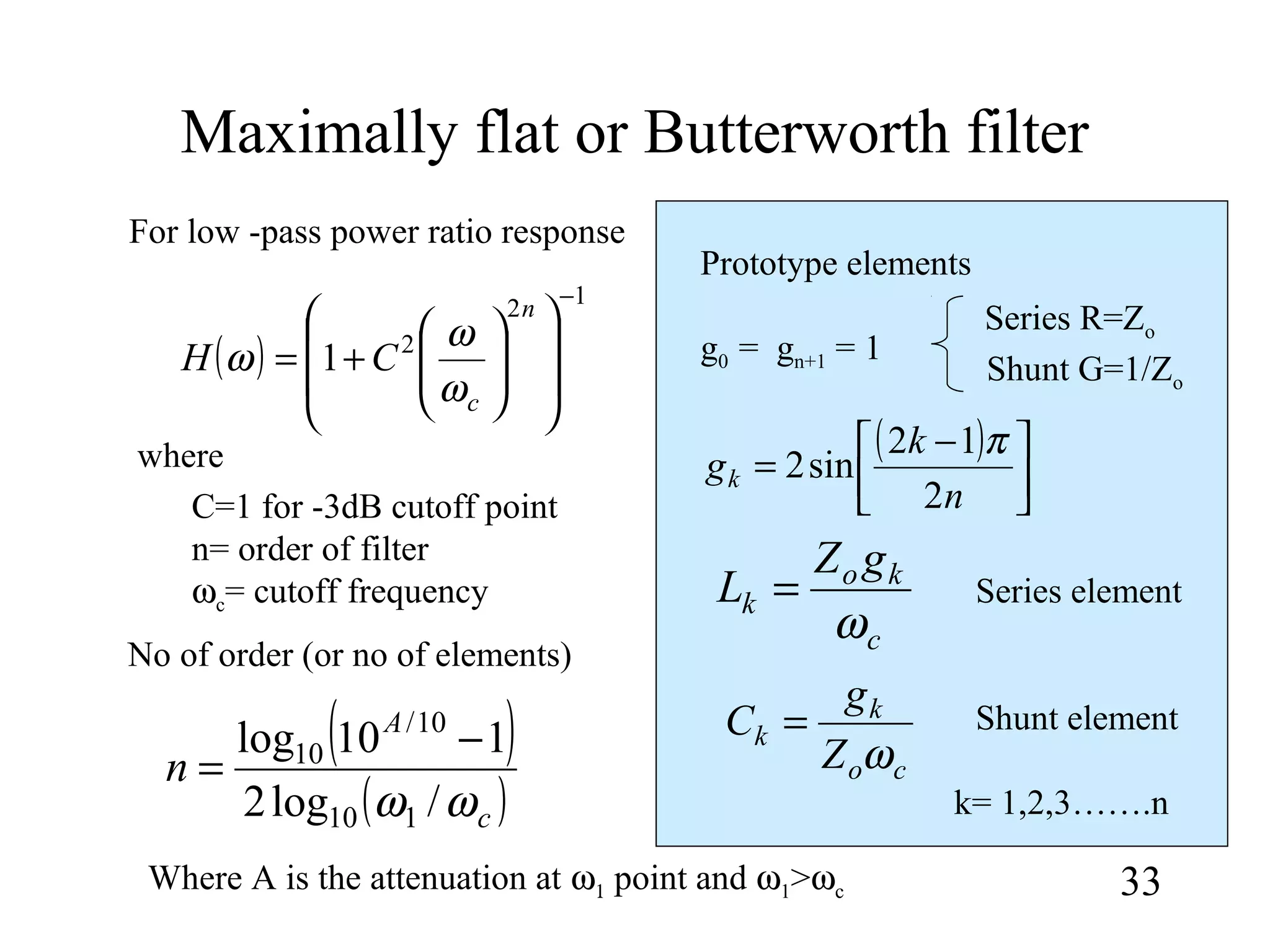
Maximally flat or Butterworth filter
33
( )
12
2
1
−














+=
n
c
CH
ω
ω
ω
For low -pass power ratio response
( )



 −
=
n
k
gk
2
12
sin2
π
g0 = gn+1 = 1
( )
( )c
A
n
ωω /log2
110log
110
10/
10 −
= co
k
k
Z
g
C
ω
=
c
ko
k
gZ
L
ω
=
where
C=1 for -3dB cutoff point
n= order of filter
ωc= cutoff frequency
No of order (or no of elements)
Where A is the attenuation at ω1 point and ω1>ωc
Prototype elements
k= 1,2,3…….n
Series element
Shunt element
Series R=Zo
Shunt G=1/Zo
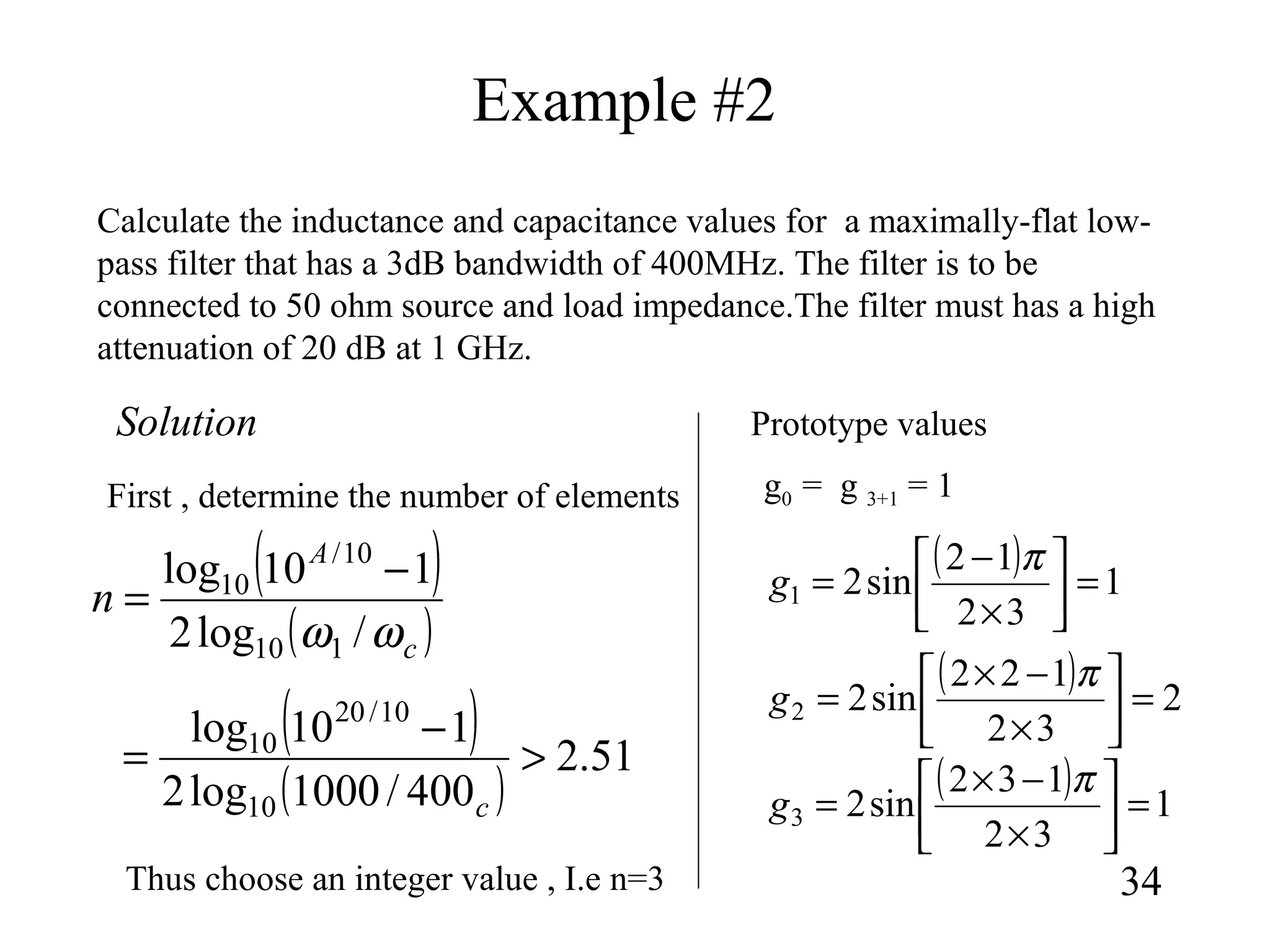
Example #2
34
Calculate the inductance and capacitance values for a maximally-flat low-
pass filter that has a 3dB bandwidth of 400MHz. The filter is to be
connected to 50 ohm source and load impedance.The filter must has a high
attenuation of 20 dB at 1 GHz.
( )
( )c
A
n
ωω /log2
110log
110
10/
10 −
=
( ) 1
32
12
sin21 =



×
−
=
π
g
g0 = g 3+1 = 1First , determine the number of elements
Solution
( )
( )
51.2
400/1000log2
110log
10
10/20
10
>
−
=
c
Thus choose an integer value , I.e n=3
Prototype values
( ) 2
32
122
sin22 =



×
−×
=
π
g
( ) 1
32
132
sin23 =



×
−×
=
π
g
continue
35
nH
gZ
LL
c
o
9.19
104002
150
6
1
13 =
×××
×
===
πω
pF
Z
g
C
co
9.15
10400250
2
6
2
2 =
××××
==
πω
15.9pF
19.9nH
50ohm
50ohm 19.9nH
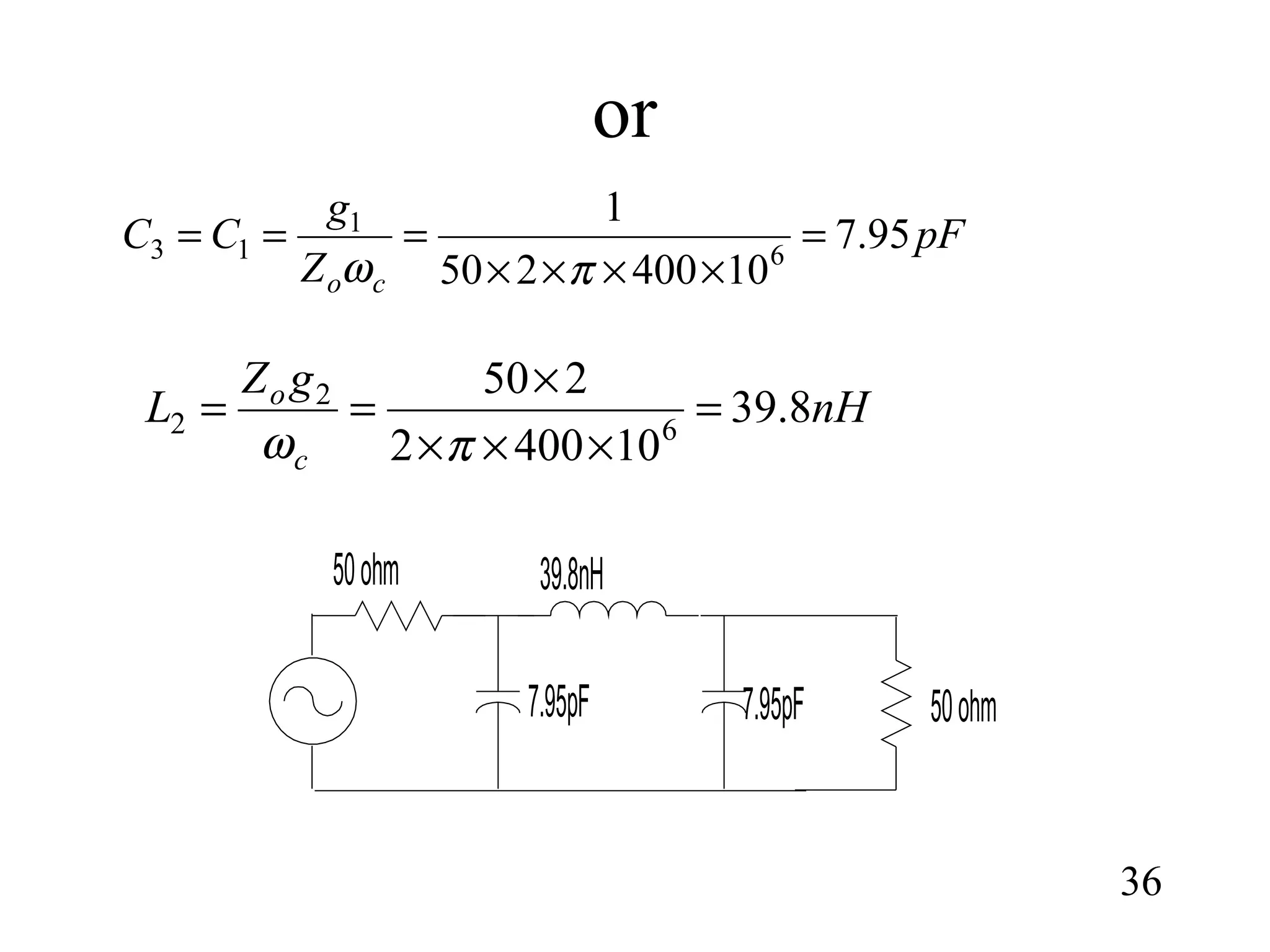
or
36
nH
gZ
L
c
o
8.39
104002
250
6
2
2 =
×××
×
==
πω
pF
Z
g
CC
co
95.7
10400250
1
6
1
13 =
××××
===
πω
7.95pF
39.8nH
50ohm
50ohm
7.95pF
Equi-ripple filter
37
( )
1
2
1
−














+=
c
noCFH
ω
ω
ω
For low -pass power ratio response
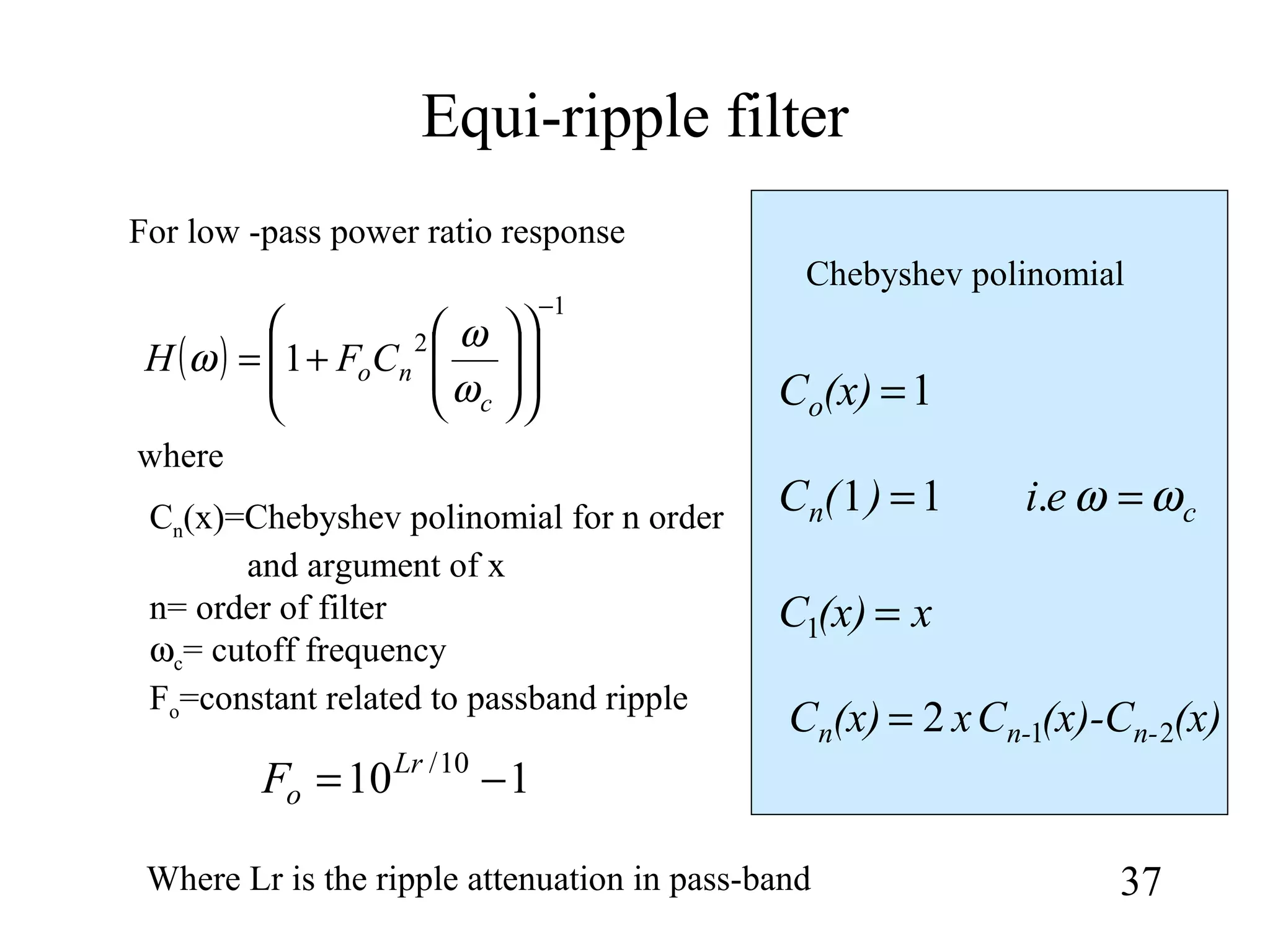
110 10/
−= Lr
oF
where
Cn(x)=Chebyshev polinomial for n order
and argument of x
n= order of filter
ωc= cutoff frequency
Fo=constant related to passband ripple
Chebyshev polinomial
Where Lr is the ripple attenuation in pass-band
(x)(x)-CCx(x)C n-n-n 212=
x(x)C =1
cn ei)(C ωω == .11
1=(x)Co
Continue
38
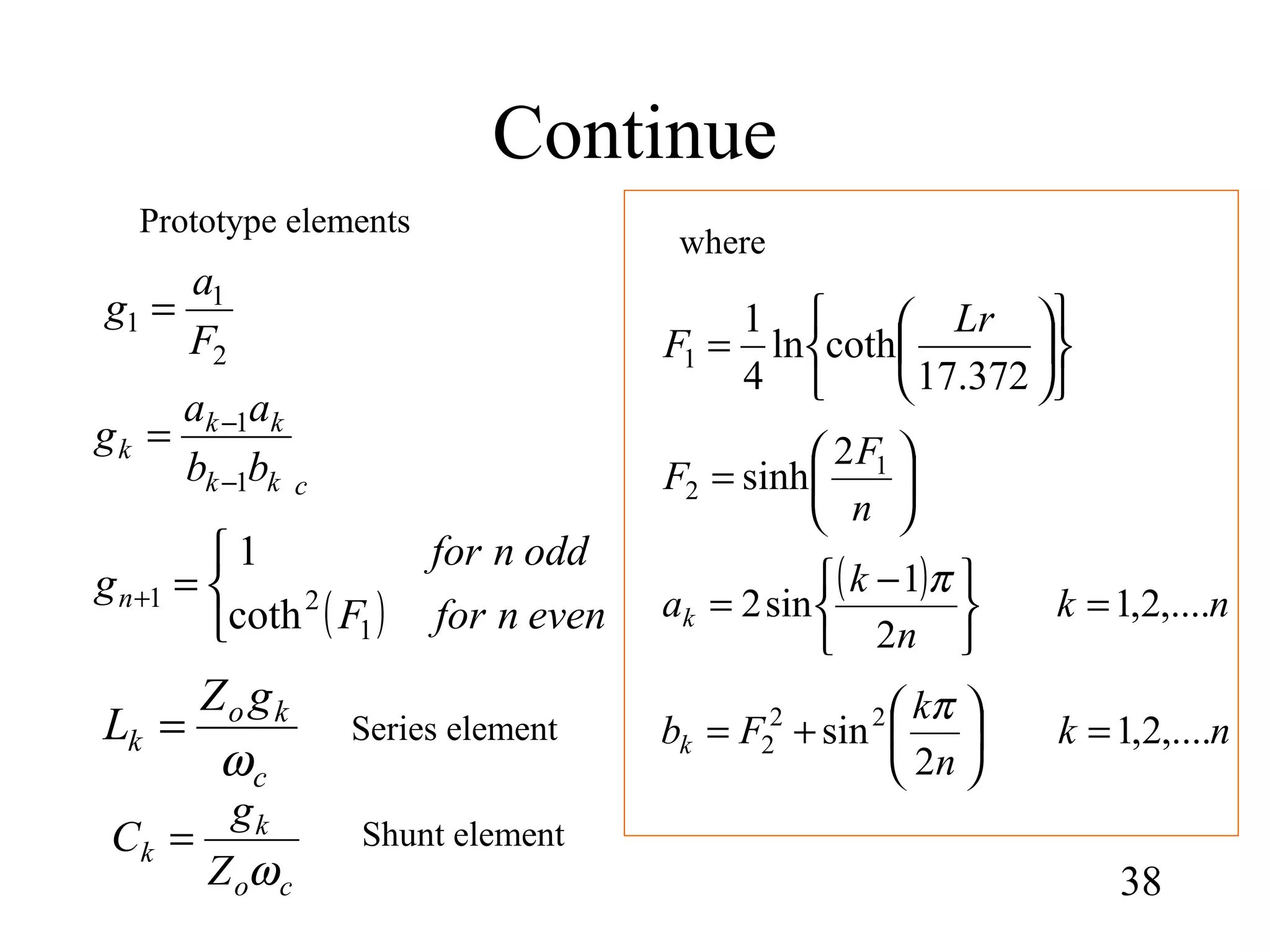
Prototype elements












=
372.17
cothln
4
1
1
Lr
F
( )


=+
evennforF
oddnfor
gn
1
21
coth
1
ckk
kk
k
bb
aa
g
1
1
−
−
=
2
1
1
F
a
g =
where






=
n
F
F 1
2
2
sinh
( ) nk
n
k
ak ,....2,1
2
1
sin2 =





 −
=
π
nk
n
k
Fbk ,....2,1
2
sin22
2 =





+=
π
c
ko
k
gZ
L
ω
=
co
k
k
Z
g
C
ω
=
Series element
Shunt element
Example #3
39
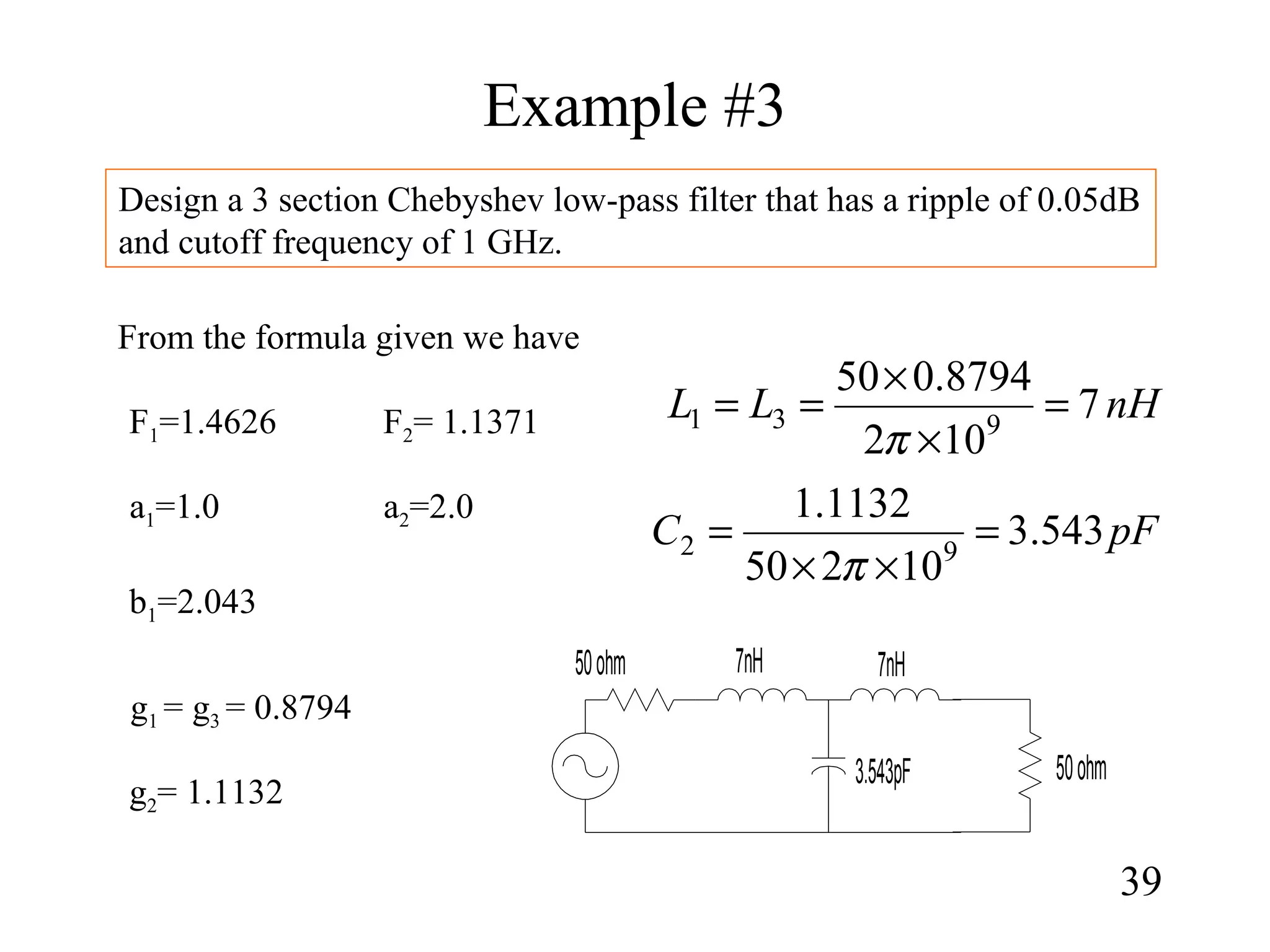
Design a 3 section Chebyshev low-pass filter that has a ripple of 0.05dB
and cutoff frequency of 1 GHz.
From the formula given we have
g2= 1.1132
g1 = g3 = 0.8794
F1=1.4626 F2= 1.1371
a1=1.0 a2=2.0
b1=2.043
nHLL 7
102
8794.050
931 =
×
×
==
π
pFC 543.3
10250
1132.1
92 =
××
=
π
3.543pF
7nH
50ohm
50ohm 7nH
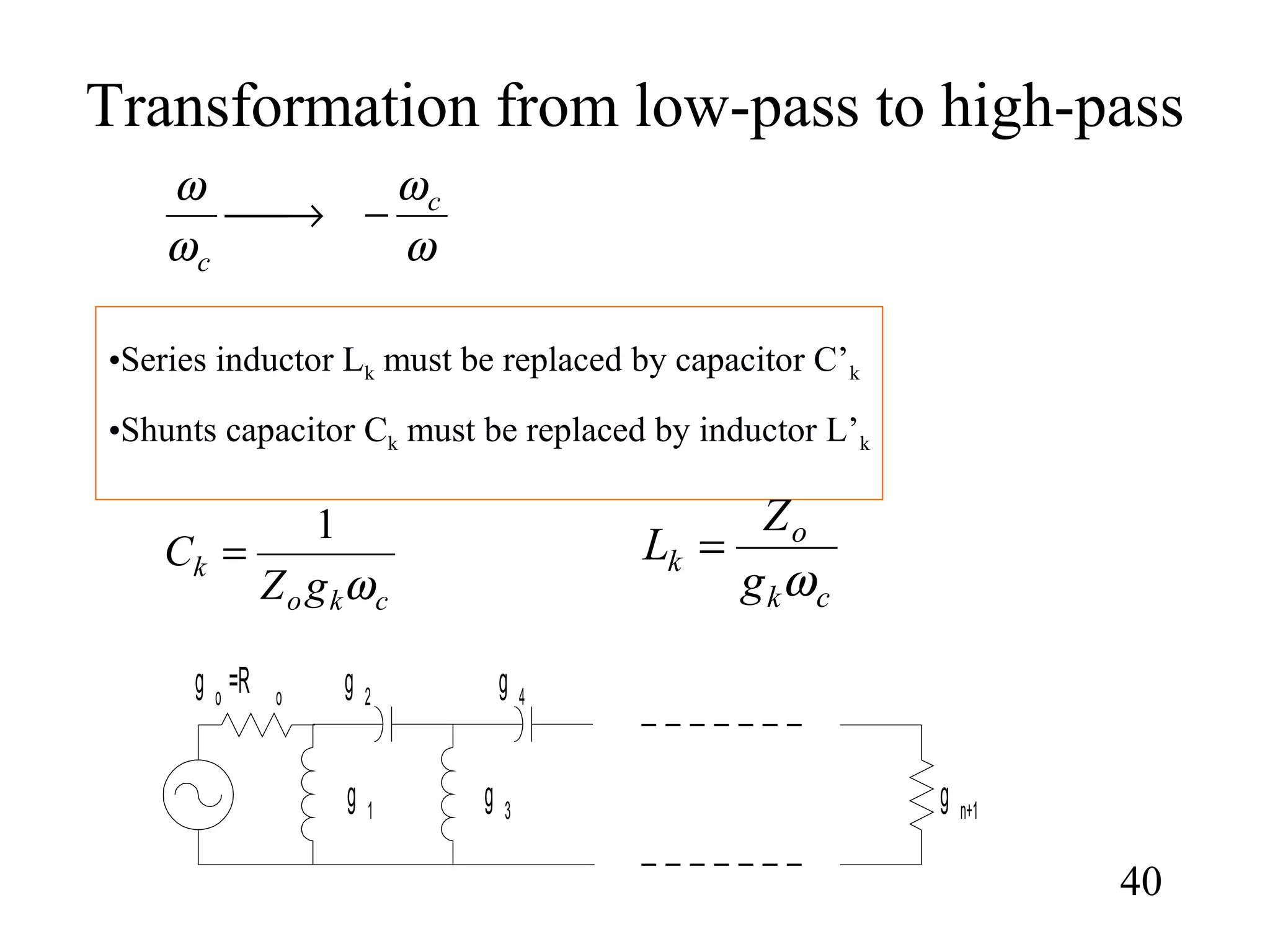
Transformation from low-pass to high-pass
40
•Series inductor Lk must be replaced by capacitor C’k
•Shunts capacitor Ck must be replaced by inductor L’k
ck
o
k
g
Z
L
ω
=
cko
k
gZ
C
ω
1
=
ω
ω
ω
ω c
c
−→
g o =R o
g 1
g 2
g 3
g 4
g n+1
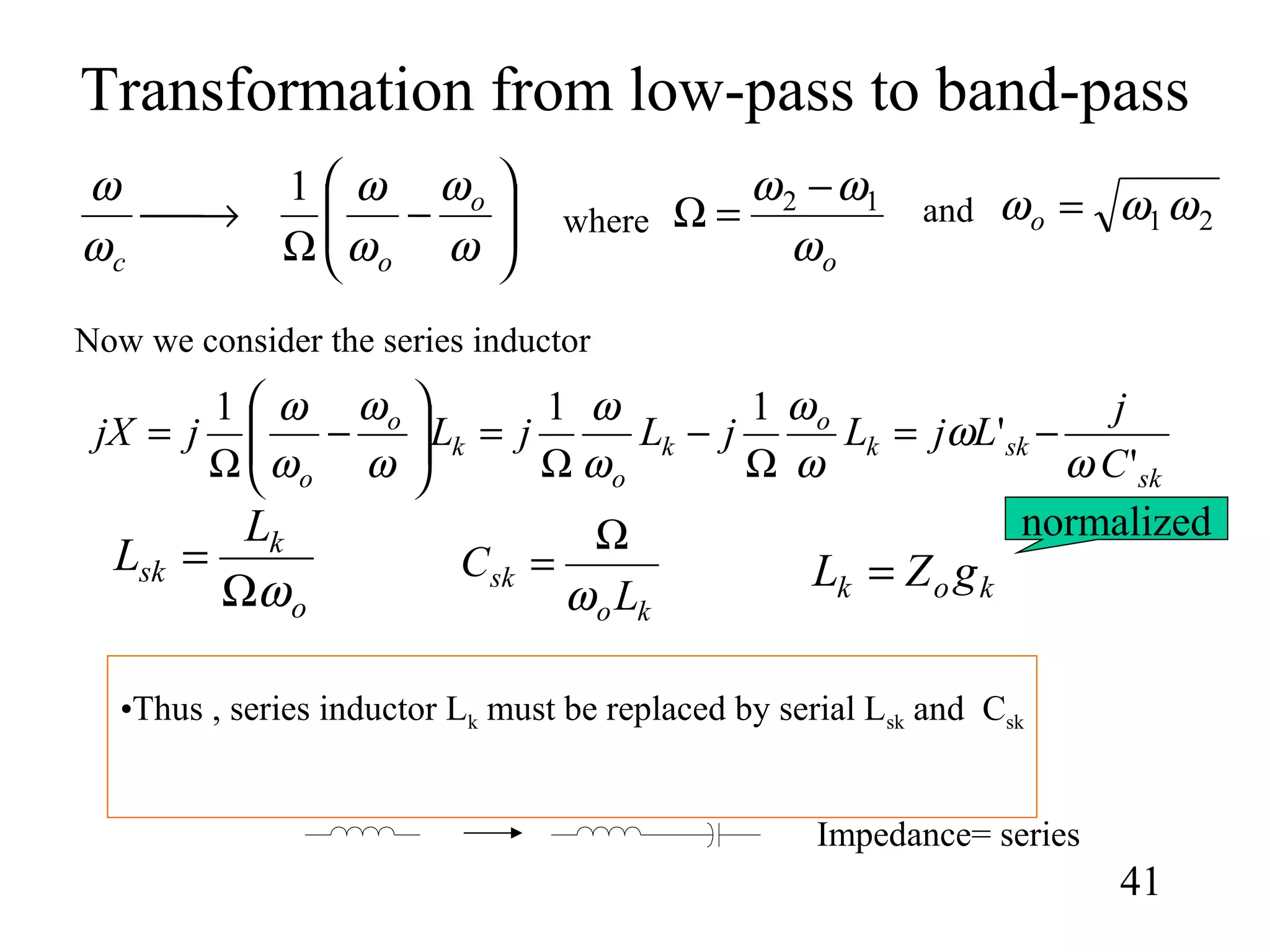
Transformation from low-pass to band-pass
41
•Thus , series inductor Lk must be replaced by serial Lsk and Csk
o
k
sk
L
L
ωΩ
=
ko
sk
L
C
ω
Ω
=






−
Ω
→
ω
ω
ω
ω
ω
ω o
oc
1
where
oω
ωω 12 −
=Ω 21 ωωω =oand
sk
skk
o
k
o
k
o
o C
j
LjLjLjLjjX
'
'
111
ω
ω
ω
ω
ω
ω
ω
ω
ω
ω
−=
Ω
−
Ω
=





−
Ω
=
Now we consider the series inductor
kok gZL =
Impedance= series
normalized
continue
42
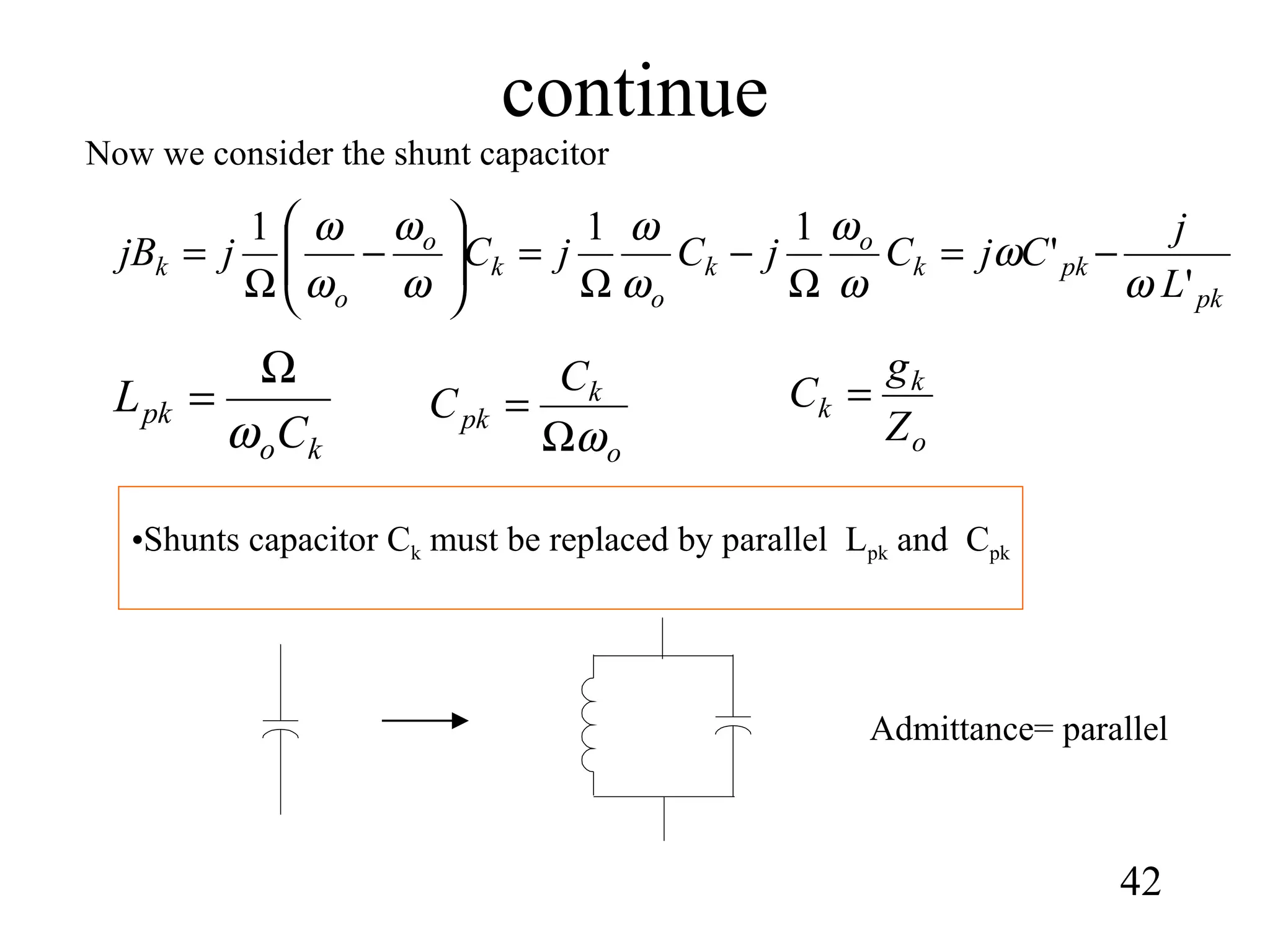
•Shunts capacitor Ck must be replaced by parallel Lpk and Cpk
ko
pk
C
L
ω
Ω
=
o
k
pk
C
C
ωΩ
=
pk
pkk
o
k
o
k
o
o
k
L
j
CjCjCjCjjB
'
'
111
ω
ω
ω
ω
ω
ω
ω
ω
ω
ω
−=
Ω
−
Ω
=





−
Ω
=
Now we consider the shunt capacitor
o
k
k
Z
g
C =
Admittance= parallel
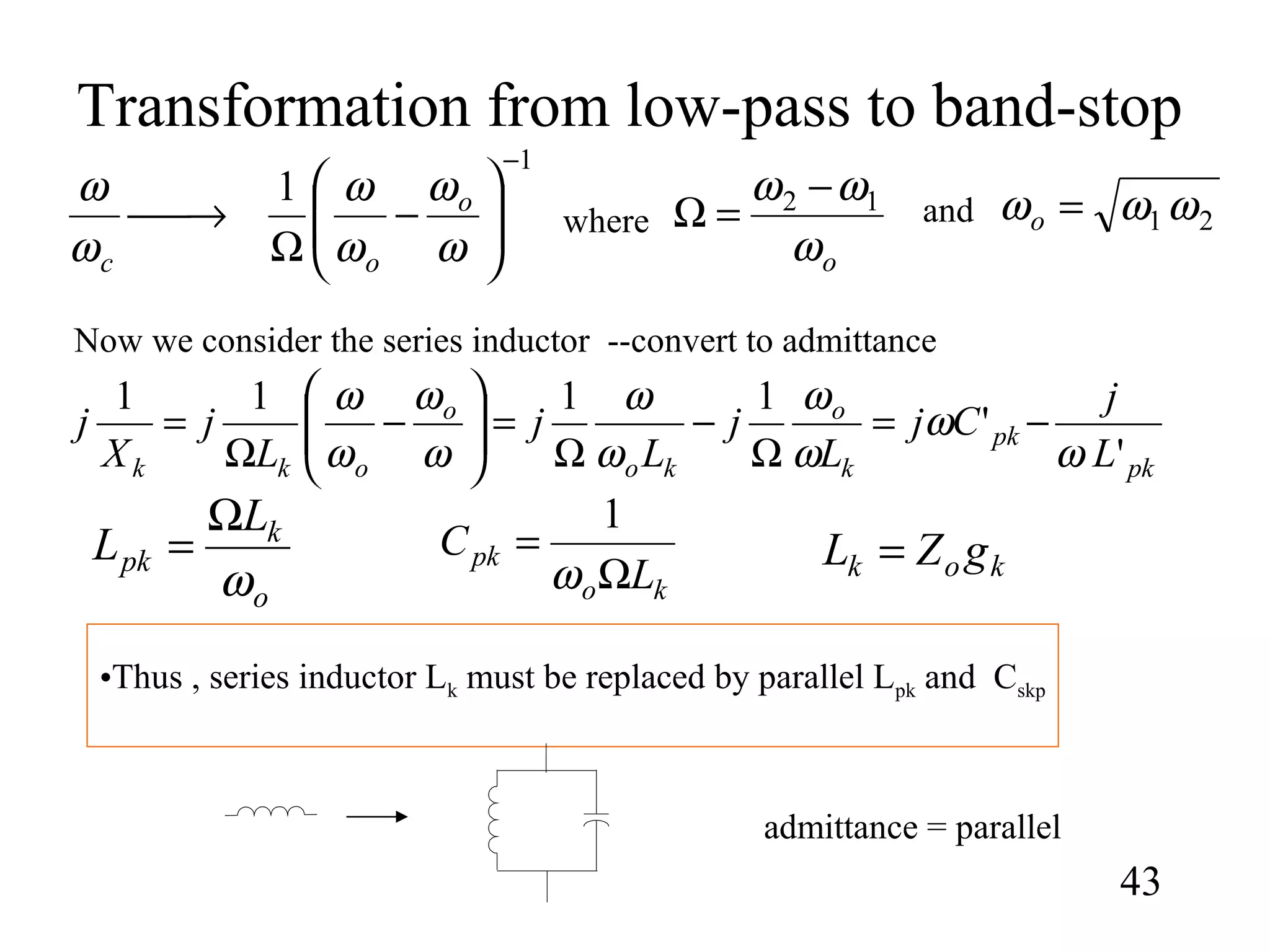
Transformation from low-pass to band-stop
43
•Thus , series inductor Lk must be replaced by parallel Lpk and Cskp
o
k
pk
L
L
ω
Ω
=
ko
pk
L
C
Ω
=
ω
1
1
1
−






−
Ω
→
ω
ω
ω
ω
ω
ω o
oc
where
oω
ωω 12 −
=Ω 21 ωωω =oand
pk
pk
k
o
ko
o
okk L
j
Cj
L
j
L
j
L
j
X
j
'
'
1111
ω
ω
ω
ω
ω
ω
ω
ω
ω
ω
−=
Ω
−
Ω
=





−
Ω
=
Now we consider the series inductor --convert to admittance
kok gZL =
admittance = parallel
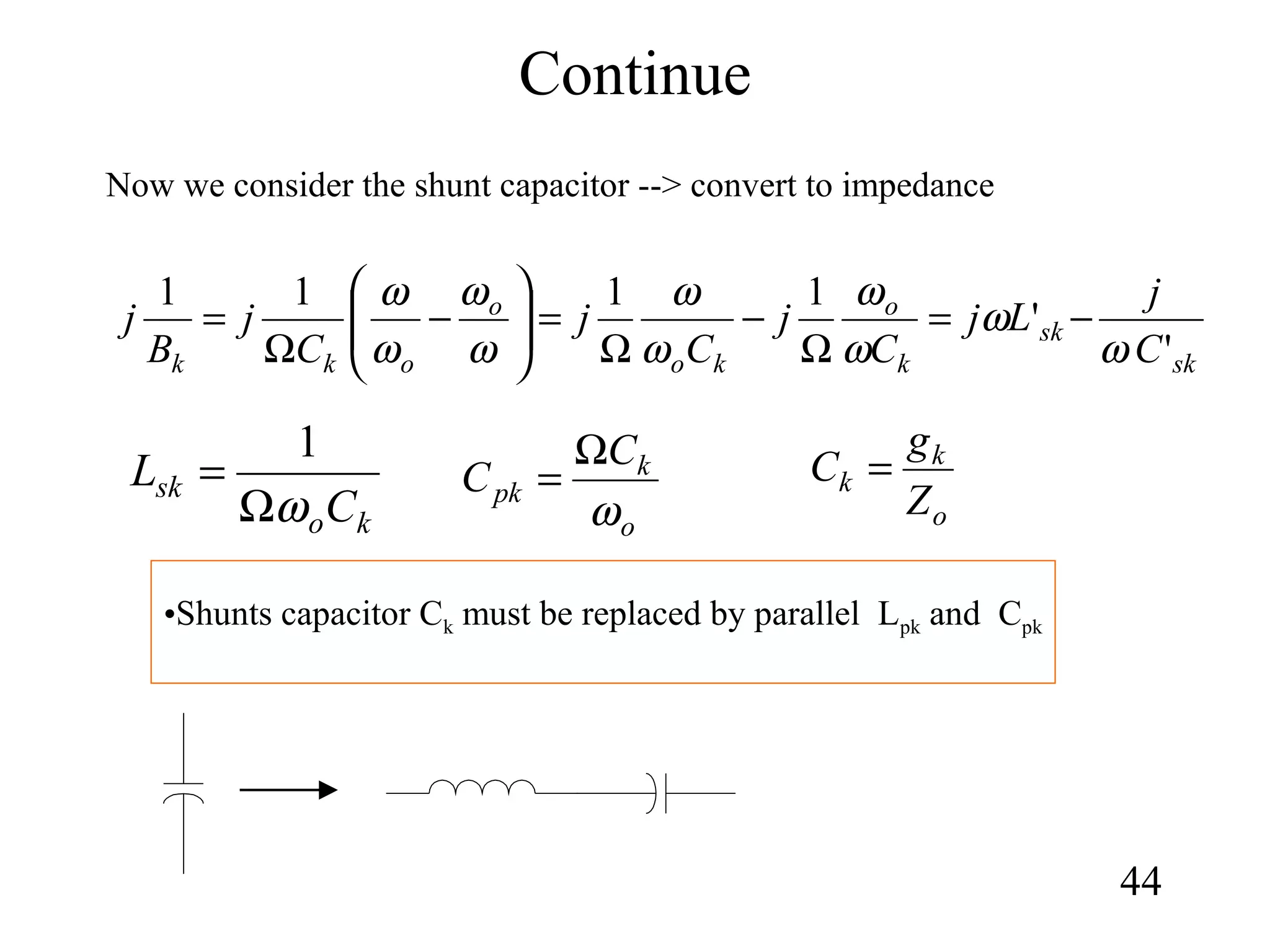
Continue
44
•Shunts capacitor Ck must be replaced by parallel Lpk and Cpk
ko
sk
C
L
ωΩ
=
1
o
k
pk
C
C
ω
Ω
=
sk
sk
k
o
ko
o
okk C
j
Lj
C
j
C
j
C
j
B
j
'
'
1111
ω
ω
ω
ω
ω
ω
ω
ω
ω
ω
−=
Ω
−
Ω
=





−
Ω
=
Now we consider the shunt capacitor --> convert to impedance
o
k
k
Z
g
C =
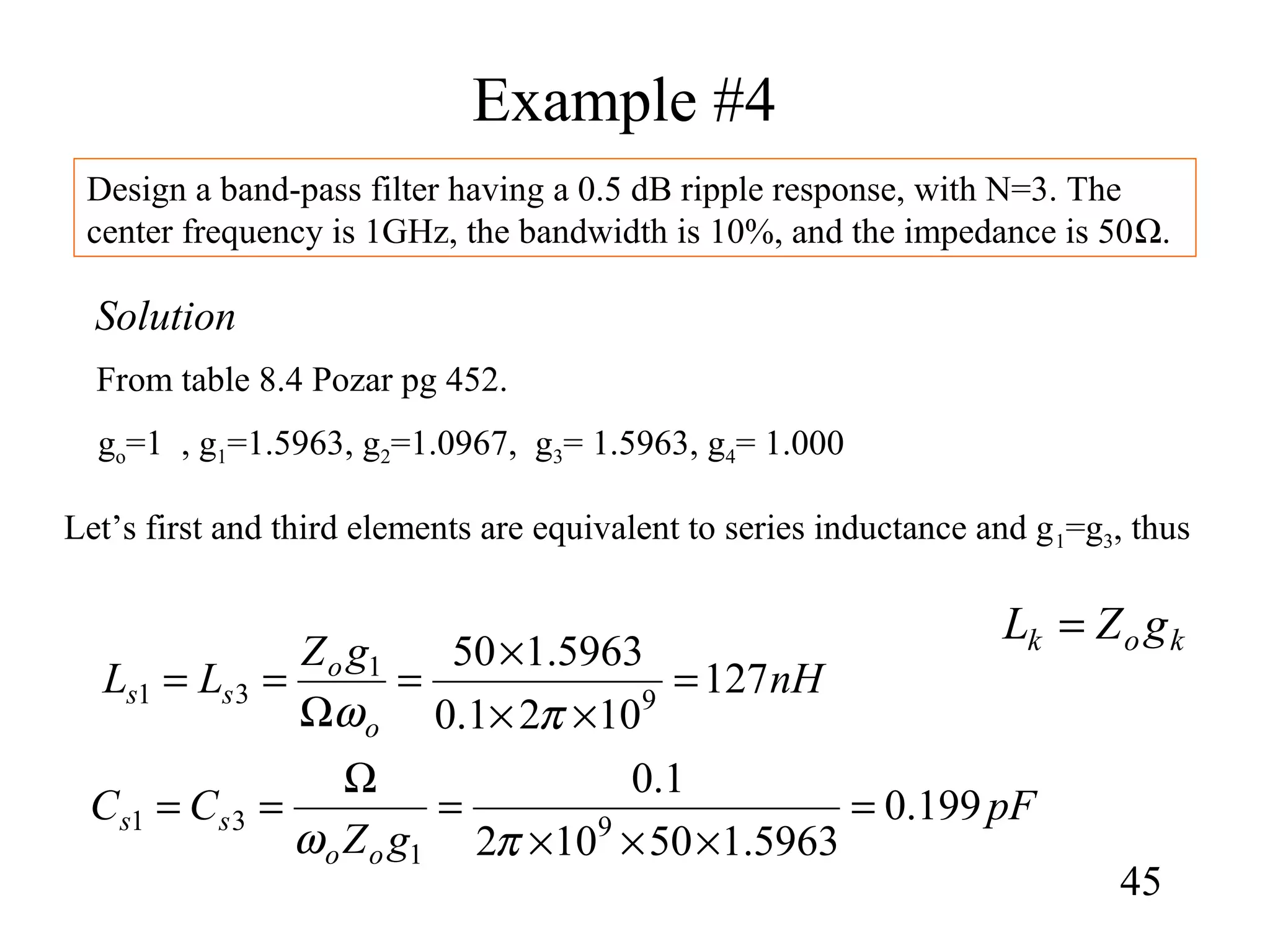
Example #4
45
Design a band-pass filter having a 0.5 dB ripple response, with N=3. The
center frequency is 1GHz, the bandwidth is 10%, and the impedance is 50Ω.
Solution
From table 8.4 Pozar pg 452.
go=1 , g1=1.5963, g2=1.0967, g3= 1.5963, g4= 1.000
Let’s first and third elements are equivalent to series inductance and g1=g3, thus
nH
gZ
LL
o
o
ss 127
1021.0
5963.150
9
1
31 =
××
×
=
Ω
==
πω
pF
gZ
CC
oo
ss 199.0
5963.150102
1.0
9
1
31 =
×××
=
Ω
==
πω
kok gZL =
continue
46
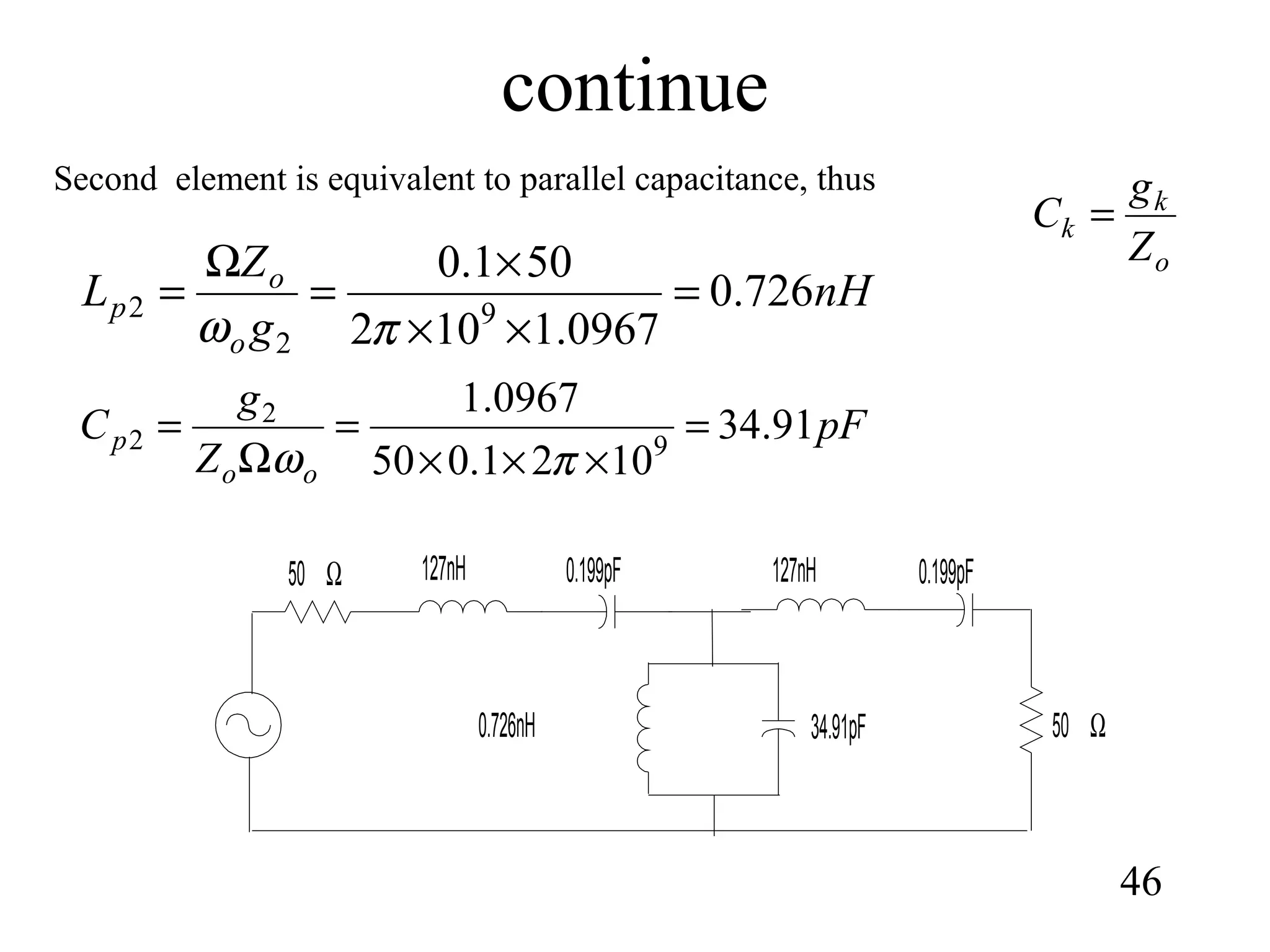
Second element is equivalent to parallel capacitance, thus
nH
g
Z
L
o
o
p 726.0
0967.1102
501.0
9
2
2 =
××
×
=
Ω
=
πω
pF
Z
g
C
oo
p 91.34
1021.050
0967.1
9
2
2 =
×××
=
Ω
=
πω
o
k
k
Z
g
C =
50 Ω 127nH 0.199pF
0.726nH 34.91pF
127nH 0.199pF
50 Ω
Implementation in microstripline
47
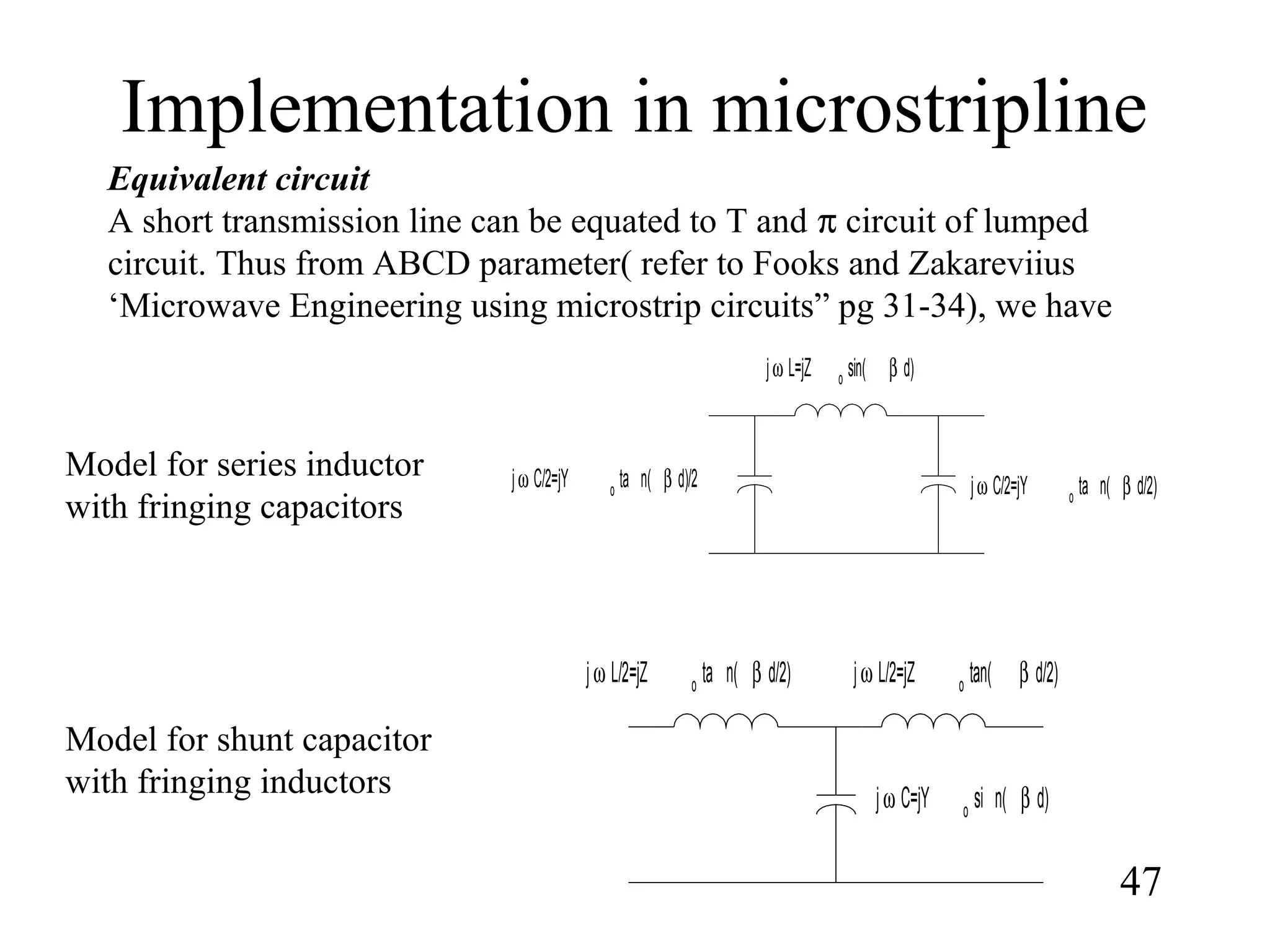
Equivalent circuit
A short transmission line can be equated to T and π circuit of lumped
circuit. Thus from ABCD parameter( refer to Fooks and Zakareviius
‘Microwave Engineering using microstrip circuits” pg 31-34), we have
jω L=jZ o sin( β d)
jω C/2=jY o ta n( β d)/2 jω C/2=jY o ta n( β d/2)
jω L/2=jZ o tan( β d/2)jω L/2=jZ o ta n( β d/2)
jω C=jY o
si n( β d)
Model for series inductor
with fringing capacitors
Model for shunt capacitor
with fringing inductors
48
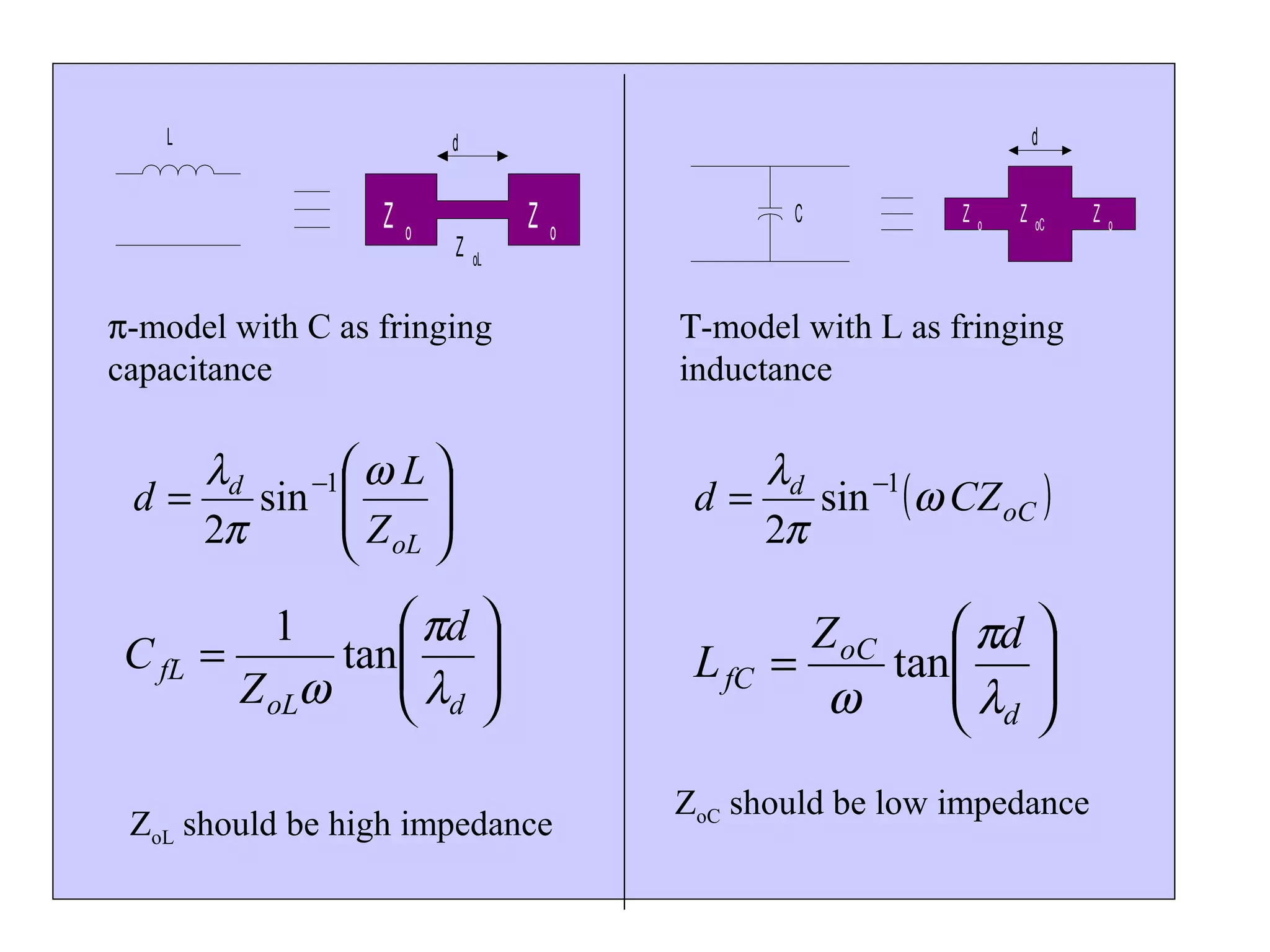
d
Z o
L
Z oL
Z o






=
d
oC
fC
dZ
L
λ
π
ω
tan





=
doL
fL
d
Z
C
λ
π
ω
tan
1
π-model with C as fringing
capacitance
Τ-model with L as fringing
inductance
ZoL should be high impedance
ZoC should be low impedance
d
Z o
Z oC
C Z o






= −
oL
d
Z
L
d
ω
π
λ 1
sin
2
( )oC
d
CZd ω
π
λ 1
sin
2
−
=
Example #5
49
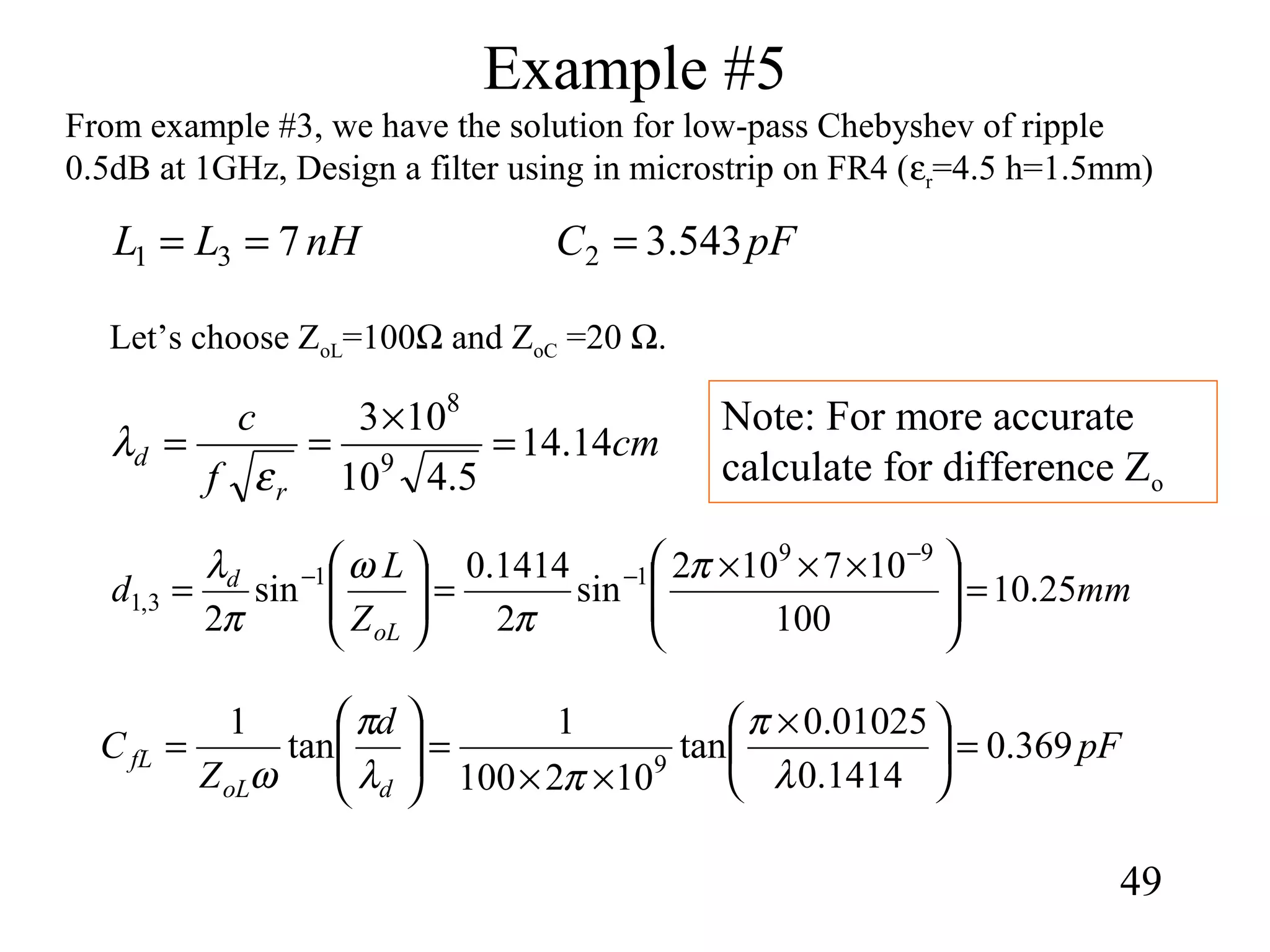
From example #3, we have the solution for low-pass Chebyshev of ripple
0.5dB at 1GHz, Design a filter using in microstrip on FR4 (εr=4.5 h=1.5mm)
nHLL 731 == pFC 543.32 =
Let’s choose ZoL=100Ω and ZoC =20 Ω.
mm
Z
L
d
oL
d
25.10
100
107102
sin
2
1414.0
sin
2
99
11
3,1 =






 ×××
=





=
−
−− π
π
ω
π
λ
cm
f
c
r
d 14.14
5.410
103
9
8
=
×
==
ε
λ
pF
d
Z
C
doL
fL 369.0
1414.0
01025.0
tan
102100
1
tan
1
9
=




 ×
××
=





=
λ
π
πλ
π
ω
Note: For more accurate
calculate for difference Zo
continue
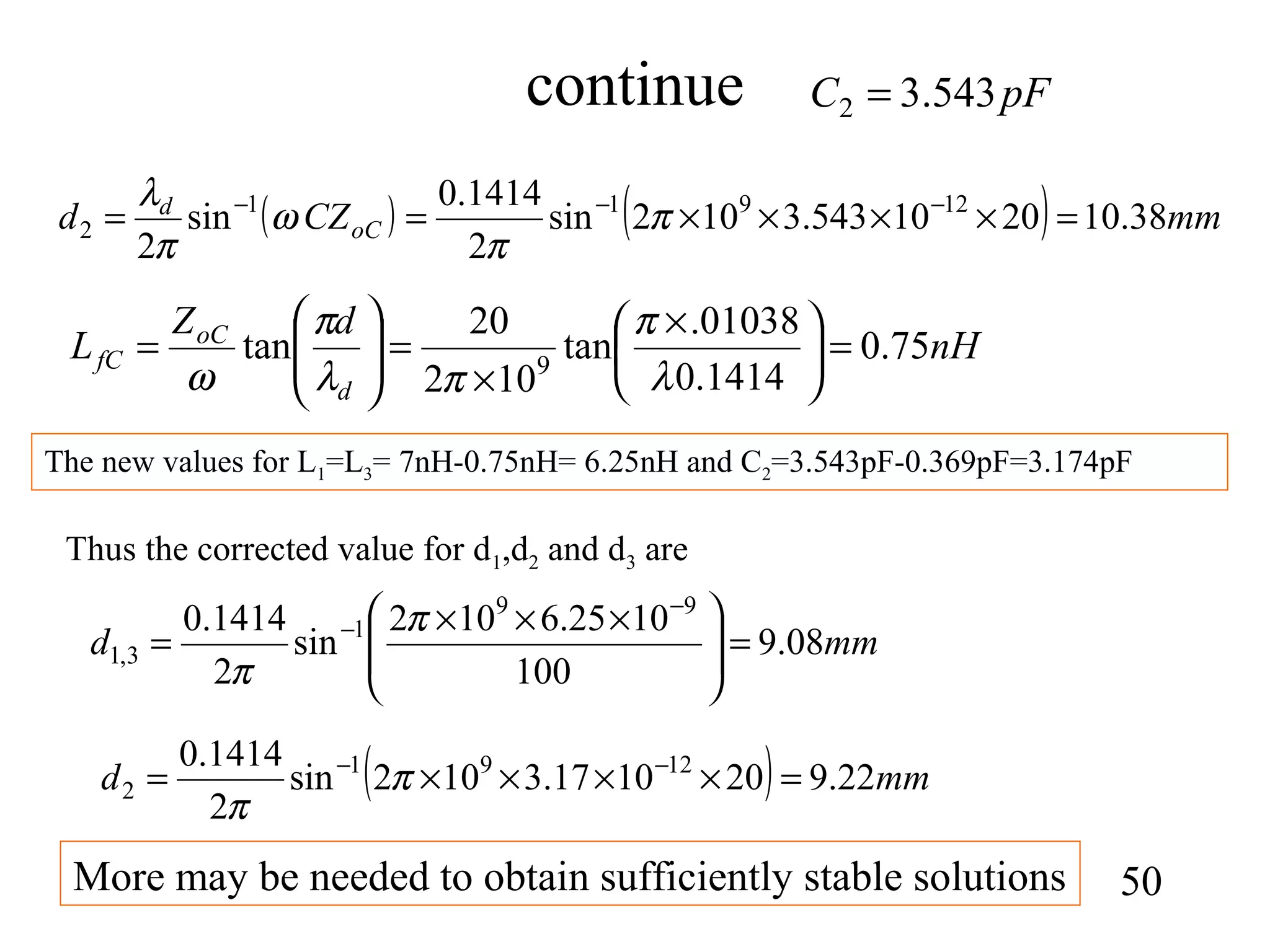
50
( ) ( ) mmCZd oC
d
38.102010543.3102sin
2
1414.0
sin
2
12911
2 =××××== −−−
π
π
ω
π
λ
nH
dZ
L
d
oC
fC 75.0
1414.0
01038.
tan
102
20
tan 9
=




 ×
×
=





=
λ
π
πλ
π
ω
pFC 543.32 =
The new values for L1=L3= 7nH-0.75nH= 6.25nH and C2=3.543pF-0.369pF=3.174pF
Thus the corrected value for d1,d2 and d3 are
mmd 08.9
100
1025.6102
sin
2
1414.0 99
1
3,1 =






 ×××
=
−
− π
π
( ) mmd 22.9201017.3102sin
2
1414.0 1291
2 =××××= −−
π
π
More may be needed to obtain sufficiently stable solutions
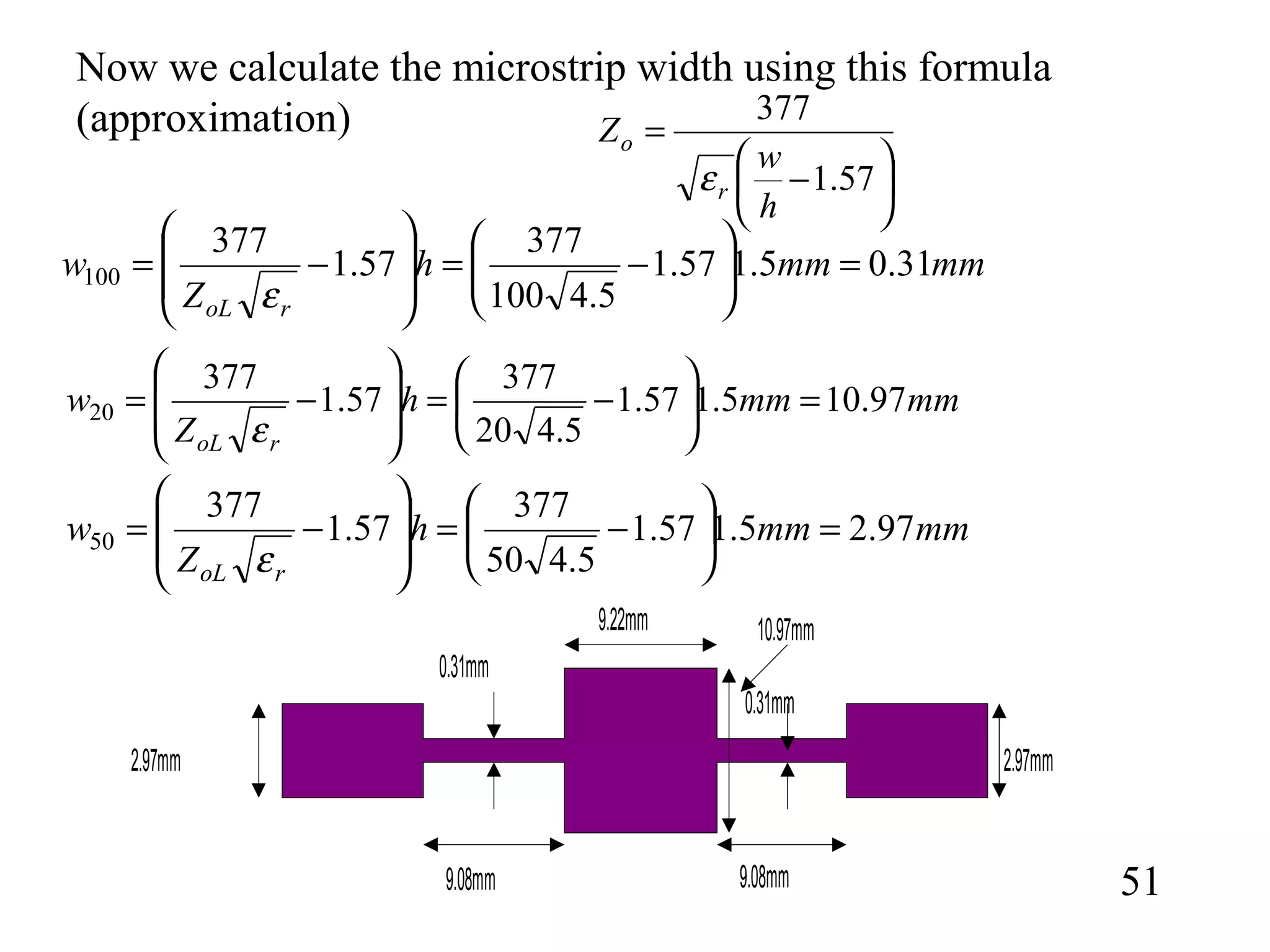
51
mmmmh
Z
w
roL
31.05.157.1
5.4100
377
57.1
377
100 =





−=








−=
ε
mmmmh
Z
w
roL
97.105.157.1
5.420
377
57.1
377
20 =





−=








−=
ε






−
=
57.1
377
h
w
Z
r
o
ε
Now we calculate the microstrip width using this formula
(approximation)
mmmmh
Z
w
roL
97.25.157.1
5.450
377
57.1
377
50 =





−=








−=
ε
10.97mm
2.97mm
0.31mm
9.08mm
9.22mm
9.08mm
2.97mm
0.31mm
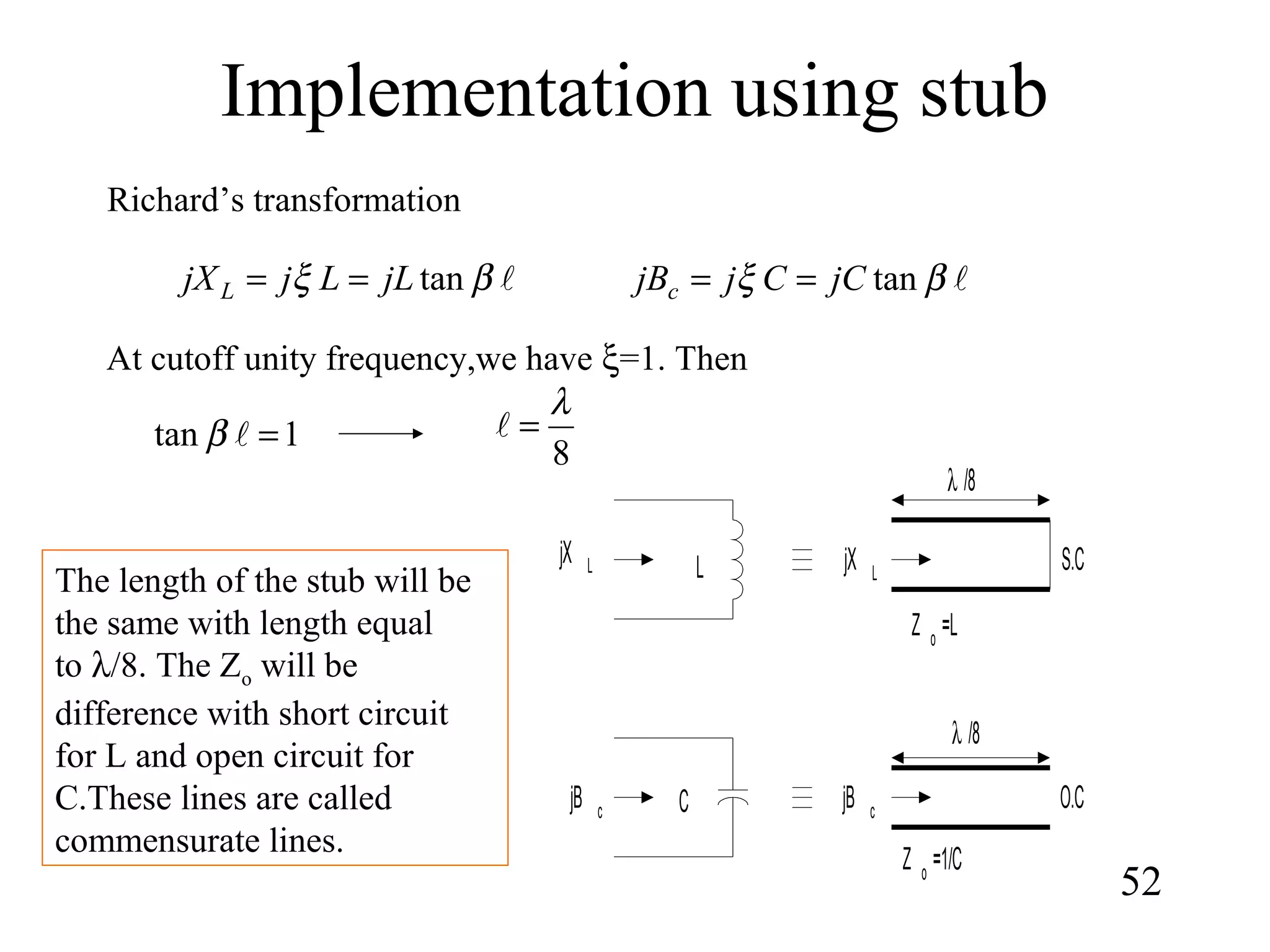
Implementation using stub
52
Richard’s transformation
βξ tanjLLjjXL == βξ tanjCCjjBc ==
At cutoff unity frequency,we have ξ=1. Then
1tan =β
8
λ
=
L
C
jX L
jB c
λ /8
S.C
O.C
Z o =L
Z o =1/C
jX L
jB c
λ /8
The length of the stub will be
the same with length equal
to λ/8. The Zo will be
difference with short circuit
for L and open circuit for
C.These lines are called
commensurate lines.
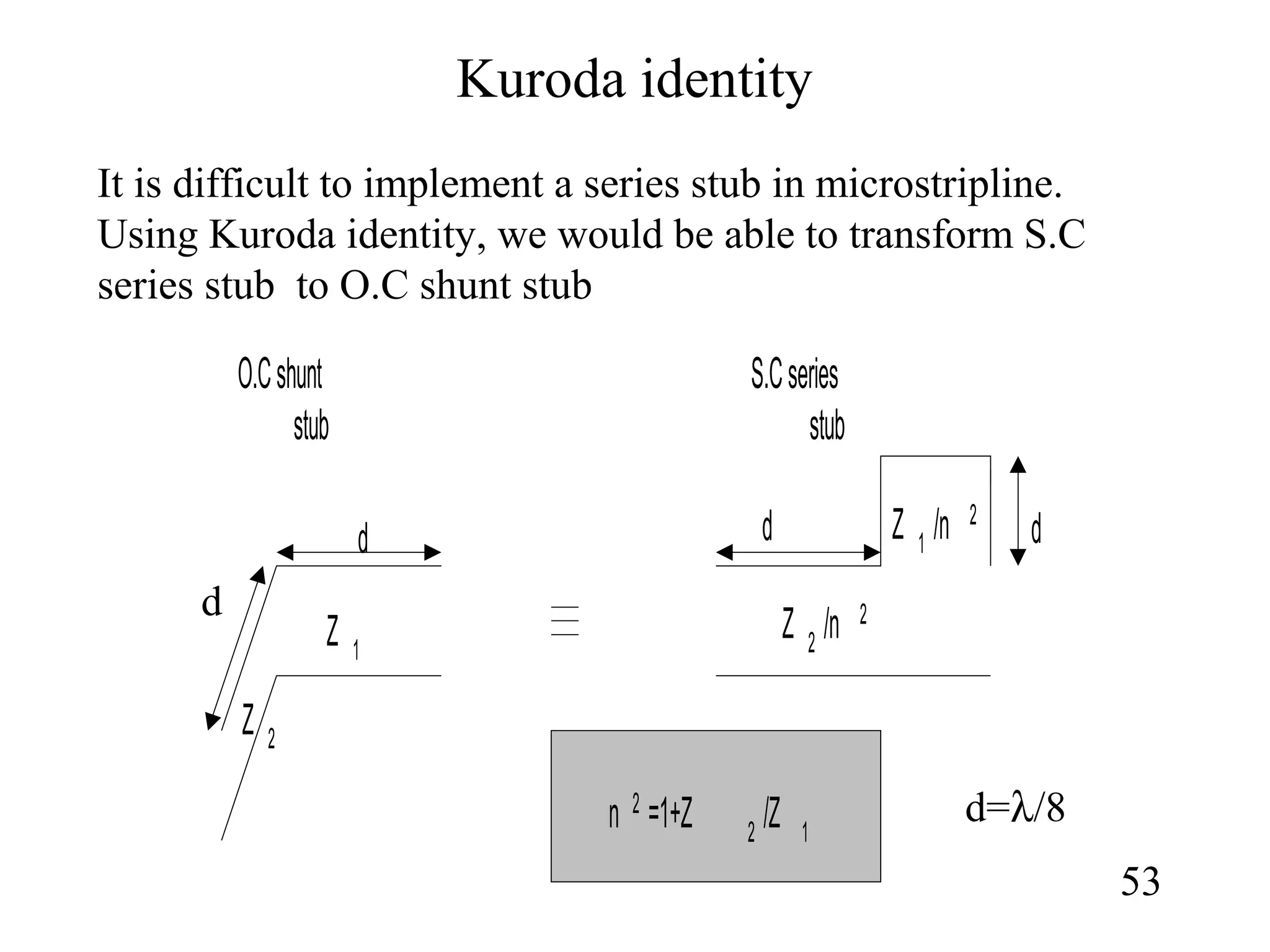
Kuroda identity
53
It is difficult to implement a series stub in microstripline.
Using Kuroda identity, we would be able to transform S.C
series stub to O.C shunt stub
d
d d d
S.Cseries
stub
O.Cshunt
stub
Z 1
Z 2
/n 2
n 2
=1+Z 2 /Z 1
Z 1 /n 2
Z 2
d=λ/8
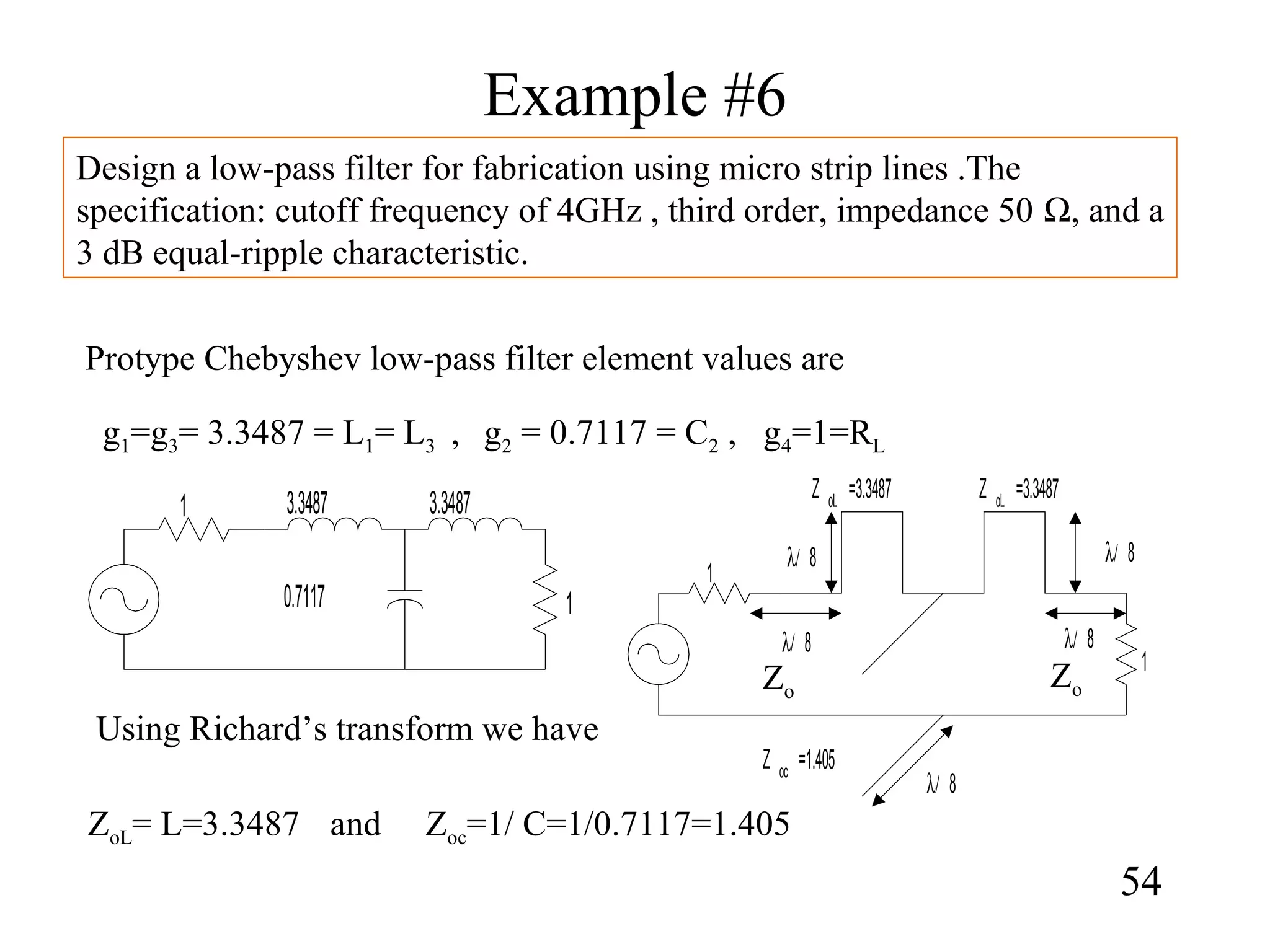
Example #6
54
Design a low-pass filter for fabrication using micro strip lines .The
specification: cutoff frequency of 4GHz , third order, impedance 50 Ω, and a
3 dB equal-ripple characteristic.
Protype Chebyshev low-pass filter element values are
g1=g3= 3.3487 = L1= L3 , g2 = 0.7117 = C2 , g4=1=RL
1
1 3.3487
0.7117
3.3487
Using Richard’s transform we have
ZoL= L=3.3487 Zoc=1/ C=1/0.7117=1.405and
1
λ/ 8
1
λ/ 8
λ/ 8
λ/ 8
λ/ 8
Z oc =1.405
Z oL =3.3487Z oL =3.3487
Zo
Zo
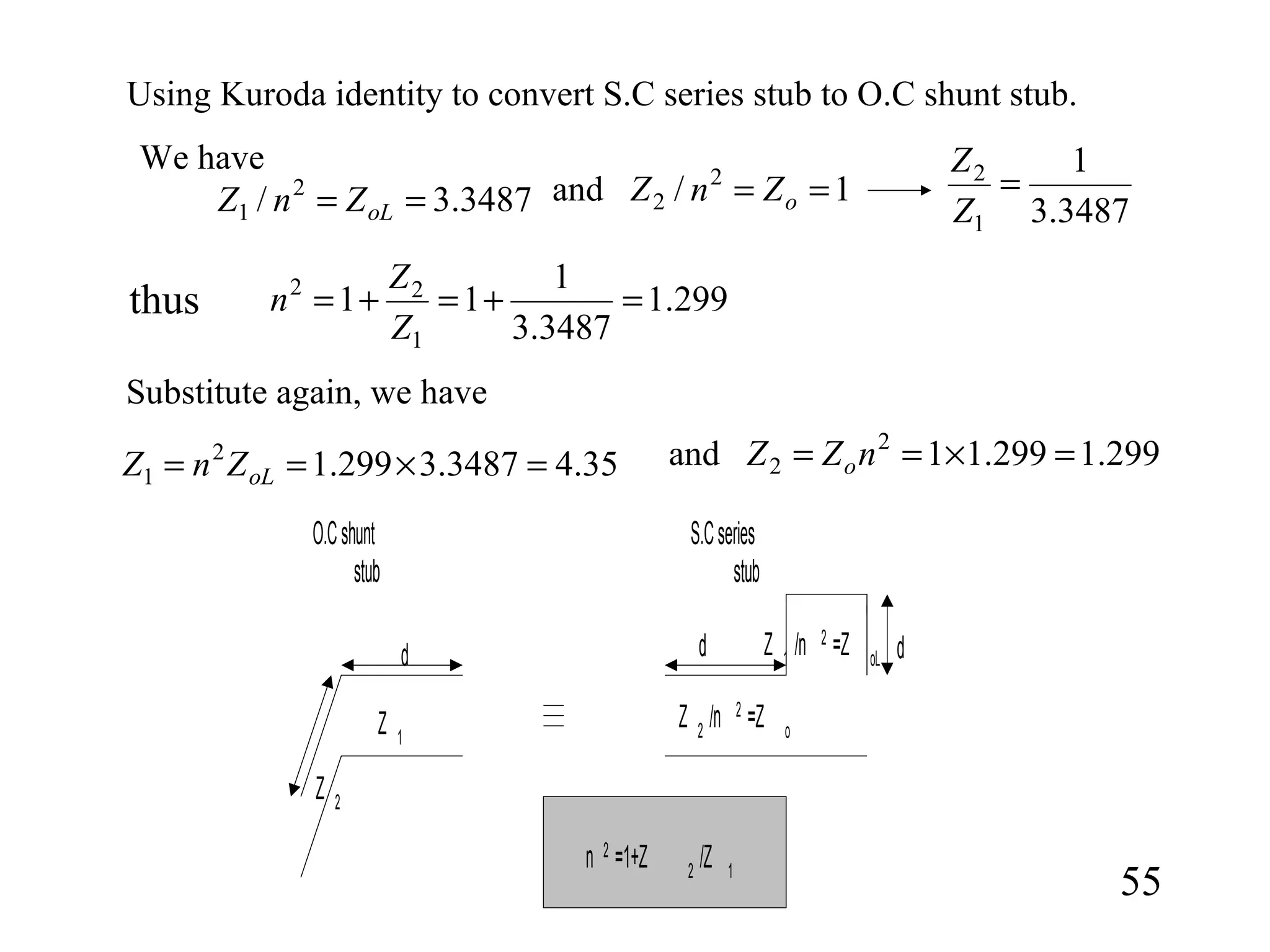
Using Kuroda identity to convert S.C series stub to O.C shunt stub.
299.1
3487.3
1
11
1
22
=+=+=
Z
Z
n
3487.3
1
1
2
=
Z
Z
3487.3/ 2
1 == oLZnZ 1/ 2
2 == oZnZ
thus
We have
and
Substitute again, we have
35.43487.3299.12
1 =×== oLZnZ 299.1299.112
2 =×== nZZ oand
55
d d d
S.Cseries
stub
O.Cshunt
stub
Z 1
Z 2 /n 2
=Z o
n 2 =1+Z 2
/Z 1
Z 1
/n 2 =Z oL
Z 2
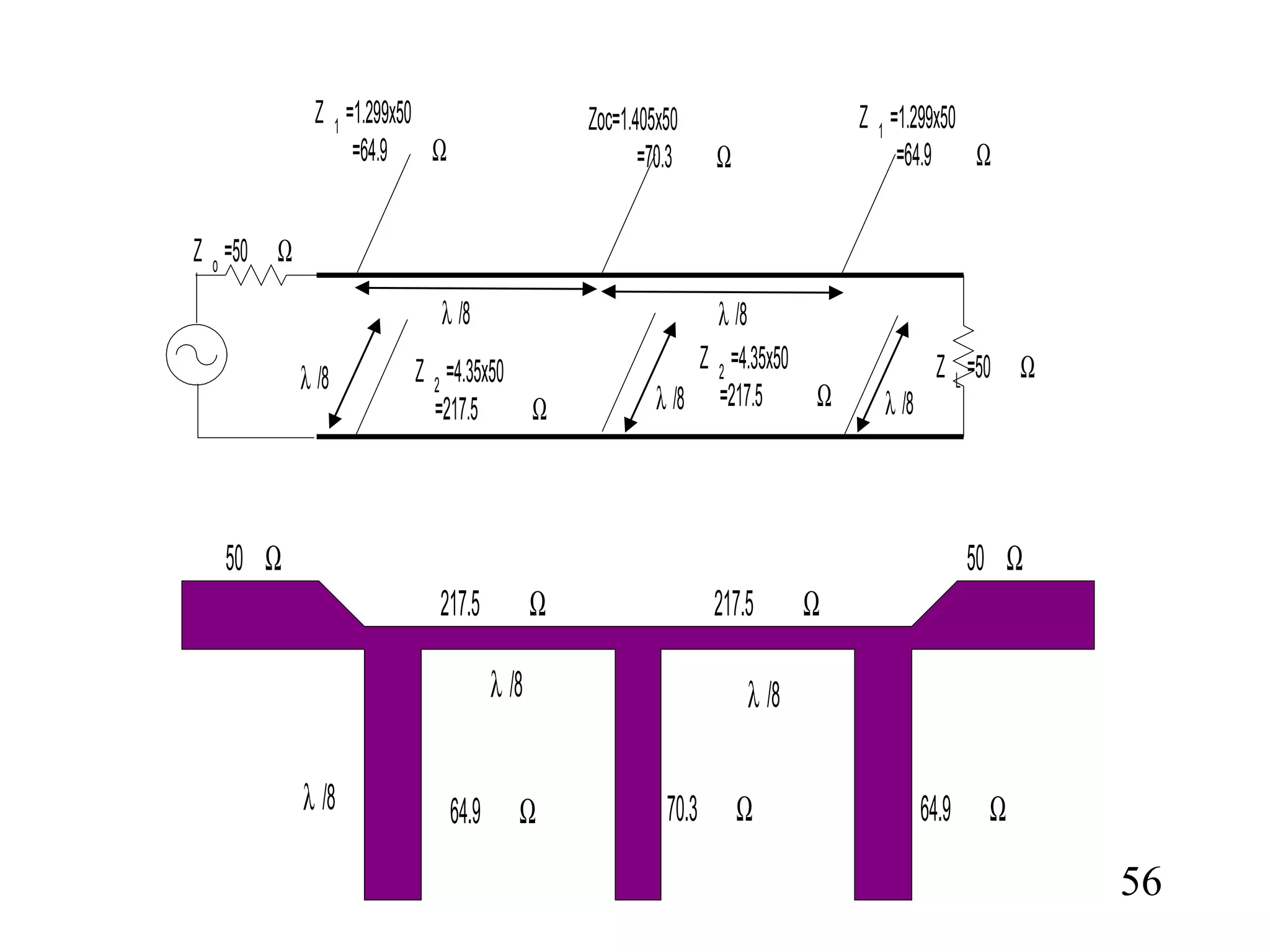
50 Ω
217.5 Ω
64.9 Ω 70.3 Ω
λ /8
64.9 Ωλ /8
λ /8
217.5 Ω
50 Ω
56
λ /8
λ /8
λ /8
λ /8
λ /8
Z o =50 Ω
Z 2 =4.35x50
=217.5 Ω
Z 1
=1.299x50
=64.9 Ω
Zoc=1.405x50
=70.3 Ω
Z L =50 Ω
Z 1 =1.299x50
=64.9 Ω
Z 2 =4.35x50
=217.5 Ω
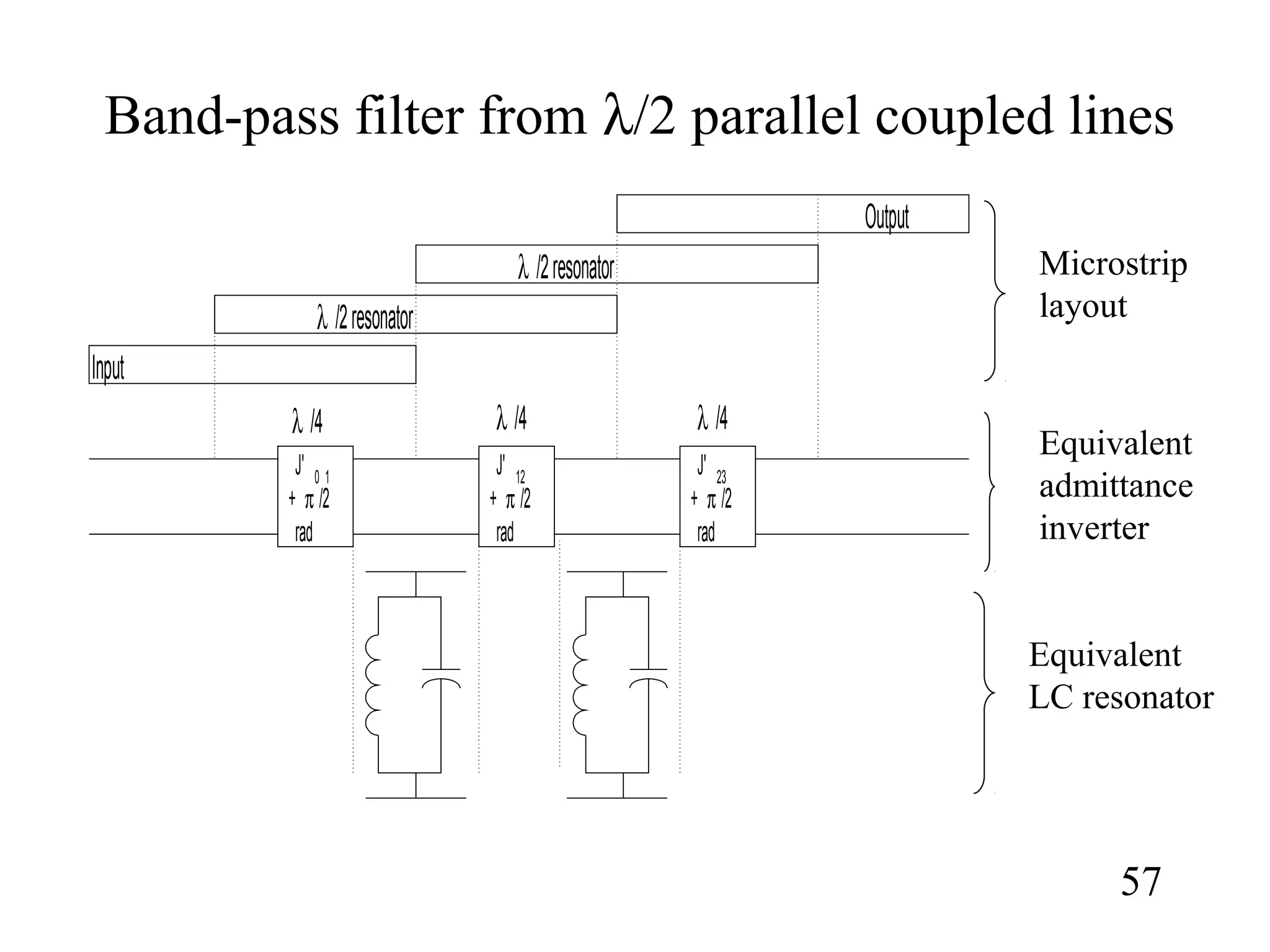
Band-pass filter from λ/2 parallel coupled lines
57
Input
λ /2resonator
λ /2resonator
Output
J' 0 1
+ π /2
rad
J' 23
+ π /2
rad
J' 12
+ π /2
rad
λ /4 λ /4λ /4
Microstrip
layout
Equivalent
admittance
inverter
Equivalent
LC resonator
Required admittance inverter parameters
58
2
1
10
01
2
'





 Ω
=
gg
J
π
1,...2,1
1
2
'
1
1, −=×
Ω
=
+
+ nkfor
gg
J
kk
kk
π
tionsofnon
gg
J
nn
nn sec.
2
'
2
1
1
1, =





 Ω
=
+
+
π
oω
ωω 12 −
=Ω
The normalized admittance inverter is given by
[ ]2
1,1,1, ''1, +++ ++= kkkkokkoe JJZZ
[ ]2
1,1,1,, ''1 +++ +−= kkkkokkoo JJZZ
okkkk ZJJ 1,1,' ++ =where
where A
B
C
D
E
Example #7
59
Design a coupled line bandpass filter with n=3 and a 0.5dB equi-ripple
response on substrate er=10 and h=1mm. The center frequency is 2 GHz, the
bandwidth is 10% and Zo=50Ω.
We have g0=1 , g1=1.5963, g2=1.0967, g3=1.5963, g4= 1 and Ω=0.1
3137.0
5963.112
1.0
2
'
2
1
2
1
10
01 =






××
×
=





 Ω
=
ππ
gg
J
[ ] Ω=++== 61.703137.03137.0150,, 2
4,31,0 oeoe ZZ
[ ] Ω=+−== 24.393137.03137.0150 2
4,3,1,0, oooo ZZ
3137.0
15963.12
1.0
2
'
2
1
2
1
43
4,3 =






××
×
=





 Ω
=
ππ
gg
J
A
C
D
E
60
1187.0
0967.15963.1
1
2
1.01
2
'
21
2,1 =
×
×
×
=×
Ω
=
ππ
gg
J
1187.0
5963.10967.1
1
2
1.01
2
'
32
3,2 =
×
×
×
=×
Ω
=
ππ
gg
JB
B
[ ] Ω=++== 64.561187.01187.0150,, 2
3,22,1 oeoe ZZ
[ ] Ω=+−== 77.441187.01187.0150 2
3,2,2,1, oooo ZZ
D
E
Using the graph Fig 7.30 in Pozar pg388 we would be able to determine the
required s/h and w/h of microstripline with εr=10. For others use other means.
m
f r
r 01767.0
101024
103
2
103
4/ 9
88
=
××
×
=
×
=
ε
λThe required resonator
61
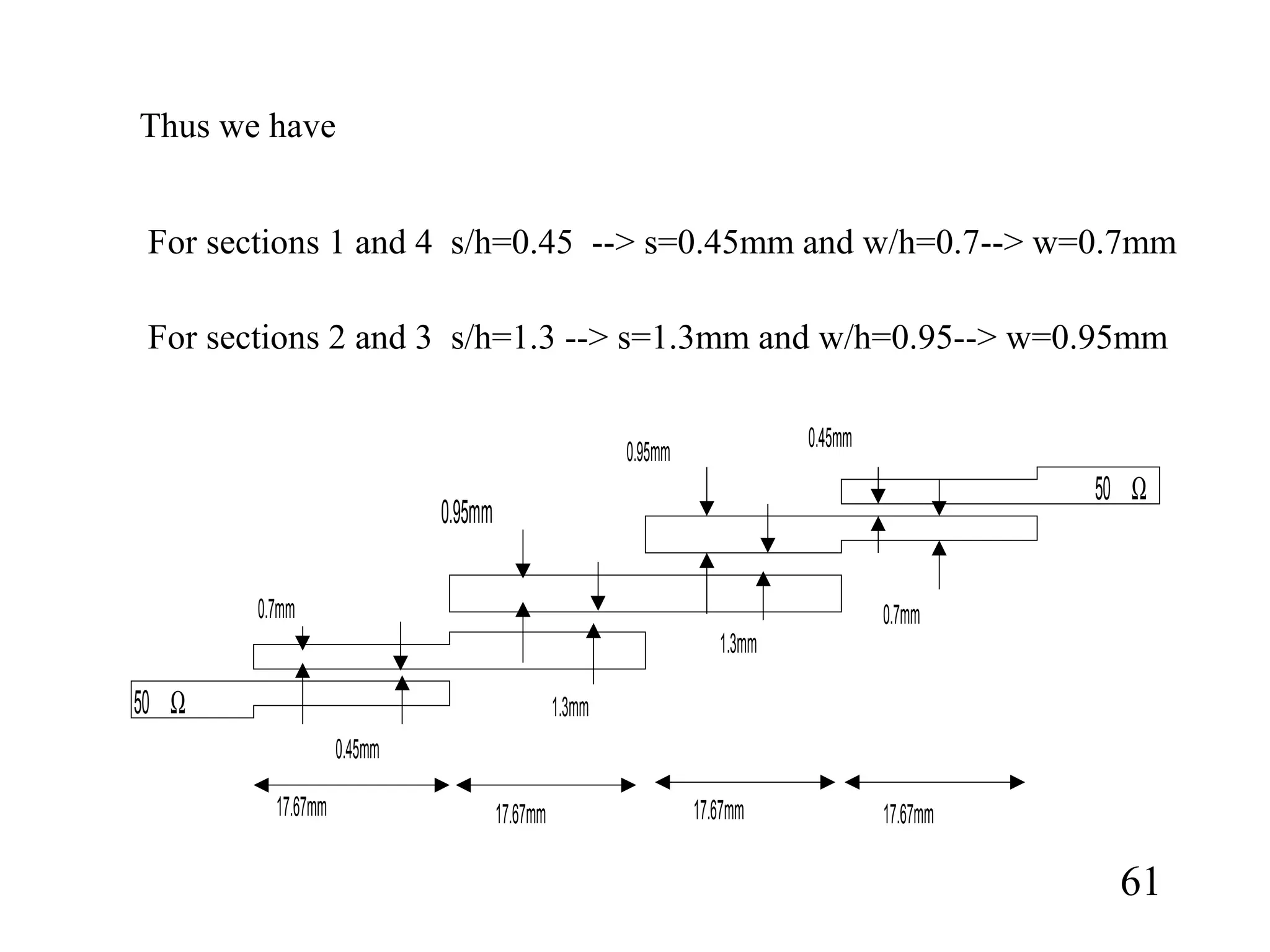
Thus we have
For sections 1 and 4 s/h=0.45 --> s=0.45mm and w/h=0.7--> w=0.7mm
For sections 2 and 3 s/h=1.3 --> s=1.3mm and w/h=0.95--> w=0.95mm
50 Ω
50 Ω
0.7mm
0.45mm
0.95mm
1.3mm
0.95mm
1.3mm
0.45mm
0.7mm
17.67mm 17.67mm 17.67mm 17.67mm
Band-pass and band-stop filter using quarter-wave stubs
62
n
o
on
g
Z
Z
4
Ω
=
π
n
o
on
g
Z
Z
Ω
=
π
4
Band-pass
Band-stop
....
Z 01
Z 02 Z on-1
Z on
Z o
Z oZ oZ o
Z o
λ /4
λ /4λ /4λ /4λ /4
λ /4
....
Z 01
Z 02
Z on-1 Z on
Z o
Z oZ oZ o
Z o
λ /4
λ /4λ /4λ /4λ /4
λ /4
Example #8
63
Design a band-stop filter using three quarter-wave open-circuit stubs . The
center frequency is 2GHz , the bandwidth is 15%, and the impedance is 50W.
Use an equi-ripple response, with a 0.5dB ripple level.
We have g0=1 , g1=1.5963, g2=1.0967, g3=1.5963, g4= 1 and Ω=0.1
n
o
on
g
Z
Znote
Ω
=
π
4
:
Ω=
××
×
== 9.265
5963.115.0
504
031
π
ZZo
Ω=
××
×
= 387
0967.115.0
504
2
π
oZ
50 Ω
λ /4
265.9Ω
387Ω
265.9Ω
λ /4
λ/4
λ/4
λ/4
Note that: It is difficult to
impliment on microstripline
or stripline for characteristic
> 150Ω.
Capacitive coupled resonator band-pass filter
64
Z o Z oZ oZ o
....
B 2B 1
θ 2θ 1
B n+1
Z o
θ n
2
1
10
01
2
'





 Ω
=
gg
J
π
1,...2,1
1
2
'
1
1, −=×
Ω
=
+
+ nkfor
gg
J
kk
kk
π
tionsofnon
gg
J
nn
nn sec.
2
'
2
1
1
1, =





 Ω
=
+
+
π
oω
ωω 12 −
=Ωwhere
( )2
1 io
i
i
JZ
J
B
−
=
( )[ ] ( )[ ]1
11
2tan
2
1
2tan
2
1
+
−−
++= ioioi BZBZπθ
i=1,2,3….n
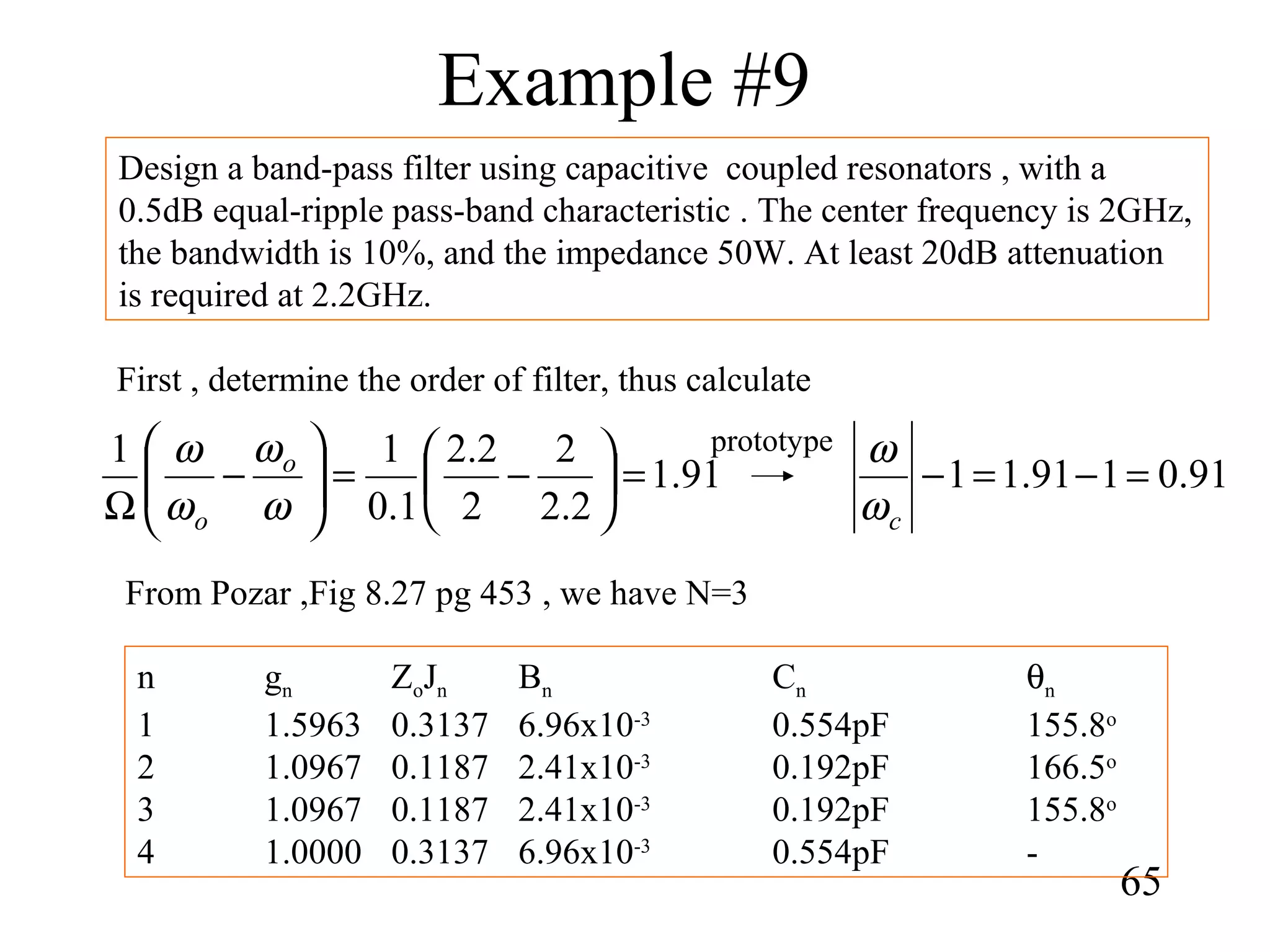
Example #9
65
Design a band-pass filter using capacitive coupled resonators , with a
0.5dB equal-ripple pass-band characteristic . The center frequency is 2GHz,
the bandwidth is 10%, and the impedance 50W. At least 20dB attenuation
is required at 2.2GHz.
First , determine the order of filter, thus calculate
91.1
2.2
2
2
2.2
1.0
11
=





−=





−
Ω ω
ω
ω
ω o
o
91.0191.11 =−=−
cω
ω
From Pozar ,Fig 8.27 pg 453 , we have N=3
prototype
n gn ZoJn Bn Cn θn
1 1.5963 0.3137 6.96x10⁻³
0.554pF 155.8o
2 1.0967 0.1187 2.41x10⁻³
0.192pF 166.5o
3 1.0967 0.1187 2.41x10⁻³
0.192pF 155.8o
4 1.0000 0.3137 6.96x10⁻³
0.554pF -
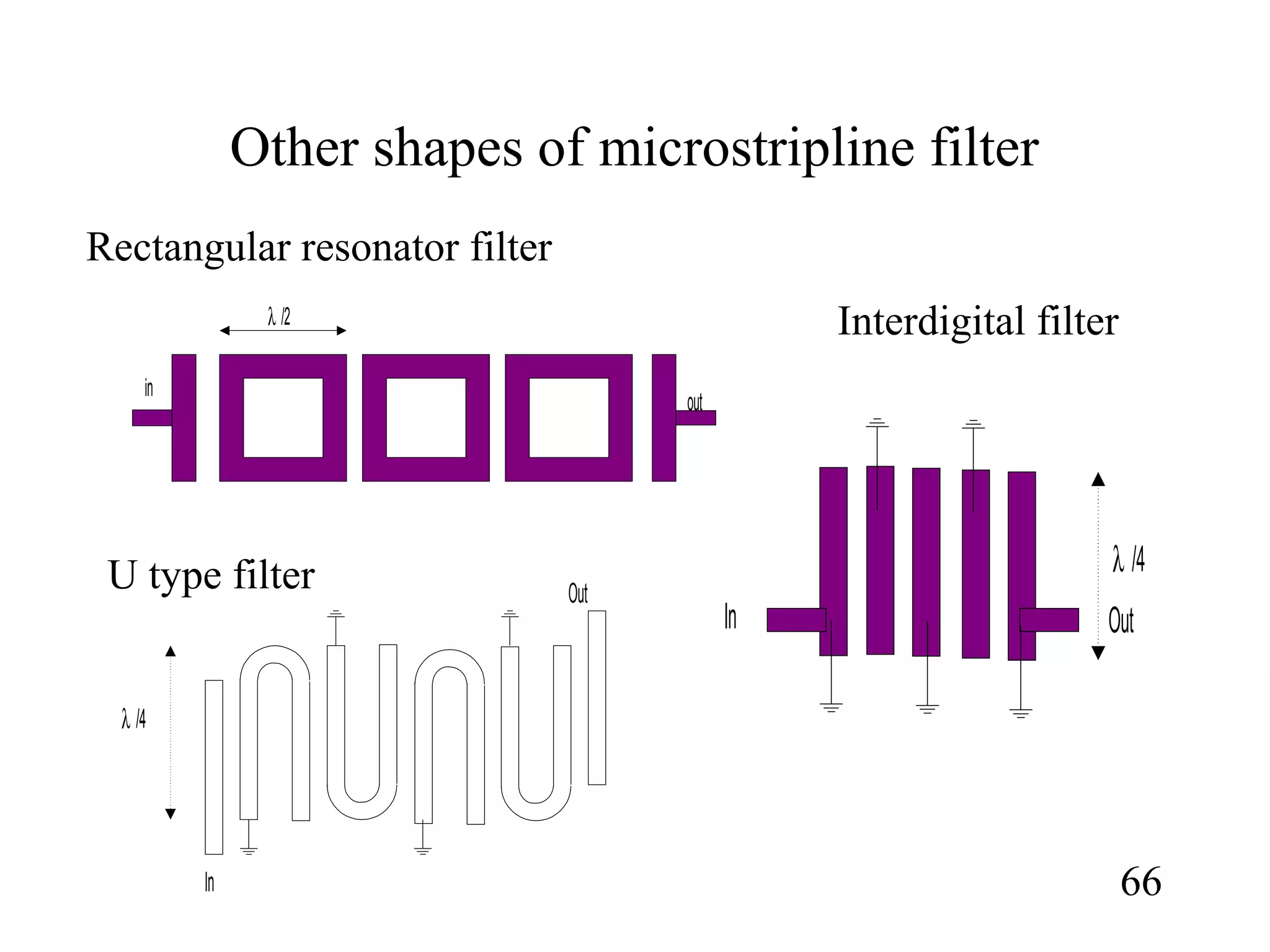
Other shapes of microstripline filter
66
Rectangular resonator filter
U type filter
λ /4
In
Out
λ /4
In Out
Interdigital filterλ /2
in
out
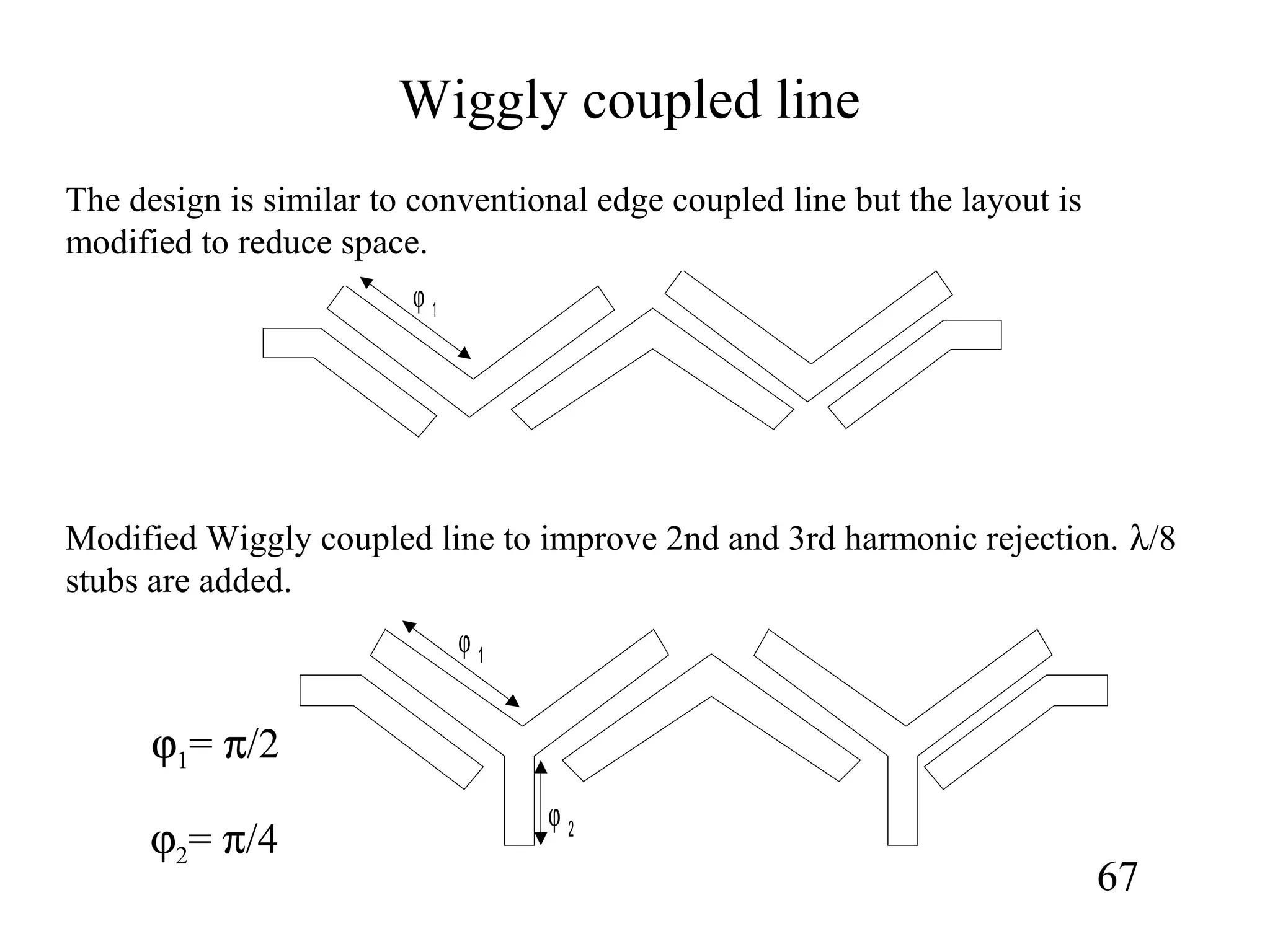
Wiggly coupled line
ϕ 1
ϕ 2
67
ϕ1= π/2
ϕ2= π/4
The design is similar to conventional edge coupled line but the layout is
modified to reduce space.
ϕ 1
Modified Wiggly coupled line to improve 2nd and 3rd harmonic rejection. λ/8
stubs are added.

Filter design1

  • 1.
    Microwave Filter Design By ProfessorSyed Idris Syed Hassan Sch of Elect. & Electron Eng Engineering Campus USM Nibong Tebal 14300 SPS Penang
  • 2.
    Contents 2 1. Composite filter 2.LC ladder filter 3. Microwave filter
  • 3.
    Composite filter 3 m=0.6 m=0.6m- derived m<0.6 constant k T π2 1 π2 1 Matching section Matching section High-f cutoff Sharp cutoff ZiT Z iT Z iT Z o Z o m<0.6 for m-derived section is to place the pole near the cutoff frequency(ωc) oZZZZZ =+ 2121 '4/'1'' iTZZZZZ =+ 2121 '4/'1/'' For 1/2 π matching network , we choose the Z’1 and Z’2 of the circuit so that
  • 4.
    Image method       DC BA Z i1Z i2 I 1 I 2 + V 1 - + V 2 - Z in1 Z in2 221 221 DICVI BIAVV += += Let’s say we have image impedance for the network Zi1 and Zi2 Where Zi1= input impedance at port 1 when port 2 is terminated with Zi2 Zi2= input impedance at port 2 when port 1 is terminated with Zi1 Then 4 @ Where Zi2= V2 / I2 and V1 = -Zi1 I1
  • 5.
    ABCD for Tand π network 5 Z 1 /2 Z 1 /2 Z 2 Z 1 2Z 2 2Z 2 T-network π -network             ++ + 2 1 2 2 1 2 1 2 1 2 1 4 1 2 1 Z Z Z Z Z Z Z Z             + ++ 2 1 2 2 2 1 1 2 1 2 1 1 42 1 Z Z Z Z Z Z Z Z
  • 6.
    Image impedance inT and π network 6 Z 1 /2 Z 1 /2 Z 2 Z 1 2Z 2 2Z 2 T-network π -network 2121 4/1 ZZZZZiT += ( ) ( )2 2 2 12121 4//2/1 ZZZZZZe +++=γ iTi ZZZZZZZZ /4/1/ 212121 =+=π ( ) ( )2 2 2 12121 4//2/1 ZZZZZZe +++=γ Image impedance Image impedance Propagation constant Propagation constant Substitute ABCD in terms of Z1 and Z2 Substitute ABCD in terms of Z1 and Z2
  • 7.
  • 8.
    Constant-k section forLow-pass filter using T-network 8 L/2 C L/2 4 14/1 2 2121 LC C L ZZZZZiT ω −=+= LjZ ω=1 CjZ ω/12 = If we define a cutoff frequency LC c 2 =ω And nominal characteristic impedance C L Zo = Then c oiT ZZ 2 2 1 ω ω −= Zi T= Zo when ω=0
  • 9.
    continue 9 Propagation constant (frompage 11), we have ( ) ( ) 1 22 14//2/1 2 2 2 2 2 2 2 12121 −+−=+++= ccc ZZZZZZe ω ω ω ω ω ωγ Two regions can be considered ∀ω<ωc : passband of filter --> Zit become real and γ is imaginary (γ= jβ ) since ω2 /ωc 2 -1<1 ∀ω>ωc : stopband of filter_--> Zit become imaginary and γ is real (γ= α ) since ω2 /ωc 2 -1<1 ωc ω Mag ωcα,β ω π β α passband stopband
  • 10.
    Constant-k section forLow-pass filter using π-network 10 LjZ ω=1 CjZ ω/12 =         − =         − == 2 2 2 2 2 21 11 / c o c o o iTi Z Z Z ZZZZ ω ω ω ω π ( ) ( ) 1 22 14//2/1 2 2 2 2 2 2 2 12121 −+−=+++= ccc ZZZZZZe ω ω ω ω ω ωγ Zi π= Zo when ω=0 Propagation constant is the same as T-network C/2 L C/2
  • 11.
    Constant-k section forhigh-pass filter using T-network 11 LCC L ZZZZZiT 22121 4 1 14/1 ω −=+= CjZ ω/11 = LjZ ω=2 If we define a cutoff frequency LC c 2 1 =ω And nominal characteristic impedance C L Zo = Then 2 2 1 ω ωc oiT ZZ −= Zi T= Zo when ω = ∞ 2C L 2C
  • 12.
    Constant-k section forhigh-pass filter using π-network 12 CjZ ω/11 = LjZ ω=2         − =         − == 2 2 2 2 2 21 11 / c c o c o o iTi Z Z Z ZZZZ ω ω ω ω π ( ) ( ) 1 22 14//2/1 2 2 2 2 2 2 2 12121 −+−=+++= ω ω ω ω ω ωγ ccc ZZZZZZe Zi π= Zo when ω= Propagation constant is the same for both T and π-network ∞ 2L C 2L
  • 13.
  • 14.
    m-derived filter T-section 14 Z1 /2 Z 1 /2 Z 2 Z' 1 /2 Z' 1 /2 Z' 2 mZ 1 /2 mZ 1 /2 Z 2 /m 1 2 4 1 Z m m− Constant-k section suffers from very slow attenuation rate and non-constant image impedance . Thus we replace Z1 and Z2 to Z’1 and Z’2 respectively. Let’s Z’1 = m Z1 and Z’2 to obtain the same ZiT as in constant-k section. 4 ' 4 ' '' 4 2 1 2 21 2 1 21 2 1 21 Zm ZmZ Z ZZ Z ZZZiT +=+=+= 4 ' 4 2 1 2 21 2 1 21 Zm ZmZ Z ZZ +=+ Solving for Z’2, we have ( ) m Zm m Z Z 4 1 ' 2 1 2 2 2 − +=
  • 15.
    Low -pass m-derivedT-section 15 L m m 4 1 2 − mC mL/2mL/2 LjZ ω=1 CjZ ω/12 = For constant-k section LmjZ ω=1' ( ) Lj m m Cmj Z ω ω 4 11 ' 2 2 − +=and ( ) ( )2 2 2 12121 '4/''/''2/'1 ZZZZZZe +++=γ ( ) ( ) ( ) ( )( )22 2 2 2 1 /11 /2 4/1/1' ' c c m m mmLjCmj Lmj Z Z ωω ωω ωω ω −− − = −+ = ( ) ( )( )22 2 2 1 /11 /1 '4 ' 1 c c mZ Z ωω ωω −− − =+ Propagation constant LC c 2 1 =ωwhere
  • 16.
    continue 16 ( ) ( )2 2 2 1 /1 /1 '4 ' 1 op c Z Z ωω ωω − − =+() ( )2 2 2 1 /1 /2 ' ' op cm Z Z ωω ωω − − = If we restrict 0 < m < 1 and 2 1 m c op − = ω ω Thus, both equation reduces to ( ) ( ) ( ) ( ) ( ) ( )         − −         − − + − − += 2 2 2 2 2 2 /1 /1 /1 /2 /1 /2 1 op c op c op c mm e ωω ωω ωω ωω ωω ωωγ Then When ω < ωc, eγ is imaginary. Then the wave is propagated in the network. When ωc<ω <ωop, eγ is positive and the wave will be attenuated. When ω = ωop, eγ becomes infinity which implies infinity attenuation. When ω>ωop, then eγ become positif but decreasing.,which meant decreasing in attenuation.
  • 17.
    Comparison between m-derivedsection and constant-k section 17 Typical attenuation 0 5 10 15 0 2 4ω c attenuation m-derived const-k composite ωop M-derived section attenuates rapidly but after ω>ωop , the attenuation reduces back . By combining the m-derived section and the constant-k will form so called composite filter.This is because the image impedances are nonconstant.
  • 18.
    High -pass m-derivedT-section 18 2C/m L/m 2C/m C m m 2 1 4 − CjmZ ω/'1 = ( ) Cmj m m Lj Z ω ω 4 1 ' 2 2 − += and ( ) ( )2 2 2 12121 '4/''/''2/'1 ZZZZZZe +++=γ ( ) ( ) ( ) ( )( )22 2 2 2 1 /11 /2 4/1/ / ' ' ωω ωω ωω ω c c m m CmjmmLj Cjm Z Z −− − = −+ = ( ) ( )( )22 2 2 1 /11 /1 '4 ' 1 ωω ωω c c mZ Z −− − =+ Propagation constant LC c 2 1 =ωwhere
  • 19.
    continue 19 ( ) ( )2 2 2 1 /1 /1 '4 ' 1 ωω ωω op c Z Z − − =+() ( )2 2 2 1 /1 /2 ' ' ωω ωω op c m Z Z − − = If we restrict 0 < m < 1 and cop m ωω 2 1−= Thus, both equation reduces to ( ) ( ) ( ) ( ) ( ) ( )         − −         − − + − − += 2 2 2 2 2 2 /1 /1 /1 /2 /1 /2 1 ωω ωω ωω ωω ωω ωωγ op c op c op c mm e Then When ω < ωop , eγ is positive. Then the wave is gradually attenuated in the networ as function of frequency. When ω = ωop, eγ becomes infinity which implies infinity attenuation. When ωχ>ω >ωop, eγ is becoming negative and the wave will be propagted. Thus ωop< ωc
  • 20.
    continue 20 α ωωop ωc M-derived sectionseem to be resonated at ω=ωop due to serial LC circuit. By combining the m-derived section and the constant-k will form composite filter which will act as proper highpass filter.
  • 21.
    m-derived filter π-section 21 mZ1 m Z22 m Z22 ( ) m Zm 4 12 1 2 −( ) m Zm 4 12 1 2 − ( ) ( )2 22 121 21 /1 4/1 /'' co iTi Z mZZZ ZZZZ ωω π − −+ == 11' mZZ = ( ) m Zm m Z Z 4 1 ' 2 1 2 2 2 − += Note that The image impedance is
  • 22.
    Low -pass m-derivedπ-section 22 mL 2 mC 2 mC ( ) m Lm 4 12 2 −( ) m Lm 4 12 2 − LjZ ω=1 CjZ ω/12 = For constant-k section 2 21 / oZCLZZ == ( )22222 1 /4 coZLZ ωωω −=−= Then and Therefore, the image impedance reduces to ( )( ) ( ) o c c i Z m Z 2 22 /1 /11 ωω ωω π − −− = The best result for m is 0.6which give a good constant Ziπ . This type of m-derived section can be used at input and output of the filter to provide constant impedance matching to or from Zo .
  • 23.
  • 24.
    Matching between constant-kand m-derived 24 πiiT ZZ ≠The image impedance ZiT does not match Ziπ, I.e The matching can be done by using half- π section as shown below and the image impedance should be Zi1= ZiT and Zi2=Ziπ Z' 1 /2 2Z' 2 Z i2 =Z iπZ i1 =Z iT             + 1 '2 1 2 ' '4 ' 1 2 1 2 1 Z Z Z Z 12121 '4/'1'' iiT ZZZZZZ =+= 22121 '4/'1/'' ii ZZZZZZ =+=π It can be shown that 11' mZZ = ( ) m Zm m Z Z 4 1 ' 2 1 2 2 2 − += Note that
  • 25.
    Example #1 25 Design alow-pass composite filter with cutoff frequency of 2GHz and impedance of 75Ω . Place the infinite attenuation pole at 2.05GHz, and plot the frequency response from 0 to 4GHz. Solution For high f- cutoff constant -k T - section C L/2 L/2 LC c 2 =ω C L Zo = L C c 12 2       = ω 2 oZ L C = 2 oCZL =or C L c 12 2       = ω Rearrange for ωc and substituting, we have nHZL co 94.11)1022/()752(/2 9 =×××== πω pFZC co 122.2)10275/(2/2 9 =××== πω
  • 26.
    continue 26 cop m ωω2 1−= ( ) ( ) 2195.01005.2/1021/1 2992 =××−=−= opcm ωω For m-derived T section sharp cutoff nH nHmL 31.1 2 94.112195.0 2 = × = pFpFmC 4658.0122.22195.0 =×= nHnHL m m 94.1294.11 2195.04 2195.01 4 1 22 = × − = − L m m 4 1 2 − mC mL/2mL/2
  • 27.
    continue 27 For matching section mL/2 mC/2mC/2 () m Lm 2 1 2 −( ) m Lm 2 1 2 − mL/2 Z iT Z o Z o m=0.6 nH nHmL 582.3 2 94.116.0 2 = × = pF pFmC 6365.0 2 122.26.0 2 = × = nHnHL m m 368.694.11 6.02 6.01 2 1 22 = × − = −
  • 28.
  • 29.
  • 30.
    continue 30 Freq response oflow-pass filter -60 -40 -20 0 0 1 2 3 4 Frequency (GHz) S11 Pole due to m=0.2195 section Pole due to m=0.6 section
  • 31.
    N-section LC laddercircuit (low-pass filter prototypes) 31 g o =G o g 1 g 2 g 3 g 4 g n+1 g o =R o g 1 g 2 g 3 g 4 g n+1 Prototype beginning with serial element Prototype beginning with shunt element
  • 32.
    Type of responsesfor n-section prototype filter 32 •Maximally flat or Butterworth •Equal ripple or Chebyshev •Elliptic function •Linear phase Maximally flat Equal ripple Elliptic Linear phase
  • 33.
    Maximally flat orButterworth filter 33 ( ) 12 2 1 −               += n c CH ω ω ω For low -pass power ratio response ( )     − = n k gk 2 12 sin2 π g0 = gn+1 = 1 ( ) ( )c A n ωω /log2 110log 110 10/ 10 − = co k k Z g C ω = c ko k gZ L ω = where C=1 for -3dB cutoff point n= order of filter ωc= cutoff frequency No of order (or no of elements) Where A is the attenuation at ω1 point and ω1>ωc Prototype elements k= 1,2,3…….n Series element Shunt element Series R=Zo Shunt G=1/Zo
  • 34.
    Example #2 34 Calculate theinductance and capacitance values for a maximally-flat low- pass filter that has a 3dB bandwidth of 400MHz. The filter is to be connected to 50 ohm source and load impedance.The filter must has a high attenuation of 20 dB at 1 GHz. ( ) ( )c A n ωω /log2 110log 110 10/ 10 − = ( ) 1 32 12 sin21 =    × − = π g g0 = g 3+1 = 1First , determine the number of elements Solution ( ) ( ) 51.2 400/1000log2 110log 10 10/20 10 > − = c Thus choose an integer value , I.e n=3 Prototype values ( ) 2 32 122 sin22 =    × −× = π g ( ) 1 32 132 sin23 =    × −× = π g
  • 35.
  • 36.
  • 37.
    Equi-ripple filter 37 ( ) 1 2 1 −               += c noCFH ω ω ω Forlow -pass power ratio response 110 10/ −= Lr oF where Cn(x)=Chebyshev polinomial for n order and argument of x n= order of filter ωc= cutoff frequency Fo=constant related to passband ripple Chebyshev polinomial Where Lr is the ripple attenuation in pass-band (x)(x)-CCx(x)C n-n-n 212= x(x)C =1 cn ei)(C ωω == .11 1=(x)Co
  • 38.
    Continue 38 Prototype elements             = 372.17 cothln 4 1 1 Lr F ( )   =+ evennforF oddnfor gn 1 21 coth 1 ckk kk k bb aa g 1 1 − − = 2 1 1 F a g= where       = n F F 1 2 2 sinh ( ) nk n k ak ,....2,1 2 1 sin2 =       − = π nk n k Fbk ,....2,1 2 sin22 2 =      += π c ko k gZ L ω = co k k Z g C ω = Series element Shunt element
  • 39.
    Example #3 39 Design a3 section Chebyshev low-pass filter that has a ripple of 0.05dB and cutoff frequency of 1 GHz. From the formula given we have g2= 1.1132 g1 = g3 = 0.8794 F1=1.4626 F2= 1.1371 a1=1.0 a2=2.0 b1=2.043 nHLL 7 102 8794.050 931 = × × == π pFC 543.3 10250 1132.1 92 = ×× = π 3.543pF 7nH 50ohm 50ohm 7nH
  • 40.
    Transformation from low-passto high-pass 40 •Series inductor Lk must be replaced by capacitor C’k •Shunts capacitor Ck must be replaced by inductor L’k ck o k g Z L ω = cko k gZ C ω 1 = ω ω ω ω c c −→ g o =R o g 1 g 2 g 3 g 4 g n+1
  • 41.
    Transformation from low-passto band-pass 41 •Thus , series inductor Lk must be replaced by serial Lsk and Csk o k sk L L ωΩ = ko sk L C ω Ω =       − Ω → ω ω ω ω ω ω o oc 1 where oω ωω 12 − =Ω 21 ωωω =oand sk skk o k o k o o C j LjLjLjLjjX ' ' 111 ω ω ω ω ω ω ω ω ω ω −= Ω − Ω =      − Ω = Now we consider the series inductor kok gZL = Impedance= series normalized
  • 42.
    continue 42 •Shunts capacitor Ckmust be replaced by parallel Lpk and Cpk ko pk C L ω Ω = o k pk C C ωΩ = pk pkk o k o k o o k L j CjCjCjCjjB ' ' 111 ω ω ω ω ω ω ω ω ω ω −= Ω − Ω =      − Ω = Now we consider the shunt capacitor o k k Z g C = Admittance= parallel
  • 43.
    Transformation from low-passto band-stop 43 •Thus , series inductor Lk must be replaced by parallel Lpk and Cskp o k pk L L ω Ω = ko pk L C Ω = ω 1 1 1 −       − Ω → ω ω ω ω ω ω o oc where oω ωω 12 − =Ω 21 ωωω =oand pk pk k o ko o okk L j Cj L j L j L j X j ' ' 1111 ω ω ω ω ω ω ω ω ω ω −= Ω − Ω =      − Ω = Now we consider the series inductor --convert to admittance kok gZL = admittance = parallel
  • 44.
    Continue 44 •Shunts capacitor Ckmust be replaced by parallel Lpk and Cpk ko sk C L ωΩ = 1 o k pk C C ω Ω = sk sk k o ko o okk C j Lj C j C j C j B j ' ' 1111 ω ω ω ω ω ω ω ω ω ω −= Ω − Ω =      − Ω = Now we consider the shunt capacitor --> convert to impedance o k k Z g C =
  • 45.
    Example #4 45 Design aband-pass filter having a 0.5 dB ripple response, with N=3. The center frequency is 1GHz, the bandwidth is 10%, and the impedance is 50Ω. Solution From table 8.4 Pozar pg 452. go=1 , g1=1.5963, g2=1.0967, g3= 1.5963, g4= 1.000 Let’s first and third elements are equivalent to series inductance and g1=g3, thus nH gZ LL o o ss 127 1021.0 5963.150 9 1 31 = ×× × = Ω == πω pF gZ CC oo ss 199.0 5963.150102 1.0 9 1 31 = ××× = Ω == πω kok gZL =
  • 46.
    continue 46 Second element isequivalent to parallel capacitance, thus nH g Z L o o p 726.0 0967.1102 501.0 9 2 2 = ×× × = Ω = πω pF Z g C oo p 91.34 1021.050 0967.1 9 2 2 = ××× = Ω = πω o k k Z g C = 50 Ω 127nH 0.199pF 0.726nH 34.91pF 127nH 0.199pF 50 Ω
  • 47.
    Implementation in microstripline 47 Equivalentcircuit A short transmission line can be equated to T and π circuit of lumped circuit. Thus from ABCD parameter( refer to Fooks and Zakareviius ‘Microwave Engineering using microstrip circuits” pg 31-34), we have jω L=jZ o sin( β d) jω C/2=jY o ta n( β d)/2 jω C/2=jY o ta n( β d/2) jω L/2=jZ o tan( β d/2)jω L/2=jZ o ta n( β d/2) jω C=jY o si n( β d) Model for series inductor with fringing capacitors Model for shunt capacitor with fringing inductors
  • 48.
    48 d Z o L Z oL Zo       = d oC fC dZ L λ π ω tan      = doL fL d Z C λ π ω tan 1 π-model with C as fringing capacitance Τ-model with L as fringing inductance ZoL should be high impedance ZoC should be low impedance d Z o Z oC C Z o       = − oL d Z L d ω π λ 1 sin 2 ( )oC d CZd ω π λ 1 sin 2 − =
  • 49.
    Example #5 49 From example#3, we have the solution for low-pass Chebyshev of ripple 0.5dB at 1GHz, Design a filter using in microstrip on FR4 (εr=4.5 h=1.5mm) nHLL 731 == pFC 543.32 = Let’s choose ZoL=100Ω and ZoC =20 Ω. mm Z L d oL d 25.10 100 107102 sin 2 1414.0 sin 2 99 11 3,1 =        ××× =      = − −− π π ω π λ cm f c r d 14.14 5.410 103 9 8 = × == ε λ pF d Z C doL fL 369.0 1414.0 01025.0 tan 102100 1 tan 1 9 =      × ×× =      = λ π πλ π ω Note: For more accurate calculate for difference Zo
  • 50.
    continue 50 ( ) () mmCZd oC d 38.102010543.3102sin 2 1414.0 sin 2 12911 2 =××××== −−− π π ω π λ nH dZ L d oC fC 75.0 1414.0 01038. tan 102 20 tan 9 =      × × =      = λ π πλ π ω pFC 543.32 = The new values for L1=L3= 7nH-0.75nH= 6.25nH and C2=3.543pF-0.369pF=3.174pF Thus the corrected value for d1,d2 and d3 are mmd 08.9 100 1025.6102 sin 2 1414.0 99 1 3,1 =        ××× = − − π π ( ) mmd 22.9201017.3102sin 2 1414.0 1291 2 =××××= −− π π More may be needed to obtain sufficiently stable solutions
  • 51.
    51 mmmmh Z w roL 31.05.157.1 5.4100 377 57.1 377 100 =      −=         −= ε mmmmh Z w roL 97.105.157.1 5.420 377 57.1 377 20 =      −=         −= ε       − = 57.1 377 h w Z r o ε Nowwe calculate the microstrip width using this formula (approximation) mmmmh Z w roL 97.25.157.1 5.450 377 57.1 377 50 =      −=         −= ε 10.97mm 2.97mm 0.31mm 9.08mm 9.22mm 9.08mm 2.97mm 0.31mm
  • 52.
    Implementation using stub 52 Richard’stransformation βξ tanjLLjjXL == βξ tanjCCjjBc == At cutoff unity frequency,we have ξ=1. Then 1tan =β 8 λ = L C jX L jB c λ /8 S.C O.C Z o =L Z o =1/C jX L jB c λ /8 The length of the stub will be the same with length equal to λ/8. The Zo will be difference with short circuit for L and open circuit for C.These lines are called commensurate lines.
  • 53.
    Kuroda identity 53 It isdifficult to implement a series stub in microstripline. Using Kuroda identity, we would be able to transform S.C series stub to O.C shunt stub d d d d S.Cseries stub O.Cshunt stub Z 1 Z 2 /n 2 n 2 =1+Z 2 /Z 1 Z 1 /n 2 Z 2 d=λ/8
  • 54.
    Example #6 54 Design alow-pass filter for fabrication using micro strip lines .The specification: cutoff frequency of 4GHz , third order, impedance 50 Ω, and a 3 dB equal-ripple characteristic. Protype Chebyshev low-pass filter element values are g1=g3= 3.3487 = L1= L3 , g2 = 0.7117 = C2 , g4=1=RL 1 1 3.3487 0.7117 3.3487 Using Richard’s transform we have ZoL= L=3.3487 Zoc=1/ C=1/0.7117=1.405and 1 λ/ 8 1 λ/ 8 λ/ 8 λ/ 8 λ/ 8 Z oc =1.405 Z oL =3.3487Z oL =3.3487 Zo Zo
  • 55.
    Using Kuroda identityto convert S.C series stub to O.C shunt stub. 299.1 3487.3 1 11 1 22 =+=+= Z Z n 3487.3 1 1 2 = Z Z 3487.3/ 2 1 == oLZnZ 1/ 2 2 == oZnZ thus We have and Substitute again, we have 35.43487.3299.12 1 =×== oLZnZ 299.1299.112 2 =×== nZZ oand 55 d d d S.Cseries stub O.Cshunt stub Z 1 Z 2 /n 2 =Z o n 2 =1+Z 2 /Z 1 Z 1 /n 2 =Z oL Z 2
  • 56.
    50 Ω 217.5 Ω 64.9Ω 70.3 Ω λ /8 64.9 Ωλ /8 λ /8 217.5 Ω 50 Ω 56 λ /8 λ /8 λ /8 λ /8 λ /8 Z o =50 Ω Z 2 =4.35x50 =217.5 Ω Z 1 =1.299x50 =64.9 Ω Zoc=1.405x50 =70.3 Ω Z L =50 Ω Z 1 =1.299x50 =64.9 Ω Z 2 =4.35x50 =217.5 Ω
  • 57.
    Band-pass filter fromλ/2 parallel coupled lines 57 Input λ /2resonator λ /2resonator Output J' 0 1 + π /2 rad J' 23 + π /2 rad J' 12 + π /2 rad λ /4 λ /4λ /4 Microstrip layout Equivalent admittance inverter Equivalent LC resonator
  • 58.
    Required admittance inverterparameters 58 2 1 10 01 2 '       Ω = gg J π 1,...2,1 1 2 ' 1 1, −=× Ω = + + nkfor gg J kk kk π tionsofnon gg J nn nn sec. 2 ' 2 1 1 1, =       Ω = + + π oω ωω 12 − =Ω The normalized admittance inverter is given by [ ]2 1,1,1, ''1, +++ ++= kkkkokkoe JJZZ [ ]2 1,1,1,, ''1 +++ +−= kkkkokkoo JJZZ okkkk ZJJ 1,1,' ++ =where where A B C D E
  • 59.
    Example #7 59 Design acoupled line bandpass filter with n=3 and a 0.5dB equi-ripple response on substrate er=10 and h=1mm. The center frequency is 2 GHz, the bandwidth is 10% and Zo=50Ω. We have g0=1 , g1=1.5963, g2=1.0967, g3=1.5963, g4= 1 and Ω=0.1 3137.0 5963.112 1.0 2 ' 2 1 2 1 10 01 =       ×× × =       Ω = ππ gg J [ ] Ω=++== 61.703137.03137.0150,, 2 4,31,0 oeoe ZZ [ ] Ω=+−== 24.393137.03137.0150 2 4,3,1,0, oooo ZZ 3137.0 15963.12 1.0 2 ' 2 1 2 1 43 4,3 =       ×× × =       Ω = ππ gg J A C D E
  • 60.
    60 1187.0 0967.15963.1 1 2 1.01 2 ' 21 2,1 = × × × =× Ω = ππ gg J 1187.0 5963.10967.1 1 2 1.01 2 ' 32 3,2 = × × × =× Ω = ππ gg JB B [] Ω=++== 64.561187.01187.0150,, 2 3,22,1 oeoe ZZ [ ] Ω=+−== 77.441187.01187.0150 2 3,2,2,1, oooo ZZ D E Using the graph Fig 7.30 in Pozar pg388 we would be able to determine the required s/h and w/h of microstripline with εr=10. For others use other means. m f r r 01767.0 101024 103 2 103 4/ 9 88 = ×× × = × = ε λThe required resonator
  • 61.
    61 Thus we have Forsections 1 and 4 s/h=0.45 --> s=0.45mm and w/h=0.7--> w=0.7mm For sections 2 and 3 s/h=1.3 --> s=1.3mm and w/h=0.95--> w=0.95mm 50 Ω 50 Ω 0.7mm 0.45mm 0.95mm 1.3mm 0.95mm 1.3mm 0.45mm 0.7mm 17.67mm 17.67mm 17.67mm 17.67mm
  • 62.
    Band-pass and band-stopfilter using quarter-wave stubs 62 n o on g Z Z 4 Ω = π n o on g Z Z Ω = π 4 Band-pass Band-stop .... Z 01 Z 02 Z on-1 Z on Z o Z oZ oZ o Z o λ /4 λ /4λ /4λ /4λ /4 λ /4 .... Z 01 Z 02 Z on-1 Z on Z o Z oZ oZ o Z o λ /4 λ /4λ /4λ /4λ /4 λ /4
  • 63.
    Example #8 63 Design aband-stop filter using three quarter-wave open-circuit stubs . The center frequency is 2GHz , the bandwidth is 15%, and the impedance is 50W. Use an equi-ripple response, with a 0.5dB ripple level. We have g0=1 , g1=1.5963, g2=1.0967, g3=1.5963, g4= 1 and Ω=0.1 n o on g Z Znote Ω = π 4 : Ω= ×× × == 9.265 5963.115.0 504 031 π ZZo Ω= ×× × = 387 0967.115.0 504 2 π oZ 50 Ω λ /4 265.9Ω 387Ω 265.9Ω λ /4 λ/4 λ/4 λ/4 Note that: It is difficult to impliment on microstripline or stripline for characteristic > 150Ω.
  • 64.
    Capacitive coupled resonatorband-pass filter 64 Z o Z oZ oZ o .... B 2B 1 θ 2θ 1 B n+1 Z o θ n 2 1 10 01 2 '       Ω = gg J π 1,...2,1 1 2 ' 1 1, −=× Ω = + + nkfor gg J kk kk π tionsofnon gg J nn nn sec. 2 ' 2 1 1 1, =       Ω = + + π oω ωω 12 − =Ωwhere ( )2 1 io i i JZ J B − = ( )[ ] ( )[ ]1 11 2tan 2 1 2tan 2 1 + −− ++= ioioi BZBZπθ i=1,2,3….n
  • 65.
    Example #9 65 Design aband-pass filter using capacitive coupled resonators , with a 0.5dB equal-ripple pass-band characteristic . The center frequency is 2GHz, the bandwidth is 10%, and the impedance 50W. At least 20dB attenuation is required at 2.2GHz. First , determine the order of filter, thus calculate 91.1 2.2 2 2 2.2 1.0 11 =      −=      − Ω ω ω ω ω o o 91.0191.11 =−=− cω ω From Pozar ,Fig 8.27 pg 453 , we have N=3 prototype n gn ZoJn Bn Cn θn 1 1.5963 0.3137 6.96x10⁻³ 0.554pF 155.8o 2 1.0967 0.1187 2.41x10⁻³ 0.192pF 166.5o 3 1.0967 0.1187 2.41x10⁻³ 0.192pF 155.8o 4 1.0000 0.3137 6.96x10⁻³ 0.554pF -
  • 66.
    Other shapes ofmicrostripline filter 66 Rectangular resonator filter U type filter λ /4 In Out λ /4 In Out Interdigital filterλ /2 in out
  • 67.
    Wiggly coupled line ϕ1 ϕ 2 67 ϕ1= π/2 ϕ2= π/4 The design is similar to conventional edge coupled line but the layout is modified to reduce space. ϕ 1 Modified Wiggly coupled line to improve 2nd and 3rd harmonic rejection. λ/8 stubs are added.