Digital Logic Circuits, Digital
Component and Data
Representation
Course: B.Sc-CS-II
Subject: Computer Organization
And Architecture
Unit-1
1
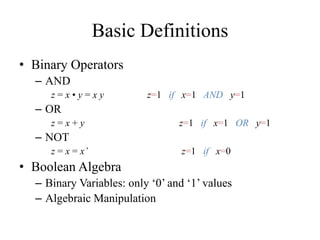
Basic Definitions
• Binary Operators
– AND
z = x • y = x y z=1 if x=1 AND y=1
– OR
z = x + y z=1 if x=1 OR y=1
– NOT
z = x = x’ z=1 if x=0
• Boolean Algebra
– Binary Variables: only ‘0’ and ‘1’ values
– Algebraic Manipulation
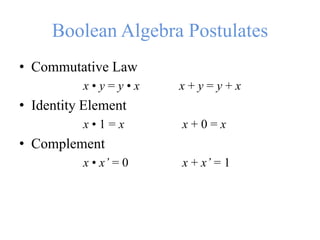
Boolean Algebra Postulates
• Commutative Law
x • y = y • x x + y = y + x
• Identity Element
x • 1 = x x + 0 = x
• Complement
x • x’ = 0 x + x’ = 1
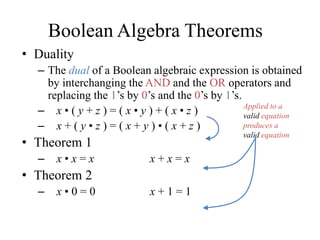
Boolean Algebra Theorems
• Duality
– The dual of a Boolean algebraic expression is obtained
by interchanging the AND and the OR operators and
replacing the 1’s by 0’s and the 0’s by 1’s.
– x • ( y + z ) = ( x • y ) + ( x • z )
– x + ( y • z ) = ( x + y ) • ( x + z )
• Theorem 1
– x • x = x x + x = x
• Theorem 2
– x • 0 = 0 x + 1 = 1
Applied to a
valid equation
produces a
valid equation
Boolean Algebra Theorems
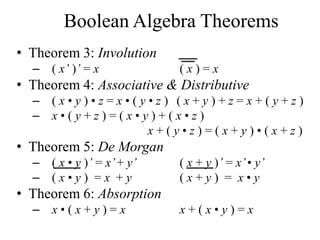
• Theorem 3: Involution
– ( x’ )’ = x ( x ) = x
• Theorem 4: Associative & Distributive
– ( x • y ) • z = x • ( y • z ) ( x + y ) + z = x + ( y + z )
– x • ( y + z ) = ( x • y ) + ( x • z )
x + ( y • z ) = ( x + y ) • ( x + z )
• Theorem 5: De Morgan
– ( x • y )’ = x’+ y’ ( x + y )’ = x’• y’
– ( x • y ) = x + y ( x + y ) = x • y
• Theorem 6: Absorption
– x • ( x + y ) = x x + ( x • y ) = x
Boolean Functions[1]
• Boolean Expression
Example: F =
x + y’ z
• Truth Table
All possible combinations
of input variables
• Logic Circuit
x y z F
0 0 0 0
0 0 1 1
0 1 0 0
0 1 1 0
1 0 0 1
1 0 1 1
1 1 0 1
1 1 1 1x
y
z
F
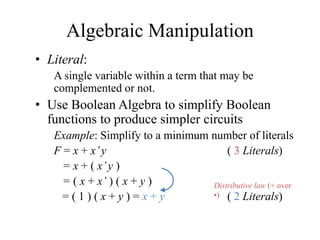
Algebraic Manipulation
• Literal:
A single variable within a term that may be
complemented or not.
• Use Boolean Algebra to simplify Boolean
functions to produce simpler circuits
Example: Simplify to a minimum number of literals
F = x + x’y ( 3 Literals)
= x + ( x’y )
= ( x + x’ ) ( x + y )
= ( 1 ) ( x + y ) = x + y ( 2 Literals)
Distributive law (+ over
•)
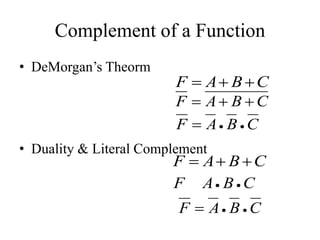
Complement of a Function
• DeMorgan’s Theorm
• Duality & Literal Complement
CBAF 
CBAF 
CBAF 
CBAF 
CBAF 
CBAF 
Canonical Forms[1]
• Minterm
– Product (AND function)
– Contains all variables
– Evaluates to ‘1’ for a
specific combination
Example
A = 0 A B C
B = 0 (0) • (0) • (0)
C = 0
1 • 1 • 1 = 1
A B C Minterm
0 0 0 0 m0
1 0 0 1 m1
2 0 1 0 m2
3 0 1 1 m3
4 1 0 0 m4
5 1 0 1 m5
6 1 1 0 m6
7 1 1 1 m7
Canonical Forms[1]
• Maxterm
– Sum (OR function)
– Contains all variables
– Evaluates to ‘0’ for a
specific combination
Example
A = 1 A B C
B = 1 (1) + (1) + (1)
C = 1
0 + 0 + 0 = 0
A B C Maxterm
0 0 0 0 M0
1 0 0 1 M1
2 0 1 0 M2
3 0 1 1 M3
4 1 0 0 M4
5 1 0 1 M5
6 1 1 0 M6
7 1 1 1 M7
Canonical Forms[1]
• Truth Table to Boolean Function
CBAF  CBA CBA ABCA B C F
0 0 0 0
0 0 1 1
0 1 0 0
0 1 1 0
1 0 0 1
1 0 1 1
1 1 0 0
1 1 1 1
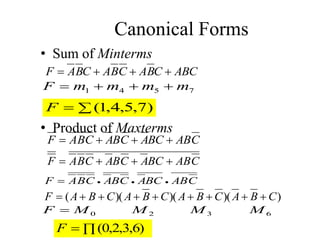
Canonical Forms
• Sum of Minterms
• Product of Maxterms
ABCCBACBACBAF 
7541 mmmmF 
 )7,5,4,1(F
CABBCACBACBAF 
CABBCACBACBAF 
CABBCACBACBAF 
))()()(( CBACBACBACBAF 
6320 MMMMF 
 (0,2,3,6)F
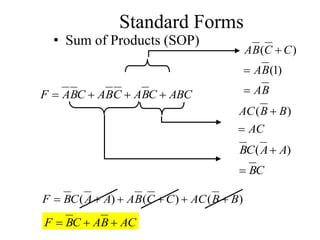
Standard Forms
• Sum of Products (SOP)
ABCCBACBACBAF  BA
BA
CCBA



)1(
)(
AC
BBAC

 )(
CB
AACB

 )(
)()()( BBACCCBAAACBF 
ACBACBF 
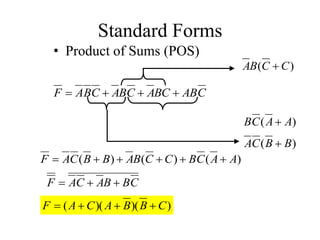
Standard Forms
• Product of Sums (POS)
CABBCACBACBAF 
)( CCBA 
)( AACB 
)( BBCA 
)()()( AACBCCBABBCAF 
CBBACAF 
))()(( CBBACAF 
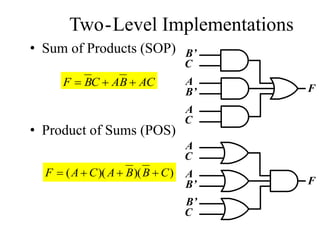
Two-Level Implementations
• Sum of Products (SOP)
• Product of Sums (POS)
B’
C
FB’
A
A
C
A
C
FB’
A
B’
C
ACBACBF 
))()(( CBBACAF 
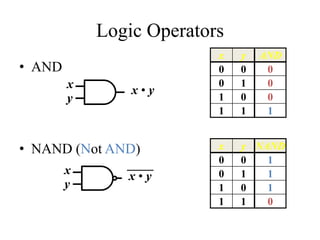
Logic Operators
• AND
• NAND (Not AND)
x
y
x • y
x
y
x • y
x y AND
0 0 0
0 1 0
1 0 0
1 1 1
x y NAND
0 0 1
0 1 1
1 0 1
1 1 0
Logic Operators
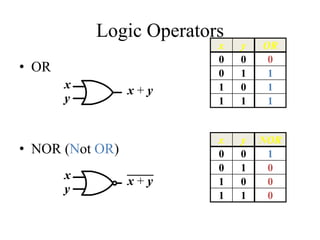
• OR
• NOR (Not OR)
x
y
x + y
x
y
x + y
x y OR
0 0 0
0 1 1
1 0 1
1 1 1
x y NOR
0 0 1
0 1 0
1 0 0
1 1 0
Logic Operators
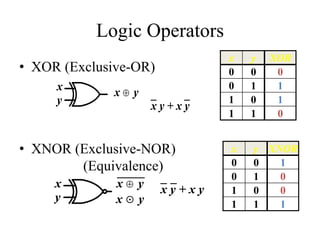
• XOR (Exclusive-OR)
• XNOR (Exclusive-NOR)
(Equivalence)
x
y
x Å y
x y + x y
x
y
x Å y
x  y
x y + x y
x y XOR
0 0 0
0 1 1
1 0 1
1 1 0
x y XNOR
0 0 1
0 1 0
1 0 0
1 1 1
Logic Operators
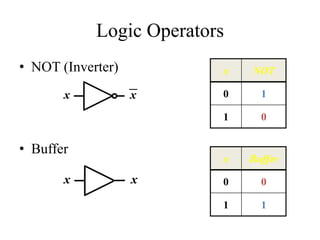
• NOT (Inverter)
• Buffer
x x
x x
x NOT
0 1
1 0
x Buffer
0 0
1 1
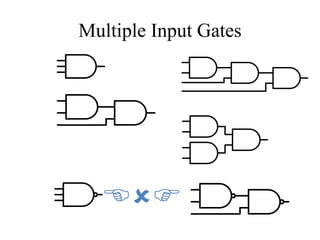
Multiple Input Gates

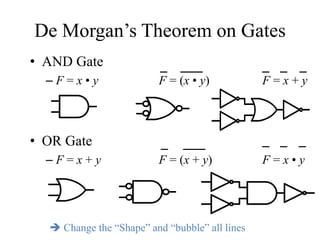
De Morgan’s Theorem on Gates
• AND Gate
– F = x • y F = (x • y) F = x + y
• OR Gate
– F = x + y F = (x + y) F = x • y
 Change the “Shape” and “bubble” all lines
References
1. Computer Organization and Architecture, Designing
for performance by William Stallings, Prentice Hall
of India.
2. Modern Computer Architecture, by Morris Mano,
Prentice Hall of India.
3. Computer Architecture and Organization by John P.
Hayes, McGraw Hill Publishing Company.
4. Computer Organization by V. Carl Hamacher,
Zvonko G. Vranesic, Safwat G. Zaky, McGraw Hill
Publishing Company.

B.sc cs-ii-u-1.5 digital logic circuits, digital component

  • 1.
    Digital Logic Circuits,Digital Component and Data Representation Course: B.Sc-CS-II Subject: Computer Organization And Architecture Unit-1 1
  • 2.
    Basic Definitions • BinaryOperators – AND z = x • y = x y z=1 if x=1 AND y=1 – OR z = x + y z=1 if x=1 OR y=1 – NOT z = x = x’ z=1 if x=0 • Boolean Algebra – Binary Variables: only ‘0’ and ‘1’ values – Algebraic Manipulation
  • 3.
    Boolean Algebra Postulates •Commutative Law x • y = y • x x + y = y + x • Identity Element x • 1 = x x + 0 = x • Complement x • x’ = 0 x + x’ = 1
  • 4.
    Boolean Algebra Theorems •Duality – The dual of a Boolean algebraic expression is obtained by interchanging the AND and the OR operators and replacing the 1’s by 0’s and the 0’s by 1’s. – x • ( y + z ) = ( x • y ) + ( x • z ) – x + ( y • z ) = ( x + y ) • ( x + z ) • Theorem 1 – x • x = x x + x = x • Theorem 2 – x • 0 = 0 x + 1 = 1 Applied to a valid equation produces a valid equation
  • 5.
    Boolean Algebra Theorems •Theorem 3: Involution – ( x’ )’ = x ( x ) = x • Theorem 4: Associative & Distributive – ( x • y ) • z = x • ( y • z ) ( x + y ) + z = x + ( y + z ) – x • ( y + z ) = ( x • y ) + ( x • z ) x + ( y • z ) = ( x + y ) • ( x + z ) • Theorem 5: De Morgan – ( x • y )’ = x’+ y’ ( x + y )’ = x’• y’ – ( x • y ) = x + y ( x + y ) = x • y • Theorem 6: Absorption – x • ( x + y ) = x x + ( x • y ) = x
  • 6.
    Boolean Functions[1] • BooleanExpression Example: F = x + y’ z • Truth Table All possible combinations of input variables • Logic Circuit x y z F 0 0 0 0 0 0 1 1 0 1 0 0 0 1 1 0 1 0 0 1 1 0 1 1 1 1 0 1 1 1 1 1x y z F
  • 7.
    Algebraic Manipulation • Literal: Asingle variable within a term that may be complemented or not. • Use Boolean Algebra to simplify Boolean functions to produce simpler circuits Example: Simplify to a minimum number of literals F = x + x’y ( 3 Literals) = x + ( x’y ) = ( x + x’ ) ( x + y ) = ( 1 ) ( x + y ) = x + y ( 2 Literals) Distributive law (+ over •)
  • 8.
    Complement of aFunction • DeMorgan’s Theorm • Duality & Literal Complement CBAF  CBAF  CBAF  CBAF  CBAF  CBAF 
  • 9.
    Canonical Forms[1] • Minterm –Product (AND function) – Contains all variables – Evaluates to ‘1’ for a specific combination Example A = 0 A B C B = 0 (0) • (0) • (0) C = 0 1 • 1 • 1 = 1 A B C Minterm 0 0 0 0 m0 1 0 0 1 m1 2 0 1 0 m2 3 0 1 1 m3 4 1 0 0 m4 5 1 0 1 m5 6 1 1 0 m6 7 1 1 1 m7
  • 10.
    Canonical Forms[1] • Maxterm –Sum (OR function) – Contains all variables – Evaluates to ‘0’ for a specific combination Example A = 1 A B C B = 1 (1) + (1) + (1) C = 1 0 + 0 + 0 = 0 A B C Maxterm 0 0 0 0 M0 1 0 0 1 M1 2 0 1 0 M2 3 0 1 1 M3 4 1 0 0 M4 5 1 0 1 M5 6 1 1 0 M6 7 1 1 1 M7
  • 11.
    Canonical Forms[1] • TruthTable to Boolean Function CBAF  CBA CBA ABCA B C F 0 0 0 0 0 0 1 1 0 1 0 0 0 1 1 0 1 0 0 1 1 0 1 1 1 1 0 0 1 1 1 1
  • 12.
    Canonical Forms • Sumof Minterms • Product of Maxterms ABCCBACBACBAF  7541 mmmmF   )7,5,4,1(F CABBCACBACBAF  CABBCACBACBAF  CABBCACBACBAF  ))()()(( CBACBACBACBAF  6320 MMMMF   (0,2,3,6)F
  • 13.
    Standard Forms • Sumof Products (SOP) ABCCBACBACBAF  BA BA CCBA    )1( )( AC BBAC   )( CB AACB   )( )()()( BBACCCBAAACBF  ACBACBF 
  • 14.
    Standard Forms • Productof Sums (POS) CABBCACBACBAF  )( CCBA  )( AACB  )( BBCA  )()()( AACBCCBABBCAF  CBBACAF  ))()(( CBBACAF 
  • 15.
    Two-Level Implementations • Sumof Products (SOP) • Product of Sums (POS) B’ C FB’ A A C A C FB’ A B’ C ACBACBF  ))()(( CBBACAF 
  • 16.
    Logic Operators • AND •NAND (Not AND) x y x • y x y x • y x y AND 0 0 0 0 1 0 1 0 0 1 1 1 x y NAND 0 0 1 0 1 1 1 0 1 1 1 0
  • 17.
    Logic Operators • OR •NOR (Not OR) x y x + y x y x + y x y OR 0 0 0 0 1 1 1 0 1 1 1 1 x y NOR 0 0 1 0 1 0 1 0 0 1 1 0
  • 18.
    Logic Operators • XOR(Exclusive-OR) • XNOR (Exclusive-NOR) (Equivalence) x y x Å y x y + x y x y x Å y x  y x y + x y x y XOR 0 0 0 0 1 1 1 0 1 1 1 0 x y XNOR 0 0 1 0 1 0 1 0 0 1 1 1
  • 19.
    Logic Operators • NOT(Inverter) • Buffer x x x x x NOT 0 1 1 0 x Buffer 0 0 1 1
  • 20.
  • 21.
    De Morgan’s Theoremon Gates • AND Gate – F = x • y F = (x • y) F = x + y • OR Gate – F = x + y F = (x + y) F = x • y  Change the “Shape” and “bubble” all lines
  • 22.
    References 1. Computer Organizationand Architecture, Designing for performance by William Stallings, Prentice Hall of India. 2. Modern Computer Architecture, by Morris Mano, Prentice Hall of India. 3. Computer Architecture and Organization by John P. Hayes, McGraw Hill Publishing Company. 4. Computer Organization by V. Carl Hamacher, Zvonko G. Vranesic, Safwat G. Zaky, McGraw Hill Publishing Company.