Logic Design
Ch 2 Part B
Boolean Algebra and Logic Gates
Contents
 Digital circuits
 Boolean Algebra
 Two-Valued Boolean Algebra
 Boolean Algebra Postulates
 Precedence of Operators
 Truth Table & Proofs
 Duality
2
 Basic Theorems of Boolean Algebra
 Boolean Functions
 Complement of Functions
 Standard Forms
 Minterm & Maxterm
 Canonical Forms
 Conversion of Canonical Forms
 Binary Functions
3
Introduction
Boolean algebra forms the basis of logic circuit design.
Consider very simple but common example: if (A is true)
and (B is false) then print “the solution is found”. In this
case, two Boolean expressions (A is true) and (B is false)
are related by a connective ‘and’. How do we define
these? This and related things are discussed in this
chapter.
In typical circuit design, there are many conditions to be
taken care of (for example, when the ‘second counter’ =
60, the ‘minute counter’ is incremented and ‘second
counter’ is made 0. Thus it is quite important to
understand Boolean algebra. In subsequent chapters, we
are going to further study how to minimize the circuit
using laws of Boolean algebra (that is very interesting…)
4
Boolean Algebra
 Boolean Algebra named after George Boole who used it to
study human logical reasoning – calculus of proposition.
 Events : true or false
 Connectives : a OR b; a AND b, NOT a
 Example: Either “it has rained” OR “someone splashed
water”, “must be tall” AND “good vision”.
5
What is an Algebra? (e.g. algebra of integers)
set of elements (e.g. 0,1,2,..)
set of operations (e.g. +, -, *,..)
postulates/axioms (e.g. 0+x=x,..)
Boolean Algebra
6
a b a AND b
F F F
F T F
T F F
T T T
a b a OR b
F F F
F T T
T F T
T T T
a NOT a
F T
T F
Two-valued Boolean Algebra
 Set of Elements: {0,1}
 Set of Operations: { ., + , ¬ }
7
x y x . y
0 0 0
0 1 0
1 0 0
1 1 1
x y x + y
0 0 0
0 1 1
1 0 1
1 1 1
x ¬x
0 1
1 0
Signals: High = 5V = 1; Low = 0V = 0
x
y
x.y
x
y
x+y x x'
Sometimes denoted by ’,
for example a’
Boolean Algebra Postulates
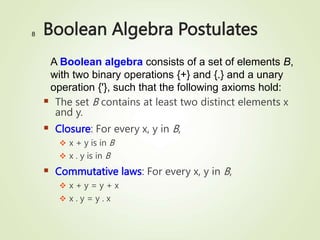
 The set B contains at least two distinct elements x
and y.
 Closure: For every x, y in B,
 x + y is in B
 x . y is in B
 Commutative laws: For every x, y in B,
 x + y = y + x
 x . y = y . x
8
A Boolean algebra consists of a set of elements B,
with two binary operations {+} and {.} and a unary
operation {'}, such that the following axioms hold:
Boolean Algebra Postulates
 Associative laws: For every x, y, z in B,
 (x + y) + z = x + (y + z) = x + y + z
 (x . y) . z = (x . y) . z = x . y . z
 Identities (0 and 1):
 0 + x = x + 0 = x for every x in B
 1 . x = x . 1 = x for every x in B
 Distributive laws: For every x, y, z in B,
 x . (y + z) = (x . y) + (x . z)
 x + (y . z) = (x + y) . (x + z)
9
Boolean Algebra Postulates
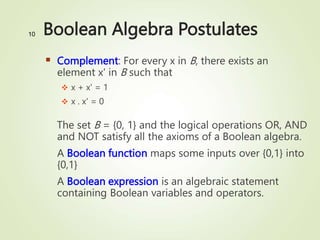
 Complement: For every x in B, there exists an
element x' in B such that
 x + x' = 1
 x . x' = 0
The set B = {0, 1} and the logical operations OR, AND
and NOT satisfy all the axioms of a Boolean algebra.
A Boolean function maps some inputs over {0,1} into
{0,1}
A Boolean expression is an algebraic statement
containing Boolean variables and operators.
10
Precedence of Operators
 To lessen the brackets used in writing boolean
expressions, operator precedence can be used.
 Precedence (highest to lowest): ' . +
 Examples:
a . b + c = (a . b) + c
b' + c = (b') + c
a + b' . c = a + ((b') . c)
11
Precedence of Operators
 Use brackets to overwrite precedence.
 Examples:
a . (b + c)
(a + b)' . c
12
Truth Table
 Provides a listing of every possible combination of
inputs and its corresponding outputs.
 Example (2 inputs, 2 outputs):
13
x y x . y x + y
0 0 0 0
0 1 0 1
1 0 0 1
1 1 1 1
INPUTS OUTPUTS
… …
… …
Truth Table
 Example (3 inputs, 2 outputs):
14
x y z y + z x.(y + z)
0 0 0 0 0
0 0 1 1 0
0 1 0 1 0
0 1 1 1 0
1 0 0 0 0
1 0 1 1 1
1 1 0 1 1
1 1 1 1 1
Proof using Truth Table
 Can use truth table to prove by perfect induction.
 Prove that: x . (y + z) = (x . y) + (x . z)
(i) Construct truth table for LHS & RHS of above equality.
(ii) Check that LHS = RHS
Postulate is SATISFIED because output column 2 & 5 (for LHS
& RHS expressions) are equal for all cases.
15
x y z y + z x.(y + z) x.y x.z (x.y)+(x.z)
0 0 0 0 0 0 0 0
0 0 1 1 0 0 0 0
0 1 0 1 0 0 0 0
0 1 1 1 0 0 0 0
1 0 0 0 0 0 0 0
1 0 1 1 1 0 1 1
1 1 0 1 1 1 0 1
1 1 1 1 1 1 1 1
Solving it yourself (Exercise 3.1)
Q. Use truth table to prove the following.
(a) A’.B’ + A.B’ + A.B = A + B’
(b) A.B.C + A’.B.C + A’.B.C’ = B.C + A’.B
16
Duality
 Duality Principle – every valid Boolean expression
(equality) remains valid if the operators and identity
elements are interchanged, as follows:
+  .
1  0
 Example: Given the expression
a + (b.c) = (a+b).(a+c)
then its dual expression is
a . (b+c) = (a.b) + (a.c)
17
Duality
 Duality gives free theorems – “two for the price of
one”. You prove one theorem and the other comes
for free!
 If (x+y+z)' = x'.y.'z' is valid, then its dual is also valid:
(x.y.z)' = x'+y'+z’
 If x + 1 = 1 is valid, then its dual is also valid:
x . 0 = 0
18
Basic Theorems of Boolean Algebra
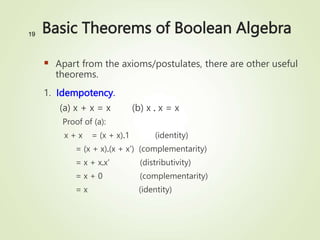
 Apart from the axioms/postulates, there are other useful
theorems.
1. Idempotency.
(a) x + x = x (b) x . x = x
Proof of (a):
x + x = (x + x).1 (identity)
= (x + x).(x + x') (complementarity)
= x + x.x' (distributivity)
= x + 0 (complementarity)
= x (identity)
19
Basic Theorems of Boolean Algebra
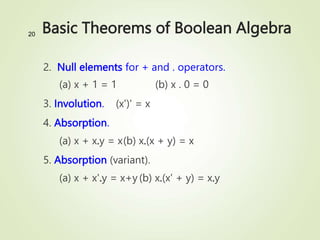
2. Null elements for + and . operators.
(a) x + 1 = 1 (b) x . 0 = 0
3. Involution. (x')' = x
4. Absorption.
(a) x + x.y = x(b) x.(x + y) = x
5. Absorption (variant).
(a) x + x'.y = x+y (b) x.(x' + y) = x.y
20
Basic Theorems of Boolean Algebra
6. DeMorgan.
(a) (x + y)' = x'.y'
(b) (x.y)' = x' + y'
7. Consensus/redundancy theroem.
(a) x.y + x'.z + y.z = x.y + x'.z
(b) (x+y).(x'+z).(y+z) = (x+y).(x'+z)
21
Basic Theorems of Boolean Algebra
 Theorems can be proved using the truth table method.
(Exercise: Prove De-Morgan’s theorem using the truth
table.)
 They can also be proved by algebraic manipulation using
axioms/postulates or other basic theorems.
22
Basic Theorems of Boolean Algebra
 Theorem 4a (absorption) can be proved by:
x + x.y = x.1 + x.y (identity)
= x.(1 + y) (distributivity)
= x.(y + 1) (commutativity)
= x.1 (Theorem 2a)
= x (identity)
 By duality, theorem 4b:
x.(x+y) = x
 Try prove this by algebraic manipulation.
23
Simplification of Boolean
Algebra
 (x + y)(x + y') = x + yy' = x
24
Boolean Functions
 Boolean function is an expression formed with binary
variables, the two binary operators, OR and AND, and
the unary operator, NOT, parenthesis and the equal
sign.
 Its result is also a binary value.
 We usually use . for AND, + for OR, and ' or ¬ for
NOT. Sometimes, we may omit the . if there is no
ambiguity.
25
Boolean Functions
 Examples:
F1= xyz'
F2= x + y'z
F3=(x'y'z)+(x'yz)+(xy')
F4=xy'+x'z
26
x y z F1 F2 F3 F4
0 0 0 0 0 0 0
0 0 1 0 1 1 1
0 1 0 0 0 0 0
0 1 1 0 0 1 1
1 0 0 0 1 1 1
1 0 1 0 1 1 1
1 1 0 1 1 0 0
1 1 1 0 1 0 0
From the truth table, F3=F4.
Can you also prove by algebraic manipulation that F3=F4?
Complement of Functions
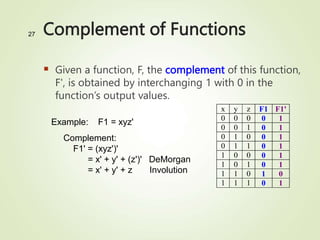
 Given a function, F, the complement of this function,
F', is obtained by interchanging 1 with 0 in the
function’s output values.
27
x y z F1 F1'
0 0 0 0 1
0 0 1 0 1
0 1 0 0 1
0 1 1 0 1
1 0 0 0 1
1 0 1 0 1
1 1 0 1 0
1 1 1 0 1
Example: F1 = xyz'
Complement:
F1' = (xyz')'
= x' + y' + (z')' DeMorgan
= x' + y' + z Involution
Complement of Functions
 More general DeMorgan’s theorems useful for
obtaining complement functions:
(A + B + C + ... + Z)' = A' . B' . C' … . Z'
(A . B . C ... . Z)' = A' + B' + C' + … + Z'
28
Standard Forms
 Certain types of Boolean expressions lead to gating
networks which are desirable from implementation
viewpoint.
 Two Standard Forms: Sum-of-
Products and Product-of-Sums
 Literals: a variable on its own or in its complemented
form. Examples: x, x' , y, y'
 Product Term: a single literal or a logical product
(AND) of several literals.
Examples: x, xyz', A'B, AB
29
Standard Forms
 Sum Term: a single literal or a logical sum (OR) of
several literals.
Examples: x, x+y+z', A'+B, A+B
 Sum-of-Products (SOP) Expression: a product term or
a logical sum (OR) of several product terms.
Examples: x, x+yz', xy'+x'yz, AB+A'B'
 Product-of-Sums (POS) Expression: a sum term or a
logical product (AND) of several sum terms.
Exampes: x, x(y+z'), (x+y')(x'+y+z), (A+B)(A'+B')
30
Standard Forms
 Every boolean expression can either be expressed as
sum-of-products or product-of-sums expression.
Examples:
SOP: xy + xy + xyz
POS: (x + y)(x + y)(x + z)
both: x + y + z or xyz
neither:x(w + yz) or z + wxy + v(xz + w)
31
Minterm & Maxterm
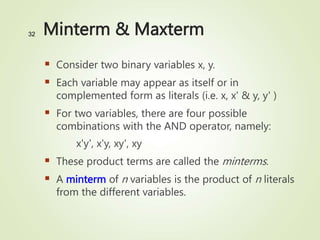
 Consider two binary variables x, y.
 Each variable may appear as itself or in
complemented form as literals (i.e. x, x' & y, y' )
 For two variables, there are four possible
combinations with the AND operator, namely:
x'y', x'y, xy', xy
 These product terms are called the minterms.
 A minterm of n variables is the product of n literals
from the different variables.
32
Minterm & Maxterm
 In general, n variables can give 2n minterms.
 In a similar fashion, a maxterm of n variables is the
sum of n literals from the different variables.
Examples: x'+y', x'+y, x+y',x+y
 In general, n variables can give 2n maxterms.
33
Minterm & Maxterm
 The minterms and maxterms of 2 variables are denoted by
m0 to m3 and M0 to M3 respectively:
34
Minterms Maxterms
x y term notation term notation
0 0 x'y' m0 x+y M0
0 1 x'y m1 x+y' M1
1 0 xy' m2 x'+y M2
1 1 xy m3 x'+y' M3
Each minterm is the complement of the corresponding
maxterm:
Example: m2 = xy'
m2' = (xy')' = x' + (y')' = x'+y = M2
Canonical Form: Sum of Minterms
 What is a canonical/normal form?
 A unique form for representing something.
 Minterms are product terms.
 Can express Boolean functions using Sum-of-Minterms form.
35
Canonical Form: Sum of Minterms
a) Obtain the truth table. Example:
36
x y z F1 F2 F3
0 0 0 0 0 0
0 0 1 0 1 1
0 1 0 0 0 0
0 1 1 0 0 1
1 0 0 0 1 1
1 0 1 0 1 1
1 1 0 1 1 0
1 1 1 0 1 0
Canonical Form: Sum of Minterms
b) Obtain Sum-of-Minterms by gathering/summing the
minterms of the function (where result is a 1)
F1 = xyz' = (m6)
F2 = x'y'z+xy'z'+xy'z+xyz'+xyz = (m1,m4,m5,m6,m7)
F3 = x'y'z+x'yz+xy'z'
+xy'z
= (m1,m3,m4,m5)
37
x y z F1 F2 F3
0 0 0 0 0 0
0 0 1 0 1 1
0 1 0 0 0 0
0 1 1 0 0 1
1 0 0 0 1 1
1 0 1 0 1 1
1 1 0 1 1 0
1 1 1 0 1 0
Canonical Form: Product of Maxterms
 Maxterms are sum terms.
 For Boolean functions, the maxterms of a function are
the terms for which the result is 0.
 Boolean functions can be expressed as Products-of-
Maxterms.
38
Canonical Form: Product of Maxterms
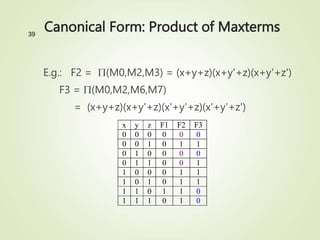
E.g.: F2 = (M0,M2,M3) = (x+y+z)(x+y'+z)(x+y'+z')
F3 = (M0,M2,M6,M7)
= (x+y+z)(x+y'+z)(x'+y'+z)(x'+y'+z')
39
x y z F1 F2 F3
0 0 0 0 0 0
0 0 1 0 1 1
0 1 0 0 0 0
0 1 1 0 0 1
1 0 0 0 1 1
1 0 1 0 1 1
1 1 0 1 1 0
1 1 1 0 1 0
Canonical Form: Product of Maxterms
 Why is this so? Take F2 as an example.
F2 = (m1,m4,m5,m6,m7)
 The complement function of F2 is:
F2' = (m0,m2,m3)
= m0 + m2 + m3
(Complement functions’ minterms
are the opposite of their original
functions, i.e. when
original function = 0)
40
x y z F2 F2'
0 0 0 0 1
0 0 1 1 0
0 1 0 0 1
0 1 1 0 1
1 0 0 1 0
1 0 1 1 0
1 1 0 1 0
1 1 1 1 0
Canonical Form: Product of Maxterms
From previous slide, F2' = m0 + m2 + m3
Therefore:
F2 = (m0 + m2 + m3 )'
= m0' . m2' . m3' DeMorgan
= M0 . M2 . M3 mx' = Mx
= (M0,M2,M3)
 Every Boolean function can be expressed as either
Sum-of-Minterms or Product-of-Maxterms.
41
Solving it yourself (Exercise 3.2)
1. A Boolean function of 5 variables can have up to ___
minterms.
2. Given a Boolean function F (A,B,C) =  m(0, 5, 7).
Which of the following is correct?
a) F' (A,B,C) = m(0,5,7) b) F (A,B,C) = M(1,2,3,4,6)
c) F (A,B,C) = M(0,5,7) d) F' (A,B,C) = m(1,2,3)
e) None above
3. Given a Boolean function F (x,y,z) = y'.(x + z') + x'.z.
Which of the following is correct?
a) F (x,y,z) = m(0,1) b) F (x,y,z) = m(0,1,4,5)
c) F (x,y,z) = m(0,1,2,3,4) d) F (x,y,z) = m(0,1,3,4,5)
e) F (x,y,z) = m(1,2,3,4,5)
42
Solving it yourself (Exercise 3.2)
4. Given a Boolean function with 6 variables a, b, c, d, e, f.
What is maxterm M60?
a) a'.b'.c'.d'.e.f b) a'+b'+c'+d' c) a'+b'+c'+d'+e+f
d) a.b.c.d.e'.f' e) a+b+c+d+e'+f'
5. Given a Boolean function F (a,b,c) = S m(0, 2, 5, 6, 7).
If a=0, b=c=1, what is the value of F?
a) 0 b) 1 c) b.c d) a' e) Unknown
6. Which of the following is NOT a minterm of the Boolean
function: F (w,x,y,z) = w.x.z' + x.y'.z + x.z
a) w.x.y.z' b) w'.x.y'.z c) w.x.y.z
d) w.x.y'.z' e) w.x'.y.z
43
Solving it yourself (Exercise 3.2)
7. Identify the following function F(x,y,z).
a) x.y'.z' + x'.y.z + x.z'
b) x'.y.z + x.y' + x'.y'.z
c) x.y'.z + x'.y'.z + x.y
d) x.y.z + x'.y'.z' + x.y'
e) None above
44
Conversion of Canonical Forms
 Sum-of-Minterms  Product-of-Maxterms
 Rewrite minterm shorthand using maxterm shorthand.
 Replace minterm indices with indices not already used.
Eg: F1(A,B,C) = m(3,4,5,6,7) = M(0,1,2)
 Product-of-Maxterms  Sum-of-Minterms
 Rewrite maxterm shorthand using minterm shorthand.
 Replace maxterm indices with indices not already used.
Eg: F2(A,B,C) = M(0,3,5,6) = m(1,2,4,7)
45
Conversion of Canonical Forms
 Sum-of-Minterms of F  Sum-of-Minterms of F'
 In minterm shorthand form, list the indices not already used in
F.
Eg: F1(A,B,C) = m(3,4,5,6,7)
F1'(A,B,C) = m(0,1,2)
 Product-of-Maxterms of F  Prod-of-Maxterms of F'
 In maxterm shorthand form, list the indices not already used in
F.
Eg: F1(A,B,C) = M(0,1,2)
F1'(A,B,C) = M(3,4,5,6,7)
46
Conversion of Canonical Forms
 Sum-of-Minterms of F  Product-of-Maxterms of F'
 Rewrite in maxterm shorthand form, using the same indices as
in F.
Eg: F1(A,B,C) = m(3,4,5,6,7)
F1'(A,B,C) = M(3,4,5,6,7)
 Product-of-Maxterms of F  Sum-of-Minterms of F'
 Rewrite in minterm shorthand form, using the same indices as in
F.
Eg: F1(A,B,C) = M(0,1,2)
F1'(A,B,C) = m(0,1,2)
47
Solving it yourself (Exercise 3.3)
Q. Consider the function
f(A,B,Y,Z) =  m(0, 2, 5, 6, 8, 11, 15).
a) Write this as a Boolean expression in canonical SOP
form.
b) Rewrite the expression in canonical POS form.
c) Write the complement of f in “little m” notation and in
canonical SOP form.
d) Write the complement of f in “big M” notation and in
canonical POS form.
48
Binary Functions
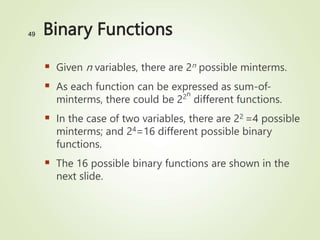
 Given n variables, there are 2n possible minterms.
 As each function can be expressed as sum-of-
minterms, there could be 22n
different functions.
 In the case of two variables, there are 22 =4 possible
minterms; and 24=16 different possible binary
functions.
 The 16 possible binary functions are shown in the
next slide.
49
Binary Functions
50
x y F0 F1 F2 F3 F4 F5 F6 F7
0 0 0 0 0 0 0 0 0 0
0 1 0 0 0 0 1 1 1 1
1 0 0 0 1 1 0 0 1 1
1 1 0 1 0 1 0 1 0 1
Symbol . / /  +
Name AND XOR OR
x y F8 F9 F10 F11 F12 F13 F14 F15
0 0 1 1 1 1 1 1 1 1
0 1 0 0 0 0 1 1 1 1
1 0 0 0 1 1 0 0 1 1
1 1 0 1 0 1 0 1 0 1
Symbol   '  '  
Name NOR XNOR NAND
End of segment
51

Boolean Algebra and Logic gates ( Chapter 2)

  • 1.
    Logic Design Ch 2Part B Boolean Algebra and Logic Gates
  • 2.
    Contents  Digital circuits Boolean Algebra  Two-Valued Boolean Algebra  Boolean Algebra Postulates  Precedence of Operators  Truth Table & Proofs  Duality 2
  • 3.
     Basic Theoremsof Boolean Algebra  Boolean Functions  Complement of Functions  Standard Forms  Minterm & Maxterm  Canonical Forms  Conversion of Canonical Forms  Binary Functions 3
  • 4.
    Introduction Boolean algebra formsthe basis of logic circuit design. Consider very simple but common example: if (A is true) and (B is false) then print “the solution is found”. In this case, two Boolean expressions (A is true) and (B is false) are related by a connective ‘and’. How do we define these? This and related things are discussed in this chapter. In typical circuit design, there are many conditions to be taken care of (for example, when the ‘second counter’ = 60, the ‘minute counter’ is incremented and ‘second counter’ is made 0. Thus it is quite important to understand Boolean algebra. In subsequent chapters, we are going to further study how to minimize the circuit using laws of Boolean algebra (that is very interesting…) 4
  • 5.
    Boolean Algebra  BooleanAlgebra named after George Boole who used it to study human logical reasoning – calculus of proposition.  Events : true or false  Connectives : a OR b; a AND b, NOT a  Example: Either “it has rained” OR “someone splashed water”, “must be tall” AND “good vision”. 5 What is an Algebra? (e.g. algebra of integers) set of elements (e.g. 0,1,2,..) set of operations (e.g. +, -, *,..) postulates/axioms (e.g. 0+x=x,..)
  • 6.
    Boolean Algebra 6 a ba AND b F F F F T F T F F T T T a b a OR b F F F F T T T F T T T T a NOT a F T T F
  • 7.
    Two-valued Boolean Algebra Set of Elements: {0,1}  Set of Operations: { ., + , ¬ } 7 x y x . y 0 0 0 0 1 0 1 0 0 1 1 1 x y x + y 0 0 0 0 1 1 1 0 1 1 1 1 x ¬x 0 1 1 0 Signals: High = 5V = 1; Low = 0V = 0 x y x.y x y x+y x x' Sometimes denoted by ’, for example a’
  • 8.
    Boolean Algebra Postulates The set B contains at least two distinct elements x and y.  Closure: For every x, y in B,  x + y is in B  x . y is in B  Commutative laws: For every x, y in B,  x + y = y + x  x . y = y . x 8 A Boolean algebra consists of a set of elements B, with two binary operations {+} and {.} and a unary operation {'}, such that the following axioms hold:
  • 9.
    Boolean Algebra Postulates Associative laws: For every x, y, z in B,  (x + y) + z = x + (y + z) = x + y + z  (x . y) . z = (x . y) . z = x . y . z  Identities (0 and 1):  0 + x = x + 0 = x for every x in B  1 . x = x . 1 = x for every x in B  Distributive laws: For every x, y, z in B,  x . (y + z) = (x . y) + (x . z)  x + (y . z) = (x + y) . (x + z) 9
  • 10.
    Boolean Algebra Postulates Complement: For every x in B, there exists an element x' in B such that  x + x' = 1  x . x' = 0 The set B = {0, 1} and the logical operations OR, AND and NOT satisfy all the axioms of a Boolean algebra. A Boolean function maps some inputs over {0,1} into {0,1} A Boolean expression is an algebraic statement containing Boolean variables and operators. 10
  • 11.
    Precedence of Operators To lessen the brackets used in writing boolean expressions, operator precedence can be used.  Precedence (highest to lowest): ' . +  Examples: a . b + c = (a . b) + c b' + c = (b') + c a + b' . c = a + ((b') . c) 11
  • 12.
    Precedence of Operators Use brackets to overwrite precedence.  Examples: a . (b + c) (a + b)' . c 12
  • 13.
    Truth Table  Providesa listing of every possible combination of inputs and its corresponding outputs.  Example (2 inputs, 2 outputs): 13 x y x . y x + y 0 0 0 0 0 1 0 1 1 0 0 1 1 1 1 1 INPUTS OUTPUTS … … … …
  • 14.
    Truth Table  Example(3 inputs, 2 outputs): 14 x y z y + z x.(y + z) 0 0 0 0 0 0 0 1 1 0 0 1 0 1 0 0 1 1 1 0 1 0 0 0 0 1 0 1 1 1 1 1 0 1 1 1 1 1 1 1
  • 15.
    Proof using TruthTable  Can use truth table to prove by perfect induction.  Prove that: x . (y + z) = (x . y) + (x . z) (i) Construct truth table for LHS & RHS of above equality. (ii) Check that LHS = RHS Postulate is SATISFIED because output column 2 & 5 (for LHS & RHS expressions) are equal for all cases. 15 x y z y + z x.(y + z) x.y x.z (x.y)+(x.z) 0 0 0 0 0 0 0 0 0 0 1 1 0 0 0 0 0 1 0 1 0 0 0 0 0 1 1 1 0 0 0 0 1 0 0 0 0 0 0 0 1 0 1 1 1 0 1 1 1 1 0 1 1 1 0 1 1 1 1 1 1 1 1 1
  • 16.
    Solving it yourself(Exercise 3.1) Q. Use truth table to prove the following. (a) A’.B’ + A.B’ + A.B = A + B’ (b) A.B.C + A’.B.C + A’.B.C’ = B.C + A’.B 16
  • 17.
    Duality  Duality Principle– every valid Boolean expression (equality) remains valid if the operators and identity elements are interchanged, as follows: +  . 1  0  Example: Given the expression a + (b.c) = (a+b).(a+c) then its dual expression is a . (b+c) = (a.b) + (a.c) 17
  • 18.
    Duality  Duality givesfree theorems – “two for the price of one”. You prove one theorem and the other comes for free!  If (x+y+z)' = x'.y.'z' is valid, then its dual is also valid: (x.y.z)' = x'+y'+z’  If x + 1 = 1 is valid, then its dual is also valid: x . 0 = 0 18
  • 19.
    Basic Theorems ofBoolean Algebra  Apart from the axioms/postulates, there are other useful theorems. 1. Idempotency. (a) x + x = x (b) x . x = x Proof of (a): x + x = (x + x).1 (identity) = (x + x).(x + x') (complementarity) = x + x.x' (distributivity) = x + 0 (complementarity) = x (identity) 19
  • 20.
    Basic Theorems ofBoolean Algebra 2. Null elements for + and . operators. (a) x + 1 = 1 (b) x . 0 = 0 3. Involution. (x')' = x 4. Absorption. (a) x + x.y = x(b) x.(x + y) = x 5. Absorption (variant). (a) x + x'.y = x+y (b) x.(x' + y) = x.y 20
  • 21.
    Basic Theorems ofBoolean Algebra 6. DeMorgan. (a) (x + y)' = x'.y' (b) (x.y)' = x' + y' 7. Consensus/redundancy theroem. (a) x.y + x'.z + y.z = x.y + x'.z (b) (x+y).(x'+z).(y+z) = (x+y).(x'+z) 21
  • 22.
    Basic Theorems ofBoolean Algebra  Theorems can be proved using the truth table method. (Exercise: Prove De-Morgan’s theorem using the truth table.)  They can also be proved by algebraic manipulation using axioms/postulates or other basic theorems. 22
  • 23.
    Basic Theorems ofBoolean Algebra  Theorem 4a (absorption) can be proved by: x + x.y = x.1 + x.y (identity) = x.(1 + y) (distributivity) = x.(y + 1) (commutativity) = x.1 (Theorem 2a) = x (identity)  By duality, theorem 4b: x.(x+y) = x  Try prove this by algebraic manipulation. 23
  • 24.
    Simplification of Boolean Algebra (x + y)(x + y') = x + yy' = x 24
  • 25.
    Boolean Functions  Booleanfunction is an expression formed with binary variables, the two binary operators, OR and AND, and the unary operator, NOT, parenthesis and the equal sign.  Its result is also a binary value.  We usually use . for AND, + for OR, and ' or ¬ for NOT. Sometimes, we may omit the . if there is no ambiguity. 25
  • 26.
    Boolean Functions  Examples: F1=xyz' F2= x + y'z F3=(x'y'z)+(x'yz)+(xy') F4=xy'+x'z 26 x y z F1 F2 F3 F4 0 0 0 0 0 0 0 0 0 1 0 1 1 1 0 1 0 0 0 0 0 0 1 1 0 0 1 1 1 0 0 0 1 1 1 1 0 1 0 1 1 1 1 1 0 1 1 0 0 1 1 1 0 1 0 0 From the truth table, F3=F4. Can you also prove by algebraic manipulation that F3=F4?
  • 27.
    Complement of Functions Given a function, F, the complement of this function, F', is obtained by interchanging 1 with 0 in the function’s output values. 27 x y z F1 F1' 0 0 0 0 1 0 0 1 0 1 0 1 0 0 1 0 1 1 0 1 1 0 0 0 1 1 0 1 0 1 1 1 0 1 0 1 1 1 0 1 Example: F1 = xyz' Complement: F1' = (xyz')' = x' + y' + (z')' DeMorgan = x' + y' + z Involution
  • 28.
    Complement of Functions More general DeMorgan’s theorems useful for obtaining complement functions: (A + B + C + ... + Z)' = A' . B' . C' … . Z' (A . B . C ... . Z)' = A' + B' + C' + … + Z' 28
  • 29.
    Standard Forms  Certaintypes of Boolean expressions lead to gating networks which are desirable from implementation viewpoint.  Two Standard Forms: Sum-of- Products and Product-of-Sums  Literals: a variable on its own or in its complemented form. Examples: x, x' , y, y'  Product Term: a single literal or a logical product (AND) of several literals. Examples: x, xyz', A'B, AB 29
  • 30.
    Standard Forms  SumTerm: a single literal or a logical sum (OR) of several literals. Examples: x, x+y+z', A'+B, A+B  Sum-of-Products (SOP) Expression: a product term or a logical sum (OR) of several product terms. Examples: x, x+yz', xy'+x'yz, AB+A'B'  Product-of-Sums (POS) Expression: a sum term or a logical product (AND) of several sum terms. Exampes: x, x(y+z'), (x+y')(x'+y+z), (A+B)(A'+B') 30
  • 31.
    Standard Forms  Everyboolean expression can either be expressed as sum-of-products or product-of-sums expression. Examples: SOP: xy + xy + xyz POS: (x + y)(x + y)(x + z) both: x + y + z or xyz neither:x(w + yz) or z + wxy + v(xz + w) 31
  • 32.
    Minterm & Maxterm Consider two binary variables x, y.  Each variable may appear as itself or in complemented form as literals (i.e. x, x' & y, y' )  For two variables, there are four possible combinations with the AND operator, namely: x'y', x'y, xy', xy  These product terms are called the minterms.  A minterm of n variables is the product of n literals from the different variables. 32
  • 33.
    Minterm & Maxterm In general, n variables can give 2n minterms.  In a similar fashion, a maxterm of n variables is the sum of n literals from the different variables. Examples: x'+y', x'+y, x+y',x+y  In general, n variables can give 2n maxterms. 33
  • 34.
    Minterm & Maxterm The minterms and maxterms of 2 variables are denoted by m0 to m3 and M0 to M3 respectively: 34 Minterms Maxterms x y term notation term notation 0 0 x'y' m0 x+y M0 0 1 x'y m1 x+y' M1 1 0 xy' m2 x'+y M2 1 1 xy m3 x'+y' M3 Each minterm is the complement of the corresponding maxterm: Example: m2 = xy' m2' = (xy')' = x' + (y')' = x'+y = M2
  • 35.
    Canonical Form: Sumof Minterms  What is a canonical/normal form?  A unique form for representing something.  Minterms are product terms.  Can express Boolean functions using Sum-of-Minterms form. 35
  • 36.
    Canonical Form: Sumof Minterms a) Obtain the truth table. Example: 36 x y z F1 F2 F3 0 0 0 0 0 0 0 0 1 0 1 1 0 1 0 0 0 0 0 1 1 0 0 1 1 0 0 0 1 1 1 0 1 0 1 1 1 1 0 1 1 0 1 1 1 0 1 0
  • 37.
    Canonical Form: Sumof Minterms b) Obtain Sum-of-Minterms by gathering/summing the minterms of the function (where result is a 1) F1 = xyz' = (m6) F2 = x'y'z+xy'z'+xy'z+xyz'+xyz = (m1,m4,m5,m6,m7) F3 = x'y'z+x'yz+xy'z' +xy'z = (m1,m3,m4,m5) 37 x y z F1 F2 F3 0 0 0 0 0 0 0 0 1 0 1 1 0 1 0 0 0 0 0 1 1 0 0 1 1 0 0 0 1 1 1 0 1 0 1 1 1 1 0 1 1 0 1 1 1 0 1 0
  • 38.
    Canonical Form: Productof Maxterms  Maxterms are sum terms.  For Boolean functions, the maxterms of a function are the terms for which the result is 0.  Boolean functions can be expressed as Products-of- Maxterms. 38
  • 39.
    Canonical Form: Productof Maxterms E.g.: F2 = (M0,M2,M3) = (x+y+z)(x+y'+z)(x+y'+z') F3 = (M0,M2,M6,M7) = (x+y+z)(x+y'+z)(x'+y'+z)(x'+y'+z') 39 x y z F1 F2 F3 0 0 0 0 0 0 0 0 1 0 1 1 0 1 0 0 0 0 0 1 1 0 0 1 1 0 0 0 1 1 1 0 1 0 1 1 1 1 0 1 1 0 1 1 1 0 1 0
  • 40.
    Canonical Form: Productof Maxterms  Why is this so? Take F2 as an example. F2 = (m1,m4,m5,m6,m7)  The complement function of F2 is: F2' = (m0,m2,m3) = m0 + m2 + m3 (Complement functions’ minterms are the opposite of their original functions, i.e. when original function = 0) 40 x y z F2 F2' 0 0 0 0 1 0 0 1 1 0 0 1 0 0 1 0 1 1 0 1 1 0 0 1 0 1 0 1 1 0 1 1 0 1 0 1 1 1 1 0
  • 41.
    Canonical Form: Productof Maxterms From previous slide, F2' = m0 + m2 + m3 Therefore: F2 = (m0 + m2 + m3 )' = m0' . m2' . m3' DeMorgan = M0 . M2 . M3 mx' = Mx = (M0,M2,M3)  Every Boolean function can be expressed as either Sum-of-Minterms or Product-of-Maxterms. 41
  • 42.
    Solving it yourself(Exercise 3.2) 1. A Boolean function of 5 variables can have up to ___ minterms. 2. Given a Boolean function F (A,B,C) =  m(0, 5, 7). Which of the following is correct? a) F' (A,B,C) = m(0,5,7) b) F (A,B,C) = M(1,2,3,4,6) c) F (A,B,C) = M(0,5,7) d) F' (A,B,C) = m(1,2,3) e) None above 3. Given a Boolean function F (x,y,z) = y'.(x + z') + x'.z. Which of the following is correct? a) F (x,y,z) = m(0,1) b) F (x,y,z) = m(0,1,4,5) c) F (x,y,z) = m(0,1,2,3,4) d) F (x,y,z) = m(0,1,3,4,5) e) F (x,y,z) = m(1,2,3,4,5) 42
  • 43.
    Solving it yourself(Exercise 3.2) 4. Given a Boolean function with 6 variables a, b, c, d, e, f. What is maxterm M60? a) a'.b'.c'.d'.e.f b) a'+b'+c'+d' c) a'+b'+c'+d'+e+f d) a.b.c.d.e'.f' e) a+b+c+d+e'+f' 5. Given a Boolean function F (a,b,c) = S m(0, 2, 5, 6, 7). If a=0, b=c=1, what is the value of F? a) 0 b) 1 c) b.c d) a' e) Unknown 6. Which of the following is NOT a minterm of the Boolean function: F (w,x,y,z) = w.x.z' + x.y'.z + x.z a) w.x.y.z' b) w'.x.y'.z c) w.x.y.z d) w.x.y'.z' e) w.x'.y.z 43
  • 44.
    Solving it yourself(Exercise 3.2) 7. Identify the following function F(x,y,z). a) x.y'.z' + x'.y.z + x.z' b) x'.y.z + x.y' + x'.y'.z c) x.y'.z + x'.y'.z + x.y d) x.y.z + x'.y'.z' + x.y' e) None above 44
  • 45.
    Conversion of CanonicalForms  Sum-of-Minterms  Product-of-Maxterms  Rewrite minterm shorthand using maxterm shorthand.  Replace minterm indices with indices not already used. Eg: F1(A,B,C) = m(3,4,5,6,7) = M(0,1,2)  Product-of-Maxterms  Sum-of-Minterms  Rewrite maxterm shorthand using minterm shorthand.  Replace maxterm indices with indices not already used. Eg: F2(A,B,C) = M(0,3,5,6) = m(1,2,4,7) 45
  • 46.
    Conversion of CanonicalForms  Sum-of-Minterms of F  Sum-of-Minterms of F'  In minterm shorthand form, list the indices not already used in F. Eg: F1(A,B,C) = m(3,4,5,6,7) F1'(A,B,C) = m(0,1,2)  Product-of-Maxterms of F  Prod-of-Maxterms of F'  In maxterm shorthand form, list the indices not already used in F. Eg: F1(A,B,C) = M(0,1,2) F1'(A,B,C) = M(3,4,5,6,7) 46
  • 47.
    Conversion of CanonicalForms  Sum-of-Minterms of F  Product-of-Maxterms of F'  Rewrite in maxterm shorthand form, using the same indices as in F. Eg: F1(A,B,C) = m(3,4,5,6,7) F1'(A,B,C) = M(3,4,5,6,7)  Product-of-Maxterms of F  Sum-of-Minterms of F'  Rewrite in minterm shorthand form, using the same indices as in F. Eg: F1(A,B,C) = M(0,1,2) F1'(A,B,C) = m(0,1,2) 47
  • 48.
    Solving it yourself(Exercise 3.3) Q. Consider the function f(A,B,Y,Z) =  m(0, 2, 5, 6, 8, 11, 15). a) Write this as a Boolean expression in canonical SOP form. b) Rewrite the expression in canonical POS form. c) Write the complement of f in “little m” notation and in canonical SOP form. d) Write the complement of f in “big M” notation and in canonical POS form. 48
  • 49.
    Binary Functions  Givenn variables, there are 2n possible minterms.  As each function can be expressed as sum-of- minterms, there could be 22n different functions.  In the case of two variables, there are 22 =4 possible minterms; and 24=16 different possible binary functions.  The 16 possible binary functions are shown in the next slide. 49
  • 50.
    Binary Functions 50 x yF0 F1 F2 F3 F4 F5 F6 F7 0 0 0 0 0 0 0 0 0 0 0 1 0 0 0 0 1 1 1 1 1 0 0 0 1 1 0 0 1 1 1 1 0 1 0 1 0 1 0 1 Symbol . / /  + Name AND XOR OR x y F8 F9 F10 F11 F12 F13 F14 F15 0 0 1 1 1 1 1 1 1 1 0 1 0 0 0 0 1 1 1 1 1 0 0 0 1 1 0 0 1 1 1 1 0 1 0 1 0 1 0 1 Symbol   '  '   Name NOR XNOR NAND
  • 51.