Digital Logic Circuits, Digital
Component and Data
Representation
Course: MCA-I
Subject: Computer Organization
And Architecture
Unit-1
1
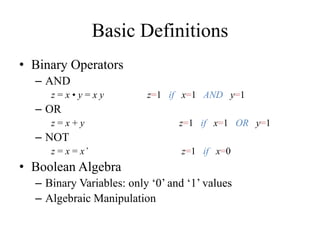
Basic Definitions
• Binary Operators
– AND
z = x • y = x y z=1 if x=1 AND y=1
– OR
z = x + y z=1 if x=1 OR y=1
– NOT
z = x = x’ z=1 if x=0
• Boolean Algebra
– Binary Variables: only ‘0’ and ‘1’ values
– Algebraic Manipulation
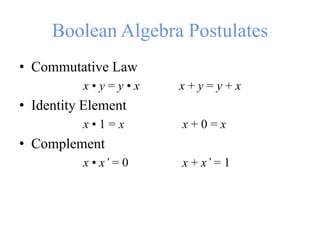
Boolean Algebra Postulates
• Commutative Law
x • y = y • x x + y = y + x
• Identity Element
x • 1 = x x + 0 = x
• Complement
x • x’ = 0 x + x’ = 1
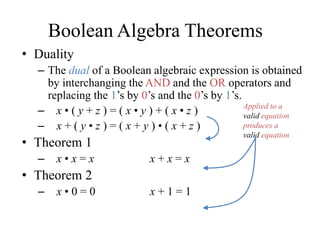
Boolean Algebra Theorems
• Duality
– The dual of a Boolean algebraic expression is obtained
by interchanging the AND and the OR operators and
replacing the 1’s by 0’s and the 0’s by 1’s.
– x • ( y + z ) = ( x • y ) + ( x • z )
– x + ( y • z ) = ( x + y ) • ( x + z )
• Theorem 1
– x • x = x x + x = x
• Theorem 2
– x • 0 = 0 x + 1 = 1
Applied to a
valid equation
produces a
valid equation
Boolean Algebra Theorems
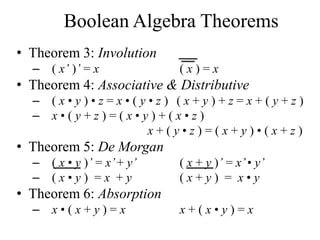
• Theorem 3: Involution
– ( x’ )’ = x ( x ) = x
• Theorem 4: Associative & Distributive
– ( x • y ) • z = x • ( y • z ) ( x + y ) + z = x + ( y + z )
– x • ( y + z ) = ( x • y ) + ( x • z )
x + ( y • z ) = ( x + y ) • ( x + z )
• Theorem 5: De Morgan
– ( x • y )’ = x’+ y’ ( x + y )’ = x’• y’
– ( x • y ) = x + y ( x + y ) = x • y
• Theorem 6: Absorption
– x • ( x + y ) = x x + ( x • y ) = x
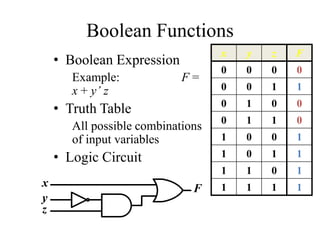
Boolean Functions
• Boolean Expression
Example: F =
x + y’ z
• Truth Table
All possible combinations
of input variables
• Logic Circuit
x y z F
0 0 0 0
0 0 1 1
0 1 0 0
0 1 1 0
1 0 0 1
1 0 1 1
1 1 0 1
1 1 1 1x
y
z
F
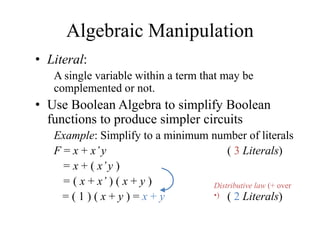
Algebraic Manipulation
• Literal:
A single variable within a term that may be
complemented or not.
• Use Boolean Algebra to simplify Boolean
functions to produce simpler circuits
Example: Simplify to a minimum number of literals
F = x + x’y ( 3 Literals)
= x + ( x’y )
= ( x + x’ ) ( x + y )
= ( 1 ) ( x + y ) = x + y ( 2 Literals)
Distributive law (+ over
•)
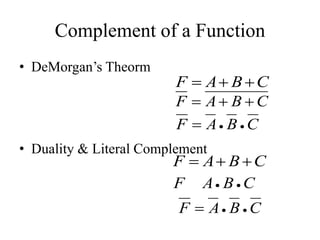
Complement of a Function
• DeMorgan’s Theorm
• Duality & Literal Complement
CBAF 
CBAF 
CBAF 
CBAF 
CBAF 
CBAF 
Canonical Forms
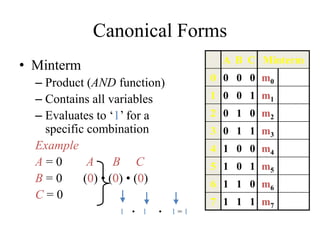
• Minterm
– Product (AND function)
– Contains all variables
– Evaluates to ‘1’ for a
specific combination
Example
A = 0 A B C
B = 0 (0) • (0) • (0)
C = 0
1 • 1 • 1 = 1
A B C Minterm
0 0 0 0 m0
1 0 0 1 m1
2 0 1 0 m2
3 0 1 1 m3
4 1 0 0 m4
5 1 0 1 m5
6 1 1 0 m6
7 1 1 1 m7
Canonical Forms
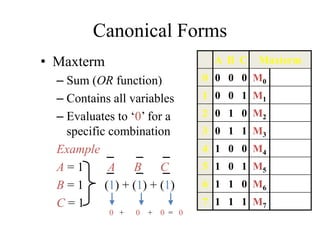
• Maxterm
– Sum (OR function)
– Contains all variables
– Evaluates to ‘0’ for a
specific combination
Example
A = 1 A B C
B = 1 (1) + (1) + (1)
C = 1
0 + 0 + 0 = 0
A B C Maxterm
0 0 0 0 M0
1 0 0 1 M1
2 0 1 0 M2
3 0 1 1 M3
4 1 0 0 M4
5 1 0 1 M5
6 1 1 0 M6
7 1 1 1 M7
Canonical Forms
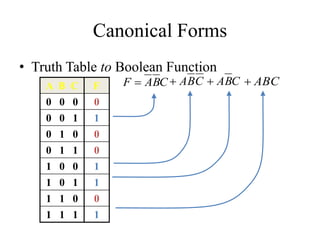
• Truth Table to Boolean Function
CBAF  CBA CBA ABCA B C F
0 0 0 0
0 0 1 1
0 1 0 0
0 1 1 0
1 0 0 1
1 0 1 1
1 1 0 0
1 1 1 1
Canonical Forms
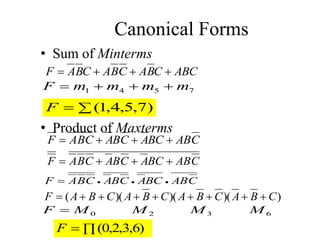
• Sum of Minterms
• Product of Maxterms
ABCCBACBACBAF 
7541 mmmmF 
 )7,5,4,1(F
CABBCACBACBAF 
CABBCACBACBAF 
CABBCACBACBAF 
))()()(( CBACBACBACBAF 
6320 MMMMF 
 (0,2,3,6)F
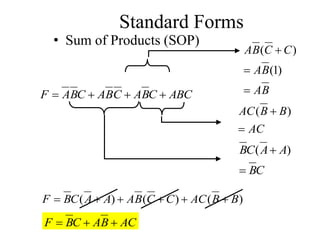
Standard Forms
• Sum of Products (SOP)
ABCCBACBACBAF  BA
BA
CCBA



)1(
)(
AC
BBAC

 )(
CB
AACB

 )(
)()()( BBACCCBAAACBF 
ACBACBF 
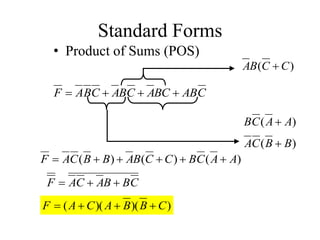
Standard Forms
• Product of Sums (POS)
CABBCACBACBAF 
)( CCBA 
)( AACB 
)( BBCA 
)()()( AACBCCBABBCAF 
CBBACAF 
))()(( CBBACAF 
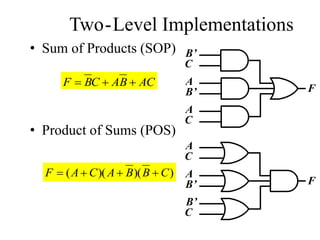
Two-Level Implementations
• Sum of Products (SOP)
• Product of Sums (POS)
B’
C
FB’
A
A
C
A
C
FB’
A
B’
C
ACBACBF 
))()(( CBBACAF 
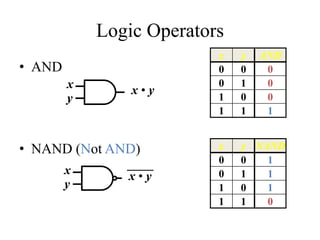
Logic Operators
• AND
• NAND (Not AND)
x
y
x • y
x
y
x • y
x y AND
0 0 0
0 1 0
1 0 0
1 1 1
x y NAND
0 0 1
0 1 1
1 0 1
1 1 0
Logic Operators
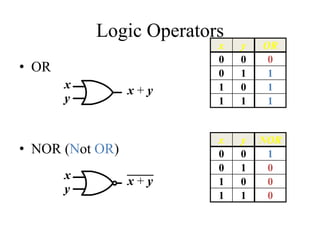
• OR
• NOR (Not OR)
x
y
x + y
x
y
x + y
x y OR
0 0 0
0 1 1
1 0 1
1 1 1
x y NOR
0 0 1
0 1 0
1 0 0
1 1 0
Logic Operators
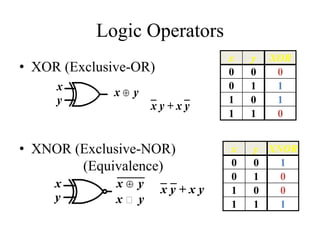
• XOR (Exclusive-OR)
• XNOR (Exclusive-NOR)
(Equivalence)
x
y
x Å y
x y + x y
x
y
x Å y
x  y
x y + x y
x y XOR
0 0 0
0 1 1
1 0 1
1 1 0
x y XNOR
0 0 1
0 1 0
1 0 0
1 1 1
Logic Operators
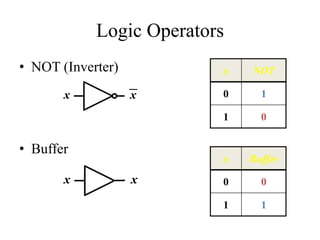
• NOT (Inverter)
• Buffer
x x
x x
x NOT
0 1
1 0
x Buffer
0 0
1 1
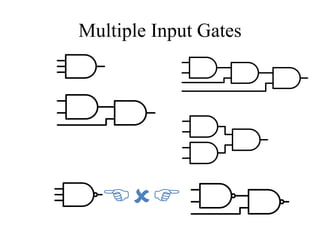
Multiple Input Gates

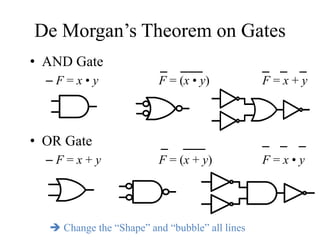
De Morgan’s Theorem on Gates
• AND Gate
– F = x • y F = (x • y) F = x + y
• OR Gate
– F = x + y F = (x + y) F = x • y
 Change the “Shape” and “bubble” all lines
Reference
Reference Book
• Computer Organization & Architecture 7e By
Stallings
• Computer System Architecture By Mano
• Digital Logic & Computer Design By Mano

digital logic circuits, digital component

  • 1.
    Digital Logic Circuits,Digital Component and Data Representation Course: MCA-I Subject: Computer Organization And Architecture Unit-1 1
  • 2.
    Basic Definitions • BinaryOperators – AND z = x • y = x y z=1 if x=1 AND y=1 – OR z = x + y z=1 if x=1 OR y=1 – NOT z = x = x’ z=1 if x=0 • Boolean Algebra – Binary Variables: only ‘0’ and ‘1’ values – Algebraic Manipulation
  • 3.
    Boolean Algebra Postulates •Commutative Law x • y = y • x x + y = y + x • Identity Element x • 1 = x x + 0 = x • Complement x • x’ = 0 x + x’ = 1
  • 4.
    Boolean Algebra Theorems •Duality – The dual of a Boolean algebraic expression is obtained by interchanging the AND and the OR operators and replacing the 1’s by 0’s and the 0’s by 1’s. – x • ( y + z ) = ( x • y ) + ( x • z ) – x + ( y • z ) = ( x + y ) • ( x + z ) • Theorem 1 – x • x = x x + x = x • Theorem 2 – x • 0 = 0 x + 1 = 1 Applied to a valid equation produces a valid equation
  • 5.
    Boolean Algebra Theorems •Theorem 3: Involution – ( x’ )’ = x ( x ) = x • Theorem 4: Associative & Distributive – ( x • y ) • z = x • ( y • z ) ( x + y ) + z = x + ( y + z ) – x • ( y + z ) = ( x • y ) + ( x • z ) x + ( y • z ) = ( x + y ) • ( x + z ) • Theorem 5: De Morgan – ( x • y )’ = x’+ y’ ( x + y )’ = x’• y’ – ( x • y ) = x + y ( x + y ) = x • y • Theorem 6: Absorption – x • ( x + y ) = x x + ( x • y ) = x
  • 6.
    Boolean Functions • BooleanExpression Example: F = x + y’ z • Truth Table All possible combinations of input variables • Logic Circuit x y z F 0 0 0 0 0 0 1 1 0 1 0 0 0 1 1 0 1 0 0 1 1 0 1 1 1 1 0 1 1 1 1 1x y z F
  • 7.
    Algebraic Manipulation • Literal: Asingle variable within a term that may be complemented or not. • Use Boolean Algebra to simplify Boolean functions to produce simpler circuits Example: Simplify to a minimum number of literals F = x + x’y ( 3 Literals) = x + ( x’y ) = ( x + x’ ) ( x + y ) = ( 1 ) ( x + y ) = x + y ( 2 Literals) Distributive law (+ over •)
  • 8.
    Complement of aFunction • DeMorgan’s Theorm • Duality & Literal Complement CBAF  CBAF  CBAF  CBAF  CBAF  CBAF 
  • 9.
    Canonical Forms • Minterm –Product (AND function) – Contains all variables – Evaluates to ‘1’ for a specific combination Example A = 0 A B C B = 0 (0) • (0) • (0) C = 0 1 • 1 • 1 = 1 A B C Minterm 0 0 0 0 m0 1 0 0 1 m1 2 0 1 0 m2 3 0 1 1 m3 4 1 0 0 m4 5 1 0 1 m5 6 1 1 0 m6 7 1 1 1 m7
  • 10.
    Canonical Forms • Maxterm –Sum (OR function) – Contains all variables – Evaluates to ‘0’ for a specific combination Example A = 1 A B C B = 1 (1) + (1) + (1) C = 1 0 + 0 + 0 = 0 A B C Maxterm 0 0 0 0 M0 1 0 0 1 M1 2 0 1 0 M2 3 0 1 1 M3 4 1 0 0 M4 5 1 0 1 M5 6 1 1 0 M6 7 1 1 1 M7
  • 11.
    Canonical Forms • TruthTable to Boolean Function CBAF  CBA CBA ABCA B C F 0 0 0 0 0 0 1 1 0 1 0 0 0 1 1 0 1 0 0 1 1 0 1 1 1 1 0 0 1 1 1 1
  • 12.
    Canonical Forms • Sumof Minterms • Product of Maxterms ABCCBACBACBAF  7541 mmmmF   )7,5,4,1(F CABBCACBACBAF  CABBCACBACBAF  CABBCACBACBAF  ))()()(( CBACBACBACBAF  6320 MMMMF   (0,2,3,6)F
  • 13.
    Standard Forms • Sumof Products (SOP) ABCCBACBACBAF  BA BA CCBA    )1( )( AC BBAC   )( CB AACB   )( )()()( BBACCCBAAACBF  ACBACBF 
  • 14.
    Standard Forms • Productof Sums (POS) CABBCACBACBAF  )( CCBA  )( AACB  )( BBCA  )()()( AACBCCBABBCAF  CBBACAF  ))()(( CBBACAF 
  • 15.
    Two-Level Implementations • Sumof Products (SOP) • Product of Sums (POS) B’ C FB’ A A C A C FB’ A B’ C ACBACBF  ))()(( CBBACAF 
  • 16.
    Logic Operators • AND •NAND (Not AND) x y x • y x y x • y x y AND 0 0 0 0 1 0 1 0 0 1 1 1 x y NAND 0 0 1 0 1 1 1 0 1 1 1 0
  • 17.
    Logic Operators • OR •NOR (Not OR) x y x + y x y x + y x y OR 0 0 0 0 1 1 1 0 1 1 1 1 x y NOR 0 0 1 0 1 0 1 0 0 1 1 0
  • 18.
    Logic Operators • XOR(Exclusive-OR) • XNOR (Exclusive-NOR) (Equivalence) x y x Å y x y + x y x y x Å y x  y x y + x y x y XOR 0 0 0 0 1 1 1 0 1 1 1 0 x y XNOR 0 0 1 0 1 0 1 0 0 1 1 1
  • 19.
    Logic Operators • NOT(Inverter) • Buffer x x x x x NOT 0 1 1 0 x Buffer 0 0 1 1
  • 20.
  • 21.
    De Morgan’s Theoremon Gates • AND Gate – F = x • y F = (x • y) F = x + y • OR Gate – F = x + y F = (x + y) F = x • y  Change the “Shape” and “bubble” all lines
  • 22.
    Reference Reference Book • ComputerOrganization & Architecture 7e By Stallings • Computer System Architecture By Mano • Digital Logic & Computer Design By Mano