Marfan SyndromeBy Andrew Redd
Normal Person
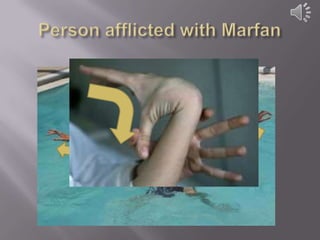
Person afflicted with Marfan
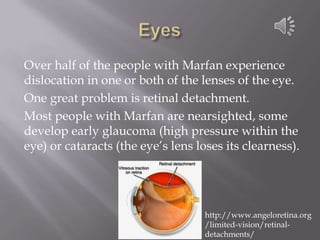
EyesOver half of the people with Marfan experience dislocation in one or both of the lenses of the eye.One great problem is retinal detachment. Most people with Marfan are nearsighted, some develop early glaucoma (high pressure within the eye) or cataracts (the eye’s lens loses its clearness). http://www.angeloretina.org/limited-vision/retinal-detachments/
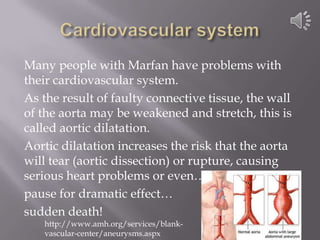
Cardiovascular systemMany people with Marfan have problems with their cardiovascular system. As the result of faulty connective tissue, the wall of the aorta may be weakened and stretch, this is called aortic dilatation. Aortic dilatation increases the risk that the aorta will tear (aortic dissection) or rupture, causing serious heart problems or even… pause for dramatic effect… sudden death!http://www.amh.org/services/blank-vascular-center/aneurysms.aspx
Nervous systemThe spinal cord and brain are surrounded by fluid contained by a membrane called the dura, the durais composed of connective tissue. When someone who has Marfan gets older, the dura often stretches and weakens, then starts to weigh on the vertebrae in the lower spine and wear away the bone that lay around the spinal cord. This is known as duralectasia. These changes may cause merely mild discomfort; or they may lead to radiated pain in the abdomen; or to pain, numbness, or weakness in the legs.
CauseMarfan syndrome is a genetic disease caused by a mutation in the fibrillin gene.The misshapen fibrillin produced from the mutated  gene weakens the tendons, ligaments, and other connective tissues in the body.Marfan is something you are born with.A child with a parent who has Marfan has a 50% chance of getting the disease.Though, very rarely, a new gene defect occurs during the formation of an egg or sperm cell.This makes it possible for two unaffected parents to have offspring with Marfan.There is only a 1 in 10,000 chance of this occurring.
TreatmentThere is no cure for Marfan syndromeSkeletal- annual evaluations are important to detect changes in the spine or sternum.Eyes- Regular and early eye examinations are necessary to identify and correct any vision problems brought about by Marfan. Surgery may be needed but glasses and contact lenses are usually sufficient.
Treatment cont.Heart and blood vessels – Echocardiograms and regular checkups help the doctor evaluate the size of the aorta and how the heart is working. The earlier a possible problem is identified and treated, the risk of life-threatening complications decreases. Those afflicted with heart problems are suggested to wear a medical alert band and to report to the emergency room if they experience back, chest, or abdominal pains. Some heart or valve problems can be managed with drugs such as beta-blockers, which may help decrease stress on the aorta. In other cases, surgery to replace a valve or repair the aorta may be needed.
BibliographyShiel, William, Jay Marks, Melissa Conrad Stoppler, Charles Davis, Dennis Lee, and Leslie Schoenfield. "Marfan Syndrome Symptoms, Causes, Diagnosis, and Treatment on MedicineNet.com." MedicineNet - Health and Medical Information Produced by Doctors. N.p., n.d. Web. 23 Mar. 2011. http://www.medicinenet.com/marfan_syndrome/article.htmHaldeman-Englert, Chad. "Marfan syndrome - PubMed Health." National Center for Biotechnology Information. N.p., 10 May 2010. Web. 23 Mar. 2011. http://www.ncbi.nlm.nih.gov/pubmedhealth/PMH0001455/
THE END

Marfan syndrome andrew

  • 1.
  • 2.
  • 3.
  • 4.
    EyesOver half ofthe people with Marfan experience dislocation in one or both of the lenses of the eye.One great problem is retinal detachment. Most people with Marfan are nearsighted, some develop early glaucoma (high pressure within the eye) or cataracts (the eye’s lens loses its clearness). http://www.angeloretina.org/limited-vision/retinal-detachments/
  • 5.
    Cardiovascular systemMany peoplewith Marfan have problems with their cardiovascular system. As the result of faulty connective tissue, the wall of the aorta may be weakened and stretch, this is called aortic dilatation. Aortic dilatation increases the risk that the aorta will tear (aortic dissection) or rupture, causing serious heart problems or even… pause for dramatic effect… sudden death!http://www.amh.org/services/blank-vascular-center/aneurysms.aspx
  • 6.
    Nervous systemThe spinalcord and brain are surrounded by fluid contained by a membrane called the dura, the durais composed of connective tissue. When someone who has Marfan gets older, the dura often stretches and weakens, then starts to weigh on the vertebrae in the lower spine and wear away the bone that lay around the spinal cord. This is known as duralectasia. These changes may cause merely mild discomfort; or they may lead to radiated pain in the abdomen; or to pain, numbness, or weakness in the legs.
  • 7.
    CauseMarfan syndrome isa genetic disease caused by a mutation in the fibrillin gene.The misshapen fibrillin produced from the mutated gene weakens the tendons, ligaments, and other connective tissues in the body.Marfan is something you are born with.A child with a parent who has Marfan has a 50% chance of getting the disease.Though, very rarely, a new gene defect occurs during the formation of an egg or sperm cell.This makes it possible for two unaffected parents to have offspring with Marfan.There is only a 1 in 10,000 chance of this occurring.
  • 8.
    TreatmentThere is nocure for Marfan syndromeSkeletal- annual evaluations are important to detect changes in the spine or sternum.Eyes- Regular and early eye examinations are necessary to identify and correct any vision problems brought about by Marfan. Surgery may be needed but glasses and contact lenses are usually sufficient.
  • 9.
    Treatment cont.Heart andblood vessels – Echocardiograms and regular checkups help the doctor evaluate the size of the aorta and how the heart is working. The earlier a possible problem is identified and treated, the risk of life-threatening complications decreases. Those afflicted with heart problems are suggested to wear a medical alert band and to report to the emergency room if they experience back, chest, or abdominal pains. Some heart or valve problems can be managed with drugs such as beta-blockers, which may help decrease stress on the aorta. In other cases, surgery to replace a valve or repair the aorta may be needed.
  • 10.
    BibliographyShiel, William, JayMarks, Melissa Conrad Stoppler, Charles Davis, Dennis Lee, and Leslie Schoenfield. "Marfan Syndrome Symptoms, Causes, Diagnosis, and Treatment on MedicineNet.com." MedicineNet - Health and Medical Information Produced by Doctors. N.p., n.d. Web. 23 Mar. 2011. http://www.medicinenet.com/marfan_syndrome/article.htmHaldeman-Englert, Chad. "Marfan syndrome - PubMed Health." National Center for Biotechnology Information. N.p., 10 May 2010. Web. 23 Mar. 2011. http://www.ncbi.nlm.nih.gov/pubmedhealth/PMH0001455/
  • 11.