Metabolic and complicated cataract
Dr.Ajai Agrawal
Additional Professor
Department of Ophthalmology
AIIMS, Rishikesh
Learning Objectives
• At the end of this class students shall be able
to :
• Classify cataract according to aetiology.
• Understand pathophysiology of metabolic and
complicated cataract.
• Identify distinct morphological subtypes of
metabolic and complicated cataract.
2
‘CATARACTA’(LATIN)MEANING ‘WATERFALL’
3
Definition of cataract
• Any opacity in the lens or its capsule
4
Etiological classification of cataract
1. Age related cataract
2. Traumatic cataract
3. Metabolic cataract
4. Complicated cataract
5. Toxic cataract
6. Radiation induced cataract
5
METABOLIC CATARACTS
• Due to endocrine disorders and biochemical
abnormalities.
• Diabetic cataract
Hyperglycemia
Excess glucose metabolizes into
sorbitol
(Aldose reductase mediated)
Osmotic over hydration 6
1. Age related cataract in
diabetics
• Early onset
• Rapid progression
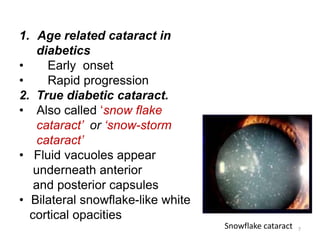
2. True diabetic cataract.
• Also called ‘snow flake
cataract’ or ‘snow-storm
cataract’
• Fluid vacuoles appear
underneath anterior
and posterior capsules
• Bilateral snowflake-like white
cortical opacities
Snowflake cataract 7
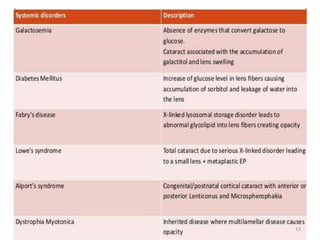
Galactosemia
• Multisystem disorder
• Inborn error of galactose
metabolism
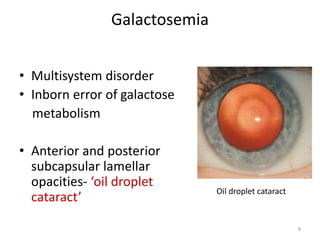
• Anterior and posterior
subcapsular lamellar
opacities- ‘oil droplet
cataract’
Oil droplet cataract
8
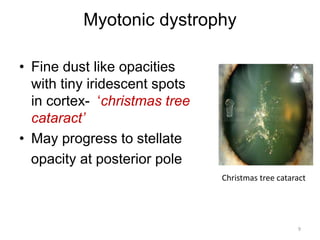
Myotonic dystrophy
• Fine dust like opacities
with tiny iridescent spots
in cortex- ‘christmas tree
cataract’
• May progress to stellate
opacity at posterior pole
Christmas tree cataract
9
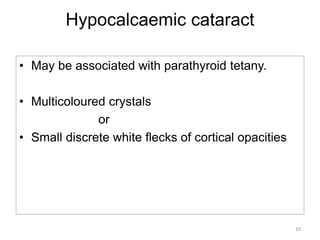
Hypocalcaemic cataract
• May be associated with parathyroid tetany.
• Multicoloured crystals
or
• Small discrete white flecks of cortical opacities
10
Wilson’s disease
• ‘Sunflower cataract’ is
rare in such patients.
• ‘Kayser-Fleischer ring’
(KF ring) in the cornea
is more common. Sunflower cataract
(Photographs- Courtesy :
Kanski’s Clinical Ophthalmology)
11
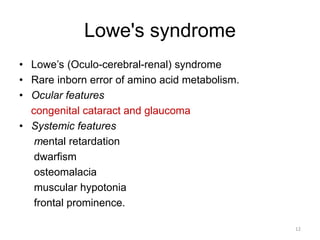
Lowe's syndrome
• Lowe’s (Oculo-cerebral-renal) syndrome
• Rare inborn error of amino acid metabolism.
• Ocular features
congenital cataract and glaucoma
• Systemic features
mental retardation
dwarfism
osteomalacia
muscular hypotonia
frontal prominence.
12
13
COMPLICATED CATARACT
• Opacification of the lens secondary to
some other intraocular disease.
• Inflammatory conditions
• Uveal inflammations
(like iridocyclitis, pars planitis, choroiditis)
• Hypopyon corneal ulcer
• Endophthalmitis.
14
• Degenerative conditions
• Retinitis pigmentosa
• Myopic chorioretinal degeneration
• Retinal detachment
Long-standing cases
• Glaucoma (primary or secondary)
• Intraocular tumours
• Retinoblastoma
• Malignant melanoma
15
COMPLICATED CATARACT
• Lens changes typically in front
of the posterior capsule.
• Irregular in outline
• Variable in density
• Appearance like ‘breadcrumb’.
• A very characteristic sign is
Iridescent coloured particles
‘polychromatic lustre’ of
reds, greens and blues.
16
COMPLICATED CATARACT
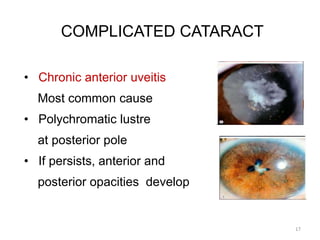
• Chronic anterior uveitis
Most common cause
• Polychromatic lustre
at posterior pole
• If persists, anterior and
posterior opacities develop
17
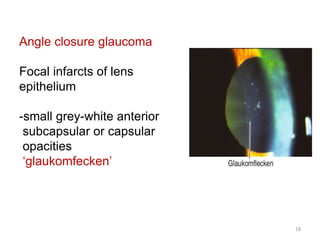
Angle closure glaucoma
Focal infarcts of lens
epithelium
-small grey-white anterior
subcapsular or capsular
opacities
‘glaukomfecken’
18
•Pathological myopia
Posterior subcapsular opacities
Early onset nuclear sclerosis
•Hereditary fundus dystrophies
Lebers: total cataract
Stickler syndrome: cortical cataract
19
Toxic cataracts
1. Smoking
2. Alcohol
3. Drug induced cataract
Corticosteroids
Phenothiazines
Pilocarpine
Diuretics
Amiodarone
Allopurinol
Chloroquine
20
Other types:
• Infrared (heat) cataract:
‘Glass-blower’s or Glassworker’s cataract’
• Irradiation cataract
• Ultraviolet radiation cataract
• Electric cataract
21
MANAGEMENT OF CATARACT IN ADULTS
• A. Non-surgical measures
• B. Surgical management
22
Non-surgical measures
1. Treatment of cause of cataract
2. Measures to delay progression
3. Measures to improve vision in the presence of
incipient and immature cataract
23
Surgical management
• Indications
1. Visual improvement
2. Medical indications :
Lens induced glaucoma
Retinal diseases like
diabetic retinopathy or retinal detachment
(treatment of which is hampered by
presence of lens opacities)
3. Cosmetic indications
24
Preoperative evaluation
I. General medical examination of the patient
II. Ocular examination
A. Retinal function tests
B. Search for local source of infection
C. Anterior segment evaluation by slit-lamp
examination
D. Intraocular pressure (IOP) measurement
25
Retinal function tests
• Light perception (PL)
• Projection of rays (PR)
• Pupillary reaction to light
• Two-light discrimination test
• Maddox rod test
26
Retinal function tests
• Colour perception
• Entoptic visualisation
• Laser interferometry
• Objective tests for evaluating retina
like VEP, ERG, EOG, USG
27
Preoperative medications and preparations
• 1. Topical antibiotics
• 2. Preparation of the eye to be operated.
• 3. An informed and detailed consent
• 4. Scrub bath and care of hair.
• 5. To lower IOP
• 6. To sustain dilated pupil
• Anaesthesia
• LA/GA
28
Types and choice of surgical techniques
• Phacoemulsification (MICS)
• Small incision cataract surgery (SICS)
• Extracapsular cataract extraction (ECCE)
• Intracapsular cataract extraction (ICCE)
29
Conclusion
• Metabolic cataracts are due to endocrine
disorders and/or biochemical abnormalities.
• Complicated cataracts involve opacification
of the lens secondary to some other
intraocular disease.
• Many metabolic and complicated cataracts
have distinctive morphologies.
30
Thank you
31

complicated_cataract. Presentation slide

  • 1.
    Metabolic and complicatedcataract Dr.Ajai Agrawal Additional Professor Department of Ophthalmology AIIMS, Rishikesh
  • 2.
    Learning Objectives • Atthe end of this class students shall be able to : • Classify cataract according to aetiology. • Understand pathophysiology of metabolic and complicated cataract. • Identify distinct morphological subtypes of metabolic and complicated cataract. 2
  • 3.
  • 4.
    Definition of cataract •Any opacity in the lens or its capsule 4
  • 5.
    Etiological classification ofcataract 1. Age related cataract 2. Traumatic cataract 3. Metabolic cataract 4. Complicated cataract 5. Toxic cataract 6. Radiation induced cataract 5
  • 6.
    METABOLIC CATARACTS • Dueto endocrine disorders and biochemical abnormalities. • Diabetic cataract Hyperglycemia Excess glucose metabolizes into sorbitol (Aldose reductase mediated) Osmotic over hydration 6
  • 7.
    1. Age relatedcataract in diabetics • Early onset • Rapid progression 2. True diabetic cataract. • Also called ‘snow flake cataract’ or ‘snow-storm cataract’ • Fluid vacuoles appear underneath anterior and posterior capsules • Bilateral snowflake-like white cortical opacities Snowflake cataract 7
  • 8.
    Galactosemia • Multisystem disorder •Inborn error of galactose metabolism • Anterior and posterior subcapsular lamellar opacities- ‘oil droplet cataract’ Oil droplet cataract 8
  • 9.
    Myotonic dystrophy • Finedust like opacities with tiny iridescent spots in cortex- ‘christmas tree cataract’ • May progress to stellate opacity at posterior pole Christmas tree cataract 9
  • 10.
    Hypocalcaemic cataract • Maybe associated with parathyroid tetany. • Multicoloured crystals or • Small discrete white flecks of cortical opacities 10
  • 11.
    Wilson’s disease • ‘Sunflowercataract’ is rare in such patients. • ‘Kayser-Fleischer ring’ (KF ring) in the cornea is more common. Sunflower cataract (Photographs- Courtesy : Kanski’s Clinical Ophthalmology) 11
  • 12.
    Lowe's syndrome • Lowe’s(Oculo-cerebral-renal) syndrome • Rare inborn error of amino acid metabolism. • Ocular features congenital cataract and glaucoma • Systemic features mental retardation dwarfism osteomalacia muscular hypotonia frontal prominence. 12
  • 13.
  • 14.
    COMPLICATED CATARACT • Opacificationof the lens secondary to some other intraocular disease. • Inflammatory conditions • Uveal inflammations (like iridocyclitis, pars planitis, choroiditis) • Hypopyon corneal ulcer • Endophthalmitis. 14
  • 15.
    • Degenerative conditions •Retinitis pigmentosa • Myopic chorioretinal degeneration • Retinal detachment Long-standing cases • Glaucoma (primary or secondary) • Intraocular tumours • Retinoblastoma • Malignant melanoma 15
  • 16.
    COMPLICATED CATARACT • Lenschanges typically in front of the posterior capsule. • Irregular in outline • Variable in density • Appearance like ‘breadcrumb’. • A very characteristic sign is Iridescent coloured particles ‘polychromatic lustre’ of reds, greens and blues. 16
  • 17.
    COMPLICATED CATARACT • Chronicanterior uveitis Most common cause • Polychromatic lustre at posterior pole • If persists, anterior and posterior opacities develop 17
  • 18.
    Angle closure glaucoma Focalinfarcts of lens epithelium -small grey-white anterior subcapsular or capsular opacities ‘glaukomfecken’ 18
  • 19.
    •Pathological myopia Posterior subcapsularopacities Early onset nuclear sclerosis •Hereditary fundus dystrophies Lebers: total cataract Stickler syndrome: cortical cataract 19
  • 20.
    Toxic cataracts 1. Smoking 2.Alcohol 3. Drug induced cataract Corticosteroids Phenothiazines Pilocarpine Diuretics Amiodarone Allopurinol Chloroquine 20
  • 21.
    Other types: • Infrared(heat) cataract: ‘Glass-blower’s or Glassworker’s cataract’ • Irradiation cataract • Ultraviolet radiation cataract • Electric cataract 21
  • 22.
    MANAGEMENT OF CATARACTIN ADULTS • A. Non-surgical measures • B. Surgical management 22
  • 23.
    Non-surgical measures 1. Treatmentof cause of cataract 2. Measures to delay progression 3. Measures to improve vision in the presence of incipient and immature cataract 23
  • 24.
    Surgical management • Indications 1.Visual improvement 2. Medical indications : Lens induced glaucoma Retinal diseases like diabetic retinopathy or retinal detachment (treatment of which is hampered by presence of lens opacities) 3. Cosmetic indications 24
  • 25.
    Preoperative evaluation I. Generalmedical examination of the patient II. Ocular examination A. Retinal function tests B. Search for local source of infection C. Anterior segment evaluation by slit-lamp examination D. Intraocular pressure (IOP) measurement 25
  • 26.
    Retinal function tests •Light perception (PL) • Projection of rays (PR) • Pupillary reaction to light • Two-light discrimination test • Maddox rod test 26
  • 27.
    Retinal function tests •Colour perception • Entoptic visualisation • Laser interferometry • Objective tests for evaluating retina like VEP, ERG, EOG, USG 27
  • 28.
    Preoperative medications andpreparations • 1. Topical antibiotics • 2. Preparation of the eye to be operated. • 3. An informed and detailed consent • 4. Scrub bath and care of hair. • 5. To lower IOP • 6. To sustain dilated pupil • Anaesthesia • LA/GA 28
  • 29.
    Types and choiceof surgical techniques • Phacoemulsification (MICS) • Small incision cataract surgery (SICS) • Extracapsular cataract extraction (ECCE) • Intracapsular cataract extraction (ICCE) 29
  • 30.
    Conclusion • Metabolic cataractsare due to endocrine disorders and/or biochemical abnormalities. • Complicated cataracts involve opacification of the lens secondary to some other intraocular disease. • Many metabolic and complicated cataracts have distinctive morphologies. 30
  • 31.