Sinus Bradycardia
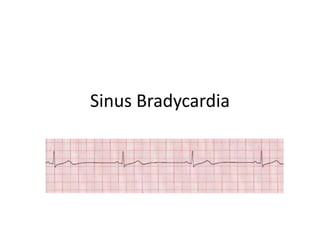
Sinus Bradycardia
• Sinus rate below 60 beats/minute
• Regular rhythm
• Occurs normally during sleep
  – Decreased metabolic demands
• Occurs normally in a person with a well-
  conditioned heart
  – Athlete
     • Well-conditioned hearts can maintain a normal stroke
       volume with less-than-normal effort
Sinus Bradycardia
• How it happens
  – Normal response to a reduced demand for blood
    flow
     • Vagal simulation increases and sympathetic stimulation
       decreases
        – Automaticity in the SA node diminishes
Sinus Bradycardia
• A tolerable condition?
  – Most adults can tolerate a sinus bradycardia of 45-
    59 beats/minute
  – Less tolerant of a rate below 45 beats/minute
Sinus Bradycardia
• Causes
  – Non-cardiac disorders
  – Conditions producing excess vagal stimulation or
    decreased sympathetic stimulation
  – Cardiac diseases
  – Certain drugs
Sinus Bradycardia
• No symptoms? No problem
• Symptoms? PROBLEM
  – Prompt attention is critical
  – Can lead to more serious problems
     • Hypotension and dizziness
     • Ventricular tachycardia and ventricular fibrillation
Symptomatic Bradycardia
• If a patient can’t tolerate bradycardia, he may
  develop these signs and symptoms:
   –   Hypotension
   –   Cool, clammy skin
   –   Altered mental status
   –   Dizziness
   –   Blurred vision
   –   Crackles, dyspnea
   –   Chest pain
   –   Syncope
Symptomatic Bradycardia
• When to call for help and what to do until help
  arrives
  – Look at the patient and ask how they are doing
  – Call for help if heart rate is too slow and/or
    symptomatic
     • Compare it their normal heart rate and rhythm
  – Stay with the patient
  – If the patient is not breathing and does not respond
     • Call code
     • ABCs/CPR
Sinus Bradycardia
• Atrial & ventricular rhythms are regular, as are
  their rates, except that they’re both under 60
  beats/minute
Sinus Bradycardia
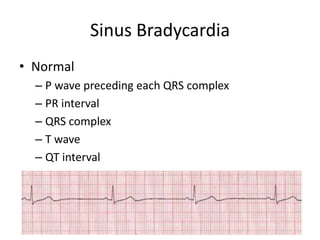
• Normal
  – P wave preceding each QRS complex
  – PR interval
  – QRS complex
  – T wave
  – QT interval
Sinus Bradycardia
• P wave
  – rounded, smooth, and upright in lead II, signaling
    that a sinus impulse has reached the atria
Sinus Bradycardia
• PR interval
• Normal indicating that the impulse is following
  normal conduction pathways
  – 0.12-0.20 seconds
Sinus Bradycardia
• QRS complex
• Normal duration representing normal
  ventricular impulse conduction and recovery
  – Less than 0.12 seconds
Sinus Bradycardia
• T wave
  – Upright in lead II, confirming that normal
    repolarization has taken place
Sinus Bradycardia
• QT interval
  – Within normal limits
     • 0.36 to 0.44 seconds

Sinus bradycardia

  • 1.
  • 2.
    Sinus Bradycardia • Sinusrate below 60 beats/minute • Regular rhythm • Occurs normally during sleep – Decreased metabolic demands • Occurs normally in a person with a well- conditioned heart – Athlete • Well-conditioned hearts can maintain a normal stroke volume with less-than-normal effort
  • 3.
    Sinus Bradycardia • Howit happens – Normal response to a reduced demand for blood flow • Vagal simulation increases and sympathetic stimulation decreases – Automaticity in the SA node diminishes
  • 4.
    Sinus Bradycardia • Atolerable condition? – Most adults can tolerate a sinus bradycardia of 45- 59 beats/minute – Less tolerant of a rate below 45 beats/minute
  • 5.
    Sinus Bradycardia • Causes – Non-cardiac disorders – Conditions producing excess vagal stimulation or decreased sympathetic stimulation – Cardiac diseases – Certain drugs
  • 6.
    Sinus Bradycardia • Nosymptoms? No problem • Symptoms? PROBLEM – Prompt attention is critical – Can lead to more serious problems • Hypotension and dizziness • Ventricular tachycardia and ventricular fibrillation
  • 7.
    Symptomatic Bradycardia • Ifa patient can’t tolerate bradycardia, he may develop these signs and symptoms: – Hypotension – Cool, clammy skin – Altered mental status – Dizziness – Blurred vision – Crackles, dyspnea – Chest pain – Syncope
  • 8.
    Symptomatic Bradycardia • Whento call for help and what to do until help arrives – Look at the patient and ask how they are doing – Call for help if heart rate is too slow and/or symptomatic • Compare it their normal heart rate and rhythm – Stay with the patient – If the patient is not breathing and does not respond • Call code • ABCs/CPR
  • 9.
    Sinus Bradycardia • Atrial& ventricular rhythms are regular, as are their rates, except that they’re both under 60 beats/minute
  • 10.
    Sinus Bradycardia • Normal – P wave preceding each QRS complex – PR interval – QRS complex – T wave – QT interval
  • 11.
    Sinus Bradycardia • Pwave – rounded, smooth, and upright in lead II, signaling that a sinus impulse has reached the atria
  • 12.
    Sinus Bradycardia • PRinterval • Normal indicating that the impulse is following normal conduction pathways – 0.12-0.20 seconds
  • 13.
    Sinus Bradycardia • QRScomplex • Normal duration representing normal ventricular impulse conduction and recovery – Less than 0.12 seconds
  • 14.
    Sinus Bradycardia • Twave – Upright in lead II, confirming that normal repolarization has taken place
  • 15.
    Sinus Bradycardia • QTinterval – Within normal limits • 0.36 to 0.44 seconds