Ebolavirus


                By
Cyrus E. Kuschner and Nate Chumley
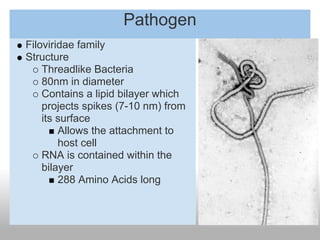
Pathogen
Filoviridae family
Structure
    Threadlike Bacteria
    80nm in diameter
    Contains a lipid bilayer which
    projects spikes (7-10 nm) from
    its surface
        Allows the attachment to
        host cell
    RNA is contained within the
    bilayer
        288 Amino Acids long
Pathogenesis
Targets Endothelial cells, Mononuclear Phagocytes, and
Hepatocytes
After a cell is infected, the host secretes the Ebola virus
glycoprotein (GP)
    GP binds to other endothelial cells
    sGP creates a dimer which interferes with White blood
    cell signals
Cell budding causes a release of Cytokines
    Causes Fever and inflammation
Degeneration of Endothelial cells results in a loss of
vascular integrity.
    Causes coagulopathy
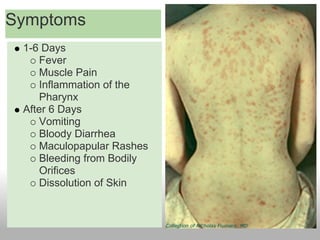
Symptoms
 1-6 Days
     Fever
     Muscle Pain
     Inflammation of the
     Pharynx
 After 6 Days
     Vomiting
     Bloody Diarrhea
     Maculopapular Rashes
     Bleeding from Bodily
     Orifices
     Dissolution of Skin
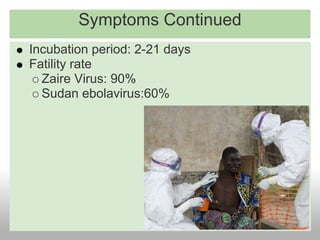
Symptoms Continued
Incubation period: 2-21 days
Fatility rate
  Zaire Virus: 90%
  Sudan ebolavirus:60%
Diagnosis
Since early symptoms are similar to other diseases Ebola is
often mistaken for Malaria, Typhoid Fever, or Influenza
Saliva and Urine samples can be used to diagnosis Ebola
by using Enzyme-Linked ImmunoSorbent Assay tests
(ELISA)
    In ELISA antibodies are applied to the antigen allowing
    them to bind.
    A substance is added so that the tester can see which
    antibodies have bound to the antigen.
Transmission
-Ebola is transmitted through bodily fluids (Saliva, vomit, semen,
blood, etc.)
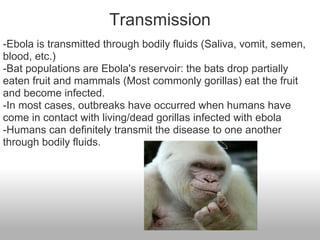
-Bat populations are Ebola's reservoir: the bats drop partially
eaten fruit and mammals (Most commonly gorillas) eat the fruit
and become infected.
-In most cases, outbreaks have occurred when humans have
come in contact with living/dead gorillas infected with ebola
-Humans can definitely transmit the disease to one another
through bodily fluids.
Epidemiology

-The virus is named after the Ebola River Valley in the Congo
-The first outbreak was in 1976, where it had a 90% fatality rate
-It has appeared in the Congo several times since then
-Ebola was contained to Africa, until the 1989 outbreak in
Reston, Virginia
-Monkeys that had the Ebola virus where transported to
Virginia, however the virus was non-pathogenic to humans
-This outbreak made Ebola virus known around the world.
-There are several different Ebola viruses, each with different
fatality rates: Zaire virus (90%), Sudan Ebolavirus (50-60%),
Reston (0%, in humans), Cote d'Ivorie Ebolavirus (0%, only one
person contracted it and she did not die), Bundibugyo
Ebolavirus (24.83%).
In-Class Discussion

   It is now 1976, the first known outbreak of Ebola has been
diagnosed in the Ebola River Valley. You are among the first
doctors sent into the Congo to help treat the epidemic. When
you arrive you notice that all of the village gathers to bury each
victim individually. What would you change? Why? What
measures would you take to stop the spread of the
disease? How would you treat the patients who already have
Ebola?
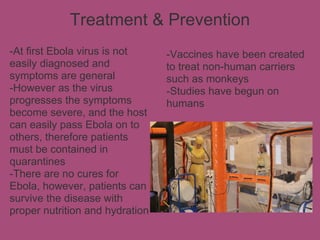
Treatment & Prevention
-At first Ebola virus is not     -Vaccines have been created
easily diagnosed and             to treat non-human carriers
symptoms are general             such as monkeys
-However as the virus            -Studies have begun on
progresses the symptoms          humans
become severe, and the host
can easily pass Ebola on to
others, therefore patients
must be contained in
quarantines
-There are no cures for
Ebola, however, patients can
survive the disease with
proper nutrition and hydration
Current & Future
-Since Ebola has high
infectiousness and infectivity
rate many people have
believed that it could be used
as a biological weapon

-It is classified as a biosafety
level 4 agent, as well as
category A bioterrorism agent
by the CDC

-The effectiveness is
compromised by its rapid
lethality, since patients die off
before they can pass it on
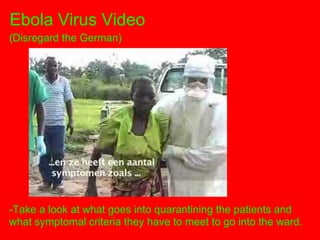
Ebola Virus Video
(Disregard the German)


-Take a look at what goes into quarantining the patients and
what symptomal criteria they have to meet to go into the ward.
Works Cited

-http://en.wikipedia.org/wiki/Ebola

-https://newsline.llnl.
gov/_rev02/articles/2009/sep/images/091809_images/bw_haza
rd.png

-http://www.youtube.com/watch?
v=iVVQPcMdUnY&feature=player_embedded

Ebolavirus

  • 1.
    Ebolavirus By Cyrus E. Kuschner and Nate Chumley
  • 2.
    Pathogen Filoviridae family Structure Threadlike Bacteria 80nm in diameter Contains a lipid bilayer which projects spikes (7-10 nm) from its surface Allows the attachment to host cell RNA is contained within the bilayer 288 Amino Acids long
  • 3.
    Pathogenesis Targets Endothelial cells,Mononuclear Phagocytes, and Hepatocytes After a cell is infected, the host secretes the Ebola virus glycoprotein (GP) GP binds to other endothelial cells sGP creates a dimer which interferes with White blood cell signals Cell budding causes a release of Cytokines Causes Fever and inflammation Degeneration of Endothelial cells results in a loss of vascular integrity. Causes coagulopathy
  • 4.
    Symptoms 1-6 Days Fever Muscle Pain Inflammation of the Pharynx After 6 Days Vomiting Bloody Diarrhea Maculopapular Rashes Bleeding from Bodily Orifices Dissolution of Skin
  • 5.
    Symptoms Continued Incubation period:2-21 days Fatility rate Zaire Virus: 90% Sudan ebolavirus:60%
  • 7.
    Diagnosis Since early symptomsare similar to other diseases Ebola is often mistaken for Malaria, Typhoid Fever, or Influenza Saliva and Urine samples can be used to diagnosis Ebola by using Enzyme-Linked ImmunoSorbent Assay tests (ELISA) In ELISA antibodies are applied to the antigen allowing them to bind. A substance is added so that the tester can see which antibodies have bound to the antigen.
  • 8.
    Transmission -Ebola is transmittedthrough bodily fluids (Saliva, vomit, semen, blood, etc.) -Bat populations are Ebola's reservoir: the bats drop partially eaten fruit and mammals (Most commonly gorillas) eat the fruit and become infected. -In most cases, outbreaks have occurred when humans have come in contact with living/dead gorillas infected with ebola -Humans can definitely transmit the disease to one another through bodily fluids.
  • 9.
    Epidemiology -The virus isnamed after the Ebola River Valley in the Congo -The first outbreak was in 1976, where it had a 90% fatality rate -It has appeared in the Congo several times since then -Ebola was contained to Africa, until the 1989 outbreak in Reston, Virginia -Monkeys that had the Ebola virus where transported to Virginia, however the virus was non-pathogenic to humans -This outbreak made Ebola virus known around the world. -There are several different Ebola viruses, each with different fatality rates: Zaire virus (90%), Sudan Ebolavirus (50-60%), Reston (0%, in humans), Cote d'Ivorie Ebolavirus (0%, only one person contracted it and she did not die), Bundibugyo Ebolavirus (24.83%).
  • 10.
    In-Class Discussion It is now 1976, the first known outbreak of Ebola has been diagnosed in the Ebola River Valley. You are among the first doctors sent into the Congo to help treat the epidemic. When you arrive you notice that all of the village gathers to bury each victim individually. What would you change? Why? What measures would you take to stop the spread of the disease? How would you treat the patients who already have Ebola?
  • 11.
    Treatment & Prevention -Atfirst Ebola virus is not -Vaccines have been created easily diagnosed and to treat non-human carriers symptoms are general such as monkeys -However as the virus -Studies have begun on progresses the symptoms humans become severe, and the host can easily pass Ebola on to others, therefore patients must be contained in quarantines -There are no cures for Ebola, however, patients can survive the disease with proper nutrition and hydration
  • 12.
    Current & Future -SinceEbola has high infectiousness and infectivity rate many people have believed that it could be used as a biological weapon -It is classified as a biosafety level 4 agent, as well as category A bioterrorism agent by the CDC -The effectiveness is compromised by its rapid lethality, since patients die off before they can pass it on
  • 13.
    Ebola Virus Video (Disregardthe German) -Take a look at what goes into quarantining the patients and what symptomal criteria they have to meet to go into the ward.
  • 14.