Severe Acute Respiratory Syndrome Cassie Goodman and Dylan Karle
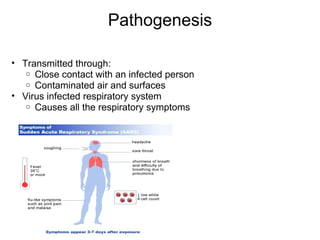
Symptoms & Signs Usually begins with a sudden onset of a high fever  Greater than 100.4 degrees Headache, overall discomfort, body/muscle aches, chills, shivering, sore throat, runny nose 10%-20% of patients get diarrhea Dry cough, breathing difficulties (after 2-7 days) Oxygen levels in the blood are low Most patients will develop pneumonia (3-4 days) Traveled recently to a SARS-affected area  Been in close contact with someone diagnosed with SARS May not be infectious until symptoms begin to appear  Usually 2-7 days, can be up to 10 days  Incubation Period
Symptoms and Signs Continued... Acute Sudden onset of a high fever Can be lethal for severe cases 11% average death rate in the most severe cases   Not lethal for mildly affected people  With time, relief of symptoms, and no complications Difficult to make an accurate prognosis because there is no cure  Based on statistics of SARS patients with similar symptoms and conditions
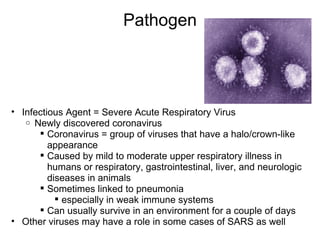
Pathogen Infectious Agent = Severe Acute Respiratory Virus Newly discovered coronavirus Coronavirus = group of viruses that have a halo/crown-like appearance  Caused by mild to moderate upper respiratory illness in humans or respiratory, gastrointestinal, liver, and neurologic diseases in animals  Sometimes linked to pneumonia  especially in weak immune systems Can usually survive in an environment for a couple of days Other viruses may have a role in some cases of SARS as well
Pathogenesis Transmitted through: Close contact with an infected person Contaminated air and surfaces Virus infected respiratory system Causes all the respiratory symptoms 
Diagnosis Doctor will ask questions (travels), perform a physical exam and tests PCR test Polymerase Chain Reaction Test - an essential test that detects the genetic material of the SARS virus in specimens of a patient's blood, stool, or nasal secretions Serologic Testing  Laboratory test that searches for antibodies (substances made by the body's immune system to fight a specific infection) to the SARS virus in the patient's blood Viral Culture A small sample of the patient's tissue or fluid that may be infected is placed in a container along with cells in which the SARS virus can grow and if the SARS virus grows in the culture, it will cause changes in the cells that can be seen under a microscope 
Transmission Close person to person contact Coughs Sneezes If a person touches a contaminated surface and then touches their eyes mouth or nose
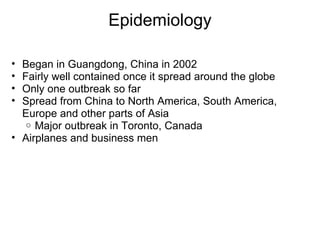
Epidemiology Began in Guangdong, China in 2002 Fairly well contained once it spread around the globe Only one outbreak so far Spread from China to North America, South America, Europe and other parts of Asia Major outbreak in Toronto, Canada Airplanes and business men
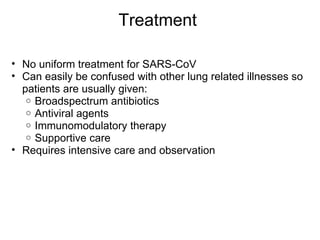
Treatment  No uniform treatment for SARS-CoV Can easily be confused with other lung related illnesses so patients are usually given: Broadspectrum antibiotics Antiviral agents Immunomodulatory therapy Supportive care Requires intensive care and observation
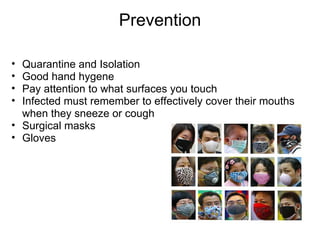
Prevention Quarantine and Isolation Good hand hygene Pay attention to what surfaces you touch Infected must remember to effectively cover their mouths when they sneeze or cough Surgical masks Gloves
 
Citations http://diseases.emedtv.com/sars/sars-prognosis.html   http://www.cdc.gov/ncidod/SARS/factsheet.htm http://www.cdc.gov/ncidod/sars/ http://www.aseansec.org/sars_symptoms.htm http://www.sarsreference.com/sarsref  www.absa.org/pdf/090911DHHS_ SARS _Select_Agent_Comments.pdf  

Severe Acute Respiratory Syndrome

  • 1.
    Severe Acute RespiratorySyndrome Cassie Goodman and Dylan Karle
  • 2.
    Symptoms & SignsUsually begins with a sudden onset of a high fever  Greater than 100.4 degrees Headache, overall discomfort, body/muscle aches, chills, shivering, sore throat, runny nose 10%-20% of patients get diarrhea Dry cough, breathing difficulties (after 2-7 days) Oxygen levels in the blood are low Most patients will develop pneumonia (3-4 days) Traveled recently to a SARS-affected area  Been in close contact with someone diagnosed with SARS May not be infectious until symptoms begin to appear  Usually 2-7 days, can be up to 10 days  Incubation Period
  • 3.
    Symptoms and SignsContinued... Acute Sudden onset of a high fever Can be lethal for severe cases 11% average death rate in the most severe cases   Not lethal for mildly affected people  With time, relief of symptoms, and no complications Difficult to make an accurate prognosis because there is no cure  Based on statistics of SARS patients with similar symptoms and conditions
  • 4.
    Pathogen Infectious Agent= Severe Acute Respiratory Virus Newly discovered coronavirus Coronavirus = group of viruses that have a halo/crown-like appearance  Caused by mild to moderate upper respiratory illness in humans or respiratory, gastrointestinal, liver, and neurologic diseases in animals  Sometimes linked to pneumonia  especially in weak immune systems Can usually survive in an environment for a couple of days Other viruses may have a role in some cases of SARS as well
  • 5.
    Pathogenesis Transmitted through:Close contact with an infected person Contaminated air and surfaces Virus infected respiratory system Causes all the respiratory symptoms 
  • 6.
    Diagnosis Doctor willask questions (travels), perform a physical exam and tests PCR test Polymerase Chain Reaction Test - an essential test that detects the genetic material of the SARS virus in specimens of a patient's blood, stool, or nasal secretions Serologic Testing  Laboratory test that searches for antibodies (substances made by the body's immune system to fight a specific infection) to the SARS virus in the patient's blood Viral Culture A small sample of the patient's tissue or fluid that may be infected is placed in a container along with cells in which the SARS virus can grow and if the SARS virus grows in the culture, it will cause changes in the cells that can be seen under a microscope 
  • 7.
    Transmission Close personto person contact Coughs Sneezes If a person touches a contaminated surface and then touches their eyes mouth or nose
  • 8.
    Epidemiology Began inGuangdong, China in 2002 Fairly well contained once it spread around the globe Only one outbreak so far Spread from China to North America, South America, Europe and other parts of Asia Major outbreak in Toronto, Canada Airplanes and business men
  • 9.
    Treatment Nouniform treatment for SARS-CoV Can easily be confused with other lung related illnesses so patients are usually given: Broadspectrum antibiotics Antiviral agents Immunomodulatory therapy Supportive care Requires intensive care and observation
  • 10.
    Prevention Quarantine andIsolation Good hand hygene Pay attention to what surfaces you touch Infected must remember to effectively cover their mouths when they sneeze or cough Surgical masks Gloves
  • 11.
  • 12.
    Citations http://diseases.emedtv.com/sars/sars-prognosis.html  http://www.cdc.gov/ncidod/SARS/factsheet.htm http://www.cdc.gov/ncidod/sars/ http://www.aseansec.org/sars_symptoms.htm http://www.sarsreference.com/sarsref  www.absa.org/pdf/090911DHHS_ SARS _Select_Agent_Comments.pdf