Gilada/Unison/Mumbai
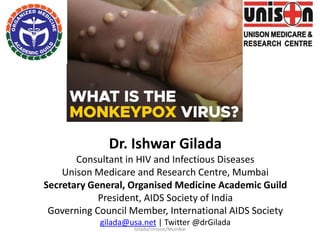
Dr. Ishwar Gilada
Consultant in HIV and Infectious Diseases
Unison Medicare and Research Centre, Mumbai
Secretary General, Organised Medicine Academic Guild
President, AIDS Society of India
Governing Council Member, International AIDS Society
gilada@usa.net | Twitter @drGilada
Gilada/Unison/Mumbai
Disclaimer and Observations
• Here we are on ‘Fact’-finding mission on Monkeypox
• Like Coronavirus, the human race is caught unawares
with human spread of Monkeypox to non-endemic zones
• In Monkeypox science, no one is expert, same with me!
• What I am expressing here is based on history, science,
experience elsewhere & some suggestions (not-
guidelines)
• No conflict of interest whatsoever, it is just a sincere
effort to reach out to medical, scientific and
administrative community as well as other intelligentsia
Gilada/Unison/Mumbai
What is Monkeypox?
The monkeypox infection is caused by Monkeypox virus- an orthopoxvirus,
a genus of viruses that encompasses Poxviridae family (83 sp) and includes:
1. Variola virus that causes smallpox
2. Vaccinia virus, which was used in making smallpox vaccine. This is also
seen in Brazil.
3. Mollusci virus that causes Molluscum Contagiosum
4. Cowpox (seen in Europe) (discovery 1770 to 1790)
5. Rabbitpox virus (discovery 1933 in USA, can not infect humans).
6. Ectromelia virus (ECTV) that causes mousepox
Also Camelpox, Horsepox, recently Alaskapox (discovery 2015)
Monkeypox causes symptoms like smallpox, although they are less severe.
It was first identified in 1958 among laboratory monkeys in Denmark
Gilada/Unison/Mumbai
Origin of Monkeypox Virus
• While vaccination eradicated smallpox worldwide in
1980, Monkeypox continues to occur in few countries
in Central and West Africa, and has on occasion
showed up elsewhere (71 cases in USA outbreak-2003)
• Monkeypox is a zoonosis, an infection transmitted from
infected animals to humans.
• Monkeypox virus infection has been detected in
squirrels, Gambian poached rats, dormice and some
species of monkeys
• West and Central Africa: 11 countries - Cameroon,
Central African Republic, DRCongo, Sierra Leone +7
Gilada/Unison/Mumbai
First cases of Monkeypox:
• Monkeypox was first discovered in 1958 when
two outbreaks of a pox-like disease occurred
in colonies of monkeys kept for research,
hence the name 'monkey-pox.'
• The first human case of Monkeypox was
recorded in 1970 in the Democratic Republic
of the Congo (DRC) during a period of
intensified effort to eliminate smallpox.
Gilada/Unison/Mumbai
Monkeypox outbreak: Headlines
• More than 250 confirmed and several suspected cases of
monkeypox from 20 countries
• Monkeypox "containable situation“ - WHO's Maria van Kerkhove
• Monkeypox outbreak will not lead to lockdowns
• Roche develops three test kits able to detect monkeypox
• US government orders $119 million of smallpox vaccine Jynneos
• Moderna starts clinical trials on monkeypox vaccine
• No mass vaccination, isolation and contact tracing suffice - WHO
• Denmark considering vaccinating monkeypox close contacts
Gilada/Unison/Mumbai
The Pathogen - MPV
• Monkeypox virus is an enveloped double-stranded DNA
virus that belongs to the Orthopoxvirus genus of the
Poxviridae family.
• There are two distinct genetic clades of the monkeypox
virus:
a) the Central African (Congo Basin) clade and
b) the West African clade.
• The Congo Basin clade has historically caused more severe
disease and was thought to be more transmissible.
• The geographical division between the two clades has so
far been in Cameroon - the only country where both virus
clades have been found.
Gilada/Unison/Mumbai
Where is the current problem?
• Monkeypox has been reported in 20 countries including the
UK, Spain, Portugal, Canada, USA, Australia, Austria,
Belgium, Denmark, Finland, France, Sweden, Germany,
Netherlands, Italy, Israel, Switzerland, singapore, Argentina
• According to reports, this is one of the biggest outbreaks of
the virus outside of West Africa (endemic)
• UK – where monkeypox was first detected in early May –
has the largest bulk of confirmed cases, 71,
• Spain with 51 cases
• Portugal- 37 reported cases.
• Canada has 15 and USA has 9.
Gilada/Unison/Mumbai
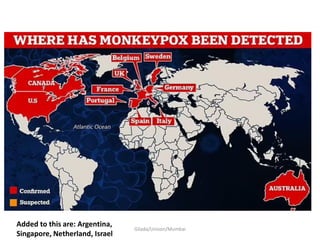
Added to this are: Argentina,
Singapore, Netherland, Israel
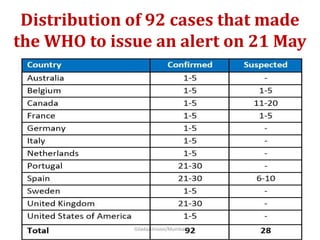
Distribution of 92 cases that made
the WHO to issue an alert on 21 May
Gilada/Unison/Mumbai
Transmission: How it spreads?
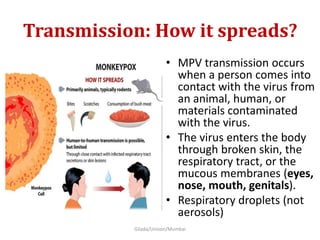
• MPV transmission occurs
when a person comes into
contact with the virus from
an animal, human, or
materials contaminated
with the virus.
• The virus enters the body
through broken skin, the
respiratory tract, or the
mucous membranes (eyes,
nose, mouth, genitals).
• Respiratory droplets (not
aerosols)
Gilada/Unison/Mumbai
Who is at high risk?
• Household or sexual contact with someone with
Monkeypox,
• Housekeeping person changing the bedding of an
infected person without wearing PPE.
Current risk factors for contracting Monkeypox include:
• Travel (within 21 days) to an area where Monkeypox
cases or exposures have been reported;
• Contact with a person who has a similar rash or a
diagnosis of confirmed or suspected Monkeypox; and
• Sexual partners of diagnosed or suspected Monkeypox,
predominantly more in MSM population
Gilada/Unison/Mumbai
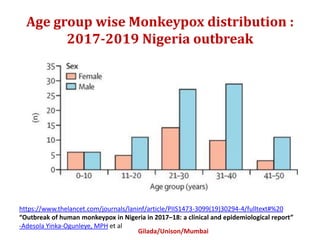
Age group wise Monkeypox distribution :
2017-2019 Nigeria outbreak
Gilada/Unison/Mumbai
https://www.thelancet.com/journals/laninf/article/PIIS1473-3099(19)30294-4/fulltext#%20
“Outbreak of human monkeypox in Nigeria in 2017–18: a clinical and epidemiological report”
-Adesola Yinka-Ogunleye, MPH et al
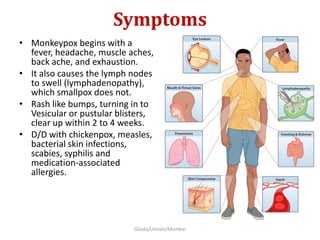
Symptoms
• Monkeypox begins with a
fever, headache, muscle aches,
back ache, and exhaustion.
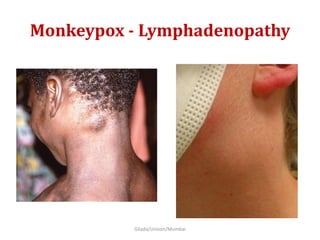
• It also causes the lymph nodes
to swell (lymphadenopathy),
which smallpox does not.
• Rash like bumps, turning in to
Vesicular or pustular blisters,
clear up within 2 to 4 weeks.
• D/D with chickenpox, measles,
bacterial skin infections,
scabies, syphilis and
medication-associated
allergies.
Gilada/Unison/Mumbai
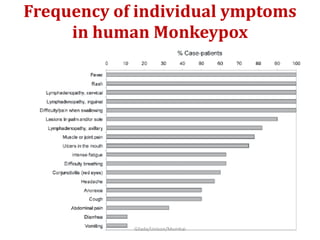
Frequency of individual ymptoms
in human Monkeypox
Gilada/Unison/Mumbai
Incubation Period
• The time from infection to first symptoms for
Monkeypox is usually 1 to 2 weeks, but in
range from 5-21 days.
• Therefore quarantine of diagnosed or
suspected cases is suggested for 21 days.
• Usually starts with Fever
Gilada/Unison/Mumbai
Progression of the Rash
• Within 1 to 3 days (may be longer) the patient
can develop a rash
• Rash progresses from red and flat (macular) ->
a bump (papular) -> water filled (vesicle) ->
pus-filled (pustule) -> crusting (desquamation)
• Starts on the face and then spreading to other
parts of the body (like the extremities and
genital areas) and palms and soles.
Gilada/Unison/Mumbai
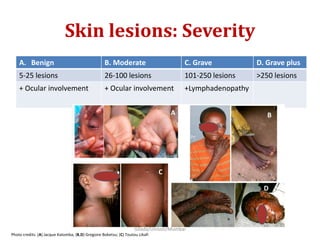
Skin lesions: Severity
A. Benign B. Moderate C. Grave D. Grave plus
5-25 lesions 26-100 lesions 101-250 lesions >250 lesions
+ Ocular involvement + Ocular involvement +Lymphadenopathy
Photo credits: (A) Jacque Katomba; (B,D) Gregoire Boketsu; (C) Toutou Likafi
Gilada/Unison/Mumbai
Monkeypox - Lymphadenopathy
Gilada/Unison/Mumbai
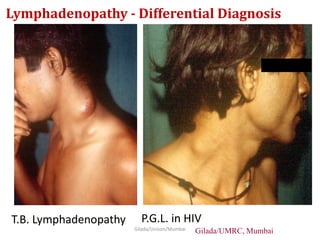
T.B. Lymphadenopathy P.G.L. in HIV
Gilada/UMRC, Mumbai
Lymphadenopathy - Differential Diagnosis
Gilada/Unison/Mumbai
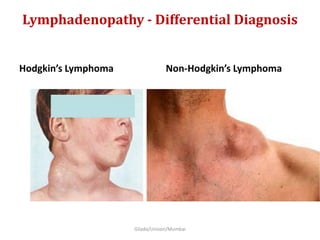
Lymphadenopathy - Differential Diagnosis
Hodgkin’s Lymphoma Non-Hodgkin’s Lymphoma
Gilada/Unison/Mumbai
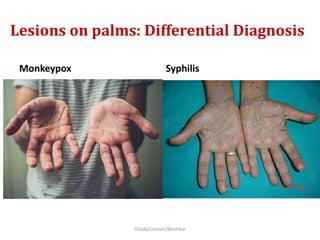
Lesions on palms: Differential Diagnosis
Monkeypox Syphilis
Gilada/Unison/Mumbai
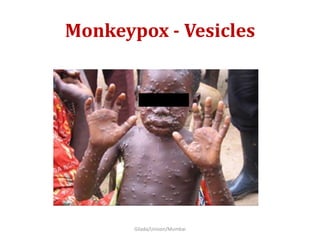
Monkeypox - Vesicles
Gilada/Unison/Mumbai
Differential Diagnosis:
• Small pox
• Chicken pox & Herpes Zoster (bilateral)
• Measles
• Superficial Bacterial infections – Impetigo
• Scabies
• Syphilis
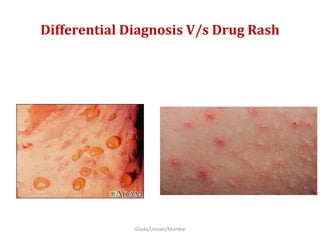
• Drug
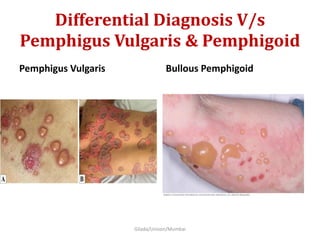
• Pemphigus Vulgaris
• Bullous Pepmhigoid
Gilada/Unison/Mumbai
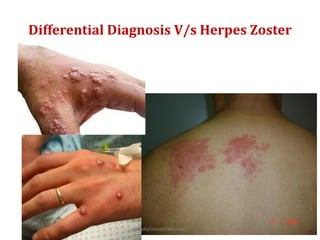
Differential Diagnosis V/s Herpes Zoster
Gilada/Unison/Mumbai
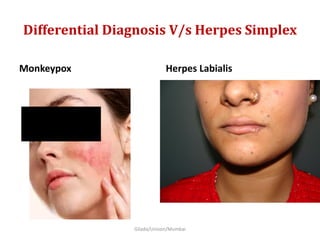
Differential Diagnosis V/s Herpes Simplex
Monkeypox Herpes Labialis
Gilada/Unison/Mumbai
Differential Diagnosis V/s Drug Rash
Gilada/Unison/Mumbai
Differential Diagnosis V/s
Pemphigus Vulgaris & Pemphigoid
Pemphigus Vulgaris Bullous Pemphigoid
Gilada/Unison/Mumbai
Investigations:
• PCR: Confirmation of MPXV infection is
based on NAAT, using real-time or
conventional PCR, for detection of unique
sequences of viral DNA. PCR can be used
alone, or in combination with sequencing.
Roche has two types of PCR and Trivitron
from India developed a PCR kit also.
• Routine Chemistry, Hematology, and
Urinalysis
• Sodium and potassium
• Proteins – especially albumin
• Routine examination of bacterial and
mycotic cultures & sensitivity
For PCR: a viral swab taken from one or more
vesicles or ulcers, or from a dry scraping of
the scab.
Gilada/Unison/Mumbai
Complications and Sequelae
• Features of illness that may be predictive of
illness severity and poor outcomes
• Consequences of compromised skin and mucosa
• Systemic Illness
• Hypoalbuminemia and low hematocrit, s/o
malnutrition
• Bronchopneumonia
• Secondary infection of the integument, sepsis,
• Encephalitis
• Infection of the cornea with ensuing loss of vision
Gilada/Unison/Mumbai
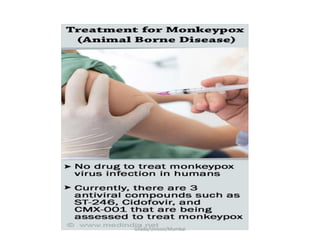
Monkeypox Treatment
There is no safe, proven treatment for Monkeypox yet
Anti-virals that can be used:
• Tecovirimat (ST246) (SIGA, USA)
• Brincidofovir or CMX 001 (Tembexa by Chimerix, USA, approved in June 2021) (for
CMV & HSV), releases Cidofovir intracelluarly
• Cidofovir (for CMV retinitis), was approved for medical use in 1996
• Smallpox vaccine
• Prevention and treatment of secondary bacterial infections and other
complications
• Ensuring adequate hydration and nutrition
• Protecting vulnerable anatomical locations such as the eyes and genitals.
• Standard of care should consider these factors and assessed in different settings
alongside antiviral therapies
• Jynneos (brand names Imvamune and Imvanex), is approved for the prevention of
monkeypox disease for >18 years and ACAM2000 (2017)
• Aventis Pasteur Smallpox Vaccine (APSV) Investigational..EUA
Gilada/Unison/Mumbai
TECOVIRIMAT
• An antiviral medication is used to treat
Smallpox, Monkeypox, and Cowpox
• Brand name TPOXX, licensed to SIGA, works
by interfering with a protein called VP37 that
is found on the surface of orthopoxviruses.
• By interacting with this protein, the medicine
prevents the viruses from reproducing
normally, slowing down the spread of
infection.
Gilada/Unison/Mumbai
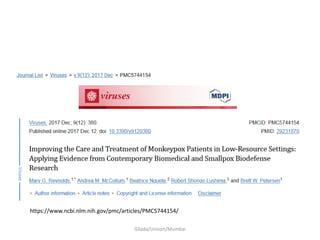
https://www.ncbi.nlm.nih.gov/pmc/articles/PMC5744154/
Gilada/Unison/Mumbai
Prevention
• Isolate infected patients from others who could be at risk for infection.
• Practice good hand hygiene after contact with infected animals or humans.
For example, washing your hands with soap and water or using an alcohol-
based hand sanitizer.
• Avoid contact with animals that could harbor the virus (including sick or
dead animals) where monkeypox is endemic
• Avoid direct contact with any materials, such as bedding or laundry, that
has been in contact with a sick patient.
(Monkeypox virus can be killed with standard washing machine with warm
water and detergent.)
• Use PPE when caring for patients, which includes gown, gloves,
respirator/mask and eye protection.
• Refrain from using products — such as creams, powders and lotions —
made from African wild animals
Gilada/Unison/Mumbai
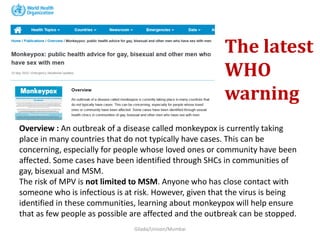
Overview : An outbreak of a disease called monkeypox is currently taking
place in many countries that do not typically have cases. This can be
concerning, especially for people whose loved ones or community have been
affected. Some cases have been identified through SHCs in communities of
gay, bisexual and MSM.
The risk of MPV is not limited to MSM. Anyone who has close contact with
someone who is infectious is at risk. However, given that the virus is being
identified in these communities, learning about monkeypox will help ensure
that as few people as possible are affected and the outbreak can be stopped.
Gilada/Unison/Mumbai
The latest
WHO
warning
Prevention : Vaccine
• JYNNEOSTM (Imvamune or Imvanex) is a USFDA
approved live attenuated virus vaccine which has been
approved by the for the prevention of Monkeypox.
• The Advisory Committee on Immunization Practices
(ACIP) of CDC, USA is currently evaluating if it can be
used for the protection of people at risk of
occupational exposure to orthopoxviruses such as
smallpox and monkeypox in a pre-event setting.
• Smallpox vaccine can provide 85% protection
Bavarian Nordic is the only licensed Smallpox vaccine
available currently
Gilada/Unison/Mumbai
Take Home Message
• Monkeypox virus is expected to spread much more than what is seen
today, though not like Covid-19, we need learn to tackle it
• It is just a matter of time when it lands in India too
• The role of sanitizers and PPE continues
• No perfect anti-Monkeypox treatment; antivirals are available
mainstay: treat of symptoms & secondary infections, fluid balance.
• Smallpox vaccine can be used for therapeutic and prevention purposes
• Disaster management plan & Global Health Security should be in place
• We can never completely understand the enemies, stay open minded
• India - a classical example of how the adversary can be turned into
opportunity and how beggary can be changed to being a donor!, has
to expand its horizons.
• India – the vaccine powerhouse of the globe has to come in action
Gilada/Unison/Mumbai
Thanks!
022-23061616
9820081566
gilada@usa.net
Twitter: @drgilada

Understanding Monkeypox

  • 1.
  • 2.
    Dr. Ishwar Gilada Consultantin HIV and Infectious Diseases Unison Medicare and Research Centre, Mumbai Secretary General, Organised Medicine Academic Guild President, AIDS Society of India Governing Council Member, International AIDS Society gilada@usa.net | Twitter @drGilada Gilada/Unison/Mumbai
  • 3.
    Disclaimer and Observations •Here we are on ‘Fact’-finding mission on Monkeypox • Like Coronavirus, the human race is caught unawares with human spread of Monkeypox to non-endemic zones • In Monkeypox science, no one is expert, same with me! • What I am expressing here is based on history, science, experience elsewhere & some suggestions (not- guidelines) • No conflict of interest whatsoever, it is just a sincere effort to reach out to medical, scientific and administrative community as well as other intelligentsia Gilada/Unison/Mumbai
  • 4.
    What is Monkeypox? Themonkeypox infection is caused by Monkeypox virus- an orthopoxvirus, a genus of viruses that encompasses Poxviridae family (83 sp) and includes: 1. Variola virus that causes smallpox 2. Vaccinia virus, which was used in making smallpox vaccine. This is also seen in Brazil. 3. Mollusci virus that causes Molluscum Contagiosum 4. Cowpox (seen in Europe) (discovery 1770 to 1790) 5. Rabbitpox virus (discovery 1933 in USA, can not infect humans). 6. Ectromelia virus (ECTV) that causes mousepox Also Camelpox, Horsepox, recently Alaskapox (discovery 2015) Monkeypox causes symptoms like smallpox, although they are less severe. It was first identified in 1958 among laboratory monkeys in Denmark Gilada/Unison/Mumbai
  • 5.
    Origin of MonkeypoxVirus • While vaccination eradicated smallpox worldwide in 1980, Monkeypox continues to occur in few countries in Central and West Africa, and has on occasion showed up elsewhere (71 cases in USA outbreak-2003) • Monkeypox is a zoonosis, an infection transmitted from infected animals to humans. • Monkeypox virus infection has been detected in squirrels, Gambian poached rats, dormice and some species of monkeys • West and Central Africa: 11 countries - Cameroon, Central African Republic, DRCongo, Sierra Leone +7 Gilada/Unison/Mumbai
  • 6.
    First cases ofMonkeypox: • Monkeypox was first discovered in 1958 when two outbreaks of a pox-like disease occurred in colonies of monkeys kept for research, hence the name 'monkey-pox.' • The first human case of Monkeypox was recorded in 1970 in the Democratic Republic of the Congo (DRC) during a period of intensified effort to eliminate smallpox. Gilada/Unison/Mumbai
  • 7.
    Monkeypox outbreak: Headlines •More than 250 confirmed and several suspected cases of monkeypox from 20 countries • Monkeypox "containable situation“ - WHO's Maria van Kerkhove • Monkeypox outbreak will not lead to lockdowns • Roche develops three test kits able to detect monkeypox • US government orders $119 million of smallpox vaccine Jynneos • Moderna starts clinical trials on monkeypox vaccine • No mass vaccination, isolation and contact tracing suffice - WHO • Denmark considering vaccinating monkeypox close contacts Gilada/Unison/Mumbai
  • 8.
    The Pathogen -MPV • Monkeypox virus is an enveloped double-stranded DNA virus that belongs to the Orthopoxvirus genus of the Poxviridae family. • There are two distinct genetic clades of the monkeypox virus: a) the Central African (Congo Basin) clade and b) the West African clade. • The Congo Basin clade has historically caused more severe disease and was thought to be more transmissible. • The geographical division between the two clades has so far been in Cameroon - the only country where both virus clades have been found. Gilada/Unison/Mumbai
  • 9.
    Where is thecurrent problem? • Monkeypox has been reported in 20 countries including the UK, Spain, Portugal, Canada, USA, Australia, Austria, Belgium, Denmark, Finland, France, Sweden, Germany, Netherlands, Italy, Israel, Switzerland, singapore, Argentina • According to reports, this is one of the biggest outbreaks of the virus outside of West Africa (endemic) • UK – where monkeypox was first detected in early May – has the largest bulk of confirmed cases, 71, • Spain with 51 cases • Portugal- 37 reported cases. • Canada has 15 and USA has 9. Gilada/Unison/Mumbai
  • 10.
    Gilada/Unison/Mumbai Added to thisare: Argentina, Singapore, Netherland, Israel
  • 11.
    Distribution of 92cases that made the WHO to issue an alert on 21 May Gilada/Unison/Mumbai
  • 12.
    Transmission: How itspreads? • MPV transmission occurs when a person comes into contact with the virus from an animal, human, or materials contaminated with the virus. • The virus enters the body through broken skin, the respiratory tract, or the mucous membranes (eyes, nose, mouth, genitals). • Respiratory droplets (not aerosols) Gilada/Unison/Mumbai
  • 13.
    Who is athigh risk? • Household or sexual contact with someone with Monkeypox, • Housekeeping person changing the bedding of an infected person without wearing PPE. Current risk factors for contracting Monkeypox include: • Travel (within 21 days) to an area where Monkeypox cases or exposures have been reported; • Contact with a person who has a similar rash or a diagnosis of confirmed or suspected Monkeypox; and • Sexual partners of diagnosed or suspected Monkeypox, predominantly more in MSM population Gilada/Unison/Mumbai
  • 14.
    Age group wiseMonkeypox distribution : 2017-2019 Nigeria outbreak Gilada/Unison/Mumbai https://www.thelancet.com/journals/laninf/article/PIIS1473-3099(19)30294-4/fulltext#%20 “Outbreak of human monkeypox in Nigeria in 2017–18: a clinical and epidemiological report” -Adesola Yinka-Ogunleye, MPH et al
  • 15.
    Symptoms • Monkeypox beginswith a fever, headache, muscle aches, back ache, and exhaustion. • It also causes the lymph nodes to swell (lymphadenopathy), which smallpox does not. • Rash like bumps, turning in to Vesicular or pustular blisters, clear up within 2 to 4 weeks. • D/D with chickenpox, measles, bacterial skin infections, scabies, syphilis and medication-associated allergies. Gilada/Unison/Mumbai
  • 16.
    Frequency of individualymptoms in human Monkeypox Gilada/Unison/Mumbai
  • 17.
    Incubation Period • Thetime from infection to first symptoms for Monkeypox is usually 1 to 2 weeks, but in range from 5-21 days. • Therefore quarantine of diagnosed or suspected cases is suggested for 21 days. • Usually starts with Fever Gilada/Unison/Mumbai
  • 18.
    Progression of theRash • Within 1 to 3 days (may be longer) the patient can develop a rash • Rash progresses from red and flat (macular) -> a bump (papular) -> water filled (vesicle) -> pus-filled (pustule) -> crusting (desquamation) • Starts on the face and then spreading to other parts of the body (like the extremities and genital areas) and palms and soles. Gilada/Unison/Mumbai
  • 19.
    Skin lesions: Severity A.Benign B. Moderate C. Grave D. Grave plus 5-25 lesions 26-100 lesions 101-250 lesions >250 lesions + Ocular involvement + Ocular involvement +Lymphadenopathy Photo credits: (A) Jacque Katomba; (B,D) Gregoire Boketsu; (C) Toutou Likafi Gilada/Unison/Mumbai
  • 20.
  • 21.
  • 22.
    T.B. Lymphadenopathy P.G.L.in HIV Gilada/UMRC, Mumbai Lymphadenopathy - Differential Diagnosis Gilada/Unison/Mumbai
  • 23.
    Lymphadenopathy - DifferentialDiagnosis Hodgkin’s Lymphoma Non-Hodgkin’s Lymphoma Gilada/Unison/Mumbai
  • 24.
    Lesions on palms:Differential Diagnosis Monkeypox Syphilis Gilada/Unison/Mumbai
  • 25.
  • 26.
    Differential Diagnosis: • Smallpox • Chicken pox & Herpes Zoster (bilateral) • Measles • Superficial Bacterial infections – Impetigo • Scabies • Syphilis • Drug • Pemphigus Vulgaris • Bullous Pepmhigoid Gilada/Unison/Mumbai
  • 27.
    Differential Diagnosis V/sHerpes Zoster Gilada/Unison/Mumbai
  • 28.
    Differential Diagnosis V/sHerpes Simplex Monkeypox Herpes Labialis Gilada/Unison/Mumbai
  • 29.
    Differential Diagnosis V/sDrug Rash Gilada/Unison/Mumbai
  • 30.
    Differential Diagnosis V/s PemphigusVulgaris & Pemphigoid Pemphigus Vulgaris Bullous Pemphigoid Gilada/Unison/Mumbai
  • 31.
    Investigations: • PCR: Confirmationof MPXV infection is based on NAAT, using real-time or conventional PCR, for detection of unique sequences of viral DNA. PCR can be used alone, or in combination with sequencing. Roche has two types of PCR and Trivitron from India developed a PCR kit also. • Routine Chemistry, Hematology, and Urinalysis • Sodium and potassium • Proteins – especially albumin • Routine examination of bacterial and mycotic cultures & sensitivity For PCR: a viral swab taken from one or more vesicles or ulcers, or from a dry scraping of the scab. Gilada/Unison/Mumbai
  • 32.
    Complications and Sequelae •Features of illness that may be predictive of illness severity and poor outcomes • Consequences of compromised skin and mucosa • Systemic Illness • Hypoalbuminemia and low hematocrit, s/o malnutrition • Bronchopneumonia • Secondary infection of the integument, sepsis, • Encephalitis • Infection of the cornea with ensuing loss of vision Gilada/Unison/Mumbai
  • 33.
    Monkeypox Treatment There isno safe, proven treatment for Monkeypox yet Anti-virals that can be used: • Tecovirimat (ST246) (SIGA, USA) • Brincidofovir or CMX 001 (Tembexa by Chimerix, USA, approved in June 2021) (for CMV & HSV), releases Cidofovir intracelluarly • Cidofovir (for CMV retinitis), was approved for medical use in 1996 • Smallpox vaccine • Prevention and treatment of secondary bacterial infections and other complications • Ensuring adequate hydration and nutrition • Protecting vulnerable anatomical locations such as the eyes and genitals. • Standard of care should consider these factors and assessed in different settings alongside antiviral therapies • Jynneos (brand names Imvamune and Imvanex), is approved for the prevention of monkeypox disease for >18 years and ACAM2000 (2017) • Aventis Pasteur Smallpox Vaccine (APSV) Investigational..EUA Gilada/Unison/Mumbai
  • 34.
    TECOVIRIMAT • An antiviralmedication is used to treat Smallpox, Monkeypox, and Cowpox • Brand name TPOXX, licensed to SIGA, works by interfering with a protein called VP37 that is found on the surface of orthopoxviruses. • By interacting with this protein, the medicine prevents the viruses from reproducing normally, slowing down the spread of infection. Gilada/Unison/Mumbai
  • 35.
  • 36.
    Prevention • Isolate infectedpatients from others who could be at risk for infection. • Practice good hand hygiene after contact with infected animals or humans. For example, washing your hands with soap and water or using an alcohol- based hand sanitizer. • Avoid contact with animals that could harbor the virus (including sick or dead animals) where monkeypox is endemic • Avoid direct contact with any materials, such as bedding or laundry, that has been in contact with a sick patient. (Monkeypox virus can be killed with standard washing machine with warm water and detergent.) • Use PPE when caring for patients, which includes gown, gloves, respirator/mask and eye protection. • Refrain from using products — such as creams, powders and lotions — made from African wild animals Gilada/Unison/Mumbai
  • 37.
    Overview : Anoutbreak of a disease called monkeypox is currently taking place in many countries that do not typically have cases. This can be concerning, especially for people whose loved ones or community have been affected. Some cases have been identified through SHCs in communities of gay, bisexual and MSM. The risk of MPV is not limited to MSM. Anyone who has close contact with someone who is infectious is at risk. However, given that the virus is being identified in these communities, learning about monkeypox will help ensure that as few people as possible are affected and the outbreak can be stopped. Gilada/Unison/Mumbai The latest WHO warning
  • 38.
    Prevention : Vaccine •JYNNEOSTM (Imvamune or Imvanex) is a USFDA approved live attenuated virus vaccine which has been approved by the for the prevention of Monkeypox. • The Advisory Committee on Immunization Practices (ACIP) of CDC, USA is currently evaluating if it can be used for the protection of people at risk of occupational exposure to orthopoxviruses such as smallpox and monkeypox in a pre-event setting. • Smallpox vaccine can provide 85% protection Bavarian Nordic is the only licensed Smallpox vaccine available currently Gilada/Unison/Mumbai
  • 39.
    Take Home Message •Monkeypox virus is expected to spread much more than what is seen today, though not like Covid-19, we need learn to tackle it • It is just a matter of time when it lands in India too • The role of sanitizers and PPE continues • No perfect anti-Monkeypox treatment; antivirals are available mainstay: treat of symptoms & secondary infections, fluid balance. • Smallpox vaccine can be used for therapeutic and prevention purposes • Disaster management plan & Global Health Security should be in place • We can never completely understand the enemies, stay open minded • India - a classical example of how the adversary can be turned into opportunity and how beggary can be changed to being a donor!, has to expand its horizons. • India – the vaccine powerhouse of the globe has to come in action Gilada/Unison/Mumbai
  • 40.