CONTENTS
Introduction
What is earthquake……?
Techniques to resist Earthquake.
Different methods to resist to buildings.
Types of frames used for construction.
Earthquakes constitute one of the worst natural hazards
which often turn into disaster causing widespread
destruction and loss to human life.
The effects of earthquake vary upon the magnitude and
intensity. Earthquakes occur every now and then all
round the world, except in some places where
earthquakes occur rarely. The devastation of cities and
towns is one of the effects of earthquake.
What is Earthquake?
An Earthquake is the result
of a sudden release of energy
in the earth’s crust that creates
seismic waves.
The seismic activity of an
area refers to the
frequency,type and size of
earthquakes experienced over
a period of time
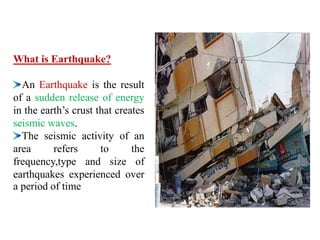
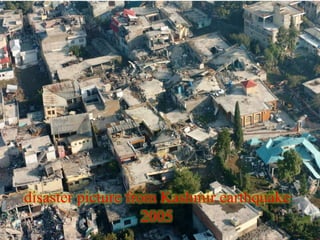
disaster picture from Kashmir earthquake
2005
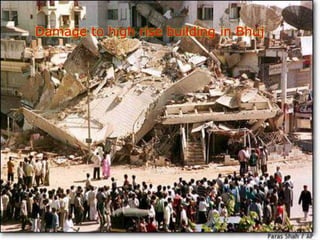
Damage to high rise building in Bhuj
Techniques to resist Earthquake
• Active & Passive system
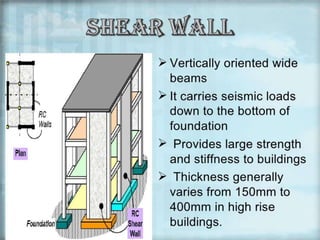
• Shear walls
• Bracing
• Dampers
• Rollers
• Isolation
• Light weight material
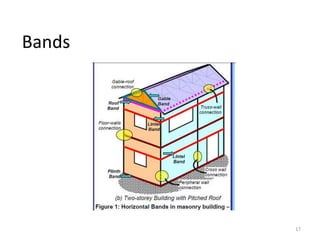
• Bands
• Others
7
Active System
Active control systems are devices integrated with real-time
processing evaluators for improved service and safety.
8
Passive control systems are conventional devices to resist or
absorb the energy produced during Earthquake.
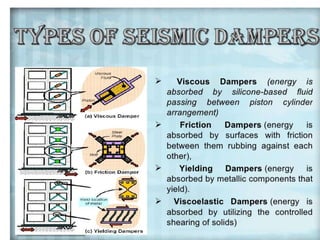
For example: Viscous Dampers
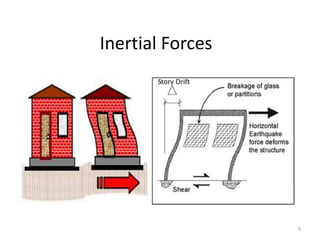
Inertial Forces
9
10
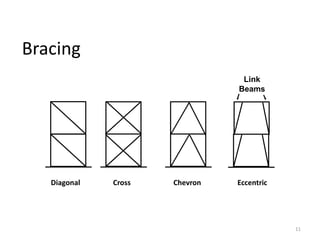
Bracing
11
Link
Beams
Diagonal Cross Chevron Eccentric
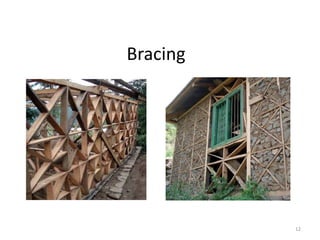
Bracing
12
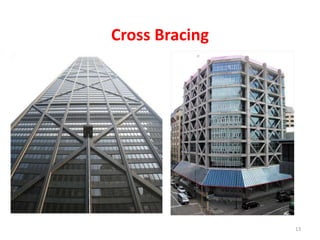
Cross Bracing
13
14
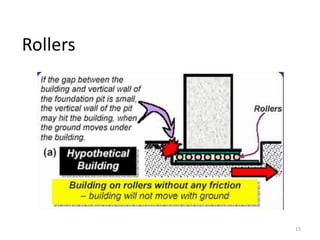
Rollers
15
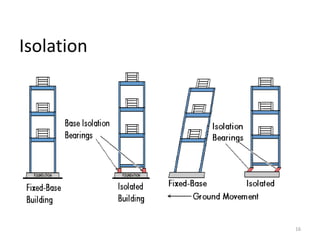
Isolation
16
Bands
17
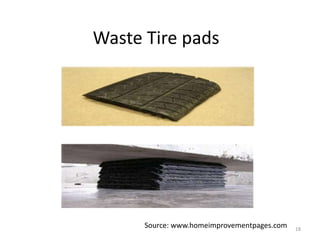
Waste Tire pads
18
Source: www.homeimprovementpages.com
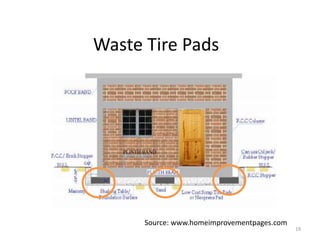
Waste Tire Pads
19
Source: www.homeimprovementpages.com
Light weight material
In recent times, many new systems and
devices using non-conventional civil
engineering materials have been
developed, either to reduce the
earthquake forces acting on a structure
or to absorb part of seismic energy.
20
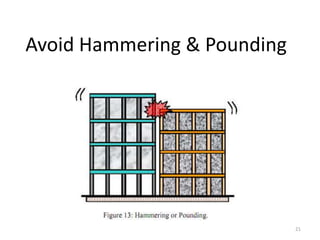
Avoid Hammering & Pounding
21
Suggestions
• Avoid weak column and strong beam design
• Provide thick slab which will help as a rigid diaphragm
• Provide cross walls which will stiffen the structures
• Provide shear walls in a symmetrical fashion
•Increase in the transverse (Shear) reinforcement.
• Horizontal lintel band should be provided
• Revision/ updation of building code of Pakistan
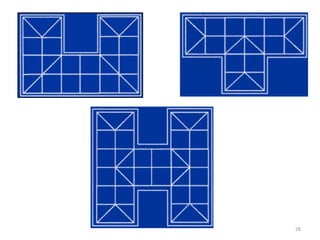
• The building must be regular and symmetrical in shape
• Reinforcing bars should be provided at the corners and the
junctions of the walls
22
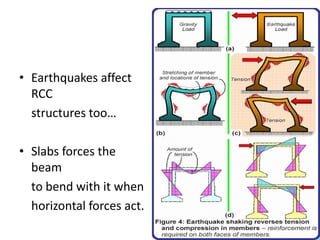
• Earthquakes affect
RCC
structures too…
• Slabs forces the
beam
to bend with it when
horizontal forces act.
23
Earthquake resistant designs
• Design - but it is analysis of forces - buildings due
to loads acting on it.
• If a building is enough to resist the earthquake,
then such building is called Earthquake resistant
structure.
• Such design is called Earthquake resistant designs
24
Popular Earthquake resistant
Techniques
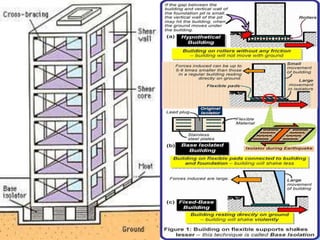
• Earthquake may not be able to damage entire
building but it damages members of it.
• So special techniques are adopted:
Base Isolation Devices and
Seismic Dampers.
25
26
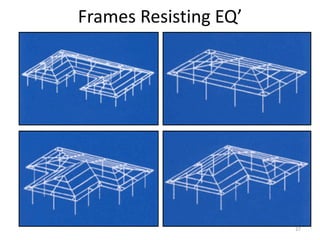
Frames Resisting EQ’
27
28
29
Earthquake resistant construction

Earthquake resistant construction

  • 2.
    CONTENTS Introduction What is earthquake……? Techniquesto resist Earthquake. Different methods to resist to buildings. Types of frames used for construction.
  • 3.
    Earthquakes constitute oneof the worst natural hazards which often turn into disaster causing widespread destruction and loss to human life. The effects of earthquake vary upon the magnitude and intensity. Earthquakes occur every now and then all round the world, except in some places where earthquakes occur rarely. The devastation of cities and towns is one of the effects of earthquake.
  • 4.
    What is Earthquake? AnEarthquake is the result of a sudden release of energy in the earth’s crust that creates seismic waves. The seismic activity of an area refers to the frequency,type and size of earthquakes experienced over a period of time
  • 5.
    disaster picture fromKashmir earthquake 2005
  • 6.
    Damage to highrise building in Bhuj
  • 7.
    Techniques to resistEarthquake • Active & Passive system • Shear walls • Bracing • Dampers • Rollers • Isolation • Light weight material • Bands • Others 7
  • 8.
    Active System Active controlsystems are devices integrated with real-time processing evaluators for improved service and safety. 8 Passive control systems are conventional devices to resist or absorb the energy produced during Earthquake. For example: Viscous Dampers
  • 9.
  • 10.
  • 11.
  • 12.
  • 13.
  • 14.
  • 15.
  • 16.
  • 17.
  • 18.
    Waste Tire pads 18 Source:www.homeimprovementpages.com
  • 19.
    Waste Tire Pads 19 Source:www.homeimprovementpages.com
  • 20.
    Light weight material Inrecent times, many new systems and devices using non-conventional civil engineering materials have been developed, either to reduce the earthquake forces acting on a structure or to absorb part of seismic energy. 20
  • 21.
    Avoid Hammering &Pounding 21
  • 22.
    Suggestions • Avoid weakcolumn and strong beam design • Provide thick slab which will help as a rigid diaphragm • Provide cross walls which will stiffen the structures • Provide shear walls in a symmetrical fashion •Increase in the transverse (Shear) reinforcement. • Horizontal lintel band should be provided • Revision/ updation of building code of Pakistan • The building must be regular and symmetrical in shape • Reinforcing bars should be provided at the corners and the junctions of the walls 22
  • 23.
    • Earthquakes affect RCC structurestoo… • Slabs forces the beam to bend with it when horizontal forces act. 23
  • 24.
    Earthquake resistant designs •Design - but it is analysis of forces - buildings due to loads acting on it. • If a building is enough to resist the earthquake, then such building is called Earthquake resistant structure. • Such design is called Earthquake resistant designs 24
  • 25.
    Popular Earthquake resistant Techniques •Earthquake may not be able to damage entire building but it damages members of it. • So special techniques are adopted: Base Isolation Devices and Seismic Dampers. 25
  • 26.
  • 27.
  • 28.
  • 29.