Pre
Engineered
Buildings
What is a PEB?
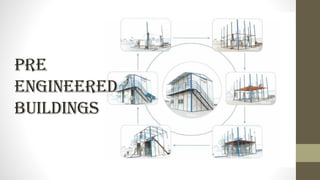
• Pre- Engineered Buildings are factory-built buildings of
steel that are shipped go site and bolted together.
• Suited to construct industrial buildings and warehouses.
• It is cheap, very fast to erect, and can also be dismantled
and moved to another site.
• These structures are sometimes called ‘metal boxes’ or
‘tin sheds’.
• They are essentially rectangular boxes enclosed in a skin
of corrugated metal sheeting.
• Great speed is achieved because while the foundations
and floor slab are being constructed, the beams and
column- the structural system- are being fabricated in the
factories.
COMPONENTS OF A PEB
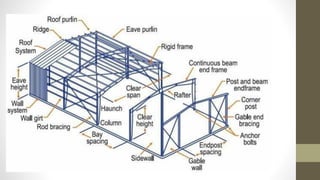
• Primary Frame: Primary framing of a PEB is
an assembly of built-up I-section members
& that framing consist trusses or
castellated beams etc.
• Secondary Structural Elements: It is
actually Cold Formed Members, which can
be in diff. shapes like “Z”, “C” etc. In general
known as “Purlins”.
• Roof & Wall Panels : Tin shades & Curtain
Wall made of Glass & Roll-formed steel
sheets usually comes in this category.
• Sandwich Panels: Sandwich Panel is made
of three layers , in which a non-Aluminium
Core is inserted b/w two aluminium sheet.
• Other Accessories: Mezzanine floors, Bolts,
Insulation, etc.construction time
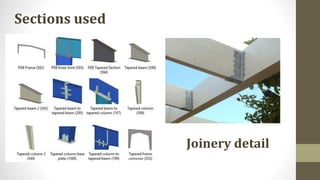
Sections used
Joinery detail
ADVANTAGES
Reduced construction time
• Buildings are typically delivered in just a few weeks after
approval of drawings.
• Foundation and anchor bolts are cast parallel with finished,
ready for the site bolting.
• PEB will reduces total construction time of the project by at
least 50%.
• This also allows faster occupancy and earlier realization of
revenue.
Lower cost
• Due to the systems approach, there is a significant saving in
design, manufacturing and on site erection cost.
• The secondary members and cladding nest together
reducing transportation cost.
• Steel buildings that are properly insulated save natural
resources, energy and money.
ADVANTAGES
Flexibility of expansion
• Buildings can be easily expanded in length by adding
additional bays.
• Also expansion in width and height is possible by pre
designing for future expansion.
Large clear spans
• Buildings can be supplied to around 80M clear spans.
Quality control
• As buildings are manufactured completely in the factory
under controlled conditions the quality is assured.
Low maintenance
• Buildings are supplied with high quality paint systems for
cladding and steel to suit ambient conditions at the site,
which results in long durability and low maintenance coats.
Energy efficient roofing and wall system
• Buildings can be supplied with polyurethane insulated panels
or fiberglass blankets insulation to achieve required ―U‖
values.
Architectural versatility
• Building can be supplied with various types of fascia's,
canopies, and curved eaves and are designed to receive pre
cast concrete wall panels, curtain walls, block walls and other
wall systems.
• All the components are available in different colors also.
Single source responsibility
• As the complete building package is supplied by a single
vendor, compatibility of all the building components and
accessories is assured.
• This is one of the major benefits of the pre engineered building
systems.
Sustainability
• Steel is 100% recyclable and is the most recycled material in the
world.
• Thus, each ton of recycled steel saves 2,500 pounds of iron ore
and approximately 1,000 pounds of coa
ADVANTAGES
DISADVANTAGES
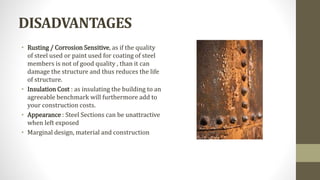
• Rusting / Corrosion Sensitive, as if the quality
of steel used or paint used for coating of steel
members is not of good quality , than it can
damage the structure and thus reduces the life
of structure.
• Insulation Cost : as insulating the building to an
agreeable benchmark will furthermore add to
your construction costs.
• Appearance : Steel Sections can be unattractive
when left exposed
• Marginal design, material and construction
• May not include all construction/fit-up
needed for the building to serve the
intended purpose.
• No secondary roof membrane
• Usually no internal finished walls
• Note: Because of the above disadvantages,
pre-engineered buildings are generally not
recommended for school buildings except
for non-instructional purposes such as
storage, maintenance facility and etc.
DISADVANTAGES
DESIGN METHODOLOGY
• Method Used : Stiffness Matrix Method
• Standard Code used :
• AISC
• ASCE
• IS : 800
• Software used : Stad.Pro v8i, ETABS, RAM Steel
• Load Considerations & their Calculations : Loads considered in the PEB design are same as for
general building structure. These are as follows ,
• Dead load Calculations : It includes Self Wt. of Purlins , Roof & Wall Sheeting , insulation material &
other structural component.
• Live / Imposed Load Calculations : It should be Considered as per given in IS 875 (Part 2 ) for diff.
type of
• Wind Load Calculations : Consider the Basic wind Speed as per Area of that particular structure.
Design wind Pressure is calculated as per IS 875 (Part 3) . Wind Load on Roof can be UDL &
calculation for this can be done as per IS875(Part 3)
• Seismic Load Calculations : Earthquake Loads affect the design of structure in areas of great seismic
activity. The seismic load can be calculated as per IS 1893-2002(Part 1).
• Other Moving Loads : It can be Moving EOT Crane load or Mono Rail etc.
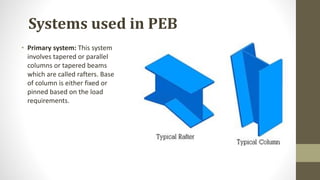
• Primary system: This system
involves tapered or parallel
columns or tapered beams
which are called rafters. Base
of column is either fixed or
pinned based on the load
requirements.
Systems used in PEB
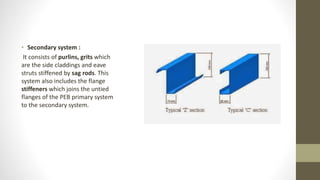
• Secondary system :
It consists of purlins, grits which
are the side claddings and eave
struts stiffened by sag rods. This
system also includes the flange
stiffeners which joins the untied
flanges of the PEB primary system
to the secondary system.
• Accessories: This part includes the Turbo
ventilator, ridge vents, Flashings, gutters,
down pipes, ladders etc.
• Skylights
• Ventilators
• Pre Engineered Building Connections
• Factories
• Warehouses
• Workshops
• Offices
• Gas stations
• Showrooms
• Aircraft hangers
• Metro stations
• Vehicle parking sheds
• Schools
• Indoor stadium roofs
• Bridges
• Railway platform shelters
• Outdoor stadium canopies
• PEB are more advantageous than the conventional structures in economy, speed of construction and
simple erection.
Applications
Thank You
Yamini K
Ruthvik
Sai Krishna
Sakshee Banga
Sakshi A Sindgi
Shivani Prabhudev
Shobitha C
Shreya P Raikar
Tharun C
Rachana V
BMSSA

Pre Engineered buildings

  • 1.
  • 2.
    What is aPEB? • Pre- Engineered Buildings are factory-built buildings of steel that are shipped go site and bolted together. • Suited to construct industrial buildings and warehouses. • It is cheap, very fast to erect, and can also be dismantled and moved to another site. • These structures are sometimes called ‘metal boxes’ or ‘tin sheds’. • They are essentially rectangular boxes enclosed in a skin of corrugated metal sheeting. • Great speed is achieved because while the foundations and floor slab are being constructed, the beams and column- the structural system- are being fabricated in the factories.
  • 3.
    COMPONENTS OF APEB • Primary Frame: Primary framing of a PEB is an assembly of built-up I-section members & that framing consist trusses or castellated beams etc. • Secondary Structural Elements: It is actually Cold Formed Members, which can be in diff. shapes like “Z”, “C” etc. In general known as “Purlins”. • Roof & Wall Panels : Tin shades & Curtain Wall made of Glass & Roll-formed steel sheets usually comes in this category. • Sandwich Panels: Sandwich Panel is made of three layers , in which a non-Aluminium Core is inserted b/w two aluminium sheet. • Other Accessories: Mezzanine floors, Bolts, Insulation, etc.construction time
  • 5.
  • 6.
    ADVANTAGES Reduced construction time •Buildings are typically delivered in just a few weeks after approval of drawings. • Foundation and anchor bolts are cast parallel with finished, ready for the site bolting. • PEB will reduces total construction time of the project by at least 50%. • This also allows faster occupancy and earlier realization of revenue. Lower cost • Due to the systems approach, there is a significant saving in design, manufacturing and on site erection cost. • The secondary members and cladding nest together reducing transportation cost. • Steel buildings that are properly insulated save natural resources, energy and money.
  • 7.
    ADVANTAGES Flexibility of expansion •Buildings can be easily expanded in length by adding additional bays. • Also expansion in width and height is possible by pre designing for future expansion. Large clear spans • Buildings can be supplied to around 80M clear spans. Quality control • As buildings are manufactured completely in the factory under controlled conditions the quality is assured. Low maintenance • Buildings are supplied with high quality paint systems for cladding and steel to suit ambient conditions at the site, which results in long durability and low maintenance coats. Energy efficient roofing and wall system • Buildings can be supplied with polyurethane insulated panels or fiberglass blankets insulation to achieve required ―U‖ values.
  • 8.
    Architectural versatility • Buildingcan be supplied with various types of fascia's, canopies, and curved eaves and are designed to receive pre cast concrete wall panels, curtain walls, block walls and other wall systems. • All the components are available in different colors also. Single source responsibility • As the complete building package is supplied by a single vendor, compatibility of all the building components and accessories is assured. • This is one of the major benefits of the pre engineered building systems. Sustainability • Steel is 100% recyclable and is the most recycled material in the world. • Thus, each ton of recycled steel saves 2,500 pounds of iron ore and approximately 1,000 pounds of coa ADVANTAGES
  • 9.
    DISADVANTAGES • Rusting /Corrosion Sensitive, as if the quality of steel used or paint used for coating of steel members is not of good quality , than it can damage the structure and thus reduces the life of structure. • Insulation Cost : as insulating the building to an agreeable benchmark will furthermore add to your construction costs. • Appearance : Steel Sections can be unattractive when left exposed • Marginal design, material and construction
  • 10.
    • May notinclude all construction/fit-up needed for the building to serve the intended purpose. • No secondary roof membrane • Usually no internal finished walls • Note: Because of the above disadvantages, pre-engineered buildings are generally not recommended for school buildings except for non-instructional purposes such as storage, maintenance facility and etc. DISADVANTAGES
  • 11.
    DESIGN METHODOLOGY • MethodUsed : Stiffness Matrix Method • Standard Code used : • AISC • ASCE • IS : 800 • Software used : Stad.Pro v8i, ETABS, RAM Steel • Load Considerations & their Calculations : Loads considered in the PEB design are same as for general building structure. These are as follows , • Dead load Calculations : It includes Self Wt. of Purlins , Roof & Wall Sheeting , insulation material & other structural component. • Live / Imposed Load Calculations : It should be Considered as per given in IS 875 (Part 2 ) for diff. type of • Wind Load Calculations : Consider the Basic wind Speed as per Area of that particular structure. Design wind Pressure is calculated as per IS 875 (Part 3) . Wind Load on Roof can be UDL & calculation for this can be done as per IS875(Part 3) • Seismic Load Calculations : Earthquake Loads affect the design of structure in areas of great seismic activity. The seismic load can be calculated as per IS 1893-2002(Part 1). • Other Moving Loads : It can be Moving EOT Crane load or Mono Rail etc.
  • 12.
    • Primary system:This system involves tapered or parallel columns or tapered beams which are called rafters. Base of column is either fixed or pinned based on the load requirements. Systems used in PEB
  • 13.
    • Secondary system: It consists of purlins, grits which are the side claddings and eave struts stiffened by sag rods. This system also includes the flange stiffeners which joins the untied flanges of the PEB primary system to the secondary system.
  • 14.
    • Accessories: Thispart includes the Turbo ventilator, ridge vents, Flashings, gutters, down pipes, ladders etc. • Skylights • Ventilators • Pre Engineered Building Connections
  • 15.
    • Factories • Warehouses •Workshops • Offices • Gas stations • Showrooms • Aircraft hangers • Metro stations • Vehicle parking sheds • Schools • Indoor stadium roofs • Bridges • Railway platform shelters • Outdoor stadium canopies • PEB are more advantageous than the conventional structures in economy, speed of construction and simple erection. Applications
  • 16.
    Thank You Yamini K Ruthvik SaiKrishna Sakshee Banga Sakshi A Sindgi Shivani Prabhudev Shobitha C Shreya P Raikar Tharun C Rachana V BMSSA