BOROŹYME TECHNOLOGiES
                        Presents


     BOROŹYME ¦ B ‘DBV-1’
                                           Concept Presentation on :
                                       Enzyme Stabilized Mud (Earthen)
                                               Construction.


    Nucleation Center    Marketed by                   Large-Scale Production
INTRODUCTION.
   BORON INNOVATIONS PVT. LTD., Bhavnagar is an identity
    created by panel of high qualified specialized
    scientists, whose aim is to protect and deliver the
    environment, with Nucleation Center at CHARUSAT
    University & Large - Scale production at DHARA
    BIOTECH, innovative Enzymes Technology has been
    developed for disposal of sewage wastes, making earthen
    roads and constructing low cost earthen mud houses.
   Company’s Vision is to make this technology reach ‘the
    common people’.                          Go Green With
                                           Bio-Enzymes
Enzyme Stabilized Mud (Earthen) Construction
               Modern building industry dealing with providing shelter
                comprises of using materials such as “Fired/burned/fused
                bricks”, “Cement” and “Steel” to produce rock solid buildings, at
                an astronomically rising cost, mainly due to the cost of producing
                the above mentioned products. Moreover, the buildings
                constructed from these materials are major energy guzzlers
                requiring energy to COOL, HEAT AND ILLUMINATE.
               EARTHEN BUILDINGS HAVE BEST INSULATION AGAINST HEAT
                AND COLD.
Go Green With
 Bio-Enzymes
What is an Enzyme?
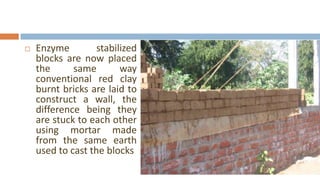
   An Enzyme is a Protein originating from a
    bacteria, fungus, plant or animal that acts
    as a catalyst to speed up a chemical
    reaction.
   Enzyme stabilization is commonly
    demonstrated by termites and ants.
   Various Enzymes performing multiple tasks will
    work to make bonds between minerals in the
    water and soil, aid in the creation of van der
    vaals forces between clay particles and aid in
    the removal of water between soil
    particles, giving better compaction and
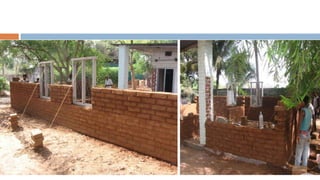
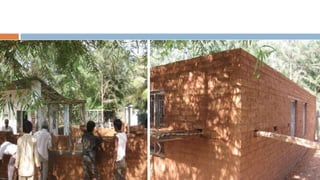
    strength.
BRICK ENZYME & SOIL SEALINGS
   BoroŹyme¦B is an innovation which converts natural common earth in to
    a quality brick without baking the same in the special furnace. This
    innovation will fulfill the dream of a common man who wants to own his
    OWN house.
   The Government authorised laboratory had certified that these bricks are
    having better compressive strength. All type of earth can be used to make
    these bricks. These bricks can be used by the people who are deprived of
    basic living amenities / tribal by using their home yard earthen material.
   The material cost of this brick is very less and can be made with help of
    handmade reusable mould. The process do not requires skilled labour and
    bricks can be made by self work.
   The house constructed by these bricks do not requires
    cement, concrete, limestone etc. The wonder enzyme can be used for
    flooring, construction and plaster. After applying waterproofing spray on
    the surface one can have an economically constructed beautiful OWN
   One can make hollow block from the same material as
    it adds to heat insulation properties. The other uses
    are compound walls, side walls, outer walls, dusting
    control, better abrasion resistant etc. An unskilled
    labour can make bricks from waste land and this can
    create a huge possibility of self employment in rural
    areas of India where farm labours remain idle in non
    crop season.
Enzyme Stabilized Mud (Earthen) Construction
   Mud has been used as a construction building
    material for the last 10000 years.
   Mud offers the same versatility in construction
    offered by burnt clay bricks/blocks, and then even
    more.
   Offers to save up to 658kg of Carbon dioxide
    emissions per 100 sq. foot of construction.
Enzyme Stabilized Mud (Earthen) Construction
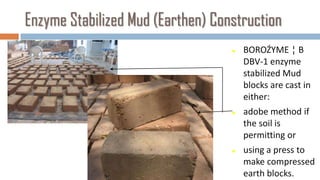
                                      BOROŹYME ¦ B
                                       DBV-1 enzyme
                                       stabilized Mud
                                       blocks are cast in
                                       either:
                                      adobe method if
                                       the soil is
                                       permitting or
                                      using a press to
                                       make compressed
                                       earth blocks.
Enzyme Stabilized Mud (Earthen) Construction


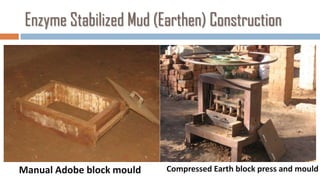
Manual Adobe block mould   Compressed Earth block press and mould
Enzyme Stabilized Mud (Earthen) Construction
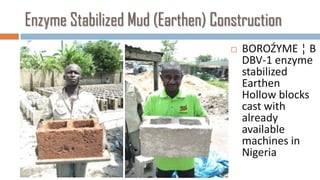
                                      BOROŹYME ¦ B
                                       DBV-1 enzyme
                                       stabilized
                                       Earthen
                                       Hollow blocks
                                       cast with
                                       already
                                       available
                                       machines in
                                       Nigeria
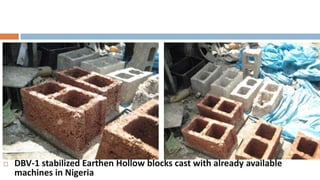
   DBV-1 stabilized Earthen Hollow blocks cast with already available
    machines in Nigeria
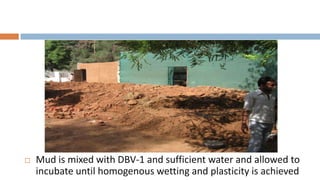
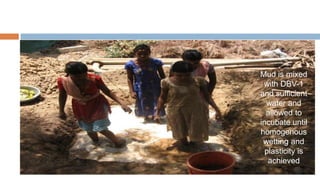
   Mud is mixed with DBV-1 and sufficient water and allowed to
    incubate until homogenous wetting and plasticity is achieved
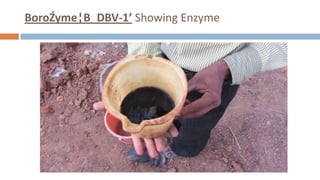
BoroŹyme¦B DBV-1’ Showing Enzyme
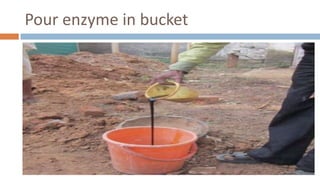
Pour enzyme in bucket
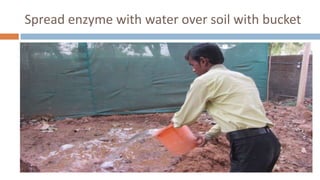
Spread enzyme with water over soil with bucket
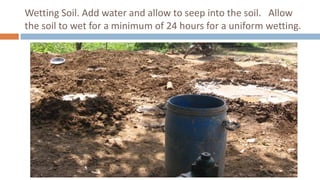
Wetting Soil. Add water and allow to seep into the soil. Allow
the soil to wet for a minimum of 24 hours for a uniform wetting.
Mud is mixed
 with DBV-1
and sufficient
  water and
  allowed to
incubate until
homogenous
 wetting and
  plasticity is
   achieved
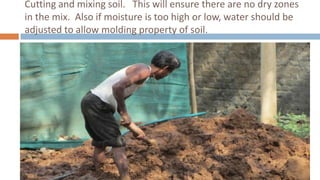
Cutting and mixing soil. This will ensure there are no dry zones
in the mix. Also if moisture is too high or low, water should be
adjusted to allow molding property of soil.
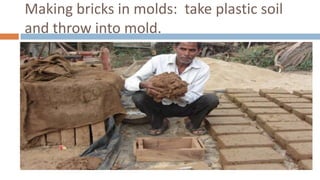
Making bricks in molds: take plastic soil
and throw into mold.
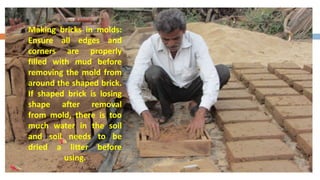
Making bricks in molds:
Ensure all edges and
corners are properly
filled with mud before
removing the mold from
around the shaped brick.
If shaped brick is losing
shape after removal
from mold, there is too
much water in the soil
and soil needs to be
dried a litter before
          using.
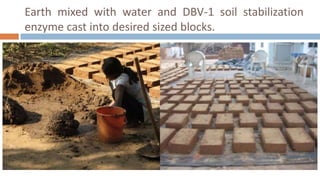
Earth mixed with water and DBV-1 soil stabilization
enzyme cast into desired sized blocks.
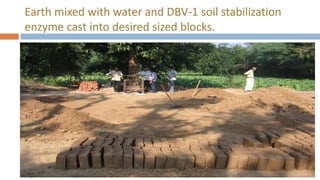
Earth mixed with water and DBV-1 soil stabilization
enzyme cast into desired sized blocks.
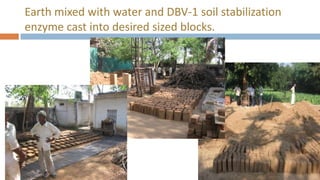
Earth mixed with water and DBV-1 soil stabilization
enzyme cast into desired sized blocks.
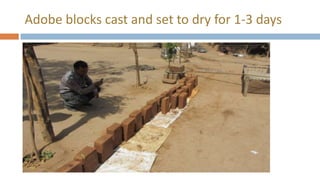
Adobe blocks cast and set to dry for 1-3 days
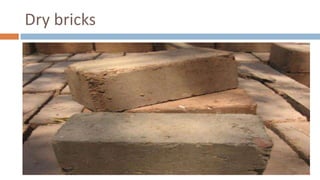
Dry bricks
   All construction presently follow codes and
    guidelines set by ASTM – E2392, Standard
    Guide for Design of Earthen Wall Building
    Systems
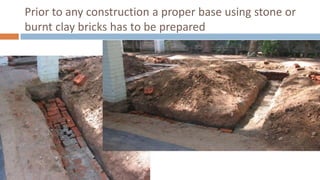
Prior to any construction a proper base using stone or
burnt clay bricks has to be prepared
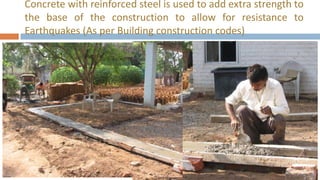
Concrete with reinforced steel is used to add extra strength to
the base of the construction to allow for resistance to
Earthquakes (As per Building construction codes)
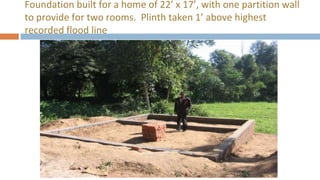
Foundation built for a home of 22’ x 17’, with one partition wall
to provide for two rooms. Plinth taken 1’ above highest
recorded flood line
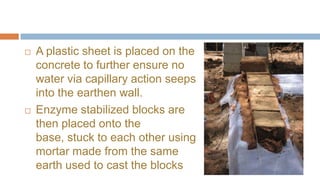
   A plastic sheet is placed on the
    concrete to further ensure no
    water via capillary action seeps
    into the earthen wall.
   Enzyme stabilized blocks are
    then placed onto the
    base, stuck to each other using
    mortar made from the same
    earth used to cast the blocks
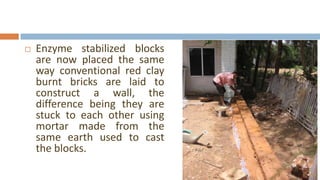
   Enzyme stabilized blocks
    are now placed the same
    way conventional red clay
    burnt bricks are laid to
    construct a wall, the
    difference being they are
    stuck to each other using
    mortar made from the
    same earth used to cast
    the blocks.
   Enzyme         stabilized
    blocks are now placed
    the      same        way
    conventional red clay
    burnt bricks are laid to
    construct a wall, the
    difference being they
    are stuck to each other
    using mortar made
    from the same earth
    used to cast the blocks
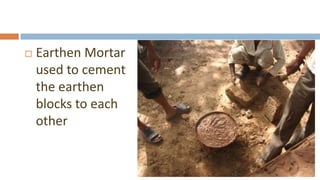
   Earthen Mortar
    used to cement
    the earthen
    blocks to each
    other
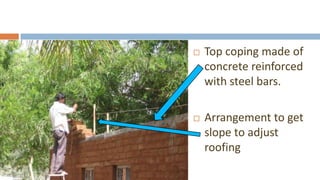
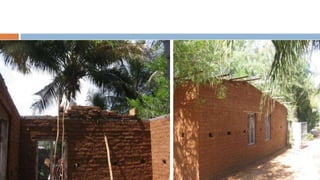
   Top coping made of
    concrete reinforced
    with steel bars.

   Arrangement to get
    slope to adjust
    roofing
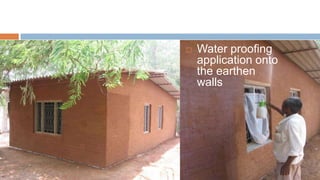
   Water proofing
    application onto
    the earthen
    walls
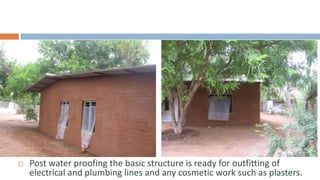
   Post water proofing the basic structure is ready for outfitting of
    electrical and plumbing lines and any cosmetic work such as plasters.
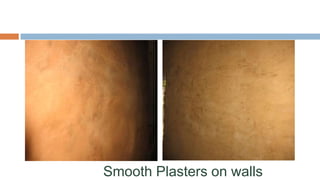
Smooth Plasters on walls
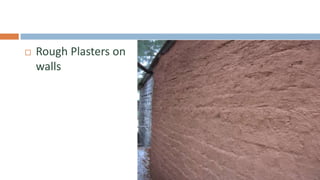
   Rough Plasters on
    walls
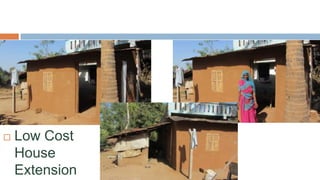
   Low Cost
    House
    Extension
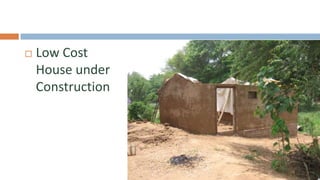
   Low Cost
    House under
    Construction
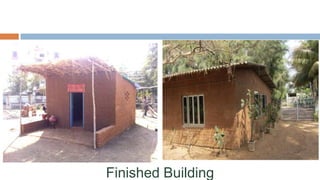
Finished Building
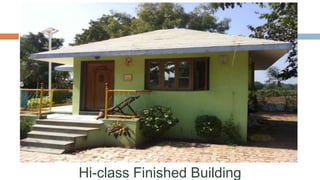
Hi-class Finished Building
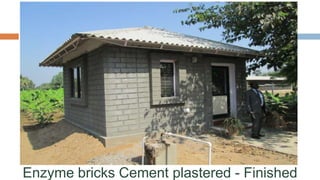
Enzyme bricks Cement plastered - Finished
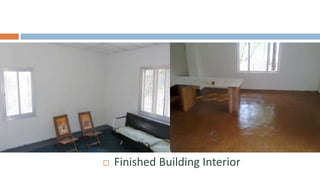
   Finished Building Interior
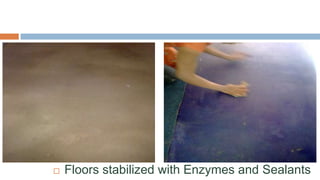
   Floors stabilized with Enzymes and Sealants
   The constructed building can be fitted with windows
    and doors of choice.
   The finished surfaces can be painted with any colour of
    choice or can be left unpainted to enjoy the natural
    colour of the earth.
   Floorings, light-fittings, and plumbing is all done the
    same way as in any other constructed buildings.
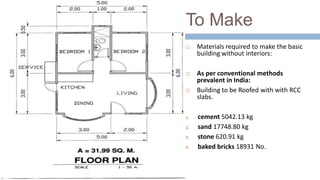
To Make
    Materials required to make the basic
     building without interiors:

    As per conventional methods
     prevalent in India:
    Building to be Roofed with with RCC
     slabs.

1.   cement 5042.13 kg
2.   sand 17748.80 kg
3.   stone 620.91 kg
4.   baked bricks 18931 No.
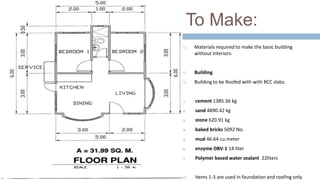
To Make:
    Materials required to make the basic building
     without interiors:


    Building
    Building to be Roofed with with RCC slabs.


1.    cement 1385.36 kg
2.    sand 4890.42 kg
3.    stone 620.91 kg
4.    baked bricks 5092 No.
5.    mud 46.64 cu.meter
6.    enzyme DBV-1 14 liter
7.    Polymer based water sealant 22liters


     Items 1-3 are used in foundation and roofing only
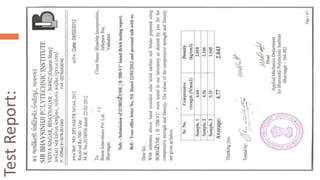
Test Report:
PROJECT COLLABORATORS
  Go Green With
   Bio-Enzymes


  www.boroninnovations.com
contact@boroninnovations.com
   Skype: boroninnovations
      +91-990-451-4703


                  Thank You and have a pleasant GREEN-DAY ahead..!!

BoroZyme Technologies ( Enzyme based Sun-Dried Bricks and Earthen House building)

  • 1.
    BOROŹYME TECHNOLOGiES Presents BOROŹYME ¦ B ‘DBV-1’ Concept Presentation on : Enzyme Stabilized Mud (Earthen) Construction. Nucleation Center Marketed by Large-Scale Production
  • 2.
    INTRODUCTION.  BORON INNOVATIONS PVT. LTD., Bhavnagar is an identity created by panel of high qualified specialized scientists, whose aim is to protect and deliver the environment, with Nucleation Center at CHARUSAT University & Large - Scale production at DHARA BIOTECH, innovative Enzymes Technology has been developed for disposal of sewage wastes, making earthen roads and constructing low cost earthen mud houses.  Company’s Vision is to make this technology reach ‘the common people’. Go Green With Bio-Enzymes
  • 3.
    Enzyme Stabilized Mud(Earthen) Construction  Modern building industry dealing with providing shelter comprises of using materials such as “Fired/burned/fused bricks”, “Cement” and “Steel” to produce rock solid buildings, at an astronomically rising cost, mainly due to the cost of producing the above mentioned products. Moreover, the buildings constructed from these materials are major energy guzzlers requiring energy to COOL, HEAT AND ILLUMINATE.  EARTHEN BUILDINGS HAVE BEST INSULATION AGAINST HEAT AND COLD. Go Green With Bio-Enzymes
  • 4.
    What is anEnzyme?  An Enzyme is a Protein originating from a bacteria, fungus, plant or animal that acts as a catalyst to speed up a chemical reaction.
  • 5.
    Enzyme stabilization is commonly demonstrated by termites and ants.  Various Enzymes performing multiple tasks will work to make bonds between minerals in the water and soil, aid in the creation of van der vaals forces between clay particles and aid in the removal of water between soil particles, giving better compaction and strength.
  • 6.
    BRICK ENZYME &SOIL SEALINGS  BoroŹyme¦B is an innovation which converts natural common earth in to a quality brick without baking the same in the special furnace. This innovation will fulfill the dream of a common man who wants to own his OWN house.  The Government authorised laboratory had certified that these bricks are having better compressive strength. All type of earth can be used to make these bricks. These bricks can be used by the people who are deprived of basic living amenities / tribal by using their home yard earthen material.  The material cost of this brick is very less and can be made with help of handmade reusable mould. The process do not requires skilled labour and bricks can be made by self work.  The house constructed by these bricks do not requires cement, concrete, limestone etc. The wonder enzyme can be used for flooring, construction and plaster. After applying waterproofing spray on the surface one can have an economically constructed beautiful OWN
  • 7.
    One can make hollow block from the same material as it adds to heat insulation properties. The other uses are compound walls, side walls, outer walls, dusting control, better abrasion resistant etc. An unskilled labour can make bricks from waste land and this can create a huge possibility of self employment in rural areas of India where farm labours remain idle in non crop season.
  • 8.
    Enzyme Stabilized Mud(Earthen) Construction  Mud has been used as a construction building material for the last 10000 years.  Mud offers the same versatility in construction offered by burnt clay bricks/blocks, and then even more.  Offers to save up to 658kg of Carbon dioxide emissions per 100 sq. foot of construction.
  • 9.
    Enzyme Stabilized Mud(Earthen) Construction  BOROŹYME ¦ B DBV-1 enzyme stabilized Mud blocks are cast in either:  adobe method if the soil is permitting or  using a press to make compressed earth blocks.
  • 10.
    Enzyme Stabilized Mud(Earthen) Construction Manual Adobe block mould Compressed Earth block press and mould
  • 11.
    Enzyme Stabilized Mud(Earthen) Construction  BOROŹYME ¦ B DBV-1 enzyme stabilized Earthen Hollow blocks cast with already available machines in Nigeria
  • 12.
    DBV-1 stabilized Earthen Hollow blocks cast with already available machines in Nigeria
  • 13.
    Mud is mixed with DBV-1 and sufficient water and allowed to incubate until homogenous wetting and plasticity is achieved
  • 14.
  • 15.
  • 16.
    Spread enzyme withwater over soil with bucket
  • 17.
    Wetting Soil. Addwater and allow to seep into the soil. Allow the soil to wet for a minimum of 24 hours for a uniform wetting.
  • 18.
    Mud is mixed with DBV-1 and sufficient water and allowed to incubate until homogenous wetting and plasticity is achieved
  • 19.
    Cutting and mixingsoil. This will ensure there are no dry zones in the mix. Also if moisture is too high or low, water should be adjusted to allow molding property of soil.
  • 20.
    Making bricks inmolds: take plastic soil and throw into mold.
  • 21.
    Making bricks inmolds: Ensure all edges and corners are properly filled with mud before removing the mold from around the shaped brick. If shaped brick is losing shape after removal from mold, there is too much water in the soil and soil needs to be dried a litter before using.
  • 22.
    Earth mixed withwater and DBV-1 soil stabilization enzyme cast into desired sized blocks.
  • 23.
    Earth mixed withwater and DBV-1 soil stabilization enzyme cast into desired sized blocks.
  • 24.
    Earth mixed withwater and DBV-1 soil stabilization enzyme cast into desired sized blocks.
  • 25.
    Adobe blocks castand set to dry for 1-3 days
  • 26.
  • 27.
    All construction presently follow codes and guidelines set by ASTM – E2392, Standard Guide for Design of Earthen Wall Building Systems
  • 28.
    Prior to anyconstruction a proper base using stone or burnt clay bricks has to be prepared
  • 29.
    Concrete with reinforcedsteel is used to add extra strength to the base of the construction to allow for resistance to Earthquakes (As per Building construction codes)
  • 30.
    Foundation built fora home of 22’ x 17’, with one partition wall to provide for two rooms. Plinth taken 1’ above highest recorded flood line
  • 31.
    A plastic sheet is placed on the concrete to further ensure no water via capillary action seeps into the earthen wall.  Enzyme stabilized blocks are then placed onto the base, stuck to each other using mortar made from the same earth used to cast the blocks
  • 32.
    Enzyme stabilized blocks are now placed the same way conventional red clay burnt bricks are laid to construct a wall, the difference being they are stuck to each other using mortar made from the same earth used to cast the blocks.
  • 33.
    Enzyme stabilized blocks are now placed the same way conventional red clay burnt bricks are laid to construct a wall, the difference being they are stuck to each other using mortar made from the same earth used to cast the blocks
  • 34.
    Earthen Mortar used to cement the earthen blocks to each other
  • 37.
    Top coping made of concrete reinforced with steel bars.  Arrangement to get slope to adjust roofing
  • 39.
    Water proofing application onto the earthen walls
  • 40.
    Post water proofing the basic structure is ready for outfitting of electrical and plumbing lines and any cosmetic work such as plasters.
  • 41.
  • 42.
    Rough Plasters on walls
  • 43.
    Low Cost House Extension
  • 44.
    Low Cost House under Construction
  • 45.
  • 46.
  • 47.
    Enzyme bricks Cementplastered - Finished
  • 48.
    Finished Building Interior
  • 49.
    Floors stabilized with Enzymes and Sealants
  • 50.
    The constructed building can be fitted with windows and doors of choice.  The finished surfaces can be painted with any colour of choice or can be left unpainted to enjoy the natural colour of the earth.  Floorings, light-fittings, and plumbing is all done the same way as in any other constructed buildings.
  • 51.
    To Make  Materials required to make the basic building without interiors:  As per conventional methods prevalent in India:  Building to be Roofed with with RCC slabs. 1. cement 5042.13 kg 2. sand 17748.80 kg 3. stone 620.91 kg 4. baked bricks 18931 No.
  • 52.
    To Make:  Materials required to make the basic building without interiors:  Building  Building to be Roofed with with RCC slabs. 1. cement 1385.36 kg 2. sand 4890.42 kg 3. stone 620.91 kg 4. baked bricks 5092 No. 5. mud 46.64 cu.meter 6. enzyme DBV-1 14 liter 7. Polymer based water sealant 22liters  Items 1-3 are used in foundation and roofing only
  • 53.
  • 55.
    PROJECT COLLABORATORS Go Green With Bio-Enzymes www.boroninnovations.com contact@boroninnovations.com Skype: boroninnovations +91-990-451-4703 Thank You and have a pleasant GREEN-DAY ahead..!!