Study On Basic
Structural System
Submitted By:
130103
130110
130113
130123
130133
120123
Title Page No
1. Introduction 1
2. The Relationship Of Structure To Building 2-3
3. Structural Requirements 4
4. Structural Development In Architectural History 5-8
5. Basic Structural Elements 9-10
6. Analysis Of Structural System 11
6. Wall Slab Structural System 12-21
7. Post Lintel Structural System 22-31
8. Post Slab Structural System 32-47
9. Common Feature 48
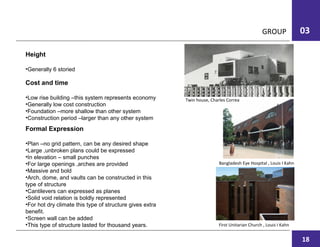
CONTENT
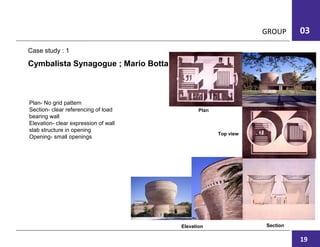
GROUP 03
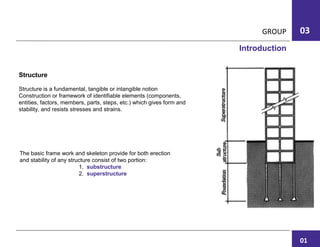
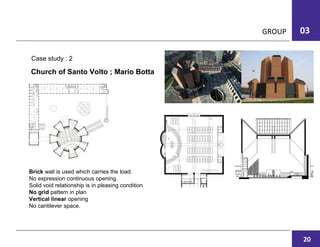
Structure
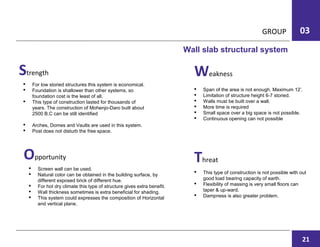
Structure is a fundamental, tangible or intangible notion
Construction or framework of identifiable elements (components,
entities, factors, members, parts, steps, etc.) which gives form and
stability, and resists stresses and strains.
The basic frame work and skeleton provide for both erection
and stability of any structure consist of two portion:
1. substructure
2. superstructure
Introduction
01
GROUP 03
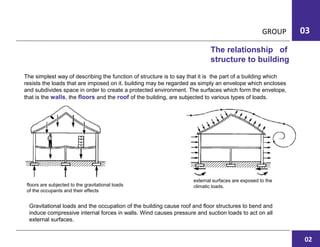
The simplest way of describing the function of structure is to say that it is the part of a building which
resists the loads that are imposed on it. building may be regarded as simply an envelope which encloses
and subdivides space in order to create a protected environment. The surfaces which form the envelope,
that is the walls, the floors and the roof of the building, are subjected to various types of loads.
Gravitational loads and the occupation of the building cause roof and floor structures to bend and
induce compressive internal forces in walls. Wind causes pressure and suction loads to act on all
external surfaces.
The relationship of
structure to building
external surfaces are exposed to the
climatic loads.floors are subjected to the gravitational loads
of the occupants and their effects
02
GROUP 03
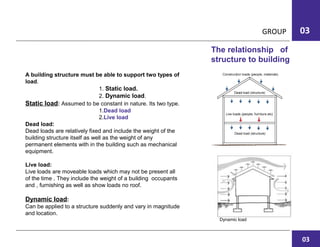
A building structure must be able to support two types of
load.
1. Static load.
2. Dynamic load.
Static load: Assumed to be constant in nature. Its two type.
1.Dead load
2.Live load
Dead load:
Dead loads are relatively fixed and include the weight of the
building structure itself as well as the weight of any
permanent elements with in the building such as mechanical
equipment.
Live load:
Live loads are moveable loads which may not be present all
of the time . They include the weight of a building occupants
and , furnishing as well as show loads no roof.
Dynamic load:
Can be applied to a structure suddenly and vary in magnitude
and location.
The relationship of
structure to building
Dynamic load
03
GROUP 03
Structural requirements
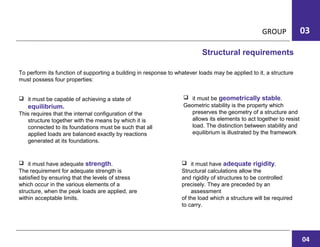
To perform its function of supporting a building in response to whatever loads may be applied to it, a structure
must possess four properties:
๏ฑ it must be capable of achieving a state of
equilibrium.
This requires that the internal configuration of the
structure together with the means by which it is
connected to its foundations must be such that all
applied loads are balanced exactly by reactions
generated at its foundations.
๏ฑ it must be geometrically stable.
Geometric stability is the property which
preserves the geometry of a structure and
allows its elements to act together to resist
load. The distinction between stability and
equilibrium is illustrated by the framework
๏ฑ it must have adequate strength.
The requirement for adequate strength is
satisfied by ensuring that the levels of stress
which occur in the various elements of a
structure, when the peak loads are applied, are
within acceptable limits.
๏ฑ it must have adequate rigidity.
Structural calculations allow the
and rigidity of structures to be controlled
precisely. They are preceded by an
assessment
of the load which a structure will be required
to carry.
04
GROUP 03
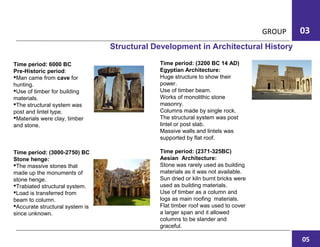
Time period: 6000 BC
Pre-Historic period:
๏‚งMan came from cave for
hunting.
๏‚งUse of timber for building
materials.
๏‚งThe structural system was
post and lintel type.
๏‚งMaterials were clay, timber
and stone.
Time period: (3000-2750) BC
Stone henge:
๏‚งThe massive stones that
made up the monuments of
stone henge.
๏‚งTrabiated structural system.
๏‚งLoad is transferred from
beam to column.
๏‚งAccurate structural system is
since unknown.
Structural Development in Architectural History
Time period: (3200 BC 14 AD)
Egyptian Architecture:
Huge structure to show their
power.
Use of timber beam.
Works of monolithic stone
masonry.
Columns made by single rock.
The structural system was post
lintel or post slab.
Massive walls and lintels was
supported by flat roof.
Time period: (2371-325BC)
Aesian Architecture:
Stone was rarely used as building
materials as it was not available.
Sun dried or kiln burnt bricks were
used as building materials.
Use of timber as a column and
logs as main roofing materials.
Flat timber roof was used to cover
a larger span and it allowed
columns to be slander and
graceful.
05
GROUP 03
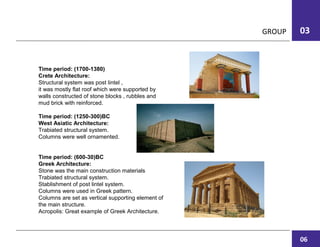
Time period: (1700-1380)
Crete Architecture:
Structural system was post lintel ,
it was mostly flat roof which were supported by
walls constructed of stone blocks , rubbles and
mud brick with reinforced.
Time period: (1250-300)BC
West Asiatic Architecture:
Trabiated structural system.
Columns were well ornamented.
Time period: (600-30)BC
Greek Architecture:
Stone was the main construction materials
Trabiated structural system.
Stablishment of post lintel system.
Columns were used in Greek pattern.
Columns are set as vertical supporting element of
the main structure.
Acropolis: Great example of Greek Architecture.
06
GROUP 03
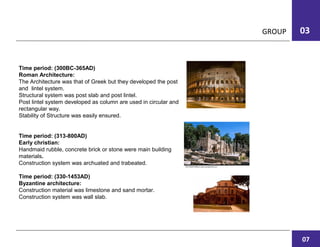
Time period: (300BC-365AD)
Roman Architecture:
The Architecture was that of Greek but they developed the post
and lintel system.
Structural system was post slab and post lintel.
Post lintel system developed as column are used in circular and
rectangular way.
Stability of Structure was easily ensured.
Time period: (313-800AD)
Early christian:
Handmaid rubble, concrete brick or stone were main building
materials.
Construction system was archuated and trabeated.
Time period: (330-1453AD)
Byzantine architecture:
Construction material was limestone and sand mortar.
Construction system was wall slab.
07
GROUP 03
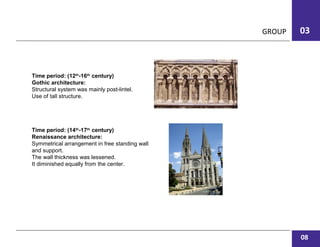
Time period: (12th
-16th
century)
Gothic architecture:
Structural system was mainly post-lintel.
Use of tall structure.
Time period: (14th
-17th
century)
Renaissance architecture:
Symmetrical arrangement in free standing wall
and support.
The wall thickness was lessened.
It diminished equally from the center.
01
08
GROUP 03
Basic structural elements
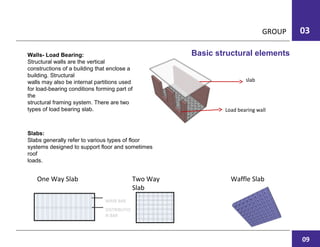
Slabs:
Slabs generally refer to various types of floor
systems designed to support floor and sometimes
roof
loads.
Walls- Load Bearing:
Structural walls are the vertical
constructions of a building that enclose a
building. Structural
walls may also be internal partitions used
for load-bearing conditions forming part of
the
structural framing system. There are two
types of load bearing slab. Load bearing wall
slab
One Way Slab Two Way
Slab
Waffle Slab
MAIN BAR
DISTRIBUTIO
N BAR
09
GROUP 03
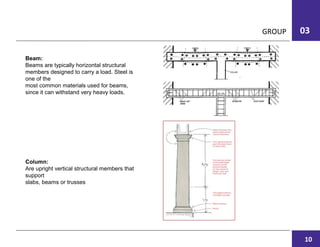
Beam:
Beams are typically horizontal structural
members designed to carry a load. Steel is
one of the
most common materials used for beams,
since it can withstand very heavy loads.
Column:
Are upright vertical structural members that
support
slabs, beams or trusses
10
GROUP 03
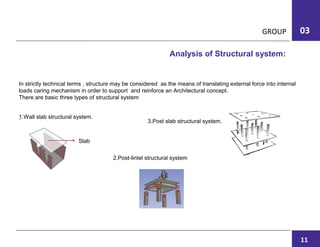
In strictly technical terms , structure may be considered as the means of translating external force into internal
loads caring mechanism in order to support and reinforce an Architectural concept.
There are basic three types of structural system
.
Analysis of Structural system:
3.Post slab structural system.
2.Post-lintel structural system
1.Wall slab structural system.
Slab
11
03
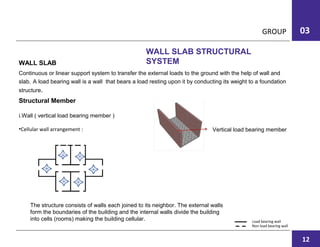
WALL SLAB
Continuous or linear support system to transfer the external loads to the ground with the help of wall and
slab. A load bearing wall is a wall that bears a load resting upon it by conducting its weight to a foundation
structure.
Structural Member
i.Wall ( vertical load bearing member )
โ€ขCellular wall arrangement :
WALL SLAB STRUCTURAL
SYSTEM
Vertical load bearing member
The structure consists of walls each joined to its neighbor. The external walls
form the boundaries of the building and the internal walls divide the building
into cells (rooms) making the building cellular.
Non load bearing wall
Load bearing wall
GROUP
12
GROUP 03
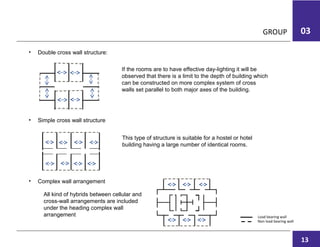
โ€ข Double cross wall structure:
โ€ข Simple cross wall structure
โ€ข Complex wall arrangement
If the rooms are to have effective day-lighting it will be
observed that there is a limit to the depth of building which
can be constructed on more complex system of cross
walls set parallel to both major axes of the building.
This type of structure is suitable for a hostel or hotel
building having a large number of identical rooms.
All kind of hybrids between cellular and
cross-wall arrangements are included
under the heading complex wall
arrangement
Non load bearing wall
Load bearing wall
13
GROUP 03
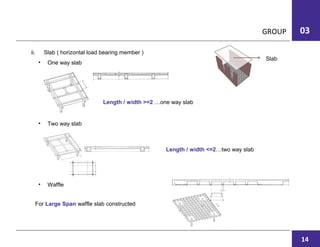
ii. Slab ( horizontal load bearing member )
Slab
โ€ข One way slab
โ€ข Two way slab
โ€ข Waffle
For Large Span waffle slab constructed
Length / width >=2 โ€ฆone way slab
Length / width <=2โ€ฆtwo way slab
14
GROUP 03
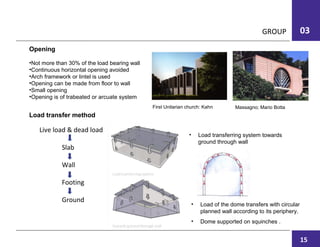
Opening
โ€ขNot more than 30% of the load bearing wall
โ€ขContinuous horizontal opening avoided
โ€ขArch framework or lintel is used
โ€ขOpening can be made from floor to wall
โ€ขSmall opening
โ€ขOpening is of trabeated or arcuate system
Load transfer method
Live load & dead load
Slab
Wall
Footing
Ground
โ€ข Load transferring system towards
ground through wall
โ€ข Load of the dome transfers with circular
planned wall according to its periphery.
โ€ข Dome supported on squinches .
First Unitarian church: Kahn Massagno; Mario Botta
15
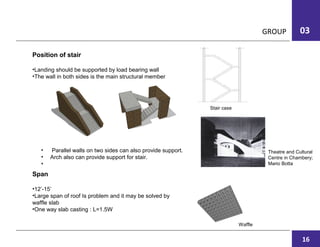
Span
โ€ข12โ€™-15โ€™
โ€ขLarge span of roof Is problem and it may be solved by
waffle slab
โ€ขOne way slab casting : L=1.5W
GROUP 03
Position of stair
โ€ขLanding should be supported by load bearing wall
โ€ขThe wall in both sides is the main structural member
โ€ข Parallel walls on two sides can also provide support.
โ€ข Arch also can provide support for stair.
โ€ข
Stair case
Waffle
Theatre and Cultural
Centre in Chambery;
Mario Botta
0606
16
GROUP 03
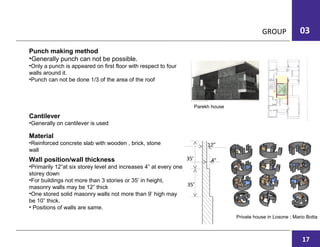
Punch making method
โ€ขGenerally punch can not be possible.
โ€ขOnly a punch is appeared on first floor with respect to four
walls around it.
โ€ขPunch can not be done 1/3 of the area of the roof
Parekh house
Cantilever
โ€ขGenerally on cantilever is used
Material
โ€ขReinforced concrete slab with wooden , brick, stone
wall
Wall position/wall thickness
โ€ขPrimarily 12โ€at six storey level and increases 4โ€ at every one
storey down
โ€ขFor buildings not more than 3 stories or 35โ€™ in height,
masonry walls may be 12โ€ thick
โ€ขOne stored solid masonry walls not more than 9โ€™ high may
be 10โ€ thick.
โ€ข Positions of walls are same.
Private house in Losone ; Mario Botta
35โ€™
35โ€™
4โ€
12โ€
17
GROUP 03
Cost and time
โ€ขLow rise building โ€“this system represents economy
โ€ขGenerally low cost construction
โ€ขFoundation โ€“more shallow than other system
โ€ขConstruction period โ€“larger than any other system
Formal Expression
โ€ขPlan โ€“no grid pattern, can be any desired shape
โ€ขLarge ,unbroken plans could be expressed
โ€ขIn elevation โ€“ small punches
โ€ขFor large openings ,arches are provided
โ€ขMassive and bold
โ€ขArch, dome, and vaults can be constructed in this
type of structure
โ€ขCantilevers can expressed as planes
โ€ขSolid void relation is boldly represented
โ€ขFor hot dry climate this type of structure gives extra
benefit.
โ€ขScreen wall can be added
โ€ขThis type of structure lasted for thousand years.
Height
โ€ขGenerally 6 storied
Twin house, Charles Correa
Bangladesh Eye Hospital , Louis I Kahn
First Unitarian Church , Louis I Kahn
18
GROUP 03
Case study : 1
Cymbalista Synagogue ; Mario Botta
Plan- No grid pattern
Section- clear referencing of load
bearing wall
Elevation- clear expression of wall
slab structure in opening
Opening- small openings
Plan
Section
Top view
Elevation
19
GROUP 03
Case study : 2
Church of Santo Volto ; Mario Botta
Brick wall is used which carries the load.
No expression continuous opening.
Solid void relationship is in pleasing condition
No grid pattern in plan
Vertical linear opening
No cantilever space.
06
20
GROUP 03
Strength
๏‚ง For low storied structures this system is economical.
๏‚ง Foundation is shallower than other systems, so
foundation cost is the least of all.
๏‚ง This type of construction lasted for thousands of
years. The construction of Mohenjo-Daro built about
2500 B.C can be still identified
๏‚ง Arches, Domes and Vaults are used in this system.
๏‚ง Post does not disturb the free space.
Weakness
๏‚ง Span of the area is not enough. Maximum 12โ€™.
๏‚ง Limitation of structure height 6-7 storied.
๏‚ง Walls must be built over a wall.
๏‚ง More time is required
๏‚ง Small space over a big space is not possible.
๏‚ง Continuous opening can not possible
Opportunity
๏‚ง Screen wall can be used.
๏‚ง Natural color can be obtained in the building surface, by
different exposed brick of different hue.
๏‚ง For hot dry climate this type of structure gives extra benefit.
๏‚ง Wall thickness sometimes is extra beneficial for shading.
๏‚ง This system could expresses the composition of Horizontal
and vertical plane.
Threat
๏‚ง This type of construction is not possible with out
good load bearing capacity of earth.
๏‚ง Flexibility of massing is very small floors can
taper & up-ward.
๏‚ง Dampness is also greater problem.
Wall slab structural system
21
GROUP 03
Post lintel
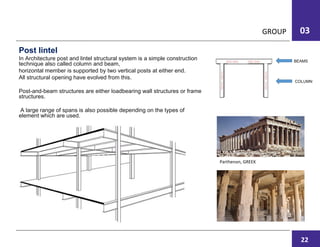
In Architecture post and lintel structural system is a simple construction
technique also called column and beam,
horizontal member is supported by two vertical posts at either end.
All structural opening have evolved from this.
Post-and-beam structures are either loadbearing wall structures or frame
structures.
A large range of spans is also possible depending on the types of
element which are used.
Parthenon, GREEK
COLUMN
BEAMS
22
GROUP 03
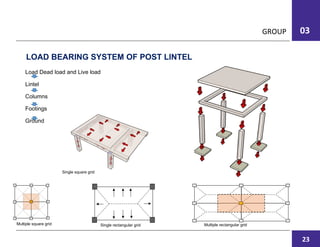
LOAD BEARING SYSTEM OF POST LINTEL
Load Dead load and Live load
Lintel
Columns
Footings
Ground
Multiple rectangular gridSingle rectangular gridMultiple square grid
Single square grid
23
GROUP 03
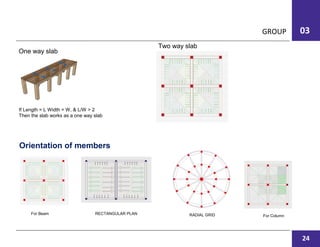
If Length = L Width = W, & L/W > 2
Then the slab works as a one way slab
One way slab
Two way slab
Orientation of members
RECTANGULAR PLAN RADIAL GRID For Column
For Beam
24
GROUP 03
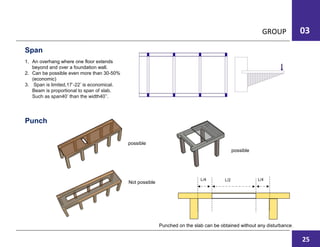
1. An overhang where one floor extends
beyond and over a foundation wall.
2. Can be possible even more than 30-50%
(economic)
3. Span is limited,17โ€™-22โ€™ is economical.
Beam is proportional to span of slab.
Such as span40โ€™ than the width40โ€™โ€™.
Span
Punched on the slab can be obtained without any disturbance.
L/2 L/4L/4
Punch
Not possible
possible
possible
25
GROUP 03
Stair
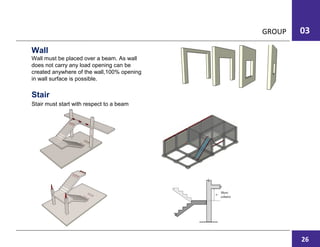
Wall
Wall must be placed over a beam. As wall
does not carry any load opening can be
created anywhere of the wall,100% opening
in wall surface is possible.
Stair must start with respect to a beam
26
GROUP 03
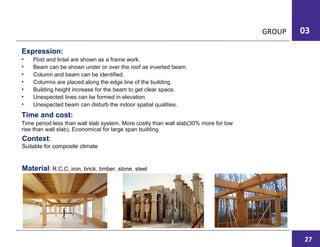
Material: R.C.C, iron, brick, timber, stone, steel
Expression:
โ€ข Post and lintel are shown as a frame work.
โ€ข Beam can be shown under or over the roof as inverted beam.
โ€ข Column and beam can be identified.
โ€ข Columns are placed along the edge line of the building.
โ€ข Building height increase for the beam to get clear space.
โ€ข Unexpected lines can be formed in elevation.
โ€ข Unexpected beam can disturb the indoor spatial qualities.
Time and cost:
Time period less than wall slab system. More costly than wall slab(30% more for low
rise than wall slab). Economical for large span building
Context:
Suitable for composite climate
27
GROUP 03
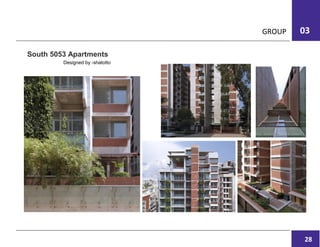
Designed by -shatotto
South 5053 Apartmentsย 
28
GROUP 03
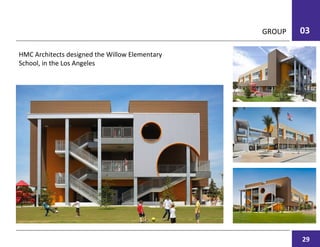
HMC Architects designed the Willow Elementary
School, in the Los Angeles
29
GROUP 03
Disadvantage:
๏‚งThe biggest disadvantage to a post and lintel
construction is the limited weight that can be held up,
and the small distances required between the posts.
๏‚งThe tension induced by deformation of self-weight
and the load above between the posts.
Advantage
โ€ขMaximum column to column opening can be
provided easily
โ€ข Roof can be provided flat, pitch or any other shape
โ€ข Punch in slab can be provided easily
โ€ขAesthetic framework can be done
30
GROUP 03
Post Lintel Structure System
๏‚ง50% cantilever system is applicable. ๏‚งUnexpected beam hampers interior.
๏‚งAcoustic problem may occur.
๏‚งStairs must be started with the reference of beam
:
๏‚งMaximum column to column opening
๏‚งAny type of roof can be provided
๏‚งAesthetic framework can be done
๏‚งIf beam is not strong enough, where large span, huge
concentrated load may occur bending stress and
deflection.
๏‚งShort span beams with large concentrated load near
the posts will occur shear stress .
Strength Weakness
Opportunity Threat
31
GROUP 03
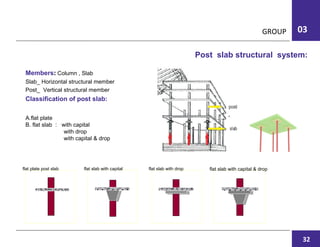
Post slab structural system:
Members: Column , Slab
Slab_ Horizontal structural member
Post_ Vertical structural member
Classification of post slab:
A.flat plate
B. flat slab : with capital
with drop
with capital & drop
flat plate post slab flat slab with capital flat slab with drop flat slab with capital & drop
32
GROUP 03
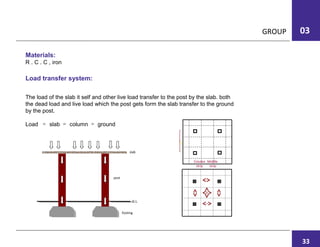
Materials:
R . C . C , iron
Load transfer system:
The load of the slab it self and other live load transfer to the post by the slab. both
the dead load and live load which the post gets form the slab transfer to the ground
by the post.
Load slab column groundโ–ป โ–ป โ–ป
slab
post
G.L.
footing
L
Middle
strip
Column
strip
33
03GROUP
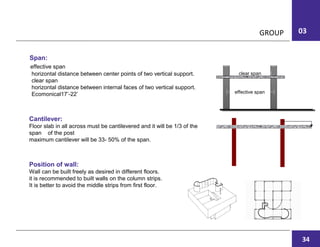
Span:
effective span
horizontal distance between center points of two vertical support.
clear span
horizontal distance between internal faces of two vertical support.
Ecomonical17โ€™-22โ€™ effective span
clear span
Cantilever:
Floor slab in all across must be cantilevered and it will be 1/3 of the
span of the post
maximum cantilever will be 33- 50% of the span.
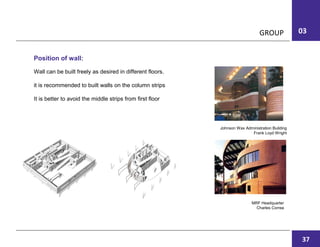
Position of wall:
Wall can be built freely as desired in different floors.
it is recommended to built walls on the column strips.
It is better to avoid the middle strips from first floor.
34
03GROUP
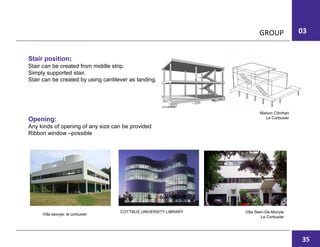
Stair position:
Stair can be created from middle strip.
Simply supported stair.
Stair can be created by using cantilever as landing.
Maison Citrohan
Le Corbusier
Opening:
Any kinds of opening of any size can be provided
Ribbon window โ€“possible
Villa savoye; le corbusier
COTTBUS UNIVERSITY LIBRARY Villa Stein-De-Monzie
Le Corbusier
35
03GROUP
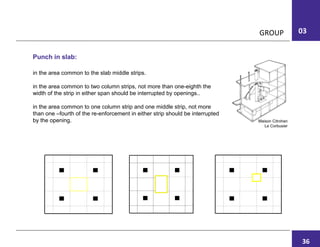
Punch in slab:
in the area common to the slab middle strips.
in the area common to two column strips, not more than one-eighth the
width of the strip in either span should be interrupted by openings..
in the area common to one column strip and one middle strip, not more
than one โ€“fourth of the re-enforcement in either strip should be interrupted
by the opening. Maison Citrohan
Le Corbusier
36
03GROUP
Wall can be built freely as desired in different floors.
it is recommended to built walls on the column strips
It is better to avoid the middle strips from first floor
Position of wall:
Johnson Wax Administration Building
Frank Loyd Wright
MRF Headquarter
Charles Correa
06
37
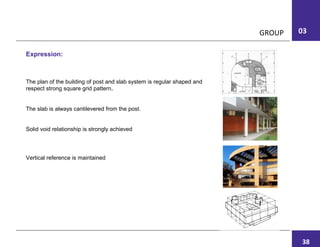
03GROUP
Expression:
The plan of the building of post and slab system is regular shaped and
respect strong square grid pattern.
The slab is always cantilevered from the post.
Solid void relationship is strongly achieved
Vertical reference is maintained
38
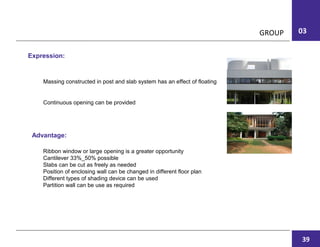
03GROUP
Massing constructed in post and slab system has an effect of floating
Continuous opening can be provided
Expression:
Advantage:
Ribbon window or large opening is a greater opportunity
Cantilever 33%_50% possible
Slabs can be cut as freely as needed
Position of enclosing wall can be changed in different floor plan
Different types of shading device can be used
Partition wall can be use as required
39
03GROUP
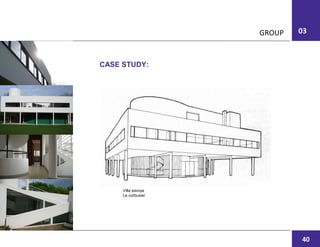
Villa savoya
Le corbusier
CASE STUDY:
06
40
03GROUP
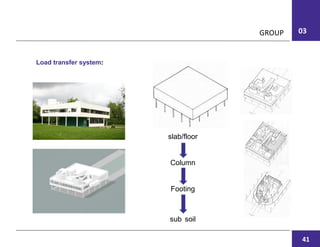
Load transfer system:
slab/floor
Column
Footing
sub soil
41
03GROUP
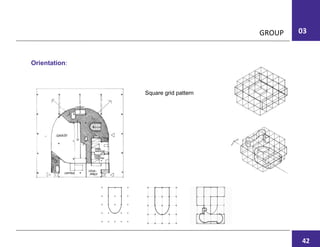
Orientation:
Square grid pattern
42
03GROUP
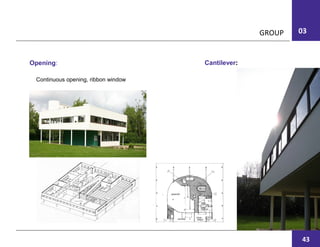
Opening:
Continuous opening, ribbon window
Cantilever:
43
03GROUP
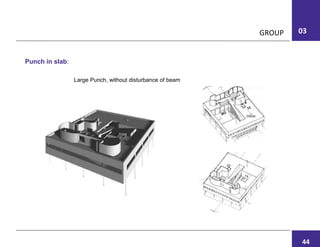
Punch in slab:
Large Punch, without disturbance of beam
44
03GROUP
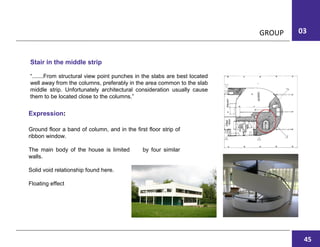
Stair in the middle strip
โ€œ.......From structural view point punches in the slabs are best located
well away from the columns, preferably in the area common to the slab
middle strip. Unfortunately architectural consideration usually cause
them to be located close to the columns.โ€
Ground floor a band of column, and in the first floor strip of
ribbon window.
The main body of the house is limited by four similar
walls.
Solid void relationship found here.
Floating effect
Expression:
45
GROUP 03
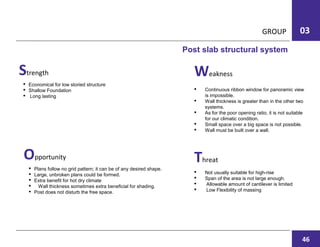
Strength
๏‚ง Economical for low storied structure
๏‚ง Shallow Foundation
๏‚ง Long lasting
Weakness
๏‚ง Continuous ribbon window for panoramic view
is impossible.
๏‚ง Wall thickness is greater than in the other two
systems.
๏‚ง As for the poor opening ratio, it is not suitable
for our climatic condition.
๏‚ง Small space over a big space is not possible.
๏‚ง Wall must be built over a wall.
Opportunity
๏‚ง Plans follow no grid pattern; it can be of any desired shape.
๏‚ง Large, unbroken plans could be formed.
๏‚ง Extra benefit for hot dry climate
๏‚ง Wall thickness sometimes extra beneficial for shading.
๏‚ง Post does not disturb the free space.
Threat
๏‚ง Not usually suitable for high-rise
๏‚ง Span of the area is not large enough.
๏‚ง Allowable amount of cantilever is limited
๏‚ง Low Flexibility of massing
Post slab structural system
46
03GROUP
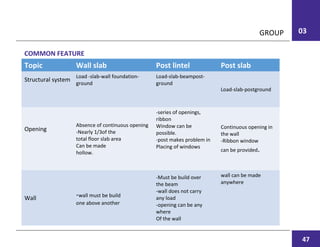
Topic Wall slab Post lintel Post slab
Structural system
Load -slab-wall foundation-
ground
Load-slab-beampost-
ground
Load-slab-postground
Opening
Absence of continuous opening
-Nearly 1/3of the
total floor slab area
Can be made
hollow.
-series of openings,
ribbon
Window can be
possible.
-post makes problem in
Placing of windows
Continuous opening in
the wall
-Ribbon window
can be provided.
Wall -wall must be build
one above another
-Must be build over
the beam
-wall does not carry
any load
-opening can be any
where
Of the wall
wall can be made
anywhere
COMMON FEATURE
47
GROUP 03
A Visual Dictionary of Architecture, Francis D.K. Ching
Building construction illustrated, Francis D.K. Ching
Complete works of Tadao Ando
BUILDING CONSTRUCTION ILLUSTRATED,FRANCIS D.
K. CHING
VISUAL DICTIONARY OF ARCHITECTURE, D.K CHING
Design of concrete structure 14
PHILOPHY AND DESIGN FROM ENGINEERING TO ARCHITECTURE
DESIGN OF MASONARY STRUCTURE , A.W. HENDRY, B. P.
SHINHA,S. R. DEVIS
DESIGN BASED PLLANING FOR COMMUNITIES
STHAPOTTO O NIRMAN
ARCHITECTURAL MONOGRAPHS โ€“MIES VEN DER ROHE
Reference
48

basic structural system in architecture

  • 1.
    Study On Basic StructuralSystem Submitted By: 130103 130110 130113 130123 130133 120123
  • 2.
    Title Page No 1.Introduction 1 2. The Relationship Of Structure To Building 2-3 3. Structural Requirements 4 4. Structural Development In Architectural History 5-8 5. Basic Structural Elements 9-10 6. Analysis Of Structural System 11 6. Wall Slab Structural System 12-21 7. Post Lintel Structural System 22-31 8. Post Slab Structural System 32-47 9. Common Feature 48 CONTENT
  • 3.
    GROUP 03 Structure Structure isa fundamental, tangible or intangible notion Construction or framework of identifiable elements (components, entities, factors, members, parts, steps, etc.) which gives form and stability, and resists stresses and strains. The basic frame work and skeleton provide for both erection and stability of any structure consist of two portion: 1. substructure 2. superstructure Introduction 01
  • 4.
    GROUP 03 The simplestway of describing the function of structure is to say that it is the part of a building which resists the loads that are imposed on it. building may be regarded as simply an envelope which encloses and subdivides space in order to create a protected environment. The surfaces which form the envelope, that is the walls, the floors and the roof of the building, are subjected to various types of loads. Gravitational loads and the occupation of the building cause roof and floor structures to bend and induce compressive internal forces in walls. Wind causes pressure and suction loads to act on all external surfaces. The relationship of structure to building external surfaces are exposed to the climatic loads.floors are subjected to the gravitational loads of the occupants and their effects 02
  • 5.
    GROUP 03 A buildingstructure must be able to support two types of load. 1. Static load. 2. Dynamic load. Static load: Assumed to be constant in nature. Its two type. 1.Dead load 2.Live load Dead load: Dead loads are relatively fixed and include the weight of the building structure itself as well as the weight of any permanent elements with in the building such as mechanical equipment. Live load: Live loads are moveable loads which may not be present all of the time . They include the weight of a building occupants and , furnishing as well as show loads no roof. Dynamic load: Can be applied to a structure suddenly and vary in magnitude and location. The relationship of structure to building Dynamic load 03
  • 6.
    GROUP 03 Structural requirements Toperform its function of supporting a building in response to whatever loads may be applied to it, a structure must possess four properties: ๏ฑ it must be capable of achieving a state of equilibrium. This requires that the internal configuration of the structure together with the means by which it is connected to its foundations must be such that all applied loads are balanced exactly by reactions generated at its foundations. ๏ฑ it must be geometrically stable. Geometric stability is the property which preserves the geometry of a structure and allows its elements to act together to resist load. The distinction between stability and equilibrium is illustrated by the framework ๏ฑ it must have adequate strength. The requirement for adequate strength is satisfied by ensuring that the levels of stress which occur in the various elements of a structure, when the peak loads are applied, are within acceptable limits. ๏ฑ it must have adequate rigidity. Structural calculations allow the and rigidity of structures to be controlled precisely. They are preceded by an assessment of the load which a structure will be required to carry. 04
  • 7.
    GROUP 03 Time period:6000 BC Pre-Historic period: ๏‚งMan came from cave for hunting. ๏‚งUse of timber for building materials. ๏‚งThe structural system was post and lintel type. ๏‚งMaterials were clay, timber and stone. Time period: (3000-2750) BC Stone henge: ๏‚งThe massive stones that made up the monuments of stone henge. ๏‚งTrabiated structural system. ๏‚งLoad is transferred from beam to column. ๏‚งAccurate structural system is since unknown. Structural Development in Architectural History Time period: (3200 BC 14 AD) Egyptian Architecture: Huge structure to show their power. Use of timber beam. Works of monolithic stone masonry. Columns made by single rock. The structural system was post lintel or post slab. Massive walls and lintels was supported by flat roof. Time period: (2371-325BC) Aesian Architecture: Stone was rarely used as building materials as it was not available. Sun dried or kiln burnt bricks were used as building materials. Use of timber as a column and logs as main roofing materials. Flat timber roof was used to cover a larger span and it allowed columns to be slander and graceful. 05
  • 8.
    GROUP 03 Time period:(1700-1380) Crete Architecture: Structural system was post lintel , it was mostly flat roof which were supported by walls constructed of stone blocks , rubbles and mud brick with reinforced. Time period: (1250-300)BC West Asiatic Architecture: Trabiated structural system. Columns were well ornamented. Time period: (600-30)BC Greek Architecture: Stone was the main construction materials Trabiated structural system. Stablishment of post lintel system. Columns were used in Greek pattern. Columns are set as vertical supporting element of the main structure. Acropolis: Great example of Greek Architecture. 06
  • 9.
    GROUP 03 Time period:(300BC-365AD) Roman Architecture: The Architecture was that of Greek but they developed the post and lintel system. Structural system was post slab and post lintel. Post lintel system developed as column are used in circular and rectangular way. Stability of Structure was easily ensured. Time period: (313-800AD) Early christian: Handmaid rubble, concrete brick or stone were main building materials. Construction system was archuated and trabeated. Time period: (330-1453AD) Byzantine architecture: Construction material was limestone and sand mortar. Construction system was wall slab. 07
  • 10.
    GROUP 03 Time period:(12th -16th century) Gothic architecture: Structural system was mainly post-lintel. Use of tall structure. Time period: (14th -17th century) Renaissance architecture: Symmetrical arrangement in free standing wall and support. The wall thickness was lessened. It diminished equally from the center. 01 08
  • 11.
    GROUP 03 Basic structuralelements Slabs: Slabs generally refer to various types of floor systems designed to support floor and sometimes roof loads. Walls- Load Bearing: Structural walls are the vertical constructions of a building that enclose a building. Structural walls may also be internal partitions used for load-bearing conditions forming part of the structural framing system. There are two types of load bearing slab. Load bearing wall slab One Way Slab Two Way Slab Waffle Slab MAIN BAR DISTRIBUTIO N BAR 09
  • 12.
    GROUP 03 Beam: Beams aretypically horizontal structural members designed to carry a load. Steel is one of the most common materials used for beams, since it can withstand very heavy loads. Column: Are upright vertical structural members that support slabs, beams or trusses 10
  • 13.
    GROUP 03 In strictlytechnical terms , structure may be considered as the means of translating external force into internal loads caring mechanism in order to support and reinforce an Architectural concept. There are basic three types of structural system . Analysis of Structural system: 3.Post slab structural system. 2.Post-lintel structural system 1.Wall slab structural system. Slab 11
  • 14.
    03 WALL SLAB Continuous orlinear support system to transfer the external loads to the ground with the help of wall and slab. A load bearing wall is a wall that bears a load resting upon it by conducting its weight to a foundation structure. Structural Member i.Wall ( vertical load bearing member ) โ€ขCellular wall arrangement : WALL SLAB STRUCTURAL SYSTEM Vertical load bearing member The structure consists of walls each joined to its neighbor. The external walls form the boundaries of the building and the internal walls divide the building into cells (rooms) making the building cellular. Non load bearing wall Load bearing wall GROUP 12
  • 15.
    GROUP 03 โ€ข Doublecross wall structure: โ€ข Simple cross wall structure โ€ข Complex wall arrangement If the rooms are to have effective day-lighting it will be observed that there is a limit to the depth of building which can be constructed on more complex system of cross walls set parallel to both major axes of the building. This type of structure is suitable for a hostel or hotel building having a large number of identical rooms. All kind of hybrids between cellular and cross-wall arrangements are included under the heading complex wall arrangement Non load bearing wall Load bearing wall 13
  • 16.
    GROUP 03 ii. Slab( horizontal load bearing member ) Slab โ€ข One way slab โ€ข Two way slab โ€ข Waffle For Large Span waffle slab constructed Length / width >=2 โ€ฆone way slab Length / width <=2โ€ฆtwo way slab 14
  • 17.
    GROUP 03 Opening โ€ขNot morethan 30% of the load bearing wall โ€ขContinuous horizontal opening avoided โ€ขArch framework or lintel is used โ€ขOpening can be made from floor to wall โ€ขSmall opening โ€ขOpening is of trabeated or arcuate system Load transfer method Live load & dead load Slab Wall Footing Ground โ€ข Load transferring system towards ground through wall โ€ข Load of the dome transfers with circular planned wall according to its periphery. โ€ข Dome supported on squinches . First Unitarian church: Kahn Massagno; Mario Botta 15
  • 18.
    Span โ€ข12โ€™-15โ€™ โ€ขLarge span ofroof Is problem and it may be solved by waffle slab โ€ขOne way slab casting : L=1.5W GROUP 03 Position of stair โ€ขLanding should be supported by load bearing wall โ€ขThe wall in both sides is the main structural member โ€ข Parallel walls on two sides can also provide support. โ€ข Arch also can provide support for stair. โ€ข Stair case Waffle Theatre and Cultural Centre in Chambery; Mario Botta 0606 16
  • 19.
    GROUP 03 Punch makingmethod โ€ขGenerally punch can not be possible. โ€ขOnly a punch is appeared on first floor with respect to four walls around it. โ€ขPunch can not be done 1/3 of the area of the roof Parekh house Cantilever โ€ขGenerally on cantilever is used Material โ€ขReinforced concrete slab with wooden , brick, stone wall Wall position/wall thickness โ€ขPrimarily 12โ€at six storey level and increases 4โ€ at every one storey down โ€ขFor buildings not more than 3 stories or 35โ€™ in height, masonry walls may be 12โ€ thick โ€ขOne stored solid masonry walls not more than 9โ€™ high may be 10โ€ thick. โ€ข Positions of walls are same. Private house in Losone ; Mario Botta 35โ€™ 35โ€™ 4โ€ 12โ€ 17
  • 20.
    GROUP 03 Cost andtime โ€ขLow rise building โ€“this system represents economy โ€ขGenerally low cost construction โ€ขFoundation โ€“more shallow than other system โ€ขConstruction period โ€“larger than any other system Formal Expression โ€ขPlan โ€“no grid pattern, can be any desired shape โ€ขLarge ,unbroken plans could be expressed โ€ขIn elevation โ€“ small punches โ€ขFor large openings ,arches are provided โ€ขMassive and bold โ€ขArch, dome, and vaults can be constructed in this type of structure โ€ขCantilevers can expressed as planes โ€ขSolid void relation is boldly represented โ€ขFor hot dry climate this type of structure gives extra benefit. โ€ขScreen wall can be added โ€ขThis type of structure lasted for thousand years. Height โ€ขGenerally 6 storied Twin house, Charles Correa Bangladesh Eye Hospital , Louis I Kahn First Unitarian Church , Louis I Kahn 18
  • 21.
    GROUP 03 Case study: 1 Cymbalista Synagogue ; Mario Botta Plan- No grid pattern Section- clear referencing of load bearing wall Elevation- clear expression of wall slab structure in opening Opening- small openings Plan Section Top view Elevation 19
  • 22.
    GROUP 03 Case study: 2 Church of Santo Volto ; Mario Botta Brick wall is used which carries the load. No expression continuous opening. Solid void relationship is in pleasing condition No grid pattern in plan Vertical linear opening No cantilever space. 06 20
  • 23.
    GROUP 03 Strength ๏‚ง Forlow storied structures this system is economical. ๏‚ง Foundation is shallower than other systems, so foundation cost is the least of all. ๏‚ง This type of construction lasted for thousands of years. The construction of Mohenjo-Daro built about 2500 B.C can be still identified ๏‚ง Arches, Domes and Vaults are used in this system. ๏‚ง Post does not disturb the free space. Weakness ๏‚ง Span of the area is not enough. Maximum 12โ€™. ๏‚ง Limitation of structure height 6-7 storied. ๏‚ง Walls must be built over a wall. ๏‚ง More time is required ๏‚ง Small space over a big space is not possible. ๏‚ง Continuous opening can not possible Opportunity ๏‚ง Screen wall can be used. ๏‚ง Natural color can be obtained in the building surface, by different exposed brick of different hue. ๏‚ง For hot dry climate this type of structure gives extra benefit. ๏‚ง Wall thickness sometimes is extra beneficial for shading. ๏‚ง This system could expresses the composition of Horizontal and vertical plane. Threat ๏‚ง This type of construction is not possible with out good load bearing capacity of earth. ๏‚ง Flexibility of massing is very small floors can taper & up-ward. ๏‚ง Dampness is also greater problem. Wall slab structural system 21
  • 24.
    GROUP 03 Post lintel InArchitecture post and lintel structural system is a simple construction technique also called column and beam, horizontal member is supported by two vertical posts at either end. All structural opening have evolved from this. Post-and-beam structures are either loadbearing wall structures or frame structures. A large range of spans is also possible depending on the types of element which are used. Parthenon, GREEK COLUMN BEAMS 22
  • 25.
    GROUP 03 LOAD BEARINGSYSTEM OF POST LINTEL Load Dead load and Live load Lintel Columns Footings Ground Multiple rectangular gridSingle rectangular gridMultiple square grid Single square grid 23
  • 26.
    GROUP 03 If Length= L Width = W, & L/W > 2 Then the slab works as a one way slab One way slab Two way slab Orientation of members RECTANGULAR PLAN RADIAL GRID For Column For Beam 24
  • 27.
    GROUP 03 1. Anoverhang where one floor extends beyond and over a foundation wall. 2. Can be possible even more than 30-50% (economic) 3. Span is limited,17โ€™-22โ€™ is economical. Beam is proportional to span of slab. Such as span40โ€™ than the width40โ€™โ€™. Span Punched on the slab can be obtained without any disturbance. L/2 L/4L/4 Punch Not possible possible possible 25
  • 28.
    GROUP 03 Stair Wall Wall mustbe placed over a beam. As wall does not carry any load opening can be created anywhere of the wall,100% opening in wall surface is possible. Stair must start with respect to a beam 26
  • 29.
    GROUP 03 Material: R.C.C,iron, brick, timber, stone, steel Expression: โ€ข Post and lintel are shown as a frame work. โ€ข Beam can be shown under or over the roof as inverted beam. โ€ข Column and beam can be identified. โ€ข Columns are placed along the edge line of the building. โ€ข Building height increase for the beam to get clear space. โ€ข Unexpected lines can be formed in elevation. โ€ข Unexpected beam can disturb the indoor spatial qualities. Time and cost: Time period less than wall slab system. More costly than wall slab(30% more for low rise than wall slab). Economical for large span building Context: Suitable for composite climate 27
  • 30.
    GROUP 03 Designed by-shatotto South 5053 Apartmentsย  28
  • 31.
    GROUP 03 HMC Architectsdesigned the Willow Elementary School, in the Los Angeles 29
  • 32.
    GROUP 03 Disadvantage: ๏‚งThe biggestdisadvantage to a post and lintel construction is the limited weight that can be held up, and the small distances required between the posts. ๏‚งThe tension induced by deformation of self-weight and the load above between the posts. Advantage โ€ขMaximum column to column opening can be provided easily โ€ข Roof can be provided flat, pitch or any other shape โ€ข Punch in slab can be provided easily โ€ขAesthetic framework can be done 30
  • 33.
    GROUP 03 Post LintelStructure System ๏‚ง50% cantilever system is applicable. ๏‚งUnexpected beam hampers interior. ๏‚งAcoustic problem may occur. ๏‚งStairs must be started with the reference of beam : ๏‚งMaximum column to column opening ๏‚งAny type of roof can be provided ๏‚งAesthetic framework can be done ๏‚งIf beam is not strong enough, where large span, huge concentrated load may occur bending stress and deflection. ๏‚งShort span beams with large concentrated load near the posts will occur shear stress . Strength Weakness Opportunity Threat 31
  • 34.
    GROUP 03 Post slabstructural system: Members: Column , Slab Slab_ Horizontal structural member Post_ Vertical structural member Classification of post slab: A.flat plate B. flat slab : with capital with drop with capital & drop flat plate post slab flat slab with capital flat slab with drop flat slab with capital & drop 32
  • 35.
    GROUP 03 Materials: R .C . C , iron Load transfer system: The load of the slab it self and other live load transfer to the post by the slab. both the dead load and live load which the post gets form the slab transfer to the ground by the post. Load slab column groundโ–ป โ–ป โ–ป slab post G.L. footing L Middle strip Column strip 33
  • 36.
    03GROUP Span: effective span horizontal distancebetween center points of two vertical support. clear span horizontal distance between internal faces of two vertical support. Ecomonical17โ€™-22โ€™ effective span clear span Cantilever: Floor slab in all across must be cantilevered and it will be 1/3 of the span of the post maximum cantilever will be 33- 50% of the span. Position of wall: Wall can be built freely as desired in different floors. it is recommended to built walls on the column strips. It is better to avoid the middle strips from first floor. 34
  • 37.
    03GROUP Stair position: Stair canbe created from middle strip. Simply supported stair. Stair can be created by using cantilever as landing. Maison Citrohan Le Corbusier Opening: Any kinds of opening of any size can be provided Ribbon window โ€“possible Villa savoye; le corbusier COTTBUS UNIVERSITY LIBRARY Villa Stein-De-Monzie Le Corbusier 35
  • 38.
    03GROUP Punch in slab: inthe area common to the slab middle strips. in the area common to two column strips, not more than one-eighth the width of the strip in either span should be interrupted by openings.. in the area common to one column strip and one middle strip, not more than one โ€“fourth of the re-enforcement in either strip should be interrupted by the opening. Maison Citrohan Le Corbusier 36
  • 39.
    03GROUP Wall can bebuilt freely as desired in different floors. it is recommended to built walls on the column strips It is better to avoid the middle strips from first floor Position of wall: Johnson Wax Administration Building Frank Loyd Wright MRF Headquarter Charles Correa 06 37
  • 40.
    03GROUP Expression: The plan ofthe building of post and slab system is regular shaped and respect strong square grid pattern. The slab is always cantilevered from the post. Solid void relationship is strongly achieved Vertical reference is maintained 38
  • 41.
    03GROUP Massing constructed inpost and slab system has an effect of floating Continuous opening can be provided Expression: Advantage: Ribbon window or large opening is a greater opportunity Cantilever 33%_50% possible Slabs can be cut as freely as needed Position of enclosing wall can be changed in different floor plan Different types of shading device can be used Partition wall can be use as required 39
  • 42.
  • 43.
  • 44.
  • 45.
  • 46.
    03GROUP Punch in slab: LargePunch, without disturbance of beam 44
  • 47.
    03GROUP Stair in themiddle strip โ€œ.......From structural view point punches in the slabs are best located well away from the columns, preferably in the area common to the slab middle strip. Unfortunately architectural consideration usually cause them to be located close to the columns.โ€ Ground floor a band of column, and in the first floor strip of ribbon window. The main body of the house is limited by four similar walls. Solid void relationship found here. Floating effect Expression: 45
  • 48.
    GROUP 03 Strength ๏‚ง Economicalfor low storied structure ๏‚ง Shallow Foundation ๏‚ง Long lasting Weakness ๏‚ง Continuous ribbon window for panoramic view is impossible. ๏‚ง Wall thickness is greater than in the other two systems. ๏‚ง As for the poor opening ratio, it is not suitable for our climatic condition. ๏‚ง Small space over a big space is not possible. ๏‚ง Wall must be built over a wall. Opportunity ๏‚ง Plans follow no grid pattern; it can be of any desired shape. ๏‚ง Large, unbroken plans could be formed. ๏‚ง Extra benefit for hot dry climate ๏‚ง Wall thickness sometimes extra beneficial for shading. ๏‚ง Post does not disturb the free space. Threat ๏‚ง Not usually suitable for high-rise ๏‚ง Span of the area is not large enough. ๏‚ง Allowable amount of cantilever is limited ๏‚ง Low Flexibility of massing Post slab structural system 46
  • 49.
    03GROUP Topic Wall slabPost lintel Post slab Structural system Load -slab-wall foundation- ground Load-slab-beampost- ground Load-slab-postground Opening Absence of continuous opening -Nearly 1/3of the total floor slab area Can be made hollow. -series of openings, ribbon Window can be possible. -post makes problem in Placing of windows Continuous opening in the wall -Ribbon window can be provided. Wall -wall must be build one above another -Must be build over the beam -wall does not carry any load -opening can be any where Of the wall wall can be made anywhere COMMON FEATURE 47
  • 50.
    GROUP 03 A VisualDictionary of Architecture, Francis D.K. Ching Building construction illustrated, Francis D.K. Ching Complete works of Tadao Ando BUILDING CONSTRUCTION ILLUSTRATED,FRANCIS D. K. CHING VISUAL DICTIONARY OF ARCHITECTURE, D.K CHING Design of concrete structure 14 PHILOPHY AND DESIGN FROM ENGINEERING TO ARCHITECTURE DESIGN OF MASONARY STRUCTURE , A.W. HENDRY, B. P. SHINHA,S. R. DEVIS DESIGN BASED PLLANING FOR COMMUNITIES STHAPOTTO O NIRMAN ARCHITECTURAL MONOGRAPHS โ€“MIES VEN DER ROHE Reference 48