EARTHQUAKE RESISTANT
STRUCTURES
BY
V.HEMANTH
14671A0141
1
CONTENTS
 INTRODUCTION
 PLATE TECTONICS
 HAZARDS DUE TO EARTHQUAKE
 CLASSIFICATION OF EARTH QUAKES
 WHAT IS EARTH QUAKE ENGINEERING ?
 PRINCIPLE OF EARTH QUAKE RESISTANT DESIGN
 EARTHQUAKE RESISTANT STRUCTURES
 RULES FOR BUILDING DESIGN
 INDIAN SEISMIC CODES
 SEISMIC EFFECTS ON STRUCTURES
 SHEAR WALL
 CASE STUDY ON JAPAN EARTHQUAKE
 EARTHQUAKE RESISTING STRUCTURE TECHNIQUES
 REFERENCES
 CONCLUSION
2
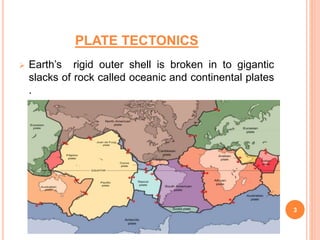
PLATE TECTONICS
 Earth’s rigid outer shell is broken in to gigantic
slacks of rock called oceanic and continental plates
.
3
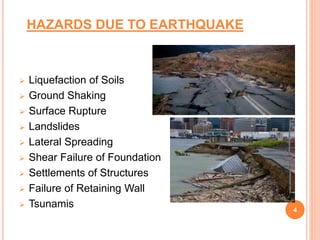
HAZARDS DUE TO EARTHQUAKE
 Liquefaction of Soils
 Ground Shaking
 Surface Rupture
 Landslides
 Lateral Spreading
 Shear Failure of Foundation
 Settlements of Structures
 Failure of Retaining Wall
 Tsunamis 4
CLASSIFICATION OF EARTH QUAKE
 Slight : Magnitude up to 4.9 on
the Richter Scale
 Moderate : Magnitude 5.0 to 6.9
 Severe : Magnitude 7.0 to 7.9
 Very Severe : Magnitude 8.0 and above
5
WHAT IS EARTHQUAKE ENGINEERING?
Earthquake engineers are
concerned with creating
earthquakes resistant designs and
construction techniques to build of
all kinds of bridges, roads and
buildings.
Earthquake engineers are faced with
many uncertainties and must be
smart in their decisions in
developing safe solutions to
challenging problems. They rely
on state-of-the-art technology,
materials science, laboratory
testing and field monitoring. 6
PRINCIPLE OF EARTHQUAKE-
RESISTANT DESIGN
 The building shall with stand with almost no
damage to moderate earth quake which have
probability of occurring several times during life of a
building.
 The building shall not collapse or harm human lives
during severe earth quake motions, which have a
probability of occurring less than once during the
life of the building.
7
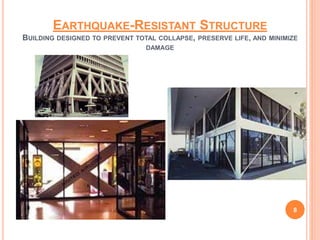
EARTHQUAKE-RESISTANT STRUCTURE
BUILDING DESIGNED TO PREVENT TOTAL COLLAPSE, PRESERVE LIFE, AND MINIMIZE
DAMAGE
8
World’s Tallest Bridge Millau, France 2004
9
San Francisco-Oakland Bay Bridge reconstruction, USA begun 2002 10
RULES FOR BUILDING DESIGN
 The configuration of the building (Plan and
elevation)should be as simple as possible.
 The foundation should generally be based on hard
and uniform ground.
 The members resisting horizontal forces should be
arranged so that torsional deformation is
not produced.
 The frame of the building structure should have
adequate ductility in addition to required strength.
11
INDIAN SEISMIC CODES
 IS 1893-2002, Indian Standard Criteria for Earthquake
Resistant Design of Structures (5thRevision)
 IS 4326-1993, Indian Standard Code of Practice for
Earthquake Resistant Design and Construction of Buildings
(2ndRevision)
 IS 13827-1993, Indian Standard Guidelines for Improving
Earthquake Resistance of Low Strength Masonry Buildings
 IS 13920-1993, Indian Standard Code of Practice for Ductile
Detailing of Reinforced Concrete Structures Subjected to
Seismic Forces
 IS 13935-1993, Indian Standard Guidelines for Repair and
Seismic Strengthening of Buildings 12
SEISMIC ZONES OF INDIA
13
SHEAR WALL
 A Wall topples down easily if pushed
horizontally at the top in a direction
perpendicular to its plane. this is
out of plane failure.
 How ever, a wall offers much greater
resistance if pushed along its length.
this is called in-plane resistance.
 Such a wall carrying horizontal loads in its own
plane, is known as a “Shear Wall”.
14
ADVANTAGES OF SHEAR WALL
 Efficient in terms of :
 Cost
 Effectiveness
 Construction
 Helps in minimizing the effect on Non-structural
elements . E.g. glass , windows.
 It is said that :-
“we cannot afford to build concrete
buildings meant to resist severe earthquakes
without Shear Wall.” 15
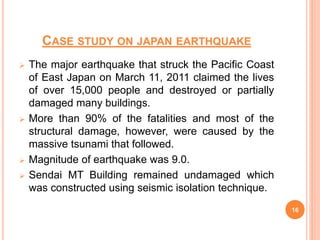
CASE STUDY ON JAPAN EARTHQUAKE
 The major earthquake that struck the Pacific Coast
of East Japan on March 11, 2011 claimed the lives
of over 15,000 people and destroyed or partially
damaged many buildings.
 More than 90% of the fatalities and most of the
structural damage, however, were caused by the
massive tsunami that followed.
 Magnitude of earthquake was 9.0.
 Sendai MT Building remained undamaged which
was constructed using seismic isolation technique.
16
17
EARTH QUAKE RESISTING
STRUCTURE TECHNIQUES
 Base Isolation Method
 Energy Dissipation Device
-(Seismic Dampers)
 Keeping Building Up Thrust
18
BASE ISOLATION
 Introduces flexibility
to the structures.
 Building is rested on
flexible pads.
 When earthquake strikes the
building does not move.
 It is suitable for hard soil only. 19
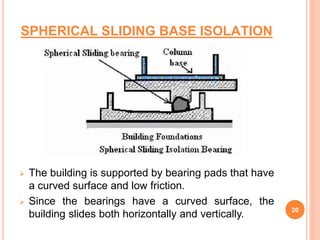
SPHERICAL SLIDING BASE ISOLATION
 The building is supported by bearing pads that have
a curved surface and low friction.
 Since the bearings have a curved surface, the
building slides both horizontally and vertically. 20
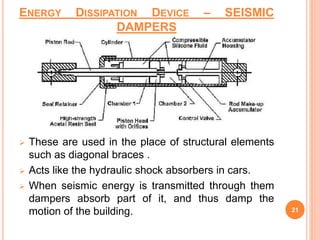
ENERGY DISSIPATION DEVICE – SEISMIC
DAMPERS
 These are used in the place of structural elements
such as diagonal braces .
 Acts like the hydraulic shock absorbers in cars.
 When seismic energy is transmitted through them
dampers absorb part of it, and thus damp the
motion of the building. 21
TYPE OF SEISMIC DAMPERS
 Viscous Dampers
(energy is absorbed by silicone-based fluid
passing between piston cylinder arrangement)
 Friction Dampers
(energy is absorbed by surfaces with friction
between them rubbing against each other)
 Yielding Dampers
(energy is absorbed by metallic components that
yield)
 Visco-elastic Dampers
(energy is absorbed by utilizing the controlled
shearing of solids). 22
KEEPING BUILDING UP THRUST
 This technique is discovered by Japan.
 It has found to be survived even in extreme
earthquakes.
23
CONCEPT OF
KEEPING BUILDING UP THRUST
 When the quake strikes, the system dissipates
energy in the building cores and exteriors.
 The frames are free to rock up and down within
fittings fixed at their bases 24
CONCLUSION
 Design the structure to resist the loads for safety
against Earthquakes.
 Base isolation can also be used for retrofitting of
structure
 Construct symmetrical structure to avoid torsion.
 No structure on the planet can be constructed
100% earthquake proof , only its resistance to
earthquake can be increased.
25
REFERENCES
 Earthquake resistant design of structure of
structures by Pankaj Agarwal and Manish
Shrikhande.
 http://web-japan.org/trends/11_sci-
tech/sci110728.html
26
27

EARTHQUAKE RESISTANT STRUCTURES

  • 1.
  • 2.
    CONTENTS  INTRODUCTION  PLATETECTONICS  HAZARDS DUE TO EARTHQUAKE  CLASSIFICATION OF EARTH QUAKES  WHAT IS EARTH QUAKE ENGINEERING ?  PRINCIPLE OF EARTH QUAKE RESISTANT DESIGN  EARTHQUAKE RESISTANT STRUCTURES  RULES FOR BUILDING DESIGN  INDIAN SEISMIC CODES  SEISMIC EFFECTS ON STRUCTURES  SHEAR WALL  CASE STUDY ON JAPAN EARTHQUAKE  EARTHQUAKE RESISTING STRUCTURE TECHNIQUES  REFERENCES  CONCLUSION 2
  • 3.
    PLATE TECTONICS  Earth’srigid outer shell is broken in to gigantic slacks of rock called oceanic and continental plates . 3
  • 4.
    HAZARDS DUE TOEARTHQUAKE  Liquefaction of Soils  Ground Shaking  Surface Rupture  Landslides  Lateral Spreading  Shear Failure of Foundation  Settlements of Structures  Failure of Retaining Wall  Tsunamis 4
  • 5.
    CLASSIFICATION OF EARTHQUAKE  Slight : Magnitude up to 4.9 on the Richter Scale  Moderate : Magnitude 5.0 to 6.9  Severe : Magnitude 7.0 to 7.9  Very Severe : Magnitude 8.0 and above 5
  • 6.
    WHAT IS EARTHQUAKEENGINEERING? Earthquake engineers are concerned with creating earthquakes resistant designs and construction techniques to build of all kinds of bridges, roads and buildings. Earthquake engineers are faced with many uncertainties and must be smart in their decisions in developing safe solutions to challenging problems. They rely on state-of-the-art technology, materials science, laboratory testing and field monitoring. 6
  • 7.
    PRINCIPLE OF EARTHQUAKE- RESISTANTDESIGN  The building shall with stand with almost no damage to moderate earth quake which have probability of occurring several times during life of a building.  The building shall not collapse or harm human lives during severe earth quake motions, which have a probability of occurring less than once during the life of the building. 7
  • 8.
    EARTHQUAKE-RESISTANT STRUCTURE BUILDING DESIGNEDTO PREVENT TOTAL COLLAPSE, PRESERVE LIFE, AND MINIMIZE DAMAGE 8
  • 9.
    World’s Tallest BridgeMillau, France 2004 9
  • 10.
    San Francisco-Oakland BayBridge reconstruction, USA begun 2002 10
  • 11.
    RULES FOR BUILDINGDESIGN  The configuration of the building (Plan and elevation)should be as simple as possible.  The foundation should generally be based on hard and uniform ground.  The members resisting horizontal forces should be arranged so that torsional deformation is not produced.  The frame of the building structure should have adequate ductility in addition to required strength. 11
  • 12.
    INDIAN SEISMIC CODES IS 1893-2002, Indian Standard Criteria for Earthquake Resistant Design of Structures (5thRevision)  IS 4326-1993, Indian Standard Code of Practice for Earthquake Resistant Design and Construction of Buildings (2ndRevision)  IS 13827-1993, Indian Standard Guidelines for Improving Earthquake Resistance of Low Strength Masonry Buildings  IS 13920-1993, Indian Standard Code of Practice for Ductile Detailing of Reinforced Concrete Structures Subjected to Seismic Forces  IS 13935-1993, Indian Standard Guidelines for Repair and Seismic Strengthening of Buildings 12
  • 13.
  • 14.
    SHEAR WALL  AWall topples down easily if pushed horizontally at the top in a direction perpendicular to its plane. this is out of plane failure.  How ever, a wall offers much greater resistance if pushed along its length. this is called in-plane resistance.  Such a wall carrying horizontal loads in its own plane, is known as a “Shear Wall”. 14
  • 15.
    ADVANTAGES OF SHEARWALL  Efficient in terms of :  Cost  Effectiveness  Construction  Helps in minimizing the effect on Non-structural elements . E.g. glass , windows.  It is said that :- “we cannot afford to build concrete buildings meant to resist severe earthquakes without Shear Wall.” 15
  • 16.
    CASE STUDY ONJAPAN EARTHQUAKE  The major earthquake that struck the Pacific Coast of East Japan on March 11, 2011 claimed the lives of over 15,000 people and destroyed or partially damaged many buildings.  More than 90% of the fatalities and most of the structural damage, however, were caused by the massive tsunami that followed.  Magnitude of earthquake was 9.0.  Sendai MT Building remained undamaged which was constructed using seismic isolation technique. 16
  • 17.
  • 18.
    EARTH QUAKE RESISTING STRUCTURETECHNIQUES  Base Isolation Method  Energy Dissipation Device -(Seismic Dampers)  Keeping Building Up Thrust 18
  • 19.
    BASE ISOLATION  Introducesflexibility to the structures.  Building is rested on flexible pads.  When earthquake strikes the building does not move.  It is suitable for hard soil only. 19
  • 20.
    SPHERICAL SLIDING BASEISOLATION  The building is supported by bearing pads that have a curved surface and low friction.  Since the bearings have a curved surface, the building slides both horizontally and vertically. 20
  • 21.
    ENERGY DISSIPATION DEVICE– SEISMIC DAMPERS  These are used in the place of structural elements such as diagonal braces .  Acts like the hydraulic shock absorbers in cars.  When seismic energy is transmitted through them dampers absorb part of it, and thus damp the motion of the building. 21
  • 22.
    TYPE OF SEISMICDAMPERS  Viscous Dampers (energy is absorbed by silicone-based fluid passing between piston cylinder arrangement)  Friction Dampers (energy is absorbed by surfaces with friction between them rubbing against each other)  Yielding Dampers (energy is absorbed by metallic components that yield)  Visco-elastic Dampers (energy is absorbed by utilizing the controlled shearing of solids). 22
  • 23.
    KEEPING BUILDING UPTHRUST  This technique is discovered by Japan.  It has found to be survived even in extreme earthquakes. 23
  • 24.
    CONCEPT OF KEEPING BUILDINGUP THRUST  When the quake strikes, the system dissipates energy in the building cores and exteriors.  The frames are free to rock up and down within fittings fixed at their bases 24
  • 25.
    CONCLUSION  Design thestructure to resist the loads for safety against Earthquakes.  Base isolation can also be used for retrofitting of structure  Construct symmetrical structure to avoid torsion.  No structure on the planet can be constructed 100% earthquake proof , only its resistance to earthquake can be increased. 25
  • 26.
    REFERENCES  Earthquake resistantdesign of structure of structures by Pankaj Agarwal and Manish Shrikhande.  http://web-japan.org/trends/11_sci- tech/sci110728.html 26
  • 27.