BY-
Shreya Thusoo
10403EN006
IDD PART IV
SUPERVISED BY-
Prof. RAJESH KUMAR
Dept. of Civil Engineering
IIT(BHU), Varanasi
SEMINAR ON
EARTHQUAKE RESISTANT
TECHNIQUES
INTRODUCTION
Some centuries back, landmark structures used to have:
 heavy masonry cladding
 wall curtains
 strong bracings
As need for taller buildings grew, advanced innovative devices
were introduced in structures.
The Todaiji Temple in Japan has log house construction
that has resisted earthquakes thousands of years (most number any structure has survived).
EARTHQUAKE
 They are natural disasters of a generally unpredictable nature.
 It is the shaking of the earth due to the movement of earth’s
crust.
Terms:
Fault plane
Hypocenter
Epicentre
IRANIAN CITY,
BAM
MAGNITUDE :
6.6 RICHTER
SCALE
KILLED : 40,000
LOMA PRIETA
MAGNITUDE :
7.1 RICHTER
SCALE
KILLED : 62
CONVENTIONAL METHODS
The concept is to strengthen the building.
Have stiffness and inelastic deformation
capacity.
CONVENTIONAL METHODS
Some of the general design concepts:
Follow current earthquake standards and codes.
Provide strong foundation.
Use best quality materials.
Avoid irregular shaped structures and framing system.
Maintain integrity by providing seismic bands:
At the plinth level of the building.
At the levels of lintels of doors and windows.
Vertical reinforcing bars at all wall junctions.
Introduce shear walls to transfer seismic loads down to
the bottom of foundation.
CONVENTIONAL METHODS
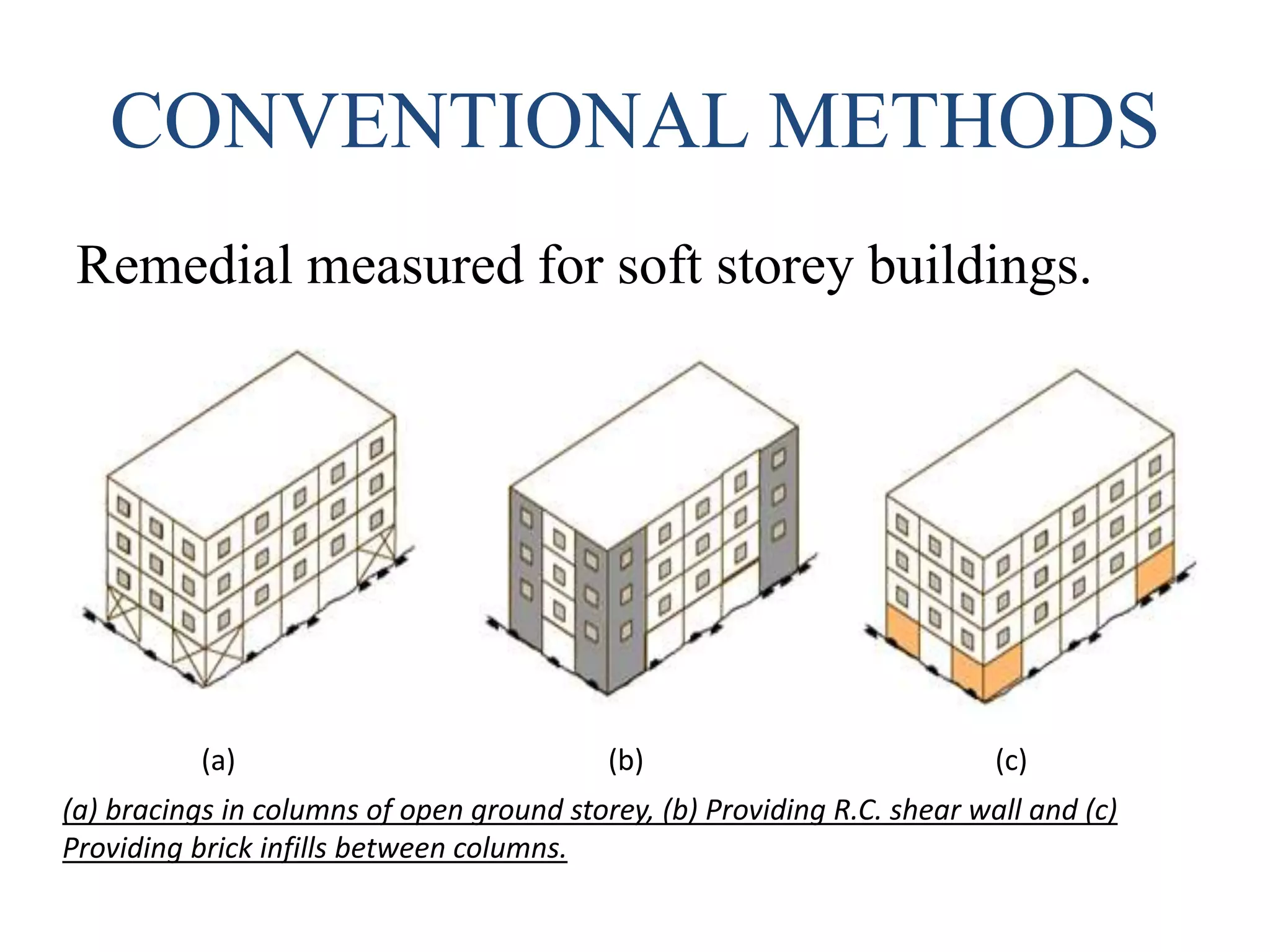
Remedial measured for soft storey buildings.
(a) bracings in columns of open ground storey, (b) Providing R.C. shear wall and (c)
Providing brick infills between columns.
(a) (b) (c)
ADVANCED METHODS
Basic approach is to reduce the earthquake
generated forces acting upon the building;
rather than strengthening it.
Two main techniques:
Base isolation
Energy dissipation devices
BASE ISOLATION DEVICES
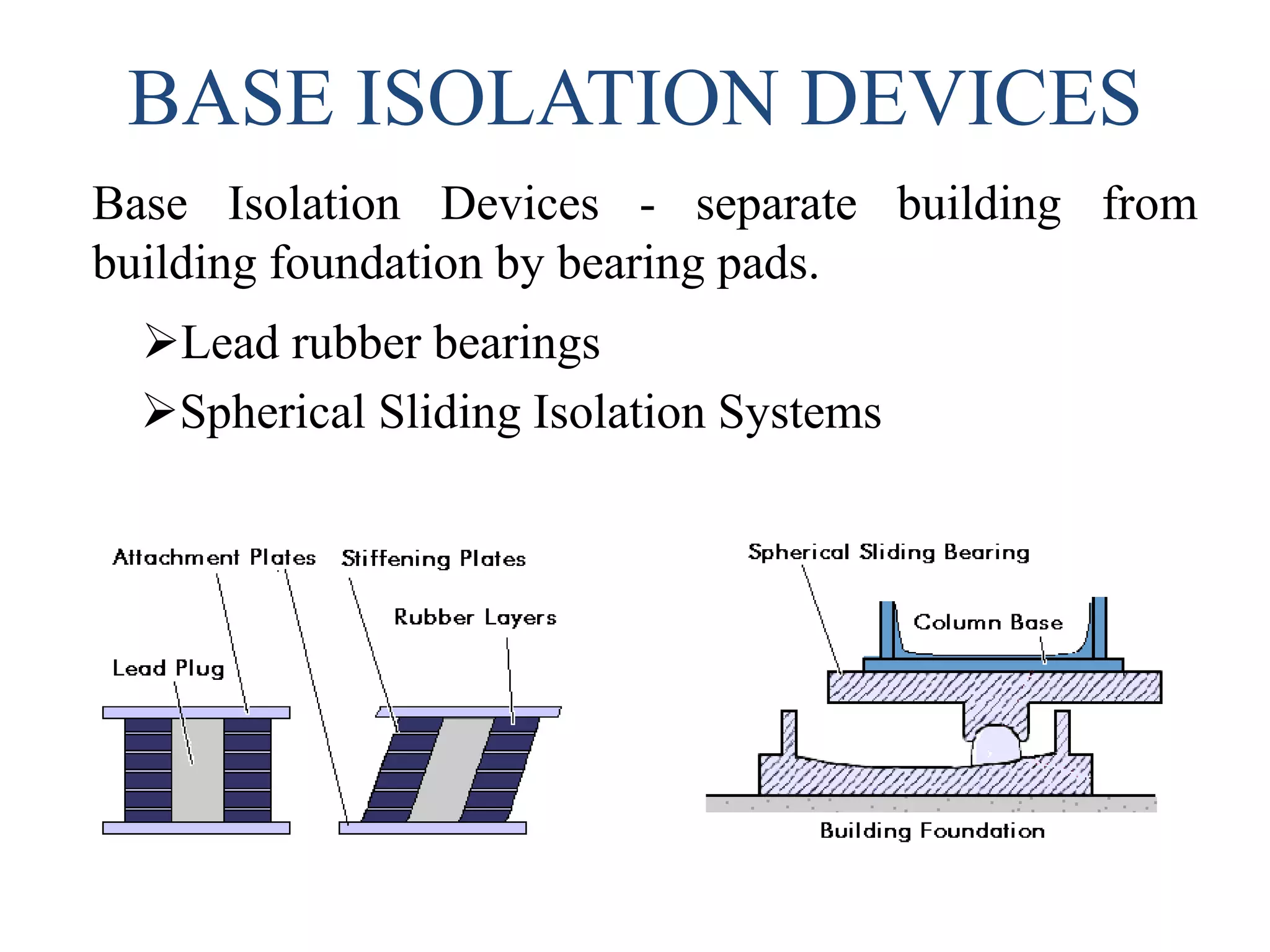
Spherical Sliding Isolation Systems
Lead rubber bearings
Base Isolation Devices - separate building from
building foundation by bearing pads.
BASE ISOLATION DEVICES
Supported by a series of bearing pads which are placed
between the building and the building's foundation.
In case of an earthquake:
Fixed base building deform
and are damaged.
Base isolated building rocks
back and forth like a boat.
Shaking is reduced
by
as much as 5 times
ENERGY DISSIPATION DEVICES/
SEISMIC DAMPERS
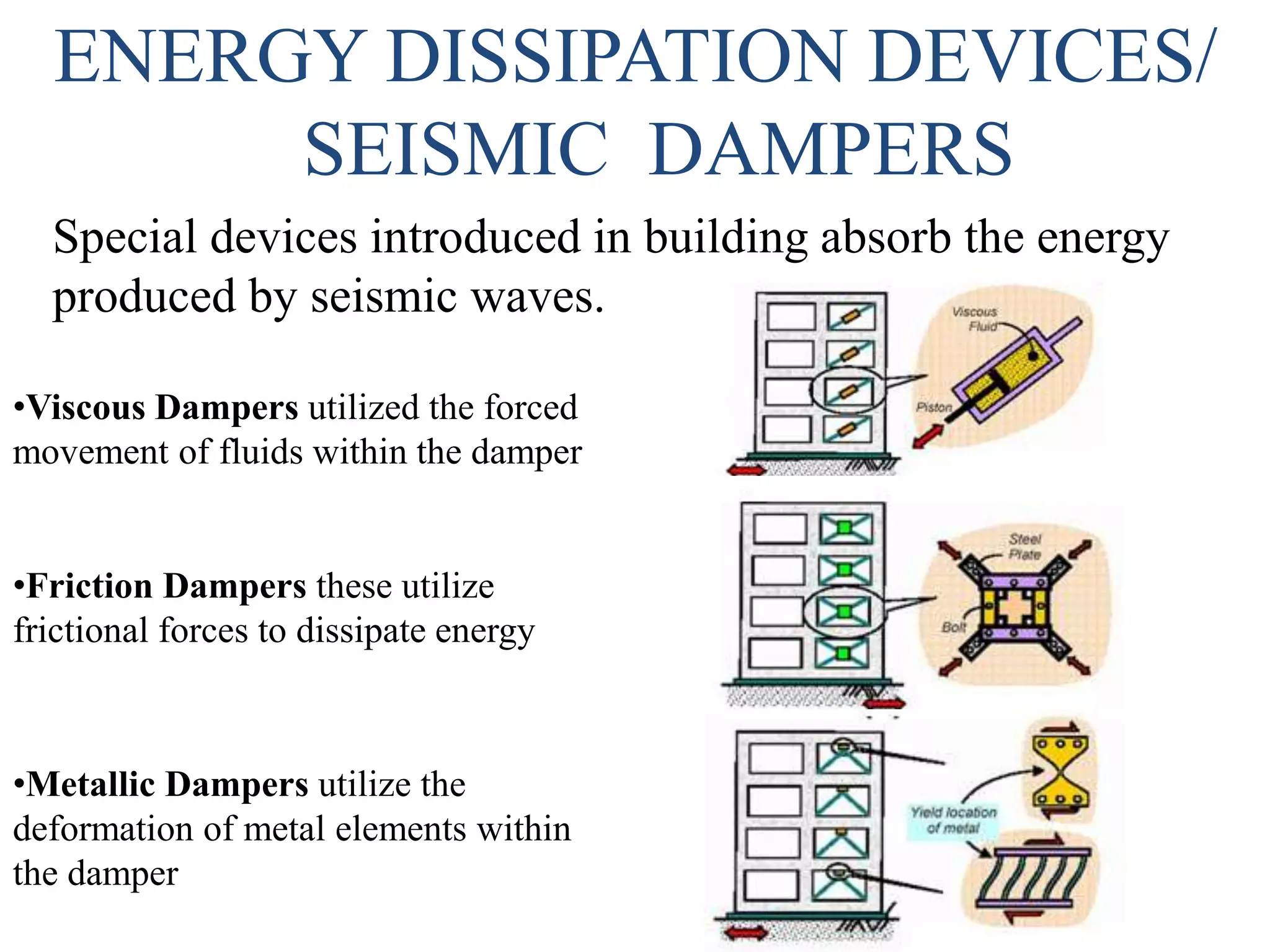
•Viscous Dampers utilized the forced
movement of fluids within the damper
Special devices introduced in building absorb the energy
produced by seismic waves.
•Friction Dampers these utilize
frictional forces to dissipate energy
•Metallic Dampers utilize the
deformation of metal elements within
the damper
CASE STUDIES -Torre Mayor
Intrinsic Bracing System
Large Viscous Dampers
252 Reinforced concrete piles on the
foundation.
46,916 m3 of concrete.
21,200 tons. of structural and
reinforcement steel.
98 fluid viscous seismic dampers.
Calculated to exceed the seismic
requirements of the Mexico city and
California Construction Regulations,
which are the strictest in the world.
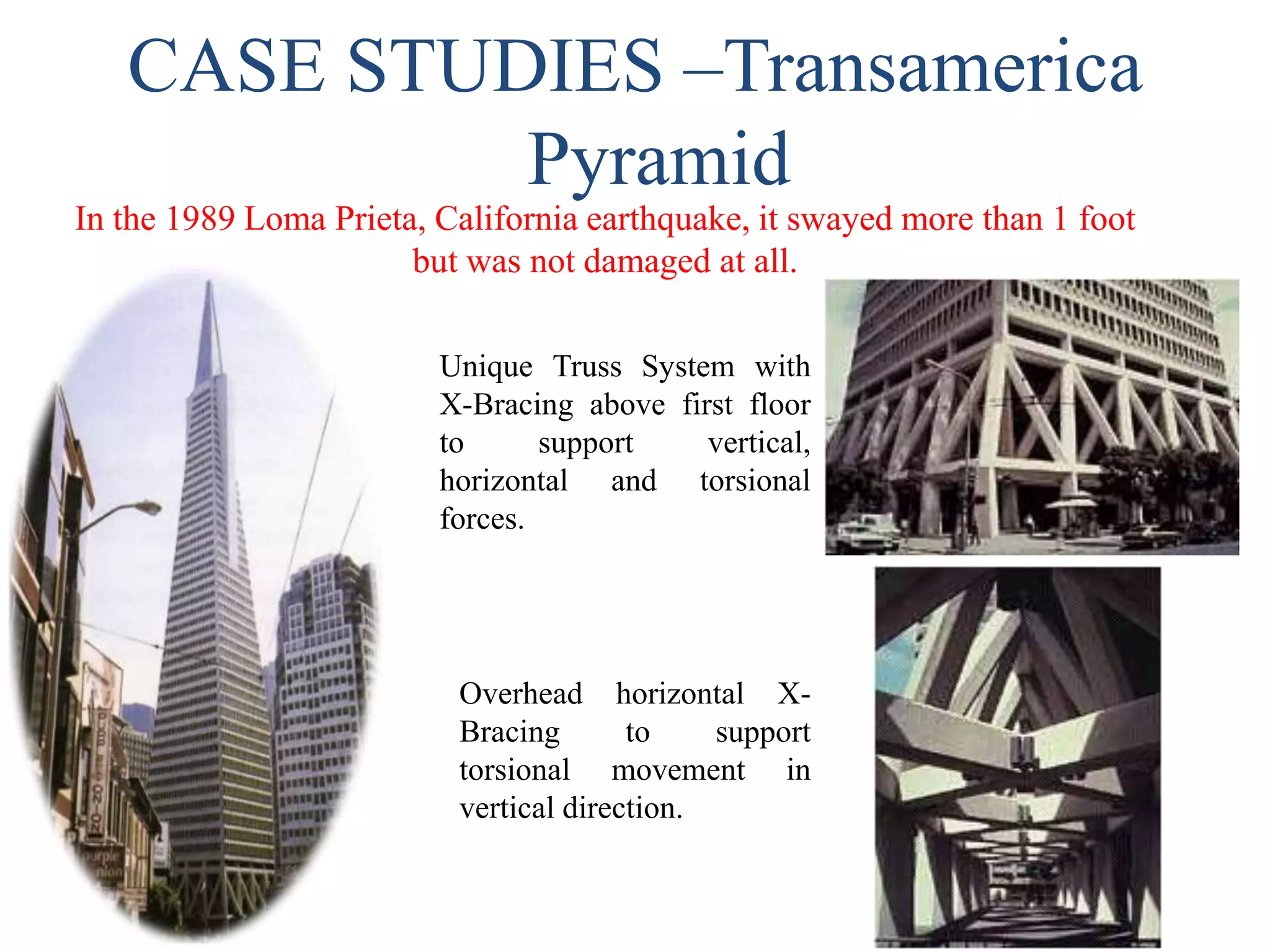
CASE STUDIES –Transamerica
Pyramid
Unique Truss System with
X-Bracing above first floor
to support vertical,
horizontal and torsional
forces.
Overhead horizontal X-
Bracing to support
torsional movement in
vertical direction.
In the 1989 Loma Prieta, California earthquake, it swayed more than 1 foot
but was not damaged at all.
CASE STUDIES –Taipei 101
It uses a tuned mass damper, also known
as a harmonic absorber
Steel sphere 18 feet across and weighing
728 ton
Suspended from the 92nd to the 87th floor
Device consists of:
1. Massive steel ball that sways to
counteract the building’s movement
2. Eight steel cables form a sling to
support the ball
3. Eight viscous dampers act like shock
absorbers when the sphere shifts
4. Two additional tuned mass dampers for
additional protection
The ball can move 5 ft. in any direction and
reduce sways by 40 percent
TECHNIQUES UNDER RESEARCH
SHAPE MEMORY ALLOYS
Bounce back after experiencing large loads.
Used in bearings, columns and beams and connecting
elements.
Most common alloys used are copper-zinc-aluminum-
nickel, copper-aluminum-nickel or nickel-titanium.
TECHNIQUES UNDER RESEARCH
MUSSEL FIBERS
 Elastomeric fibers combine stiffness and flexibility which helps
mussel to attach to hard surfaces.
 Construction materials made of a similar blend of firm and
flexible parts could help buildings withstand high-stress forces
during an earthquake.
Ratio of stiff-to-flexible
fibers = 80:20.
TECHNIQUES UNDER RESEARCH
VISCO-ELASTIC DAMPERS CST30
Two layer of high damping rubber sandwiched between
steel plates.
Absorb energy produce from vibrations.
TECHNIQUES UNDER RESEARCH
VISCO-ELASTIC DAMPERS CST30
 Advantages over traditional damping system.
 Effective utilization of interior space.
 Improvement in the degree of freedom of design.
 Accepts different vibration types.
 High performance and high quality.
 Environmental friendliness.
 Maintenance free.
TECHNIQUES UNDER RESEARCH
RUBBER CLOAKING DEVICE
Rubber 'cloaking device' could make buildings immune to
earthquakes.
 Waves can be made to bend their path by various techniques.
 Seismic waves can also be redirected. This is called ‘cloaking’.
TECHNIQUES UNDER RESEARCH
RUBBER CLOAKING DEVICE
• INSTALLATION: Concrete-and-plastic plate of concentric rings encircles
the foundation.
• DETOUR: During earthquake, bending force deflects waves from their
path toward a stiffer ring away from the building.
• EXIT: About halfway around plate, bending force weakens; waves' forward
momentum propels them on their original path.
WORK ON EARTHQUAKE RESISTANCE
IN INDIA
 In India, base isolation technique was first
demonstrated after 1993 Killari earthquake. Two
single storey building were built with rubber base
isolators resting on hard ground.
 The four storey bhuj hospital building was built with
base isolation technique after 2001 bhuj earthquake.
IS CODES FOR EARTHQUAKE RESISTANT
DESIGN
IS 1893 (Part 1), 2002, Indian Standard Criteria For Earthquake
Resistant Design of Structures (5th revision).
IS 4326, 1993, Indian Standard Code of Practice for Earthquake
Resistant Design and Construction of Buildings (2nd revision).
IS 13827, 1993, Indian Standard Guidelines for Improving
Earthquake Resistant of Earthen Buildings.
IS 13828, 1993, Indian Standard Guidelines for Improving
Earthquake Resistant of Low Strength Masonry Buildings.
IS 13920, 1993, Indian Standard Code of Practice for Ductile
Detailing of Reinforced Concrete Structures Subjected to
Seismic Forces.
SEISMIC ZONES IN INDIA
REFERENCES
[1]. Morris, Neil; Earthquakes; Crabtree Publishing Company; 1998.
[2]. Mazza and Vulcano; Base-isolation techniques for the seismic protection of RC
framed structures subjected to near-fault ground motions; Paper No. 2935; 13th
World Conference on Earthquake Engineering at Vancouver, B.C., Canada; August
1-6, 2004.
[3]. Kelly, Skinner and Heine; Mechanisms of energy absorption in special devices for
use in earthquake resistant structures; Bulletin of N.Z. Society for Earthquake
Engineering, Vol. 5 No. 3, September 1997.
[4]. Seismic Protection with Fluid Viscous Dampers for the Torre Mayor, a 57-Story
Office Tower in Mexico City, Mexico; Publisher: Taylor Devices, Inc.;Date: 2011-
02-18.
[5]. Kourakis, Ioannis; Structural systems and tuned mass dampers of super-tall
buildings: case study of Taipei 101; Publisher: Massachusetts Institute of
Technology; 2007.
[6]. Farhat, Guenneau and Enoch, Flexural waves on a thin elastic plate are smoothly
bent around an obstacle ("E") surrounded by a metamaterial cloak, Volume 103,
Issue 2, DOI 10 July 2009.
Earthquake resistant techniques

Earthquake resistant techniques

  • 1.
    BY- Shreya Thusoo 10403EN006 IDD PARTIV SUPERVISED BY- Prof. RAJESH KUMAR Dept. of Civil Engineering IIT(BHU), Varanasi SEMINAR ON EARTHQUAKE RESISTANT TECHNIQUES
  • 2.
    INTRODUCTION Some centuries back,landmark structures used to have:  heavy masonry cladding  wall curtains  strong bracings As need for taller buildings grew, advanced innovative devices were introduced in structures. The Todaiji Temple in Japan has log house construction that has resisted earthquakes thousands of years (most number any structure has survived).
  • 3.
    EARTHQUAKE  They arenatural disasters of a generally unpredictable nature.  It is the shaking of the earth due to the movement of earth’s crust. Terms: Fault plane Hypocenter Epicentre
  • 4.
    IRANIAN CITY, BAM MAGNITUDE : 6.6RICHTER SCALE KILLED : 40,000 LOMA PRIETA MAGNITUDE : 7.1 RICHTER SCALE KILLED : 62
  • 5.
    CONVENTIONAL METHODS The conceptis to strengthen the building. Have stiffness and inelastic deformation capacity.
  • 6.
    CONVENTIONAL METHODS Some ofthe general design concepts: Follow current earthquake standards and codes. Provide strong foundation. Use best quality materials. Avoid irregular shaped structures and framing system. Maintain integrity by providing seismic bands: At the plinth level of the building. At the levels of lintels of doors and windows. Vertical reinforcing bars at all wall junctions. Introduce shear walls to transfer seismic loads down to the bottom of foundation.
  • 7.
    CONVENTIONAL METHODS Remedial measuredfor soft storey buildings. (a) bracings in columns of open ground storey, (b) Providing R.C. shear wall and (c) Providing brick infills between columns. (a) (b) (c)
  • 8.
    ADVANCED METHODS Basic approachis to reduce the earthquake generated forces acting upon the building; rather than strengthening it. Two main techniques: Base isolation Energy dissipation devices
  • 9.
    BASE ISOLATION DEVICES SphericalSliding Isolation Systems Lead rubber bearings Base Isolation Devices - separate building from building foundation by bearing pads.
  • 10.
    BASE ISOLATION DEVICES Supportedby a series of bearing pads which are placed between the building and the building's foundation. In case of an earthquake: Fixed base building deform and are damaged. Base isolated building rocks back and forth like a boat. Shaking is reduced by as much as 5 times
  • 11.
    ENERGY DISSIPATION DEVICES/ SEISMICDAMPERS •Viscous Dampers utilized the forced movement of fluids within the damper Special devices introduced in building absorb the energy produced by seismic waves. •Friction Dampers these utilize frictional forces to dissipate energy •Metallic Dampers utilize the deformation of metal elements within the damper
  • 12.
    CASE STUDIES -TorreMayor Intrinsic Bracing System Large Viscous Dampers 252 Reinforced concrete piles on the foundation. 46,916 m3 of concrete. 21,200 tons. of structural and reinforcement steel. 98 fluid viscous seismic dampers. Calculated to exceed the seismic requirements of the Mexico city and California Construction Regulations, which are the strictest in the world.
  • 13.
    CASE STUDIES –Transamerica Pyramid UniqueTruss System with X-Bracing above first floor to support vertical, horizontal and torsional forces. Overhead horizontal X- Bracing to support torsional movement in vertical direction. In the 1989 Loma Prieta, California earthquake, it swayed more than 1 foot but was not damaged at all.
  • 14.
  • 15.
    CASE STUDIES –Taipei101 It uses a tuned mass damper, also known as a harmonic absorber Steel sphere 18 feet across and weighing 728 ton Suspended from the 92nd to the 87th floor Device consists of: 1. Massive steel ball that sways to counteract the building’s movement 2. Eight steel cables form a sling to support the ball 3. Eight viscous dampers act like shock absorbers when the sphere shifts 4. Two additional tuned mass dampers for additional protection The ball can move 5 ft. in any direction and reduce sways by 40 percent
  • 16.
    TECHNIQUES UNDER RESEARCH SHAPEMEMORY ALLOYS Bounce back after experiencing large loads. Used in bearings, columns and beams and connecting elements. Most common alloys used are copper-zinc-aluminum- nickel, copper-aluminum-nickel or nickel-titanium.
  • 17.
    TECHNIQUES UNDER RESEARCH MUSSELFIBERS  Elastomeric fibers combine stiffness and flexibility which helps mussel to attach to hard surfaces.  Construction materials made of a similar blend of firm and flexible parts could help buildings withstand high-stress forces during an earthquake. Ratio of stiff-to-flexible fibers = 80:20.
  • 18.
    TECHNIQUES UNDER RESEARCH VISCO-ELASTICDAMPERS CST30 Two layer of high damping rubber sandwiched between steel plates. Absorb energy produce from vibrations.
  • 19.
    TECHNIQUES UNDER RESEARCH VISCO-ELASTICDAMPERS CST30  Advantages over traditional damping system.  Effective utilization of interior space.  Improvement in the degree of freedom of design.  Accepts different vibration types.  High performance and high quality.  Environmental friendliness.  Maintenance free.
  • 20.
    TECHNIQUES UNDER RESEARCH RUBBERCLOAKING DEVICE Rubber 'cloaking device' could make buildings immune to earthquakes.  Waves can be made to bend their path by various techniques.  Seismic waves can also be redirected. This is called ‘cloaking’.
  • 21.
    TECHNIQUES UNDER RESEARCH RUBBERCLOAKING DEVICE • INSTALLATION: Concrete-and-plastic plate of concentric rings encircles the foundation. • DETOUR: During earthquake, bending force deflects waves from their path toward a stiffer ring away from the building. • EXIT: About halfway around plate, bending force weakens; waves' forward momentum propels them on their original path.
  • 22.
    WORK ON EARTHQUAKERESISTANCE IN INDIA  In India, base isolation technique was first demonstrated after 1993 Killari earthquake. Two single storey building were built with rubber base isolators resting on hard ground.  The four storey bhuj hospital building was built with base isolation technique after 2001 bhuj earthquake.
  • 23.
    IS CODES FOREARTHQUAKE RESISTANT DESIGN IS 1893 (Part 1), 2002, Indian Standard Criteria For Earthquake Resistant Design of Structures (5th revision). IS 4326, 1993, Indian Standard Code of Practice for Earthquake Resistant Design and Construction of Buildings (2nd revision). IS 13827, 1993, Indian Standard Guidelines for Improving Earthquake Resistant of Earthen Buildings. IS 13828, 1993, Indian Standard Guidelines for Improving Earthquake Resistant of Low Strength Masonry Buildings. IS 13920, 1993, Indian Standard Code of Practice for Ductile Detailing of Reinforced Concrete Structures Subjected to Seismic Forces.
  • 24.
  • 25.
    REFERENCES [1]. Morris, Neil;Earthquakes; Crabtree Publishing Company; 1998. [2]. Mazza and Vulcano; Base-isolation techniques for the seismic protection of RC framed structures subjected to near-fault ground motions; Paper No. 2935; 13th World Conference on Earthquake Engineering at Vancouver, B.C., Canada; August 1-6, 2004. [3]. Kelly, Skinner and Heine; Mechanisms of energy absorption in special devices for use in earthquake resistant structures; Bulletin of N.Z. Society for Earthquake Engineering, Vol. 5 No. 3, September 1997. [4]. Seismic Protection with Fluid Viscous Dampers for the Torre Mayor, a 57-Story Office Tower in Mexico City, Mexico; Publisher: Taylor Devices, Inc.;Date: 2011- 02-18. [5]. Kourakis, Ioannis; Structural systems and tuned mass dampers of super-tall buildings: case study of Taipei 101; Publisher: Massachusetts Institute of Technology; 2007. [6]. Farhat, Guenneau and Enoch, Flexural waves on a thin elastic plate are smoothly bent around an obstacle ("E") surrounded by a metamaterial cloak, Volume 103, Issue 2, DOI 10 July 2009.