INDIAN INSTITUTE OF TECHNOLOGY GUWAHATI
MODULAR CONSTRUCTION
PRESENTED BY-
SANDEEP KUMAR
ROLL NO. 204104307
CONTENTS
 What is modular construction
 Application of modular construction
 Types of modular construction
 Why modular construction
 Planning traffic route
 Modular construction process
 Comparison between modular and conventional construction
 Advantages
 limitations of modular construction
 Conclusion
 Case study
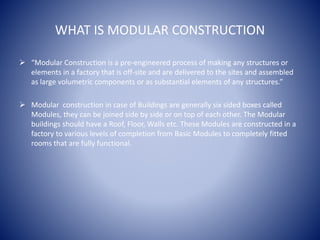
WHAT IS MODULAR CONSTRUCTION
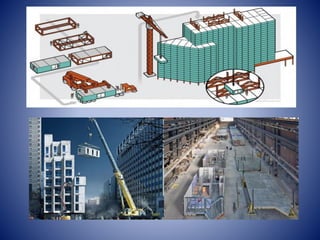
 “Modular Construction is a pre-engineered process of making any structures or
elements in a factory that is off-site and are delivered to the sites and assembled
as large volumetric components or as substantial elements of any structures.”
 Modular construction in case of Buildings are generally six sided boxes called
Modules, they can be joined side by side or on top of each other. The Modular
buildings should have a Roof, Floor, Walls etc. These Modules are constructed in a
factory to various levels of completion from Basic Modules to completely fitted
rooms that are fully functional.
APPLICATION OF MODULAR CONSTRUCTION
 Private housing
 Social housing
 Apartments
 Education sector and student residences
 Health sector buildings
 Hotels
TYPES OF MODULAR CONSTRUCTION
 Permanent Modular Construction (PMC)
 Re-locatable Buildings
WHY MODULAR CONSTRUCTION
 One of the major reason to adopt modular construction is that not only can one
save up to 35% on the initial construction costs like labour and materials, but there
are other benefits as well.
 Another major reason is about the quality as one can attain a suitable quality in
the elements of any structures that are to be pre-fabricated or pre-cast in the
construction factory.
 Modular construction takes most of the construction phase away from the
building site. Quicker and efficient factory processes are replacing the slow, less
productive site activities.
 Sustainability in modular construction can be achieved through the factory
production of the modular units .
 For a modular construction project to complete with a good result, proper
planning, coordination and communication must exist between various relevant
parties involved from the early stage of the project.
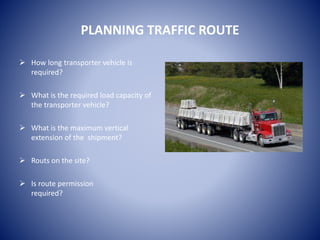
PLANNING TRAFFIC ROUTE
 How long transporter vehicle is
required?
 What is the required load capacity of
the transporter vehicle?
 What is the maximum vertical
extension of the shipment?
 Routs on the site?
 Is route permission
required?
MODULAR CONSTRUCTION PROCESS
Process in modular construction :
1. Designing the structure
2. Engineering review
3. Permit and approvals
4. Site development
5. Plant fabrication
6. Transportation
7. Installation
COMPARISON
SITE-CAST
 No transportation.
 The size limitation is depending on
the elevation capacity only.
 Lower quality because directly
affected by weather.
 Proper, large free space required.
PRECAST AT PLANT
 Transportation and elevation capacity
limits the size.
 Higher, industrialized quality less
affected by weather.
 No space requirement on the site for
fabrication.
 Unlimited opportunities of
architectural appearance.
 Option of standardized components.
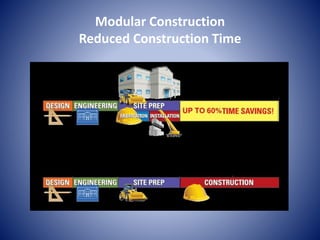
Modular Construction
Reduced Construction Time
BENEFITS OF MODULAR CONSTRUCTION
 Greater Flexibility and Reuse
 Less Material Waste
 Improved Air Quality
 Reduced Construction Schedule
 Elimination of Weather Delays
 Built to Code with Quality Materials
 Safer Construction
 Faster Construction
 Quality Construction
 Eco-Friendly
DRAWBACKS OF MODULAR CONSTRUCTIONS
 Handling and transportation may cause breakages of members during the transit
and extra provision is to be made.
 Difficulty in connecting precast units so as to produce same effect as monolithic.
This leads to non-monolithic construction.
 They are to be exactly placed in position, otherwise the loads coming on them are
likely to get changed and the member may be affected.
 High transport cost.
 Need of erection equipment.
 Skilled labour and supervision is required.
CONCLUSION
 The use of precast concrete construction can significantly reduce the amount of
construction waste generated on construction sites.
 Reduce adverse environmental impact on sites.
 Enhance quality control of concreting work.
 Reduce the amount of site labour.
 Increase worker safety .
Case study
Domain Apartments San Jose, California
DISCRIPTION
 Main Category: Modular Building Design
 Company: Guerdon, LLC
 Affiliate: Guerdon Modular Buildings
 Location: San Jose, California
 Building Use: Apartments
 Gross Size of Project: 481569 Square Feet
 Days to complete: 609
Thank you

modular construction

  • 1.
    INDIAN INSTITUTE OFTECHNOLOGY GUWAHATI MODULAR CONSTRUCTION PRESENTED BY- SANDEEP KUMAR ROLL NO. 204104307
  • 2.
    CONTENTS  What ismodular construction  Application of modular construction  Types of modular construction  Why modular construction  Planning traffic route  Modular construction process  Comparison between modular and conventional construction  Advantages  limitations of modular construction  Conclusion  Case study
  • 3.
    WHAT IS MODULARCONSTRUCTION  “Modular Construction is a pre-engineered process of making any structures or elements in a factory that is off-site and are delivered to the sites and assembled as large volumetric components or as substantial elements of any structures.”  Modular construction in case of Buildings are generally six sided boxes called Modules, they can be joined side by side or on top of each other. The Modular buildings should have a Roof, Floor, Walls etc. These Modules are constructed in a factory to various levels of completion from Basic Modules to completely fitted rooms that are fully functional.
  • 5.
    APPLICATION OF MODULARCONSTRUCTION  Private housing  Social housing  Apartments  Education sector and student residences  Health sector buildings  Hotels
  • 6.
    TYPES OF MODULARCONSTRUCTION  Permanent Modular Construction (PMC)  Re-locatable Buildings
  • 7.
    WHY MODULAR CONSTRUCTION One of the major reason to adopt modular construction is that not only can one save up to 35% on the initial construction costs like labour and materials, but there are other benefits as well.  Another major reason is about the quality as one can attain a suitable quality in the elements of any structures that are to be pre-fabricated or pre-cast in the construction factory.  Modular construction takes most of the construction phase away from the building site. Quicker and efficient factory processes are replacing the slow, less productive site activities.  Sustainability in modular construction can be achieved through the factory production of the modular units .  For a modular construction project to complete with a good result, proper planning, coordination and communication must exist between various relevant parties involved from the early stage of the project.
  • 8.
    PLANNING TRAFFIC ROUTE How long transporter vehicle is required?  What is the required load capacity of the transporter vehicle?  What is the maximum vertical extension of the shipment?  Routs on the site?  Is route permission required?
  • 9.
    MODULAR CONSTRUCTION PROCESS Processin modular construction : 1. Designing the structure 2. Engineering review 3. Permit and approvals 4. Site development 5. Plant fabrication 6. Transportation 7. Installation
  • 10.
    COMPARISON SITE-CAST  No transportation. The size limitation is depending on the elevation capacity only.  Lower quality because directly affected by weather.  Proper, large free space required. PRECAST AT PLANT  Transportation and elevation capacity limits the size.  Higher, industrialized quality less affected by weather.  No space requirement on the site for fabrication.  Unlimited opportunities of architectural appearance.  Option of standardized components.
  • 11.
  • 12.
    BENEFITS OF MODULARCONSTRUCTION  Greater Flexibility and Reuse  Less Material Waste  Improved Air Quality  Reduced Construction Schedule  Elimination of Weather Delays  Built to Code with Quality Materials  Safer Construction  Faster Construction  Quality Construction  Eco-Friendly
  • 13.
    DRAWBACKS OF MODULARCONSTRUCTIONS  Handling and transportation may cause breakages of members during the transit and extra provision is to be made.  Difficulty in connecting precast units so as to produce same effect as monolithic. This leads to non-monolithic construction.  They are to be exactly placed in position, otherwise the loads coming on them are likely to get changed and the member may be affected.  High transport cost.  Need of erection equipment.  Skilled labour and supervision is required.
  • 14.
    CONCLUSION  The useof precast concrete construction can significantly reduce the amount of construction waste generated on construction sites.  Reduce adverse environmental impact on sites.  Enhance quality control of concreting work.  Reduce the amount of site labour.  Increase worker safety .
  • 15.
    Case study Domain ApartmentsSan Jose, California
  • 16.
    DISCRIPTION  Main Category:Modular Building Design  Company: Guerdon, LLC  Affiliate: Guerdon Modular Buildings  Location: San Jose, California  Building Use: Apartments  Gross Size of Project: 481569 Square Feet  Days to complete: 609
  • 17.