




Presented by:
Vikrant Sabat
Karan Shirsat

K.J.Somaiya Polytechnic , Vidyavihar
Mumbai-77
s
 What is Earthquake?


Types of Earthquake



How Earthquake Occurs?



Causes and Effects of Earthquake



Seismic Waves



Seismic Performance and Design



Improving Earthquake Resistant Of The Minor Building



Shear Walls

 Advantages of Shear Walls


Earthquake Resisting Structure Techniques
 Base Isolation Method
 Energy Dissipation Device ( Seismic Dampers)
 Keeping Building Up thrust



Conclusion
 They are natural disasters of a generally
unpredictable nature
 It is the shaking of earth due to the
movement of earth’s crust
 A sudden, rapid shaking of the earth
caused by the breaking and shifting of
rocks beneath the earth surface.
There are two types of earthquake:
 Inter plate earthquake


Intra-plate earthquake

In both types of earthquake, during
earthquake at fault strike slip(horizontal
movement) & dip slip (vertical movement)
 Because of Earth's rotation and other
energy factors different shells or the rock
layers constantly move or slid past each
other.
 Different continental mass fragments of
lesser densities float and move overriding
the denser rock layers.
This causes earthquake.
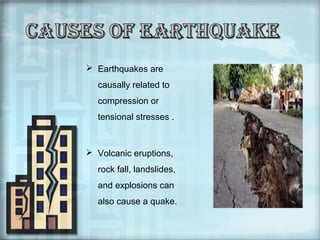
 Earthquakes are
causally related to
compression or
tensional stresses .

 Volcanic eruptions,
rock fall, landslides,
and explosions can
also cause a quake.
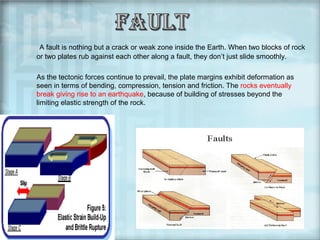
A fault is nothing but a crack or weak zone inside the Earth. When two blocks of rock
or two plates rub against each other along a fault, they don’t just slide smoothly.
As the tectonic forces continue to prevail, the plate margins exhibit deformation as
seen in terms of bending, compression, tension and friction. The rocks eventually
break giving rise to an earthquake, because of building of stresses beyond the
limiting elastic strength of the rock.
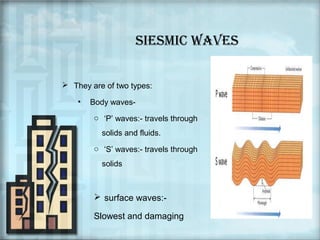
SIESMIC WAVES
 They are of two types:
•

Body waveso ‘P’ waves:- travels through
solids and fluids.
o ‘S’ waves:- travels through
solids

 surface waves:Slowest and damaging
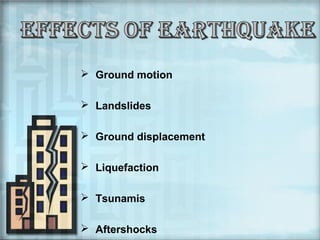
 Ground motion
 Landslides
 Ground displacement
 Liquefaction
 Tsunamis
 Aftershocks
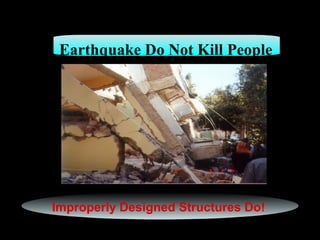
Earthquake Do Not Kill People

Improperly Designed Structures Do!
SEISMIC PERFORMANCE
 Ability of structure to sustain its function
viz. safety and serviceability at earthquake.

SEISMIC dESIgN
 It is Authorized engineering : Procedure
 Principles
 Criteria

To design structures subject to earthquake
exposure
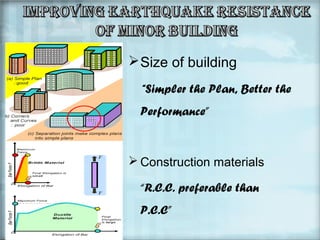
 Size of building
“Simpler the Plan, Better the
Performance”

 Construction materials
“R.C.C. preferable than
P.C.C”
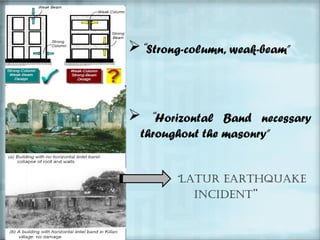
“Strong-column, weak-beam”

 “Horizontal

Band necessary
throughout the masonry”

“latur earthquake
incident”
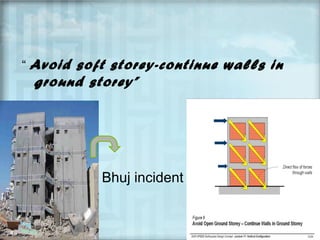
“ Avoid soft storey-continue walls in

ground storey”

Bhuj incident
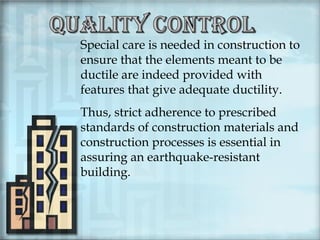
Special care is needed in construction to
ensure that the elements meant to be
ductile are indeed provided with
features that give adequate ductility.
Thus, strict adherence to prescribed
standards of construction materials and
construction processes is essential in
assuring an earthquake-resistant
building.
1.Regular testing of construction
materials
at
qualified
laboratories (at site or away)
2. Periodic training of workmen
at professional training houses,
and
3. On-site evaluation of the
technical work
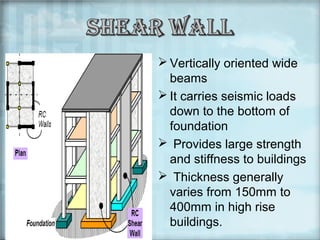
 Vertically oriented wide
beams
 It carries seismic loads
down to the bottom of
foundation
 Provides large strength
and stiffness to buildings
 Thickness generally
varies from 150mm to
400mm in high rise
buildings.
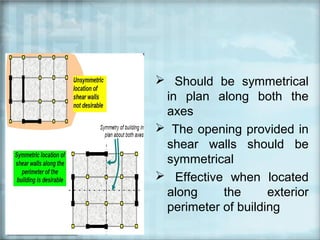
 Should be symmetrical
in plan along both the
axes
 The opening provided in
shear walls should be
symmetrical
 Effective when located
along
the
exterior
perimeter of building
 Efficient in terms of: Cost
 Effectiveness
 Construction



Helps in minimizing the effect on nonstructural elements. E.g. Glass, Windows

 It is said that:“We cannot afford to build concrete
buildings meant to resist severe earthquakes
without SHEAR WALL”
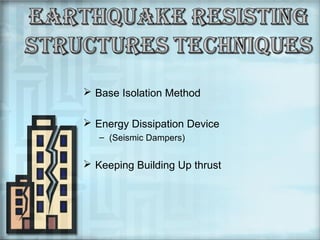
 Base Isolation Method
 Energy Dissipation Device
– (Seismic Dampers)

 Keeping Building Up thrust
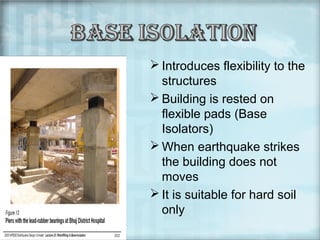
 Introduces flexibility to the
structures
 Building is rested on
flexible pads (Base
Isolators)
 When earthquake strikes
the building does not
moves
 It is suitable for hard soil
only
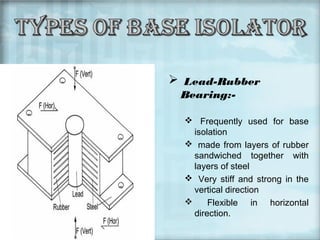
 Lead-Rubber
Bearing: Frequently used for base
isolation
 made from layers of rubber
sandwiched together with
layers of steel
 Very stiff and strong in the
vertical direction

Flexible in horizontal
direction.


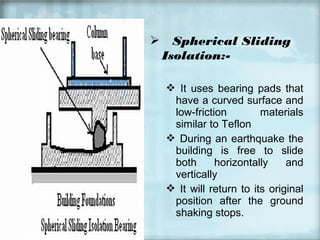
Spherical Sliding
Isolation: It uses bearing pads that
have a curved surface and
low-friction
materials
similar to Teflon
 During an earthquake the
building is free to slide
both
horizontally
and
vertically
 It will return to its original
position after the ground
shaking stops.
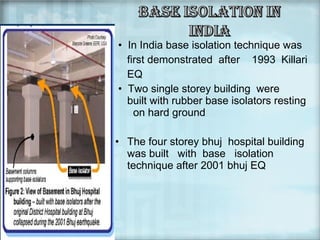
• In India base isolation technique was
first demonstrated after 1993 Killari
EQ
• Two single storey building were
built with rubber base isolators resting
on hard ground
• The four storey bhuj hospital building
was built with base isolation
technique after 2001 bhuj EQ
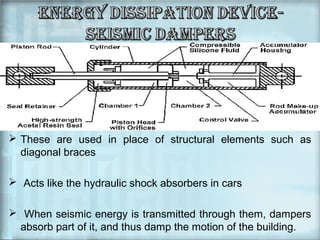
 These are used in place of structural elements such as
diagonal braces
 Acts like the hydraulic shock absorbers in cars
 When seismic energy is transmitted through them, dampers
absorb part of it, and thus damp the motion of the building.
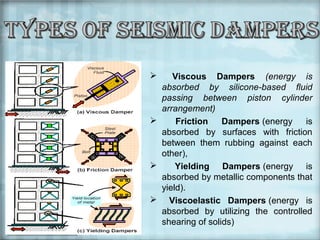
Viscous Dampers (energy is
absorbed by silicone-based fluid
passing between piston cylinder
arrangement)

Friction
Dampers (energy
is
absorbed by surfaces with friction
between them rubbing against each
other),

Yielding Dampers (energy is
absorbed by metallic components that
yield).
 Viscoelastic Dampers (energy is
absorbed by utilizing the controlled
shearing of solids)

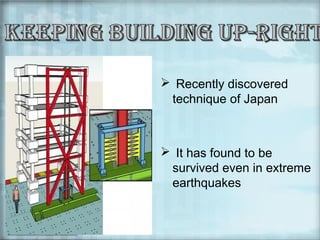
 Recently discovered
technique of Japan

 It has found to be
survived even in extreme
earthquakes
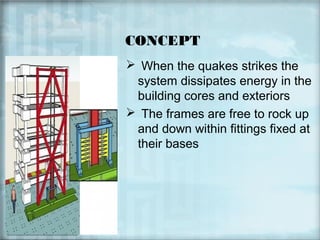
CONCEPT
 When the quakes strikes the
system dissipates energy in the
building cores and exteriors
 The frames are free to rock up
and down within fittings fixed at
their bases
IS 1893 (Part I), 2002, Indian Standard Criteria for Earthquake
Resistant Design of Structures (5th Revision)
IS 4326, 1993, Indian Standard Code of Practice for Earthquake
Resistant Design and Construction of Buildings (2nd Revision)
IS 13827, 1993, Indian Standard Guidelines for Improving
Earthquake Resistance of Earthen Buildings
IS 13828, 1993, Indian Standard Guidelines for Improving
Earthquake Resistance of Low Strength Masonry Buildings
IS 13920, 1993, Indian Standard Code of Practice for Ductile
Detailing of Reinforced Concrete Structures Subjected to Seismic
Forces
While Earthquake Are Inevitable, Each earthquake Need Not
Convert
Into A Disaster… As What Comes In Between Is
The Culture of Safety And Prevention
Let us Work Together to Build a Culture of Prevention !
Earthquake resistant structure

Earthquake resistant structure

  • 1.
    Presented by: Vikrant Sabat KaranShirsat K.J.Somaiya Polytechnic , Vidyavihar Mumbai-77 s
  • 2.
     What isEarthquake?  Types of Earthquake  How Earthquake Occurs?  Causes and Effects of Earthquake  Seismic Waves  Seismic Performance and Design  Improving Earthquake Resistant Of The Minor Building  Shear Walls  Advantages of Shear Walls  Earthquake Resisting Structure Techniques  Base Isolation Method  Energy Dissipation Device ( Seismic Dampers)  Keeping Building Up thrust  Conclusion
  • 3.
     They arenatural disasters of a generally unpredictable nature  It is the shaking of earth due to the movement of earth’s crust  A sudden, rapid shaking of the earth caused by the breaking and shifting of rocks beneath the earth surface.
  • 4.
    There are twotypes of earthquake:  Inter plate earthquake  Intra-plate earthquake In both types of earthquake, during earthquake at fault strike slip(horizontal movement) & dip slip (vertical movement)
  • 5.
     Because ofEarth's rotation and other energy factors different shells or the rock layers constantly move or slid past each other.  Different continental mass fragments of lesser densities float and move overriding the denser rock layers. This causes earthquake.
  • 6.
     Earthquakes are causallyrelated to compression or tensional stresses .  Volcanic eruptions, rock fall, landslides, and explosions can also cause a quake.
  • 7.
    A fault isnothing but a crack or weak zone inside the Earth. When two blocks of rock or two plates rub against each other along a fault, they don’t just slide smoothly. As the tectonic forces continue to prevail, the plate margins exhibit deformation as seen in terms of bending, compression, tension and friction. The rocks eventually break giving rise to an earthquake, because of building of stresses beyond the limiting elastic strength of the rock.
  • 8.
    SIESMIC WAVES  Theyare of two types: • Body waveso ‘P’ waves:- travels through solids and fluids. o ‘S’ waves:- travels through solids  surface waves:Slowest and damaging
  • 9.
     Ground motion Landslides  Ground displacement  Liquefaction  Tsunamis  Aftershocks
  • 10.
    Earthquake Do NotKill People Improperly Designed Structures Do!
  • 11.
    SEISMIC PERFORMANCE  Abilityof structure to sustain its function viz. safety and serviceability at earthquake. SEISMIC dESIgN  It is Authorized engineering : Procedure  Principles  Criteria To design structures subject to earthquake exposure
  • 12.
     Size ofbuilding “Simpler the Plan, Better the Performance”  Construction materials “R.C.C. preferable than P.C.C”
  • 13.
    “Strong-column, weak-beam”  “Horizontal Bandnecessary throughout the masonry” “latur earthquake incident”
  • 14.
    “ Avoid softstorey-continue walls in ground storey” Bhuj incident
  • 16.
    Special care isneeded in construction to ensure that the elements meant to be ductile are indeed provided with features that give adequate ductility. Thus, strict adherence to prescribed standards of construction materials and construction processes is essential in assuring an earthquake-resistant building.
  • 17.
    1.Regular testing ofconstruction materials at qualified laboratories (at site or away) 2. Periodic training of workmen at professional training houses, and 3. On-site evaluation of the technical work
  • 18.
     Vertically orientedwide beams  It carries seismic loads down to the bottom of foundation  Provides large strength and stiffness to buildings  Thickness generally varies from 150mm to 400mm in high rise buildings.
  • 19.
     Should besymmetrical in plan along both the axes  The opening provided in shear walls should be symmetrical  Effective when located along the exterior perimeter of building
  • 20.
     Efficient interms of: Cost  Effectiveness  Construction  Helps in minimizing the effect on nonstructural elements. E.g. Glass, Windows  It is said that:“We cannot afford to build concrete buildings meant to resist severe earthquakes without SHEAR WALL”
  • 21.
     Base IsolationMethod  Energy Dissipation Device – (Seismic Dampers)  Keeping Building Up thrust
  • 22.
     Introduces flexibilityto the structures  Building is rested on flexible pads (Base Isolators)  When earthquake strikes the building does not moves  It is suitable for hard soil only
  • 23.
     Lead-Rubber Bearing: Frequentlyused for base isolation  made from layers of rubber sandwiched together with layers of steel  Very stiff and strong in the vertical direction  Flexible in horizontal direction.
  • 24.
     Spherical Sliding Isolation: Ituses bearing pads that have a curved surface and low-friction materials similar to Teflon  During an earthquake the building is free to slide both horizontally and vertically  It will return to its original position after the ground shaking stops.
  • 25.
    • In Indiabase isolation technique was first demonstrated after 1993 Killari EQ • Two single storey building were built with rubber base isolators resting on hard ground • The four storey bhuj hospital building was built with base isolation technique after 2001 bhuj EQ
  • 26.
     These areused in place of structural elements such as diagonal braces  Acts like the hydraulic shock absorbers in cars  When seismic energy is transmitted through them, dampers absorb part of it, and thus damp the motion of the building.
  • 27.
    Viscous Dampers (energyis absorbed by silicone-based fluid passing between piston cylinder arrangement)  Friction Dampers (energy is absorbed by surfaces with friction between them rubbing against each other),  Yielding Dampers (energy is absorbed by metallic components that yield).  Viscoelastic Dampers (energy is absorbed by utilizing the controlled shearing of solids) 
  • 28.
     Recently discovered techniqueof Japan  It has found to be survived even in extreme earthquakes
  • 29.
    CONCEPT  When thequakes strikes the system dissipates energy in the building cores and exteriors  The frames are free to rock up and down within fittings fixed at their bases
  • 30.
    IS 1893 (PartI), 2002, Indian Standard Criteria for Earthquake Resistant Design of Structures (5th Revision) IS 4326, 1993, Indian Standard Code of Practice for Earthquake Resistant Design and Construction of Buildings (2nd Revision) IS 13827, 1993, Indian Standard Guidelines for Improving Earthquake Resistance of Earthen Buildings IS 13828, 1993, Indian Standard Guidelines for Improving Earthquake Resistance of Low Strength Masonry Buildings IS 13920, 1993, Indian Standard Code of Practice for Ductile Detailing of Reinforced Concrete Structures Subjected to Seismic Forces
  • 31.
    While Earthquake AreInevitable, Each earthquake Need Not Convert Into A Disaster… As What Comes In Between Is The Culture of Safety And Prevention Let us Work Together to Build a Culture of Prevention !

Editor's Notes

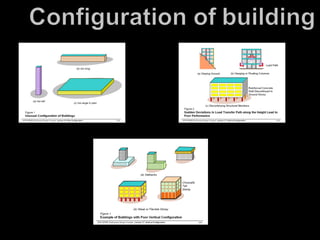
  • #16 Buildings with one of their overall sizes much larger or much smaller than the other two, or very large buildings, do not perform well during earthquakes.