EARHTQUAKE RESISTING
ELEMENTS AND TECHNIQUES IN
HIGH RISE BUILDINGS
PRECENTED BY
YAHIYA.K
2201012432
ABSTRACT
• A part of the techniques which are well documented in the codes of practice
there are some other earthquake resistant techniques which have been
proved to be more effective to resisting earthquake loading and are also cost
effective with easy constructability.An earthquake resisting elements are the
components that are introduces in a structure to improved its seismic
resistance and method of application of these elements are said as
techniques. Tough structures are designed and detailed as per code provision
there remains some possibility of damage or failure is strong earthquake.
CONTENTS
• Introduction.
• What is earthquake?.
• Importance of earthquake.
• Type of earthquake.
• Performance of ground during earthquake.
• Seismic zone.
• Seismic zone India.
• How small and large building are affected by earthquake?.
• Earthquake resistant building.
• Purpose of shear wall.
• Forces acting on shear wall.
• Classification of shear wall.
• Advantages of shear wall.
• Design consideration.
• How to reduce earthquake effects on building.
• Resisting building
• Planning.
• Design load.
• Conclusion
• Modern technology earthquake resistant buildings
• Thank you.
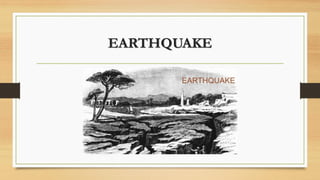
EARTHQUAKE
INTRODUCTION
• Earthquake is the several threat to high raised building.
• They gets easily collapse with in fraction of seconds if an earthquake arises
in area.
• The concept of earthquake resistant design is that the building should be
designed to resist the seismic forces which arises due to earthquake.
• Key consideration include base isolation, shear wall, moment resisting frames
and innovative techniques.
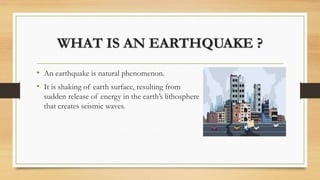
WHAT IS AN EARTHQUAKE ?
• An earthquake is natural phenomenon.
• It is shaking of earth surface, resulting from
sudden release of energy in the earth’s lithosphere
that creates seismic waves.
IMPORTANCE OF EARTHQUAKE
• Earthquake have the potential to cause catastrophic damage, leading to loss of life,
injury and widespread destruction.
• Earthquake resistant design and construction techniques are essential for safe
guarding the structural integrity of buildings and protecting the safety of occupants
during seismic events.
• By implementing earthquake resistant element such as base isolation damping
systems reinforced concrete and steel frames, shear walls, bracing systems and
moment resisting frames the risk of collapse and damage can be significantly
reduced.
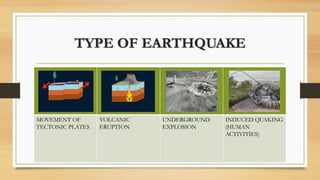
TYPE OF EARTHQUAKE
MOVEMENT OF
TECTONIC PLATES
VOLCANIC
ERUPTION
UNDERGROUND
EXPLOSION
INDUCED QUAKING
(HUMAN
ACTIVITIES)
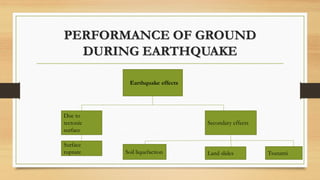
PERFORMANCE OF GROUND
DURING EARTHQUAKE
Earthquake effects
Due to
tectonic
surface
Surface
rupture
Secondary effects
Soil liquefaction Land slides Tsunami
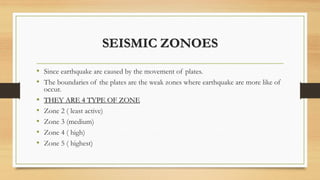
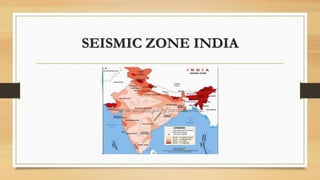
SEISMIC ZONOES
• Since earthquake are caused by the movement of plates.
• The boundaries of the plates are the weak zones where earthquake are more like of
occur.
• THEY ARE 4 TYPE OF ZONE
• Zone 2 ( least active)
• Zone 3 (medium)
• Zone 4 ( high)
• Zone 5 ( highest)
SEISMIC ZONE INDIA
How small and large building are
affected by earthquake ?
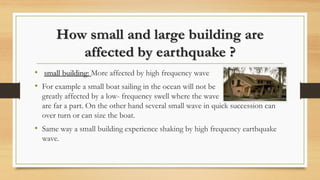
• small building: More affected by high frequency wave
• For example a small boat sailing in the ocean will not be
greatly affected by a low- frequency swell where the wave
are far a part. On the other hand several small wave in quick succession can
over turn or can size the boat.
• Same way a small building experience shaking by high frequency earthquake
wave.
How small and large building are affected
by earthquake ?
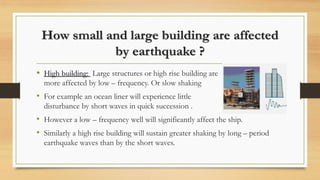
• High building: Large structures or high rise building are
more affected by low – frequency. Or slow shaking
• For example an ocean liner will experience little
disturbance by short waves in quick succession .
• However a low – frequency well will significantly affect the ship.
• Similarly a high rise building will sustain greater shaking by long – period
earthquake waves than by the short waves.
EARTHQUAKE RESISTANT BUILDING
• Cross – bracing.
• Shear wall.
• Shock absorbers ( base isolators).
• Carbon fiber.
• Seismic dampers.
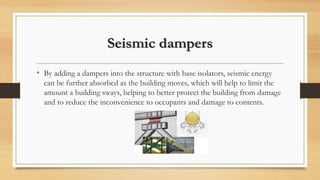
Seismic dampers
• By adding a dampers into the structure with base isolators, seismic energy
can be further absorbed as the building moves, which will help to limit the
amount a building sways, helping to better protect the building from damage
and to reduce the inconvenience to occupants and damage to contents.
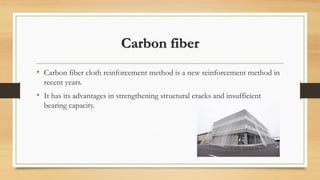
Carbon fiber
• Carbon fiber cloth reinforcement method is a new reinforcement method in
recent years.
• It has its advantages in strengthening structural cracks and insufficient
bearing capacity.
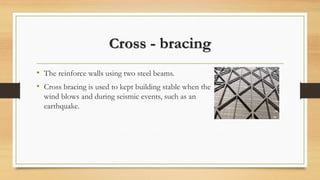
Cross - bracing
• The reinforce walls using two steel beams.
• Cross bracing is used to kept building stable when the
wind blows and during seismic events, such as an
earthquake.
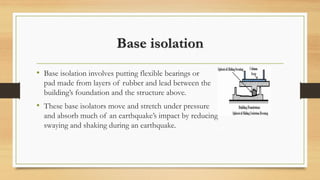
Base isolation
• Base isolation involves putting flexible bearings or
pad made from layers of rubber and lead between the
building’s foundation and the structure above.
• These base isolators move and stretch under pressure
and absorb much of an earthquake’s impact by reducing
swaying and shaking during an earthquake.
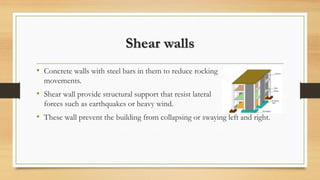
Shear walls
• Concrete walls with steel bars in them to reduce rocking
movements.
• Shear wall provide structural support that resist lateral
forces such as earthquakes or heavy wind.
• These wall prevent the building from collapsing or swaying left and right.
PURPOSE OF SHEAR WALL
• Resists the lateral loads of wind and earthquake.
• Resists gravity or vertical loads of self weight.
• Resists other living/moving loads.
• Resists shear.
• Enhances strength and stability of a building structure.
FORCES ACTING ON SHEAR WALL
• They are two type forces:
• Shear force: Produced due to ground movement and lateral force such as
waves, winds.
• Uplift force: Produced due to forces acting horizontally on the top of the
wall.
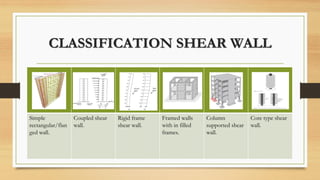
CLASSIFICATION SHEAR WALL
Simple
rectangular/flan
ged wall.
Coupled shear
wall.
Rigid frame
shear wall.
Framed walls
with in filled
frames.
Column
supported shear
wall.
Core type shear
wall.
ADVANTAGES OF SHEAR WALL
• Reduces lateral sway of the building.
• Provides strength, stability and stiffness of the building structure.
• Construction and implementations are easy at the site.
• Walls being thinner are thus are thus light – weight.
• Helps minimize the damage to structural and non – structural elements due
to earthquakes and other forces.
• Lesser cost, faster construction, time saving, long lasting.
DESIGN CONSIDERATIONS
• General design concepts:
• One must follow current earthquake standards and codes.
• Provide strong foundation.
• Use of good quality of materials.
• Avoid irregular shape structures and framing system.
HOW TO REDUCE EARTHQUAKE
EFFECTS ON BUILDING
• Tow basic technologies are used to protect building from damaging earthquake
effects.
• * The base isolation devices.
• * Seismic dampers.
• The idea behind base isolation is to detach ( isolate) the building from the ground in
such a way that earthquake motion are not transmitted up through the building , or
at least greatly reduced .
• Seismic dampers are special devices introduced in the building to absorb the energy
provided by the ground motion to the building.
RESISTING ELEMENT
• Shear wall must be evenly through out the building in both direction side to
side as well as top to bottom.
• Such as well and the roof should be tied together so as act an integrated unit
during earthquake shaking, transferring forces across connection and
preventing separation.
PLANNING
• Planning and layout of the building involving consideration of the location
room and walls opening such as and windows the number of story etc…. .
• At this stage site and foundation aspects should also be considered.
• Layout and general design of the structural framing system with special
attention to furnishing lateral resistance.
• Consideration of highly loaded and critical sections with provision of
reinforcement as required.
DESIGN LOAD
• Generally design loads are obtained from Indian standard codes , they are provided:
• IS 875 ( part 1): 1987 – Dead load ( unit weight of building materials and stored materials ).
• IS 875 ( part 2 ): 1987 – Impact loads.
• IS 875 ( part 3 ): 1987 – Wind loads.
• IS 875 ( part 4 ): 1987 – Special loads and load combinations.
• IS 1898 ( part 5): 2002 – Seismic loads.
• IS 64 ( SUT ) : 2001 – Explanatory handbook on Indian stand code of practice for design
loads ( other than earthquake ) for building and structures.
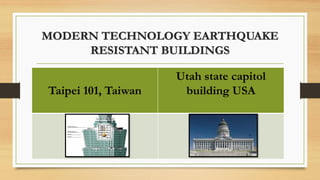
MODERN TECHNOLOGY EARTHQUAKE
RESISTANT BUILDINGS
Taipei 101, Taiwan
Utah state capitol
building USA
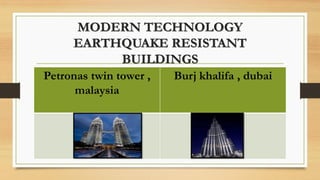
MODERN TECHNOLOGY
EARTHQUAKE RESISTANT
BUILDINGS
Petronas twin tower ,
malaysia
Burj khalifa , dubai
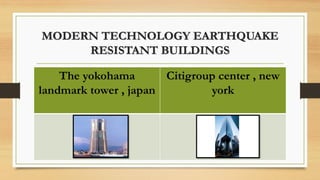
MODERN TECHNOLOGY EARTHQUAKE
RESISTANT BUILDINGS
The yokohama
landmark tower , japan
Citigroup center , new
york
MODERN TECHNOLOGY EARTHQUAKE
RESISTANT BUILDINGS
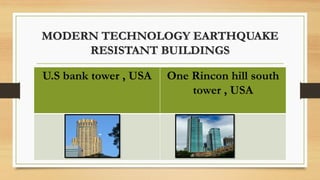
U.S bank tower , USA One Rincon hill south
tower , USA
MODERN TECHNOLOGY EARTHQUAKE
RESISTANT BUILDINGS
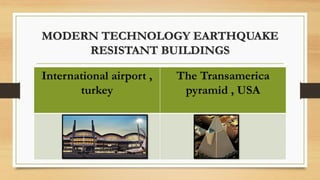
International airport ,
turkey
The Transamerica
pyramid , USA
conclusion
• Earthquake are not now to the world
• It is a very common thing an many parts of the earth.
• We discuss how to prevent earthquake
• Planning, design load.
• We are discuss shear wall and purpose etc…
• And type of earthquake, how reduce earthquake etc…
REFERENCES
• International journal of trends in scientific research and development
(IJTSRD) Volume-4 Issue-4, June 2020 ISSN: 2456 – 6470.
• International journal of technology and exploring engineering ( IJITEE)
Volume-9 Issue-3 January 2020 ISSN: 2278 – 3075.
• Global scientific journal (GSL): Volume-8 Issue-6 June 2020 ISSN:2320 –
9186 .
THANK YOU

EARHTQUAKE RESISTING ELEMENTS AND TECHNIQUES IN HIGH RISE FINAL WORK 2201012432.pdf

  • 1.
    EARHTQUAKE RESISTING ELEMENTS ANDTECHNIQUES IN HIGH RISE BUILDINGS PRECENTED BY YAHIYA.K 2201012432
  • 2.
    ABSTRACT • A partof the techniques which are well documented in the codes of practice there are some other earthquake resistant techniques which have been proved to be more effective to resisting earthquake loading and are also cost effective with easy constructability.An earthquake resisting elements are the components that are introduces in a structure to improved its seismic resistance and method of application of these elements are said as techniques. Tough structures are designed and detailed as per code provision there remains some possibility of damage or failure is strong earthquake.
  • 3.
    CONTENTS • Introduction. • Whatis earthquake?. • Importance of earthquake. • Type of earthquake. • Performance of ground during earthquake. • Seismic zone. • Seismic zone India. • How small and large building are affected by earthquake?. • Earthquake resistant building. • Purpose of shear wall. • Forces acting on shear wall. • Classification of shear wall. • Advantages of shear wall. • Design consideration. • How to reduce earthquake effects on building. • Resisting building • Planning. • Design load. • Conclusion • Modern technology earthquake resistant buildings • Thank you.
  • 4.
  • 5.
    INTRODUCTION • Earthquake isthe several threat to high raised building. • They gets easily collapse with in fraction of seconds if an earthquake arises in area. • The concept of earthquake resistant design is that the building should be designed to resist the seismic forces which arises due to earthquake. • Key consideration include base isolation, shear wall, moment resisting frames and innovative techniques.
  • 6.
    WHAT IS ANEARTHQUAKE ? • An earthquake is natural phenomenon. • It is shaking of earth surface, resulting from sudden release of energy in the earth’s lithosphere that creates seismic waves.
  • 7.
    IMPORTANCE OF EARTHQUAKE •Earthquake have the potential to cause catastrophic damage, leading to loss of life, injury and widespread destruction. • Earthquake resistant design and construction techniques are essential for safe guarding the structural integrity of buildings and protecting the safety of occupants during seismic events. • By implementing earthquake resistant element such as base isolation damping systems reinforced concrete and steel frames, shear walls, bracing systems and moment resisting frames the risk of collapse and damage can be significantly reduced.
  • 8.
    TYPE OF EARTHQUAKE MOVEMENTOF TECTONIC PLATES VOLCANIC ERUPTION UNDERGROUND EXPLOSION INDUCED QUAKING (HUMAN ACTIVITIES)
  • 9.
    PERFORMANCE OF GROUND DURINGEARTHQUAKE Earthquake effects Due to tectonic surface Surface rupture Secondary effects Soil liquefaction Land slides Tsunami
  • 10.
    SEISMIC ZONOES • Sinceearthquake are caused by the movement of plates. • The boundaries of the plates are the weak zones where earthquake are more like of occur. • THEY ARE 4 TYPE OF ZONE • Zone 2 ( least active) • Zone 3 (medium) • Zone 4 ( high) • Zone 5 ( highest)
  • 11.
  • 12.
    How small andlarge building are affected by earthquake ? • small building: More affected by high frequency wave • For example a small boat sailing in the ocean will not be greatly affected by a low- frequency swell where the wave are far a part. On the other hand several small wave in quick succession can over turn or can size the boat. • Same way a small building experience shaking by high frequency earthquake wave.
  • 13.
    How small andlarge building are affected by earthquake ? • High building: Large structures or high rise building are more affected by low – frequency. Or slow shaking • For example an ocean liner will experience little disturbance by short waves in quick succession . • However a low – frequency well will significantly affect the ship. • Similarly a high rise building will sustain greater shaking by long – period earthquake waves than by the short waves.
  • 14.
    EARTHQUAKE RESISTANT BUILDING •Cross – bracing. • Shear wall. • Shock absorbers ( base isolators). • Carbon fiber. • Seismic dampers.
  • 15.
    Seismic dampers • Byadding a dampers into the structure with base isolators, seismic energy can be further absorbed as the building moves, which will help to limit the amount a building sways, helping to better protect the building from damage and to reduce the inconvenience to occupants and damage to contents.
  • 16.
    Carbon fiber • Carbonfiber cloth reinforcement method is a new reinforcement method in recent years. • It has its advantages in strengthening structural cracks and insufficient bearing capacity.
  • 17.
    Cross - bracing •The reinforce walls using two steel beams. • Cross bracing is used to kept building stable when the wind blows and during seismic events, such as an earthquake.
  • 18.
    Base isolation • Baseisolation involves putting flexible bearings or pad made from layers of rubber and lead between the building’s foundation and the structure above. • These base isolators move and stretch under pressure and absorb much of an earthquake’s impact by reducing swaying and shaking during an earthquake.
  • 19.
    Shear walls • Concretewalls with steel bars in them to reduce rocking movements. • Shear wall provide structural support that resist lateral forces such as earthquakes or heavy wind. • These wall prevent the building from collapsing or swaying left and right.
  • 20.
    PURPOSE OF SHEARWALL • Resists the lateral loads of wind and earthquake. • Resists gravity or vertical loads of self weight. • Resists other living/moving loads. • Resists shear. • Enhances strength and stability of a building structure.
  • 21.
    FORCES ACTING ONSHEAR WALL • They are two type forces: • Shear force: Produced due to ground movement and lateral force such as waves, winds. • Uplift force: Produced due to forces acting horizontally on the top of the wall.
  • 22.
    CLASSIFICATION SHEAR WALL Simple rectangular/flan gedwall. Coupled shear wall. Rigid frame shear wall. Framed walls with in filled frames. Column supported shear wall. Core type shear wall.
  • 23.
    ADVANTAGES OF SHEARWALL • Reduces lateral sway of the building. • Provides strength, stability and stiffness of the building structure. • Construction and implementations are easy at the site. • Walls being thinner are thus are thus light – weight. • Helps minimize the damage to structural and non – structural elements due to earthquakes and other forces. • Lesser cost, faster construction, time saving, long lasting.

  • 24.
    DESIGN CONSIDERATIONS • Generaldesign concepts: • One must follow current earthquake standards and codes. • Provide strong foundation. • Use of good quality of materials. • Avoid irregular shape structures and framing system.
  • 25.
    HOW TO REDUCEEARTHQUAKE EFFECTS ON BUILDING • Tow basic technologies are used to protect building from damaging earthquake effects. • * The base isolation devices. • * Seismic dampers. • The idea behind base isolation is to detach ( isolate) the building from the ground in such a way that earthquake motion are not transmitted up through the building , or at least greatly reduced . • Seismic dampers are special devices introduced in the building to absorb the energy provided by the ground motion to the building.
  • 26.
    RESISTING ELEMENT • Shearwall must be evenly through out the building in both direction side to side as well as top to bottom. • Such as well and the roof should be tied together so as act an integrated unit during earthquake shaking, transferring forces across connection and preventing separation.
  • 27.
    PLANNING • Planning andlayout of the building involving consideration of the location room and walls opening such as and windows the number of story etc…. . • At this stage site and foundation aspects should also be considered. • Layout and general design of the structural framing system with special attention to furnishing lateral resistance. • Consideration of highly loaded and critical sections with provision of reinforcement as required.
  • 28.
    DESIGN LOAD • Generallydesign loads are obtained from Indian standard codes , they are provided: • IS 875 ( part 1): 1987 – Dead load ( unit weight of building materials and stored materials ). • IS 875 ( part 2 ): 1987 – Impact loads. • IS 875 ( part 3 ): 1987 – Wind loads. • IS 875 ( part 4 ): 1987 – Special loads and load combinations. • IS 1898 ( part 5): 2002 – Seismic loads. • IS 64 ( SUT ) : 2001 – Explanatory handbook on Indian stand code of practice for design loads ( other than earthquake ) for building and structures.
  • 29.
    MODERN TECHNOLOGY EARTHQUAKE RESISTANTBUILDINGS Taipei 101, Taiwan Utah state capitol building USA
  • 30.
    MODERN TECHNOLOGY EARTHQUAKE RESISTANT BUILDINGS Petronastwin tower , malaysia Burj khalifa , dubai
  • 31.
    MODERN TECHNOLOGY EARTHQUAKE RESISTANTBUILDINGS The yokohama landmark tower , japan Citigroup center , new york
  • 32.
    MODERN TECHNOLOGY EARTHQUAKE RESISTANTBUILDINGS U.S bank tower , USA One Rincon hill south tower , USA
  • 33.
    MODERN TECHNOLOGY EARTHQUAKE RESISTANTBUILDINGS International airport , turkey The Transamerica pyramid , USA
  • 34.
    conclusion • Earthquake arenot now to the world • It is a very common thing an many parts of the earth. • We discuss how to prevent earthquake • Planning, design load. • We are discuss shear wall and purpose etc… • And type of earthquake, how reduce earthquake etc…
  • 35.
    REFERENCES • International journalof trends in scientific research and development (IJTSRD) Volume-4 Issue-4, June 2020 ISSN: 2456 – 6470. • International journal of technology and exploring engineering ( IJITEE) Volume-9 Issue-3 January 2020 ISSN: 2278 – 3075. • Global scientific journal (GSL): Volume-8 Issue-6 June 2020 ISSN:2320 – 9186 .
  • 36.