1
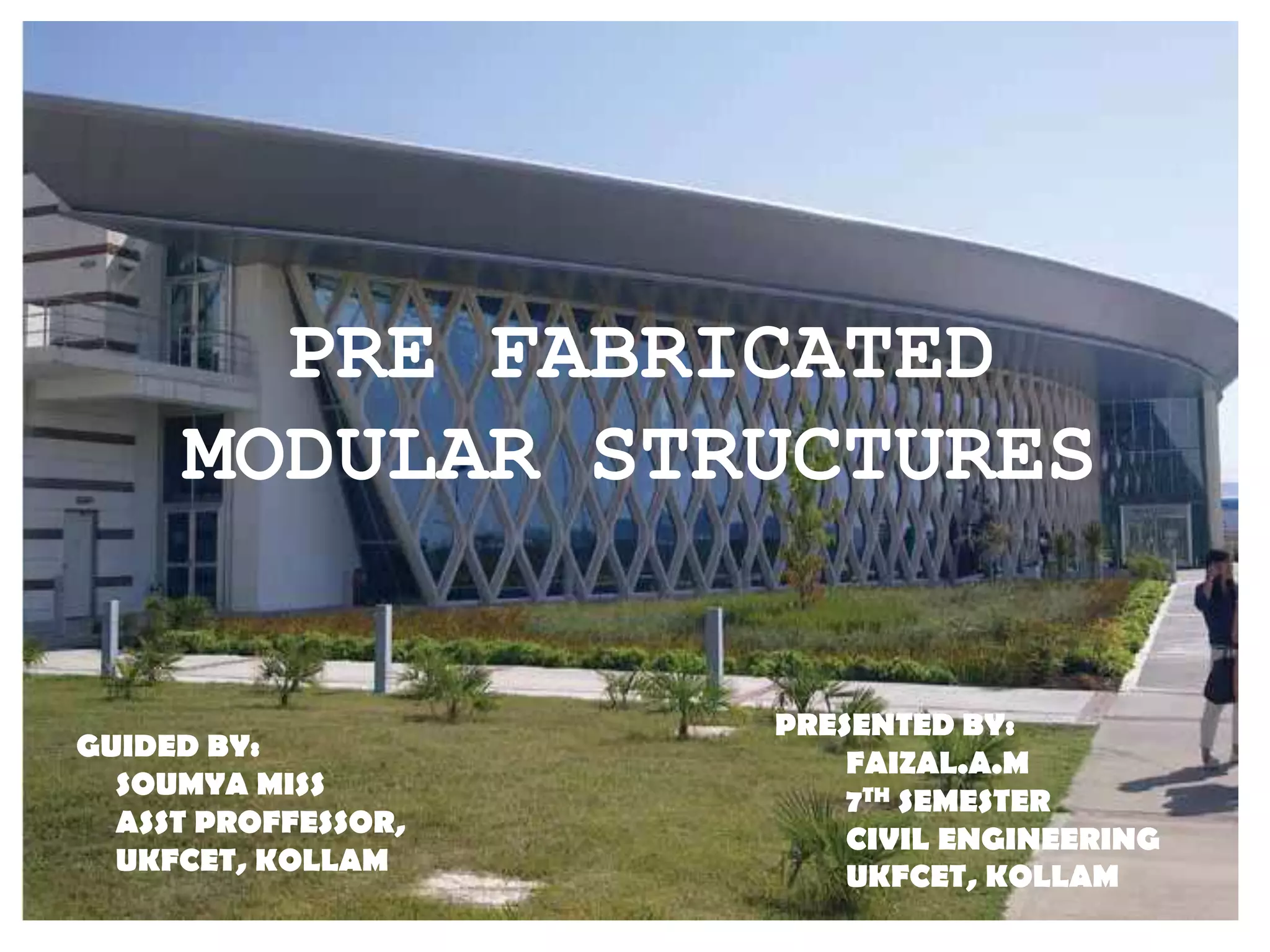
PRE FABRICATED
MODULAR STRUCTURES
GUIDED BY:
SOUMYA MISS
ASST PROFFESSOR,
UKFCET, KOLLAM
PRESENTED BY:
FAIZAL.A.M
7TH SEMESTER
CIVIL ENGINEERING
UKFCET, KOLLAM
Contents
 Introduction
 Features
 Comparison
 Design concept
 Components
 Types of precast
system
 Design
consideration
 Equipments
 Assembling
 scheduling
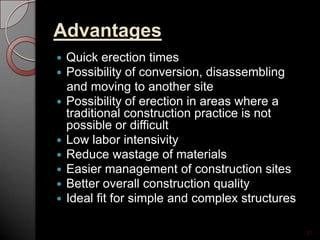
 Advantages
 Limitations
 Conclusion
 references
2
Introduction
 The concept of precast structures also known
as prefabricated/ modular structures.
 The structural components are standardized
and produced in plants in a location away
from the building site.
 Then transported to the site for assembly.
 The components are manufactured by
industrial methods based on mass production
in order to build a large number of buildings
in a short time at low cost.
3
Features
 The division and specialization of the human
workforce.
 The use of tools, machinery, and other
equipment, usually automated, in the
production of standard, interchangeable parts
and products.
 Compared to site-cast concrete, precast
concrete erection is faster and less affected by
adverse weather conditions.
 Plant casting allows increased efficiency, high
quality control and greater control on finishes.
4
Comparison
Site-cast
 no transportation
 the size limitation is
depending on the
elevation capacity only
 lower quality because
directly affected by
weather
 proper, large free space
required
Precast at plant
 transportation and
elevation capacity limits
the size-
 higher, industrialized
quality – less affected by
weather
 no space requirement on
the site for fabrication
 unlimited opportunities of
architectural appearance
 option of standardized
components
5
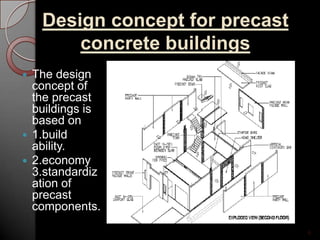
Design concept for precast
concrete buildings
 The design
concept of
the precast
buildings is
based on
 1.build
ability.
 2.economy
3.standardiz
ation of
precast
components.
6
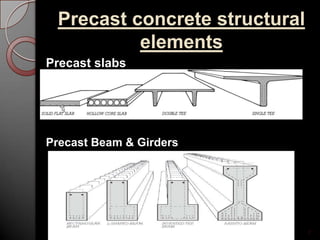
Precast concrete structural
elements
7
Precast slabs
Precast Beam & Girders
8
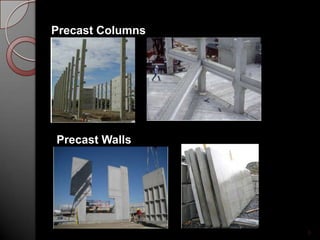
Precast Columns
Precast Walls
9
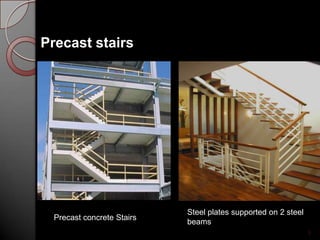
Precast stairs
Precast concrete Stairs
Steel plates supported on 2 steel
beams
Design considerations
 final position and loads
 transportation requirements – self load and
position during transportation
 storing requirements – self load and position
during storing – (avoid or store in the same
position as it transported / built in)
 lifting loads – distribution of lifting points –
optimal way of lifting (selection of lifting and
rigging tools)
 vulnerable points (e.g. edges) – reduction of
risk (e.g. rounded edges)
10
Types of pre cast system
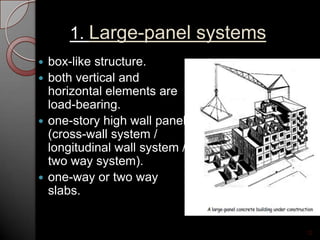
1. Large-panel systems
2. Frame systems
3. Slab-column systems with walls
4. Mixed systems
11
 box-like structure.
 both vertical and
horizontal elements are
load-bearing.
 one-story high wall panels
(cross-wall system /
longitudinal wall system /
two way system).
 one-way or two way
slabs.
12
1. Large-panel systems
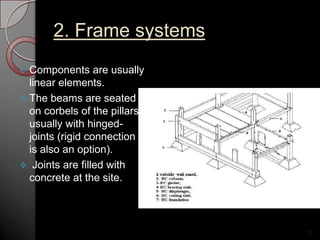
2. Frame systems
 Components are usually
linear elements.
 The beams are seated
on corbels of the pillars
usually with hinged-
joints (rigid connection
is also an option).
 Joints are filled with
concrete at the site.
13
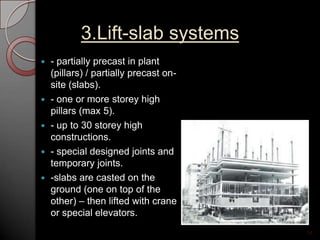
3.Lift-slab systems
 - partially precast in plant
(pillars) / partially precast on-
site (slabs).
 - one or more storey high
pillars (max 5).
 - up to 30 storey high
constructions.
 - special designed joints and
temporary joints.
 -slabs are casted on the
ground (one on top of the
other) – then lifted with crane
or special elevators.
14
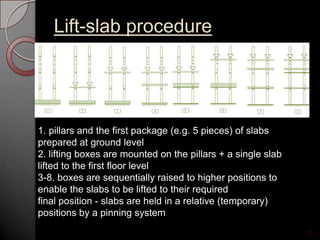
Lift-slab procedure
15
1. pillars and the first package (e.g. 5 pieces) of slabs
prepared at ground level
2. lifting boxes are mounted on the pillars + a single slab
lifted to the first floor level
3-8. boxes are sequentially raised to higher positions to
enable the slabs to be lifted to their required
final position - slabs are held in a relative (temporary)
positions by a pinning system
Planning traffic route
 How long transporter
vehicle is required?
 What is the required
load capacity of the
transporter vehicle?
 What is the maximum
vertical extension of the
shipment
 Routs on the site
16
• Is route permission
required?
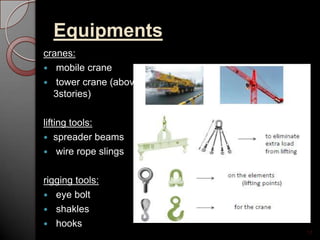
Equipments
cranes:
 mobile crane
 tower crane (above
3stories)
lifting tools:
 spreader beams
 wire rope slings
rigging tools:
 eye bolt
 shakles
 hooks
17
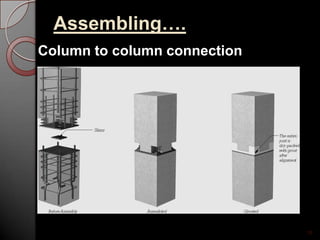
Assembling….
18
Column to column connection
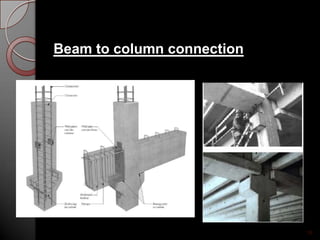
Beam to column connection
19
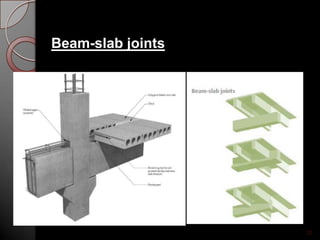
Beam-slab joints
20
21
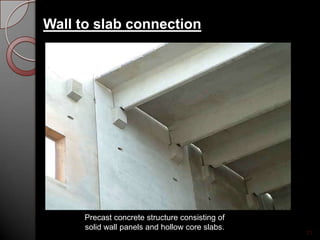
Precast concrete structure consisting of
solid wall panels and hollow core slabs.
Wall to slab connection
Advantages
 Quick erection times
 Possibility of conversion, disassembling
and moving to another site
 Possibility of erection in areas where a
traditional construction practice is not
possible or difficult
 Low labor intensivity
 Reduce wastage of materials
 Easier management of construction sites
 Better overall construction quality
 Ideal fit for simple and complex structures
22
Limitations
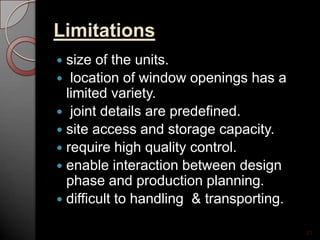
 size of the units.
 location of window openings has a
limited variety.
 joint details are predefined.
 site access and storage capacity.
 require high quality control.
 enable interaction between design
phase and production planning.
 difficult to handling & transporting.
23
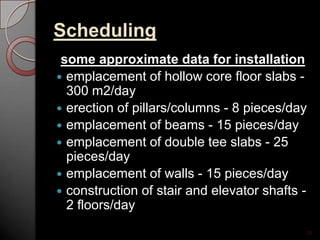
Scheduling
some approximate data for installation
 emplacement of hollow core floor slabs -
300 m2/day
 erection of pillars/columns - 8 pieces/day
 emplacement of beams - 15 pieces/day
 emplacement of double tee slabs - 25
pieces/day
 emplacement of walls - 15 pieces/day
 construction of stair and elevator shafts -
2 floors/day
24
Examples….
25
The hospital will feature multi-trade prefabricated racks in the corridors, an
approach that is still new in the U.S.
26
Miami Valley Hospital Dayton,OH
Conclusion
27
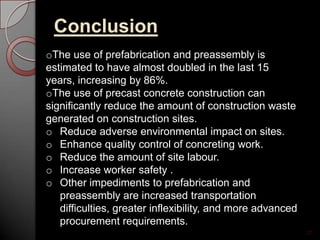
oThe use of prefabrication and preassembly is
estimated to have almost doubled in the last 15
years, increasing by 86%.
oThe use of precast concrete construction can
significantly reduce the amount of construction waste
generated on construction sites.
o Reduce adverse environmental impact on sites.
o Enhance quality control of concreting work.
o Reduce the amount of site labour.
o Increase worker safety .
o Other impediments to prefabrication and
preassembly are increased transportation
difficulties, greater inflexibility, and more advanced
procurement requirements.
References
 [1] Szőnyi L.: Construction of prefabricated reinforced concrete
buildings, 2011
 [2] Benett, D.: Concrete Elegance 2004. Concrete Centre, 2005
 [3] Precast Concrete Structures. www.paradigm.in 2012.10.10
 [4] S. Brzev, T. Guevara-Perez: Precast Concrete Construction.
http://business.management6.com/PRECAST-CONCRETE-
CONSTRUCTION-pdfe13174.
 [5] Sonjoy Deb: Precast Concrete for Building
Systemshttp://masterbuilder.co.in/Archives/Building%20Material
s/Concrete/Precast%20
Concrete%20for%20Building%20Systems.pdf 2012.10.10
 [6] Lift slab
systemhttp://webs.demasiado.com/forjados/patologia/lift_slab/as
pect/index.htm2012.10.23
 [7] http://www.liftplanner.net/steamdrum.html 2012.10.23
28
29
Questions ?.....
30
Thank you

Prefabricated structures

  • 1.
    1 PRE FABRICATED MODULAR STRUCTURES GUIDEDBY: SOUMYA MISS ASST PROFFESSOR, UKFCET, KOLLAM PRESENTED BY: FAIZAL.A.M 7TH SEMESTER CIVIL ENGINEERING UKFCET, KOLLAM
  • 2.
    Contents  Introduction  Features Comparison  Design concept  Components  Types of precast system  Design consideration  Equipments  Assembling  scheduling  Advantages  Limitations  Conclusion  references 2
  • 3.
    Introduction  The conceptof precast structures also known as prefabricated/ modular structures.  The structural components are standardized and produced in plants in a location away from the building site.  Then transported to the site for assembly.  The components are manufactured by industrial methods based on mass production in order to build a large number of buildings in a short time at low cost. 3
  • 4.
    Features  The divisionand specialization of the human workforce.  The use of tools, machinery, and other equipment, usually automated, in the production of standard, interchangeable parts and products.  Compared to site-cast concrete, precast concrete erection is faster and less affected by adverse weather conditions.  Plant casting allows increased efficiency, high quality control and greater control on finishes. 4
  • 5.
    Comparison Site-cast  no transportation the size limitation is depending on the elevation capacity only  lower quality because directly affected by weather  proper, large free space required Precast at plant  transportation and elevation capacity limits the size-  higher, industrialized quality – less affected by weather  no space requirement on the site for fabrication  unlimited opportunities of architectural appearance  option of standardized components 5
  • 6.
    Design concept forprecast concrete buildings  The design concept of the precast buildings is based on  1.build ability.  2.economy 3.standardiz ation of precast components. 6
  • 7.
  • 8.
  • 9.
    9 Precast stairs Precast concreteStairs Steel plates supported on 2 steel beams
  • 10.
    Design considerations  finalposition and loads  transportation requirements – self load and position during transportation  storing requirements – self load and position during storing – (avoid or store in the same position as it transported / built in)  lifting loads – distribution of lifting points – optimal way of lifting (selection of lifting and rigging tools)  vulnerable points (e.g. edges) – reduction of risk (e.g. rounded edges) 10
  • 11.
    Types of precast system 1. Large-panel systems 2. Frame systems 3. Slab-column systems with walls 4. Mixed systems 11
  • 12.
     box-like structure. both vertical and horizontal elements are load-bearing.  one-story high wall panels (cross-wall system / longitudinal wall system / two way system).  one-way or two way slabs. 12 1. Large-panel systems
  • 13.
    2. Frame systems Components are usually linear elements.  The beams are seated on corbels of the pillars usually with hinged- joints (rigid connection is also an option).  Joints are filled with concrete at the site. 13
  • 14.
    3.Lift-slab systems  -partially precast in plant (pillars) / partially precast on- site (slabs).  - one or more storey high pillars (max 5).  - up to 30 storey high constructions.  - special designed joints and temporary joints.  -slabs are casted on the ground (one on top of the other) – then lifted with crane or special elevators. 14
  • 15.
    Lift-slab procedure 15 1. pillarsand the first package (e.g. 5 pieces) of slabs prepared at ground level 2. lifting boxes are mounted on the pillars + a single slab lifted to the first floor level 3-8. boxes are sequentially raised to higher positions to enable the slabs to be lifted to their required final position - slabs are held in a relative (temporary) positions by a pinning system
  • 16.
    Planning traffic route How long transporter vehicle is required?  What is the required load capacity of the transporter vehicle?  What is the maximum vertical extension of the shipment  Routs on the site 16 • Is route permission required?
  • 17.
    Equipments cranes:  mobile crane tower crane (above 3stories) lifting tools:  spreader beams  wire rope slings rigging tools:  eye bolt  shakles  hooks 17
  • 18.
  • 19.
    Beam to columnconnection 19
  • 20.
  • 21.
    21 Precast concrete structureconsisting of solid wall panels and hollow core slabs. Wall to slab connection
  • 22.
    Advantages  Quick erectiontimes  Possibility of conversion, disassembling and moving to another site  Possibility of erection in areas where a traditional construction practice is not possible or difficult  Low labor intensivity  Reduce wastage of materials  Easier management of construction sites  Better overall construction quality  Ideal fit for simple and complex structures 22
  • 23.
    Limitations  size ofthe units.  location of window openings has a limited variety.  joint details are predefined.  site access and storage capacity.  require high quality control.  enable interaction between design phase and production planning.  difficult to handling & transporting. 23
  • 24.
    Scheduling some approximate datafor installation  emplacement of hollow core floor slabs - 300 m2/day  erection of pillars/columns - 8 pieces/day  emplacement of beams - 15 pieces/day  emplacement of double tee slabs - 25 pieces/day  emplacement of walls - 15 pieces/day  construction of stair and elevator shafts - 2 floors/day 24
  • 25.
    Examples…. 25 The hospital willfeature multi-trade prefabricated racks in the corridors, an approach that is still new in the U.S.
  • 26.
  • 27.
    Conclusion 27 oThe use ofprefabrication and preassembly is estimated to have almost doubled in the last 15 years, increasing by 86%. oThe use of precast concrete construction can significantly reduce the amount of construction waste generated on construction sites. o Reduce adverse environmental impact on sites. o Enhance quality control of concreting work. o Reduce the amount of site labour. o Increase worker safety . o Other impediments to prefabrication and preassembly are increased transportation difficulties, greater inflexibility, and more advanced procurement requirements.
  • 28.
    References  [1] SzőnyiL.: Construction of prefabricated reinforced concrete buildings, 2011  [2] Benett, D.: Concrete Elegance 2004. Concrete Centre, 2005  [3] Precast Concrete Structures. www.paradigm.in 2012.10.10  [4] S. Brzev, T. Guevara-Perez: Precast Concrete Construction. http://business.management6.com/PRECAST-CONCRETE- CONSTRUCTION-pdfe13174.  [5] Sonjoy Deb: Precast Concrete for Building Systemshttp://masterbuilder.co.in/Archives/Building%20Material s/Concrete/Precast%20 Concrete%20for%20Building%20Systems.pdf 2012.10.10  [6] Lift slab systemhttp://webs.demasiado.com/forjados/patologia/lift_slab/as pect/index.htm2012.10.23  [7] http://www.liftplanner.net/steamdrum.html 2012.10.23 28
  • 29.
  • 30.