Presented by:
TARANJEET SINGH LUBANA
M.Sc. 3rd Semester
Department of Geology
University of Lucknow
 When the ground shakes, building responds to the
acceleration transmitted from the ground through
the structure foundations.
 The inertia ( which wants to sty at rest) can cause
shearing of the structure which can concentrate
stresses on the weak walls or the joints in the
structure resulting in failure or perhaps total
collapse.
 The type of shaking and frequency depends on the
structure .
 Tall buildings tends to amplify the motion of the
buildings as compare to smaller one’s.
 During earthquakes columns undergo relative
moment between there're ends and forms
plastic hinges and cause ultimate failure .
 Earthquake causes vertical displacement as
well as horizontal .
 Generally structure are primarily designed to
carry the gravity loads so that the design of
gravity loads is adequate for earthquake shake
at vertical direction but may not be able to
sustain the effects in horizontal direction.
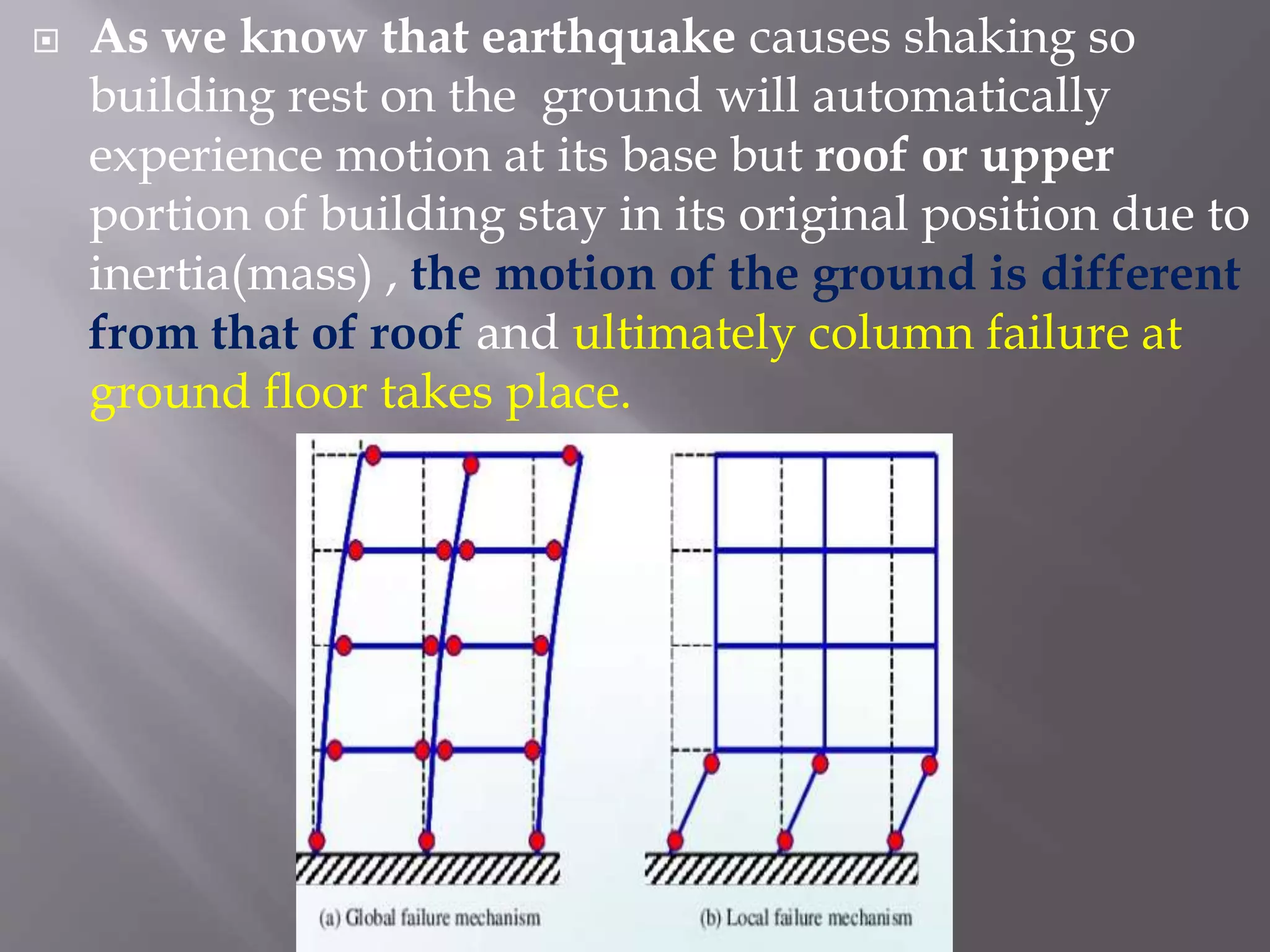
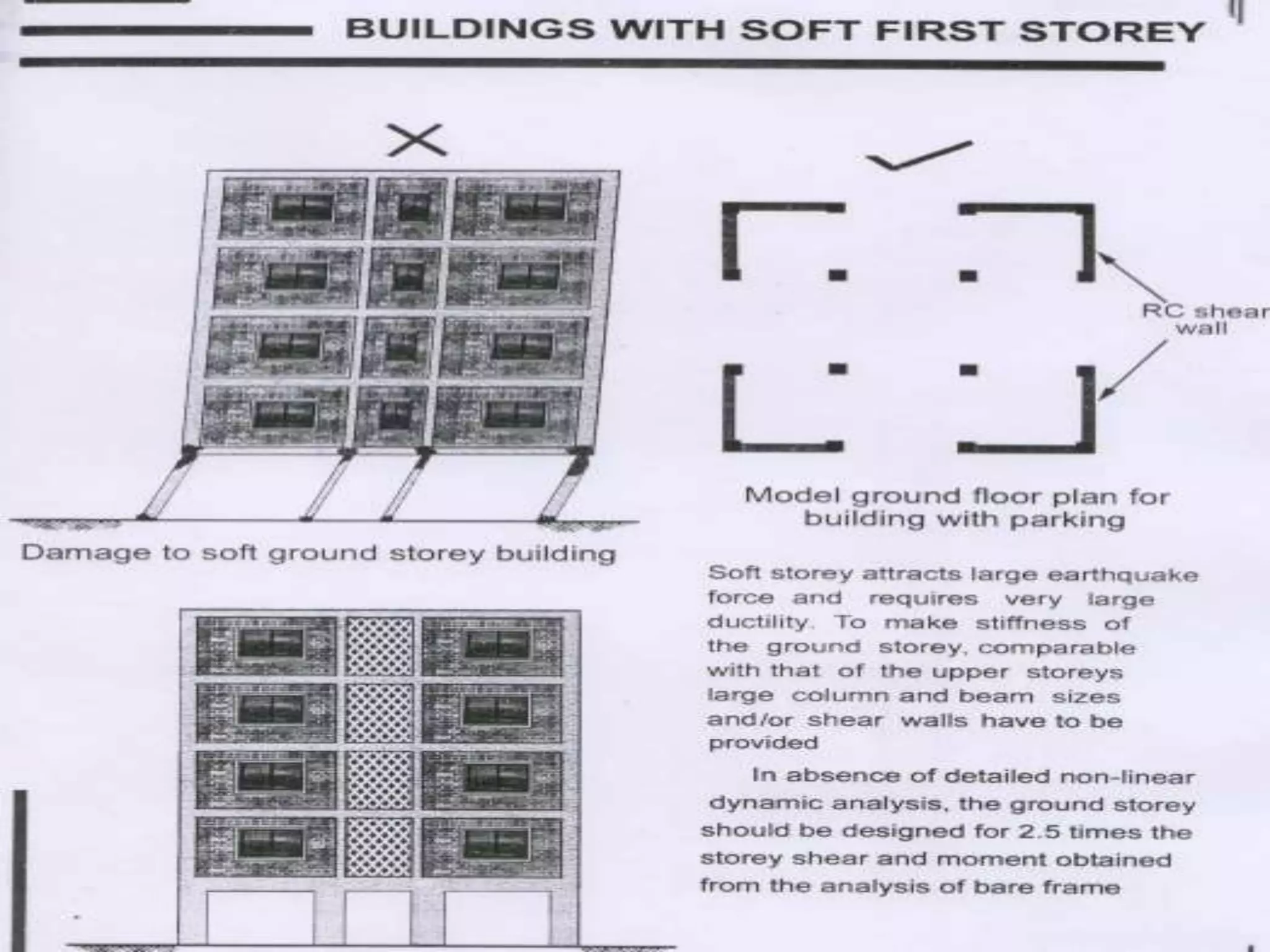
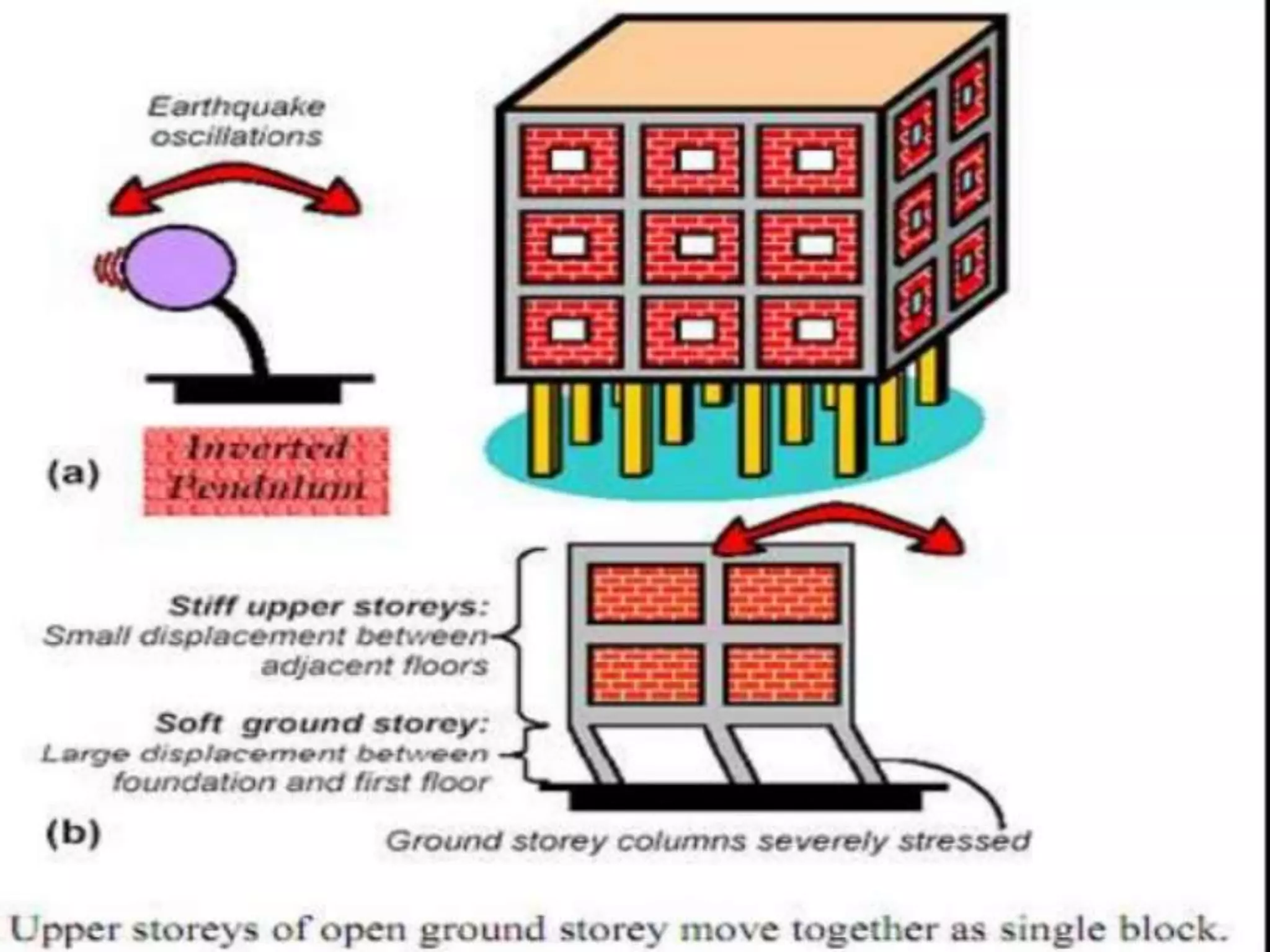
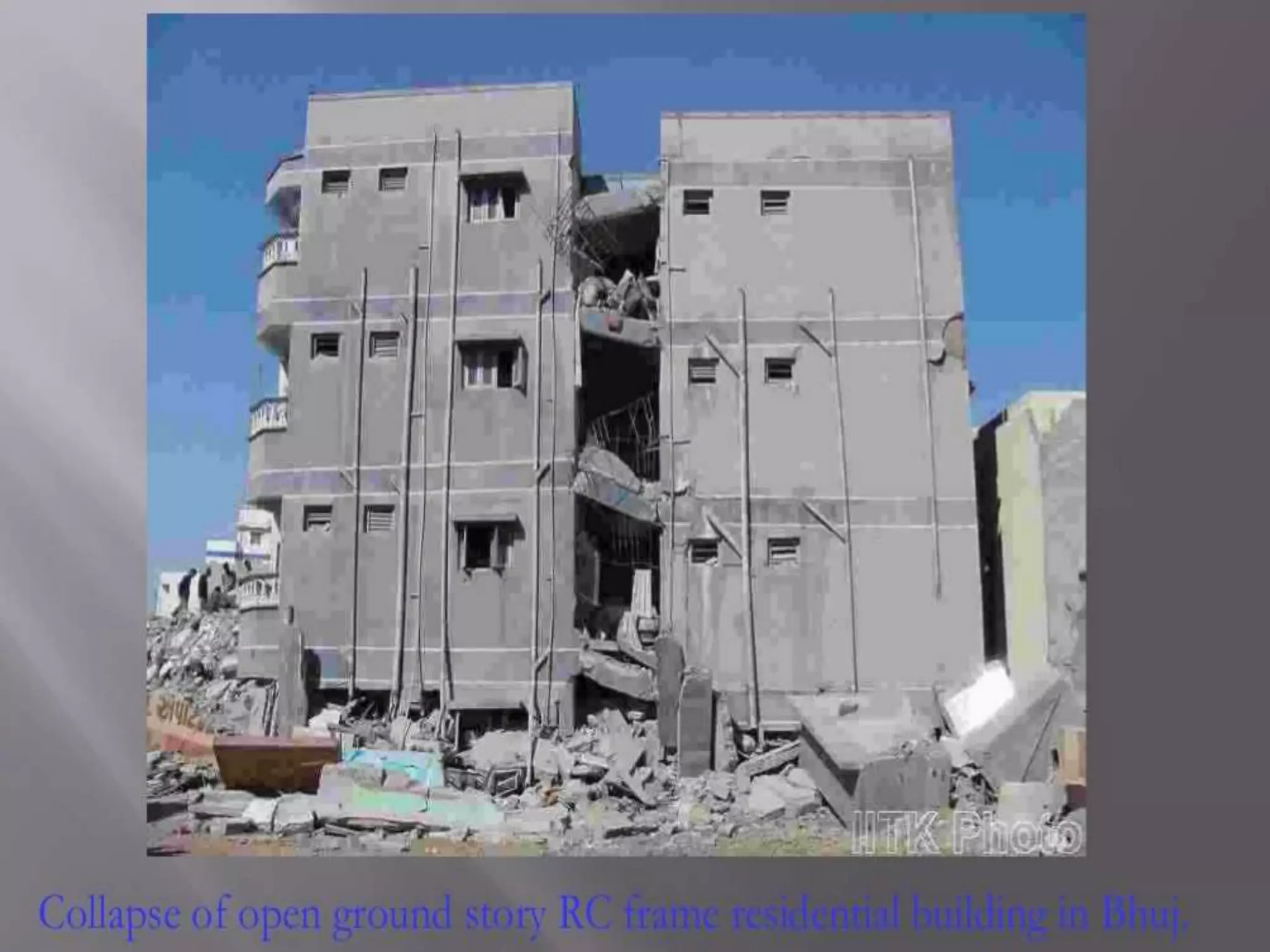
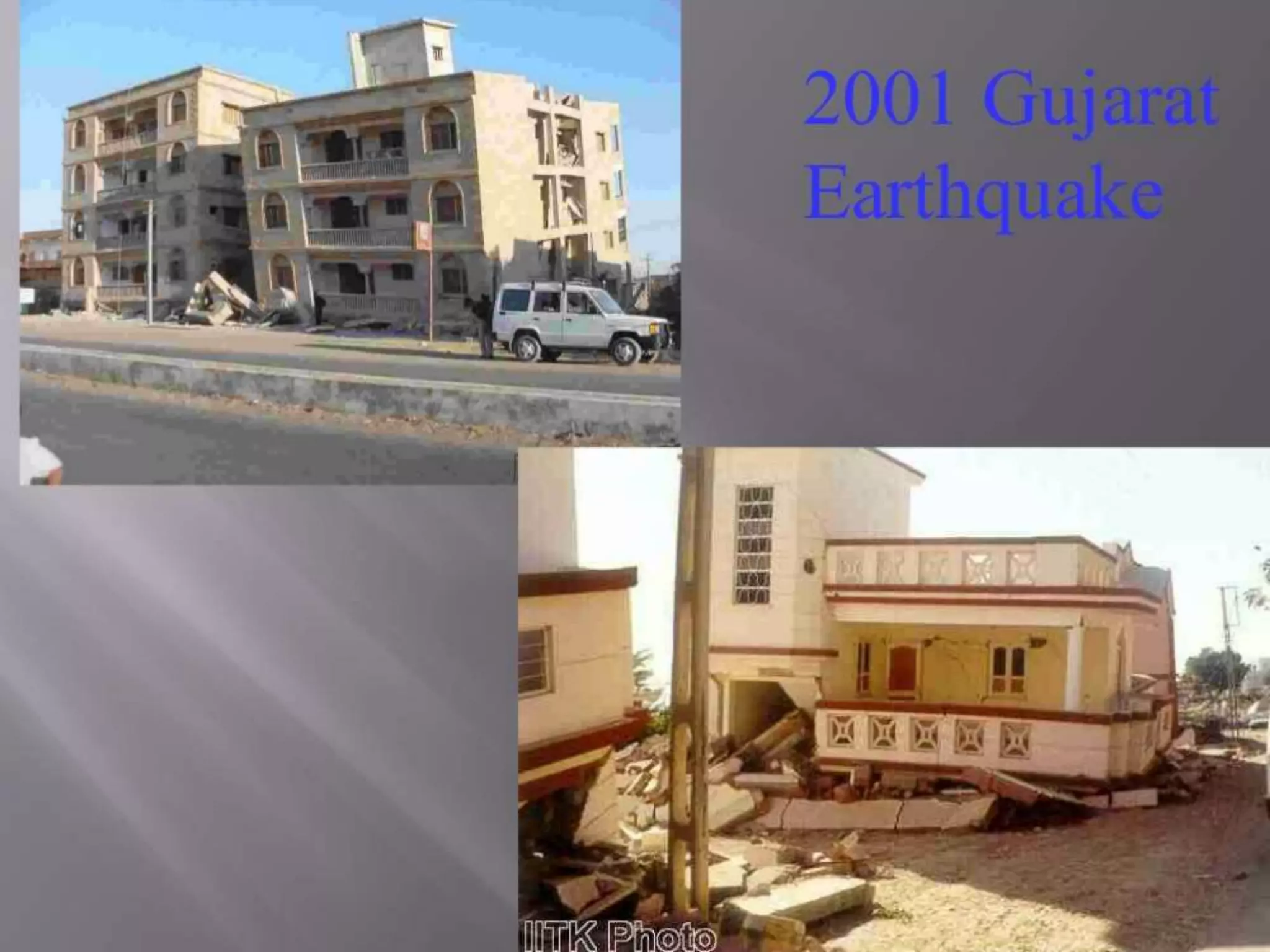
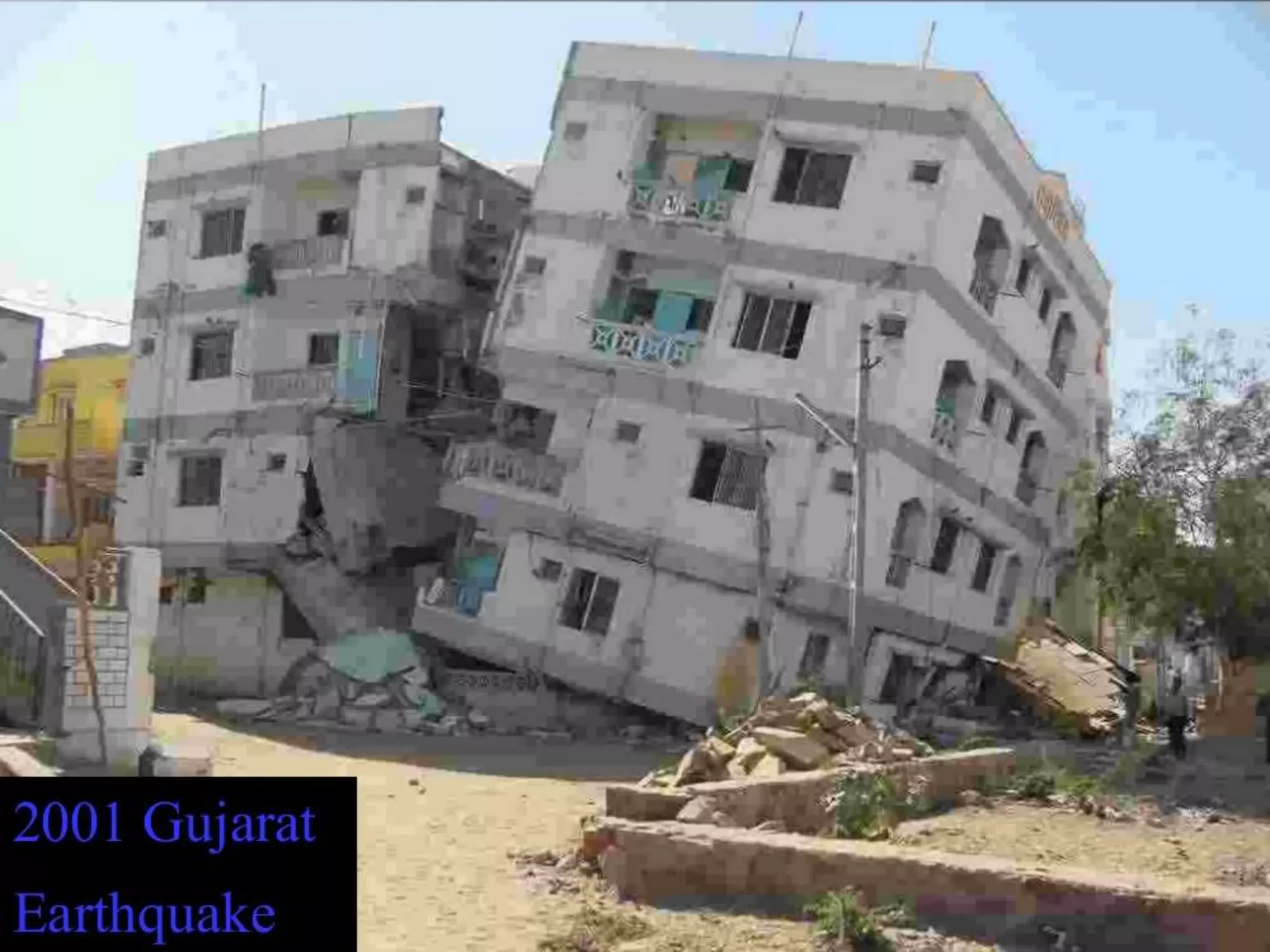
 As we know that earthquake causes shaking so
building rest on the ground will automatically
experience motion at its base but roof or upper
portion of building stay in its original position due to
inertia(mass) , the motion of the ground is different
from that of roof and ultimately column failure at
ground floor takes place.
 Designing of structure is done manually after
analysis of structure is done .
 Using Data Analysis all the structural elements in
building are designed .
 Generally the structural elements are :---
1. Beams
2. Columns
3. Slabs
4. Foundation
5. Shear wall
6. Bracing of Masonry walls
7. Bracings etc…..
 There are two ways to safeguard a building against
earthquake , one way is strengthening all structural
elements & second way is reducing the impact of
seismic forces on building , rather than strengthening
it .
 And these ways are :-
 FIRST APPROACH
1. Shear wall 2. Bracings 3. Moment resisting frames.
 SECOND APPROACH
1. Base isolation technique. 2. Energy Dissipation
Devices
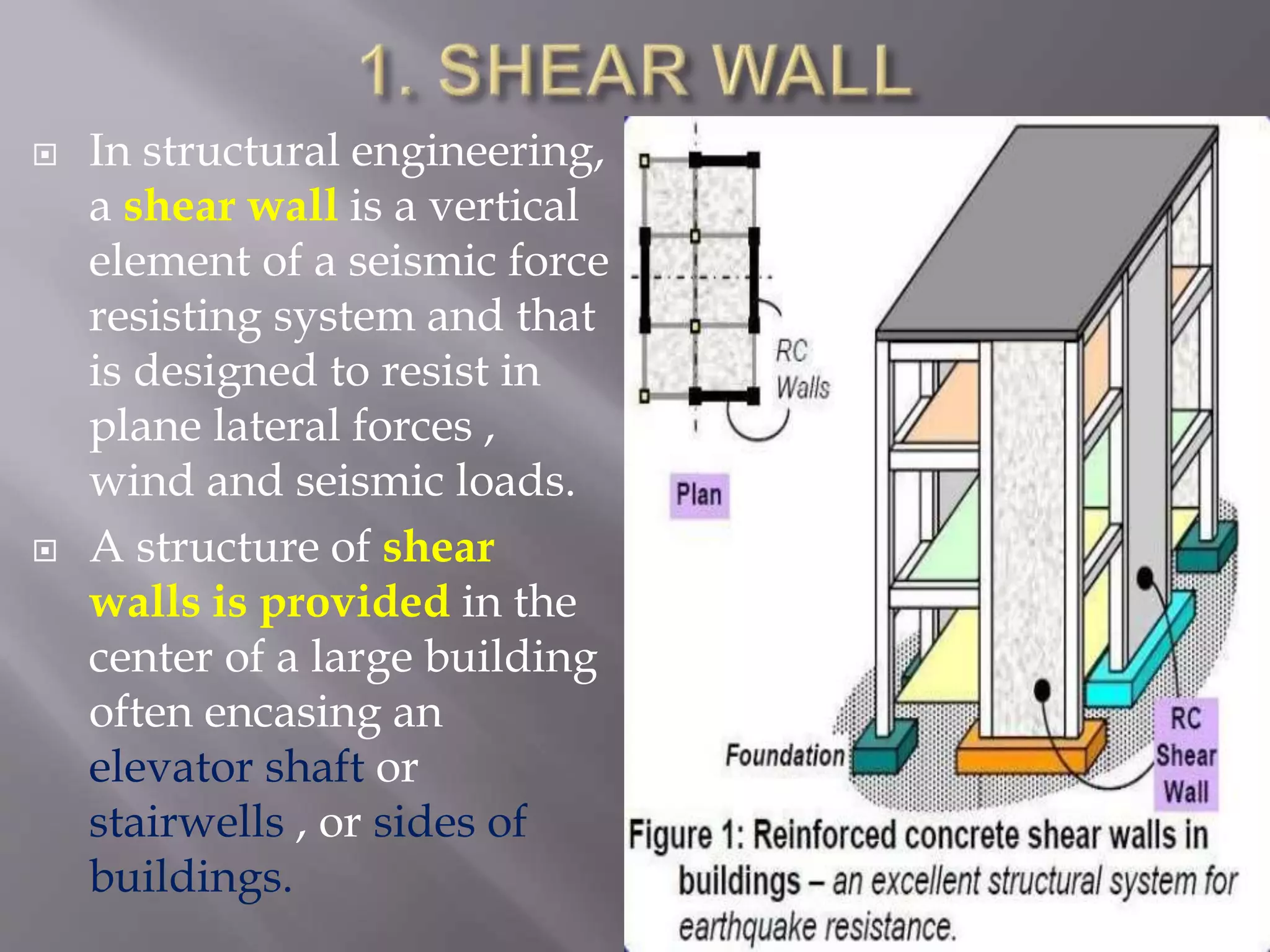
 In structural engineering,
a shear wall is a vertical
element of a seismic force
resisting system and that
is designed to resist in
plane lateral forces ,
wind and seismic loads.
 A structure of shear
walls is provided in the
center of a large building
often encasing an
elevator shaft or
stairwells , or sides of
buildings.
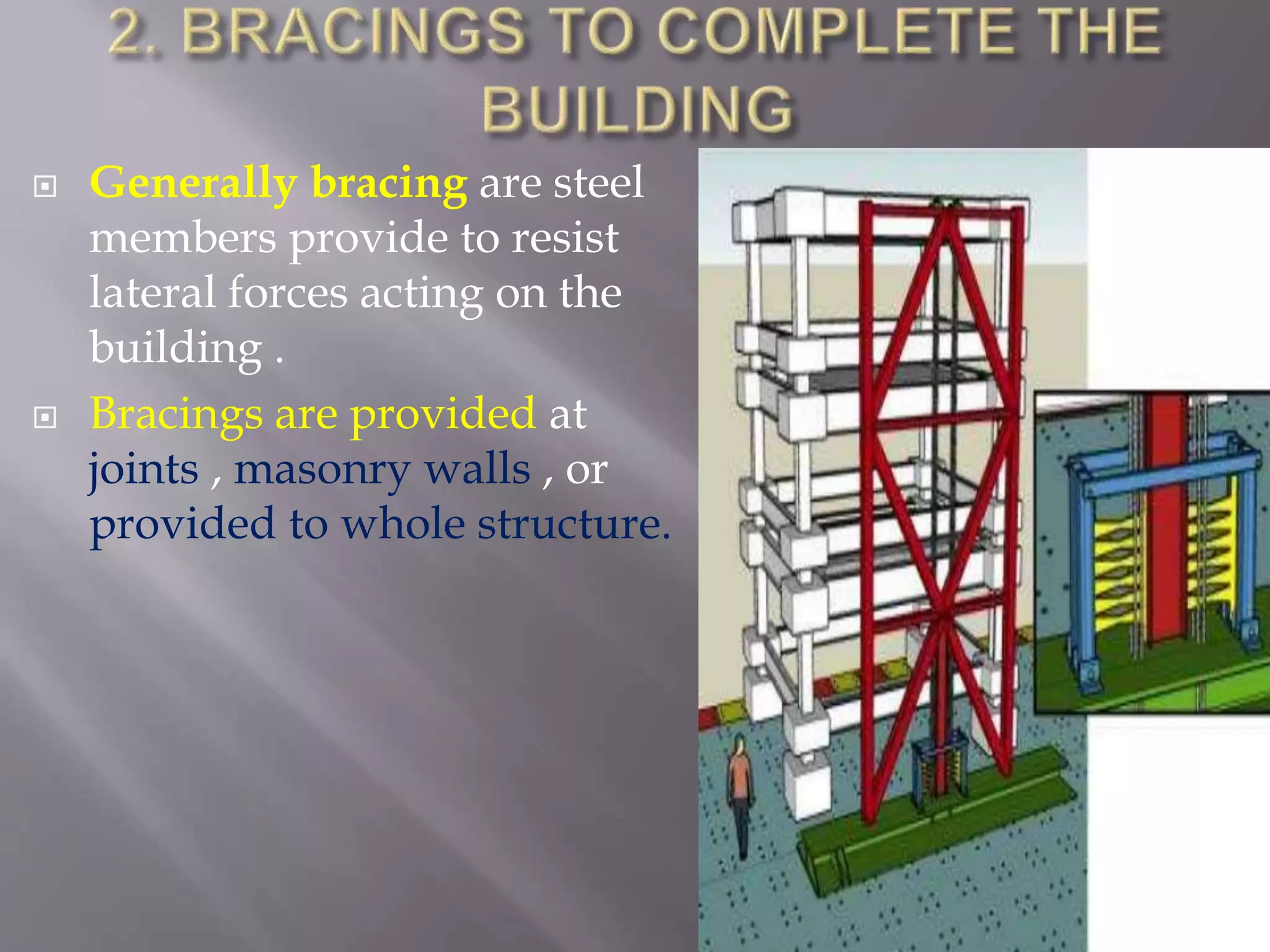
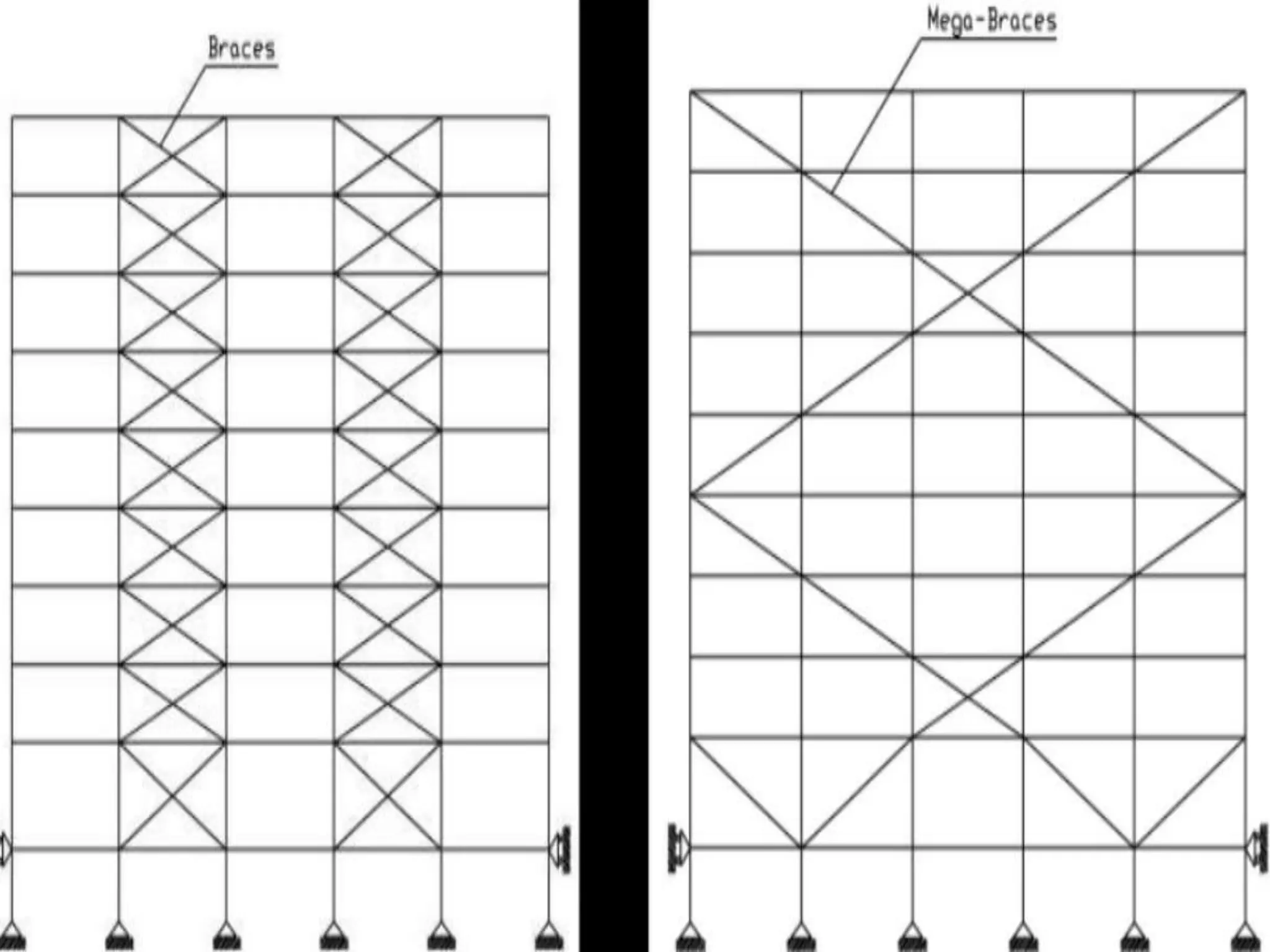
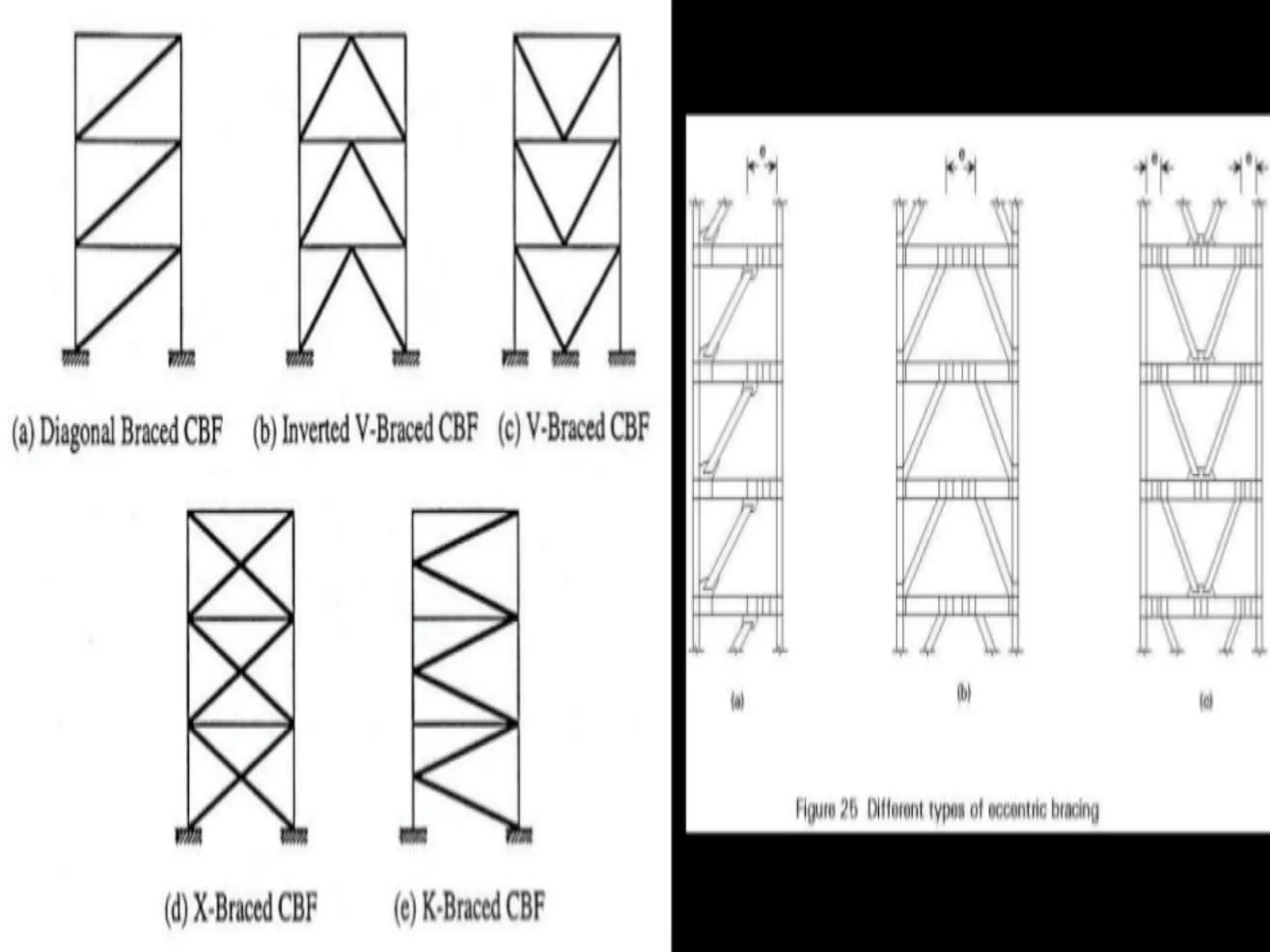
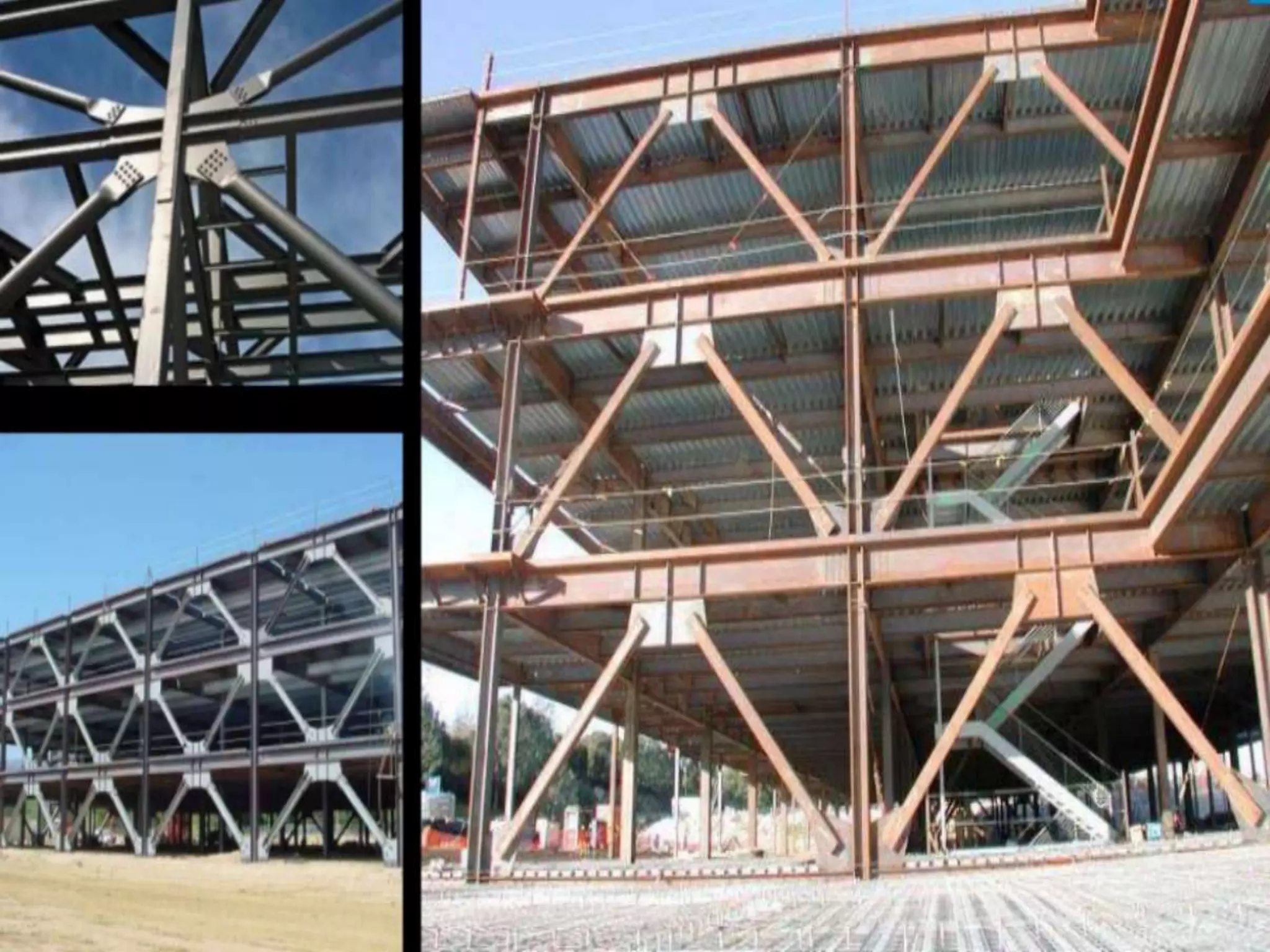
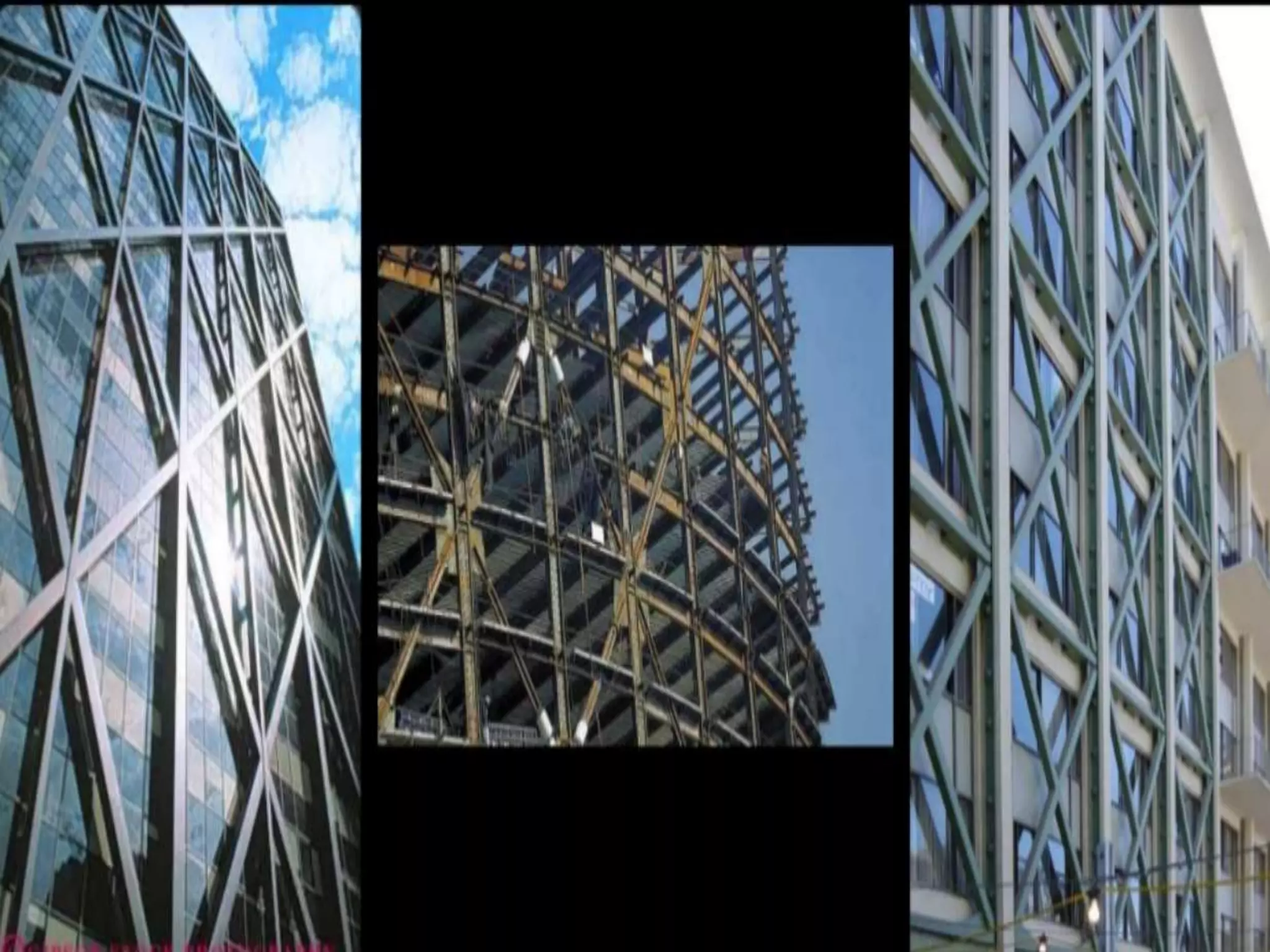
 Generally bracing are steel
members provide to resist
lateral forces acting on the
building .
 Bracings are provided at
joints , masonry walls , or
provided to whole structure.
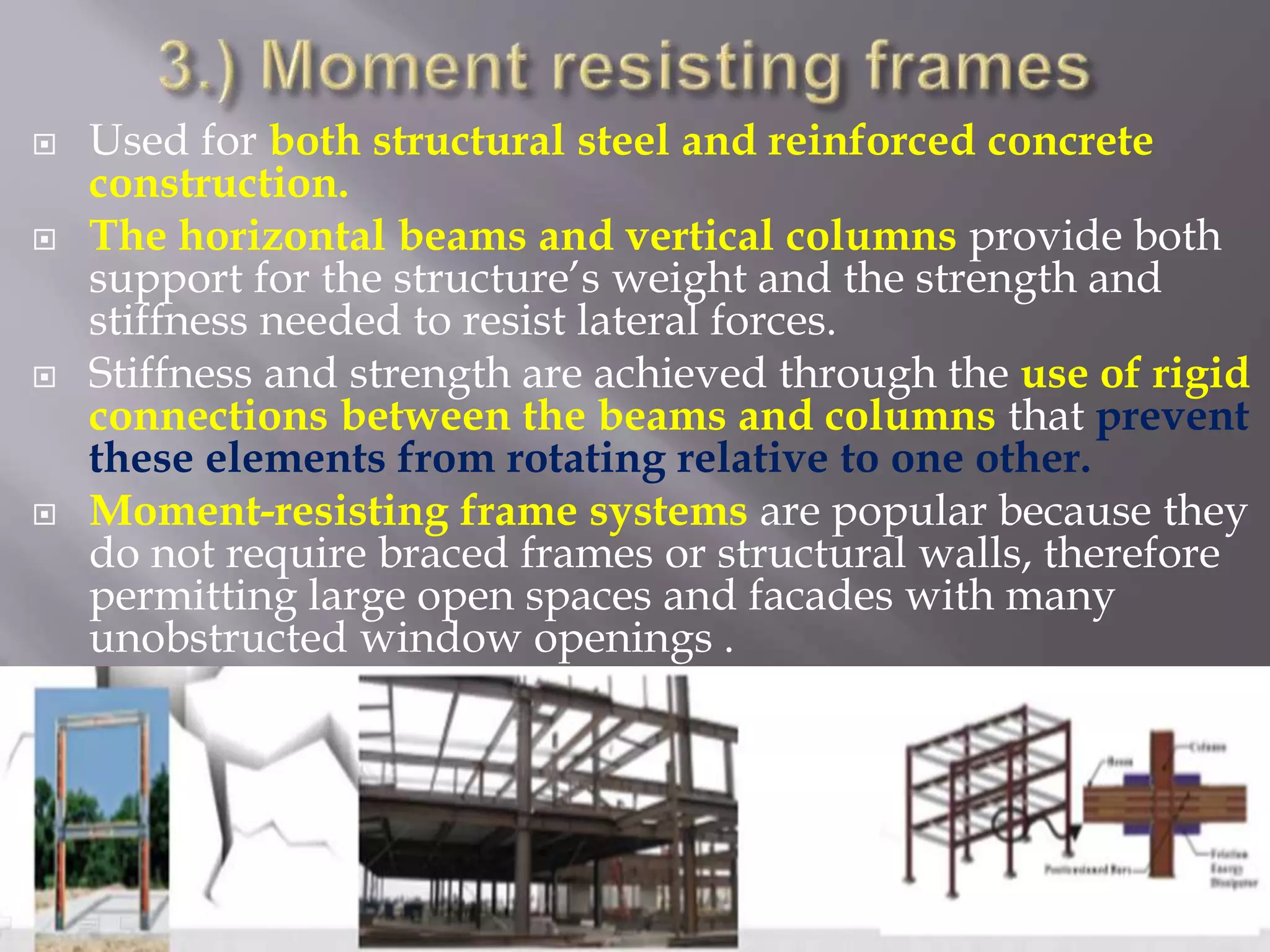
 Used for both structural steel and reinforced concrete
construction.
 The horizontal beams and vertical columns provide both
support for the structure’s weight and the strength and
stiffness needed to resist lateral forces.
 Stiffness and strength are achieved through the use of rigid
connections between the beams and columns that prevent
these elements from rotating relative to one other.
 Moment-resisting frame systems are popular because they
do not require braced frames or structural walls, therefore
permitting large open spaces and facades with many
unobstructed window openings .
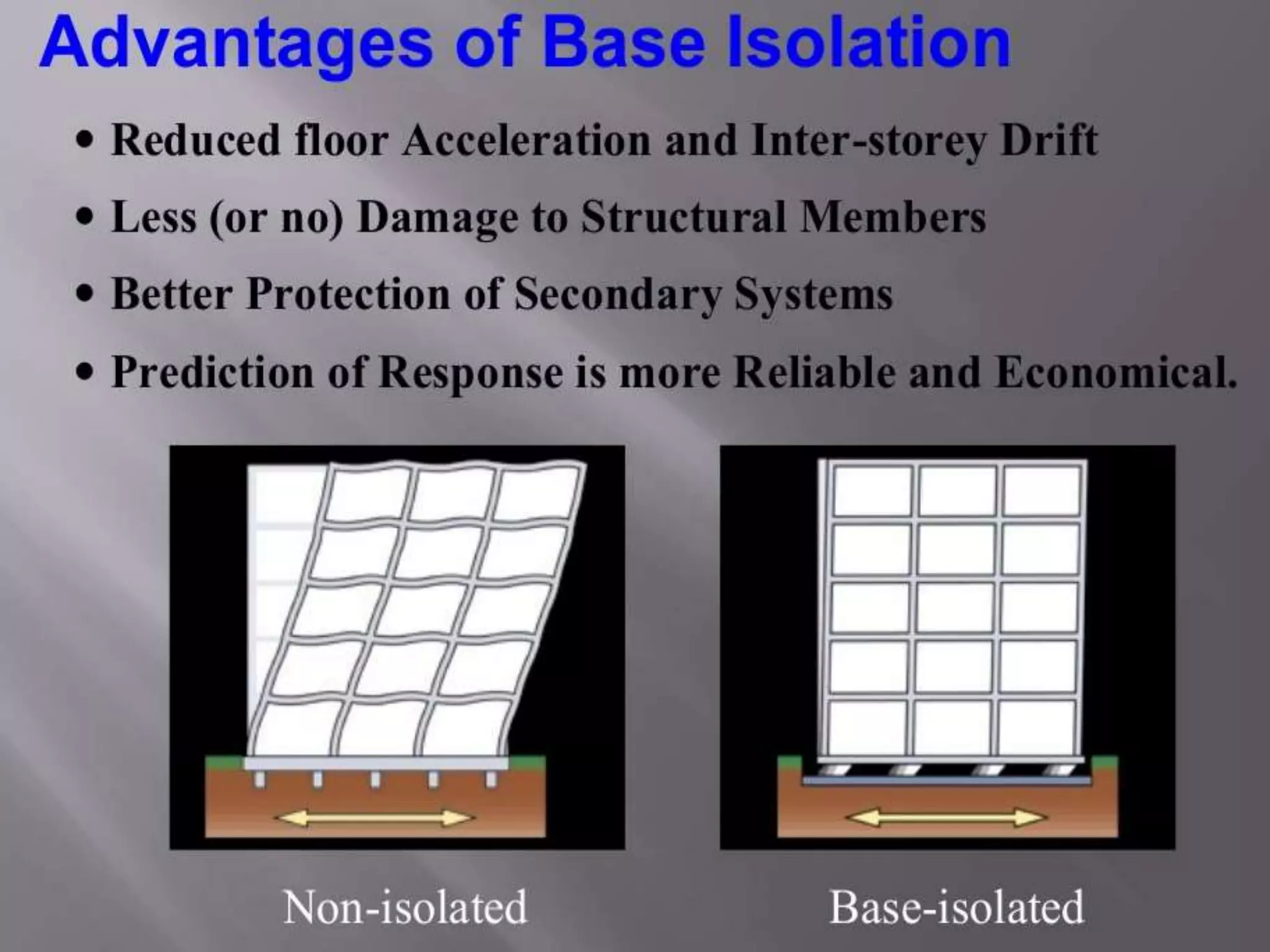
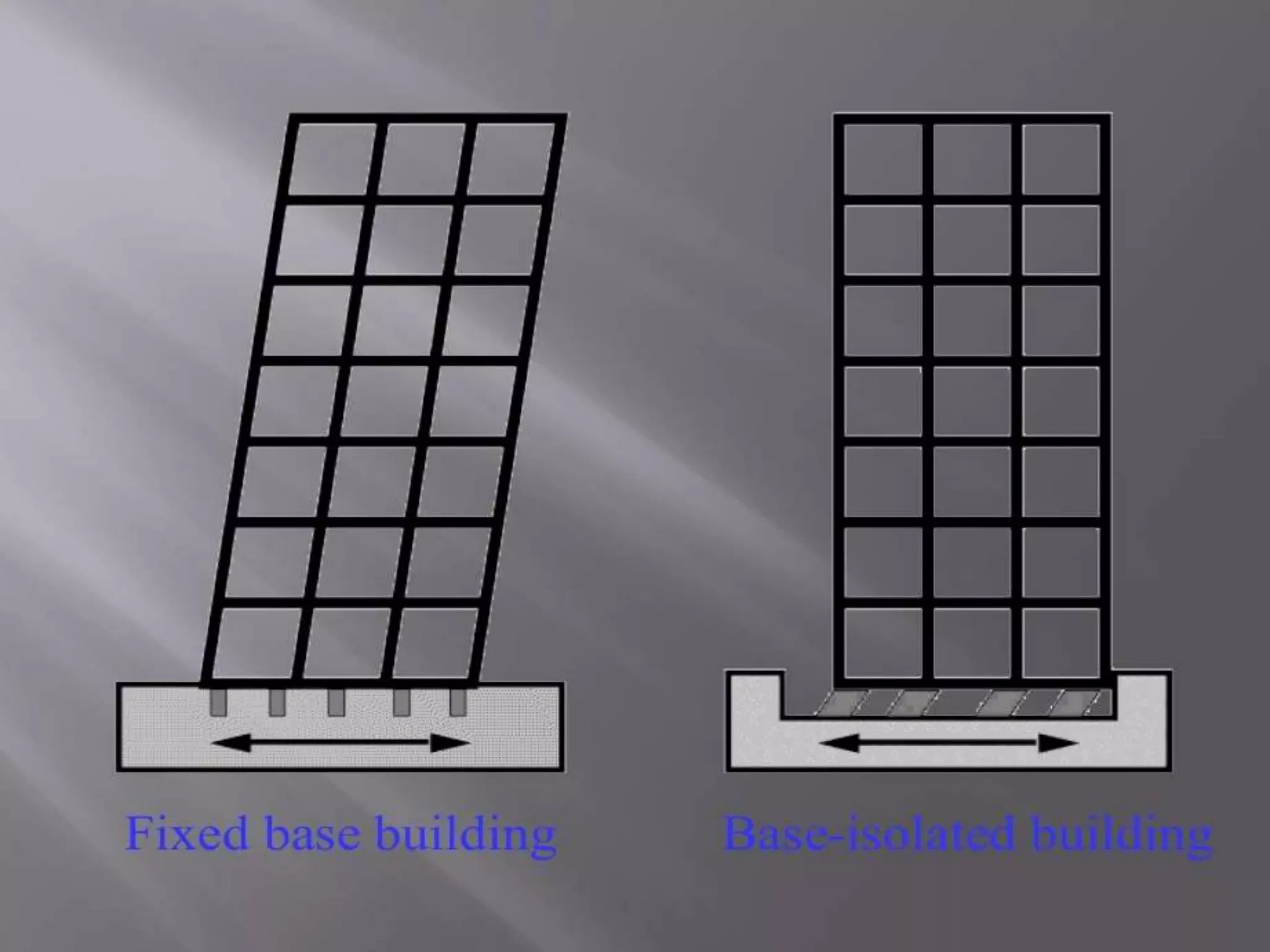
 To reduce the intent of earthquake base isolation is
done and it is one of the most popular means of
protecting a structure against earthquake forces.
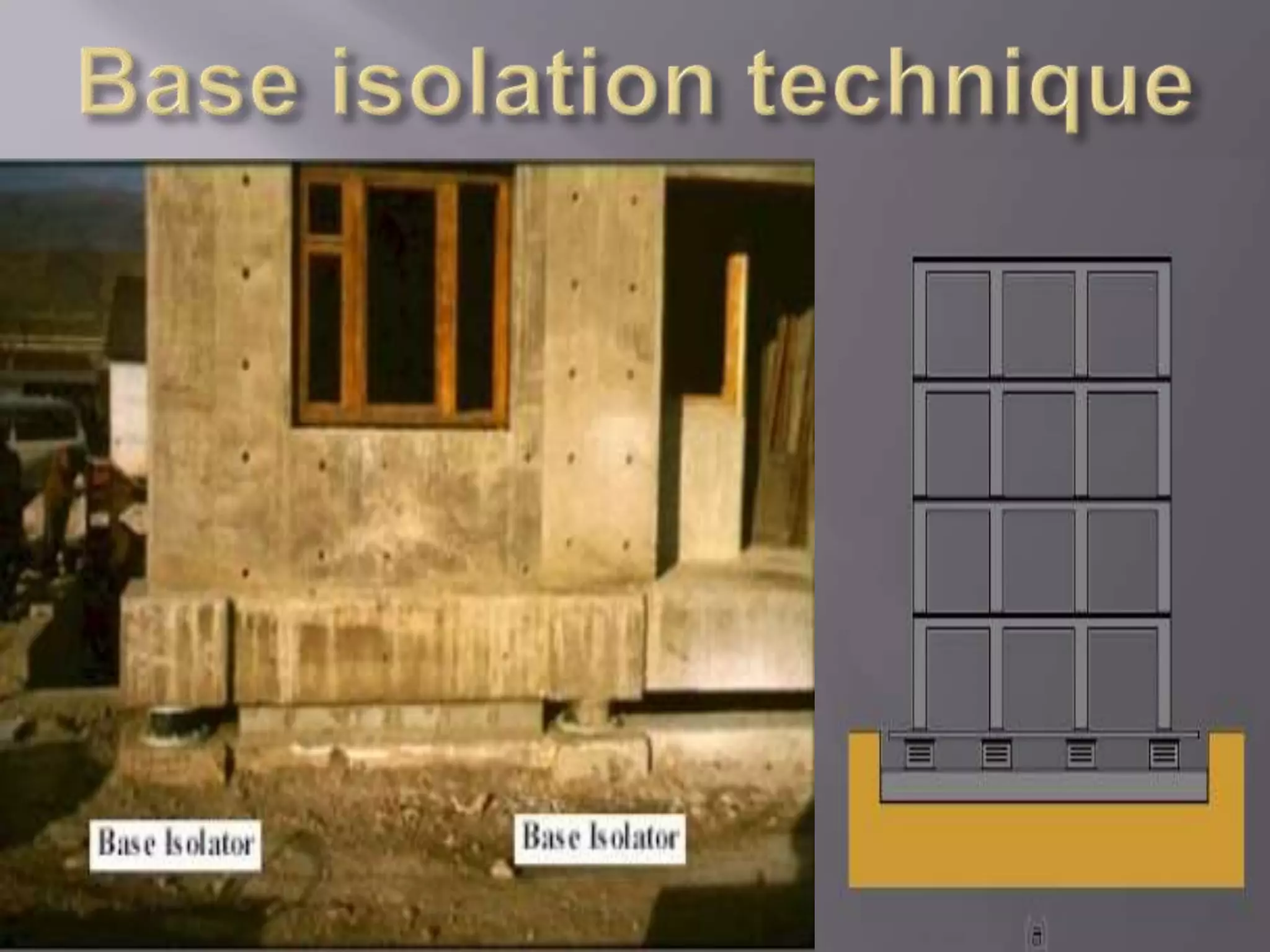
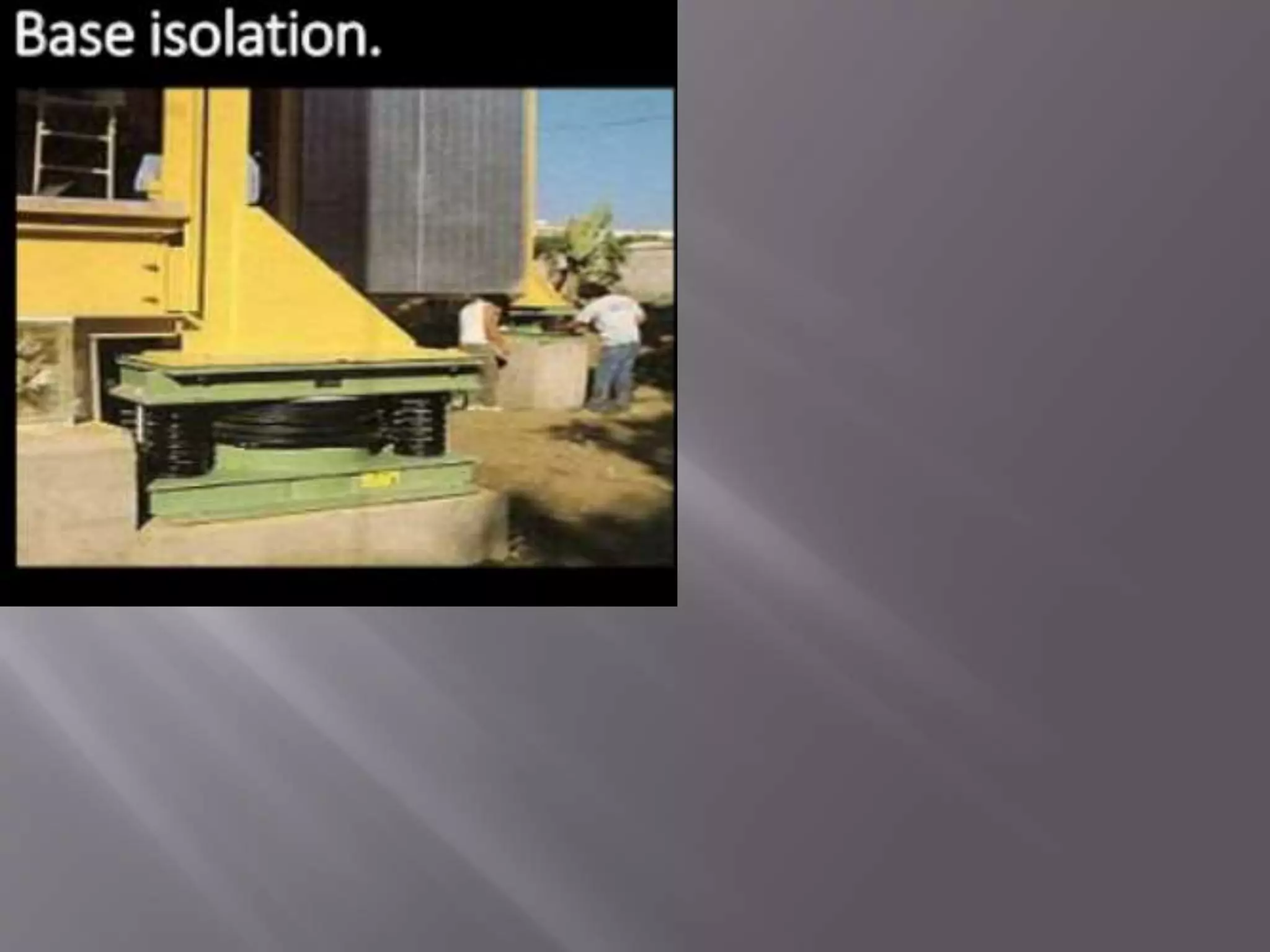
 For e.g. buildings , base-isolation may be achieved
by reducing the coefficient of friction between
structure and its foundation or by placing a flexible
connection between the structure and its foundation.
 A flexible joint is used between column and footing
at the floor level , it separates super structure from
the foundation, thus during earthquake no vibration
is carried to the superstructure .
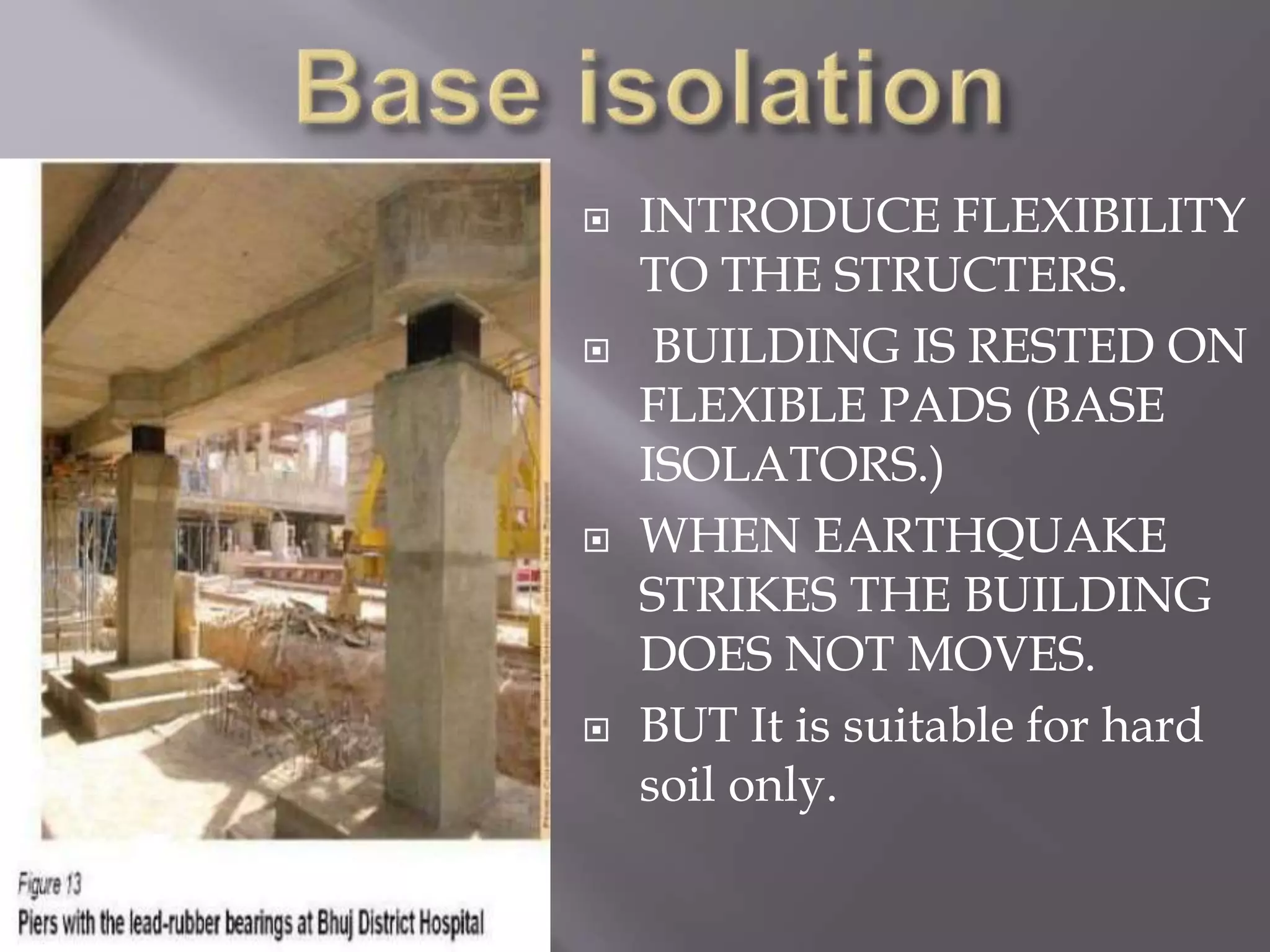
 INTRODUCE FLEXIBILITY
TO THE STRUCTERS.
 BUILDING IS RESTED ON
FLEXIBLE PADS (BASE
ISOLATORS.)
 WHEN EARTHQUAKE
STRIKES THE BUILDING
DOES NOT MOVES.
 BUT It is suitable for hard
soil only.
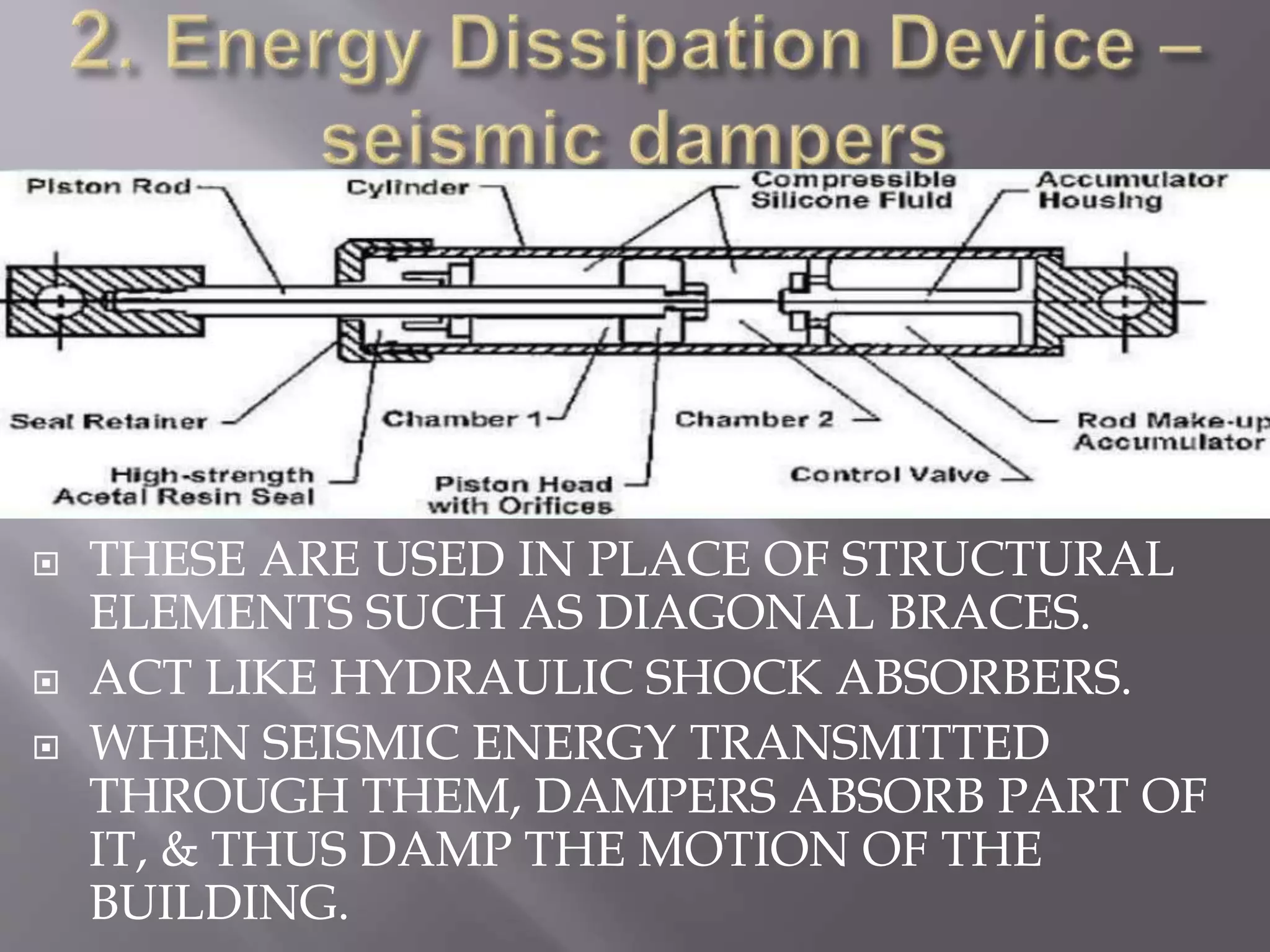
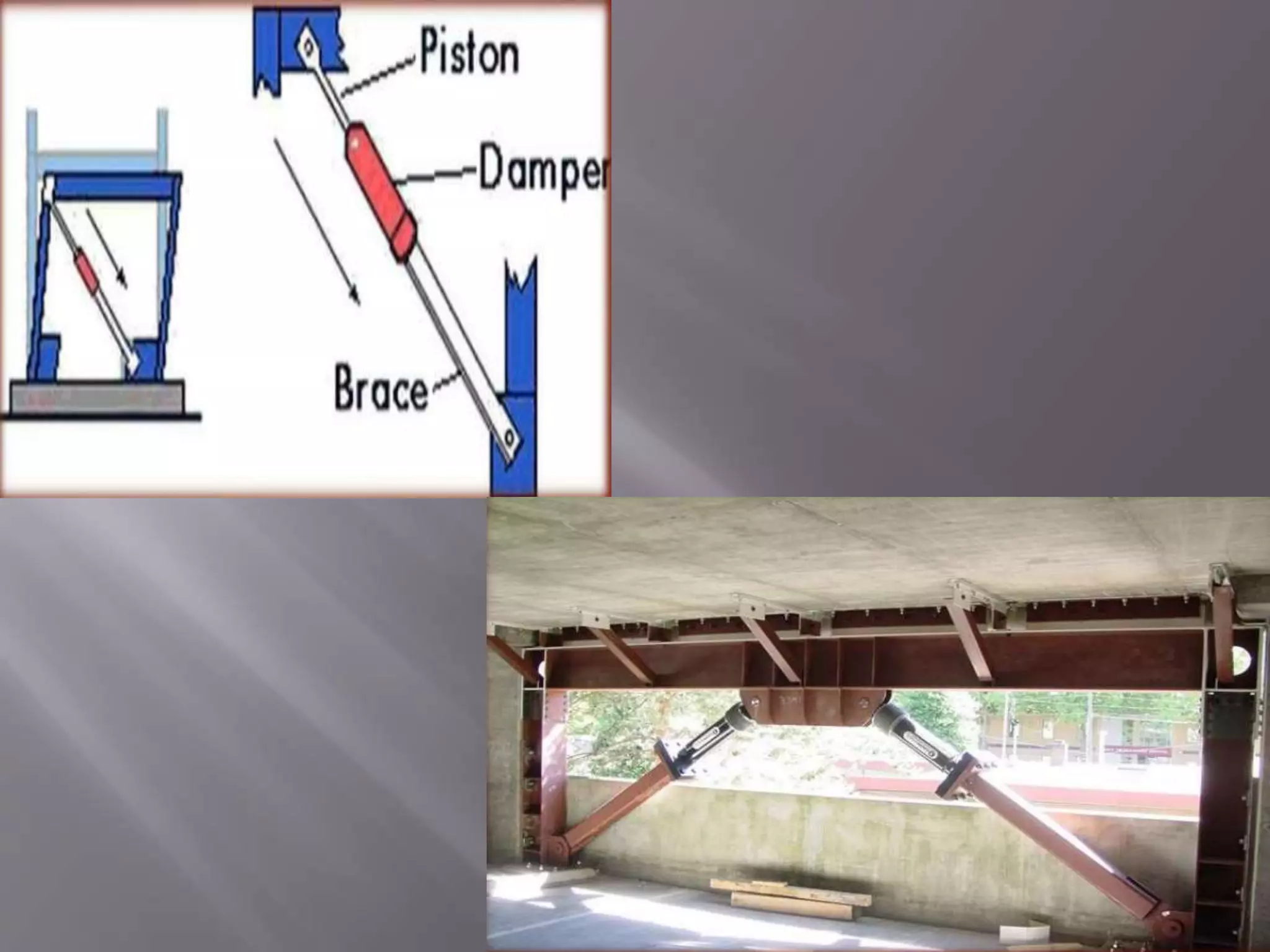
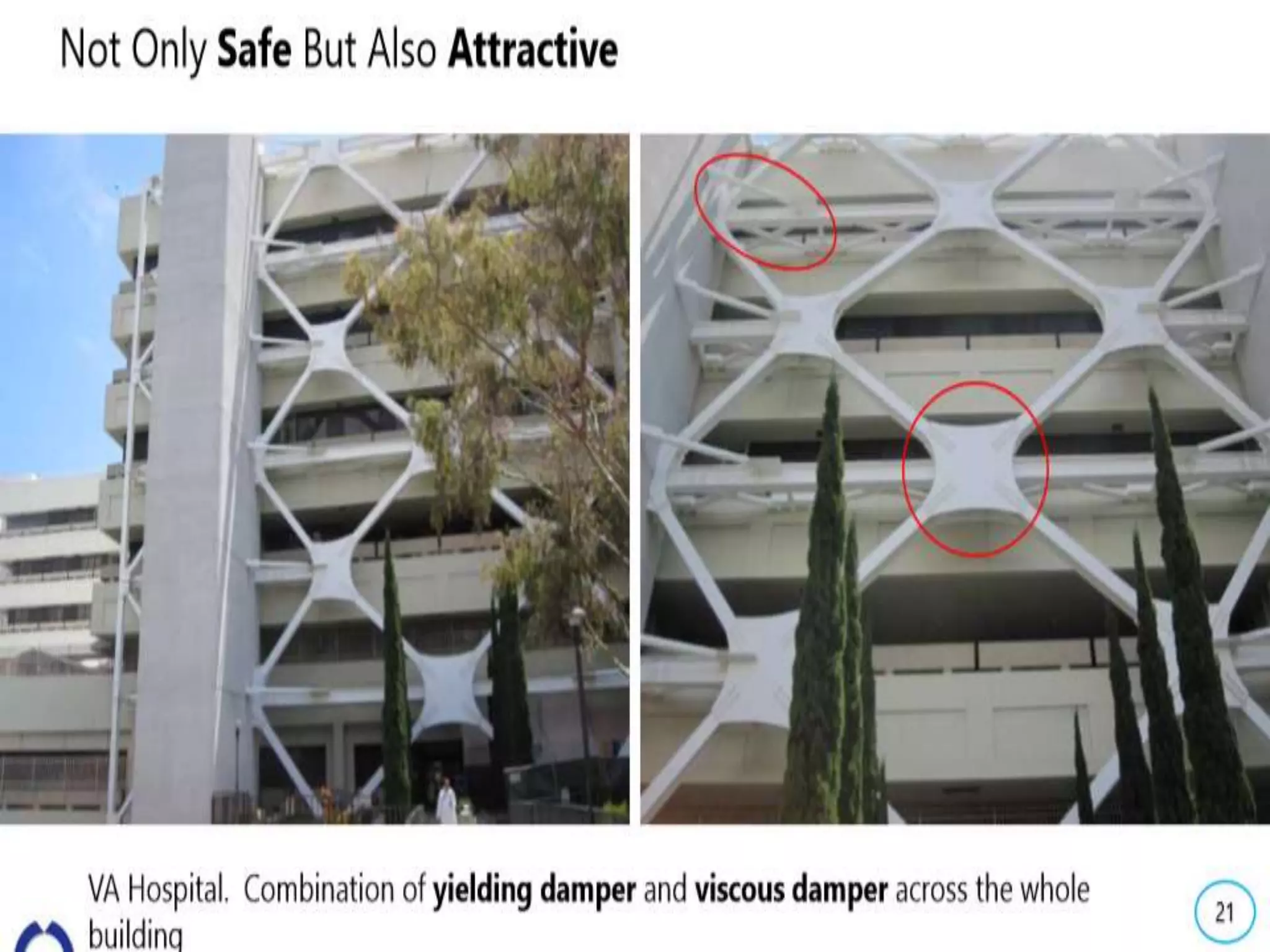
 THESE ARE USED IN PLACE OF STRUCTURAL
ELEMENTS SUCH AS DIAGONAL BRACES.
 ACT LIKE HYDRAULIC SHOCK ABSORBERS.
 WHEN SEISMIC ENERGY TRANSMITTED
THROUGH THEM, DAMPERS ABSORB PART OF
IT, & THUS DAMP THE MOTION OF THE
BUILDING.
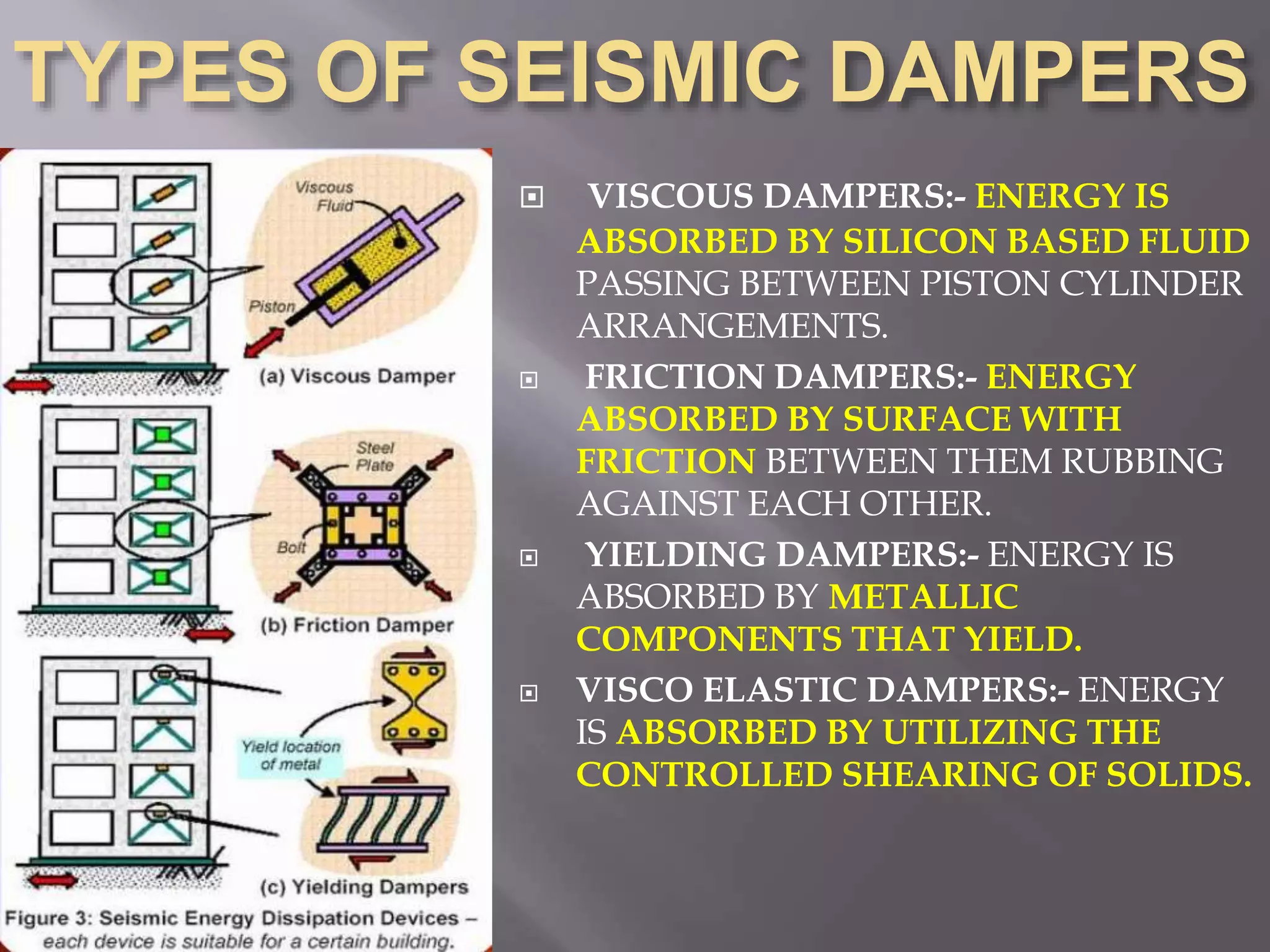
TYPES OF SEISMIC DAMPERS
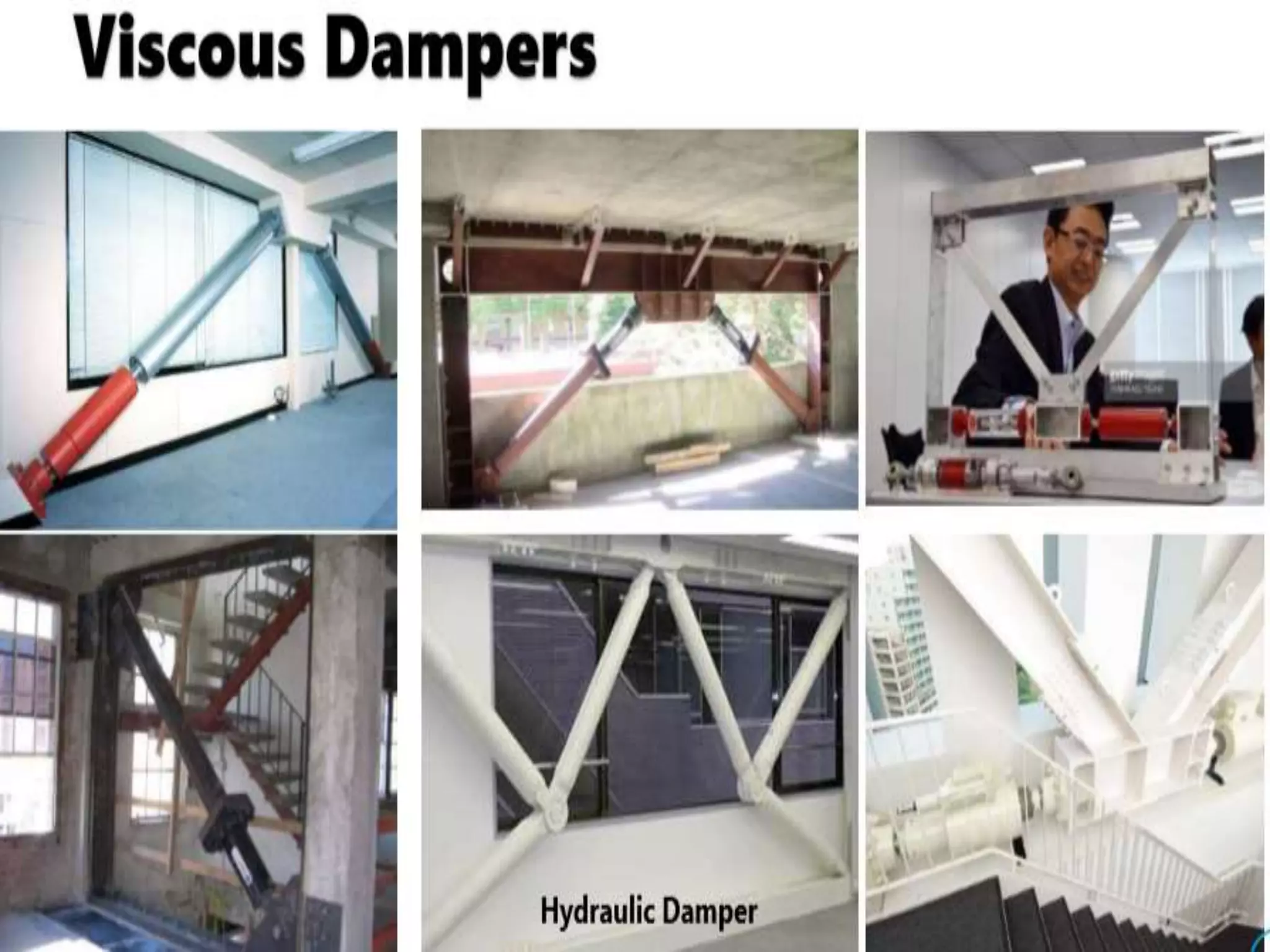
 VISCOUS DAMPERS:- ENERGY IS
ABSORBED BY SILICON BASED FLUID
PASSING BETWEEN PISTON CYLINDER
ARRANGEMENTS.
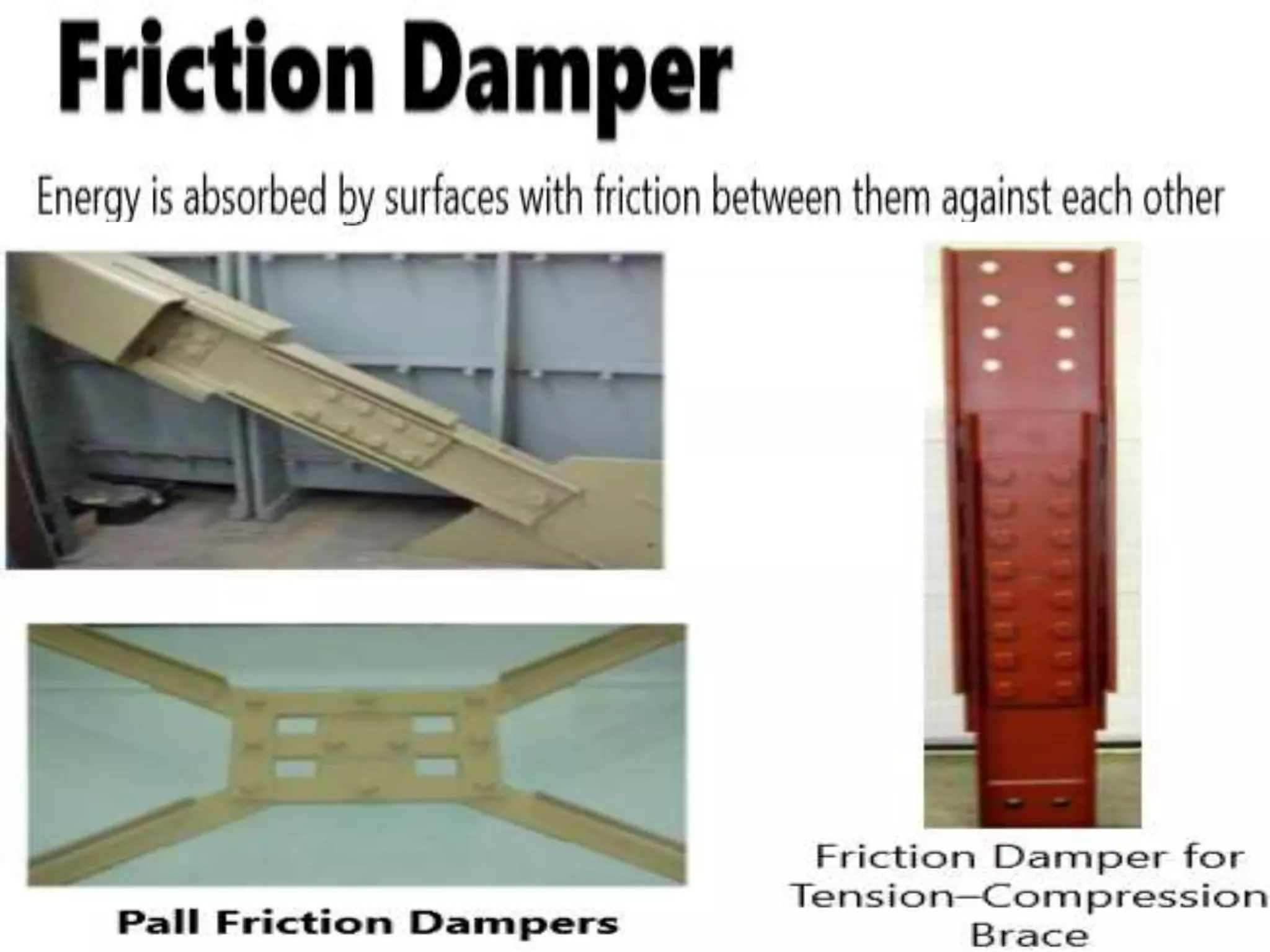
 FRICTION DAMPERS:- ENERGY
ABSORBED BY SURFACE WITH
FRICTION BETWEEN THEM RUBBING
AGAINST EACH OTHER.
 YIELDING DAMPERS:- ENERGY IS
ABSORBED BY METALLIC
COMPONENTS THAT YIELD.
 VISCO ELASTIC DAMPERS:- ENERGY
IS ABSORBED BY UTILIZING THE
CONTROLLED SHEARING OF SOLIDS.
 Avoid weak column and strong beam design
 Provide thick slab which will help as a rigid
diaphragm
 Provide cross walls which will stiffen the structures
 Provide shear walls in a symmetrical fashion
 Increase in the transverse (Shear) reinforcement.
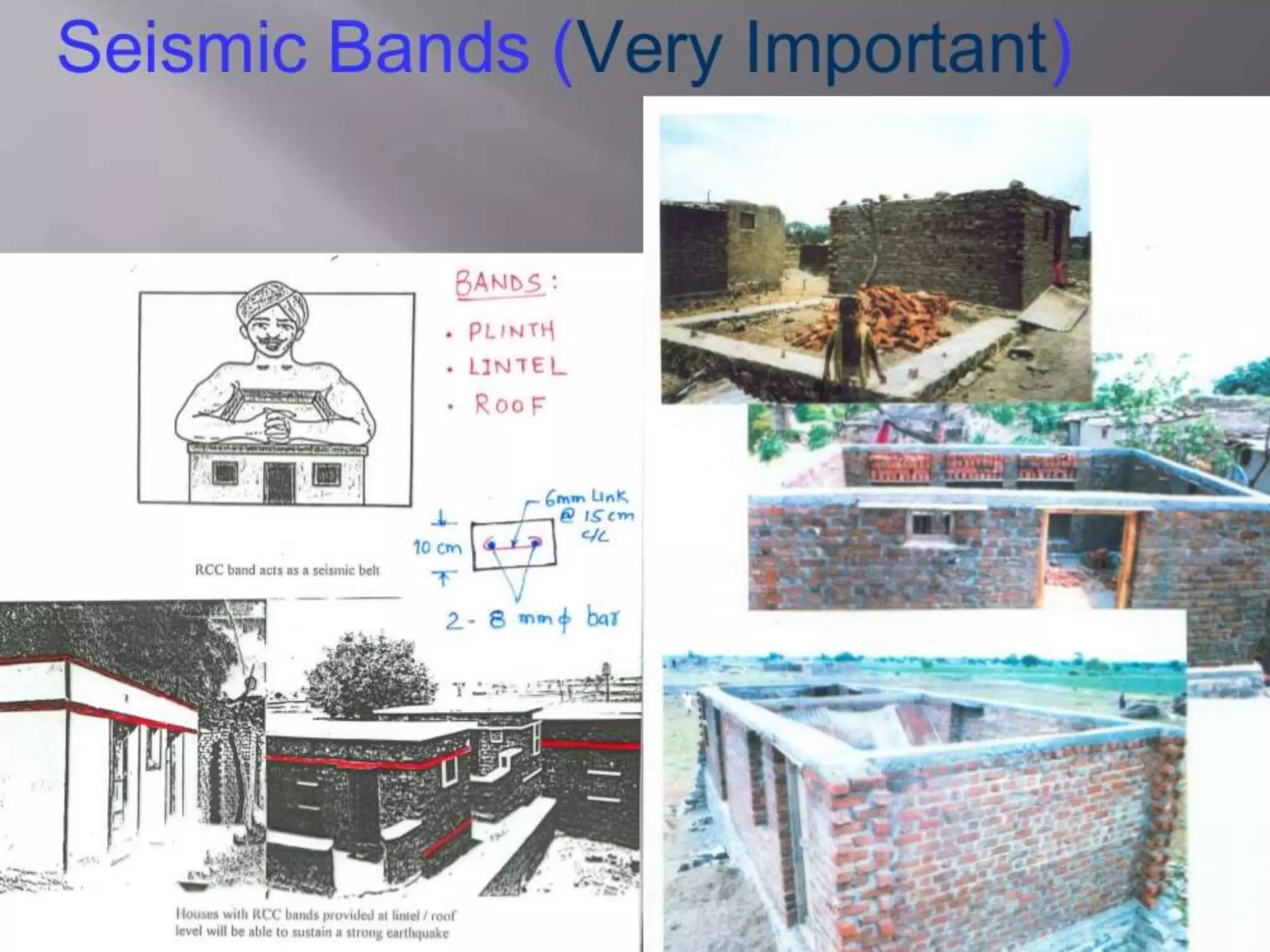
 Horizontal lintel band should be provided
 Revision/ updating of building code of INDIA
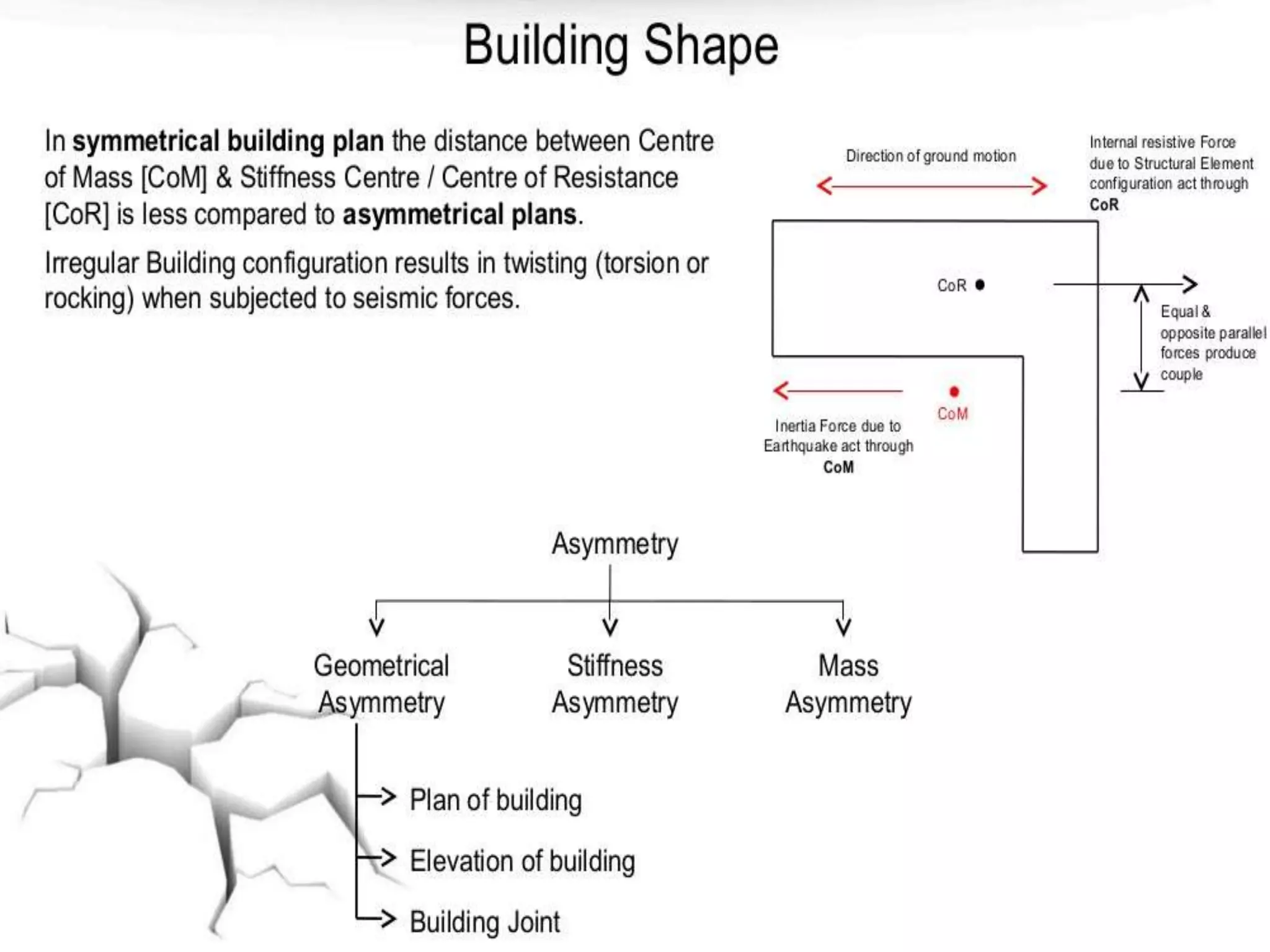
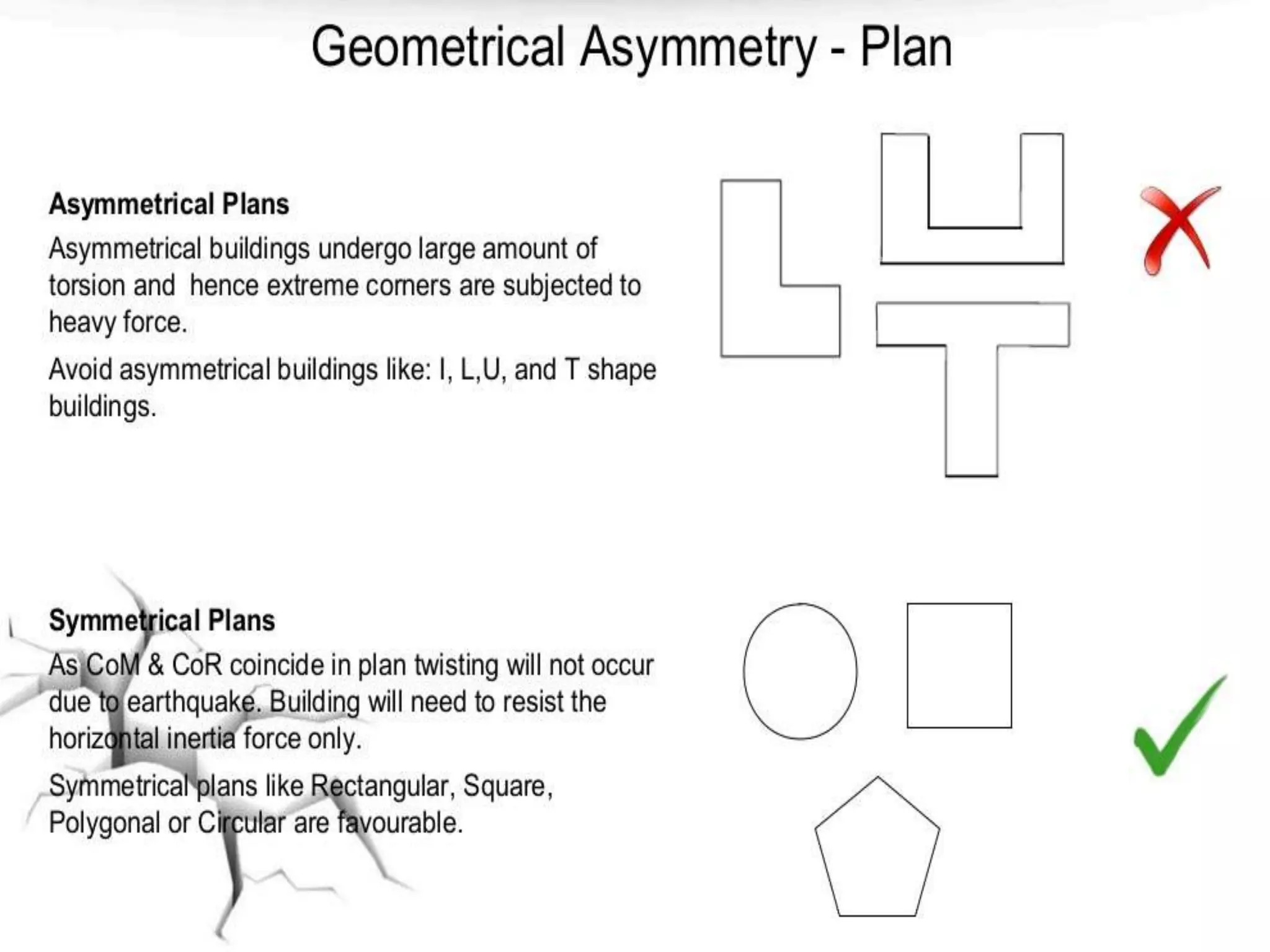
 The building must be regular and symmetrical in
shape
 Reinforcing bars should be provided at the corners
and the junctions of the walls….
 Design the structure to resist the loads for safety
against Earthquakes.
 Base isolation can also be used for retrofitting of
structure .
 Construct symmetrical structure to avoid torsion.
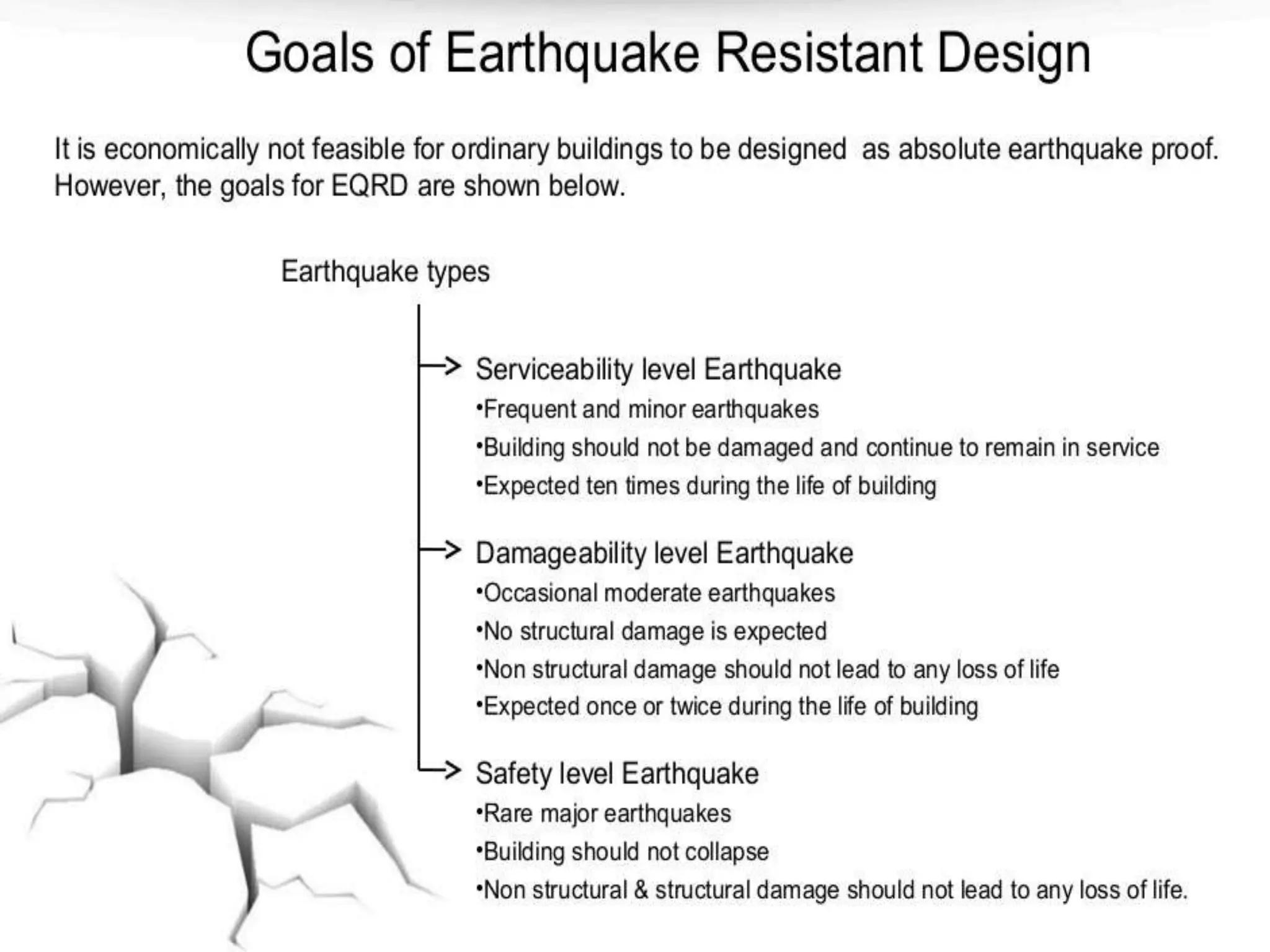
 No structure on the planet can be constructed 100%
earthquake proof , only its resistance to earthquake
can be increased .
 Earthquakes are not predictable .
 Construct Earthquake-Resistant Structures .
 It is possible to evaluate the earthquake forces acting
on the structure.
 Design the structure to resist the above loads for
safety against Earthquakes.
 Base isolation can also be used for retrofitting of
structure.
 WHILE EARTHQUAKES ARE INEVITABLE, EACH
EARTHQUAKE NEED NOT CONVERT INTO A
DISASTER... AS WHAT COMES IN BETWEEN IS A
CULTURE OF SAFETY &
PREVENTATION…………..

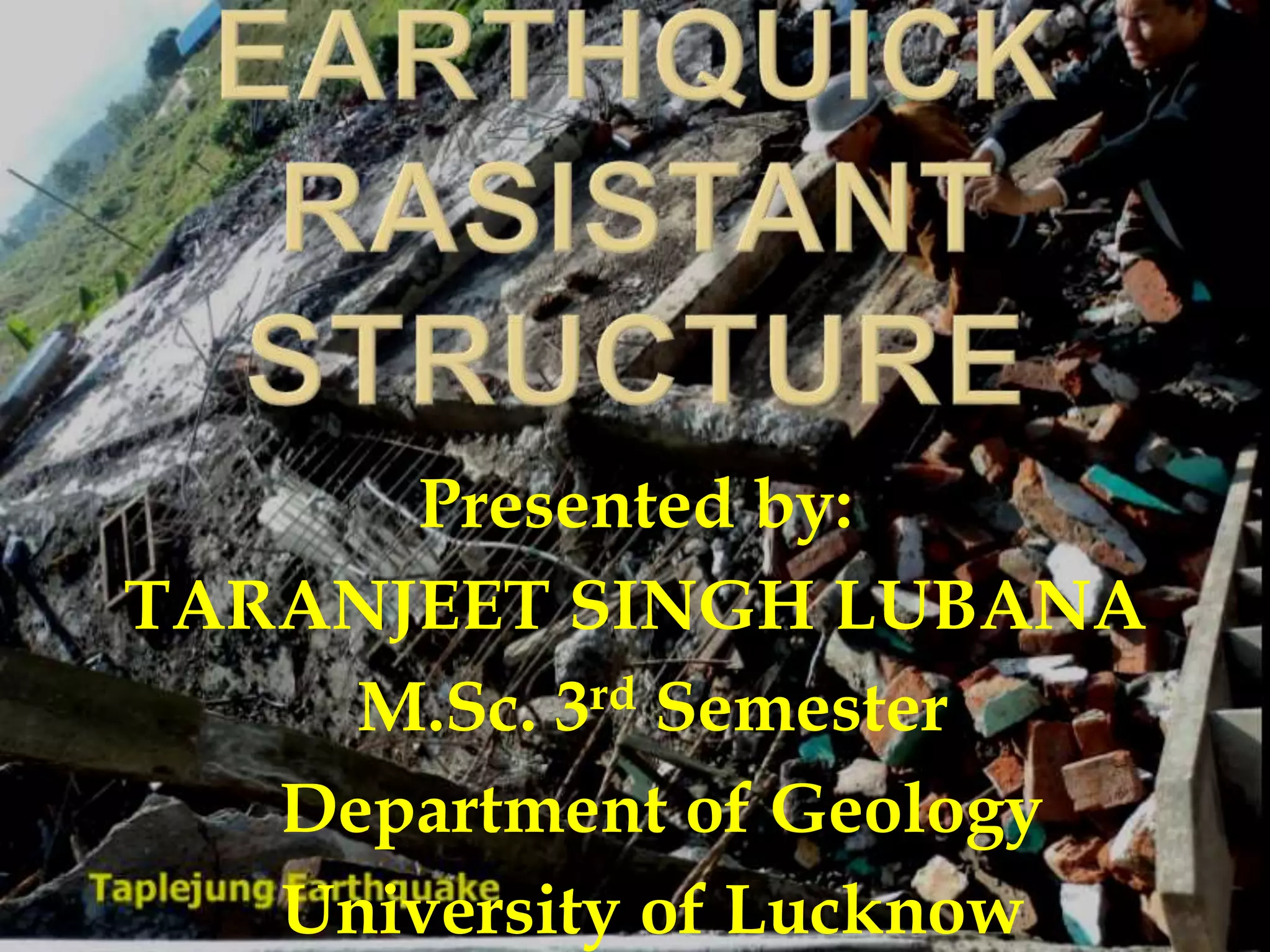
Earthquick rasistant structure

  • 1.
    Presented by: TARANJEET SINGHLUBANA M.Sc. 3rd Semester Department of Geology University of Lucknow
  • 10.
     When theground shakes, building responds to the acceleration transmitted from the ground through the structure foundations.  The inertia ( which wants to sty at rest) can cause shearing of the structure which can concentrate stresses on the weak walls or the joints in the structure resulting in failure or perhaps total collapse.  The type of shaking and frequency depends on the structure .  Tall buildings tends to amplify the motion of the buildings as compare to smaller one’s.
  • 11.
     During earthquakescolumns undergo relative moment between there're ends and forms plastic hinges and cause ultimate failure .  Earthquake causes vertical displacement as well as horizontal .  Generally structure are primarily designed to carry the gravity loads so that the design of gravity loads is adequate for earthquake shake at vertical direction but may not be able to sustain the effects in horizontal direction.
  • 12.
     As weknow that earthquake causes shaking so building rest on the ground will automatically experience motion at its base but roof or upper portion of building stay in its original position due to inertia(mass) , the motion of the ground is different from that of roof and ultimately column failure at ground floor takes place.
  • 19.
     Designing ofstructure is done manually after analysis of structure is done .  Using Data Analysis all the structural elements in building are designed .  Generally the structural elements are :--- 1. Beams 2. Columns 3. Slabs 4. Foundation 5. Shear wall 6. Bracing of Masonry walls 7. Bracings etc…..
  • 20.
     There aretwo ways to safeguard a building against earthquake , one way is strengthening all structural elements & second way is reducing the impact of seismic forces on building , rather than strengthening it .  And these ways are :-  FIRST APPROACH 1. Shear wall 2. Bracings 3. Moment resisting frames.  SECOND APPROACH 1. Base isolation technique. 2. Energy Dissipation Devices
  • 21.
     In structuralengineering, a shear wall is a vertical element of a seismic force resisting system and that is designed to resist in plane lateral forces , wind and seismic loads.  A structure of shear walls is provided in the center of a large building often encasing an elevator shaft or stairwells , or sides of buildings.
  • 22.
     Generally bracingare steel members provide to resist lateral forces acting on the building .  Bracings are provided at joints , masonry walls , or provided to whole structure.
  • 27.
     Used forboth structural steel and reinforced concrete construction.  The horizontal beams and vertical columns provide both support for the structure’s weight and the strength and stiffness needed to resist lateral forces.  Stiffness and strength are achieved through the use of rigid connections between the beams and columns that prevent these elements from rotating relative to one other.  Moment-resisting frame systems are popular because they do not require braced frames or structural walls, therefore permitting large open spaces and facades with many unobstructed window openings .
  • 28.
     To reducethe intent of earthquake base isolation is done and it is one of the most popular means of protecting a structure against earthquake forces.  For e.g. buildings , base-isolation may be achieved by reducing the coefficient of friction between structure and its foundation or by placing a flexible connection between the structure and its foundation.  A flexible joint is used between column and footing at the floor level , it separates super structure from the foundation, thus during earthquake no vibration is carried to the superstructure .
  • 30.
     INTRODUCE FLEXIBILITY TOTHE STRUCTERS.  BUILDING IS RESTED ON FLEXIBLE PADS (BASE ISOLATORS.)  WHEN EARTHQUAKE STRIKES THE BUILDING DOES NOT MOVES.  BUT It is suitable for hard soil only.
  • 35.
     THESE AREUSED IN PLACE OF STRUCTURAL ELEMENTS SUCH AS DIAGONAL BRACES.  ACT LIKE HYDRAULIC SHOCK ABSORBERS.  WHEN SEISMIC ENERGY TRANSMITTED THROUGH THEM, DAMPERS ABSORB PART OF IT, & THUS DAMP THE MOTION OF THE BUILDING.
  • 37.
    TYPES OF SEISMICDAMPERS  VISCOUS DAMPERS:- ENERGY IS ABSORBED BY SILICON BASED FLUID PASSING BETWEEN PISTON CYLINDER ARRANGEMENTS.  FRICTION DAMPERS:- ENERGY ABSORBED BY SURFACE WITH FRICTION BETWEEN THEM RUBBING AGAINST EACH OTHER.  YIELDING DAMPERS:- ENERGY IS ABSORBED BY METALLIC COMPONENTS THAT YIELD.  VISCO ELASTIC DAMPERS:- ENERGY IS ABSORBED BY UTILIZING THE CONTROLLED SHEARING OF SOLIDS.
  • 48.
     Avoid weakcolumn and strong beam design  Provide thick slab which will help as a rigid diaphragm  Provide cross walls which will stiffen the structures  Provide shear walls in a symmetrical fashion  Increase in the transverse (Shear) reinforcement.  Horizontal lintel band should be provided  Revision/ updating of building code of INDIA  The building must be regular and symmetrical in shape  Reinforcing bars should be provided at the corners and the junctions of the walls….
  • 50.
     Design thestructure to resist the loads for safety against Earthquakes.  Base isolation can also be used for retrofitting of structure .  Construct symmetrical structure to avoid torsion.  No structure on the planet can be constructed 100% earthquake proof , only its resistance to earthquake can be increased .  Earthquakes are not predictable .  Construct Earthquake-Resistant Structures .
  • 51.
     It ispossible to evaluate the earthquake forces acting on the structure.  Design the structure to resist the above loads for safety against Earthquakes.  Base isolation can also be used for retrofitting of structure.  WHILE EARTHQUAKES ARE INEVITABLE, EACH EARTHQUAKE NEED NOT CONVERT INTO A DISASTER... AS WHAT COMES IN BETWEEN IS A CULTURE OF SAFETY & PREVENTATION…………..