Dr. K. Ravikumar
Associate Professor
Department of Civil Engg
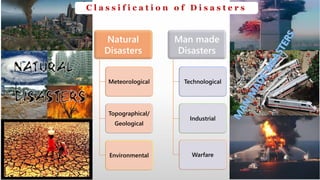
C l a s s i f i c a t i o n o f D i s a s t e r s
Natural
Disasters
Meteorological
Topographical/
Geological
Environmental
Man made
Disasters
Technological
Industrial
Warfare
2
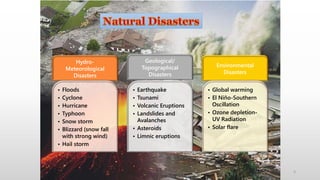
Hydro-
Meteorological
Disasters
• Floods
• Cyclone
• Hurricane
• Typhoon
• Snow storm
• Blizzard (snow fall
with strong wind)
• Hail storm
Geological/
Topographical
Disasters
• Earthquake
• Tsunami
• Volcanic Eruptions
• Landslides and
Avalanches
• Asteroids
• Limnic eruptions
Environmental
Disasters
• Global warming
• El Niño-Southern
Oscillation
• Ozone depletion-
UV Radiation
• Solar flare
3
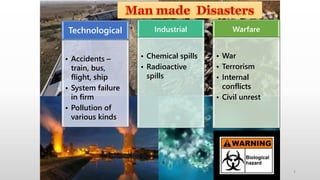
Technological
• Accidents –
train, bus,
flight, ship
• System failure
in firm
• Pollution of
various kinds
Industrial
• Chemical spills
• Radioactive
spills
Warfare
• War
• Terrorism
• Internal
conflicts
• Civil unrest
4
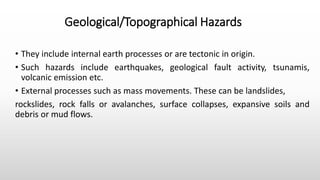
Geological/Topographical Hazards
• They include internal earth processes or are tectonic in origin.
• Such hazards include earthquakes, geological fault activity, tsunamis,
volcanic emission etc.
• External processes such as mass movements. These can be landslides,
rockslides, rock falls or avalanches, surface collapses, expansive soils and
debris or mud flows.
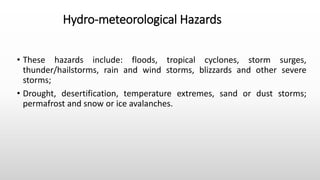
Hydro-meteorological Hazards
• These hazards include: floods, tropical cyclones, storm surges,
thunder/hailstorms, rain and wind storms, blizzards and other severe
storms;
• Drought, desertification, temperature extremes, sand or dust storms;
permafrost and snow or ice avalanches.
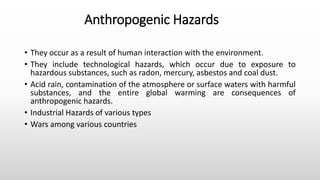
Anthropogenic Hazards
• They occur as a result of human interaction with the environment.
• They include technological hazards, which occur due to exposure to
hazardous substances, such as radon, mercury, asbestos and coal dust.
• Acid rain, contamination of the atmosphere or surface waters with harmful
substances, and the entire global warming are consequences of
anthropogenic hazards.
• Industrial Hazards of various types
• Wars among various countries
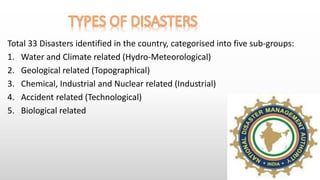
Total 33 Disasters identified in the country, categorised into five sub-groups:
1. Water and Climate related (Hydro-Meteorological)
2. Geological related (Topographical)
3. Chemical, Industrial and Nuclear related (Industrial)
4. Accident related (Technological)
5. Biological related
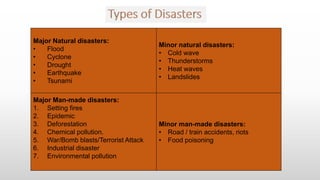
Major Natural disasters:
• Flood
• Cyclone
• Drought
• Earthquake
• Tsunami
Minor natural disasters:
• Cold wave
• Thunderstorms
• Heat waves
• Landslides
Major Man-made disasters:
1. Setting fires
2. Epidemic
3. Deforestation
4. Chemical pollution.
5. War/Bomb blasts/Terrorist Attack
6. Industrial disaster
7. Environmental pollution
Minor man-made disasters:
• Road / train accidents, riots
• Food poisoning
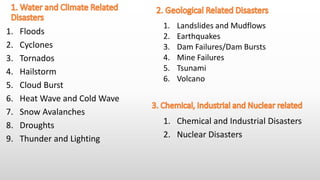
1. Floods
2. Cyclones
3. Tornados
4. Hailstorm
5. Cloud Burst
6. Heat Wave and Cold Wave
7. Snow Avalanches
8. Droughts
9. Thunder and Lighting
1. Landslides and Mudflows
2. Earthquakes
3. Dam Failures/Dam Bursts
4. Mine Failures
5. Tsunami
6. Volcano
1. Chemical and Industrial Disasters
2. Nuclear Disasters
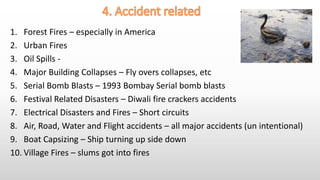
1. Forest Fires – especially in America
2. Urban Fires
3. Oil Spills -
4. Major Building Collapses – Fly overs collapses, etc
5. Serial Bomb Blasts – 1993 Bombay Serial bomb blasts
6. Festival Related Disasters – Diwali fire crackers accidents
7. Electrical Disasters and Fires – Short circuits
8. Air, Road, Water and Flight accidents – all major accidents (un intentional)
9. Boat Capsizing – Ship turning up side down
10. Village Fires – slums got into fires
Largest oil spills.
Spill / Tanker Location Date
Tonnes of crude oil
(thousands)[a]
Barrels
(thousands)
US Gallons
(thousands)
References
Kuwaiti oil fires[dubious –
discuss] [b] Kuwait
January 16, 1991 -
November 6, 1991
136,000 1,000,000 42,000,000 [5][6]
Kuwaiti oil lakes [c] Kuwait
January 1991 -November
1991
3,409-6,818 25,000-50,000 1,050,000-2,100,000 [7][8][9]
Lakeview Gusher
United States, Kern
County, California
March 14, 1910 –
September 1911
1,200 9,000 378,000 [10]
Gulf War oil spill [d] Kuwait, Iraq, and
the Persian Gulf
January 19, 1991 -January
28, 1991
818–1,091 6,000–8,000 252,000–336,000 [8][12][13]
Deepwater Horizon
United States, Gulf of
Mexico
April 20, 2010 – July 15,
2010
560-585 4,100-4,900 172,000-180,800 [14][15][16][17][18]
Ixtoc I Mexico, Gulf of Mexico
June 3, 1979 –March 23,
1980
454–480 3,329–3,520 139,818–147,840 [19][20][21]
Atlantic
Empress / Aegean
Captain
Trinidad and Tobago July 19, 1979 287 2,105 88,396 [22][23][24]
Fergana Valley Uzbekistan March 2, 1992 285 2,090 87,780 [25]
Nowruz Field Platform Iran, Persian Gulf February 4, 1983 260 1,907 80,080 [26]
ABT Summer
Angola, 700 nmi
(1,300 km; 810 mi)
offshore
May 28, 1991 260 1,907 80,080 [22]
Castillo de Bellver
South Africa, Saldanha
Bay
August 6, 1983 252 1,848 77,616 [22]
Amoco Cadiz France, Brittany March 16, 1978 223 1,635 68,684 [22][25][25][27][28]
MAJOR OIL SPILLS IN THE WORLD
1. Biological Disasters and Epidemics - devastating effects caused by an
enormous spread of a certain kind of living organism – that may spread a
disease. e.g., a locusts, plague, chickengunya virus etc.
2. Pest Attacks - A pest is any living organism which is invasive, detrimental,
troublesome, a nuisance to either plants or animals, human or human
concerns, livestock, human structures, wild ecosystems etc.
3. Cattle Epidemics – Cattle Diseases, diseases due to non-veg consumption
etc.,
4. Food Poisoning - illness caused by bacteria or other toxins in food, typically
with vomiting and diarrhea
More than 250 different diseases can cause food poisoning. Some of the
most common diseases are infections caused by bacteria, such as
Campylobacter, Salmonella, Shigella, E. coli O157:H7, Listeria, botulism,
and norovirus.
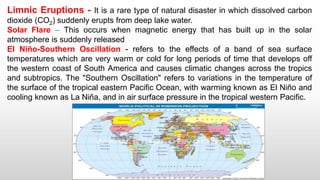
Limnic Eruptions - It is a rare type of natural disaster in which dissolved carbon
dioxide (CO2) suddenly erupts from deep lake water.
Solar Flare – This occurs when magnetic energy that has built up in the solar
atmosphere is suddenly released
El Niño-Southern Oscillation - refers to the effects of a band of sea surface
temperatures which are very warm or cold for long periods of time that develops off
the western coast of South America and causes climatic changes across the tropics
and subtropics. The "Southern Oscillation" refers to variations in the temperature of
the surface of the tropical eastern Pacific Ocean, with warming known as El Niño and
cooling known as La Niña, and in air surface pressure in the tropical western Pacific.
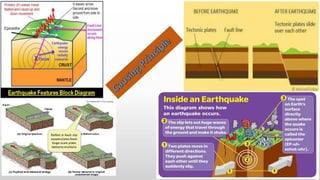
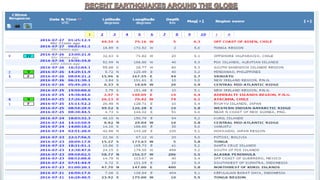
An earthquake (also known as a quake, tremor or temblor) is the perceptible shaking of the surface of
the Earth, which can be violent enough to destroy major buildings and kill thousands of people. The
severity of the shaking can range from barely felt to violent enough to toss people around.
Earthquakes are measured using observations from seismometers.
The moment magnitude is the most common scale to measure earthquakes larger than approximately
5 are reported for the entire globe.
The Richter magnitude scale is used to measure earthquakes smaller than magnitude 5.
These two scales are numerically similar over their range of validity.
Magnitude <=3 are mostly almost imperceptible or weak and magnitude >7 potentially cause serious
damage over larger areas, depending on their depth.
The largest earthquakes in historic times have been of magnitude slightly over 9, although there is no
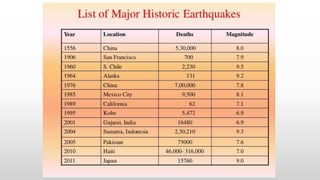
limit to the possible magnitude. The most recent large earthquake of 9.0 magnitude in Japan in 2011 (as
of March 2014), and it was the largest Japanese earthquake since records began.
Naturally occurring earthquakes
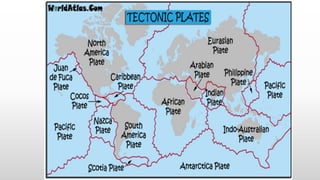
Tectonic earthquakes occur anywhere in the earth where there is sufficient stored elastic strain
energy to drive fracture propagation along a fault plane. The sides of a fault move past each other
smoothly and aseismically only if there are no irregularities or asperities along the fault surface that
increase the frictional resistance. Most fault surfaces do have such asperities and this leads to a form
of stick-slip behaviour. Once the fault has locked, continued relative motion between the plates leads
to increasing stress and therefore, stored strain energy in the volume around the fault surface. This
continues until the stress has risen sufficiently to break through the asperity, suddenly allowing
sliding over the locked portion of the fault, releasing the stored energy.
This energy is released as a combination of radiated elastic strain seismic waves, frictional heating of
the fault surface, and cracking of the rock, thus causing an earthquake. This process of gradual build-
up of strain and stress followed by occasional sudden frictional failure is referred to as the elastic-
rebound theory. It is estimated that only 10 percent or less of an earthquake's total energy is
radiated as seismic energy. Most of the earthquake's energy is used to power the
earthquake fracture growth or is converted into heat generated by friction.
Size and frequency of occurrence
It is estimated that around 5,00,000 earthquakes occur each year, detectable
with current instrumentation. About 1,00,000 of these can be felt. Minor
earthquakes occur nearly constantly around the world in places
like California and Alaska in the U.S., as well as in El
Salvador, Mexico, Chile, Peru, Indonesia, Iran, Pakistan, the Azores
in Portugal, Turkey, New Zealand, Greece, Italy, India, Nepal and Japan, but
earthquakes can occur almost anywhere, including Downstate New
York, England, and Australia.
Larger earthquakes occur less frequently, the relationship being exponential; for
example, roughly ten times as many earthquakes larger than magnitude 4 occur
in a particular time period than earthquakes larger than magnitude 5. In the
(low seismicity) United Kingdom, for example, it has been calculated that the
average recurrences are: an earthquake of 3.7–4.6 every year, an earthquake of
4.7–5.5 every 10 years, and an earthquake of 5.6 or larger every 100 years.
Induced seismicity
While most earthquakes are caused by movement of the Earth's tectonic plates,
human activity can also produce earthquakes. Four main activities contribute to
this phenomenon: (a) storing large amounts of water behind a dam (and
possibly building an extremely heavy building), (b) drilling and injecting liquid
into wells, by (c)coal mining and (d) oil drilling.
Measuring and locating earthquakes
• Earthquakes can be recorded by seismometers up to great distances,
because seismic waves travel through the whole Earth's interior. The absolute
magnitude of a quake is conventionally reported by numbers on the moment
magnitude scale (magnitude >7 causing serious damage over large areas),
whereas the felt magnitude is reported using the Richter scale.
• Every tremor produces different types of seismic waves, which travel through
rock with different velocities:
• Longitudinal P-waves (shock- or pressure waves)
• Transverse S-waves (both body waves)
• Surface waves — (Rayleigh and Love waves)
Propagation velocity of the seismic waves ranges from approx. 3 km/s up to
13 km/s, depending on the density and elasticity of the medium. In the Earth's
interior, the shock- or P waves travel much faster than the S waves (approx.
relation 1.7 : 1).
The differences in travel time from the epicentre to the observatory are a
measure of the distance and can be used to image both sources of quakes and
structures within the Earth. Also the depth of the hypocentre can be computed
roughly.
In solid rock P-waves travel at about 6 to 7 km per second; the velocity increases
within the deep mantle to ~13 km/s. The velocity of S-waves ranges from 2–
3 km/s in light sediments and 4–5 km/s in the Earth's crust up to 7 km/s in the
deep mantle.
Effects of earthquakes
1. Shaking and ground rupture
2. Landslides and avalanches
3. Soil liquefaction
4. Fires
5. Tsunami
6. Human impacts – loss of life, causalities
7. Property damage etc
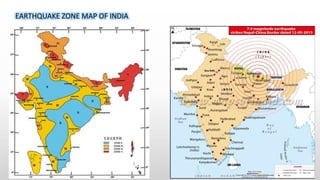
EARTHQUAKE ZONE MAP OF INDIA
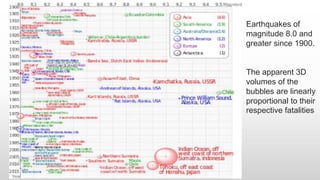
Earthquakes of
magnitude 8.0 and
greater since 1900.
The apparent 3D
volumes of the
bubbles are linearly
proportional to their
respective fatalities
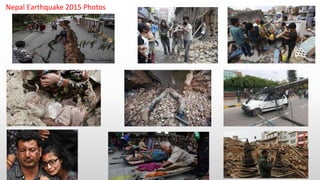
Nepal Earthquake 2015 Photos

Unit ii disaster types and earthquake

  • 1.
    Dr. K. Ravikumar AssociateProfessor Department of Civil Engg
  • 2.
    C l as s i f i c a t i o n o f D i s a s t e r s Natural Disasters Meteorological Topographical/ Geological Environmental Man made Disasters Technological Industrial Warfare 2
  • 3.
    Hydro- Meteorological Disasters • Floods • Cyclone •Hurricane • Typhoon • Snow storm • Blizzard (snow fall with strong wind) • Hail storm Geological/ Topographical Disasters • Earthquake • Tsunami • Volcanic Eruptions • Landslides and Avalanches • Asteroids • Limnic eruptions Environmental Disasters • Global warming • El Niño-Southern Oscillation • Ozone depletion- UV Radiation • Solar flare 3
  • 4.
    Technological • Accidents – train,bus, flight, ship • System failure in firm • Pollution of various kinds Industrial • Chemical spills • Radioactive spills Warfare • War • Terrorism • Internal conflicts • Civil unrest 4
  • 5.
    Geological/Topographical Hazards • Theyinclude internal earth processes or are tectonic in origin. • Such hazards include earthquakes, geological fault activity, tsunamis, volcanic emission etc. • External processes such as mass movements. These can be landslides, rockslides, rock falls or avalanches, surface collapses, expansive soils and debris or mud flows.
  • 6.
    Hydro-meteorological Hazards • Thesehazards include: floods, tropical cyclones, storm surges, thunder/hailstorms, rain and wind storms, blizzards and other severe storms; • Drought, desertification, temperature extremes, sand or dust storms; permafrost and snow or ice avalanches.
  • 7.
    Anthropogenic Hazards • Theyoccur as a result of human interaction with the environment. • They include technological hazards, which occur due to exposure to hazardous substances, such as radon, mercury, asbestos and coal dust. • Acid rain, contamination of the atmosphere or surface waters with harmful substances, and the entire global warming are consequences of anthropogenic hazards. • Industrial Hazards of various types • Wars among various countries
  • 8.
    Total 33 Disastersidentified in the country, categorised into five sub-groups: 1. Water and Climate related (Hydro-Meteorological) 2. Geological related (Topographical) 3. Chemical, Industrial and Nuclear related (Industrial) 4. Accident related (Technological) 5. Biological related
  • 9.
    Major Natural disasters: •Flood • Cyclone • Drought • Earthquake • Tsunami Minor natural disasters: • Cold wave • Thunderstorms • Heat waves • Landslides Major Man-made disasters: 1. Setting fires 2. Epidemic 3. Deforestation 4. Chemical pollution. 5. War/Bomb blasts/Terrorist Attack 6. Industrial disaster 7. Environmental pollution Minor man-made disasters: • Road / train accidents, riots • Food poisoning
  • 10.
    1. Floods 2. Cyclones 3.Tornados 4. Hailstorm 5. Cloud Burst 6. Heat Wave and Cold Wave 7. Snow Avalanches 8. Droughts 9. Thunder and Lighting 1. Landslides and Mudflows 2. Earthquakes 3. Dam Failures/Dam Bursts 4. Mine Failures 5. Tsunami 6. Volcano 1. Chemical and Industrial Disasters 2. Nuclear Disasters
  • 11.
    1. Forest Fires– especially in America 2. Urban Fires 3. Oil Spills - 4. Major Building Collapses – Fly overs collapses, etc 5. Serial Bomb Blasts – 1993 Bombay Serial bomb blasts 6. Festival Related Disasters – Diwali fire crackers accidents 7. Electrical Disasters and Fires – Short circuits 8. Air, Road, Water and Flight accidents – all major accidents (un intentional) 9. Boat Capsizing – Ship turning up side down 10. Village Fires – slums got into fires
  • 12.
    Largest oil spills. Spill/ Tanker Location Date Tonnes of crude oil (thousands)[a] Barrels (thousands) US Gallons (thousands) References Kuwaiti oil fires[dubious – discuss] [b] Kuwait January 16, 1991 - November 6, 1991 136,000 1,000,000 42,000,000 [5][6] Kuwaiti oil lakes [c] Kuwait January 1991 -November 1991 3,409-6,818 25,000-50,000 1,050,000-2,100,000 [7][8][9] Lakeview Gusher United States, Kern County, California March 14, 1910 – September 1911 1,200 9,000 378,000 [10] Gulf War oil spill [d] Kuwait, Iraq, and the Persian Gulf January 19, 1991 -January 28, 1991 818–1,091 6,000–8,000 252,000–336,000 [8][12][13] Deepwater Horizon United States, Gulf of Mexico April 20, 2010 – July 15, 2010 560-585 4,100-4,900 172,000-180,800 [14][15][16][17][18] Ixtoc I Mexico, Gulf of Mexico June 3, 1979 –March 23, 1980 454–480 3,329–3,520 139,818–147,840 [19][20][21] Atlantic Empress / Aegean Captain Trinidad and Tobago July 19, 1979 287 2,105 88,396 [22][23][24] Fergana Valley Uzbekistan March 2, 1992 285 2,090 87,780 [25] Nowruz Field Platform Iran, Persian Gulf February 4, 1983 260 1,907 80,080 [26] ABT Summer Angola, 700 nmi (1,300 km; 810 mi) offshore May 28, 1991 260 1,907 80,080 [22] Castillo de Bellver South Africa, Saldanha Bay August 6, 1983 252 1,848 77,616 [22] Amoco Cadiz France, Brittany March 16, 1978 223 1,635 68,684 [22][25][25][27][28] MAJOR OIL SPILLS IN THE WORLD
  • 13.
    1. Biological Disastersand Epidemics - devastating effects caused by an enormous spread of a certain kind of living organism – that may spread a disease. e.g., a locusts, plague, chickengunya virus etc. 2. Pest Attacks - A pest is any living organism which is invasive, detrimental, troublesome, a nuisance to either plants or animals, human or human concerns, livestock, human structures, wild ecosystems etc. 3. Cattle Epidemics – Cattle Diseases, diseases due to non-veg consumption etc., 4. Food Poisoning - illness caused by bacteria or other toxins in food, typically with vomiting and diarrhea More than 250 different diseases can cause food poisoning. Some of the most common diseases are infections caused by bacteria, such as Campylobacter, Salmonella, Shigella, E. coli O157:H7, Listeria, botulism, and norovirus.
  • 14.
    Limnic Eruptions -It is a rare type of natural disaster in which dissolved carbon dioxide (CO2) suddenly erupts from deep lake water. Solar Flare – This occurs when magnetic energy that has built up in the solar atmosphere is suddenly released El Niño-Southern Oscillation - refers to the effects of a band of sea surface temperatures which are very warm or cold for long periods of time that develops off the western coast of South America and causes climatic changes across the tropics and subtropics. The "Southern Oscillation" refers to variations in the temperature of the surface of the tropical eastern Pacific Ocean, with warming known as El Niño and cooling known as La Niña, and in air surface pressure in the tropical western Pacific.
  • 15.
    An earthquake (alsoknown as a quake, tremor or temblor) is the perceptible shaking of the surface of the Earth, which can be violent enough to destroy major buildings and kill thousands of people. The severity of the shaking can range from barely felt to violent enough to toss people around. Earthquakes are measured using observations from seismometers. The moment magnitude is the most common scale to measure earthquakes larger than approximately 5 are reported for the entire globe. The Richter magnitude scale is used to measure earthquakes smaller than magnitude 5. These two scales are numerically similar over their range of validity. Magnitude <=3 are mostly almost imperceptible or weak and magnitude >7 potentially cause serious damage over larger areas, depending on their depth. The largest earthquakes in historic times have been of magnitude slightly over 9, although there is no limit to the possible magnitude. The most recent large earthquake of 9.0 magnitude in Japan in 2011 (as of March 2014), and it was the largest Japanese earthquake since records began.
  • 17.
    Naturally occurring earthquakes Tectonicearthquakes occur anywhere in the earth where there is sufficient stored elastic strain energy to drive fracture propagation along a fault plane. The sides of a fault move past each other smoothly and aseismically only if there are no irregularities or asperities along the fault surface that increase the frictional resistance. Most fault surfaces do have such asperities and this leads to a form of stick-slip behaviour. Once the fault has locked, continued relative motion between the plates leads to increasing stress and therefore, stored strain energy in the volume around the fault surface. This continues until the stress has risen sufficiently to break through the asperity, suddenly allowing sliding over the locked portion of the fault, releasing the stored energy. This energy is released as a combination of radiated elastic strain seismic waves, frictional heating of the fault surface, and cracking of the rock, thus causing an earthquake. This process of gradual build- up of strain and stress followed by occasional sudden frictional failure is referred to as the elastic- rebound theory. It is estimated that only 10 percent or less of an earthquake's total energy is radiated as seismic energy. Most of the earthquake's energy is used to power the earthquake fracture growth or is converted into heat generated by friction.
  • 18.
    Size and frequencyof occurrence It is estimated that around 5,00,000 earthquakes occur each year, detectable with current instrumentation. About 1,00,000 of these can be felt. Minor earthquakes occur nearly constantly around the world in places like California and Alaska in the U.S., as well as in El Salvador, Mexico, Chile, Peru, Indonesia, Iran, Pakistan, the Azores in Portugal, Turkey, New Zealand, Greece, Italy, India, Nepal and Japan, but earthquakes can occur almost anywhere, including Downstate New York, England, and Australia. Larger earthquakes occur less frequently, the relationship being exponential; for example, roughly ten times as many earthquakes larger than magnitude 4 occur in a particular time period than earthquakes larger than magnitude 5. In the (low seismicity) United Kingdom, for example, it has been calculated that the average recurrences are: an earthquake of 3.7–4.6 every year, an earthquake of 4.7–5.5 every 10 years, and an earthquake of 5.6 or larger every 100 years.
  • 19.
    Induced seismicity While mostearthquakes are caused by movement of the Earth's tectonic plates, human activity can also produce earthquakes. Four main activities contribute to this phenomenon: (a) storing large amounts of water behind a dam (and possibly building an extremely heavy building), (b) drilling and injecting liquid into wells, by (c)coal mining and (d) oil drilling.
  • 20.
    Measuring and locatingearthquakes • Earthquakes can be recorded by seismometers up to great distances, because seismic waves travel through the whole Earth's interior. The absolute magnitude of a quake is conventionally reported by numbers on the moment magnitude scale (magnitude >7 causing serious damage over large areas), whereas the felt magnitude is reported using the Richter scale. • Every tremor produces different types of seismic waves, which travel through rock with different velocities: • Longitudinal P-waves (shock- or pressure waves) • Transverse S-waves (both body waves) • Surface waves — (Rayleigh and Love waves)
  • 21.
    Propagation velocity ofthe seismic waves ranges from approx. 3 km/s up to 13 km/s, depending on the density and elasticity of the medium. In the Earth's interior, the shock- or P waves travel much faster than the S waves (approx. relation 1.7 : 1). The differences in travel time from the epicentre to the observatory are a measure of the distance and can be used to image both sources of quakes and structures within the Earth. Also the depth of the hypocentre can be computed roughly. In solid rock P-waves travel at about 6 to 7 km per second; the velocity increases within the deep mantle to ~13 km/s. The velocity of S-waves ranges from 2– 3 km/s in light sediments and 4–5 km/s in the Earth's crust up to 7 km/s in the deep mantle.
  • 22.
    Effects of earthquakes 1.Shaking and ground rupture 2. Landslides and avalanches 3. Soil liquefaction 4. Fires 5. Tsunami 6. Human impacts – loss of life, causalities 7. Property damage etc
  • 24.
  • 26.
    Earthquakes of magnitude 8.0and greater since 1900. The apparent 3D volumes of the bubbles are linearly proportional to their respective fatalities
  • 28.