Earned Value Analysis
By Er. NikhilRaj
BAC BUDGETED AT COMPLETION PV PLANNED VALUE EV
EARNED VALUE
SV SCHEDULE VARIANCE CV COST VARIANCE SPI SCHEDULE
PERFORMANCE INDEX
CPI COST PERFORMANCE INDEX EAC ESTIMATE AT COMPLETION ETC
ESTIMATE TO COMPLETION
VAC VARIANCE AT
COMPLETION
1/21/2016
1all rights reserved to www.tutomaash.com | any queries can be mailed to tutomaash@gmail.com
Performance measuring system | Forecasting system
Contents
• What is earned value?
• Why earned value?
• EVM practiced industries
• Application example
• Application of same example in primavera p6
• Generation of financial s-curve
1/21/2016
2
Definition
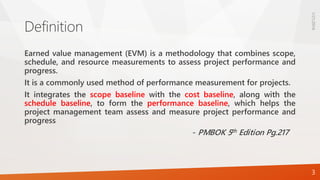
Earned value management (EVM) is a methodology that combines scope,
schedule, and resource measurements to assess project performance and
progress.
It is a commonly used method of performance measurement for projects.
It integrates the scope baseline with the cost baseline, along with the
schedule baseline, to form the performance baseline, which helps the
project management team assess and measure project performance and
progress
- PMBOK 5th Edition Pg.217
1/21/2016
3
Why EVM?
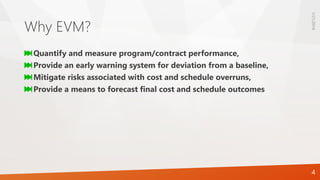
Quantify and measure program/contract performance,
Provide an early warning system for deviation from a baseline,
Mitigate risks associated with cost and schedule overruns,
Provide a means to forecast final cost and schedule outcomes
1/21/2016
4
EVM practiced industries
Department of Defense (DoD)
The Federal government
Construction
IT sector
Commercial sector
R&D
Aerospace
1/21/2016
5
Example
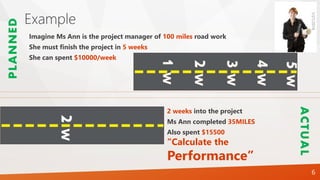
2 weeks into the project
Ms Ann completed 35MILES
Also spent $15500
“Calculate the
Performance”
Imagine Ms Ann is the project manager of 100 miles road work
She must finish the project in 5 weeks
She can spent $10000/week
PLANNED
ACTUAL
2W
4W
3W
2W
1W
5W
1/21/2016
6
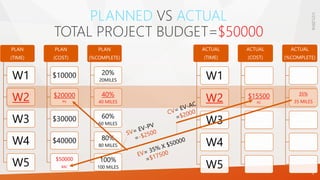
PLANNED VS ACTUAL
TOTAL PROJECT BUDGET=$50000
PLAN
(TIME)
W1
W2
W3
W4
W5
PLAN
(COST)
$10000
$20000
PV
$30000
$40000
$50000
BAC
PLAN
(%COMPLETE)
20%
20MILES
40%
40 MILES
60%
60 MILES
80%
80 MILES
100%
100 MILES
ACTUAL
(TIME)
W1
W2
W3
W4
W5
ACTUAL
(COST)
$15500
AC
ACTUAL
(%COMPLETE)
35%
35 MILES
1/21/2016
7
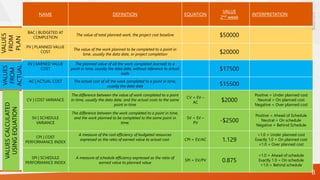
NAME DEFINITION EQUATION
VALUE
2nd week
INTERPRETATION
BAC | BUDGETED AT
COMPLETION
The value of total planned work, the project cost baseline $50000
PV | PLANNED VALUE
COST
The value of the work planned to be completed to a point in
time, usually the data date, or project completion $20000
EV | EARNED VALUE
COST
The planned value of all the work completed (earned) to a
point in time, usually the data date, without reference to actual
costs
$17500
AC | ACTUAL COST The actual cost of all the work completed to a point in time,
usually the data date $15500
CV | COST VARIANCE
The difference between the value of work completed to a point
in time, usually the data date, and the actual costs to the same
point in time
CV = EV –
AC $2000
Positive = Under planned cost
Neutral = On planned cost
Negative = Over planned cost
SV | SCHEDULE
VARIANCE
The difference between the work completed to a point in time,
and the work planned to be completed to the same point in
time.
SV = EV –
PV -$2500
Positive = Ahead of Schedule
Neutral = On schedule
Negative = Behind Schedule
CPI | COST
PERFORMANCE INDEX
A measure of the cost efficiency of budgeted resources
expressed as the ratio of earned value to actual cost. CPI = EV/AC 1.129
>1.0 = Under planned cost
Exactly 1.0 = On planned cost
<1.0 = Over planned cost
SPI | SCHEDULE
PERFORMANCE INDEX
A measure of schedule efficiency expressed as the ratio of
earned value to planned value
SPI = EV/PV 0.875
>1.0 = Ahead of schedule
Exactly 1.0 = On schedule
<1.0 = Behind schedule
VALUESCALCULATED
USINGEQUATION
VALUES
FROM
ACTUAL
VALUES
FROM
PLAN
1/21/2016
8
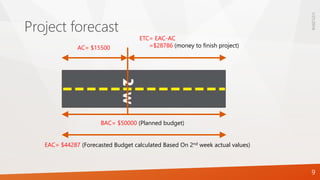
Project forecast
2WBAC= $50000 (Planned budget)
EAC= $44287 (Forecasted Budget calculated Based On 2nd week actual values)
ETC= EAC-AC
=$28786 (money to finish project)AC= $15500
1/21/2016
9
NAME DEFINITION EQUATION
VALUE
2nd week
EAC | ESTIMATE AT
COMPLETION
If the CPI is expected to be the same for the remainder of the
project, EAC can be calculated using EAC = BAC/CPI $44286.979
If future work will be accomplished at the planned rate, use: EAC = AC + BAC – EV $48000
If the initial plan is no longer valid, use: EAC = AC + Bottom-up ETC
If both the CPI and SPI influence the remaining work, use EAC = AC + [(BAC – EV)/(CPI x SPI)] $48398.899
ETC | ESTIMATE TO
COMPLETION
Assuming work is proceeding on plan, the cost of completing the
remaining authorized work can be calculated using:
ETC = EAC – AC $28786
Reestimate the remaining work from the bottom up ETC = Reestimate
VAC | VARIANCE AT
COMPLETION
The estimated difference in cost at the completion of the project.
Positive = Under planned cost
Neutral = On planned cost
Negative = Over planned cost
VAC = BAC – EAC $5713.021
1/21/2016
10
FORECASTEDVALUES
See Mix
in Action!
https://mix.office.com/watch/1otxpj7hz6kbx
(Copy the link and paste into your browser.
Or, when in a slide show, click the photo.)
1/21/2016
11
Get the add-in
Office Mix
Learn more at http://aka.ms/officemix
1/21/2016

Earned value analysis

  • 1.
    Earned Value Analysis ByEr. NikhilRaj BAC BUDGETED AT COMPLETION PV PLANNED VALUE EV EARNED VALUE SV SCHEDULE VARIANCE CV COST VARIANCE SPI SCHEDULE PERFORMANCE INDEX CPI COST PERFORMANCE INDEX EAC ESTIMATE AT COMPLETION ETC ESTIMATE TO COMPLETION VAC VARIANCE AT COMPLETION 1/21/2016 1all rights reserved to www.tutomaash.com | any queries can be mailed to tutomaash@gmail.com Performance measuring system | Forecasting system
  • 2.
    Contents • What isearned value? • Why earned value? • EVM practiced industries • Application example • Application of same example in primavera p6 • Generation of financial s-curve 1/21/2016 2
  • 3.
    Definition Earned value management(EVM) is a methodology that combines scope, schedule, and resource measurements to assess project performance and progress. It is a commonly used method of performance measurement for projects. It integrates the scope baseline with the cost baseline, along with the schedule baseline, to form the performance baseline, which helps the project management team assess and measure project performance and progress - PMBOK 5th Edition Pg.217 1/21/2016 3
  • 4.
    Why EVM? Quantify andmeasure program/contract performance, Provide an early warning system for deviation from a baseline, Mitigate risks associated with cost and schedule overruns, Provide a means to forecast final cost and schedule outcomes 1/21/2016 4
  • 5.
    EVM practiced industries Departmentof Defense (DoD) The Federal government Construction IT sector Commercial sector R&D Aerospace 1/21/2016 5
  • 6.
    Example 2 weeks intothe project Ms Ann completed 35MILES Also spent $15500 “Calculate the Performance” Imagine Ms Ann is the project manager of 100 miles road work She must finish the project in 5 weeks She can spent $10000/week PLANNED ACTUAL 2W 4W 3W 2W 1W 5W 1/21/2016 6
  • 7.
    PLANNED VS ACTUAL TOTALPROJECT BUDGET=$50000 PLAN (TIME) W1 W2 W3 W4 W5 PLAN (COST) $10000 $20000 PV $30000 $40000 $50000 BAC PLAN (%COMPLETE) 20% 20MILES 40% 40 MILES 60% 60 MILES 80% 80 MILES 100% 100 MILES ACTUAL (TIME) W1 W2 W3 W4 W5 ACTUAL (COST) $15500 AC ACTUAL (%COMPLETE) 35% 35 MILES 1/21/2016 7
  • 8.
    NAME DEFINITION EQUATION VALUE 2ndweek INTERPRETATION BAC | BUDGETED AT COMPLETION The value of total planned work, the project cost baseline $50000 PV | PLANNED VALUE COST The value of the work planned to be completed to a point in time, usually the data date, or project completion $20000 EV | EARNED VALUE COST The planned value of all the work completed (earned) to a point in time, usually the data date, without reference to actual costs $17500 AC | ACTUAL COST The actual cost of all the work completed to a point in time, usually the data date $15500 CV | COST VARIANCE The difference between the value of work completed to a point in time, usually the data date, and the actual costs to the same point in time CV = EV – AC $2000 Positive = Under planned cost Neutral = On planned cost Negative = Over planned cost SV | SCHEDULE VARIANCE The difference between the work completed to a point in time, and the work planned to be completed to the same point in time. SV = EV – PV -$2500 Positive = Ahead of Schedule Neutral = On schedule Negative = Behind Schedule CPI | COST PERFORMANCE INDEX A measure of the cost efficiency of budgeted resources expressed as the ratio of earned value to actual cost. CPI = EV/AC 1.129 >1.0 = Under planned cost Exactly 1.0 = On planned cost <1.0 = Over planned cost SPI | SCHEDULE PERFORMANCE INDEX A measure of schedule efficiency expressed as the ratio of earned value to planned value SPI = EV/PV 0.875 >1.0 = Ahead of schedule Exactly 1.0 = On schedule <1.0 = Behind schedule VALUESCALCULATED USINGEQUATION VALUES FROM ACTUAL VALUES FROM PLAN 1/21/2016 8
  • 9.
    Project forecast 2WBAC= $50000(Planned budget) EAC= $44287 (Forecasted Budget calculated Based On 2nd week actual values) ETC= EAC-AC =$28786 (money to finish project)AC= $15500 1/21/2016 9
  • 10.
    NAME DEFINITION EQUATION VALUE 2ndweek EAC | ESTIMATE AT COMPLETION If the CPI is expected to be the same for the remainder of the project, EAC can be calculated using EAC = BAC/CPI $44286.979 If future work will be accomplished at the planned rate, use: EAC = AC + BAC – EV $48000 If the initial plan is no longer valid, use: EAC = AC + Bottom-up ETC If both the CPI and SPI influence the remaining work, use EAC = AC + [(BAC – EV)/(CPI x SPI)] $48398.899 ETC | ESTIMATE TO COMPLETION Assuming work is proceeding on plan, the cost of completing the remaining authorized work can be calculated using: ETC = EAC – AC $28786 Reestimate the remaining work from the bottom up ETC = Reestimate VAC | VARIANCE AT COMPLETION The estimated difference in cost at the completion of the project. Positive = Under planned cost Neutral = On planned cost Negative = Over planned cost VAC = BAC – EAC $5713.021 1/21/2016 10 FORECASTEDVALUES
  • 11.
    See Mix in Action! https://mix.office.com/watch/1otxpj7hz6kbx (Copythe link and paste into your browser. Or, when in a slide show, click the photo.) 1/21/2016 11
  • 12.
    Get the add-in OfficeMix Learn more at http://aka.ms/officemix 1/21/2016