



PROJECT COST
MANAGEMENT
KNOWLEDGE AREA
COST MANAGEMENT
KNOWLEDGE AREA
OVERVIEW
7.1 Plan Cost management
7.2 Estimate costs
7.3 determine budget
7.4 control costs
COST MANAGEMENT KNOWLEDGE
AREA OVERVIEW
All the processes needed to work
through a project within the confines of
the budget. The cost baseline is created
within this knowledge area’s processes.
7.1 PLAN COST
MANAGEMENT
-PART OF THE PLANNING PROCESS GROUP
This Photo by Unknown Author is licensed under CC BY-SA
PLAN COST MANAGEMENT PROCESS
The process of planning how
managing costs associated with the
project will be planned and
controlled
7.1 PLAN COST
MANAGEMENT
 Part of the Planning Process
Group
 Establishes policies and
procedures for planning,
managing, and controlling
project costs
 OUTPUT:
 Cost Management Plan
COST MANAGEMENT PLAN
GUIDES THE ESTIMATION OF COSTS
AND BUDGET CONSTRUCTION
GUIDES THE PROPER USE OF
SPENDING WITHIN THE PROJECT
INCLUDED IN THE PROJECT
MANAGEMENT PLAN
LIFECYCLE COSTING
The cost of a product’s entire life
expectancy
Life expectancy value of resources
purchased for a project that can be
used in later projects or organizational
activities
VALUE ENGINEERING / ANALYSIS
Lower cost ways to do the same
amount of work
Can be brought on by process
improvements or better resource
purchasing conditions
7.2 ESTIMATE COSTS
-PART OF THE PLANNING PROCESS GROUP
This Photo by Unknown Author is licensed under CC BY-SA
ESTIMATE COST PROCESS
The development of estimates related
to the anticipated costs of project
activities
7.2 ESTIMATE COSTS
 Part of the Planning Process
Group
 Each activity’s cost must be
estimated
 Entire project cost is
estimated
 Products purchased,
wages/labor, contingency
reserves for delay
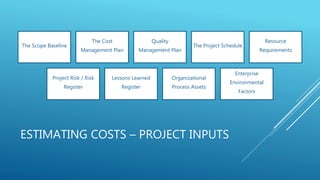
ESTIMATING COSTS – PROJECT INPUTS
The Scope Baseline
The Cost
Management Plan
Quality
Management Plan
The Project Schedule
Resource
Requirements
Project Risk / Risk
Register
Lessons Learned
Register
Organizational
Process Assets
Enterprise
Environmental
Factors
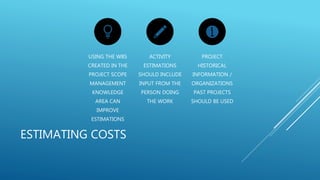
ESTIMATING COSTS
USING THE WBS
CREATED IN THE
PROJECT SCOPE
MANAGEMENT
KNOWLEDGE
AREA CAN
IMPROVE
ESTIMATIONS
ACTIVITY
ESTIMATIONS
SHOULD INCLUDE
INPUT FROM THE
PERSON DOING
THE WORK
PROJECT
HISTORICAL
INFORMATION /
ORGANIZATIONS
PAST PROJECTS
SHOULD BE USED
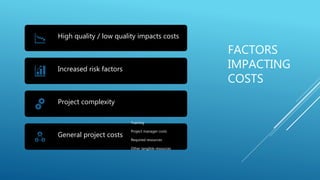
FACTORS
IMPACTING
COSTS
High quality / low quality impacts costs
Increased risk factors
Project complexity
General project costs
Training
Project manager costs
Required resources
Other tangible resources
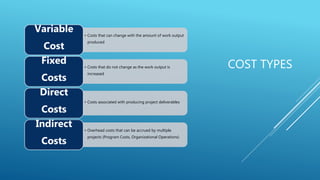
COST TYPES
• Costs that can change with the amount of work output
produced
Variable
Cost
• Costs that do not change as the work output is
increased
Fixed
Costs
• Costs associated with producing project deliverables
Direct
Costs
• Overhead costs that can be accrued by multiple
projects (Program Costs, Organizational Operations)
Indirect
Costs
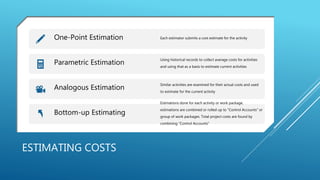
ESTIMATING COSTS
One-Point Estimation Each estimator submits a cost estimate for the activity
Parametric Estimation
Using historical records to collect average costs for activities
and using that as a basis to estimate current activities
Analogous Estimation
Similar activities are examined for their actual costs and used
to estimate for the current activity
Bottom-up Estimating
Estimations done for each activity or work package,
estimations are combined or rolled up to “Control Accounts” or
group of work packages. Total project costs are found by
combining “Control Accounts”
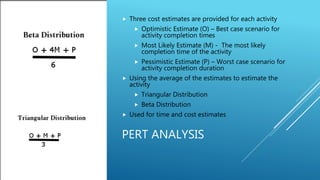
PERT ANALYSIS
 Three cost estimates are provided for each activity
 Optimistic Estimate (O) – Best case scenario for
activity completion times
 Most Likely Estimate (M) - The most likely
completion time of the activity
 Pessimistic Estimate (P) – Worst case scenario for
activity completion duration
 Using the average of the estimates to estimate the
activity
 Triangular Distribution
 Beta Distribution
 Used for time and cost estimates
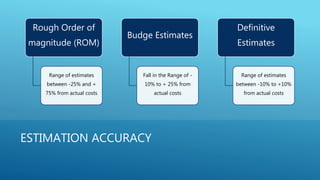
ESTIMATION ACCURACY
Rough Order of
magnitude (ROM)
Range of estimates
between -25% and +
75% from actual costs
Budge Estimates
Fall in the Range of -
10% to + 25% from
actual costs
Definitive
Estimates
Range of estimates
between -10% to +10%
from actual costs
7.3 DETERMINE BUDGET
-PART OF THE PLANNING PROCESS GROUP
This Photo by Unknown Author is licensed under CC BY-SA
THE DETERMINE BUDGET PROCESS
Aggregating costs of
activities or work
packages together to
create the project cost
baseline
7.3 DETERMINE BUDGET
Part of the Planning
Process Group
Creates the cost baseline
Activity risks need to be
considered and cost
reserves need to be placed
into the estimates
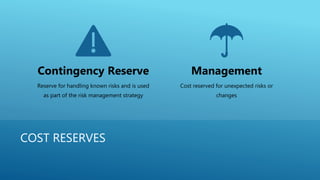
COST RESERVES
Contingency Reserve
Reserve for handling known risks and is used
as part of the risk management strategy
Management
Cost reserved for unexpected risks or
changes
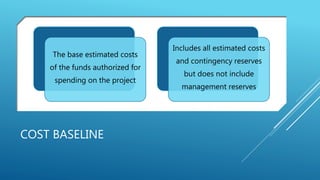
COST BASELINE
The base estimated costs
of the funds authorized for
spending on the project
Includes all estimated costs
and contingency reserves
but does not include
management reserves
PROJECT
BUDGET
The project cost budget includes
the cost baseline plus the
management reserve
7.4 CONTROL COSTS
-PART OF THE MONITORING & CONTROLLING PROCESS
GROUP
This Photo by Unknown Author is licensed under CC BY-SA
THE CONTROL COSTS PROCESS
The monitoring of the project
expenditures throughout the project
and handling changes to the cost
baseline
7.4 CONTROL COSTS
 Part of the Monitoring &
Controlling Process Group
 Calculating the actual costs spend
and measuring it against the cost
baseline
 Work to prevent changes or
handle changes to the cost if they
do occur
EARNED VALUE
MANAGEMENT
(EVM)
EARNED VALUE MANAGEMENT
Can be used to measure the
performance of the project against the
baselines for scope, schedule, and
costs
This Photo by Unknown Author is licensed under CC BY-NC
EARNED VALUE MANAGEMENT
Planned Value
The planned or estimated value
for planned work
Earned Value (EV)
The value of the work
completed based on the
estimated value
Actual Cost (AC)
The actual cost for the
completed work
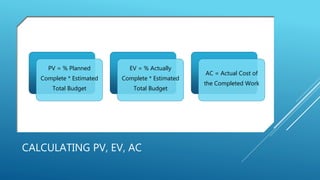
CALCULATING PV, EV, AC
PV = % Planned
Complete * Estimated
Total Budget
EV = % Actually
Complete * Estimated
Total Budget
AC = Actual Cost of
the Completed Work
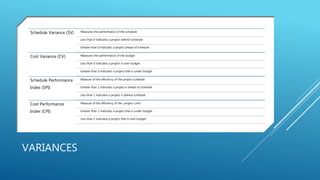
VARIANCES
Schedule Variance (SV) Measures the performance of the schedule
Less than 0 indicates a project behind schedule
Greater than 0 indicates a project ahead of schedule
Cost Variance (CV) Measures the performance of the budget
Less than 0 indicates a project is over budget
Greater than 0 indicates a project that is under budget
Schedule Performance
Index (SPI)
Measure of the efficiency of the project schedule
Greater than 1 indicates a project is ahead of schedule
Less than 1 indicates a project is behind schedule
Cost Performance
Index (CPI)
Measure of the efficiency of the project costs
Greater than 1 indicates a project that is under budget
Less than 1 indicates a project that is over budget
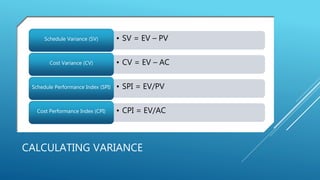
CALCULATING VARIANCE
• SV = EV – PVSchedule Variance (SV)
• CV = EV – ACCost Variance (CV)
• SPI = EV/PVSchedule Performance Index (SPI)
• CPI = EV/ACCost Performance Index (CPI)
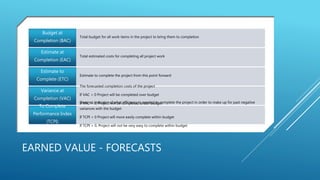
EARNED VALUE - FORECASTS
Total budget for all work items in the project to bring them to completion
Budget at
Completion (BAC)
Total estimated costs for completing all project work
Estimate at
Completion (EAC)
Estimate to complete the project from this point forward
Estimate to
Complete (ETC)
The forecasted completion costs of the project
If VAC < 0 Project will be completed over budget
If VAC > 0, Project will be completed under budget
Variance at
Completion (VAC)
Gives an indicator of what efficiency is needed to complete the project in order to make up for past negative
variances with the budget
If TCPI < 0 Project will more easily complete within budget
If TCPI > 0, Project will not be very easy to complete within budget
To Complete
Performance Index
(TCPI)
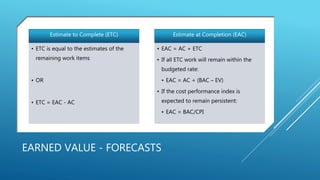
EARNED VALUE - FORECASTS
Estimate to Complete (ETC)
• ETC is equal to the estimates of the
remaining work items
• OR
• ETC = EAC - AC
Estimate at Completion (EAC)
• EAC = AC + ETC
• If all ETC work will remain within the
budgeted rate:
• EAC = AC + (BAC – EV)
• If the cost performance index is
expected to remain persistent:
• EAC = BAC/CPI
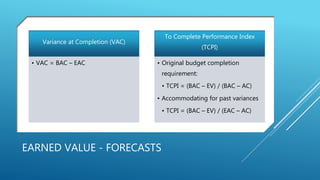
EARNED VALUE - FORECASTS
Variance at Completion (VAC)
• VAC = BAC – EAC
To Complete Performance Index
(TCPI)
• Original budget completion
requirement:
• TCPI = (BAC – EV) / (BAC – AC)
• Accommodating for past variances
• TCPI = (BAC – EV) / (EAC – AC)
SOURCES
A Guide to the Project
Management Body of
Knowledge – PMBOK 6th
Edition
https://www.pmi.org/
Joshua Render
https://agile-mercurial.com

Project Management: Cost Management Knowledge Area

  • 1.
  • 2.
    COST MANAGEMENT KNOWLEDGE AREA OVERVIEW 7.1Plan Cost management 7.2 Estimate costs 7.3 determine budget 7.4 control costs
  • 3.
    COST MANAGEMENT KNOWLEDGE AREAOVERVIEW All the processes needed to work through a project within the confines of the budget. The cost baseline is created within this knowledge area’s processes.
  • 4.
    7.1 PLAN COST MANAGEMENT -PARTOF THE PLANNING PROCESS GROUP This Photo by Unknown Author is licensed under CC BY-SA
  • 5.
    PLAN COST MANAGEMENTPROCESS The process of planning how managing costs associated with the project will be planned and controlled
  • 6.
    7.1 PLAN COST MANAGEMENT Part of the Planning Process Group  Establishes policies and procedures for planning, managing, and controlling project costs  OUTPUT:  Cost Management Plan
  • 7.
    COST MANAGEMENT PLAN GUIDESTHE ESTIMATION OF COSTS AND BUDGET CONSTRUCTION GUIDES THE PROPER USE OF SPENDING WITHIN THE PROJECT INCLUDED IN THE PROJECT MANAGEMENT PLAN
  • 8.
    LIFECYCLE COSTING The costof a product’s entire life expectancy Life expectancy value of resources purchased for a project that can be used in later projects or organizational activities
  • 9.
    VALUE ENGINEERING /ANALYSIS Lower cost ways to do the same amount of work Can be brought on by process improvements or better resource purchasing conditions
  • 10.
    7.2 ESTIMATE COSTS -PARTOF THE PLANNING PROCESS GROUP This Photo by Unknown Author is licensed under CC BY-SA
  • 11.
    ESTIMATE COST PROCESS Thedevelopment of estimates related to the anticipated costs of project activities
  • 12.
    7.2 ESTIMATE COSTS Part of the Planning Process Group  Each activity’s cost must be estimated  Entire project cost is estimated  Products purchased, wages/labor, contingency reserves for delay
  • 13.
    ESTIMATING COSTS –PROJECT INPUTS The Scope Baseline The Cost Management Plan Quality Management Plan The Project Schedule Resource Requirements Project Risk / Risk Register Lessons Learned Register Organizational Process Assets Enterprise Environmental Factors
  • 14.
    ESTIMATING COSTS USING THEWBS CREATED IN THE PROJECT SCOPE MANAGEMENT KNOWLEDGE AREA CAN IMPROVE ESTIMATIONS ACTIVITY ESTIMATIONS SHOULD INCLUDE INPUT FROM THE PERSON DOING THE WORK PROJECT HISTORICAL INFORMATION / ORGANIZATIONS PAST PROJECTS SHOULD BE USED
  • 15.
    FACTORS IMPACTING COSTS High quality /low quality impacts costs Increased risk factors Project complexity General project costs Training Project manager costs Required resources Other tangible resources
  • 16.
    COST TYPES • Coststhat can change with the amount of work output produced Variable Cost • Costs that do not change as the work output is increased Fixed Costs • Costs associated with producing project deliverables Direct Costs • Overhead costs that can be accrued by multiple projects (Program Costs, Organizational Operations) Indirect Costs
  • 17.
    ESTIMATING COSTS One-Point EstimationEach estimator submits a cost estimate for the activity Parametric Estimation Using historical records to collect average costs for activities and using that as a basis to estimate current activities Analogous Estimation Similar activities are examined for their actual costs and used to estimate for the current activity Bottom-up Estimating Estimations done for each activity or work package, estimations are combined or rolled up to “Control Accounts” or group of work packages. Total project costs are found by combining “Control Accounts”
  • 18.
    PERT ANALYSIS  Threecost estimates are provided for each activity  Optimistic Estimate (O) – Best case scenario for activity completion times  Most Likely Estimate (M) - The most likely completion time of the activity  Pessimistic Estimate (P) – Worst case scenario for activity completion duration  Using the average of the estimates to estimate the activity  Triangular Distribution  Beta Distribution  Used for time and cost estimates
  • 19.
    ESTIMATION ACCURACY Rough Orderof magnitude (ROM) Range of estimates between -25% and + 75% from actual costs Budge Estimates Fall in the Range of - 10% to + 25% from actual costs Definitive Estimates Range of estimates between -10% to +10% from actual costs
  • 20.
    7.3 DETERMINE BUDGET -PARTOF THE PLANNING PROCESS GROUP This Photo by Unknown Author is licensed under CC BY-SA
  • 21.
    THE DETERMINE BUDGETPROCESS Aggregating costs of activities or work packages together to create the project cost baseline
  • 22.
    7.3 DETERMINE BUDGET Partof the Planning Process Group Creates the cost baseline Activity risks need to be considered and cost reserves need to be placed into the estimates
  • 23.
    COST RESERVES Contingency Reserve Reservefor handling known risks and is used as part of the risk management strategy Management Cost reserved for unexpected risks or changes
  • 24.
    COST BASELINE The baseestimated costs of the funds authorized for spending on the project Includes all estimated costs and contingency reserves but does not include management reserves
  • 25.
    PROJECT BUDGET The project costbudget includes the cost baseline plus the management reserve
  • 26.
    7.4 CONTROL COSTS -PARTOF THE MONITORING & CONTROLLING PROCESS GROUP This Photo by Unknown Author is licensed under CC BY-SA
  • 27.
    THE CONTROL COSTSPROCESS The monitoring of the project expenditures throughout the project and handling changes to the cost baseline
  • 28.
    7.4 CONTROL COSTS Part of the Monitoring & Controlling Process Group  Calculating the actual costs spend and measuring it against the cost baseline  Work to prevent changes or handle changes to the cost if they do occur
  • 29.
  • 30.
    EARNED VALUE MANAGEMENT Canbe used to measure the performance of the project against the baselines for scope, schedule, and costs This Photo by Unknown Author is licensed under CC BY-NC
  • 31.
    EARNED VALUE MANAGEMENT PlannedValue The planned or estimated value for planned work Earned Value (EV) The value of the work completed based on the estimated value Actual Cost (AC) The actual cost for the completed work
  • 32.
    CALCULATING PV, EV,AC PV = % Planned Complete * Estimated Total Budget EV = % Actually Complete * Estimated Total Budget AC = Actual Cost of the Completed Work
  • 33.
    VARIANCES Schedule Variance (SV)Measures the performance of the schedule Less than 0 indicates a project behind schedule Greater than 0 indicates a project ahead of schedule Cost Variance (CV) Measures the performance of the budget Less than 0 indicates a project is over budget Greater than 0 indicates a project that is under budget Schedule Performance Index (SPI) Measure of the efficiency of the project schedule Greater than 1 indicates a project is ahead of schedule Less than 1 indicates a project is behind schedule Cost Performance Index (CPI) Measure of the efficiency of the project costs Greater than 1 indicates a project that is under budget Less than 1 indicates a project that is over budget
  • 34.
    CALCULATING VARIANCE • SV= EV – PVSchedule Variance (SV) • CV = EV – ACCost Variance (CV) • SPI = EV/PVSchedule Performance Index (SPI) • CPI = EV/ACCost Performance Index (CPI)
  • 35.
    EARNED VALUE -FORECASTS Total budget for all work items in the project to bring them to completion Budget at Completion (BAC) Total estimated costs for completing all project work Estimate at Completion (EAC) Estimate to complete the project from this point forward Estimate to Complete (ETC) The forecasted completion costs of the project If VAC < 0 Project will be completed over budget If VAC > 0, Project will be completed under budget Variance at Completion (VAC) Gives an indicator of what efficiency is needed to complete the project in order to make up for past negative variances with the budget If TCPI < 0 Project will more easily complete within budget If TCPI > 0, Project will not be very easy to complete within budget To Complete Performance Index (TCPI)
  • 36.
    EARNED VALUE -FORECASTS Estimate to Complete (ETC) • ETC is equal to the estimates of the remaining work items • OR • ETC = EAC - AC Estimate at Completion (EAC) • EAC = AC + ETC • If all ETC work will remain within the budgeted rate: • EAC = AC + (BAC – EV) • If the cost performance index is expected to remain persistent: • EAC = BAC/CPI
  • 37.
    EARNED VALUE -FORECASTS Variance at Completion (VAC) • VAC = BAC – EAC To Complete Performance Index (TCPI) • Original budget completion requirement: • TCPI = (BAC – EV) / (BAC – AC) • Accommodating for past variances • TCPI = (BAC – EV) / (EAC – AC)
  • 38.
    SOURCES A Guide tothe Project Management Body of Knowledge – PMBOK 6th Edition https://www.pmi.org/ Joshua Render https://agile-mercurial.com